Showing posts with label Frankenstorm. Show all posts

Wednesday, May 25, 2022

NOAA predicts another above average hurricane season for 2022

Time to shift from climate to weather as I examine the National Hurricane Center's predictions for the 2022 Atlantic hurricane season beginning with CBS New York reporting NOAA unveils prediction for hurricane season as Mayor Adams urges New Yorkers to prepare.

With the damage caused by the remains of Hurricane Ida fresh on their minds, some New York City residents are bracing for another active hurricane season. CBS2's Christina Fan and Lonnie Quinn report.
Seeing the aftermath of Hurricane Ida added to the clips I embedded in 2021 in climate and weather from ABC News, NBC News, and WeatherNation shows that the storm left "a long-lasting legacy of loss" despite my hopes at the time. That reminds me that this year is the tenth anniversary of Hurricane Sandy, the Frankenstorm. If this year turns out to have as active a season as predicted, the remembrance of that disaster should have extra significance.

While I think CBS New York did an excellent job of depicting the human impact of Hurricane Ida, I found its explanation of the science behind the storm season prediction a bit lacking compared to ABC 13 Houston's NOAA predicts above average Atlantic hurricane season, releases storm names, which includes the primary list for names for 2022's tropical storms and hurricanes.

Chief Meteorologist Travis Herzog explains NOAA's 2022 hurricane season predictions.
I have a personal interest in this season, as one of my names is on this list, just like it was on the lists for 2010, when it actually was used, but I don't recall noticing it then, and 2016, when it wasn't. I paid more attention when another of my names appeared in the 2005 list, when it was used, as that was the first time there were more storms than names, just like 2020. I paid even more attention in 2011, when that name appeared next to my ex-girlfriend's. We broke up more than 15 years ago, but we're still together as hurricane names and will be until at least 2023. Ironic.

Speaking of named storms, if this season results in 21 named storms, it will be the third consecutive year that all names on the primary list will be used. Yikes! That's enough to make me conclude by being a good environmentalist and recycling what I last wrote in August 2021.
First, welcome to the 400 ppm world. Second, are you scared enough by climate change? My readers should be.
That reminds me; I should write about the greenhouse gas levels recorded this spring. Stay tuned.

Wednesday, June 6, 2018

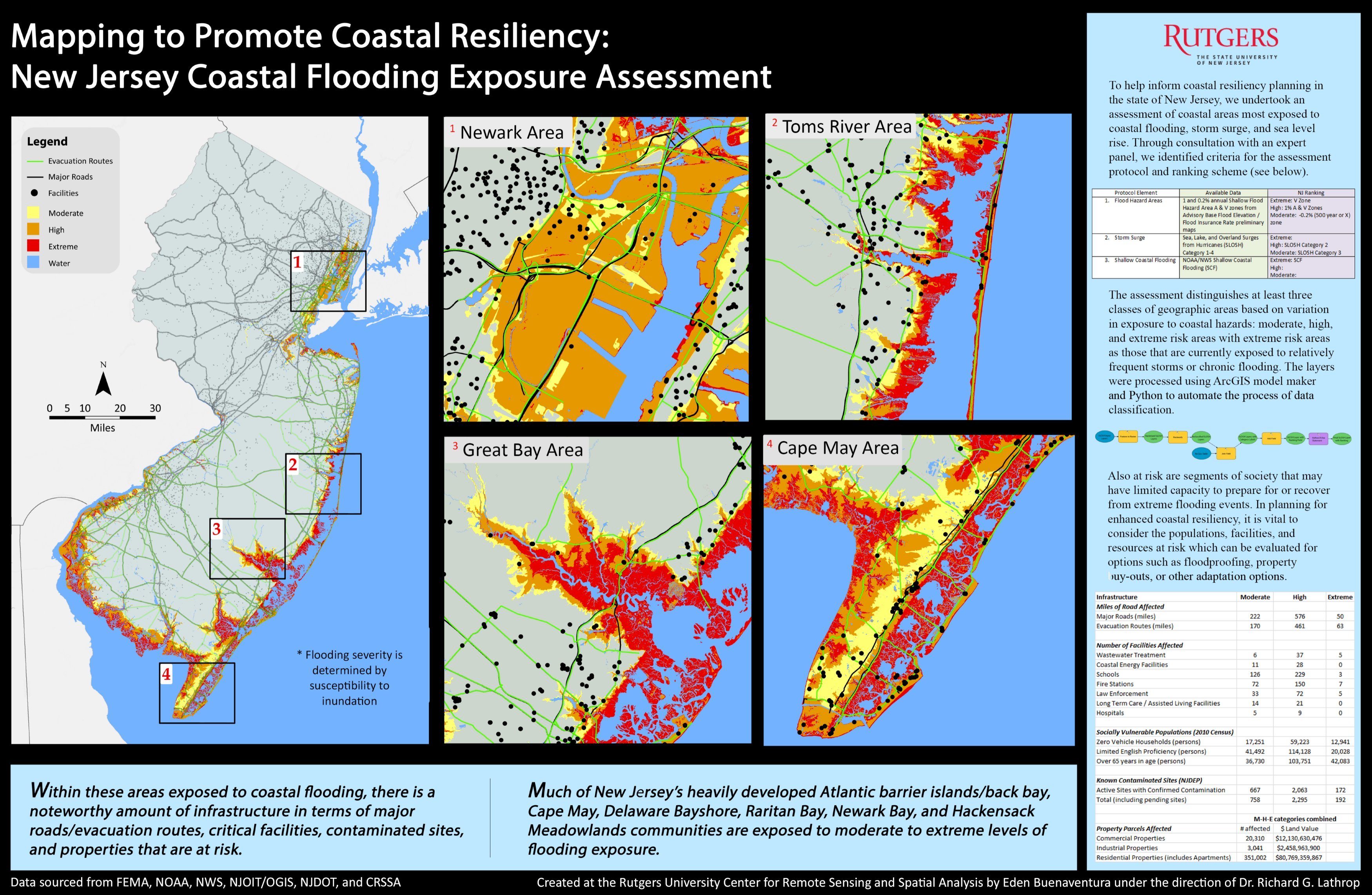
Sea level rise is already causing coastal flooding in New Jersey and Vox thinks it will get worse


Climate change does not rest.  Vox posted an example during the first week of this month when the channel explained Why chronic floods are coming to New Jersey.

Railroads aren’t great if they’re underwater.
...
Scientists have directly observed sea level rise since the late 18th century. And as they forecast the next 20, 50, and 100 years, sea level rise will continue to accelerate at an alarming rate. That rise won’t just threaten homeowners on the coast -- it will also impact the critical infrastructure that supports many of our largest cities.

While sea level rise is often phrased as an issue of concern in the future, we can already see some of the implications. Many coastal communities have witnessed a sharp uptick in flooding, during lunar king tide periods. Other places are forced to consider what life might be like as the land they currently occupy goes underwater.
The main focus on coastal flooding is usually on south Florida.    However, the mid-Atlantic coast, including New Jersey, is at just as much, if not more risk, and it deserves the attention Vox gave it.  For what it's worth, "An Inconvenient Sequel" portrayed the situations at both locations, although mostly in the context of Hurricane Sandy for New York, while showing the chronic flooding in Florida.*   Sea level rise will become a chronic issue for both locales.

*I also watched "Chasing Ice."  Right now, I'm favoring the latter to show to my students.

Saturday, August 29, 2015

Accuweather remembers Hurricane Katrina ten years later


For today's tenth anniversary of the second landfall of Hurricane Katrina, I'm sharing Accuweather's Remembering Katrina: An In-Depth Look at Hurricane Katrina Then and Now.

From the timeline of the storm to the devastating aftermath; AccuWeather takes an in-depth look at Hurricane Katrina including visiting the Lower Ninth Ward, the levees and the Superdome in New Orleans.
The big storm on this blog has been Hurricane Sandy, so much so that the one time I mentioned Katrina in a title, it shared billing wiith Sandy.  That doesn't make Katrina any less important.

Thursday, November 6, 2014

Students compare notes about Katrina and Sandy


Last week was the second anniversary of the landfall of Hurricane Sandy, the Frankenstorm.  To mark the occasion, Colorado State University in collaboration with Columbia University issued a press release accompanied by a video.  CSU goes first with NYC, Gulf Coast students compare notes on disastersby Jeff Dodge on October 31, 2014.
A program affiliated with Colorado State University marked the two-year anniversary of Superstorm Sandy in a special way: On Oct. 29, high school students in New York City posed questions about life during and after a catastrophe to a very particular group of experts – high school students in the Gulf Coast who experienced the BP Oil Spill and lived through as many as six hurricanes in the past decade, including Hurricane Katrina in 2005.

Their youth-led rapid video project, “The Katrina/Sandy Youth Dialogue, Part 1,” is a product of the SHOREline program, a national youth-empowerment project developed at Columbia University’s National Center for Disaster Preparedness at the Earth Institute and at the Center for Disaster and Risk Analysis at Colorado State University.
Here's the video from Columbia University on Vimeo: Shoreline - Katrina/Sandy Youth Dialogue Part I.

It has been two years since Superstorm Sandy struck the East Coast and nearly ten years since Hurricane Katrina devastated the Gulf Coast. At SHOREline, we took this moment to reflect upon the issues of response and recovery it raised among the members of our SHOREline network – high school students at five Gulf Coast schools and one New York City school.

How are Katrina and Sandy similar? From the perspective of young people, what can they learn from one another about such catastrophic events? Ninth and tenth graders at NYC’s Urban Assembly School for Emergency Management developed questions that they posed to their Gulf Coast counterparts in Louisiana, Mississippi, and Alabama.
For last year's retrospective, see PBS NewsHour on Hurricane Sandy one year later, then be happy that, as predicted, the U.S. didn't have a severe Atlantic hurricane season this year.

Sunday, May 4, 2014

Preparing for food shortages during disasters


In yesterday's Nourish entry, I reported on the possibilitty of a global food shortage by 2050 and what could be done about it.  It turns out we don't have to wait 36 years for a food shortage.  One could happen any time there's a large enough natural disaster as Bob Norton of Auburn University described on April 3, 2014 in Food Defense Begins with Food Intelligence.
Consumers have largely lost an understanding of the traditional sources of food (such as farms, fields, ranches and orchards) and now tend to think of food’s origin as the grocery store or the fast-food restaurant. America has moved so far away from its agrarian past that most people cannot produce for themselves even the most simply grown foods.

Consumers need to understand the complexities of modern food production so they can prepare for disruptions caused by natural disasters or terrorist attacks. This can be accomplished in part by better understanding how food corporations plan for contingencies and then applying those lessons at the household level.

The average large city in the United States contains about three days’ supply of food, smaller communities often even less. Should the supply chain be disrupted, a readily available alternative supply might not exist. Some people think the government would step in to provide necessities in an emergency, but countless cases—including the disasters caused by tornadoes in the Oklahoma City region last year—have proven that the government is only marginally effective in providing even short-term solutions. Like companies, individuals should always consider food disruption as a distinct possibility when an emergency looms.

After the Oklahoma tornadoes and Hurricane Sandy, some people actually did go hungry, some for several days, because no one could get through the debris to offer assistance. This is one reason the Department of Homeland Security recommends that all households store at least a three-day supply of nonperishable food.
...
Emergencies cause incredible amounts of stress, which may naturally depress appetites. It is important to choose food products that will provide sufficient nutrition while proving palatable enough to encourage consumption. Some food products require water in their preparation, and water is a key ingredient for human survival. Food and water supplies have to be kept close by, so that in an emergency both are readily available.  Prepare for a longer duration emergency and you will have sufficient capacity to help other family and friends, should an emergency be of shorter duration.  In this way neighbors can look out for neighbors when roads are impassible and government assistance will be delayed.
...
Communities made up of households that understand and practice food security are communities less likely to experience widespread food emergencies in the face of natural- or terrorist-related disasters. Food-secure households make food-secure neighborhoods, which in turn make food-secure communities, which make food-secure regions and a food-secure nation.
Read the rest of the article at the link to get advice for communities and companies.

Fortunately, this year's hurricane season will be less likely to produce a Sandy or Katrina, as North Carolina State University reported Expect Relatively Quiet Hurricane Season, NC State Researchers Say on April 16, 2014.
The 2014 Atlantic hurricane season will be less active than in the past 20 years, but still in line with overall averages from 1950 to the present, according to researchers at North Carolina State University.

Eight to 11 named storms should form in 2014 in the Atlantic basin, which includes the entire Atlantic Ocean, the Gulf of Mexico and the Caribbean Sea, according to Dr. Lian Xie, professor of marine, earth and atmospheric sciences (MEAS), and collaborators Dr. Montserrat Fuentes, professor of statistics, Marcela Alfaro-Cordoba, graduate research assistant in statistics and Bin Liu, research assistant professor in MEAS. This number is slightly lower than – but within the margin of error for – the (1950-2013) 63-year average of 10.8 named storms.

Of those named storms, four to six may grow strong enough to become hurricanes, and one to three may become major hurricanes.
That's good news.  Just the same, be prepared.

Saturday, November 16, 2013

Hurricane Sandy and the Boston Marathon Bombings in this week's health news

At the end of Health news for the week of election day, I wrote "Look for one more installment next week."  I also wrote in Kepler findings and other space news "This one will be huge!"  I wasn't kidding.

Rutgers University has the honor of going first, with Rise in Falls and Fractures Among Elderly After Superstorm Sandy.
Rutgers researcher attributes increase in injuries in older New Jerseyans to power outages
By Lisa Intrabartola
Monday, November 11, 2013
Everyone knows Superstorm Sandy left many New Jersey homes and businesses battered and bruised.

But most are not aware of the considerable toll the storm and its aftermath took on our state’s residents.

“With disasters, there are things beyond the obvious,” said Rutgers’ Sue Shapses, a professor in the department of Nutrition and chair of the Interagency Council of Osteoporosis. “There are real health hazard risks, especially falling and fracturing.  And it’s especially a problem for our elderly population.”

Based on a report Shapses wrote using data from the New Jersey Hospital Association that showed state hospitals experienced an 18 percent increase in visits related to falls and a 13 percent increase in visits related to fractures, during the week following the storm in comparison to the week prior. Of those who sought medical attention for falls and fractures after the hurricane, there was a 40 percent rise in falls and fractures in those who were 65 or older.
I couldn't resist putting a health story about Hurricane Sandy first, especially after four retrospectives last week.

Speaking of stories I've covered before, and being the exception to the rule that "if it bleeds, it doesn't necessarily lead" here at Crazy Eddie's Motie News, Boston University has a four-part video series about the university hospital's response to the Boston Marathon Bombings accompanied by a feature story in its magazine Bostonia.  Videos first.

Trauma Part 1: The Trauma Algorithm


Trauma Part 2: The Clock is Ticking


Trauma Part 3: The Lethal Triad


Trauma Part 4: Why It's Called a "Trauma Team"

Peter Burke discusses the methods his team uses to shave seconds off response time.
Now, the excerpt from the feature article Trauma.
Peter Burke spent 14 years building a surgical team that could handle the worst kind of emergencies. On April 15, that emergency arrived.
By Susan Seligson
Peter Burke had just finished the morning session of a medical conference at the Four Seasons Hotel Las Vegas when the news flashed on a lobby TV: two bombs had exploded near the Boston Marathon finish line, turning an annual celebration into a war zone.

Minutes later he received an emergency text message from Boston Medical Center (BMC), where he is chief trauma surgeon. The unit was inundated with the grievously injured from an attack that killed 3, among them BU graduate student Lu Lingzi (GRS’13), and wounded at least 260. Many of those rushed to BMC were battling for life, with mangled legs, collapsed lungs, and profound blood loss. Burke called his chief nurse to find out if there was any way he could help from a distance of nearly 3,000 miles. The answer was no.

When he arrived in Boston around midnight, Burke rushed from Logan Airport to BMC, one of the city’s five adult Level 1 trauma centers, all of which were scrambling to stabilize the injured. BMC received 28 bomb victims; 19 were admitted, 11 with critical injuries.

In his 14 years at BMC, Burke had dealt with hundreds of multiple admissions from car crashes or shootings. But Marathon day presented a scene more familiar to trauma program manager Joseph Blansfield, a nurse practitioner who has been at BMC since 1992. An active colonel in the US Army Reserve, Blansfield (SON’78) had run combat support hospitals in Mosul and Tikrit, Iraq. As BMC trauma surgeons, anesthesiologists, and nurses mobilized, Blansfield was doing what had become second nature in those war-torn places: identifying the most critically injured and getting them to the trauma bays.
Follow over the jump for the rest of this installment of health news from Overnight News Digest: Science Saturday (Super Typhoon Haiyan).

Monday, November 4, 2013

Hurricane Sandy anniversary and other climate news from campuses on the campaign trail

I concluded PBS NewsHour on Hurricane Sandy one year later by writing, "I'll have more about the anniversary of Sandy's landfall from Columbia University and other sources after Midnight.  Stay tuned."  As promised, here it is.

I begin with this video from PBS NewsHour, which features a Columbia University faculty member, so I decided it counts.

Climate Change, Hurricane Sandy and How to Cope

Klaus Jacob, a special research scientist with the Lamont-Doherty Earth Observatory, explains how climate change will turn events like Hurricane Sandy into more frequent and more disastrous events."One weather event like Sandy does not make climate change. But it is a symptom with many other events that will show yes there is something going [on] and we call it climate change," Jacob said.
Columbia University proper had even more about the occasion in Hurricane Sandy, One Year Later.
October 29, 2013
The year since Hurricane Sandy blew ashore in the New York area has been one of rebuilding and searching for how best to prevent the level of destruction and death it brought with it.

Columbia, with experts across multiple schools and disciplines and broad expertise in climate science, has played an important role in the recovery. “We have 700 people in the Earth Institute working on this,” said Steve Cohen, the institute’s executive director. “The Lamont Doherty Observatory has close to 100 doctoral level scientists working on this all the time.”

Columbia students and staffers helped communities rebuild. Scores of Columbia scientists have been explaining the causes behind the storm in hundreds of media interviews. Columbia professors serve on government panels that study how to prevent future damage and make recommendations to elected officials on preparedness and infrastructure changes.
Follow over the jump for more Hurricane Sandy and other climate news from Boston University via its NPR station WBUR, Columbia University, Rutgers University, and New York University, all of which I shared in Overnight News Digest: Science Saturday (Eclipse, Sandy Anniversary, and Fall Back), plus one story I was planning on including in that diary on Daily Kos but left out by mistake.

Sunday, November 3, 2013

PBS NewsHour on Hurricane Sandy one year later

As I promised in Rutgers on Sandy anniversary and other climate news and repeated in PBS NewsHour on preppers, here is more on the first anniversary of Hurricane Sandy's landfall from PBS NewsHour.

First, here's the set-up from the day before the anniversary, New York uses Sandy lessons to build storm defenses.

One year after Hurricane Sandy struck the East Coast, the Big Apple is still rebuilding. But city officials have taken lessons learned from the storm's surge into account to ensure power and transit systems can withstand future natural disasters. Miles O'Brien reports on high-tech infrastructure adjustments in New York City.
The next day, O'Brien expanded on the changes since Sandy to remediate the damage.

New York Plans for Resilience

The storm surge from Hurricane Sandy wiped out power and businesses in New York, some of which took weeks to come back online. Now power and telephone companies have bounced back and are taking precautions for the next big storm.
Follow over the jump for more, including four videos I included in Overnight News Digest: Science Saturday (Eclipse, Sandy Anniversary, and Fall Back).

PBS NewsHour on preppers

I promised "more news about the anniversary later." I'm working on it, but first here's a video clip about preppers that I found while searching through PBS NewsHour's YouTube videos about Hurricane Sandy one year later: Survivors of Sandy ditch N.Y. to prepare for doomsday.

Some Hurricane Sandy survivors have begun to study up on "doomsday prepping" in case another environmental disaster hits. City slickers by day, survivalists in the NYC Preppers Network head up to the Catskill Mountains on the weekends, armed with just the basics to practice living off the land. Paul Solman reports.
Solman is right; these people and those like them are easy to make fun of.  In my case, I would have felt like a rusty former expert on the skills they were learning, based upon my experience backpacking with the Boy Scouts in my youth.  I did all of the things they were doing when I was 12.  I could have taught them, just like I was taught by the adults in my troop, most of whom, including my dad, were ex-GIs.  They had to know this stuff to survive in the Army.

Solman was also right about the positive moral of the story.  The people in this group had to learn how to survive through the power of community.  That's something I hope they take back to NYC with them.

Tuesday, October 29, 2013

Rutgers on Sandy anniversary and other climate news


Today is the anniversary of the landfall of Hurricane Sandy, the Frankenstorm, on the Jersey shore.  To mark the event, here are the stories from Rutgers University about the event.

Rutgers University: Rutgers-Newark Report: Superstorm Sandy Recovery Short $28.3 Billion; Pain Spread Across NJ
By Stephanie Hoopes Halpin
Friday, October 25, 2013
On the one-year anniversary of Superstorm Sandy, New Jersey towns and residents across the state still face $28.3 billion in unmet recovery needs, according to a new report from Rutgers-Newark, School of Public Affairs and Administration.

The report finds that the storm cost New Jersey more than $37.1 billion statewide, including $13.6 billion in direct physical and economic damage, plus $23.5 billion in remediation costs. Recovery assistance has met only a fraction of these costs, according to the report’s author, Rutgers University Assistant Professor Stephanie Hoopes Halpin. Through this report, Halpin reveals that damage was far more widespread than has been understood to date, stretching beyond the coastal communities and disproportionately affecting low- and moderate-income families.

“We believe this is the most comprehensive cost analysis of the storm so far,” said Marc Holzer, founding dean of the School of Public Affairs and Administration at Rutgers-Newark. "It was our goal to give the state objective data that can be used to learn from Sandy and improve the state’s disaster response in the future."
Rutgers University: 'Jersey Shore Hurricane News' Promotes Virtues of Participatory Journalism in Tracking Disasters
Rutgers Graduate Justin Auciello might be New Jersey's biggest one-man volunteer operation
By Jen. A. Miller
Friday, October 25, 2013
If there is a natural disaster, storm, traffic accident, fire, lost pet or missing child in the Garden State, chances are the details are posted on Justin Auciello’s Facebook page, Jersey Shore Hurricane News.

Auciello, who earned his master’s degree from the university’s Edward J. Bloustein School of Public Policy in 2005, started the page just before Hurricane Irene slammed the state in August 2011.

After that storm, his page had 27,000 users. Instead of shutting it down once the hurricane blew over, Auciello kept Jersey Shore Hurricane News alive and expanded its coverage beyond natural disasters, using tips, photos and messages from the site's fans to report on the state’s other major happenings in real time.

"The Internet continues to democratize media," he said. "People are realizing they do have a stake in news reporting and are willing participants in the process."

After Superstorm Sandy hit the East Coast on Oct. 29, 2013, the site was thrown into another stratosphere, and now has more than 200,000 users.
I'll have more news about the anniversary later.  For now, follow over the jump for more climate news from Overnight News Digest on Daily Kos.

Sunday, June 9, 2013

More storms from space

In the spirit of Storms from orbit and other space and astronomy news, I present two more views of recent superstorms from space, or at least Space.com.  The first is Oklahoma's EF-5 Tornado Scar Seen From Space | Video.

The May 20, 2013 tornado that ripped through Moore, Oklahoma was 1.3 miles wide at its peak and had winds that reached 210 mph. The NASA Terra satellite took imagery of the tornado track and NOAA's GOES-13 captured the storm from over head.
The second is a simulated view from geosynchronous orbit: Superstorm Sandy's Track, Winds Intensity Visualized By Supercomputer | Video

In the most accurate assessment to date, the changing wind speeds are seen over a 5-day time-lapse (Oct. 26 to Oct. 31, 2012). NASA GOES-5 atmosphere model computer was used to create the simulation.
Both of these are impressive in disturbing ways, showing how huge both storms were.  In particular, note how far out Sandy's winds reached, with strong winds blowing over Lake Michigan while the eye was still over the ocean.  I've had hurricane remnants pass over me before, including Tropical Storm Lee, but I've never been inside an active hurricane before.  It was eerie.

Saturday, June 8, 2013

Tropical Storm Andrea and the 2013 hurricane season

ABC News has the latest in Tropical Storm Andrea Drenches North East.

Massive storm causes flooding as it barrels up eastern seaboard.
One of the commenters on YouTube pointed out an inaccuracy in the report.
Ginger is wrong. A teenage boy in Maryland died due to flash flooding. Your affiliate WMDT has more.
I searched WMDT's website and found Juvenile Killed In Fatal Taylor's Island Crash.

WMDT 47 News - Delmarva's Choice
A 16-year-old was reportedly driving on Talyor's Island Road in the area of Smithville Road, when the vehicle hydroplaned, and the driver lost control. He struck a tree and was killed.
The newscaster said that weather may be implicated, not that it definitely was.  Also, she didn't say anything about flash flooding.  That would have washed the car downstream, not resulted in hydroplaning.  I'll be generous and say the commenter was right in general, but wrong about the details.

Finally, as the first storm of the season, it's time to revisit NOAA's prediction of an active or 'extremely active' Atlantic hurricane season this year, which I quoted in Weather and climate news for Memorial Day.  Yesterday, The Weather Channel asked Is It Irresponsible to Predict Entire Hurricane Season?

Dr. Jeff Masters with Weather Undergound talks about forecasting the hurricane season and the difficulties involved.
Apparently, it isn't Dr. Masters' style to make such predictions, but he does seem to be on board with the idea that this year's season will be very active and that storms will be larger.  I agree with those last two thoughts.

To paraphrase Masters, may the steering winds be our friends.

Monday, May 6, 2013

2012 ninth warmest global average temperature in history

WHO: WMO Annual Climate Statement Confirms 2012 as Among Top Ten Warmest Years
GENEVA, 2 May 2013 (WMO) The World Meteorological Organization’s Statement on the Status of the Global Climate says that 2012 joined the ten previous years as one of the warmest — at ninth place — on record despite the cooling influence of a La Niña episode early in the year.

The 2012 global land and ocean surface temperature during January–December 2012 is estimated to be 0.45°C (±0.11°C) above the 1961–1990 average of 14.0°C. This is the ninth warmest year since records began in 1850 and the 27th consecutive year that the global land and ocean temperatures were above the 1961–1990 average, according to the statement. The years 2001–2012 were all among the top 13 warmest years on record.

“Although the rate of warming varies from year to year due to natural variability caused by the El Niño cycle, volcanic eruptions and other phenomena, the sustained warming of the lower atmosphere is a worrisome sign,” said WMO Secretary-General Michel Jarraud. “The continued upward trend in atmospheric concentrations of greenhouse gases and the consequent increased radiative forcing of the Earth’s atmosphere confirm that the warming will continue,” he said.

“The record loss of Arctic sea ice in August-September — 18% less than the previous record low of 2007 of 4.17 million km2 — was also a disturbing sign of climate change,” said Mr Jarraud. “The year 2012 saw many other extremes as well, such as droughts and tropical cyclones. Natural climate variability has always resulted in such extremes, but the physical characteristics of extreme weather and climate events are being increasingly shaped by climate change,” he said.

“For example, because global sea levels are now about 20 cm higher than they were in 1880, storms such as Hurricane Sandy are bringing more coastal flooding than they would have otherwise,” said Mr Jarraud.
Here are the last 60+ years in chronological order with El Niño and La Niña years marked. 2012 was warm despite the first half of the year taking place during a La Niña event, which cools down the planet.


With CO2 at levels not seen since the late Tertiary, the next El Niño year should set the new record for high temperatures.

Desdemona Despair has an even more striking graph arranging the fifty warmest years in order from hottest to coldest.  Unfortunately, it won't display here.

Thursday, May 2, 2013

Sandy six months later from The Weather Channel

Monday marked six months to the day since Hurricane Sandy made landfall.  The Weather Channel, which had its third-highest daily viewership that day, capitalized on the occasion by following up on how New York and New Jersey were recovering.

First, showing that no story is too small, here is a report about a photographer who is helping residents reconstruct their photo albums: Restoring Memories After Sandy.

Photographer, Allie Smith, helps some New York City families rebuild their lives one picture at a time.
I should not have been surprised that Allie Smith was working with Occupy Sandy, but I was, pleasantly.

Going from Occupy Sandy to one of the usual sources, Rebuilding After Sandy consists of an interview with Mary Christie, First Lady of New Jersey.

New Jersey First Lady Mary Christie talks about the rebuilding of New Jersey six months after super-storm Sandy devastated the east coast.
Finally, a story close to my heart and interests, The New York Aquarium Reopens.

New York Aquarium is ready to reopen 6 months after hurricane Sandy.
I take comfort from the Aquarium re-opening.

Saturday, April 20, 2013

The legacy of Sandy and other climate news


Time for an update of the climate news since Weather and climate as March went out like a lion.  First, two stories about how Hurricane Sandy has changed the policies of the National Weather Service and the National Hurricane Center.

Accuweather via OurAmazingPlanet: Post Sandy: The Jersey Shore's Susceptibility to Major Storms
by Jillian MacMath, AccuWeather.com
Apr 05, 2013 10:38 AM ET
Before Superstorm Sandy made landfall on the Jersey coast on Oct. 29, 2012, few realized the intensity of the storm that headed in their direction.

The National Hurricane Center opted not to issue hurricane warnings north of North Carolina, and instead handed the reins to regional National Weather Service offices.

Local governments warned the public of the approaching threat, and issued evacuation orders to many towns. While some residents agreed to leave, others resisted, believing that people were 'crying wolf' about the storm.
Accuweather via OurAmazingPlanet: Weather Service Broadens Hurricane Warning Definition
by Accuweather.com
Apr 04, 2013 03:09 PM ET
The National Weather Service announced today that, starting June 1, the definitions of hurricane and tropical storm watches and warnings will be broadened.

The new changes will allow watches and warnings to be issued or remain in effect after a tropical cyclone becomes post-tropical, when such a storm poses a significant threat to life and property.

In addition, the National Hurricane Center will be permitted to issue advisories during the post-tropical stage.
Follow over the jump for more climate-related news from Overnight News Digest: Science Saturday (BRAIN Initiative) on Daily Kos.

Wednesday, March 6, 2013

Examiner.com article on another U-M climate change survey

Here's another examination of risk, this time about climate change.  At least in this case, the news about acceptance is good.

Hurricane Sandy increased the number of people who cited weather changes and severe weather as reasons to accept global warming.
CREDIT: NASA/Getty Images
U-M study: Two-thirds of Americans accept global warming is real
Two-thirds (67%) of all Americans now accept the evidence that global warming is real, according to a study by the University of Michigan released March 4th.  This is the most positive response since Fall 2008, when 72 percent of all Americans surveyed thought that climate change was real, and fifteen percent higher than Spring 2010, when only 52 percent gave a positive response.

Much of the rise came from increasing acceptance among Republicans, 51 percent of whom agreed with the statement that there is "solid evidence that the average temperature of the Earth has been getting warming over the past four decades."  This is the highest level of agreement with that statement among Republicans since Fall 2008, when 53 percent said yes to the survey question, and eighteen percent higher than Spring 2010, when only 33 percent agreed while 55 percent said no.  In contrast, 79 percent of Democrats and 71 percent of independents agreed with the same statement.

In a press release, University of Michigan Professor Barry Rabe, director of the Center for Local, State, and Urban Policy at the Ford School of Government said, "The only individual characteristic that reveals stark differences among Americans regarding the existence of global warming continues to be partisan standing."

This study came on the heels of one released last December showing that a majority of Americans surveyed favored government action to reduce greenhouse gases.  Both reports used information gathered as part of the Fall 2012 climate change survey, one of the National Surveys on Energy and Environment (NSEE).
Click on the link in the headline for more details.

I blogged about the study referenced in the fourth paragraph in Examiner.com article on U-M climate change survey.  As I wrote then, this is good news.  I'm not going to drop Professor Farnsworth on you.  Instead, I'll give you a real life professor, Barry Rabe of the University of Michigan's Ford School of Government, who discusses survey results showing two-thirds of Americans now accept global warming, including a majority of Republicans.  As I wrote, good news!

Saturday, January 19, 2013

Hurricane Sandy from Accuweather

Time to finish the series.

2012 in Review: Hurricane Sandy

As we look back over 2012, we remember some of the top memorable weather moments. One of those historic times in weather was Sandy. Valerie Smock recaps.
Hurricane Sandy was such a major story on this blog last year that I gave it its own tag, Frankenstorm.

Saturday, January 5, 2013

Top energy stories of 2012


In Rewind YouTube Style and science year in review 2012, there was one topic I intentially omitted--energy.  I did that because I already knew that the Nablopomo theme for January would be energy, so I was saving the stories.  I also held off because the the best list of stories available had not been finalized yet; it was still being voted on by readers.  It's now January and the top ten has been announced, so I no longer have any reason to delay.  Without any further ado, here are The Top 10 Energy Stories of 2012 as voted on by the readers of the Christian Science Monitor and Consumer Energy Report.
1. Revolution in US oil and gas production continues
...
 2. Hurricane Sandy and the Aftermath
...
 3. New CAFE standards doubled to 54.5 MPG by 2025
...
 4. India blackouts leaves 680 million people in the dark
...
 5. Low natural gas prices stimulate US economy
...
 6. California Implements Cap and Trade
...
 7. China in North America’s Oil Sands
...
 8. Obama Rejects Keystone XL Extension, Endorses Southern Leg
...
 9. Obama reelection
...
* 10. US Carbon Emissions Plummet
The five stories that were voted on but which didn't make the cut were:
  • Rigs shifting from natural gas to oil,
  • EPA rejects RFS waiver request
  • Sanctions on Iran
  • California gasoline shortage
  • BP settlements

The common theme among all these stories was that they had to do with fossil fuels and the effects of extracting, transporting, and burning them, not with renewables, except maybe the last two, which still have major fossil fuel components to them.  In the short run, that's good, as it means we have enough fossil fuel to make the transition away from them.  In the long run, it's bad, as we could definitely pump enough greenhouse gases to really heat up the planet.

Follow over the jump for more energy stories from Overnight News Digest: Science Saturday (Science in 2012 edition) on Daily Kos.

Sunday, November 25, 2012

Meanwhile, at the bottom of the ballot

Next Media Animation picks up on two trends in Marijuana legalization and same-sex marriage celebrate epic victories.

For the first time in the history of the U.S. voters had the option to approve same-sex marriage at the ballot box. Gay rights advocates were able to add Maine, Maryland and Minnesota to the short list of same-sex marriage approved states.

Wisconsin also contributed to the monumental leap forward by electing Democrat Tammy Baldwin as the state's first female senator and first openly gay person elected to the chamber. Many individuals believe that victories such as these, demonstrate a shift in the public opinion.

Colorado and Washington state also made history by legalizing marijuana. Before you go and do a happy dance, there are some key factors complicating the issue. For one, marijuana is still considered illegal under federal law. Some are claiming that the federal government will fight these measures or threaten marijuana shops.

In the meantime residents in Colorado and Washington state must closely follow the rules, and make sure they have the appropriate paperwork to legally grow and consume marijuana.
This video came out right after the election. On the 19th, Michigan State University explained how the trend has been playing out for marriage equality in Support for gay marriage grows in Michigan.
Support for gay marriage is growing in Michigan, mirroring changing attitudes in many parts of the United States, according to Michigan State University’s State of the State Survey.

A recent survey found that 56 percent of the state’s residents support gay marriage while 39 percent oppose it. Two years ago, 48 percent supported gay marriage and 51 percent were opposed.

“Support for gay marriage has increased in recent years, in Michigan and across the country,” said Charles Ballard, MSU economics professor and director of the State of the State Survey.
...
The State of the State Survey, based on a June 12-Aug. 13 telephone survey of 1,015 Michigan adults, showed substantial differences among different groups:
  • Among those with at least some college education, 63 percent favored gay marriage, while it was favored by only 26 percent of those who had never been to college.
  • About 71 percent of those with household income over $100,000 favored gay marriage, compared with only 26 percent of those with household income below $20,000. Since income is strongly influenced by education, Ballard said, it is not surprising that there are major differences among Michigan residents of different income levels.
  • Some 57 percent of whites favored gay marriage, whereas only 30 percent of blacks did so.
  • Gay marriage was favored by 58 percent of Catholics, 48 percent of Protestants and 78 percent of those with no religious preference.
“Although a majority of Michigan residents favored gay marriage in this survey,” Ballard said, “there remain substantial differences among different groups.”
I'm not surprised by any of this except maybe the speed with which it's happening. Two years ago, I told one of my students that there would be two changes in his lifetime propelled by his generation--marijuana legalization and marriage equality. This past election confirmed my predictions--so far. He came by my office to express his amazement that I was right. It's not that amazing. All I had to do was pay attention to the trends and remember that society, like science, changes one funeral at a time.

Speaking of astonished students, another one emailed me to remind me that I had said recently that New Jersey would be underwater in two years and asked how I knew. I don't recall saying two years. I think I said twenty. I'll chalk that up to the student misremembering and a grand coincidence that Sandy hit when it did. Even so, it's better to be lucky than to be good!

Sunday, November 18, 2012

Sandy bumps the gas price rollercoaster

Since the previous update the first week of this month, gas prices here bumped up, then down, although they haven't returned to where they started November. Calculated Risk took a snapshot of the situation in Gasoline Prices down 30 cents over last month, where Bill McBride quoted the Sacramento Bee.
"Gas prices at the end of October were dropping at the fastest speeds in nearly four years," said Beth Mosher, director of public affairs for AAA Chicago. "If this trend continues, motorists could be paying less than last year to fill up their cars."

Assuming a smooth restart to production following Hurricane Sandy, AAA predicts that gas prices will continue to drop through the end of the year. ... The Northeast is a significant gasoline consumer and not a major producer, so it is expected that the decline in demand from people not driving will outweigh any disruption in gasoline production.
That was on November 5th, when the corner station was selling gas at $3.37. Then came Election Day, when the price jumped up to $3.45. Shortly after that, it bounced again to $3.49. The stations down the street bracketed the price, selling unleaded regular for anywhere from $3.45 to $3.55. Shortly after that, all of them including the one at the corner, returned to $3.45. Last week, all of their prices shot up to 3.59. The Detroit Free Press reported that rise in Gas prices in Michigan up 6 cents from last week. The average price in the state last Sunday was $3.47. The good news is that was a penny less that it was a year ago. Hey, year-over-year, gas price is down!

That passed, and gas is now selling between $3.45 and $3.49 again. That was part of a nationwide trend, as Average retail gas prices fall seven cents on trend: survey. Here's the relevant excerpt from the Reuters story.
The average price for a gallon of regular gasoline in the United States fell during the past two weeks as demand took a hit from supply disruption after Hurricane Sandy and the loss of daylight savings time, according to a widely followed survey released on Sunday.
...
"U.S. crude oil prices actually rose a little in the past two weeks but the weak gasoline demand has helped pull down prices and contributed to the down trend (in gasoline prices)," Lundberg said.

"Unless we have a significant reason for crude oil prices to rise, such as escalating conflicts in the Middle East, I do expect retail gasoline prices to continue to edge down in the near future," she added.
About those "significant reasons," a Reuters article from last Friday read Oil rises on Middle East conflict, Gulf of Mexico fire.
Oil rose on Friday as a fire on a Gulf of Mexico platform and the escalating conflict between Israel and Palestinians stoked supply concerns.

News of the fire at a Black Elk platform in morning U.S. activity helped crude extend early gains, although the Coast Guard later said it had not been producing oil at the time of the fire, which helped calm market jitters. Two workers were missing and four others injured by the fire.
...
The market was already on edge after Iraq's envoy to the Arab League said in Cairo it would invite Arab states to use oil as a weapon to press for a halt to Israeli attacks on Gaza. He later appeared to withdraw the remark, saying Baghdad would make no particular proposal to a League meeting.
The conflict has gripped oil markets, which have been looking for any signs it could impact Middle East supplies.
...
Trading was volatile with the U.S. December crude contract expiring at the end of Friday's session, following the Brent December contract's expiry the day before.

Expiring U.S. December crude traded up $1.22 to settle at $86.67 a barrel. The more heavily traded U.S. January crude gained $1.05 to settle at $86.92 a barrel. Front-month January Brent crude rose 94 cents to settle at $108.95 a barrel.
According to the gas price calculator at Econobrowser, a Brent price of $108.95/barrel translates to a price at the pump of $3.56. In that case, $3.45-$3.49 looks pretty good. Time for Professor Farnsworth.