"Batman vs. Bateman" – Hungry Man and Highdive (State Farm)Unlike previous years, there doesn't seem to be a single public service announcement (PSA) in the field. Those are what attracted me to the category in the first place eight years ago, so I miss them. Let's see if still do by the time I finish watching all the nominees. Follow over the jump.
"The Boy & The Octopus" – Hungry Man and adam&eveDDB (Disney)
"Brian Cox Goes to College" – O Positive and Special US (Uber One for Students)
"Flock" – Smuggler and TBWA\ Media Arts Lab (Apple Privacy)
"Heartstrings" – Smuggler and TBWA\ Media Arts Lab (Apple AirPods Pro)
"So Win." – Somesuch and Wieden+Kennedy (Nike)
Thursday, July 17, 2025
No PSAs among nominees for Outstanding Commercial plus winners for Outstanding Promotional Announcement at the Emmy Awards
It's time for me to begin my coverage of the Emmy Awards with the nominations for Outstanding Commercial.


Wednesday, July 16, 2025
'Shogun' leads Action Series at the Super Awards
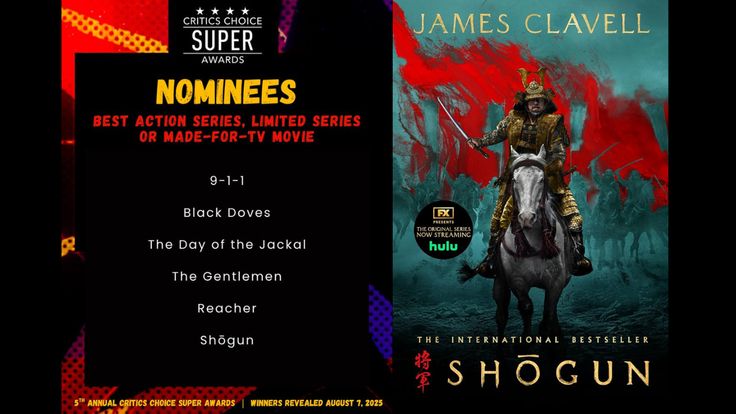
I closed 'Severance' leads Science Fiction/Fantasy Series but could lose to 'Andor' at the Super Awards by writing "I have one more genre to cover, Action, which I expect will be a sweep or nearly so for Shogun." Time to follow through.
Shogun leads action nominees with four nominations, one in each category for which it's eligible. It's followed by Black Doves and The Day of the Jackal tied at three, then 9-1-1, Reacher, and The Gentlemen with two apiece. These are all good shows, but Shogun should win easily.
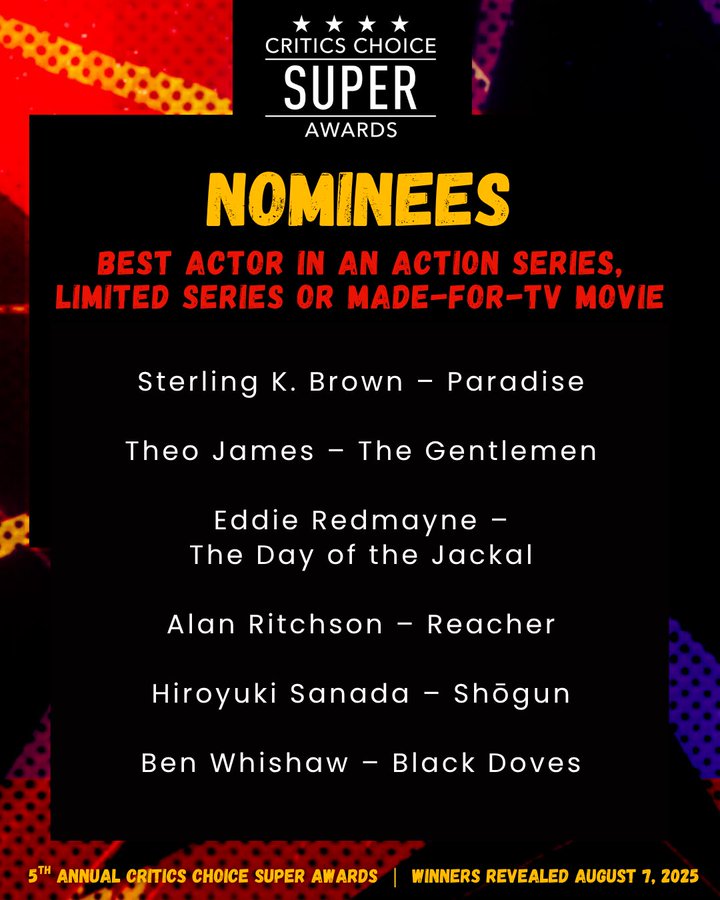
Hiroyuki Sanada has won all the major awards for this role already, so what's one more? Conceivably, Oscar-winner Eddie Redmayne or Emmy-winner Sterling K. Brown could upset him, but Redmayne also has a Razzie. Not all of his performances are great.

The same is true of Anna Sawai, although her competition is stiffer on paper. Angela Bassett, Viola Davis, and Zoe Saldaña all have Oscars, even if Bassett's is honorary, Keira Knightley was nominated for two Oscars, and Lashana Lynch won a BAFTA Award. Sawai's most prestigious awards are an Emmy and a Golden Globe for this role; she didn't win the main Critics Choice Award for this role, losing to Kathy Bates. Fortunately, Bates isn't nominated here — Knightley is — so my reminder that electorates matter still applies.
For the final time, I'm revisiting a category I covered in 'The Last of Us' leads TV nominees at the Critics Choice Super Awards.

I think Farrell is the favorite to win as a villain protagonist, but my favorite villain I love to hate is Michael Emerson from Evil. I'm glad I got to boo him again as a guest star in his wife's show Elsbeth. That was fun to watch and I bet the two of them have stories!This is the one category I think Shogun won't win, so it won't be a complete sweep. Only Emerson and Farrell earned nominations for Best Actor in their respective genres in addition to Best Villain, so I think one of them will win. I want Emerson, but I think it will be Farrell.
There is no shortage of action shows for the Saturn Awards. 9-1-1, Black Doves, The Day of the Jackal, G20, Lioness, Paradise, and Reacher should all be eligible, although 9-1-1 has never earned a Saturn Awards nomination despite my submitting it. Also, G20 is a movie, so it would be eligible for Presentation on Television. Just the same, there are plenty of action and thriller shows, including The Night Agent and The Handmaid's Tale. There is no need to cannibalize the superhero series category to fill out the action nominees, although there might be no other category for them to go. Sigh.
That completes my series on the Critics Choice Super Awards nominations. I plan on returning with the winners next month. In the meantime, stay tuned as I begin Emmy coverage tomorrow.
Previous entries about the 5th Critics Choice Super Awards
- 'Deadpool & Wolverine' and 'Thunderbolts*' lead movie nominees at the Critics Choice Super Awards
- 'Dune: Part Two' at the Critics Choice Super Awards
- 'Sinners' leads Best Horror Movie nominees at the Critics Choice Super Awards
- Drink to the action movie nominees at the Critics Choice Super Awards on National Piña Colada Day
- 'The Last of Us' leads TV nominees at the Critics Choice Super Awards
- 'Severance' leads Science Fiction/Fantasy Series but could lose to 'Andor' at the Super Awards
Tuesday, July 15, 2025
'Severance' leads Science Fiction/Fantasy Series but could lose to 'Andor' at the Super Awards

I closed 'The Last of Us' leads TV nominees at the Critics Choice Super Awards by telling my audience "The next day I could continue this series would be Tuesday the 15th, but that's when this year's Primetime and Creative Arts Emmy nominations will be announced, and I might prioritize those." The Emmy nominations won't be announced until 11:30 A.M. EDT and I don't want to wait that long to start blogging, so Super Awards it is.
The next category with series that have the most nominations is Science Fiction/Fantasy, where there are two shows with four nominations each, Severance and Fallout. All of Severance's nominations are in Science Fiction/Fantasy, while three of Fallout's are in Superhero, where video game properties also reside, so Severance wins the tiebreaker. Besides, Fallout isn't even nominated in this category, just Best Actor in a Science Fiction/Fantasy Series, Limited Series or Made-for-TV Movie. Andor and Black Mirror both have three nominations, followed by Doctor Who and Fantasmas tied at two, and Dune: Prophecy with just this one. I think this is between Severance and Andor with Black Mirror as a spoiler.

Walter Goggins is having a moment — I expect he will earn a nomination for Outstanding Supporting Actor in a Drama Series at the Emmy Awards for his role in The White Lotus by the time I post this (ETA: he did) and he has a second nomination for this role at these awards in Best Actor in a Superhero Series, Limited Series or Made-for-TV Movie — but I don't think he's going to win this award. Instead, I think it's between Diego Luna and Adam Scott.

I'm sharing this image not because I think Caitriona Balfe will win — she might and I would be happy if she did, although I think a couple of actresses have a better shot — but because she appears to have the one campaign going for this award. It's from her fans, not the studio, but at least they believe in her. I think Cristin Milioti, who has another nomination for The Penguin (and she just got an Emmy nomination for it), Kathrin Hahn, and Britt Lower have better odds to win. Michelle Yeoh is an Oscar winner, but I'm not sure Star Trek: Section 31 is the best vehicle for her.
No science fiction or fantasy show earned a nominee for its villain, so on to what these nominations mean for the Saturn Awards. Severance, Andor, Black Mirror, Doctor Who, Dune: Prophecy, Outlander, and Star Trek: Section 31 should all earn nominations, although not all as Best Science Fiction Series. Season One of Severance landed in Horror / Thriller Series, Outlander moved from Fantasy to Action/Adventure/Thriller, and Star Trek: Section 31 could be a Science Fiction Film or Presentation on Television. It wouldn't surprise me if Superman & Lois competed in Science Fiction again. It has and it won.
I have one more genre to cover, Action, which I expect will be a sweep or nearly so for Shogun. Now excuse me while I watch the Emmy nominations announcement.
Previous entries about the 5th Critics Choice Super Awards
- 'Deadpool & Wolverine' and 'Thunderbolts*' lead movie nominees at the Critics Choice Super Awards
- 'Dune: Part Two' at the Critics Choice Super Awards
- 'Sinners' leads Best Horror Movie nominees at the Critics Choice Super Awards
- Drink to the action movie nominees at the Critics Choice Super Awards on National Piña Colada Day
- 'The Last of Us' leads TV nominees at the Critics Choice Super Awards
Monday, July 14, 2025
Drink to who played 'An American in Paris' best for a drum corps Bastille Day
Happy Bastille Day! I haven't celebrated today as one of my trademark drum corps holidays since Drink to who played the '1812 Overture' best for a drum corps Bastille Day in 2021 and I think it's about time I return to that tradition with Drum Corps International (DCI) asking Who Did It Best? | Gershwin's "An American in Paris" – Phantom Regiment Edition.
Speaking of sharing, I observed the following in 2021.
Today is also National Grand Marnier Day, which I haven't observed since 2023, so I'm embedding another take on a recipe I've shared before, Make and Drink Frozen's How to Make the Best Orange Slush from Epcot’s France Pavilion!
Here's the AI summary.
The George Gershwin classic, "An American in Paris," performed by Phantom Regiment four different times over 40 years — Who did it best?The consensus among those leaving comments at the video is 2015 and I agree. It helps that 2005 was the highest placing year, third. 1976 was fourth, 2015 was seventh, and 1975 was tenth. That written, I have a certain fondness for 1975. Not only was it the first year I saw the corps on the PBS broadcast, I marched in a youth band that played "An American in Paris" while performing the scatter drill into a company front in 1977. The band also played the French National Défilé, which I featured in France 24 English asks 'France and the US: Best frenemies?' for Bastille Day 2022. I'm in a sharing mood today.
Speaking of sharing, I observed the following in 2021.
With this video, I've featured five different years of Phantom Regiment in three different posts to celebrate Bastille Day. That makes them by far my favorite for this holiday.While 2015 is a repeat, although the part of the show is new to this blog, 1975, 1976, and 2005 are new, so it's now eight years in four posts for Phantom Regiment on this holiday. I think they're still second behind the Madison Scouts overall.
Today is also National Grand Marnier Day, which I haven't observed since 2023, so I'm embedding another take on a recipe I've shared before, Make and Drink Frozen's How to Make the Best Orange Slush from Epcot’s France Pavilion!
Here's the AI summary.
This video details a copycat recipe for the Grand Marnier orange slush from Epcot’s France pavilion. The creator explains why they distrust most online recipes for this drink and shares their personal recipe, which uses Planter’s rum, Grand Marnier, Grey Goose orange vodka, and orange juice. The video concludes with a tasting of the slush and a discussion of how well it matches the original.To recycle what I wrote in 2023 and 2021, "Vive la France (Pavilion)! Liberté, Egaliteé, Fraternité!"
Sunday, July 13, 2025
Fun with wombats and ice cream for Souther 2025
Happy Souther, the first Sunday after the first full moon after the Summer Solstice, a holiday created by John Michael Greer, who also designated the wombat as the animal mascot. Since the first Souther fell on National Ice Cream Day and usually occurs during July, National Ice Cream Month, the food for today is ice cream. I managed to find a cartoon wombat trying to get an ice cream cone to a friend in Chutes and Ladders | Work It Out Wombats! on PBS KIDS.
The fake holiday even has a theme song, "Ice Cream" by The Wombats. Watch The Wombats "Ice cream" @ Le Trabendo Paris - 05/02/2019.
That concludes today's celebration of a fake holiday. The next fake holiday is Wester, which inspired Greer to create both Souther and Norther, on October 12th. In the meantime, stay tuned for Bastille Day, the third patriotic holiday I celebrate during July.
Sammy is sick and in need of ice cream! Can his best friend Malik travel across the Treeborhood before the cold treat melts?I've found a cartoon for Souther just like Grizzy & the Lemmings for Norther, another fake holiday Greer created. Yay! More relevant content!
The fake holiday even has a theme song, "Ice Cream" by The Wombats. Watch The Wombats "Ice cream" @ Le Trabendo Paris - 05/02/2019.
That concludes today's celebration of a fake holiday. The next fake holiday is Wester, which inspired Greer to create both Souther and Norther, on October 12th. In the meantime, stay tuned for Bastille Day, the third patriotic holiday I celebrate during July.
Saturday, July 12, 2025
'The Last of Us' leads TV nominees at the Critics Choice Super Awards

As I promised twice, I'm beginning my coverage of the TV nominees at the Critics Choice Super Awards as an early Sunday entertainment feature. Like last year, The Last of Us has the most nominations among TV shows. Here's the relevant paragraph from the press release.
“The Last of Us” leads this year’s television nominees with 6 nominations overall including Best Superhero Series, Limited Series or Made-for-TV Movie and Best Horror Series, Limited Series or Made-for-TV Movie. Pedro Pascal received nods for both Best Actor in a Superhero Series, Limited Series or Made-for-TV Movie and Best Actor in a Horror Series, Limited Series or Made-for-TV Movie, while Bella Ramsey earned nominations for both Best Actress in a Superhero Series, Limited Series or Made-for-TV Movie and Best Actress in a Horror Series, Limited Series or Made-for-TV Movie. (Superhero categories also include Comic Book and Video Game Inspired series.)The Last of Us swept all of its nominated categories last year, so I wouldn't be surprised if does so this year. As I'm fond of writing about awards shows, electorates matter, and this is the same electorate. That written, The Last of Us is neither the most nominated show solely in the categories of horror series nor in superhero series. Follow over the jump to find out what shows those are.
Friday, July 11, 2025
Listening to people worry about lower birthrates on World Population Day is enough to drive me to drink on National Mojito Day
Happy World Population Day and National Mojito Day! I begin the holiday observances with Newsweek's Singles Pandemic: Why Global Birthrates Are Falling—and What It Means for Our Future.
Speaking of focusing on the U.S., I'm looking at the other side of American population equation before examining birth rates with TODAY reporting U.S. life expectancy rose to 78.4 years in 2023 early this year.
Follow over the jump for videos about the situation in the U.S., including what, if anything, can be done about it, plus a video about National Mojito Day.
Birthrates are falling fast—and the impact could reshape the future of economies, families, and entire nations.It was time to put the world back in World Population Day after concentrating on U.S. trends since 2020. Japan and especially South Korea have it worse than the U.S., while the French seem to have it better.
In this episode of Blind Spots, we explore the global fertility crisis, from Japan and South Korea to the United States. Why are fewer people having children? How do economic pressure, changing cultural norms, and government policy play a role? And what happens when aging populations outnumber the young?
Singles Pandemic breaks down one of the most urgent demographic trends of our time.
Speaking of focusing on the U.S., I'm looking at the other side of American population equation before examining birth rates with TODAY reporting U.S. life expectancy rose to 78.4 years in 2023 early this year.
U.S. life expectancy rose to 78.4 years in 2023, hitting its highest level since the beginning of the Covid pandemic, according to a report from the Centers for Disease Control and Prevention.Well, that's good news, although U.S. life expectancy still hasn't risen to its 2014 value of 78.9 years. It sank most of the years since, which I started blogging about in 2016, before collapsing during the pandemic and recovering afterwards. If U.S. life expectancy reaches 80 years, I might post Professor Farnsworth. That might be awhile.
Follow over the jump for videos about the situation in the U.S., including what, if anything, can be done about it, plus a video about National Mojito Day.
Thursday, July 10, 2025
Drink to the action movie nominees at the Critics Choice Super Awards on National Piña Colada Day

Happy Piña Colada Day! I closed PBS Terra explains 'The REAL STORY of Climate Skeptics New Favorite Graph' by wondering about today's post: "Tomorrow is Piña Colada Day. Stay tuned to see if I celebrate it or cover the action movie nominees at the Critics Choice Super Awards. Maybe I will do both." I've decided to do both.
While Civil War and The Fall Guy tie for the lead in Best Action Movie with three Critics Choice Super Awards nominations apiece, Mission: Impossible – The Final Reckoning with two nominations is my choice to win this category. Tying Mission: Impossible – The Final Reckoning at two nominations each are Monkey Man and Rebel Ridge, while Warfare has only this one nomination.
I see one snub, Twisters. That would have been my vote for Best Action Film at the Saturn Awards had Deadpool & Wolverine not been added to that category in the absence of Best Superhero Film. Yeah, but which nominee would it have replaced? I don't know.
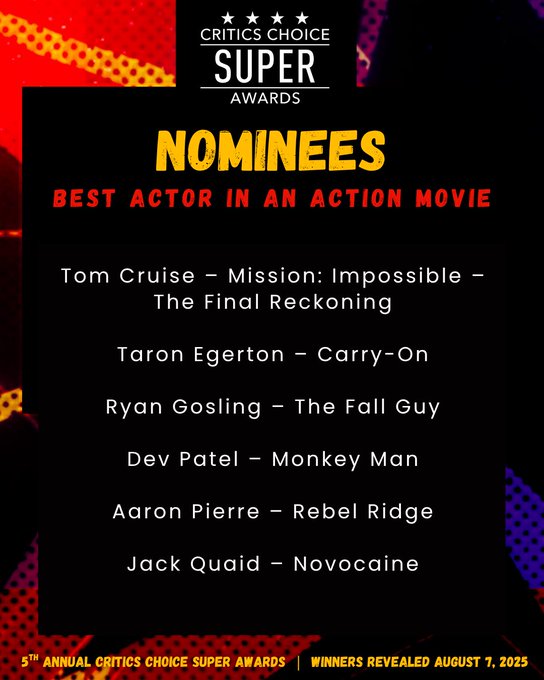
Just like Mission: Impossible – The Final Reckoning is my pick to win Best Action Movie, its star Tom Cruise is my choice to win Best Actor in an Action Movie. I don't think it's even close. Sorry, Taron Egerton, Ryan Gosling, Dev Patel, Aaron Pierre, and Jack Quaid are all great actors, but they don't have Cruise's star power.
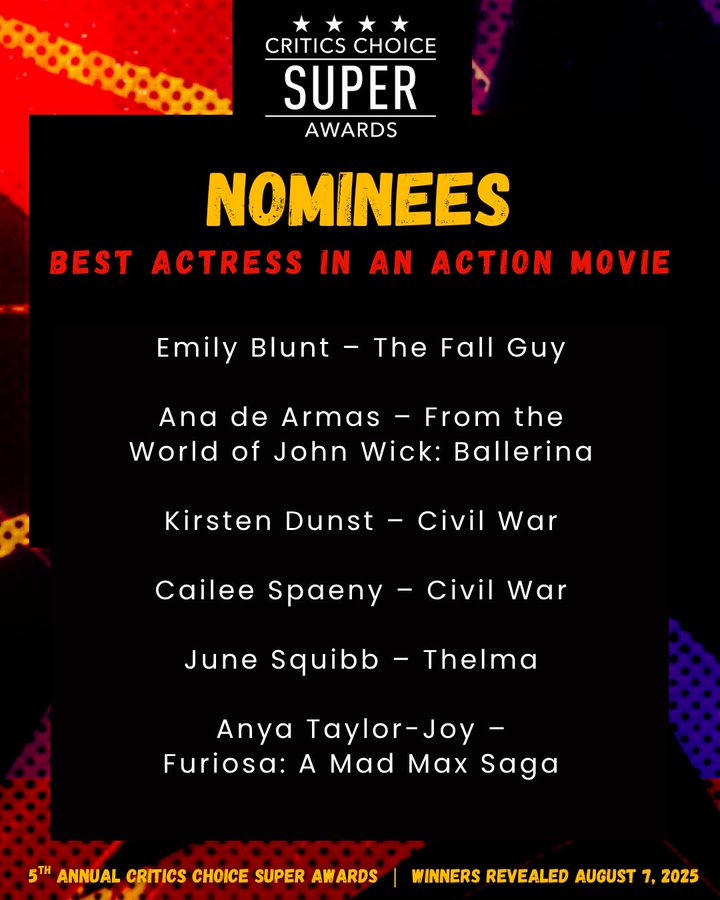
Without a nominated actress from Mission: Impossible – The Final Reckoning to create the likelihood of a full sweep, Best Actress in an Action Movie is much more open. Emily Blunt, Ana de Armas, Kirsten Dunst, and June Squibb all have Oscar nominations, Anya Taylor-Joy has an Emmy nomination, and Cailee Spaeny has a second nomination at these awards for Alien: Romulus. Since electorates matter, I'm giving the edge to Blunt because she has the most Critics Choice Award nominations and wins, including winning Best Actress in an Action Movie for Edge of Tomorrow when this award was part of the main ceremony before the Critics Choice Association split off the Super Awards. Besides, like Cruise, I think she has the most star power.
Now for a category I last revisited in 'Sinners' leads Best Horror Movie nominees at the Critics Choice Super Awards.

This is the only nomination for Gladiator II, which qualifies it for consideration in the next paragraph.I'm going along with Hunter and picking Grant over Washington. Why not?Emma Corrin really chewed the scenery in Deadpool & Wolverine, making for a good villain one loves to hate, but I'm not going to pick a winner yet. I have until August 7th to do that, so I'll hold off until I look at the rest of the categories.As I wrote above, Austin Butler has a better chance to win Best Villain in a Movie and might do so as part of a Dune: Part Two sweep. Still, I think there are better villains, or at least villains played by more well-known actors, like Hugh Grant and Denzel Washington, so I'm not getting out the broom just yet.
Like Best Horror Film, there are plenty of nominees for action/adventure and thriller film at the upcoming Saturn Awards among the movies nominated here, although I have to include all the acting nominees to say so. Joining Mission: Impossible – The Final Reckoning and Warfare from the movie category would be Carry-On, Novocaine, From the World of John Wick: Ballerina, and Gladiator II from the acting categories.* That's a full slate for one category right there.
Box Office Mojo's top grossing films of 2024 adds in one other possible nominee, September 5 — Red One is also an action movie, but I think it's more likely to be nominated as fantasy — while Box Office Mojo's top movies of 2025 adds F1: The Movie, The Accountant 2, Karate Kid: Legends, The Amateur, A Working Man, Den of Thieves: Pantera, Flight Risk, Black Bag, Last Breath, Babygirl, and The Phoenician Scheme in the top 50. There are 150 movies with lower box office totals that I didn't even look at! Furthermore, Box Office Mojo's Calendar lists Sovereign, She Rides Shotgun, and The Naked Gun upcoming between now and August 10th. While they are likely to be split among three categories, action/adventure, thriller, and independent film, there are still enough to fill all three and then some. There is no need to sacrifice the superhero film category to add Thunderbolts* and Captain America: Brave New World to Best Action Film!
I close with National Day Calendar's NATIONAL PINA COLADA DAY | July 10 to celebrate today's holiday.
July 10 recognizes a sweet, rum-based cocktail on National Pina Colada Day. Today, we are anxiously waiting for the end of the work day to enjoy the cream of coconut and pineapple juice with a dash of run cocktail.Sorry, no update on the prospects for Puerto Rican statehood today. Like Flag Day, I wasn't feeling it. Maybe next year.
This concludes my examination of the movie nominees at the Critics Choice Super Awards. I think I'll begin blogging about the television nominees on Saturday, for an early Sunday entertainment feature because Sunday is Souther. In the meantime, stay tuned for a joint celebration of World Population Day and National Mojito Day.
*I predicted "I expect Gladiator II will be nominated for Best Action/Adventure Film at next year's Saturn Awards" last December. As I wrote then, "You read it here first."
Previous entries about the 5th Critics Choice Super Awards
Wednesday, July 9, 2025
PBS Terra explains 'The REAL STORY of Climate Skeptics New Favorite Graph'
I'm returning to climate change with PBS Terra explaining The REAL STORY of Climate Skeptics New Favorite Graph.
I teach Milankovitch cycles to my geology students, both on the first field trip where I ask them to describe a display at a museum which summarizes the effects as "stretch, wobble, and tilt (eccentricity, precession, and obliquity)" and in a lecture about glaciers and glacial features, where I reinforce my point with The History of Climate Cycles (and the Woolly Rhino) Explained from PBS Eons.
Back to May on PBS Terra, who is revisiting PBS Terra's Weathered asks 'Earth's Temperature Has Changed WILDLY, So What's the Big Deal About a Few Degrees?'
That's a wrap for today's story I tell my students. Tomorrow is Piña Colada Day. Stay tuned to see if I celebrate it or cover the action movie nominees at the Critics Choice Super Awards. Maybe I will do both.
Is global warming just part of Earth’s natural cycle? In this episode of Weathered, we break down why that’s not the full story. From ice ages and Milankovitch cycles to the role of CO2 and fossil fuels, today’s climate change is unlike anything in Earth’s deep past. Learn why the speed of warming matters and how we can bring our temperature down.It's because of my knowledge of Milankovitch cycles that I was able to answer a persistent but now gone skeptic, which I recapped in PBS Digital's Be Smart debunks 'The Biggest Myth About Climate Change'.
I have mentioned several times that I'm a paleontologist who studies Pleistocene fossils, particularly snails. What I don't mention is that I used data from the snails, clams, and plants of Rancho La Brea to reconstruct the late Pleistocene climate of southern California, so I'm quite familiar with natural climate change. That's why I was able to respond intelligently to Ed, the troll who was better than a spammer, when he snarked "Maybe you can tell us what the climate is supposed to be so we will know if it's changing too much."I'm glad to see Maiya May and Jessica Tierney of the University of Arizona confirm both what the climate would have been doing naturally and what it's doing instead. It shows what I told Ed was (and still is) correct.Ed, actually, I can. The average temperature of the Northern Hemisphere should be almost two degrees Fahrenheit cooler than it is today based on the pre-1900 temperature trend, three degrees based on the progress of previous interglacials. If you want the reasoning and evidence, you will have to wait until I put together an entire entry with links; it will take more effort than a simple comment is worth. In the meantime, count your blessings that you stumbled onto someone who actually knows the answer to what you may have thought was a rhetorical question too hard to answer.That was back in 2015.
I teach Milankovitch cycles to my geology students, both on the first field trip where I ask them to describe a display at a museum which summarizes the effects as "stretch, wobble, and tilt (eccentricity, precession, and obliquity)" and in a lecture about glaciers and glacial features, where I reinforce my point with The History of Climate Cycles (and the Woolly Rhino) Explained from PBS Eons.
Throughout the Pleistocene Epoch, the range of the woolly rhino grew and shrank in sync with global climate. So what caused the climate -- and the range of the woolly rhino -- to cycle back and forth between such extremes?I've been showing this video since just before the pandemic; I'm surprised I haven't embedded it here until now. I guess I just needed the right opportunity.
Back to May on PBS Terra, who is revisiting PBS Terra's Weathered asks 'Earth's Temperature Has Changed WILDLY, So What's the Big Deal About a Few Degrees?'
The correlation between carbon dioxide levels and temperature from ice-core data is another story I tell my students. I asked them about it in my worksheets about An Inconvenient Truth and still ask them about it in my worksheet for Chasing Ice. I also ask them about it on my exams, but for test security reasons, I don't post those here. Maybe after I retire.As Dr. Tierney points out, carbon dioxide is at levels not seen for 3.6 million years so the Earth is on track for much warmer temperatures even if humans stop putting greenhouse gases into the atmosphere. Because of the fossil foolishness in the Big Brutal Bill, the U.S. alone will continue emitting carbon dioxide and methane for years. Worse yet, as Zeke Hausfather of Berkeley Earth described, it will take 400,000 years for natural processes to remove the excess carbon dioxide from the atmosphere. That's four more Milankovitch cycles! Maybe that will make our distant descendants less subject to ice ages, but it's going to mess up the near future for us and progeny down to our great-grandchildren.
That's a wrap for today's story I tell my students. Tomorrow is Piña Colada Day. Stay tuned to see if I celebrate it or cover the action movie nominees at the Critics Choice Super Awards. Maybe I will do both.
Tuesday, July 8, 2025
'Sinners' leads Best Horror Movie nominees at the Critics Choice Super Awards

I'm returning to the the Critics Choice Super Awards nominations once again, this time to examine the nominees for Best Horror Movie. The most nominated horror film is Sinners with four nominations, one each in all the categories in which it's eligible, followed by Heretic and Nosferatu with three each and Bring Her Back, Longlegs, and The Substance with two nominations apiece. I think this award is among Sinners, Nosferatu, and The Substance with Sinners as the nominal favorite by a nose, although I admit being influenced by Jim Hunter, critic at WEHT-ABC and WTVW-CW in Evansville, Indiana, who picked Sinners over The Substance.

Hunter's choice is Michael B. Jordan for his double role in Sinners. That's not a gimme, as Jordan is contending against heavy hitters Nicolas Cage in Longlegs, Hugh Grant in Heretic and Bill Skarsgård in Nosferatu and up-and-comers David Dastmalchian in Late Night With the Devil and Justice Smith in I Saw the TV Glow. I'll go with Hunter's pick after noting that Nicolas Cage won Best Actor in a Film at the Saturn Awards. I doubt the Critics Choice Association will go along with that; electorates matter.

While Demi Moore won Best Actress in a Film at the Saturn Awards, she also won Best Actress at the main Critics Choice Awards. Electorates matter, which is why I had her picked to win even before I heard Hunter.
Now for a category I've examined twice before.
I'm going along with Hunter and picking Grant over Washington. Why not?Emma Corrin really chewed the scenery in Deadpool & Wolverine, making for a good villain one loves to hate, but I'm not going to pick a winner yet. I have until August 7th to do that, so I'll hold off until I look at the rest of the categories.As I wrote above, Austin Butler has a better chance to win Best Villain in a Movie and might do so as part of a Dune: Part Two sweep. Still, I think there are better villains, or at least villains played by more well-known actors, like Hugh Grant and Denzel Washington, so I'm not getting out the broom just yet.
Unlike Superhero Film, where the best nominees have yet to premiere, and Science Fiction Film, where the best nominees have already been honored at the last Saturn Awards, these nominations yield a rich field of possible nominees for Best Horror Film at the next Saturn Awards, including Bring Her Back, Heretic, Nosferatu, and Sinners.* Box Office Mojo's top movies of 2025 adds Clown in a Cornfield, Final Destination: Bloodlines, Heart Eyes, Until Dawn, and Wolf Man, along with several more than I care to name. Box Office Mojo's Calendar lists Skillhouse, Abraham's Boys, I Know What You Did Last Summer, Bambi: The Reckoning, House on Eden, Ick, and Weapons between now and August 8th. There is no shortage of horror films!
I have one more movie genre, action, to cover before I move on to the television nominees. I expect to get to that Thursday or Friday. Stay tuned.
*For what it's worth, I've been looking forward to this category since April, when I wrote, "Nosferatu [is] my co-favorite so far with Sinners for Best Horror Film at the next Saturn Awards." Still is.
Previous entries about the 5th Critics Choice Super Awards
Subscribe to:
Posts (Atom)