Showing posts with label PhysOrg. Show all posts

Monday, May 23, 2016

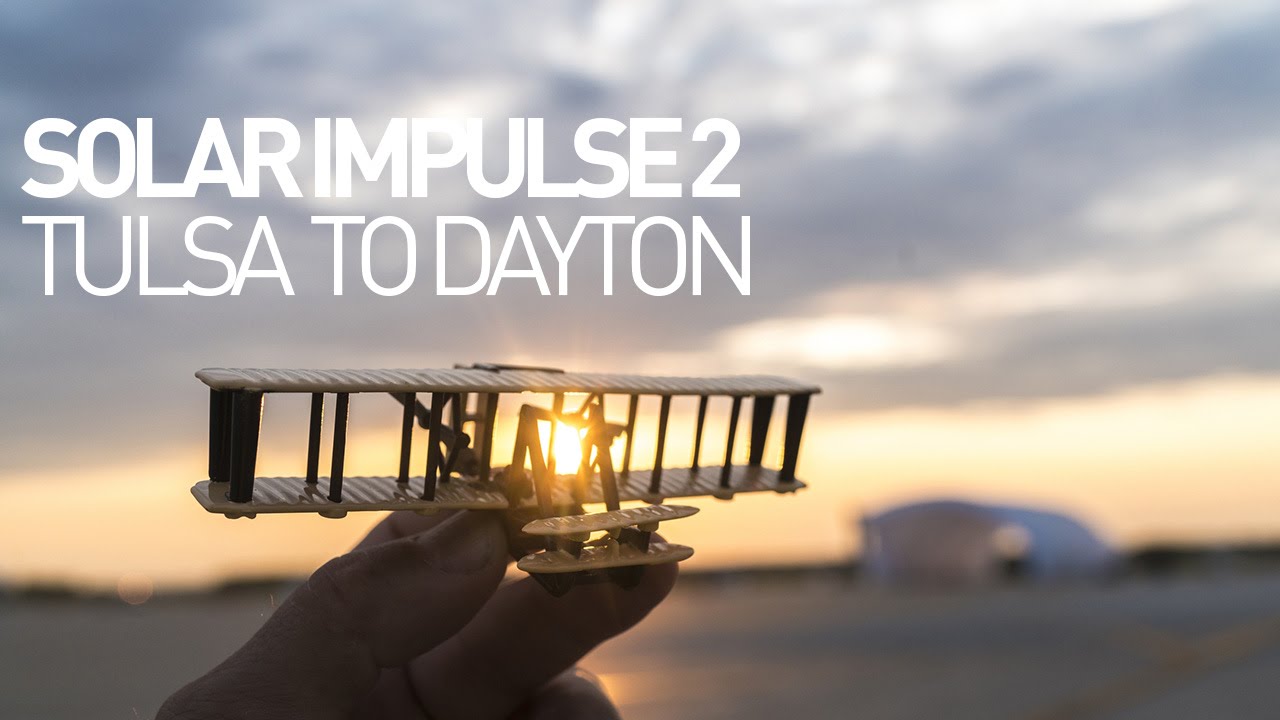
Solar Impulse 2 travels to Tulsa and Dayton


I concluded Solar Impulse 2 lands in Phoenix with a vague program note.
As for the plane's next stop, The Daily Mail reported "The solar-powered plane, which stores energy in batteries for when the sun is not shining, will make several stops across the United States, although the team is still examining potential destinations."  In other words, they don't know yet.  Stay tuned.
While I was looking elsewhere, the Solar Impulse team decided on their next stops.  First, Solar Impulse 2 arrives in Tulsa from May 13th.


After a week, the news became Solar Impulse 2 Makes an impact on Tulsa.

Solar Impulse 2 left for Dayton Ohio Saturday morning, but not before making an impact in Tulsa.
Looks like the plane succeeded in the educational part of its mission.

Saturday, the Associated Press reported Solar Impulse Lands At Home of Wright Brothers.

Solar powered plane travels from Tulsa, Oklahoma to Dayton, Ohio overnight to land at the city that is proud to be the hometown of the Wright Brothers.
USA Today also pointed out the significance of the location, but also of the date, pointing out that it was the 89th anniversary of Charles Lindbergh landing in Paris after his solo trans-Atlantic flight.

As for the next stage, AFP via Phys.org reported two more stops in the U.S. before flying over the Atlantic.
It may next fly to Pennsylvania as early as Tuesday, the team said. Its final destination in the United States is New York.
It could leave the day after tomorrow.  Stay tuned.

Wednesday, September 24, 2014

Racetrack Playa, a story my students tell me


Overnight News Digest: Science Saturday (Blair Mountain and Labor Day) on Daily Kos contained articles about a story I tell my students and a story my students tell me.  Tonight, I'm sharing the story my students tell me when they submit articles about geology for extra credit, the sliding stones of Racetrack Playa.  I've received copies of that article more times than I care to count. Last month, the mystery of how these rocks moved was solved.

Scripps Research Institute via PhysOrg: Mystery solved: 'Sailing stones' of death valley seen in action for the first time
August 28, 2014
Racetrack Playa is home to an enduring Death Valley mystery. Littered across the surface of this dry lake, also called a "playa," are hundreds of rocks – some weighing as much as 320 kilograms (700 pounds) – that seem to have been dragged across the ground, leaving synchronized trails that can stretch for hundreds of meters.

What powerful force could be moving them? Researchers have investigated this question since the 1940s, but no one has seen the process in action – until now.

In a paper published in the journal PLOS ONE on Aug. 27, a team led by Scripps Institution of Oceanography, UC San Diego, paleobiologist Richard Norris reports on first-hand observations of the phenomenon.
Here's the video explaining the discovery of the mechanism: How Rocks Move.

Scripps Oceanography paleooceanographer Richard Norris describes the phenomenon of sliding rocks in Death Valley.
I tell my students I learn as much from them as a group as they learn from me individually.  The story of these rocks serves as one example of what my students have taught me.

Thursday, June 5, 2014

NASA mid-year report and other space and astronomy news


Time for a review of the year so far in 2014 Mid Year Report on This Week @NASA.

The This Week At NASA crew is on a short mid-year hiatus -- but we thought we'd leave you with a quick look back at some of the big and exciting news featured so far in 2014 on This Week at NASA. We're back on June 13 with a fresh, new This Week At NASA.
Follow over the jump for news from distant galaxies to deep in the heart of Texas, where the stars at night are big and bright.

Thursday, January 30, 2014

More energy and the State of the Union


I'm not done with Energy and climate in the State of the Union.  It turns out that being Secretary of Energy singles one out for special treatment during the speech.  Time explains in This Man Will Be Your President If The Worst Happens.
If the unthinkable happens during Tuesday night’s State of the Union address, Secretary of Energy Ernest Moniz will assume the role of President of the United States.

Moniz, the 12th person in the line of succession for the Oval Office, will be protected by Secret Service agents at an undisclosed location as the so-called “designated survivor” while President Barack Obama delivers his address to Congress. Meanwhile, the vice president, members of the Cabinet, Supreme Court justices and others will gather at the Capitol to listen to the president’s annual address.

...He’s better liked inside the administration than his predecessor—and last year’s designated survivor—Steven Chu, who was considered by some administration officials to be a political loose cannon.
It just so happens that I have articles about both men, beginning with Virginia Tech's Nobel laureate talks about innovation in modern research world before capacity Burruss audience.
BLACKSBURG, Va., Oct. 14, 2013 – Steven Chu, a Nobel laureate and a former United States Secretary of Energy, talked about how to create a research and development environment modeled after the famously successful “Bell Labs” on Friday during the initial Hugh and Ethel Kelly Speaker Series presentation, hosted by the Institute for Critical Technology and Applied Science (ICTAS) and the College of Engineering.

Chu said researchers in today's research climate are forced to concentrate on their best ideas, work in small groups, and to collaborate with experts from different fields. In that respect, it reinforces the Bell Laboratories' philosophy to build small research groups containing usually just an investigator, a postdoctoral associate, and a lab technician, and to have active scientists fill the management roles.

"A small group makes you think hard about the most important things to work on, and being forced to share ideas may be a good thing," Chu said. "That's the lemonade from the lemons."
Next, Science Magazine updates its readers with the people around the new Energy Secretary in Obama Names Energy Science Team.
President Barack Obama has added two academic researchers to his new science team at the U.S. Department of Energy (DOE).

Obama yesterday announced his intention to nominate chemical engineer Franklin "Lynn" Orr, a professor and administrator at Stanford University in California, to fill the newly created position of undersecretary for science and energy. The same announcement tapped physicist Marc Kastner of the Massachusetts Institute of Technology (MIT) in Cambridge to lead DOE’s Office of Science, which manages a $4.6 billion research portfolio. Last week, the White House picked physicist Ellen Williams, chief scientist at energy giant BP and a former longtime professor at the University of Maryland (UMD), College Park, to run DOE’s Advanced Research Projects Agency-Energy (ARPA-E).

If approved by the U.S. Senate, the trio will round out Energy Secretary Ernest Moniz’s leadership team for DOE’s civilian research programs, which include 10 national laboratories run by the Office of Science.
That's not all.  As I wrote in Unemployment insurance extension and the State of the Union about the speech:
It also reminded me that I have a long backlog of material from the past two months of Overnight News Digests on Daily Kos about healthcare and energy that I need to post here.
Follow over the jump for the energy news from the past three months that I've posted on Daily Kos since Renewable energy news from campuses on the campaign trail.

Tuesday, January 28, 2014

Asian air pollution and other global pollution stories


Two weeks ago, the Daily Mail reported China starts televising the sunrise on giant TV screens because Beijing is so clouded in smog.
The smog has become so thick in Beijing that the city's natural light-starved masses have begun flocking to huge digital commercial television screens across the city to observe virtual sunrises.

The futuristic screens installed in the Chinese capital usually advertize tourist destinations, but as the season's first wave of extremely dangerous smog hit - residents donned air masks and left their homes to watch the only place where the sun would hail over the horizon that morning.
The article then goes on to describe the terrible smog and the horrible health problems that result from it.  All of that is true, but the hook is baloney, as Quartz pointed out in Westerners are so convinced China is a dystopian hellscape they’ll share anything that confirms it.
When it comes to China stories, people will believe almost anything. Take, for instance, the reports about pollution being so severe in Beijing that residents now watch radiant sunrises broadcast on a huge screen in Tiananmen Square.

So, that never happened. As Tech in Asia flags, the sunrise is a clip from a tourism ad for Shandong province, in China’s northeast; it’s on screen for maybe 10 seconds or so per loop.

But that didn’t prevent a slew of prominent media outlets—including Time, CBS News and the Huffington Post—from running the story, which originated in the UK-based Daily Mail, each taking their own liberties with the truth. The “glorious sunrise was broadcast as part of a patriotic video loop,” explained Time.

How do stories like this happen? One reason is shabby journalism, something for which the Daily Mail is renowned.
That's why The Daily Mail is called The Daily Fail.  Still, it's a striking image, one that I will use when I next lecture on air pollution.  I already have a photo of air pollution in Beijing.  For balance, I'll also tell my students the full story as a cautionary tale about journalism that appeals to their prejudices.

That written, the air pollution from Asia is real and it's affecting the rest of the planet, as Texas A&M explains in Asian Air Pollution Affecting World’s Weather.
Extreme air pollution in Asia is affecting the world’s weather and climate patterns, according to a study by Texas A&M University and NASA’s Jet Propulsion Laboratory researchers.

Yuan Wang, a former doctoral student at Texas A&M, along with Texas A&M atmospheric sciences professors Renyi Zhang and R. Saravanan, have had their findings published in the current issue of Nature Communications.
Satellite photo shows huge air pollution clouds at far left. Japan is on the right.

Using climate models and data collected about aerosols and meteorology over the past 30 years, the researchers found that air pollution over Asia – much of it coming from China – is impacting global air circulations.

“The models clearly show that pollution originating from Asia has an impact on the upper atmosphere and it appears to make such storms or cyclones even stronger,” Zhang explains.

“This pollution affects cloud formations, precipitation, storm intensity and other factors and eventually impacts climate.  Most likely, pollution from Asia can have important consequences on the weather pattern here over North America.”
There is much more at the link, including the following image.


Let that be a lesson in "Everything is connected to everything else," "There is no away," and "There is no such thing as a free lunch."

Follow over the jump for more stories that illustrate Commoner's Laws as pollution from one place ends up going somewhere else, as well as other stories about what people are doing about pollution elsewhere on the planet, all of them originally included in Overnight News Digest on Daily Kos.

Wednesday, January 15, 2014

ISS extended and dead stars in this week's space news


This week's space news report has good news for the ISS.  NASA Television reports that ISS Extended to 2024 on This Week @NASA.

NASA Administrator Charlie Bolden and White House Science Advisor John Holdren, announced that the Obama administration is extending usage of the International Space Station to at least the year 2024. In his blog, Bolden noted that NASA is hopeful and optimistic that our ISS partners will join this extension effort and enable continuation of the groundbreaking research being conducted on the unique orbiting laboratory. Also, International Space Exploration Forum, Cygnus' resupply flight, Super Bowl of Astronomy, 10 years roving Mars, TDRS-L Update and more!
I'm tempted to break out Professor Farnsworth, but decided not to jinx the announcement, so I illustrated this entry with the ISS instead.

Follow over the jump for more astronomy news originally included in Overnight News Digest: Science Saturday (Polar Vortex) on Daily Kos.

Sunday, January 12, 2014

Science from the fans in the stands


In Research from BCS Championship universities, I described the science generated by Florida State and Auburn, the schools participating in the event.  Now, it's time to document the science generated by the fans of pro football teams participating in the NFL playoffs.  Here are two stories from last night's Overnight News Digest: Science Saturday (Polar Vortex) on Daily Kos that share this connection.

First, some real science from the University of Washington via PhysOrg: Scientists to observe seismic energy from Seahawks' '12th man' quakes by Bill Steele on Jan 10, 2014.
University of Washington seismologists this week installed two strong-motion seismometers at CenturyLink Field in Seattle to augment an existing station in recording shaking from "earthquakes" expected on Saturday during the NFC divisional game between the Seattle Seahawks and New Orleans Saints.

The Pacific Northwest Seismic Network is preparing a special website at www.pnsn.org/seahawks for the game to display seismograms from all three seismic stations in near-real time, and seismologists will also be available to explain interesting signals. Seismologists also will highlight interesting signals in tweets (@PNSN1) and on Facebook (thePNSN).

Seahawks fans, collectively known as "the 12th man," have a well-known reputation for generating noise and shaking in the stadium during games. Perhaps the best-known example occurred on Jan. 8, 2011, during a 67-yard touchdown run by the Seahawks Marshawn Lynch that helped Seattle defeat New Orleans in an NFC Wild Card game.
The seismogram for the sequence of events leading to the score and the point after illustrates this entry.
Scientists hope to record similar shaking during Saturday's game to better understand how the stadium responds to the activity, and to measure the energy transmitted to the ground within the stadium and within the surrounding neighborhood.
History repeated itself yesterday, as Seahawks beat Saints 23-15, advance to NFC championship game.  It looks like they'll be facing the 49ers, who are beating the Carolina Panthers halfway through the fourth quarters as I type this.  I'll be rooting for the 49ers.

Next, a health story with a human interest angle from UCSD: Football Fans Team Up for Organ Match by Jackie Carr on January 08, 2014.
Random stadium seat assignment leads to lifesaving transplant surgery
In October 2013, Louis Munoz donated one of his kidneys to William Lynch. The organ match would not have occurred without a bit of serendipity and a big love of football. Munoz and Lynch had been childhood friends, but hadn’t seen each other in years – then they found themselves randomly seated next to each other at a Chargers game.

“Louis and I knew each other as kids and then lost touch. Years later, by surprise, we ended up sitting right next to each other at Chargers games,” said William, a middle school teacher. “When I started missing games, Louis asked me why and I explained that due to kidney complications, I’d been unwell. His wife half-jokingly suggested that he give me a kidney.”

Louis immediately volunteered to be tested as a possible donor. William initially declined his friend’s offer, believing another donor would come through. But when that didn’t happen, Louis followed through and proved to be a match.
The Chargers are playing in the next elimination game today.  They're underdogs against the Denver Broncos.  That's not stopping me from rooting for them, so there will be an all-California Super Bowl.  If that happens, I'll be rooting for the Chargers, but I'd be happy with either winning the NFL championship.
Tuesday, August 27, 2013

Hot: IPCC report leaked


It's time to return to my original take on this month's Hot theme, climate change stories.  Here's the lead story from last Saturday's Overnight News Digest: Science Saturday (IPCC report leaked) on Daily Kos.  Agence France Presse via PhysOrg has the story.

Human activity is 'almost certainly' driving climate change, IPCC leaked report says
Aug 21, 2013
Human activity is almost certainly the cause of climate change and global sea levels could rise by several feet by the end of the century, according to an Intergovernmental Panel on Climate Change (IPCC) report leaked to media.

The draft summary of the report all but dismissed recent claims of a slowdown in the pace of warming, which has seized upon by climate-change sceptics.

"It is extremely likely that human influence on climate caused more than half of the observed increase in global average surface temperature from 1951 to 2010," The New York Times on Tuesday quoted a section of the leaked report as saying.
That's the first of at least six stories about climate from the past two weeks of ONDs.  Stay tuned and keep cool.

Saturday, June 1, 2013

Storms from orbit and other space and astronomy news

For this past week's news, I point out a connection between two stories, one in which NASA observed storms on Earth from orbit, and another which describes storms on exoplanets, again observed by NASA from orbit.

First, NASA Television on YouTube reports on The Oklahoma Storms As Seen From Space on This Week @NASA.

Also, NASA Administrator Charlie Bolden received updates on the important work being on done at the agency's California centers, , a New Crew Prepares for Launch to the International Space Station, and a look at Dream Chaser Flight Simulations. These and other stories on This Week @NASA.
NASA Television on YouTube also has the next story, ScienceCasts: Big Weather on Hot Jupiters.

Astronomers using NASA's Spitzer Space Telescope are making weather maps of an exotic class of exoplanets called "hot Jupiters." What they're finding is wilder than anything we experience here in our own solar system.
More space and astronomy news from the week that was over the jump.

Wednesday, May 15, 2013

Discovery News and PhysOrg on colony collapse disorder

Yesterday, I began my lecture on economics and the environment.  One of the main topics was natural capital, including the ecosystem services nature provides.  One of these is pollination, or at least, it used to be.  During the past decade, growers have had to pay more and more for beehive rentals to the point where beekeepers have been earning more from rentals than from honey.  This means that what used to be a beneficial externality is now an internalized cost.  This is one of the factors making the prices of food that requires bee pollination go up.

This topic led to a lively discussion and a lot of questions.  Fortunately, I had answers to nearly all of them.  However, it would have been really useful to have shown my class this video, which came out the day before.  It had the answers to all of them.

Why All The Bees Are Dying

Bee population around the world have collapsed. Now scientists are scrambling to find out why. Anthony has a list of the possible causes, and the threat this poses to food supplies worldwide.
I had seen the preview of this the night before last and was thinking of adding the link to it in the Powerpoint for the lecture, but ran out of time that morning because of other duties.  Too bad, it would have been really helpful.  Maybe I'll show it to the class tomorrow.

Also, I just happen to have article about one of the factors hypothesized to be contributing to colony collapse disorder, feeding high-fructose corn syrup to bees.

PhysOrg: Researchers find high-fructose corn syrup may be tied to worldwide collapse of bee colonies
by Bob Yirka
Apr 30, 2013
A team of entomologists from the University of Illinois has found a possible link between the practice of feeding commercial honeybees high-fructose corn syrup and the collapse of honeybee colonies around the world. The team outlines their research and findings in a paper they've had published in the Proceedings of the National Academy of Sciences.

Since approximately 2006, groups that manage commercial honeybee colonies have been reporting what has become known as colony collapse disorder—whole colonies of bees simply died, of no apparent cause. As time has passed, the disorder has been reported at sites all across the world, even as scientists have been racing to find the cause, and a possible cure. To date, most evidence has implicated pesticides used to kill other insects such as mites. In this new effort, the researchers have found evidence to suggest the real culprit might be high-fructose corn syrup, which beekeepers have been feeding bees as their natural staple, honey, has been taken away from them.
I'll remind students about how HFCS may be unhealthy for bees when I show "Food, Inc."  If it's not good for bees, why would it be good for people?