A new report from the NOAA finds that despite global shutdowns, greenhouse gas levels in 2020 surged. In fact, levels of carbon dioxide are at the highest they've been in 3.6 million years. CBS News meteorologist and climate specialist Jeff Berardelli joins CBSN to explain.Jeff Berardelli and anchor Lana Zak concentrated more on the rate of increasing greenhouse gas concentrations and temperatures, the consequences of the higher temperatures, and what humans can do to keep temperatures from rising more than two degrees Celsius above pre-industrial levels than they did on the effects of the pandemic-driven recession or the implications of the subtitle of the report, "Carbon dioxide levels are now higher than at anytime in the past 3.6 million years." Follow over the jump for the first half of the NOAA press release with my commentary on those two subjects.
Showing posts with label Science News. Show all posts
Showing posts with label Science News. Show all posts
Saturday, April 10, 2021
Carbon dioxide at levels not seen for 3.6 million years despite economic slowdown from pandemic
The reason I told my readers to "stay tuned for a climate update tomorrow" was that my wife checked the weather at NOAA and saw the following headline Despite pandemic shutdowns, carbon dioxide and methane surged in 2020. CBS News summarized and commented on that in Greenhouse gas levels surged in 2020, NOAA says.


Wednesday, December 27, 2017
Neutron star collision detected and other top science stories of 2017

When I posted Gravity waves and other top science stories of 2016, I had no idea that the discoverers of gravity waves would win the Nobel Prize for physics this year, but they did. Gravity waves are still the number one science story of the year, at least according to the AAAS and Science Magazine, as they named them Breakthrough of the Year, 2017.
Check out what Science's editors deemed the top results of 2017, including our Breakthrough of the Year!That discovery topped most of the other lists I examined from what I considered reputable sources. The other stories that Science Magazine placed in this year's top ten that showed up elsewhere were CRISPR and its role in gene therapy, the discovery of the oldest Homo sapiens fossils in Morrocco, and a new endangered species of orangutan. Stories that Science Magazine did not mention that made many other sources' top science story lists included the Great American Eclipse and the end of the Cassini mission, perhaps because they were not breakthroughs or discoveries, even if both were big news.
Follow over the jump for videos from New Scientist, Curiosity Stream, Science News, and Scientific American on their top science stories of 2017.
Tuesday, December 20, 2016
Gravity waves and other top science stories of 2016

I promised to return to reality today after a three day weekend devoted to entertainment. I was planning on blogging about the Electoral College or the Flint Water Crisis, but I decided to write about something positive about the past year instead, the year in science. Following my own adage of "if it moves, it leads," here is New Scientist's The 12 biggest science stories of 2016.
Gravitational waves, humming gorillas, a new neighbour and more: here are New Scientist's stories of the year.Science News, Gizmodo, and Newsweek have their own reviews of the top science stories of the year about to end. Every one of them included the discovery of the gravitational waves predicted by Albert Einstein, so it's the top science story of the year by consensus. Planet Nine and Proxima B showed up in three of the four. The remaining stories that showed up in half the lists were human gene editing, a three-parent baby being born, Google's A.I. beating a human Go master, and Zika. No single environmental story showed in more than one list, although two different climate change stories were mentioned in different articles. Also, no one story about fighting aging made more than one list, but several different ones also were mentioned, so I'm giving climate change and anti-aging breakthroughs honorable mentions.
The New York Times had its own science, environment, and health year in review articles, but I found them next to useless. The science summary mentioned none of the above stories, the environmental review was all about climate change, and the health one only mentioned Zika. I suppose that reinforces my awarding climate change an honorable mention and allows me to break the tie among the third place stories in favor of Zika, but that's about it. Still, it's enough to convince me to blog about Zika; today's entry is the first time I've mentioned the disease here.
Tomorrow is the winter (hibernal) solstice. I have something special planned for the occasion. Stay tuned.
Sunday, December 29, 2013
2013 in space

Original at Gizmag.
I've already begun my end of year retrospectives with What did 2013 say on YouTube? That means it's time to work my way up from the ridiculous to the sublime. The best way to do that is to begin as high up as possible, with the year in space. Under the "if it moves, it leads" policy of the blog, I begin with From Earth to Deep Space: NASA 2013 Highlights.
NASA highlights its accomplishments in air and space for 2013.
2013 What Happened This Year @NASA
In 2013, NASA helped transform access to low Earth orbit ... even as one of our venerable spacecraft reached the boundaries of the solar system ... and we moved ahead on technologies -- that will help us carry out an ambitious asteroid mission we announced ... and, eventually, move on to Mars.Follow over the jump for the rest of the space stories from last night's Overnight News Digest: Science Saturday (Science in 2013) on Daily Kos.
Here's a quick trip back through 2013 for those and some of the other big things that happened This Year at NASA.
Saturday, October 5, 2013
Climate news from NASA, IPCC, and University of Alabama
It's long past time for me to post the lead story from Overnight News Digest: Science Saturday (IPCC report released), one that I foreshadowed Climate news from NASA and campuses on the campaign trail when I opened the entry with "The latest IPCC report on climate change that I previewed in Hot: IPCC report leaked is due out today."
Science News: Humans found guilty in climate change
International panel's confidence increases that society is responsible for global warming
By Beth Mole
Web edition: September 27, 2013
Follow over the jump as I make good on another promise from that entry and post two climate stories from the University of Alabama.
Science News: Humans found guilty in climate change
International panel's confidence increases that society is responsible for global warming
By Beth Mole
Web edition: September 27, 2013
Scientists are now 95 to 100 percent certain that humans are cranking up the global thermostat.As jamess on Daily Kos pointed out in Likely, Very Likely, Extremely Likely, 95+% confidence is the gold standard in science. Any scientist who says something is 95% likely is confident in their results.
The boosted confidence in humans' role in climate change comes from a distillation of thousands of scientific studies, by the United Nations' Intergovernmental Panel on Climate Change, which released a summary of its findings September 27.
The IPCC, which produces such a report about every six years, had previously estimated only a 90 percent confidence level that human activities, such as burning fossil fuels, are contributing to the world's rising temperatures. A warmer climate threatens to raise sea level - drowning islands and coastlines - and dramatically alter agriculture and ecosystems around the world.
Follow over the jump as I make good on another promise from that entry and post two climate stories from the University of Alabama.
Monday, September 2, 2013
Serve: How selfishness is punished and heroism rewarded
Continuing with this month's Serve theme, here are two stories I originally included in Overnight News Digest on Daily Kos about selfishness and heroism.
First, Laci Green of Discovery News explains how Evolution Punishes the Selfish.
In contrast, Sid Perkins of Science News asked and answered an important question in BOOK REVIEW: What Makes a Hero? The Surprising Science of Selflessness by Elizabeth Svoboda.
First, Laci Green of Discovery News explains how Evolution Punishes the Selfish.
You'd think being selfish would help a species survive... but you'd be wrong! Turns out not only is it important to be generous, our species' survival depends on it! Laci explains why.The rich and powerful should take note. Selfishness does not pay.
In contrast, Sid Perkins of Science News asked and answered an important question in BOOK REVIEW: What Makes a Hero? The Surprising Science of Selflessness by Elizabeth Svoboda.
Stories of heroes are all over the news: First responders and even concerned passersby put themselves in harm’s way to help others, going against every instinct for self-preservation. What could explain such selfless acts? Even Charles Darwin struggled to understand the evolutionary upside of self-sacrifice.So, will you serve and be someones hero this month?
Svoboda, a science writer, takes an in-depth look at some of the scientists who study altruism and what they are finding. Brain scans (including one of Svoboda) reveal that people who envision themselves giving to charity show neurological responses similar to the effects of taking an addictive drug. It’s ironic, Svoboda writes, that acts of selflessness can stem from such self-centered motivations.
Saturday, June 8, 2013
More news about the 400 ppm world

In Carbon Dioxide at Miocene levels, I wrote, "If the 10-15 million year figure is right, the last time CO2 was this high, Antarctica still had forests." Even if it isn't, and the last time was about 3 million years ago, the world was still a very different place, as Erin Wayman of Science News reported in The Arctic was once warmer, covered by trees
Pliocene epoch featured greenhouse gas levels similar to today's but with higher average temperaturesThat was then. What about the effects now?
The Arctic wasn’t always frozen tundra. About 3.6 million years ago, the far north was blanketed in boreal forests, and summers were 8 degrees Celsius warmer than they are today, geologists report May 9 in Science.
Researchers pieced together that picture from sediments buried beneath Lake El’gygytgyn (pronounced EL-gih-git-gin), about 100 kilometers north of the Arctic Circle in northeastern Russia (SN: 11/20/10, p. 13). The sediments preserve the most complete history of Arctic climate on land over the last 3.6 million years.
“It’s an unprecedented record,” says study coauthor Julie Brigham-Grette, a geologist at the University of Massachusetts Amherst. “It gives us a way of envisioning what the future may hold.”
Science News: Southwest's monsoon season may heat up with the climate
Warmer temperatures may bring stronger rainy seasons over the long term, study finds
By Erin Wayman
Web edition: May 28, 2013
The summer monsoon that dumps rain on an otherwise-arid American Southwest may grow stronger as the climate warms, suggests a study of the region’s monsoon patterns of the last millennium.My friend Nebris will appreciate this prediction for reasons that will take too long to explain here now.
Across the Northern Hemisphere, monsoons — winds that change directions seasonally, altering rainfall — could intensify, the team reports May 27 in the Proceedings of the National Academy of Sciences.
The results complement recent observations and simulations of monsoon activity, says Pang-chi Hsu, a climate scientist at the University of Hawaii at Manoa, who was not involved in the work. “We do see enhanced Northern Hemisphere monsoons over the recent decades, from the 1970s.”
Monday, April 29, 2013
White House Science Fair and other STEM education news
The featured story for this week's Overnight News Digest: Science Saturday (White House Science Fair) on Daily Kos came from the Washington Post with video from Discovery News on YouTube.
Whiz Kid Inventors Invade The White House
By Lyndsey Layton
Published: April 22
Follow over the jump for more stories aabout STEM education from Daily Kos.
Whiz Kid Inventors Invade The White House
Trace joins President Obama in Washington DC for the 3rd Annual White House Science Fair. Watch as young inventors show off everything from portable windmills to underwater robots!Robots, biofuel, whiz kids at the White House Science Fair
By Lyndsey Layton
Published: April 22
In his dark blue business suit, President Obama climbed onto a bicycle anchored to the ground outside the White House. He pedaled in his polished dress shoes, generating electricity to run a water sanitation system built by a group of Florida teenagers.I hope the answer is use science and technology to help with our environmental issues.
He peered into a flask of green liquid containing a new breed of algae that was created by a 17-year-old Colorado girl who wants to solve the country’s energy problems.
And he shook hands with three small boys from Georgia who dreamed up a system to automatically cool down and hydrate sweating athletes.
“Keep in mind, they’re in third, fourth grade, and they’ve already got this idea,” Obama said. “If you’re inventing stuff in the third grade, what are you going to do by the time you get to college?”
Follow over the jump for more stories aabout STEM education from Daily Kos.
Monday, February 11, 2013
Cats as a threat to biodiversity
I love cats and consider their rodent-catching ability to be a feature, not a bug, but some people have exactly the opposite opinions. Discovery News has a particularly extreme example in Eliminate Cats! A Crazy Plan to Save Birds in New Zealand.
Science News has a more general view of the situation in Cats kill more than one billion birds each year.
New estimate suggests hunting felines take bigger bite than expected out of wildlife
By Susan Milius
Web edition: January 29, 2013
Housecats are destroying New Zealand's natural habitat! They are an invasive species and a threat to indigenous wildlife! At least that's what Gareth Morgan says, the man behind a radical cat eradication campaign in New Zealand. But as Anthony asks, is removing felines the answer? And what might happen once they're gone?Good luck with that.
Science News has a more general view of the situation in Cats kill more than one billion birds each year.
New estimate suggests hunting felines take bigger bite than expected out of wildlife
By Susan Milius
Web edition: January 29, 2013
Domestic cats kill many more wild birds in the United States than scientists thought, according to a new analysis. Cats may rank as the biggest immediate danger that living around people brings to wildlife, researchers say.I don't care. I'm still keeping my indoor-outdoor cats in an urban setting. Here, they're catching animals that are not endangered and could become pests. On the other hand, cats in Pacific Islands like the Hawaiian Islands or New Zealand might not be as beneficial.
America’s cats, including housecats that adventure outdoors and feral cats, kill between 1.4 billion and 3.7 billion birds in a year, says Peter Marra of the Smithsonian Conservation Biology Institute in Washington, D.C., who led the team that performed the analysis. Previous estimates of bird kills have varied, he says, but “500 million is a number that has been thrown around a lot.”
For wild mammals, the annual toll lies between 6.9 billion and 20.7 billion, Marra and his colleagues report along with the bird numbers January 29 in Nature Communications. The majority of these doomed mammals and birds fall into the jaws of cats that live outdoors full-time with or without food supplements from people.
Tuesday, February 5, 2013
The science of sex and housework

Science News: Some chores linked to less sex
Husbands who do more household work make love less, new study suggests
By Nathan Seppa
Web edition: January 30, 2013
Maybe it’s the apron. Couples in the United States in which the men do more chores around the house have less sex than those in which the husbands don’t do the dishes and laundry as much, a new study finds. The findings appear in the February American Sociological Review.When I posted this as part of Overnight News Digest: Science Saturday (Groundhog Day 2013) on Daily Kos, it got quite a bit of pushback. On commenter noted that this study appeared to be more correlation than causation, which I agree with. He also pointed out that being a parent, which generates more housework, leads to less sex. As you can see, he was skeptical about the finding. Another commenter supported the first, quoting a Marlo Thomas and friends song.
The division of labor in the typical U.S. household became more egalitarian between 1965 and 1995 says study coauthor Sabino Kornrich, a sociologist at the Juan March Institute in Madrid. As women entered the workforce in droves and had smaller families, men took on more chores.
But the new study, a snapshot of more than 3,500 heterosexual married couples in the United States in the early 1990s, finds that wives were still doing four-fifths of the household chores traditionally associated with women: doing dishes, washing clothes, cooking, cleaning and shopping. The husbands did a bare majority of traditionally male jobs, which comprised yard work, auto maintenance, driving and paying bills, Kornrich says.
If you want your days to be sunny as summer weather, do the housework together.The article itself concluded by quoting researchers who disagreed with the finding.
Some scientists remain unconvinced that less work around the home by the man is a turn-on for a couple. “The jury is out on this,” says Oriel Sullivan, a sociologist at the University of Oxford in England, citing research that draws different conclusions.As for me, this isn't going to convince me to do less housework. There are more important things in a marriage than how often one has sex.
Constance Gager, a sociologist at Montclair State University in New Jersey, has found that couples in which both spouses contribute a lot to household work tend to have more sex than couples who do less around the house. She refers to it as “work hard, play hard.”
Sullivan acknowledges the possibility that the underlying sensibilities guiding sexual desire and frequency in a marriage have not changed in step with the division of household labor. After all, popular culture still often represents men in highly traditional roles, she says. “The movie image of masculinity, the action hero, has hardly shifted at all over the last 50 years.”
As for sex, frequency may not explain it all, anyway. Gager says that social workers tell her that patients insist that quality matters just as much as quantity.
Sunday, December 30, 2012
Double serving of space and astronomy news leftovers
I've been passing out the space and astronomy stories from the past two weeks in installments as responses to the Fake Mayan Doomsday, Christmas (twice), Gangnam Style, and discovering a potentially habitable exoplanet. That didn't take care of all of them, however. Here are almost* all the rest of them from Overnight News Digest: Science Saturday (Two Higgs Bosons? edition) and Overnight News Digest: Science Saturday (Apocalypse Not edition) that didn't either meet the funny test, fit a special occasion, or both, plus two stories that I had planned on including, but removed because they had already been covered in another OND, and a third from last night's OND.
I begin with the final This Week @NASA video for the year.
NASA Television on YouTube: Countdown to Launch on This Week @NASA
Follow over the jump for much more space and astronomy news from the far reaches of time and space to the surface of the Earth.
I begin with the final This Week @NASA video for the year.
NASA Television on YouTube: Countdown to Launch on This Week @NASA
With their launch from Kazakhstan to the International Space Station fast approaching, Expedition 34/35 Soyuz Commander Roman Romanenko, Flight Engineer Tom Marshburn of NASA and Flight Engineer Chris Hadfield of the Canadian Space Agency continue to train and finalize plans for the December 19 flight. Also, Orion taking shape; Mars field trip: GRAIL's impact; FASTSat's finale; "Big Wind"; rocket holiday; and more!DarkSyde at Daily Kos has more general space and science news in This week in science: It's the sun, stupid and This week in science: Showboats as does cynndara in ALSO IN THE NEWS TODAY.
Follow over the jump for much more space and astronomy news from the far reaches of time and space to the surface of the Earth.
Did we just discover Plateau?

Science News: News in brief: Possible planet looks habitable
Candidate body pushes limit of astronomical detection
By Alexandra Witze
Web edition: December 19, 2012
The closest single star like the sun — Tau Ceti, 12 light-years away — may harbor five planets slightly more massive than Earth. One may even lie in the star’s habitable zone.For a science fiction fan, discovery of a habitable planet around Tau Ceti would be very significant, as the list of planets around the star in Tau Ceti in fiction indicates. Since this blog has a Niven and Pournelle theme, I'll quote the entry on the two they created for their fiction.
...
According to the analysis, Tau Ceti is surrounded by five planets that weigh between two and six Earth masses and take between 14 and 640 days to orbit the star. The one reported in the habitable zone is a five-Earth-mass planet with a period of 168 days.
A Gift from Earth (1968), Known Space novel by Larry Niven. The colony world Plateau in the Tau Ceti system lives by a rigorous code: All crimes are punishable by involuntary organ harvesting, while organ transplants are reserved to the benefit of the aristocracy. A robotic Bussard ramjet (see graphic) arrives from Earth, bearing a gift that will upset the unstable social balance on Plateau.[16] The relative proximity of Tau Ceti to the Earth (with a turnaround point at UV Ceti) is an important plot element in the novel, enabling Plateau to be isolated from the mother planet, and yet still close enough to receive occasional cargoes via ramjet.Tau Ceti also makes a cameo appearance in The Ethics of Madness, as noted in the Wikipedia entry on Known Space.
Plateau in the Tau Ceti system is Venus-like, with a plateau (called Mount Lookitthat), half the size of California, rising high enough out of the dense atmosphere to be habitable. Inhabitants ("Mountaineers") are divided into two rigid hereditary castes, the "crew" and the "colonists", depending on whether their ancestors piloted the colonizing vessel. The crew are the upper caste, and hold power through their monopoly on organ transplantation and control of the police. The original colonists signed the "Covenant of Planetfall", agreeing that this outcome was just recompense for the labors of the crew during the voyage; that they signed at gunpoint as they were awakened from hibernation is kept secret from later generations, and also that those who refused, died. This repressive system is overthrown in A Gift From Earth, and the former inequality and caste system appears to have disappeared by the time The Ethics of Madness takes place.Now for a planet that both Niven and Pournelle created.
The Legacy of Heorot (1987), first novel in the Heorot trilogy (1987–1997) by Larry Niven, Steven Barnes, and Jerry Pournelle. Two hundred colonists arrive on the paradise world Avalon (Tau Ceti IV) to found a new community, having made the 100-year journey from Earth in suspended animation. The colonists, all selected for their outstanding physical and mental attributes, make a terrible discovery: Their intelligence and reasoning skill have been damaged in transit, a devolution that will ill serve them in their upcoming struggle with the native grendels for control of their new land.Colonists to Avalon fighting Grendels. That doesn't remind me of anything, does it?
Finally, read the rest of the list of fictional inhabitable worlds around Tau Ceti; it's impressive.
Friday, December 28, 2012
UCLA football players as biodiversity tourists plus biodiversity news
Last night, my undergraduate alma mater played in the Holiday Bowl. Before the game, the football players visited the major attractions of San Diego, which just happen to include the San Diego Zoo and Sea World, both places for a certain kind of biodiversity tourism. Here are the videos UCLA posted on its YouTube channel about the visits.
First, UCLA Football Visit the San Diego Zoo.
UCLA Celebrates Christmas at Sea World
So, how did the team do at the game itself? The Los Angeles Times has the answer.
Bruins' flat showing in Holiday Bowl takes fizz out of UCLA's season
The Bruins' weak performance in a 49-26 loss to Baylor casts Coach Jim Mora's debut season in a much less flattering light.
What, you were expecting something more serious from me? First, I can't be all doom all the time. Second, follow over the jump for the biodiversity news from the past three weeks of Overnight News Digest: Science Saturday on Daily Kos. That should be serious enough for anyone.
First, UCLA Football Visit the San Diego Zoo.
The Bruins visit the World Famous San Diego Zoo as part of activities leading up to the Bridgepoint Education Holiday Bowl.It looks like the players got some entertainment value out of the zoo, but I'm not sure they learned much, or if they did, they didn't communicate it. How about the next stop on their itinerary, Sea World, which is more about entertainment than education?
UCLA Celebrates Christmas at Sea World
Bruins continue the leadup to the Bridgepoint Education Holiday Bowl.I think this was a better video, but that's because the focus was on Christmas, not the animals, although the players really enjoyed their experiences with the beluga whales.
So, how did the team do at the game itself? The Los Angeles Times has the answer.
Bruins' flat showing in Holiday Bowl takes fizz out of UCLA's season
The Bruins' weak performance in a 49-26 loss to Baylor casts Coach Jim Mora's debut season in a much less flattering light.
SAN DIEGO — There have been rumors down here that the Chargers might be interested in UCLA's Jim Mora as a replacement for Coach Norv Turner.It's just as well I didn't watch the game. Here's to hoping that Michigan does better against South Carolina in the Outback Bowl next week. MGoBlue has already posted a video of their trip to Tampa. They've already visited a children's hospital, something UCLA also did in San Diego. If they visit Busch Gardens, I'll let you know.
If the Holiday Bowl was an audition, Mora could not have done more to prove himself the ideal choice to be the next Chargers' head coach.
Like the Chargers do so often, the Bruins played flat and let their fans down, losing 49-26.
What, you were expecting something more serious from me? First, I can't be all doom all the time. Second, follow over the jump for the biodiversity news from the past three weeks of Overnight News Digest: Science Saturday on Daily Kos. That should be serious enough for anyone.
Saturday, December 15, 2012
Geminid meteor shower and other space and astronomy news
Time for the past week's space and astronomy stories from Overnight News Digest: Science Saturday (Doha climate talks conclude edition) at Daily Kos. First, an event that is still happening, just barely.
Space.com via Scientific American: A "Gem" of a Meteor Shower Is Coming up Next Week
The Geminid Meteor Shower offers stargazers a host of slow, bright fireballs and lasts for two to three days
By Joe Rao and SPACE.com
December 7, 2012
Space.com via Scientific American: A "Gem" of a Meteor Shower Is Coming up Next Week
The Geminid Meteor Shower offers stargazers a host of slow, bright fireballs and lasts for two to three days
By Joe Rao and SPACE.com
December 7, 2012
If you were disappointed with the meager showing put on by this year's Leonid Meteor Shower, don't fret. What potentially will be the best meteor display of the year is just around the corner, scheduled to reach its peak on Thursday night, Dec. 13: the Geminid Meteors.More stories over the jump.
The Geminids get their name from the constellation of Gemini, the Twins. On the night of this shower's maximum the meteors will appear to emanate from a spot in the sky near the bright star Castor in Gemini.
The Geminid Meteors are usually the most satisfying of all the annual showers, even surpassing the famous Perseids of August. Studies of past displays show that this shower has a reputation for being rich both in slow, bright, graceful meteors and fireballs as well as faint meteors, with relatively fewer objects of medium brightness. Geminids typically encounter Earth at 22 miles per second (35 kilometers per second), roughly half the speed of a Leonid meteor. Many appear yellowish in hue. Some even appear to travel jagged or divided paths.
Sunday, December 9, 2012
Climate news leftover: Melting ice caps

I collected this story for Overnight News Digest: Science Saturday (Obamafish edition) on Daily Kos. but then decided not to use it as it had been used two days earlier. No wonder I forgot to use it in Climate news from commerical sources for 12/6/12.
Science News: Shrinking polar ice caused one-fifth of sea level rise
Comprehensive analysis quantifies ice sheet loss in Greenland and Antarctica
By Erin Wayman
Web edition: November 29, 2012
Scientists now have one polar ice study to rule them all. An international team of researchers has compiled 20 years of data from 10 satellite missions to create the most comprehensive assessment to date of Greenland’s and Antarctica’s shrinking ice sheets.I'll have more climate news coming up later this week, including a story about the conclusion of the Doha conference.
And the verdict: Between 1992 and 2011, the Greenland ice sheet lost 2,940 billion metric tons of ice while the Antarctic ice sheet shed 1,320 billion metric tons. All that water raised the sea level by an average of 11.1 millimeters, accounting for one-fifth of sea level rise over that period, the team reports in the Nov. 30 Science.
The findings are a good starting point for making improved predictions of future sea level increases. “Our estimates of ice sheet mass loss are the most reliable to date,” says study coleader Andrew Shepherd of the University of Leeds in England.
Saturday, December 8, 2012
Wheaton, Shatner, and Lockhart praise NASA spinoffs and other space and astronomy news
I concluded yesterday's post with "The next one in the series should be about space. It's been three weeks since I last posted one of those." As promised, here it is. All stories originally used in Overnight News Digest: Science Saturday (Obamafish edition) on Daily Kos.
The three video public service announcements about NASA's spinoff technologies narrated by Wil Wheaton, William Shatner, and June Lockhart together compose this installement's featured story.
NASA Television on YouTube: Wheaton Steps Up for NASA Spinoffs
NASA Television on YouTube: William Shatner's NASA Spinoff PSA
The three video public service announcements about NASA's spinoff technologies narrated by Wil Wheaton, William Shatner, and June Lockhart together compose this installement's featured story.
NASA Television on YouTube: Wheaton Steps Up for NASA Spinoffs
Wil Wheaton, the actor who played Wesley Crusher on "Star Trek: The Next Generation," is host of a new public service announcement about how much of the technology we rely on daily was developed by NASA for space exploration and then adapted or enhanced for use here on Earth.Here are the other two PSAs.
Similar PSAs are hosted by William Shatner and June Lockhart, both of whom also portrayed space explorers on TV and the silver screen. Wheaton, who also has a large social media following, explains how many of these technologies have found their way into our schools, homes, cars, computers and American industry.
NASA Television on YouTube: William Shatner's NASA Spinoff PSA
Actor William Shatner, who portrayed "Star Trek's" Captain James Kirk on TV and in film, hosts a video highlighting how NASA's outstanding accomplishments in space are used to improve life on Earth.NASA Television on YouTube: NASA Spinoffs Lauded by Lockhart
Actress June Lockhart hosts this public service announcement about how NASA's outstanding accomplishments in space are used to improve life on Earth.More space news over the jump.
Friday, December 7, 2012
Biodiversity news from commercial sources for 12/7/12
Continuing with my series of news posts about cars, fuel and climate. All stories originally used in Overnight News Digest: Science Saturday (Obamafish edition) on Daily Kos. I'll begin with the featured story from that diary.

This week's featured story comes from Scientific American: All the Presidents’ fish: Five new species named after Obama, Clinton, Roosevelt, Carter and Gore
By Becky Crew
November 29, 2012
More stories after the jump.
This week's featured story comes from Scientific American: All the Presidents’ fish: Five new species named after Obama, Clinton, Roosevelt, Carter and Gore
By Becky Crew
November 29, 2012
Getting a second term is pretty good, but getting your own fish is arguably pretty good too because Obamafish. Say it out loud, it’s great.There are also species named after Carter, Clinton, Gore, and Teddy Roosevelt.
Five new species of colourful, freshwater fish called darters have been discovered in river drainages in eastern North America and named after four Presidents and a Vice. Darters are the smallest members of the perch family, and are named after their ability to zip around, under and into rocks and sediment on the beds of clean, fast-moving waterways.
...
The first of the new species to be described by the researchers in a paper to be published by the Bulletin of the Alabama Museum of Natural History is the spangled darter (Etheostoma obama), the males of which are resplendent in bright orange and iridescent blue spots, stripes and checks. Endemic to the Duck and Buffalo Rivers of the Tennessee River drainage, the males can grow up to 48 mm long, while the largest females reach just under 43 mm. Twenty-nine percent of the specimens observed had palatine teeth.
“We chose President Obama for his environmental leadership, particularly in the areas of clean energy and environmental protection, and because he is one of our first leaders to approach conservation and environmental protection from a more global vision,” says Layman regarding how he and Mayden chose its name.
More stories after the jump.
Saturday, November 10, 2012
Space photographs as art and other space and astronomy news
It's that time of the week again. This week, the stories I'm featuring aren't about scientific discoveries or space flights, at least night directly. Instead, they're about how the photos that document scientific discoveries and space flight make for great art, as well as educational opportunities.
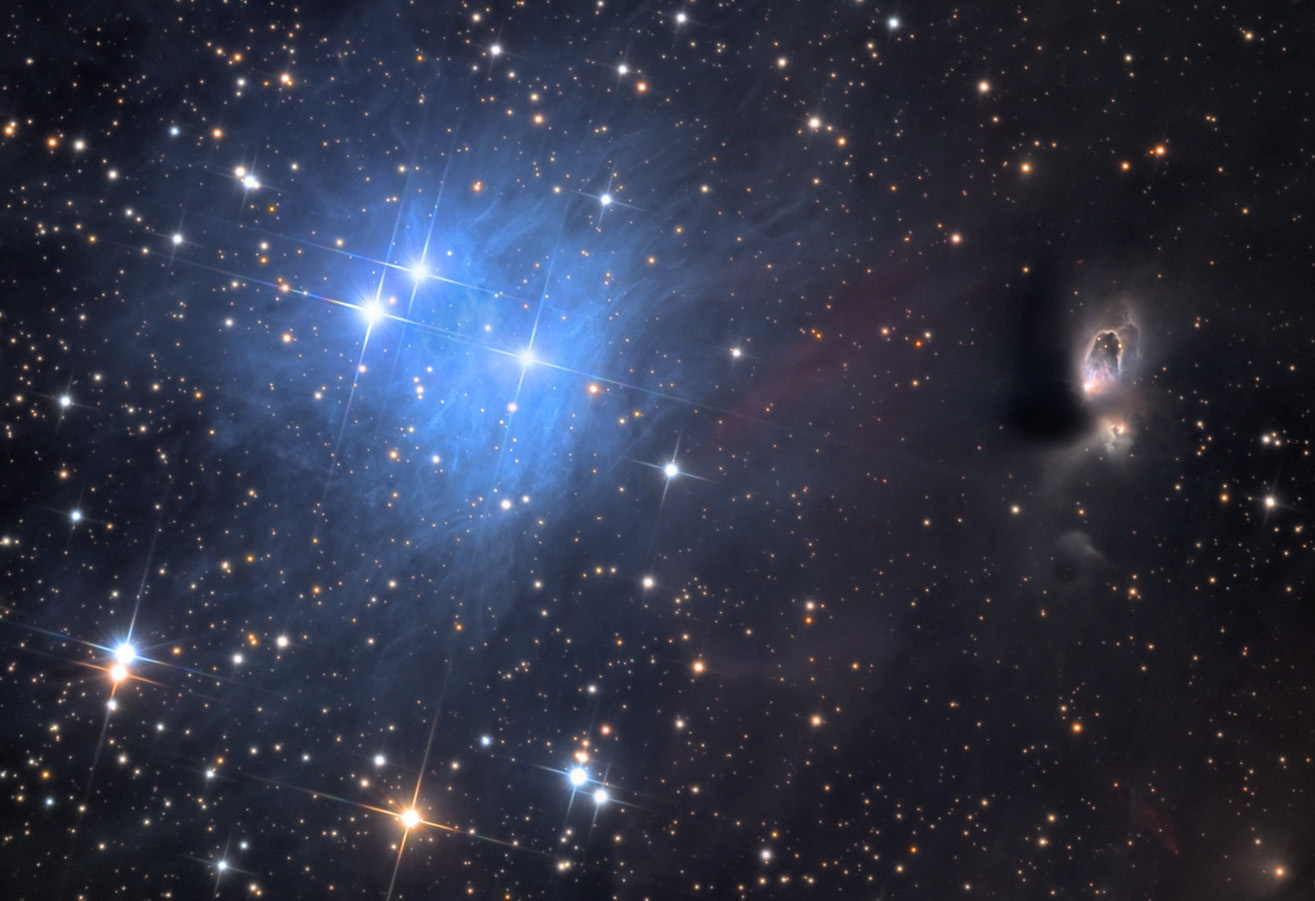
University of Arizona: Adam Block and the Cosmic Canvas
Adam Block, astrophotographer and astronomy educator with the UA's Mt. Lemmon SkyCenter, has been selected to receive the Advanced Imaging Conference Hubble Award to honor his work in "bringing the cosmos to the people."
By Daniel Stolte, University Communications
October 29, 2012

Arizona State University: Moon and art go hand in hand
October 29, 2012
University of Arizona: Adam Block and the Cosmic Canvas
Adam Block, astrophotographer and astronomy educator with the UA's Mt. Lemmon SkyCenter, has been selected to receive the Advanced Imaging Conference Hubble Award to honor his work in "bringing the cosmos to the people."
By Daniel Stolte, University Communications
October 29, 2012
Adam Block, astrophotographer and astronomy educator with the University of Arizona's Mt. Lemmon SkyCenter, has been selected to receive the Advanced Imaging Conference Hubble Award to honor his work in "bringing the cosmos to the people." Block received the award at the annual Advanced Imaging Conference held Oct. 26-28 in San Jose, Calif.
...
NASA regularly features his images on its "Astronomy Picture of the Day" website, such as this image of Reflection Nebula vdB1 (used as the illustration above--P.S.). Hundreds of Block's photos have appeared in magazines such as National Geographic, Scientific American, Astronomy, Sky & Telescope, Arizona Highways, Coelum, Astronomie and The Practical Astronomer. Space.com has featured a score of his images as its image of the day.
"Adam's pictures draw people in and facilitate their thinking about science," said Alan Strauss, director of the Mount Lemmon SkyCenter. "One of the things that distinguishes our outreach efforts from similar public programs is that Adam's photographs are used so widely. The images are beautiful, and they awaken a curiosity and an appreciation of science in general, and astronomy specifically."
Arizona State University: Moon and art go hand in hand
October 29, 2012
To patrons of fine art, space might seem like a foreign frontier but the monOrchid art gallery in downtown Phoenix will bring the two together when it hosts dozens of images taken from NASA’s Lunar Reconnaissance Orbiter Camera (LROC).For the rest of last week's space news from Overnight News Digest: Science Saturday (Sandy's aftermath edition) on Daily Kos, follow over the jump.
The Lunar Reconnaissance Orbiter (LRO) is a NASA mission that is a precursor to the return of humans to the Moon. LROC, which is one of seven instruments aboard the orbiter, is run from the Tempe campus by principal investigator Mark Robinson.
This unusual exhibit will feature LROC images of the Moon depicting impact craters, ancient lava flows and the Apollo landing site where astronauts first stepped onto the lunar surface. The exhibit will premiere Nov. 2, during the First Friday art walk in downtown Phoenix, and remain open from 5 to 10 p.m. every Friday in November. MonOrchid is located at 214 E. Roosevelt St., in downtown Phoenix.
“The Moon is a really beautiful place,” said Robinson, creator of the exhibit. “These are like Ansel Adams images of the Moon.”
Sunday, September 9, 2012
Voyager 1 launch 35th anniversary and other space and astronomy news
I'm working on a story for Examiner.com on the Michigan Republican Convention, which produced a lot more drama that the Michigan Democratic Convention. While I write that, enjoy this past week's space and astronomy news from Overnight News Digest: Science Saturday (35th Anniversary of Voyager 1 edition) on Daily Kos. As you can see, the top story for today's entry, which comes from Science News, is the same as that of the Daily Kos diary.
Voyager chasing solar system's edge
On 35th anniversary of spacecraft’s launch, scientists ponder when it will move beyond the sun’s reach
By Nadia Drake
Web edition : Wednesday, September 5th, 2012
Voyager chasing solar system's edge
On 35th anniversary of spacecraft’s launch, scientists ponder when it will move beyond the sun’s reach
By Nadia Drake
Web edition : Wednesday, September 5th, 2012
NASA’s Voyager 1 spacecraft, launched 35 years ago on September 5, 1977, is bracing for a controlled plunge into interstellar space. Soon the craft will leave the solar system behind, bursting through the windy bubble blown by sun.More stories over the jump.
The question is: How soon? That boundary may be a bit farther away than expected, a team from the Johns Hopkins University Applied Physics Laboratory reports in the Sept. 6 Nature.
Now 18 billion kilometers away, Voyager 1 is the most distant spacecraft flung from Earth. Voyager 2, launched two weeks earlier, is trailing its twin by about 3.4 billion kilometers.
Subscribe to:
Posts (Atom)