A blog about societal, cultural, and civilizational collapse, and how to stave it off or survive it. Named after the legendary character "Crazy Eddie" in Larry Niven and Jerry Pournelle's "The Mote in God's Eye." Expect news and views about culture, politics, economics, technology, and science fiction.
Americans drive much more than in any other country – twice as much as the average German, for example. And the actual experience of driving isn’t quite as romantic as the image. Drivers are often stuck in traffic. Cars pump out pollution. Less walking means less exercise. Cars also can kill people. Some skeptics say, indeed–cars are awesome. But they got a lot of help from favorable policies and strong lobbies. CNBC spoke with some researchers and looked at numbers to get the full picture of why Americans became so dependent on cars.
Car brain is insidious, and it seeps into seemingly everything. Let's explore.
I watched this yesterday, then experienced car brain as I drove to work. A man in a Mercedes tailgated me, then gave the "come on" gesture. I sped up to get away from him, then briefly tapped my brakes to tell him to back off. Dude, I'm already driving five miles over the speed limit along a stretch of road that the police patrol. Do you want me to break the law more so you can, too? He then passed me and had to wait for someone else to turn right to get to his destination. Hurry up and wait.
CityNerd Ray reminded me of a video I watched in school more than 50 years ago, Goofy - Motor Mania.
A classic Goofy episode from the 50's!
In fact, from 1950. Car brain has been around that long.
That's the general situation. Follow over the jump for my personal update.
You may have seen the word "Bluesky" popping up on your social media pages.
It is an alternative platform to Elon Musk's X and the company said it is growing rapidly with users and new sign-ups.
So, what is it and why are so many people reportedly joining?
While BBC's subject line asked about Twitter/X, Bluesky CEO Jay Graber compared herself and her running of Bluesky to Mark Zuckerberg of Meta. I plan on getting to Zuckerberg and Meta's legal fight with the Federal Trade Commission (FTC) on Flashback Friday, when I finish this series with the blog's year on Instagram and Threads. For a comparison focused on Twitter/X, I turn to Fast Company explaining Why Everyone Is Leaving X for Bluesky!
The breakdown of Bluesky's ascendant year and what they plan to do next.
Today, we will be discussing the virtualization of the public sphere, taking a deeper dive into the rise and fall of social media platforms.
I agree with the findings about why users left Twitter/X for Bluesky, although the numbers show that Bluesky's growth has slowed. That indicates that the answer to BBC News asking "Will Bluesky be able to rival X or Twitter" is no, not any time soon. That's O.K., for reasons I described in CNBC describes 'How Bluesky Grew From A Twitter Side Project To An X Competitor'.
I've grown my followers faster on Bluesky than I ever did on any other platform. It took me 13 years to get to 1,000 followers on Twitter/X. It took me one month on Bluesky. I now have nearly 3,000 followers two-and-one-half months after I joined. That's almost triple the 1,075 friends and 174 followers I have on Facebook, the next largest audience I have on social media, and that took 17 years to achieve. I'm also getting more engagement in the form of likes, reposts, and replies on Bluesky than X, although Facebook still beats both, but not enough link clicks from Bluesky to register, while X ranks in the top five. I'm not deactivating my X account for just that reason; it's still useful.
Six months after I joined Bluesky, I now have more than 6,300 followers. Bluesky's growth may be slowing down, but mine isn't and I'm getting even more engagement there than on Twitter/X, particularly since only post on the latter once a day while I'm consistently active on Bluesky. It doesn't help that Twitter/X's analytics are now a service for paid subscribers, and I won't pay to support Elon Musk, so they end up being little better than what I can collect from Bluesky for free.
Follow over the jump for the blog's top shares on Bluesky and Twitter/X between March 21, 2024 and March 20, 2025, the 2024-2025 blogging year.
It didn't take long for weight loss drugs like Ozempic to drive Weight Watchers into bankruptcy. Since they operate brick-and-mortar locations, they're now another candidate for my Retail Apocalypse coverage. Add that to my to-do list.
WeightWatchers, a major cultural force that went beyond the fitness space that’s been around for more than 60 years, files for Chapter 11 bankruptcy in a bid to shed more than $1 billion in debt and reposition itself in the industry. “We are going through this transaction to strengthen our financial foundation for WeightWatchers moving forward so that we can innovate and compete and continue to invest in our business,” president and CEO Tara Comonte says. NBC’s Christine Romans reports for TODAY.
WeightWatchers decided that if they couldn't beat Ozempic and other weight loss drugs, they'd join them. Too bad things moved so quickly that they were late to that party.
Weight Watchers, a weight loss program with a history of over 60 years, has entered the Chapter 11 bankruptcy process. WW says services for members will continue.
"All good things come to an end." I don't think WeightWatchers filing for bankruptcy will be the end of the company, at least for now. There will still be a need for its services, as the panelists on The View pointed out in WeightWatchers Files For Bankruptcy.
#TheView co-hosts react to injectable weight loss drugs becoming so popular that WeightWatchers filled for bankruptcy.
The panelists did a good job of humanizing the issue and explaining how weight loss drugs are not the answer for everyone because of affordability and individual reactions to the medications. Behavioral modification, including diet, will still be on the menu, pun intended. At least Donald "Hoover Cleveland" Trump is trying to do something about drug affordability, which I'm adding to ending minting pennies and daylight saving time among his few good ideas. Even a stuck clock is right twice a day, and Hoover Cleveland is definitely a stuck clock.
Last year, I wrote "a name I've been tracking for years, Mateo, the name of Jane's son in 'Jane the Virgin,' continued its rise to eleventh from fifteenth in 2021, twentieth in 2020, 26th in 2019, and 37th in 2018. I wouldn't be surprised if Mateo reached the top ten this year or next." Mateo made the top ten in a big way in 2023, soaring to sixth. I'm not surprised Mateo made it, just that the name got this high this soon. Theodore also made a move from tenth last year to seventh this year. On the other hand, Henry and Lucas both dropped one place, William fell from sixth to tenth, and Benjamin dropped out of the top ten entirely to eleventh!
All ten of last year's girls names remained in the top ten with only Mia leapfrogging over Isabella and Ava to shuffle the order. Even Harper, which fell out in 2022, stayed in eleventh. On the topic of girl's names, Xiomara, another name from Jane the Virgin I've been tracking, continued gaining in popularity, rising to 402 in 2023 from 493 (corrected from 494) in 2022, 551 in 2021, 606 in 2020, and 652 in 2019. Jane itself managed to reverse its long-term slide in popularity, rising nine places to 281 from 290 in 2022 and 265 in 2021 after peaking at 261 in 2020. Whew! Finally!
While some names didn't break into the top 10, they proved to have grown in popularity. The name Emryn for girls jumped 1,287 places, coming it at No. 888 on the list. Fastest-rising boys name Izael burst into the top 1,000 in 2023, landing at No. 806.
Chozen also spiked, becoming the second-fastest rising boys name, coming it at No. 813. In the Netflix show "Cobra Kai," the character Chozen becomes the hero at the end of the fifth and latest season, which aired in September 2022 and could've had an impact on the baby name trend.
The fastest-rising name for girls may have also been influenced by media – social media, that is. Kaeli, the name of YouTuber and TikTok star Kaeili McEwen, rose 1,692 spots. The content creator, who goes by Kaeli Mae, has 14.8 million followers on TikTok and is known for lifestyle videos focused on cleaning and organizing.
Another popular boy name has a connection to social media. Content creator Wyatt Eiden, who has 3.1 million followers on TikTok, is known for quizzing strangers on the street and giving out prizes. His last name, Eiden, is the third-fastest riser on the boy name list.
That's an analysis I couldn't have written myself!
I'm briefly calling attention to the fourth-fastest rising name on the boys list, Cassian. It's the given name of the protagonist of RogueOne and Andor and is thus a Star Wars name. I plan on covering those names for Father'sDayweekend. In the meantime, stay tuned for a Mother's Day edition of Saturday Night Live.
The national gas average dipped below $4 for the first time since March on Thursday, signaling record inflation could be cooling off. NBC’s Tom Costello reports for TODAY.
That was good news for the consumer on gas prices, but bad news about other goods, indicating continuing high inflation. That's a topic I'm very likely to return to.*
OPIS chief oil analyst Denton Cinquegrana discusses the move in retail gas prices below $4 a gallon for the first time in months, and what risks lie ahead for the energy market.
I'll be sure to keep an eye on the weather for this reason and others.
Follow over the jump for my personal driving update.
At 1.75 percent, the three-month yield is still well below the 10-year yield of 3.48 percent, so no inversion there.
But on Tuesday, the two-year Treasury yield briefly crossed above the 10-year yield, before pulling back underneath at 3.42 percent. The two yields inverted previously in early April. Other, less-followed parts of the yield curve are also already inverted. Though they’re less consistent in predicting recessions as the three-month yield versus the 10-year, they show the trend is swinging toward pessimism.
Following an inversion in 2019, the global economy plunged into recession in less than a year. At that time, though, the bond market did not see the pandemic coming. It was focused on global trade tensions and slowing growth.
I followed the yield curve closely in 2018 and 2019, but haven't mentioned it since. It's time I did, as I would be derelict in my duty as a doomer blogger if I didn't discern a coming recession. For that reason, I'm sharing CNBC explaining Why Recessions May Be Inevitable.
America has experienced at least 30 recessions throughout history, dating back as early as 1857. Some experts believe that they have become an inevitable part of the economic cycle that fluctuates between periods of expansion and contraction. Nonetheless, certain measures can still be taken to make recessions less likely. As the nation’s authority on monetary policies, the Federal Reserve plays a critical role in managing recessions. So why do recessions happen and what can the Fed do about it? Watch the video to find out.
It's the question everyone is asking: Are we about to enter a recession?
A tepid stock market, soaring inflation, and rising interest rates have left Americans less than optimistic about the state of the economy. Consumer sentiment has plunged to a record low, according to a University of Michigan survey released last week, fueled by frustration over high prices.
Earlier in June, the consumer price index jumped to its highest level in 40 years. The government's primary inflation gauge saw prices surging 8.6% for the past 12 months. And now the Fed is raising interest rates at an aggressive pace as it looks to slow down economic activity.
To be clear: we are not in a recession, at least not yet. But signs of an economic downturn are cropping up all over, in sectors from commodities to housing.
One of the signs CNBC mentioned was falling consumer sentiment, which was also a cause. CNN reported that's happening.
A closely followed University of Michigan survey released Friday found that US consumer sentiment hit a new record low in June -— the lowest recorded level since the university started collecting the data 70 years ago.
The June index saw a 14.4% drop since May as consumers became increasingly alarmed about inflation. About 79% of those consumers said they expected bad times for business conditions in the upcoming year, the highest level for that metric since 2009.
Yikes! Maybe I was too sanguine about the likelihood of high gas prices causing a recession when I wrote "Most of the money being spent on petroleum now stays in the U.S., which won't reduce GDP directly, although it will cause other economic hardships and move enough money around in ways that could cause a recession indirectly." That may be happening now.
On a less serious note, tomorrow is Paul Bunyan Day. Stay tuned to see if I blog about the figure from folklore or something more realistic.
Weekend Update compares this week's headlines to 'Mad Max' on last night's 'SNL'
"opened with a litany of unpleasant realities" that were "also a list of future blogging topics." One of those was the baby formula shortage. As Colin Jost (and his writers) noted, it's ironic, if not downright perverse, that Alito's leakedSupreme Court opinion mentioned "the domestic supply of infants" at the same time we're having trouble feeding the ones we already have. That's dystopian.
A baby formula shortage has become a major problem for parents around the U.S., one without quick solutions. About 40 percent of formula is out of stock nationwide due to supply chain disruptions, inflation and a recall by one of the biggest producers. Meanwhile, the White House announced steps to address the shortage. Brian Dittmeier, of the National WIC Association, joins Ali Rogin to discuss.
I agree with Jessica Cohen Taubman that moms should be in charge of the world, at least for a few days, just to solve problems like this. I'm sharing one such solution at the end of the post.
While PBS did a good job of showing the effects of the shortages in its interviews of mothers and explaining what the U.S. government could do to solve it, it didn't focus enough on the causes of the problem. For that, I turn to CNBC Television explaining How the baby formula shortage happened.
CNBC's Valerie Castro joins The News with Shepard Smith to report on the baby formula shortage and what the administration hopes to do about it.
Four companies control 90% of the market. I've seen that before, as four companies control the beef industry. I wrote then that this could be bad for consumers. The baby formula shortage shows one way this happens.
President Joe Biden spoke with retailers and manufacturers to make supplies available as quickly as possible, White House press secretary Jen Psaki said Thursday.
Looks like the Biden Administration is taking this issue seriously. Also, this was one of Jen Psaki's final press conferences. I wish her success in her future endeavors.
The White House promised it’s working hard to solve the national baby formula shortage. But for families with newborn babies and infants, a solution can’t come soon enough. As they get down to their last formula supply, people are getting more and more desperate in their search. A mom named Gina from Sound Beach, New York, drove for hours with her 10-month-old son, looking for formula. She found a lot of bare shelves.
As I've written before, Inside Edition is a syndicated infotainment newsmagazine that is not the hardest news source, so I'm not surprised it presents stories in a very personalized and somewhat sensationalized way. Still, it's a major source of information for many people — this video currently has 412,976 views, nearly twenty times more than the next most viewed video I embedded from CNBC Television with 24,779 — so I shouldn't ignore it. Besides, it shows a Natureknowsbest solution, donating breast milk, that mothers are contributing to help with the shortage. I find that admirable; I just don't know how scalable it is.
I told my readers to "Stay tuned to see how many of [the unpleasant realities] I tackle this week" yesterday. One down.
Sometimes, especially in a galaxy far, far away, you've just got to loosen up. And what better way to do so than drinking yourself into oblivion! I'm noel from TheCancrizans, and here are the top 10 alcoholic beverages in Star Wars.
[T]he Oscars and Emmys are the two oldest entertainment award ceremonies. Making their broadcasting debut to millions of televisions in the 1950s, the Oscars and Emmys have had a stronghold on the entertainment award-show zeitgeist. However, in 2021, viewership for award shows has been steadily declining. On top of dwindling in ratings, the prestigious Hollywood events have also been hit with controversies and protests that jeopardize these award shows as we’ve come to know them.
I might have more to say about the decline in awards show viewership later. In the meantime, stay tuned for an entry on Russian invasion of Ukraine for the final post of the month.
The Michigan State Police is joining law enforcement agencies across the state in cracking down on speeding after reporting an alarming rise in speeding and fatalities since the start of the pandemic.
The U.S. Department of Transportation’s National Highway Traffic Safety Administration today released preliminary estimates of crash fatalities in 2020 involving motor vehicle occupants, motorcyclists, and people walking and biking...
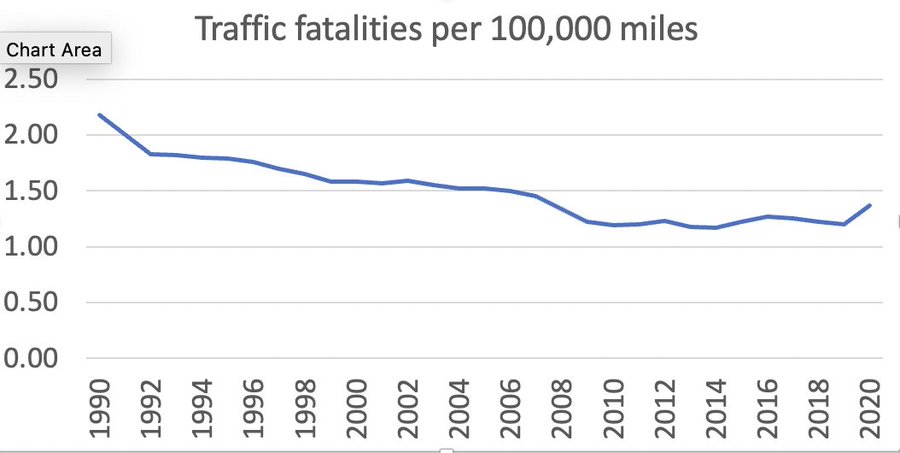
While Americans drove less in 2020 due to the pandemic, NHTSA’s early estimates show that an estimated 38,680 people died in motor vehicle traffic crashes—the largest projected number of fatalities since 2007. This represents an increase of about 7.2 percent as compared to the 36,096 fatalities reported in 2019. Preliminary data from the Federal Highway Administration (FHWA) shows vehicle miles traveled (VMT) in 2020 decreased by about 430.2 billion miles, or about a 13.2-percent decrease. The fatality rate for 2020 was 1.37 fatalities per 100 million VMT, up from 1.11 fatalities per 100 million VMT in 2019. NHTSA’s analysis shows that the main behaviors that drove this increase include: impaired driving, speeding and failure to wear a seat belt.
“Safety is the top priority for the U.S. Department of Transportation. Loss of life is unacceptable on our nation’s roadways and everyone has a role to play in ensuring that they are safe. We intend to use all available tools to reverse these trends and reduce traffic fatalities and injuries,” said Dr. Steven Cliff, NHTSA’s Acting Administrator. “The President’s American Jobs Plan would provide an additional $19 billion in vital funding to improve road safety for all users, including people walking and biking. It will increase funding for existing safety programs and allow for the creation of new ones, with a goal of saving lives.”
NHTSA’s projections show significant increases in fatalities during the third and fourth quarters of 2020 as compared to the corresponding quarters of 2019. NHTSA will continue to carefully analyze various data sources to understand how the risks to vulnerable road users might have changed during 2020 and the contributing factors for the increase.
Krugman also created a chart of traffic fatalities per miles driven from 1990 to 2020.
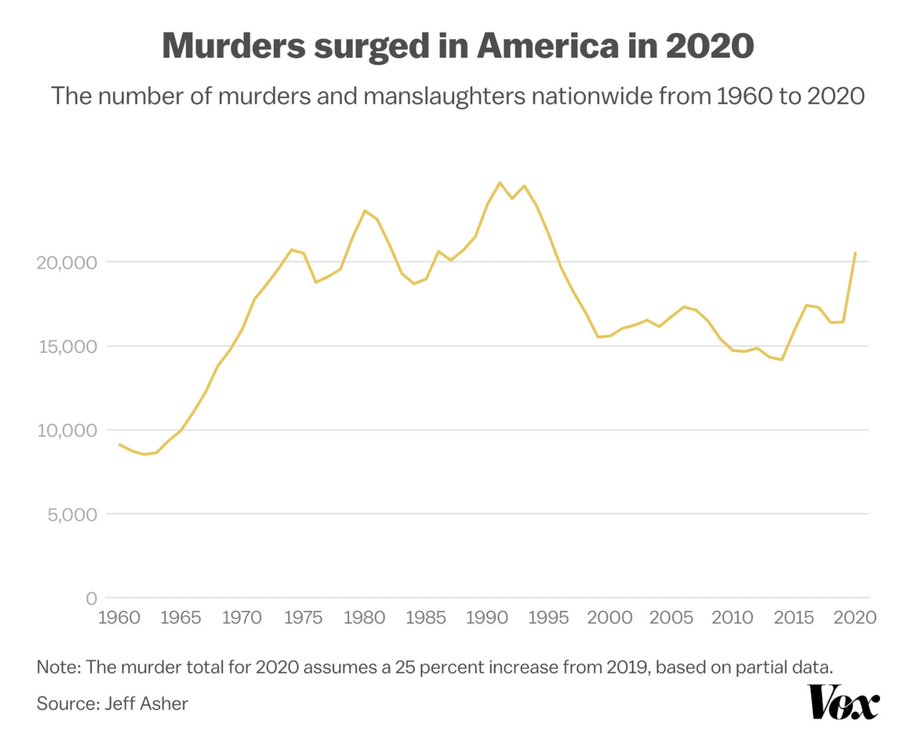
He then compared it to Vox's graph of homicides from 1960 to 2020.
Krugman commented on the parallel between traffic deaths and homicides in the rest of the Twitter thread.
Lots of people blaming Black Lives Matter for the murder surge; good reasons not to buy this, including the fact that red-state cities saw the same surge as blue-state cities. But here's another reason: did BLM cause bad driving? 6/
My point is that the pandemic and its disruptions seem to have done a number on social psychology in many dimensions. The worrisome thing is that troubled behavior seems to be persisting even as the country reopens. 7/
In the past week of returning to in-person teaching and resuming my pre-pandemic driving patterns, I've observed several people driving just as Krugman described, weaving in and out of traffic at high speeds. While a few Michigan drivers were doing that all along before the pandemic, I think I've seen more this week than the pre-pandemic average. Based on the data and my personal observations, I agree with Krugman that "the pandemic and its disruptions seem to have done a number on social psychology in many dimensions. The worrisome thing is that troubled behavior seems to be persisting even as the country reopens." Here's to hoping that subsides when the pandemic is over, which itisn't.
Enough of the big picture. Follow over the jump for the numbers about my personal driving.
Both of our cars passed another 1,000 miles within the past seven days, so it's time for a driving update. I'll post details over the jump, but first, I'm sharing CNBC explaining Why Covid-19 Caused A Bike Boom, which includes a graph showing how driving has decreased during the pandemic.
Bikes have been a hot ticket item during the Covid pandemic as more people look for recreational activities and outdoor transportation. With more bikes and other forms of micromobility on the road, transportation experts say the moment is prime for a transit upheaval in the United States. Here’s how the Covid bike boom could change the way Americans get to work and around major cities.
I'm glad to see something positive happening from decreased driving during the pandemic that might last, which might contribute to less air pollution and a decreased environmental footprint, two things I thought might not last after the pandemic ends.
CNBC also asked its viewers "Did you invest in a bike during the coronavirus pandemic?" No, I didn't. I gave up that resolution six years ago. Instead, I bought Pearl. However, if any of my readers did, I'll repeat CNBC's invitation, "Let us know in the comments if you plan to stick with it after the pandemic." I hope some of you do.
Have you received checks in the mail from your auto insurance company? Many are getting refunds, because they didn't drive during the stay at home order.
While some of this report pertains only to Michigan, which recently changed its laws governing auto insurance, some of this should, if it isn't already, apply to the rest of the U.S., as most of us are driving much less.* Bill McBride of Calculated Risk has an update on that story in DOT: Vehicle Miles Driven decreased 26% year-over-year in May
Travel on all roads and streets changed by -25.5% (-72.9 billion vehicle miles) for May 2020 as compared with May 2019. Travel for the month is estimated to be 213.2 billion vehicle miles.
The seasonally adjusted vehicle miles traveled for May 2020 is 199.8 billion miles, a -26.1% (-70.6 billion vehicle miles) decline from May 2019. It also represents [a] 24.1% increase (38.8 billion vehicle miles) compared with April 2020.
Cumulative Travel for 2020 changed by -17.3% (-227.2 billion vehicle miles). The cumulative estimate for the year is 1,087.0 billion vehicle miles of travel.
emphasis added
This graph shows the rolling 12 month total vehicle miles driven to remove the seasonal factors.
The drop is even more dramatic in this graph than it was last month. On the other hand, the year-over-year comparison between May 2019 and May 2020 shows that driving is recovering, if still way down from last year.
Both of these graphs show the situation two months ago. For a more up-to-date depiction of how much Americans are driving now, I'm sharing the latest graph of gasoline consumption from the Energy Information Administration in Calculated Risk's High Frequency Indicators for the Economy.
This is what I expect the graph comparing the year-over-year change in monthly driving will look like in two months. Even so, the rolling 12 month total vehicle miles driven will continue to go down for at least the next year, although I expect it will start to bottom out in the second half of 2021. I don't know what it will mean for auto insurance rates yet.
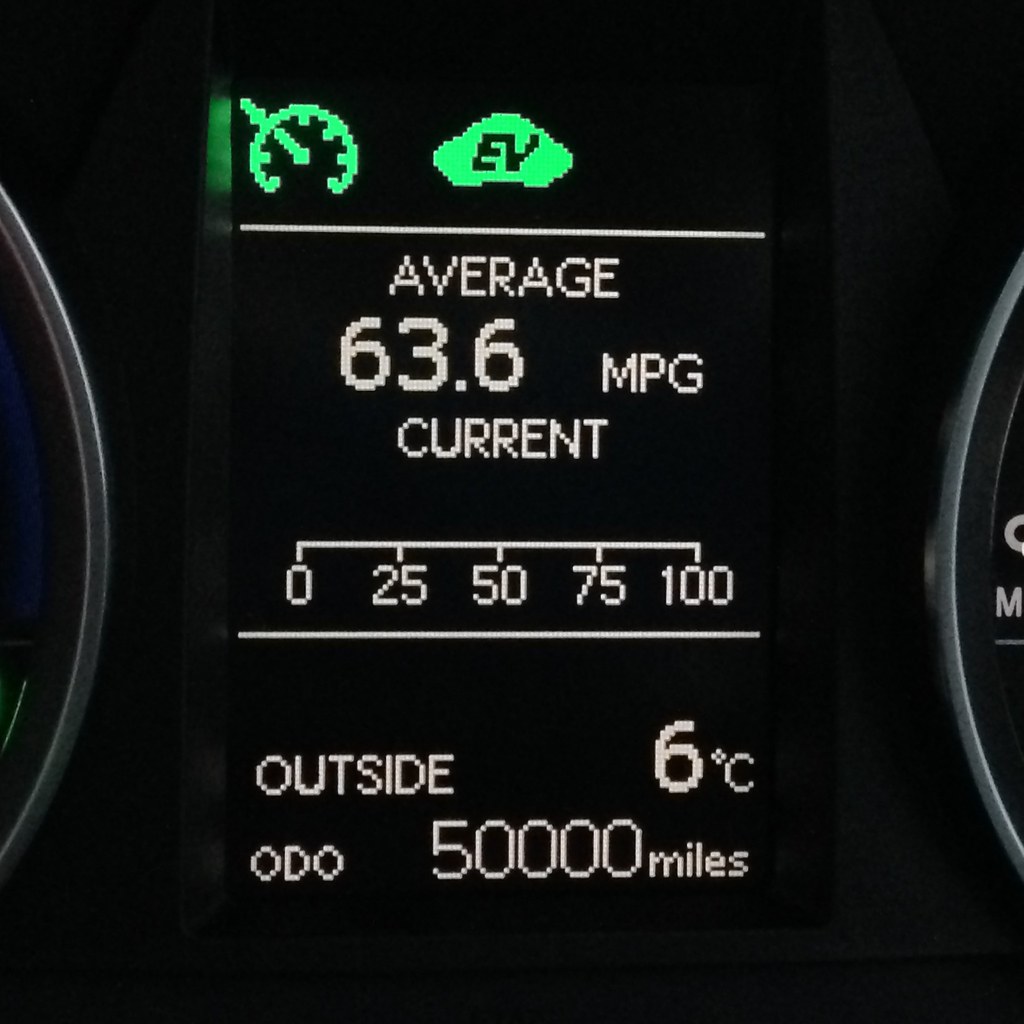
It's not just June, but late June, and Pearl didn't pass 51,000 miles until yesterday, Friday, June 26, 151 days — almost five full months — since Pearl the Prius's odometer rolled over 50,000 miles on January 27, 2020. That translates to 6.62 miles per day, 201.99 miles per standard month, and 2423.84 miles per leap year or 2417.22 miles per standard year. I have never driven my primary vehicle so little. The next lowest I can find was for February 2012, 7.25 miles per day, 236.4 miles per standard month, and 2828.75 per standard year, and that was because I was not driving my old car Yuki for more than three weeks, had a long holiday break during which I didn't drive much and a mild winter that allowed me to walk more in a walkable neighborhood. Of course, that's all due to the pandemic and resulting recession keeping people at home.
Travel on all roads and streets changed by -39.8% (-112.0 billion vehicle miles) for April 2020 as compared with April 2019. Travel for the month is estimated to be 169.6 billion vehicle miles.
The seasonally adjusted vehicle miles traveled for April 2020 is 160.9 billion miles, a -41.2% (-112.9 billion vehicle miles) decline from April 2019. It also represents -27.2% decline (-60 billion vehicle miles) compared with March 2020.
Cumulative Travel for 2020 changed by -14.8% (
-152.3 billion vehicle miles). The cumulative estimate for the year is 875.9 billion vehicle miles of travel.
Bill McBride made two graphs with the data. Here's the second graph, which shows the year-over-year change in vehicle miles driven.
That's quite the drop in driving! In contrast, the usual graph I use, which depicts the rolling 12 month total vehicle miles driven, does not make the drop look as dramatic.
Bill McBride of Calculated Risk wrote "This will be an interesting measure to watch when the economy eventually starts to recover." For a foretaste of what that might look like, here's the year-over-year change in gasoline consumption from the most recent Six High Frequency Indicators for a Recovery.
The year-over-year miles driven should look a lot like this, but the rolling 12 month total vehicle miles driven will continue to go down for at least the next year.
With millions of people following stay-at-home orders, those with a need for speed can’t seem to resist the allure of empty highways. Rush hour is non-existent, and lots of “crazy COVID drivers” are putting the pedal to the metal and ignoring the speed limit during the pandemic. Inside Edition sent a team of investigative reporters to New York City and Long Island where they clocked people going as much as 50 miles an hour over the speed limit, along with plenty of reckless driving.
With many people staying home during the coronavirus pandemic, once-crowded highways are now relatively empty, prompting more drivers to speed. According to the California Highway Patrol, officers have seen an 87% increase in citations for speeding in excess of 100 miles per hour. NBC’s Erin McLaughlin reports for Weekend TODAY.
While the roads have been open, if not empty, here in Metro Detroit, I haven't been tempted to drive that fast, nor have I seen people driving 90+ MPH. Then again, I stayed pretty much at home during the latter half of March and all of April, so I avoided the freeways when they at their emptiest. Even so, there is little in the way of traffic congestion now. Rush hour? What's that?
I told my readers to "stay tuned for a driving update" at the end of Meyers and Noah take closer looks at Bolton book and Parnas tape, the plot twists of Episode 4, Season 4 of 'The Worst Wing'. That's because Pearl passed 50,000 miles on Monday, January 27, 2020. That means it's been exactly 13 weeks or a full quarter of a year (91 days) since Pearl passed 49,000 miles on Monday, October 28. That translates to averages of 10.99 miles per day, 335.16 miles per standard month, and 4010.99 miles per year. That's a lot less than the averages of 18.52 miles per day, 564.81 miles per standard month, and 6759.26 miles per year I drove Pearl between September 16 and October 28, 2019. In fact, it's the least I've driven my car since January 2015, right after my wife and I moved into our house. Five years ago, I drove my previous vehicle Ruby an average of 9.90 miles/day, 301.95 miles/month, and 3613.5 miles per year between September 2014 and January 2015.
I never thought I'd drive so few miles again in my new, car-dependent neighborhood, but here I am. I'm crediting it to having my car out of commission for two weeks because of a dead battery, which might show up when I next report on Snow Bear this summer, and then having a four week break between semesters were two reasons that won't likely repeat while I'm driving Pearl. Otherwise, I might have driven her closer to 13.33 miles per day, 406.67 miles per standard month, and 4866.7 miles per year, like I did during the comparable period last year. That's still low.
As for my real annual average mileage, I have to go back to December 21, 2018, when Pearl passed 44,000 miles, for the best comparison. That was 403 days before her odometer rolled over 50,000 miles, which converts to averages of 14.89 miles per day, 454.09 miles per standard month, and 5434.24 miles per year. That's less than the averages of 16.22 miles per day, 494.59 miles per month, and 5918.92 miles per year I had driven her between October 2018 and October 2019. I did surprisingly well at keeping my driving down, well below my original goal of 6,500 miles per year I set two years ago. I'm sure I'll drive more between now and early April, when I expect to post my next driving update, although I will probably still be driving less than 6,000 miles per year. I would be pleased if that ends up being the case.
Enough of this driving update that is only a driving update, something I haven't done in years. I'm sure I'll return to "The Worst Wing" tomorrow, unless an even shinier object catches my eye first. Yeah, right.
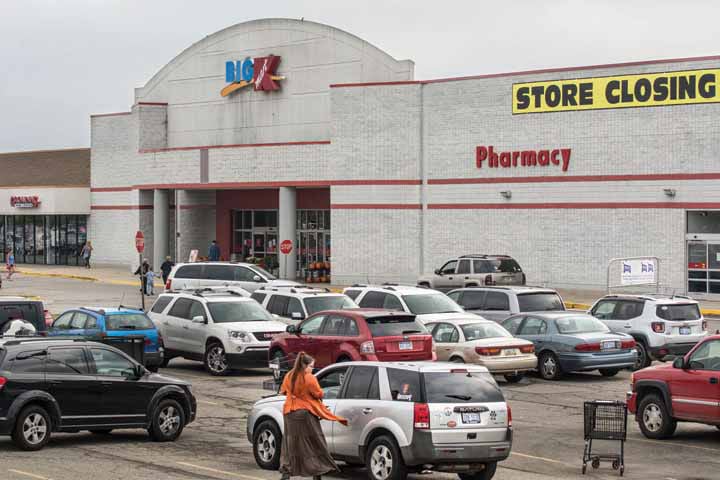
Two of the three remaining Kmart stores in the state, located in Warren and Waterford, will close their doors, the company announced Thursday.
The two metro Detroit closures are part of larger list of 96 Kmart and Sears stores that will shut down nationwide. The cuts are an attempt for the company, also known as Transformco, to keep the two retailers afloat since acquiring assets of Sears Holdings in February...
Kmart previously announced in September plans to shutter nearly 100 stores in December or earlier, including eight in Michigan: Belleville, Clio, Grayling, Hastings, Menominee, Midland, Oscoda and Marine City. ... In addition, a Sears in Lansing is set to close at that time.
The closures leave one remaining Kmart store in Michigan, in Marshall located at 15861 Michigan Ave.
Destination Maternity filed for Chapter 11 bankruptcy protection Monday [October 21] as the apparel company hopes to avoid the graveyard of fashion retailers.
The retailer operates stores under several brands, including Destination Maternity, Motherhood Maternity and A Pea in the Pod.
The company had 446 stores in the U.S., Canada and Puerto Rico as of Aug. 3. It also operated 491 shops-within-a-shop at various department stores and baby specialty retailers.
The company plans to close 183 stores after already shuttering 27 recently, according to a court filing. Bankruptcy allows companies to escape unprofitable leases.
...the company, in a court document, blamed the retail industry's turmoil, declining birth rates, high rents and leadership turnover for faltering. The company has had five CEOs in the last five years.
The declining national birthrate isn't just a sociological concern — it also holds perilous economic implications for several industries, including, most recently, maternity apparel.
US birthrates hit a record 32-year low in 2018 after dropping 2% from 2017, according to the Centers for Disease Control and Prevention. Over the past two years, the dip has negatively impacted a variety of companies, from Toys R Us and Babies R Us to consumer-packaged-goods companies like Kimberly-Clark and Procter & Gamble that sell diapers and other products for babies.
Now it's coming for Destination Maternity, the largest global maternity company. ... On Thursday, analysts at Demographic Intelligence — a forecasting firm specializing in national marriage and birthrates — said decreasing birthrates have played a direct role in the Destination Maternity bankruptcy.
"While competition from online retailers and other widely discussed factors may have had some role to play, Destination Maternity's declining net sales in recent years have tracked fairly closely with the sharp decline in births in the United States," Lyman Stone, an advisor at Demographic Intelligence advisor, said in a statement.
Once again, I'm being a good environmentalist and recycling.
On the one hand, the U.S. is doing its part to slow down population growth. On the other hand, [this means] a possible shrinking economy in the future, which is bad for business as usual. It's time to be a good environmentalist and recycle what I wrote last year.
I have been in favor of zero population growth for as long as I can remember. However, I'm not sure the U.S. economy is set up for a stable or slowly declining population, a point I made in the Hipcrime Vocab: Why Slowing Population Growth is a Problem. We are going to have to figure how to do so. Otherwise, I might live long enough to experience the wisdom of the saying "Be careful what you wish for; you might get it."
Here's to hoping the U.S. learns how to thread that needle.
Sears, the once-dominant retail chain that changed how Americans shopped and lived, has filed for bankruptcy.
The Taylor store that served as the backdrop for the location shoot was not on the closure list. Instead, the Sears in Ann Arbor and Lincoln Park and the KMarts in Lake Orion and North Charlevoix were. I used to shop at the Sears in Briarwood Mall in Ann Arbor, so that hits close to home. Also, last I checked, Briarwood Mall is not a dead mall, so seeing it on the closure list surprises me. Maybe it just lost customers to the other anchors, JCPenney, Macy's, and Von Maur. However, my prediction that the Twelve Oaks Mall location in Novi would be open until the entire chain goes under continues to look good. Good thing I didn't write that about the Sears in Briarwood!
In addition to Sears filing for bankruptcy, Eddie Lampert, who I call Fast Eddie Lamprey, has stepped down as CEO. CNBC discusses that and more in Cramer: Capitalism getting rid of Sears is good.
The 'Squawk on the Street' team discusses Sears filing for bankruptcy and Eddie Lampert, Sears Holdings CEO, stepping down.
I can imagine trying to run a retail chain that isn't for rich people from a yacht in Florida would be difficult, not that I feel sorry for Fast Eddie Lamprey. He needed to go. Also, I think Cramer may not be wrong that the creditors could force the hand of Sears Holdings and cause the firm to go into Chapter 7 bankruptcy, resulting in liquidation of assets and closure of all stores by early next year. I hope that's not the case, but I think the entire company will be out of business by late next year or early 2020 at the latest.
Liz Dunn, Pro4ma founder and CEO, and Charlie O’Shea, Moody’s retail analyst, discuss the future for Sears following its bankruptcy filing as well as who else in the sector stands to benefit.
My opinion of what the bankruptcy will do for malls is still the same as it was last Friday. "It will sink a lot of malls, although some landlords will be able to lure more lucrative tenants (subscription required); the rich will get richer while the poor get poorer." As for which competitors will benefit, I agree with the panel — Macy's, JCPenney, WalMart and Target for general purchases, Best Buy for electronics, and Amazon for people who want to shop online.
A video tour and mini documentary about the dying retail store Sears. Footage was filmed in Mesa, AZ on 11/30/2016.
While this does not take the same long-range perspective as Sears: The Rise And Fall Of The Massive U.S. Retailer from CNBC, it still gives a sense of history though personal detail as well as serving as an example of the decline of Sears.
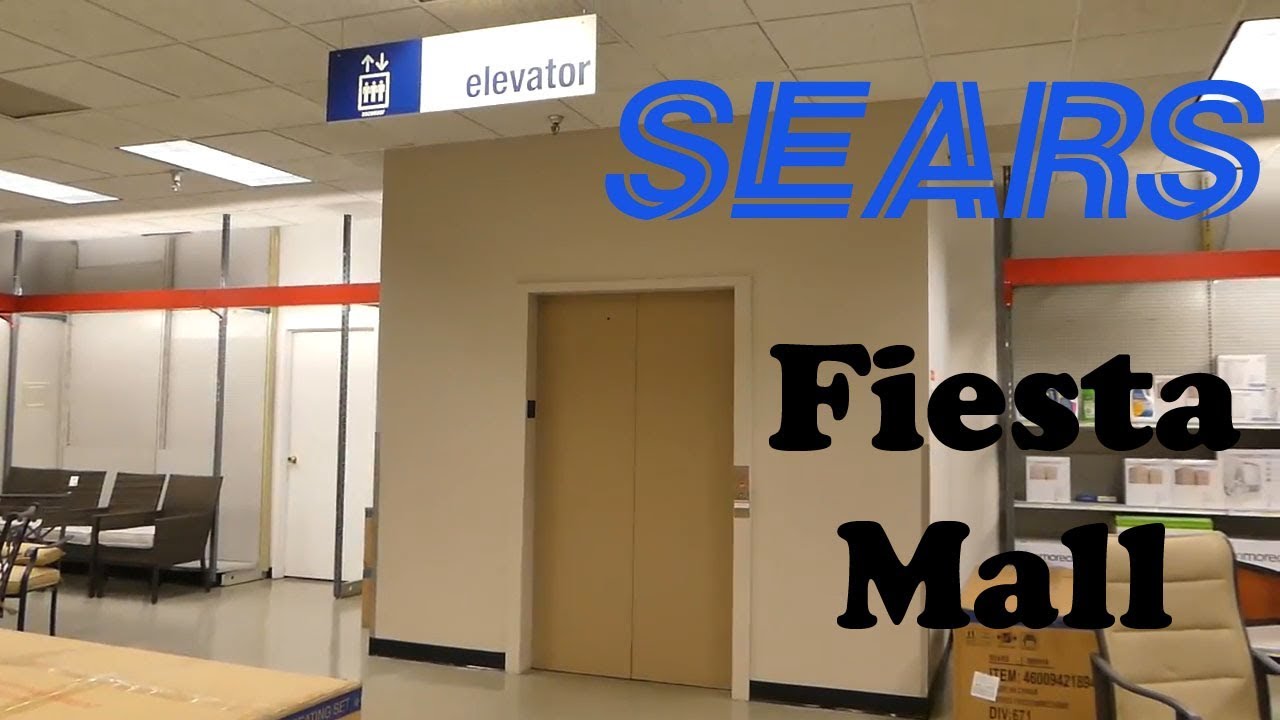
In this episode of Retail Archaeology we take a look at the Sears located at Fiesta Mall. It was announced on 11/2/2017 that this store will be closing in January of 2018. Filming for this video was done on a Saturday afternoon between 12pm & 1pm at Fiesta Mall. What the hell does "open for the community" mean?
In this episode of Retail Archaeology we take a look at a Sears in the final stages of its liquidation sale. This is the Sears at the dead mall Fiesta Mall and is the same location I covered 6 months ago that put up the weird "Open For The Community" banner.
That's every bit as sad as the closing stores in Toys R Us closing down and Kmart may follow. As Sears closes more stores, expect to see more scenes like this. When that happens, I'll post a third part to this mini-series.
Retail Archeology has videos on other stores suffering during the retail apocalypse, including Macy's, Penny's, Radio Shack, Claire's, and, of course, Toys R Us and Kmart. I plan on posting entries with those videos as well. Stay tuned.
*I may post videos of that mall's decline and closing, too.