Showing posts with label University of Arizona. Show all posts

Tuesday, March 17, 2020

Marching music and a drink for the St. Patrick's Day primaries

Stay tuned for another edition of marching music for a primary election, this time an update of A Drum Corps Ides of March for an election year on St. Patrick's Day.  The holidays March on!
That was my program note at the end of The Washington Post and Full Frontal explain FOIA for Freedom of Information Day.  As for what's on the agenda, I wrote that in a response to a comment two weeks ago.
AZGeoScience: As an Arizonan, I recommend for our primary in a couple of weeks, the 2012 University of Arizona Radiohead 2.0 show. Great show. BTW, loving these posts. My son and I are huge DCI fans.

Me: Glad you're enjoying this series. Also, that's a great suggestion, probably the best show the Wildcats have done. I'll add it to roster of The Academy, [The] Cavaliers, Phantom Regiment, Bluecoats, Columbus Saints, Cincinnati Tradition, and Heat Wave that I already have planned for that date.
At the last minute, Ohio postponed its primary because of the coronavirus pandemic, so I'm postponing posting its corps until the vote is held, possibly on June 2.  To compensate, I'm adding the Florida A&M University (FAMU) Marching Band to the list.  I hope that's enough marching music for my readers to watch and listen to while they are waiting for the results from the three states voting today.

To make up for not adding an Illinois marching band along with ones from Arizona and Florida, I begin with an Illinois corps, The Cavaliers playing their 2016 show, Propaganda.

Rosemont, IL - 5th Place 94.025
...
"Music For The Funeral Of Queen Mary" Written by Henry Purcell; As Arranged By Michael Martin Published by MICHAEL MARTIN MUSIC; "Symphony For Band" Written by Morton Gould Published by G. SCHIRMER, INC.; "Elegy For Dunkirk" Written by Marianelli Dario Published by UNIVERSAL MUSIC CORP OBO UNIVERSAL PICTURES MUSIC; "Lollapalooza" Written by John Adams Published by HENDON MUSIC, INC.
Given the political theme, I thought this was the best choice of show.

Next, the corps I featured four years ago, Phantom Regiment performing their 2018 program, This New World.

Rockford, IL | 11th | 86.950
...
“Finale (from ‘Mr. Magorium’s Wonder Emporium’)”
Written by Aaron Zigman, Alexandre Desplat
...
“Piano Concerto No. 3 in C Major, Op. 26”
Written by Sergei Prokofiev
...
“A Child’s Garden of Dreams”
Written by David Maslanka
...
“Picture Studies”
Written by Adam Schoenberg
...
“Symphony No. 9”
Written by Antonin Dvorak, Arr. by William Pitts
I'm saving the 2019 show for a Bastille Day post, as it has a French theme — sort of.  I'm an environmentalist, I conserve my resources.

Follow over the jump for videos of drum corps and marching bands from Arizona and Florida plus a bonus drink for the holiday.

Wednesday, January 23, 2019

National Institute for Civil Discourse joins CBS News to promote civility as part of a solution to the shutdown


I was planning on writing about the Oscar nominees today, but I found something that made me change my plans.*  Instead, I found a video that connects to Universities studying and promoting civility in politics, which I posted in 2012.  In that entry, I wrote "It is no secret that I'm a member of the Coffee Party, as I blog about it here. One of the founding principles of the Coffee Party is civility, including having members sign a Civility Pledge."  I also included a press release from the University of Arizona about the National Institute for Civil Discourse (NICD).  So I was intrigued to see a representative of the NICD on CBS News this morning.

Join me in watching How to promote civility during polarized times.

Both sides of the aisle are blaming the other for the longest government shutdown in history. Keith Allred, the executive director of the National Institute for Civil Discourse, joins CBSN to discuss how his organization specifically prepares for times like these.
As a director of the organization, I'm glad to see that someone is talking about one of the Coffee Party's pet issues as part of a solution for the longest government shutdown on record.  May he have success with his initiative.  As snarky as I can be here (or at least, as much as I outsource my snark to late-night comedians), I really think we need people talking with each other, not at each other to solve our problems.

I'll return to this subject on Friday to write about Irish Coffee Day and Coffee Party USA's birthday.  In the meantime, I conclude today's entry with the Coffee Party Civility Pledge.  May my readers join our lawmakers in trying to follow it.


*I plan on writing about the Oscar nominees this weekend.  Stay tuned.

ETA: This entry has now been crossposted to the Coffee Party USA website.

Saturday, October 4, 2014

Bees and broccoli--two stories I tell my students


I opened Racetrack Playa, a story my students tell me by noting the links and excerpts in the diary reinforced my teaching.
Overnight News Digest: Science Saturday (Blair Mountain and Labor Day) on Daily Kos contained articles about a story I tell my students and a story my students tell me.
I then told the story my students tell me. It's time to tell the story I tell my students and note that there were actually two of them.

The first is one that I have already mentioned here, the importance of honeybees, first in Discovery News and PhysOrg on colony collapse disorder, the Discovery News video in which I show to my classes, and then in More bad news for bees, some of the findings of which I mention to my students as well.  The University of Arizona repeats this theme in Your Secret Food Supplier: The Humble Honeybee By Shelley Littin on August 28, 2014.
Honeybees play a vital, behind-the-scenes role in Arizona's agricultural industry.

The next time you tuck into a salad, thank a honeybee.

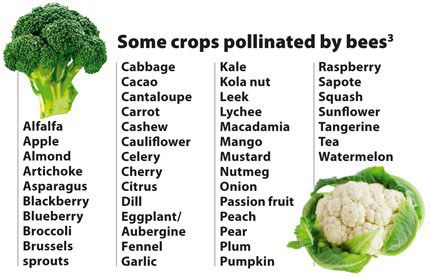
"Honeybees are responsible for pollinating agricultural crops that make up one-third of our diet, including fruits and vegetables. They're the cornerstones of heart-healthy and cancer prevention diets," says Gloria DeGrandi-Hoffman, an adjunct professor in the Department of Entomology in the College of Agriculture and Life Sciences at the University of Arizona and a research leader at the Carl Hayden Bee Research Center in the Agricultural Research Service of the U.S. Department of Agriculture.

"We're the honeybee nutrition lab," DeGrandi-Hoffman said. "Humans are healthier when we have good nutrition and so are bees. We study the effects of malnutrition on bees, including the effects of fungicides and pesticides and how they alter the ability of bees to acquire nutrients from flower nectar."

The lab also looks at the role of microbes in the ability of bees to digest their food and acquire nutrients from it.
In the spirit of a picture being worth 1000 words, here's a graphic that illustrates DeGrandi-Hoffman's point.


Follow over the jump for a story that I've told my students many times, but haven't recounted here until now.

Monday, August 25, 2014

Ebola news from The Archdruid, Daily Kos, and campuses on the campaign trail


Greer the Archdruid made this observation in Heading Toward The Sidewalk.
I suspect that most of my readers have been paying at least some attention to the Ebola epidemic now spreading across West Africa. Over the last week, the World Health Organization has revealed that official statistics on the epidemic’s toll are significantly understated, the main nongovernmental organization fighting Ebola has admitted that the situation is out of anyone’s control, and a series of events neatly poised between absurdity and horror—a riot in one of Monrovia’s poorest slums directed at an emergency quarantine facility, in which looters made off with linens and bedding contaminated with the Ebola virus, and quarantined patients vanished into the crowd—may shortly plunge Liberia into scenes of a kind not witnessed since the heyday of the Black Death. The possibility that this outbreak may become a global pandemic, while still small, can no longer be dismissed out of hand.
I couldn't resist responding and promoting one of my entries.
As for the Ebola outbreak becoming a top story, I mentioned in a comment here that it looked concerning weeks ago.  Honestly, Ebola scares me.  I first read about it in "The Hot Zone," the very first chapter of which described the death of an Ebola patient on a plane back to the U.S.  Stephen King described that story as "the scariest thing he'd ever read--and then it got worse."  Fortunately, it's not an immediate threat to people in the developed world.  That's small comfort to the people in west Africa, who are in immediate and growing danger.
That got a direct response from Gwaiharad.
@Pinku-Sensei: I'm not at all surprised that Ebola's become a top news story. After all, Stephen King's right. Ebola is really scary stuff. And media companies thrive on selling fear.
Media companies aren't alone.  Three universities whose press releases I quoted in Overnight News Digest: Science Saturday (Shark Week) and Overnight News Digest: Science Saturday (Bardarbunga eruption) have also been capitalizing on the outbreak, which threatens to become an epidemic, if not a pandemic.  Follow over the jump for them, as well as a frightening diary from Daily Kos.

Wednesday, November 28, 2012

Social media stories: Tweeting the news, finding auto defects, and scientific outreach


Over at Kunstler's blog, I left the following program note on Monday.
Today's post is about Cyber Monday, and tomorrow's is about the stink of retail desperation. As for the rest of the week, I know I'll be marking my third anniversary of writing for Examiner.com and starting another month on Saturday.
As you can read, that's only four posts for six days, which means I didn't know what I'd be writing about on two of them, although I had a few ideas.  Yesterday, my readers gave me a push, as Social media shaping policy was the most read post of the day with 39 views during the 24 hours before 8:30 PM yesterday.  It was also the third most viewed entry of the past seven days with 66 views.  Since I just happen to have some social media stories handy and was thinking of posting them anyway, that made my choice of topic tonight easy.

I'll begin with research on social media itself, starting with this study about how news spreads on Twitter.

University of Arizona: UA Study Examines How News Spreads on Twitter
A study of the Twitter activity of 12 major news agencies shows varying levels of success for the social network as a news-sharing tool, based on factors like article lifespan and number of retweets.
By Alexis Blue, University Communications
October 15, 2012
Nearly every major news organization has a Twitter account these days, but just how effective is the microblogging website at spreading news? That’s the question University of Arizona professor Sudha Ram set out to answer in a recent study of a dozen major news organizations that use the social media website as one tool for sharing their content.

The answer, according to Ram’s research, varies widely by news agency, and there may not be one universally applicable strategy for maximizing Twitter effectiveness. However, news agencies can learn a lot by looking at how their news diffuses once it is posted on Twitter, said Ram, McClelland Professor of Management Information Systems in the UA’s Eller College of Management.

Ram, who recently presented her findings at the International Workshop on Business Applications of Social Network Analysis in Istanbul, examined, over a six-month period, the Twitter activity of 12 major news organizations focused on U.S. news, global news, technology news or financial news.

All of the agencies selected – The New York Times, Washington Post, BBC, NPR, Reuters, Guardian, Forbes, Financial Times, Mashable, Arstechnica, Wired and Bloomberg – regularly share news articles on Twitter, which allows users to post 140-character messages as well as links to online content.

Ram, working with Devi Bhattacharya, an MIS doctoral student at the UA, tracked what happened to a news article after it was tweeted by a news organization. Together, they looked at how many people retweeted, or reposted, the article on their own Twitter feeds, then how many times it was subsequently retweeted from those accounts and so forth.

They were then able to evaluate the volume and extend of spread of an article on Twitter, as well as its overall lifespan.

“The goal for a news agency is to have a lot of people reading and following your articles,” said Ram, who is also a professor of computer science at the UA. “What we’ve done is use network analysis, which is quite different from just looking at the total number of tweets or total number of retweets. You’re starting to see, over time, how information is spreading.”

Ram and Bhattacharya rendered the data they collected from each organization visually as images showing how the news is diffused. The network visualizations appear something like fireworks, with dots representing individual twitter users and cascade streams from those dots depicting retweets. The images reveal different diffusion patterns for the different agencies, which can provide clues to those organizations about how their news is spreading and what they might want to focus on to be successful, Ram said.

“This gives them good feedback, and it’s kind of a performance report for them,” Bhattacharya said. “It gives them an idea about the reading habits of people online and how they like to consume news.”
Here are three of her images showing the propagations of tweets from Forbes, the New York Times, and Reuters, along with the captions accompanying each image.


A study by UA professor Sudha Ram shows, through network visualizations, varying patterns of news diffusion on Twitter for a dozen different news agencies. Shown here is...the Twitter Activity Network for Forbes.


The Twitter Activity Network for The New York Times shows a high number of users participating in long chains of tweeting and retweeting.


The Twitter Activity Network for Reuters shows a high number of users posting direct retweets of news agencies' tweets.
Those are just three of the news organizations studied.  What about the rest?
Of the organizations analyzed, BBC had the maximum reach in terms of affected users and retweet levels. BBC articles also had the highest chance of survival on Twitter, with 0.1 percent of articles surviving, through continual retweets, for three or more days. The BBC’s high numbers were likely due in large part to the fact that the main "bbcnews" Twitter account also is supported by two other agency accounts – "bbcbreaking" and "bbcworld," Ram said. The New York Times and Mashable had the second highest reach. Articles from Forbes, Wired and Bloomberg had the shortest Twitter lifespans.
I suspect that the differences in the dispersal patterns of news tweets has as much or more to do with the nature of the readers/viewers of the respective news services and their attachment to the organization as it does with the reliability or reputation of the news services themselves or their use of Twitter.  The BBC and New York Times are held in generally high regard by their readers/viewers/listeners as among the most respected news sources in their countries and that might have as much to do with the longevity of their tweets as the evergreen nature of their stories.  On the other hand, the techies and financial people might find the news from Wired, Forbes, and Bloomberg to have a very limited shelf life, as well as the publications themselves being less established than the Beeb and Gray Lady.

Now, why that 72-hour benchmark used above?
Overall, Ram said the data showed that articles on Twitter dissipate fairly quickly, with retweeting typically ending between 10 and 72 hours after an article is originally shared.
I've seen that 72 hour lifespan before; it's the time limit for a story to be considered newsworthy on Examiner.com.  Looks like Ram has found empirical evidence in support of that rule of thumb.

So, what's the point of all this, besides academic curiosity?
Ram says she hopes to do more extensive research on news sharing and develop partnerships with news agencies to help them answer specific questions about their social media practices and performance.

“The idea is really to see if we can make some predictions,” Ram said. “What are some attributes of these networks that will help us make predictions? Is it number of followers? Is it engagement of followers? Is it what time you tweet? Is it who else is tweeting at the same time? Which are the more useful attributes that will help us predict, and therefore will help us give organizations suggestions on how to be more effective in spreading their news? Because ultimately their goal is more people reading their articles and talking about them.”
Cool.  Since I use social media to share the articles I write for Examiner.com, I could use any tips from Ram's research.

Follow over the jump for more social media stories originally posted on Overnight News Digest on Daily Kos.

Saturday, November 10, 2012

Space photographs as art and other space and astronomy news

It's that time of the week again. This week, the stories I'm featuring aren't about scientific discoveries or space flights, at least night directly. Instead, they're about how the photos that document scientific discoveries and space flight make for great art, as well as educational opportunities.


University of Arizona: Adam Block and the Cosmic Canvas
Adam Block, astrophotographer and astronomy educator with the UA's Mt. Lemmon SkyCenter, has been selected to receive the Advanced Imaging Conference Hubble Award to honor his work in "bringing the cosmos to the people."
By Daniel Stolte, University Communications
October 29, 2012
Adam Block, astrophotographer and astronomy educator with the University of Arizona's Mt. Lemmon SkyCenter, has been selected to receive the Advanced Imaging Conference Hubble Award to honor his work in "bringing the cosmos to the people." Block received the award at the annual Advanced Imaging Conference held Oct. 26-28 in San Jose, Calif.
...
NASA regularly features his images on its "Astronomy Picture of the Day" website, such as this image of Reflection Nebula vdB1 (used as the illustration above--P.S.). Hundreds of Block's photos have appeared in magazines such as National Geographic, Scientific American, Astronomy, Sky & Telescope, Arizona Highways, Coelum, Astronomie and The Practical Astronomer. Space.com has featured a score of his images as its image of the day.

"Adam's pictures draw people in and facilitate their thinking about science," said Alan Strauss, director of the Mount Lemmon SkyCenter. "One of the things that distinguishes our outreach efforts from similar public programs is that Adam's photographs are used so widely. The images are beautiful, and they awaken a curiosity and an appreciation of science in general, and astronomy specifically."

Arizona State University: Moon and art go hand in hand
October 29, 2012
To patrons of fine art, space might seem like a foreign frontier but the monOrchid art gallery in downtown Phoenix will bring the two together when it hosts dozens of images taken from NASA’s Lunar Reconnaissance Orbiter Camera (LROC).

The Lunar Reconnaissance Orbiter (LRO) is a NASA mission that is a precursor to the return of humans to the Moon. LROC, which is one of seven instruments aboard the orbiter, is run from the Tempe campus by principal investigator Mark Robinson.

This unusual exhibit will feature LROC images of the Moon depicting impact craters, ancient lava flows and the Apollo landing site where astronauts first stepped onto the lunar surface. The exhibit will premiere Nov. 2, during the First Friday art walk in downtown Phoenix, and remain open from 5 to 10 p.m. every Friday in November. MonOrchid is located at 214 E. Roosevelt St., in downtown Phoenix.

“The Moon is a really beautiful place,” said Robinson, creator of the exhibit. “These are like Ansel Adams images of the Moon.”
For the rest of last week's space news from Overnight News Digest: Science Saturday (Sandy's aftermath edition) on Daily Kos, follow over the jump.

Saturday, November 3, 2012

Finally, the week's space and astronomy news on time!

Unlike the previous two reports, I finally got around to posting this in a timely manner. Without any more ado, here is the space and astronomy news from Overnight News Digest: Science Saturday (Frankenstorm edition) on Daily Kos.

First up, an overview of space news from NASA Television on YouTube.

Ford's Job One on This Week @NASA

NASA Flight Engineer Kevin Ford and his two Russian colleagues have made it to the International Space Station and are working to make themselves comfortable aboard the orbiting complex they'll call home for the next five months. Also, Dragon's ready to return; Curiosity Rover Report; Red Road to Mars; Milk Way's Black Hole; Planetary Exploration at 50; and more!
Also, here is the report for the week I skipped.

NASA Television on YouTube: Endeavour's Parade on This Week @NASA

Space Shuttle Endeavour brings out the crowds in Los Angeles as the orbiter wends its way from LAX to the California Science Center. Also, legacy power; milestone met; water drop tests; Curiosity Rover Report; and more!
For more general space and science news, check out This week in science by DarkSyde on Daily Kos.

Follow over the jump for stories from deep space and time to Earth's surface.

Friday, November 2, 2012

Election news from campuses in the swing states

Here's this week's collection of election news from state universities in swing states that I originally included in Overnight News Digest: Science Saturday (Frankenstorm edition) on Daily Kos. Hey, I'm an environmentalist; I recycle.

First, the most popular of the political stories that I tweeted as I put together last Saturday's OND.


Purdue University: Prof: Election season makes it hard to like some Facebook friends
October 25, 2012
WEST LAFAYETTE, Ind. — People dropping Facebook friends over political differences is a reminder that some of those so-called friendships are virtual, not the face-to-face type, says a Purdue University communication professor.

"Facebook friendships are often diluted, because the reality of managing dozens, hundreds or thousands of these friendships is just not possible," says Glenn Sparks, who studies mass media effects and interpersonal relationships. "That's why people are easily surprised when some of their Facebook friends post or like different political candidates or issues. It begs the question of how well do you really know these people. And, it also explains why people can quickly dismiss these connections."

Sparks, who is co-author of "Refrigerator Rights: Our Crucial Need for Close Connection," says the ease of dropping these social media friends is a reminder that weaker social connections should not be a replacement for face-to-face interactions.
Take heart. The election will be over in less than a week. With any luck, your Facebook feed will return to normal after that.

Follow over the jump for more stories from the three Arizona universities, University of Colorado, and Iowa State University.

Saturday, October 27, 2012

More late space and astronomy news

Remember this?
I was so busy posting election news last week that I never got around to posting my roundup of space and astronomy news.
The same thing happened this week. So, here is the space news from Overnight News Digest: Science Saturday (2012 Nobel Prizes edition) on Daily Kos, a week late.

The week's lead story took place on the streets of Los Angeles, as the shuttle was towed from LAX to Exposition Park.

ABC News on YouTube: Space Shuttle Endeavor to Reach Final Resting Place; Retired Ship Makes Way Through Los Angeles


L.A. Times: Space shuttle Endeavour rolls on toward its new home October 13, 2012
The space shuttle Endeavour rolled across its final frontier Saturday, successfully crossing a bridge over the 405 Freeway and pivoting through tight spots en route to its new home at the California Science Center in Exposition Park.

Thousands of people thronged the streets to watch the shuttle crawl through the streets of Inglewood and then Los Angeles.

The massive space vehicle made a two-hour stop at the Forum in Inglewood, arriving early to the delight of crowds and politicians who crowed about Southern California landing what they called a national treasure.
The rest of the week's space and astronomy news from deep space to classrooms in Virginia over the break.

Wednesday, October 17, 2012

Last week's space and astronomy news a week late

I was so busy posting election news last week that I never got around to posting my roundup of space and astronomy news. Here it is, the space news from Overnight News Digest: Science Saturday (Change in the weather edition) on Daily Kos, a week late.

NASA Television on YouTube: Dragon Ready to Ride the Falcon on This Week @NASA

The historic launch of the first-ever contracted cargo resupply flight to the International Space Station by Space Exploration Technologies Corporationis ready. Also, cybersecurity; Antares rollout; hangin' out on Google; the Hubble constant; space orchestra, and more!
The University of Colorado, Boulder, had their own press release on one of the experiments sent up on Dragon.

CU hardware to fly on first-ever NASA-contracted resupply mission to space station
October 5, 2012
A University of Colorado Boulder space center is providing hardware and technical support for scientific experiments aboard the first-ever NASA-contracted resupply flight to the International Space Station, slated for launch Oct. 7 from Cape Canaveral, Fla.

BioServe Space Technologies, a NASA-funded center in CU-Boulder’s aerospace engineering sciences department, has provided an automated, suitcase-sized incubator carrying fluid-processing devices for use by Montana State University researchers to test how a pathogenic yeast strain responds to the low gravity of space. The experiments will fly on the unmanned Dragon cargo spacecraft developed by Space Exploration Technologies X, or SpaceX, which made history during a May 2012 demonstration flight by becoming the first commercial spacecraft to dock with the International Space Station, or ISS.

BioServe’s incubator, known as a Commercial Generic Bioprocessing Apparatus, or CGBA, will provide space support for nearly 130 fluid-processing devices headed for ISS and loaded up with a common pathogen known as Canada albacans, said BioServe Business Development Manager Stefanie Countryman. The pathogen is under study by MSU faculty and students because it can cause localized infections in healthy people but can trigger potentially lethal infections in immune-compromised people.
Also, two diaries on Daily Kos examined what Curiosity did that week.

On Mars: One Scoop or Two? by LeftOfYou

Cool Greebly Mars Rock! by Autonomeritus

More astronomy news over the jump.

Thursday, October 11, 2012

Election news from campuses on the campaign trail

I should post something for tonight's VP debate, but I'm not up for it right now. Instead, it's time for the remaining election news from Overnight News Digest: Science Saturday (Change in the weather edition). There's enough here for an indirect comment on the upcoming matchup between Biden and Paul.

University of Arizona: 'Voices and Choices of the 2012 Election' to Create Positive Dialogue The three free special events are designed to create positive conversation around communication during election campaigns.
By Lori Harwood, College of Social and Behavioral Sciences
October 5, 2012
The University of Arizona College of Social and Behavioral Sciences is presenting three free special events as part of “Voices and Choices in the 2012 Election” – a star-studded panel discussion, a film and a cartoon debate.

“In election years, we get bombarded with negative media about the candidates, the voters and the issues,” said John Paul Jones III, dean of the College of Social and Behavioral Sciences.

“This year our college is offering an alternative. 'Voices and Choices' will engage Tucson in a positive dialogue about the election and the ways in which we communicate during campaigns. The events we have planned bring people from diverse perspectives together to talk and hopefully to have fun."
Purdue University: Economic issues, presidential election will be focus on Oct. 17 panel October 5, 2012
WEST LAFAYETTE, Ind. — Susan Swain, co-CEO of C-SPAN, will moderate a discussion with national journalists on economic issues and the presidential election at an audience-interactive forum on Oct. 17 at Purdue University.

Charles Blow, columnist for The New York Times, and Nick Gillespie, editor of Reason magazine, will present their views on the economy in a forum titled, "Your Money and Your Life: The Economy, the Election, and You."

The forum will run from 5:30 to 6:45 p.m. in Stewart Center's Loeb Playhouse. Seating for the event will begin at 5 p.m. The discussion, which is free and open to the public, is co-sponsored by Project Impact and Future Impact. The public also is invited to attend a pre-forum reception from 4-5 p.m. under the Mural in Stewart Center.
...
The event will be streamed live via webcast that will be available at mms://video1.itap.purdue.edu/ProjectImpact.
University of Wisconsin: UW students prepare for president’s visit to campus
by Aimee Katz
Oct. 4, 2012
As President Barack Obama makes his way to speak in front of thousands on Bascom Hill on Oct. 4 — a month before the 2012 presidential election — many students at the University of Wisconsin-Madison are adjusting their schedules accordingly to attend the historic event.

“It’s a great opportunity to become informed as we head toward the election,” says UW senior Heather Laing. “Most days, we don’t get the chance to hear from the leaders of our country. Events like this should serve as a reminder of the benefits of living in Wisconsin’s capital city.”

Other students echo this sentiment, saying they are looking forward to seeing to the president speak live in Madison, less than 24 hours after his first debate with Republican presidential nominee Mitt Romney.
Here's the address, courtesy of The Daily Cardinal.

President Obama Visits Bascom Hill on UW Campus
 

Saturday, October 6, 2012

Streambed on Mars and other space and astronomy news

Just like last week's space and astronomy news, I've been procrastinating posting the most recent installment. So, without any more ado, here is the space and astronomy news from Overnight News Digest: Science Saturday (Streambed on Mars discovered edition) on Daily Kos. This week's lead story, as you can see from the similarity in subject lines, is the same both here and on Daily Kos, Mars Rover finds evidence of water on Mars from CNN.

NASA rover Curiosity finds what appears to be an ancient riverbed on Mars. CNN's Chad Myers has more.
The discovery is such a good example of one of the assumptions of science, that scientific laws and the features that result from them being the same at all times and places, which is the basis of uniformitarianism, that I've already included in the slideshow for this coming week's lecture on sedimentary rocks. That it also does a good job of explaining how the clasts in conglomerate are rounded is a bonus.

The JPL video about this discovery also composes the second segment of Dragon Awaits on This Week @NASA.

October 7 is the launch date for SpaceX's Dragon spacecraft on the first commercial resupply mission to the International Space Station. This will be the first of 12 contracted flights by SpaceX to resupply the space station under the Commercial Resupply Services contract and will restore an American capability to transport cargo to and from the orbiting laboratory. Also, Curiosity Finds Streambed; New ISS Crew; Endeavour in L.A.; Extreme Hubble; Webb's Mirrors; Milky Way's Halo; and more!
This was such big news that there were two diaries on Daily Kos about it, DarkSyde's This week in science: Water is thick enough and LeftOfYou's On Mars: Sol 52 Update.

More stories from black holes to the ancient Earth after the jump.

Saturday, September 29, 2012

Endeavour's last flight and other space and astronomy news

I've delayed long enough in posting the space and astronomy news from last week's Overnight News Digest: Science Saturday (2012 IgNobel Prizes edition) on Daily Kos, so here it is. The top story is the transcontinental flight of space shuttle Endeavour to its new home in a California museum.

NASA Television on YouTube: Endeavour Goes Cross-Country on This Week @NASA

Atop the Shuttle Carrier Aircraft, Endeavour completes its journey from the Kennedy Space Center in Florida to Los Angeles, where it'll go on display at the California Science Center next month. Also, Shuttle Social, Curiosity Cruises, Helping Hangout, Ride Remembered, and more.
I have more from the University of Arizona on YouTube, which was fortunate enough to have a flyover by request.

Space Shuttle Endeavour Flies Over UA Mall
 
On it's way to retirement at the California Science Center in Los Angeles, the space shuttle Endeavour few over the University of Arizona as thousands of students, faculty and staff looked on. Mark Kelly, the last person to command a mission aboard the shuttle, requested the UA visit in honor of his wife, former Congresswoman Gabrielle Giffords. Viewers on the UA Mall cheered and took photographs of the shuttle as it passed.
This completes the previous chapter in human space flight by the U.S. May there be another one so that our society does not act out the tragic science fiction plot of losing the ability to travel to space as a sign of a declining technological civilization.

More news from the asteroid belt to college campuses over the jump

Social media shaping policy


In last week's Overnight News Digest: Science Saturday (2012 IgNobel Prizes edition) on Daily Kos, I found these two stories about how social media is shaping policy. The first involves the use of social media in diplomacy. My reaction is "about time" considering how important social media was in the Arab Spring and also the current unrest over "The Innocence of Muslims."*

University of Arizona: UA Study Looks at Use of Social Media in Public Diplomacy
School of Journalism
September 17, 2012
The use of social media for the purpose of public diplomacy has increasingly drawn the attention of U.S. diplomacy professionals, observers and political analysts especially after the recent attacks on the U.S. embassies in Egypt and Libya that were triggered by outrage over an anti-Islamic video released on Sept. 11. As more riots are planned in neighboring countries, including Algeria and Yemen, U.S. embassies have used Twitter posts to save face and play defense.

Shahira Fahmy, an associate professor in the University of Arizona School of Journalism, and a colleague from the University of Texas examined foreign public diplomacy specialists’ adoption of social media such as Twitter for public diplomacy purposes. Using a survey of foreign embassies and consulates, their study explored whether effort and performance expectancy, social influence and attitudes, facilitating conditions and perceived credibility might have influenced the adoption of social media in public diplomacy practice.

“The U.S. government and foreign policy analysts have shown great interest and enthusiasm in exploring how to increase the efficiency of using social media for more effective public diplomacy. However, studies on the issue have been rare. By the time my colleague and I initiated this research in 2009, a search in the scholarly database ProQuest with key words ‘diplomacy’ and ‘social media’ or any type of the social media such as ‘blog,’ ‘YouTube,’ ‘Twitter,’ or ‘Wikipedia’ generated no results,” Fahmy said.
The second describes how researchers are monitoring social media for reports of adverse drug reactions. If it improves medical care, I'm all for it.

University of Virginia: Research To Sift Social Media for Early Signs of Adverse Drug Reactions
H. Brevy Cannon
September 20, 2012
The National Science Foundation has awarded a $130,000 grant to a team co-led by University of Virginia professor Ahmed Abbasi to fund research that will analyze social media, including tweets and online discussion forums, to identify adverse drug reactions – a process that promises to be much faster and perhaps also more accurate than the existing methods of identifying such reactions.

Using state-of-the-art data analysis tools, Abbasi, a professor of information technology at U.Va.’s McIntire School of Commerce, and four collaborators at West Virginia University will explore how tens of thousands of pharmaceutical-related comments shared on Web forums, blogs and other social media can be harnessed as an early-warning signal of adverse drug reactions.

Currently, once drugs come to market, the FDA relies upon consumers to report adverse side-effects through physicians and other official reporting channels.
Welcome to the 21st Century; we live in science-fiction times.

Sunday, September 23, 2012

The psychology of campaign ads plus a bad sign for representative democracy

In the tip jar to Overnight News Digest: Science Saturday (2012 IgNobel Prizes edition) on Daily Kos, I included these four items. The first, from Ohio State University, describes how people tune out ads they don't want to pay attention to. It's a good example of "don't confuse me with the 'facts'; my mind's made up."

Zheng Wang, assistant professor of communication at Ohio State University, demonstrates how she and her colleagues measured physiological responses to viewing presidental campaign ads.
Your Body Doesn’t Lie: People Ignore Political Ads of Candidates They Oppose
September 17, 2012
COLUMBUS, Ohio - A recent study examined people’s bodily responses while watching presidential campaign ads - and discovered another way that people avoid political information that challenges their beliefs.

In the last days of the 2008 campaign, researchers had people watch a variety of actual ads for Republican presidential candidate John McCain and his Democratic rival Barack Obama while the viewers’ heart rates, skin conductance and activation of facial muscles were monitored.

The results showed that partisan participants reacted strongly to ads featuring their favored candidate, but barely responded to ads featuring the rival candidate.

In comparison, people who didn’t favor one candidate over the other showed similar physiological response patterns and intensity to ads for both Obama and McCain.
I admit to doing this myself, as I am already tuning out the ads for the positions I disagree with on some of the ballot proposals. While the above is normal, the next pair of articles should give one pause, as they demonstrate that negative ads are becoming less effective for a paradoxical reason, decreased faith in government. It seems that one can't discourage someone who doesn't believe in government in the first place.

University of Florida: Negative political ads pack punch with voters who trust politicians, UF study shows September 18, 2012
GAINESVILLE, Fla. — Contrary to conventional wisdom, negative political advertisements don’t always work as well as some believe. In part, this is because the audience with which they seem to work best — people who think government works — has been shrinking.

In a study presented in September to the American Political Science Association, University of Florida political science professor Stephen Craig and Paulina S. Rippere, a UF doctoral student and faculty member at Flagler College, examined the effect of negative ads on voters with varying levels of trust and confidence in their political leaders. The findings suggest that political trust and political knowledge can play a role in shaping citizens’ reactions to negative campaign appeals.
University of Arizona: Key Undecided, Independent Voters Seek Different Tone for Campaign
Most American voters have lost confidence in the ability of elected officials to solve the problems facing the U.S., finds a new survey commissioned by the National Institute for Civil Discourse.
National Institute for Civil Discourse
September 14, 2012
WASHINGTON, D.C. – A survey commissioned by the National Institute for Civil Discourse, headquartered at the University of Arizona, indicates that a majority of American voters have lost confidence in the ability of elected leaders to solve the problems facing our country. In fact, fewer than one in 10 American voters has “a great deal” of confidence in elected officials to solve the problems of our country – while twice as many say they have no confidence at all.

“We’ve known for some time how dissatisfied the electorate has become with Congress,” said Carolyn Lukensmeyer, the institute’s executive director. “This is the strongest indication we’ve seen that voters think our Congressional leaders are incapable of solving problems.”

Survey respondents identified several underlying causes for the problem-solving paralysis. Most often cited (90 percent) was politicians’ unwillingness to cross party lines, while 83 percent cited the lack of respectful dialogue as an obstacle to solving problems.
In other words, compromise and civility would be good things. Too bad one of the parties has turned into an authoritarian movement, something that precludes either. If the lack of faith in our elected representatives continues, the authoritarian movement might just--paradoxically--succeed.

As for what things would look like if there were more civility, Northern Arizona University is attempting to provide an example.

Statewide forum sets stage for civil discourse on ballot initiatives
September 18, 2012
Arizona voters from all political affiliations are invited to participate in a public forum simulcast around the state that is designed to bring together people with varying opinions to engage in civil dialogue about three upcoming ballot initiatives.

The event, called “Mapping Arizona’s Future,” is being hosted locally by Northern Arizona University’s Philosophy in the Public Interest and Coconino Community College, in collaboration with the non-partisan organization Project Civil Discourse.

“Being able to discuss matters—even potentially controversial ones—with respect and civility allows for better problem-solving and ultimately higher-leveled thinking,” said Leah Bornstein, president of Coconino Community College.
Good luck, NAU. We'll need it.

Sunday, September 16, 2012

Election news from campuses on the campaign trail

In Overnight News Digest: Science Saturday (End of primary season edition) last night on Daily Kos, I marked the end of a series.
Between now and the end of the primary/caucus season, Overnight News Digest: Science Saturday will highlight the research stories from the public universities in each of the states having elections and caucuses during the week (or in the upcoming weeks if there is no primary or caucus that week). Tonight's edition highlights the science, space, environment, health, and energy stories from universities in the states of Delaware, Michigan, New Hampshire, and Rhode Island (list from Politics1.com) and will be the last to do so, as primary season is over.
As for what will replace that series, I plan on replacing it with featuring the research of public universities in swing states, with the additions of states hosting presidential and vice-presidential debates. As of right now, that would mean stories from Colorado, Florida, Iowa, North Carolina, Ohio, and Virginia, along with Kentucky and New York the weeks surrounding the vice-presidential debate in Danville, Kentucky on October 11th and the second presidential debate in at Hofstra University in New York on October 16th. The schedule shows the other two debates are already in swing states, Colorado and Florida. If other states come into play, I might add them. In particular, I'm keeping a close eye on Wisconsin, not only because Paul Ryan might once again make that state close, but because the University of Wisconsin provides good stories.

Enough of my plans for the future. Follow over the jump for the beginning of my celebration of the end of this series with election news for the past month originally included in Overnight News Digest: Science Saturday (Curiosity's first destination edition), Overnight News Digest: Science Saturday (Labor Day weekend edition), and Overnight News Digest: Science Saturday (35th Anniversary of Voyager 1 edition).

Tuesday, September 4, 2012

Another possibly habitable exoplanet and other space and astronomy stories

Time for the past week's space and astronomy stories from Overnight News Digest: Science Saturday (Labor Day weekend edition) on Daily Kos, which had the same lead story.

Another potentially habitable world emerges
Planet orbits a common dwarf star, suggesting more may be out there
By Nadia Drake
Web edition : Friday, August 31st, 2012
BEIJING — A potentially habitable planet has been discovered orbiting the star Gliese 163, 50 light-years away. The planet is bigger than Earth — roughly seven times as massive — and resides near the inner edge of the star’s habitable zone, Thierry Forveille of France’s Observatoire de Grenoble reported on August 30 at the International Astronomical Union’s general assembly meeting. Depending on its composition and how insulating its atmosphere is, the planet could be capable of supporting life.

“I’d say that’s a habitable planet,” said Raymond Pierrehumbert of the University of Chicago. It’s unlikely the planet would experience any sort of runaway greenhouse effect that would heat it beyond the point of livability, he says.

Forveille and his colleagues found the planet by searching for wobbles in the planet’s host star with a telescope in Chile. Astronomers calculate that Gl 163c, as the planet is called, receives 30 to 40 percent more energy than Earth receives from the sun. Because the planet’s radius is unknown, it’s not yet clear what the planet is made of, but scientists speculate that it’s a mix of rock and water.
Note the dateline. The International Astronomical Union held its annual meeting in China. That makes this entry one about the CoDominion.

More stories after the jump.

Wednesday, August 29, 2012

Climate news from archeology and history for July and August 2012

I know that there are two major news stories breaking, the Republican National Convention and Hurricane Issac, which become intertwined last week when Republicans cancelled the first day of their convention because of the passing storm, but I'm not up to examining either in any detail right now. Instead, I present the climate news from archeology and history that first appeared in Overnight News Digest: Science Saturday (Opening of London Olympics edition), Overnight News Digest: Science Saturday (PECASE, President's Birthday, and Curiosity edition), Overnight News Digest: Science Saturday (Curiosity's first destination edition), and Overnight News Digest: Science Saturday (Neil Armstrong R.I.P. edition) on Daily Kos this past month.

Follow over the jump from stories from the beginning of civilization to projections of the effects of future climate change and sea level rise on archeological sites to read the past month's articles on climate in history, both ancient and modern.

Sunday, August 26, 2012

R.I.P. Neil Armstrong and other space and astronomy news

As you can tell from the title of my diary at Daily Kos, Overnight News Digest: Science Saturday (Neil Armstrong R.I.P. edition), the top story today is that of Neil Armstrong's passing. This marks both the loss of a great American, but also another sign of the acting out of the great science fiction tragedy of losing the capability of manned space flight. Since the Apollo program, no human has ventured beyond low Earth orbit. That's 40 years.

Mind you, I'm sure the Chinese will land on the Moon by the end of this decade, so humanity won't have lost the ability, but the U.S. is not racing to get back there before they do. Here's to hoping that the U.S. doesn't repeat the 21st Century version of the Chinese mistake of sending treasure ships to Africa, then abandoning their exploring and the open ocean technology that made it possible. It took the Chinese 500 years to recover from that misjudgment.

But enough of what this event means to me. Time to celebrate the life of Neil Armstrong, the first man on the Moon. The tribute begins with the featured story from the Washington Post accompanied by a video from CNN.

Neil Armstrong, first man to step on the moon, dies at 82
By Paul Duggan, Updated: Saturday, August 25, 4:00 PM
Neil Armstrong, the astronaut who marked an epochal achievement in exploration with “one small step” from the Apollo 11 lunar module on July 20, 1969, becoming the first person to walk on the moon, died Aug. 25 in the Cincinnati area. He was 82.

His family announced the death in a statement and attributed it to “complications resulting from cardiovascular procedures.”

A taciturn engineer and test pilot who was never at ease with his fame, Mr. Armstrong was among the most heroized Americans of the 1960s Cold War space race. “That’s one small step for man, one giant leap for mankind,” he is noted for saying as he stepped on the moon.
Armstrong, first man on the moon, dies

Neil Armstrong, the first man to walk on the moon, has died, his family said Saturday. He was 82.
The video CNN posted immediately before the above on their YouTube Channel was Four legendary astronauts are awarded the Congressional G....

Astronauts John Glenn, Neil Armstrong, Michael Collins and Buzz Aldrin are presented the Congressional Gold Medal.
Although CNN posted this video today, this ceremony took place on November 16, 2011, according to the Associated Press via the Miami Herald.

Space.com on YouTube also joined in with Neil Armstrong's 'One Small Step' That Changed The World | Video.

When Apollo 11 touched down on the Lunar surface the whole world stopped. Relive the moment when humanity took its giant leap forward.
Finally, at least three diarists on Daily Kos chimed in, beginning with Breaking: Neil Armstrong Has Passed Away (Updated X4) by Diogenes2008, followed by Neil Armstrong, August 5 1930-August 25 2012 by caul, and finally If We Could Land a Man on the Moon... by jpmassar. Those were just the ones that posted before Midnight. I haven't checked for more recent ones.

Before I move on the the rest of the space and astronomy news, a moment of silence, please.


Saturday, August 25, 2012

Science crime scenes 6: Accidental and intentional responses to GOP war on science

As I wrote yesterday, after skipping last week, it's time to post another installment of a continuing series. Today, it's science crime scenes.

I'm going to skip the usual archeology stories about atrocities from the past and modern day smuggling, looting, and vandalism. That's not because I don't have any; I have quite a lot of them from Overnight News Digest: Science Saturday (Curiosity's first destination edition) on Daily Kos that I'll post in another edition. Instead, I'm going to focus on stories about crimes against science, the planet, and society from other disciplines, including psychology, sociology, and technology, along with a dose of policy, all but one of which come from the public research universities of Arizona, where there will be a primary election this coming Tuesday, according to Politics1.com. It turns out that all of these stories either directly or indirectly comment on the GOP's science policies or the party's top candidates.

I begin with a story from Science Magazine that is about a potential crime against science itself, a law from the state of Todd Akin and one that bears the stamp of the religious wing of the Republican Party.

Missouri 'Right to Pray' Law Could Limit Teaching Evolution
Last week, Missouri voters gave themselves the right to pray without state interference. But some science educators are worried that the seemingly innocuous referendum on the 7 August ballot, which passed overwhelmingly, could also undermine the teaching of evolution in public schools.

Amendment 2 "is a lawyer's dream" because of its vagueness, says Joshua Rosenau, programs and policy director of the National Center for Science Education in Oakland, California, which tracks efforts by groups that oppose evolution. While the amendment begins by declaring that all residents "have a natural and indefeasible right to worship Almighty God according to the dictates of their own consciences," it also lists several situations in which that right must be protected. Rosenau is worried about one particular clause: "that no student shall be compelled to perform or participate in academic assignments or educational presentations that violate his or her religious beliefs."

Those words give students the legal right to skip assignments related to evolution if the subject matter conflicts with their beliefs, Rosenau says. And that exemption could extend throughout their scholastic career, he adds, since evolution is not just taught in one lesson but remains a recurrent theme throughout science education. The amendment also leaves a hole in their coursework, he says, as it provides no guidance on any substitute lessons.
Hat/tip to CharlesInCharge on Daily Kos, who included the above excerpt in You've Got to Show Me: The (New) Epistemological Crisis and commented about the law's greater significance.
We face a new epistemological crisis in this country. The crisis has been brewing for well over 50 years but, I would argue, since the advent of the internet has reached epidemic proportions. In an age where every URL is created equal and where precedence goes not to knowledge which is tested in the cauldron of the scientific method but rather by which spurious link comes up first in a Google search, how are we to evaluate statements and data to see whether they accurately represent truth or reality?

Thomas Kuhn, in The Structure of Scientific Revolutions, argued that the history of science could be explained by anomalies in a prevailing paradigm reaching the point where a 'crisis' occurs, such that the existing paradigm must be overthrown and replaced by a new paradigm. Think Einstein replacing Newton or Darwin replacing the Biblical account of Creation. The point is that internal contradictions within an older established order reach such a fever pitch that the older order no longer suffices. That crisis now besets the very mechanisms by which our culture arbitrates what it calls knowledge. The epistemological crisis is now upon us and it is hard to forsee the new paradigm that will replace the ancien regime.
Scientific revolutions are almost always advancements in our understanding of the universe. I have my doubts that what is happening qualifies as one.

Follow over the jump for the rest of the past week's stories, all of which bear on a weakness of the Republican presidential ticket.