Showing posts with label Wired. Show all posts

Friday, August 19, 2022

Using biotechnology to eliminate and control mosquitoes for an early celebration of World Mosquito Day

A happy early World Mosquito Day! I'm celebrating early because tomorrow is also World Honey Bee Day and I thought both days deserved their own entries and the post I am planning for tomorrow is already big enough.

I begin today's early observance with DW Planet A asking We could kill all mosquitoes (but should we?).

Malaria-carrying mosquitoes kill hundreds of thousands of people every year. Scientists have found a way to get rid of them by spreading a gene to wipe out mosquito populations. But is it a good idea?
The experts interviewed by DW Planet A expressed ambivalence about the prospect, although I doubt humans would ever get around to all the thousands of mosquito species. As for using genetic modification on mosquito species that carry diseases other than malaria, that's already happening in the U.S., as Wired reported in Inside the Plan to Release Life-Saving Mosquitoes two months ago.

The Florida Keys Mosquito Control District is turning towards a novel tool to combat harmful insecticide-resistant mosquitoes like the Aedes aegypti. What are they doing exactly? They're releasing millions of genetically modified male mosquitoes engineered to reduce the population of Aedes aegypti. How exactly does this work? We'll break it down.
Not only is Aedes aegypti a disease vector, it's also invasive in the Florida Keys, so eliminating it could restore balance to the ecosystem instead of disturbing it. Good riddance!

One of the goals of the Gates Foundation is the elimination of malaria and parasitic diseases. Bill Gates (or at least the people who run his YouTube channel) uploaded The Mosquito Factory this week, showing a biological control method other than genetic modification.

Inside a two-story brick building in MedellĂ­n, Colombia, scientists work long hours in muggy labs breeding millions and millions of mosquitoes. They tend to the insects’ every need as they grow from larvae to pupae to adults, keeping the temperature just right and feeding them generous helpings of fishmeal, sugar, and, of course, blood. Then, they release them across the country to breed with wild mosquitoes that can carry dengue and other viruses threatening to sicken and kill the population of Colombia. This might sound like the beginnings of a Hollywood writer’s horror film plot. But it’s not. This factory is real. And the mosquitoes being released don’t terrorize the local population. Far from it. They’re actually helping to save and improve millions of lives.
Using one parasite that doesn't affect humans to reduce the ability of an insect to spread a parasite harmful to humans — clever! It's also not forever in the same way genetic modification is. Fine by me.

That concludes this year's celebration of World Mosquito Day. Stay tuned for an entry about award-nominated television documentaries for World Honey Bee Day.

Friday, July 5, 2019

Wired on dead malls, a tale of the Retail Apocalypse


My wife and I just finished binge-watching season 3 of "Stranger Things" today.  A lot of the action centers around a mall, which didn't exist in the first two seasons.  That's actually an important plot point, but I won't discuss that any more today.  This is not a post about speculative fiction.  Instead, it's about the past, present, and possible future of malls.

What struck me most about the fictional Starcourt Mall was how much it reminded me of being in a mall in the mid-80s through early-2000s — the crowds, the bright colors, and the now bygone chair stores.  In other words, the show did a good job of capturing the look and feel of the times, which is a contrast to the tales of the Retail Apocalypse I've been telling here the past year.  I'm not the only person struck by the clips of the mall in the trailers and the contrast with today.  They also inspired Wired to ask an architecture professor to explain why malls are dying.

The 1980's nostalgia and sci-fi show Stranger Things returns for season three with a new setting: The Starcourt Mall. WIRED's Emily Dreyfuss talks with architecture professor Ellen Dunham-Jones about mall culture and the fate of dead malls. Hint, zombies.
The story Dr. Dunham-Jones tells about the history of suburbia up to the 1990s and the clips Wired used to illustrate it reminds me a lot of "The End of Suburbia."  As for the beginning of the end, her pointing to the mid-to-late 1990s came off as a bit surprising to me, as I would have picked the early-to-mid-2000s, when I first noticed the decline of Northland Mall, but she's the expert who looks at the numbers and identfies the trends, not me.

It was interesting to listen to Dunham-Jones' ideas of how to deal with dead malls.  The least common is reviving them with new retail, especially restaurants.  That would be more business as usual.  The other three possibilities look more interesting.  Turning the old malls into the new downtowns that the suburbs never really had is one I'd like, although I have trouble seeing that happening in Southfield; the old Northland Mall is too far from the actual downtown.  Repurposing old malls into office complexes with community services, including churches, is something I've seen in Brick Immortar's videos of dead malls on the Great Plains.  Finally, re-greening a dead mall by having it return to nature is something I hadn't considered, but it might not be a bad idea.

Dunham-Jones estimating that a quarter to a third of existing malls is likely to close by a decade from now suggests that I will be busy writing about the Retail Apocalypse for quite a while.  That's good for my blogging, but I wonder how good it will be for the country in the short run.  In the long run, we're probably better off because of decreased sprawl and a more sustainable, human-scale built environment.

Finally, Ace's Adventures managed to get a good look at Gwinnett Place Mall, an actual dead mall repurposed as the fictional Starcourt Mall, last year and posted it to YouTube as STRANGER THINGS SEASON 3 - BATTLE OF STARCOURT MALL.

My exclusive tour of the Gwinnett Place Mall in Duluth, Ga, featuring a tour of the stranger things season 3 80s food court and mall set!
Anyone who has seen this season will say that's exactly what the stores looked like in the show.  It's like a living museum.

That's it for the Retail Apocalypse for now.  I plan on posting the update to the Democratic candidates at On The Issues I promised in Senators and Representatives running for the Democratic nomination are drifting to the left as they campaign tomorrow.  Stay tuned.

Sunday, June 30, 2019

CBS and Wired report on the Planetary Defense Conference Exercise for Asteroid Day 2019


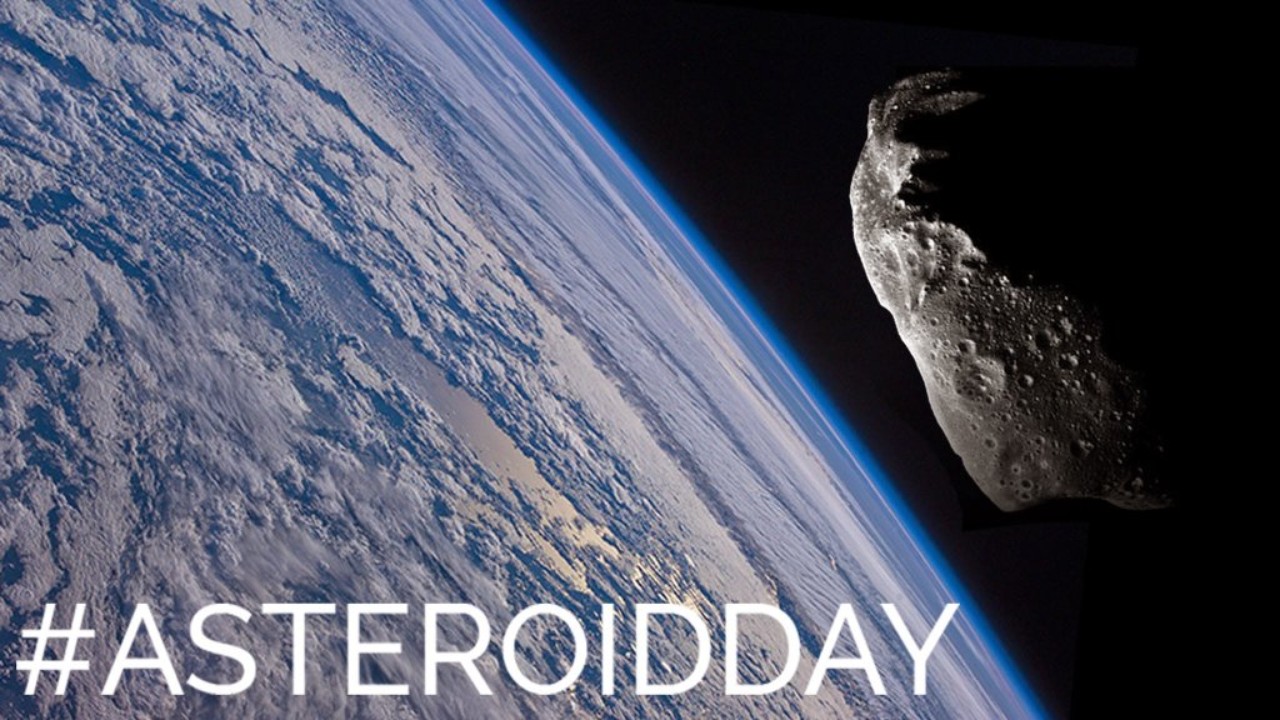
Happy International Asteroid Day!  To celebrate the event, which I see as the younger but more established version of Apophis Day, I'm sharing two videos about an exercise NASA and other governmental agencies participated in last month called the Planetary Defense Conference Exercise.  CBS Evening News reported How NASA plans to keep an asteroid from hitting Earth as the conference began.

It's unlikely a large asteroid would come speeding toward Earth. But NASA is preparing just in case. Chip Reid explains.
CBS gave a good overview.  Wired went into more depth at the end of the exercise in How Scientists Are Preparing Earth for an Incoming Asteroid.

Some of the world's best scientists are running drills to practice for a near earth object collision. WIRED's Robbie Gonzalez spoke with Cathy Plesko from the Los Alamos National Laboratory, to find out how we would respond to an incoming collision. Would nuclear detonations work? What does a "City Killer" look like? Would impact in the water be worse than impact on land? Find out more from Plesko.
Plesko mentioned Apophis, which will return twice on April 13 in 2029 and 2036.  That's why I call April 13 Apophis Day.  Asteroid Day commemorates an asteroid impact that happened more than 100 years ago.  The Times of India explains in Tunguska event, 1908: Why Asteroid Day is observed on June 30?

The Tunguska event was a large explosion that occurred near the Podkamennaya Tunguska River in Yeniseysk Governorate (now Krasnoyarsk Krai), Russia, on the morning of 30 June 1908. This explosion took place over thinly populated Eastern Siberian Taiga in 2,000 square kilometres (770 square miles) of forest. The explosion is generally credited to the air burst of the meteor. The Tunguska event is the largest impact event on Earth in recorded history. The estimates of the energy of the air burst range from 10–15 megatons of TNT to 30 megatons of TNT. The 15-megaton (Mt) estimate represents an energy about 1,000 times greater than that of the atomic bomb dropped on Hiroshima, Japan in 1945.
Note that the explosive power of the impact that the Planetary Defense Conference was trying to protect Earth from is in the same range as the Tunguska event.  I don't think that's a coincidence.

That's it for June.  Stay tuned for a celebration of Canada Day.

Saturday, July 23, 2016

Marble Machine for a Saturday


I'm just not feeling up to dealing with either Trump's acceptance speech or Tim Kaine as Hillary Clinton's pick for Vice President today.  Instead, I'm going to succumb to my "I can't be all DOOM all the time" mood and share some ingenious technology in the service of music: Wintergatan - Marble Machine (music instrument using 2000 marbles).


Wired explains.
The internet is no stranger to ridiculously complex attempts to make music with technology. But this might be one of the most purely spectacular attempts yet to take something which is now incredibly easy, and make it virtually impossible to comprehend.

The Wintergartan Marble Machine, built by Swedish musician Martin Molin and filmed by Hannes Knutsson, is a hand-made music box that powers a kick drum, bass, vibraphone and other instruments using a hand crank and 2,000 marbles.

The machine has to be seen to be appreciated: with dozens of beautifully carved wooden parts, tracks, pulleys and funnels for collecting and rerouting spent marbles, it's a true work of art. And though marble machines as an art form of their own have a long and complex history, this might be one of the best.
Slate and NPR also have stories on this Rube Goldberg music machine.

Stay tuned for Sunday's entertainment feature, which should be a follow up to Speculative Fiction on television at the Teen Choice Awards 2016, this time about the nominated speculative fiction movies.

Thursday, March 24, 2016

My blog shares a birthday with Twitter, which turned 10 Monday


Yesterday, I found out that March 21st is not just this blog's birthday as well as Nowruz (Persian New Year), it's also Twitter's birthday.  Wired reported Monday On Its 10th Birthday, a Short History of Twitter in Tweets.
TWITTER TURNS TEN today.

As it enters its awkward pre-teen years, the company that invented fame in 140 characters has had a tough run recently. It lost its longtime CEO Dick Costolo, who was replaced by co-founder and formerly ousted CEO turned new CEO-slash-savior Jack Dorsey. Yes, people use Twitter (more than 300 million of them), and yes, Twitter brings in money (more than $500 million each quarter), but its stock plummeted to an all-time low this year as Wall Street worried over its slowing user growth.

People rightfully complain that the platform can be a hotbed for hostility. It also offers a loudspeaker for the disenfranchised, but swarms of voices also silence through harassment. It’s a company, it’s a platform, and it’s the world’s biggest cocktail party. That means sometimes it’s a mess.

But for all its problems, Twitter is everywhere. It’s the place where the world talks to itself, often sharing and even making news in the process. Twitter has become a powerful force, but it wasn’t always that way.

It all begins with a tweet from Jack Dorsey himself.
That tweet was sent out March 21, 2006.  Surf on over to read the tweets Wired thought were significant in a timeline.  For a different selection, watch CTV's Twitter Turns 10: A look at the network's defining moments.

Digital Public Affairs Strategist Mark Blevis explains why Twitter will continue to be relevant, despite its stalling growth.
A belated Happy 10th birthday to Twitter!  From now on, I promise to remember the service's birthday when I celebrate my blog's.

Tuesday, January 6, 2015

2014 in space and astronomy


Moving Day is over, so it's time to post from the new house.  To mark the occasion, I'm continuing my series of retrospectives for 2014 with the year in space.  As a firm believer in "if it moves, it leads," I begin this installment with two videos from NASA.  First, 2014 What Happened This Year @NASA

In 2014, NASA took significant steps on the agency’s journey to Mars -- testing cutting-edge technologies and making scientific discoveries while studying our changing Earth and the infinite universe as the agency made progress on the next generation of air travel. Here’s a look at some of the top NASA stories of the year!
That's the long version.  Here's the short version: NASA 2014.

As 2014 comes to a close we look back on a few of the events that took place this year at NASA.
As one can see, NASA accentuated the positive, highlighting the Orion test flight.  That mission contrasts with the two disasters one after another described in a bad week for private space.  Those were not highlights of the year in space, although they were big stories.

Follow over the jump for more about the year in space.

Sunday, January 4, 2015

2014 in movies for nerds and geeks


For the Sunday entertainment entry, I'm making good on the promise I with which I closed Happy to rewind 2014 in entertainment and social media to "have more to write about 2014 in entertainment when I post about awards shows and magazine picks for the best and worst."  Time for the magazine selections, beginning with Top 5 MOVIES of 2014! (Nerdist News w/ Jessica Chobot).  If it moves, it leads.

From original sci-fi dramas to Marvel’s blockbuster superhero movies, join Jessica Chobot as we count down the Top 5 Nerd Movies of 2014 on Nerdist News.
I saw two of these movies, "Snowpiercer" and "Guardians of the Galaxy."  "Snowpiercer" was better as art, "Guardians of the Galaxy" was better as entertainment.  Both were excellent in their own way and I recommend both.  In addition, my wife loves the songs used in the sound track.

Follow over the jump for more science fiction and fantasy films from io9 and documentaries about technology and general nerdiness from Wired.

Wednesday, December 31, 2014

The Archdruid picked a good year to be down on science


One of Greer's overarching themes for the past year has been that technological and scientific progress has become a secular religion and that the failure of actual technological progress to live up to expectations is causing people to lose faith.  He called that faith Technological Superstitions and told people they should give A Pink Slip for the Progress Fairy.*  In particular, he thinks that science as currently practiced is a doomed cultural project, a thesis he stated explicitly in The Suicide of Science and elaborated upon in Dark Age America: The Sharp Edge of the Shell.  He had pointed things to say about the future of science in both.  In "The Suicide of Science," he made the following forecast:
What Oswald Spengler called the Second Religiosity, the resurgence of religion in the declining years of a culture, could have taken many forms in the historical trajectory of industrial society; at this point I think it's all too likely to contain a very large dollop of hostility toward science and complex technology.
He expanded on the form that rejection would take in "Dark Age America: The Sharp Edge of the Shell."
Modern science is extremely vulnerable to such a turn of events. There was a time when the benefits of scientific research and technological development routinely reached the poor as well as the privileged, but that time has long since passed; these days, the benefits of research and development move up the social ladder, while the costs and negative consequences move down. Nearly all the jobs eliminated by automation, globalization, and the computer revolution, for example, used to hire from the bottom end of the job market. In the same way, changes in US health care in recent decades have benefited the privileged while subjecting most others to substandard care at prices so high that medical bills are the leading cause of bankruptcy in the US today.

It’s all very well for the promoters of progress to gabble on about science as the key to humanity’s destiny; the poor know that the destiny thus marketed isn’t for them.  To the poor, progress means fewer jobs with lower pay and worse conditions, more surveillance and impersonal violence carried out by governments that show less and less interest in paying even lip service to the concept of civil rights, a rising tide of illnesses caused by environmental degradation and industrial effluents, and glimpses from afar of an endless stream of lavishly advertised tech-derived trinkets, perks and privileges that they will never have. Between the poor and any appreciation for modern science stands a wall made of failed schools, defunded libraries, denied opportunities, and the systematic use of science and technology to benefit other people at their expense. Such a wall, it probably bears noting, makes a good surface against which to sharpen oyster shells.
"A wall made of failed schools, defunded libraries, denied opportunities, and the systematic use of science and technology to benefit other people at their expense"--those look like things I've been worried about since the very beginning of this blog.  At least Greer and I agree on a common set of perils to civilization.

That written, it turns out that the year coming to a close was a good year for Greer to pick the topic of loss of faith in science.  While it had its scientific triumphs, it also had its very public failures, such as the two I described in A bad week for private space.  USA Today, as seen in the Guam Pacific Daily News went so far as to declare Science took a step back in 2014.
In 2012, scientists finally cornered the elusive Higgs particle, essential to explaining the most fundamental forces of nature. In 2013, we learned the Voyager spacecraft had reached the space between stars. As for 2014 - well, some years are best forgotten.

The year now winding down has seen its share of trailblazing scientific developments. But it has also had more than its fair share of disappointments and goofs, led by the retraction of two ballyhooed stem-cell papers from the top journal Nature and backtracking on a spectacular astrophysics finding announced at a press conference in March.
Even the technologically boosterish Wired acknowledged the public embarassments in The Best and Worst in a Tumultuous Year for Science.
It’s been a roller-coaster year for science. It started with what looked like a remarkable breakthrough in stem cell science, which was soon followed by a stunning announcement by cosmologists: the first detection of gravitational waves, direct evidence for a popular theory of how the universe began. But as the year draws to a close, the first of these discoveries has been thoroughly discredited, and the second appears to be on the ropes.

That’s not to say it was all bad. In October, scientists landed a spacecraft on a comet for the first time ever. And the year saw other interesting breakthroughs in everything from synthetic biology to anthropology. Here are our picks for the best and worst of science in 2014. If nothing else, they remind us that while science often moves in fits and starts, and sometimes stumbles, it keeps pushing forward.
I'll get to science's successes in a later entry.  For now, follow over the jump for more examples of the past year's goofs, failures, and downright frauds in science.

Saturday, May 3, 2014

Asteroids from Mars and Earth from space in this week's space news leftovers


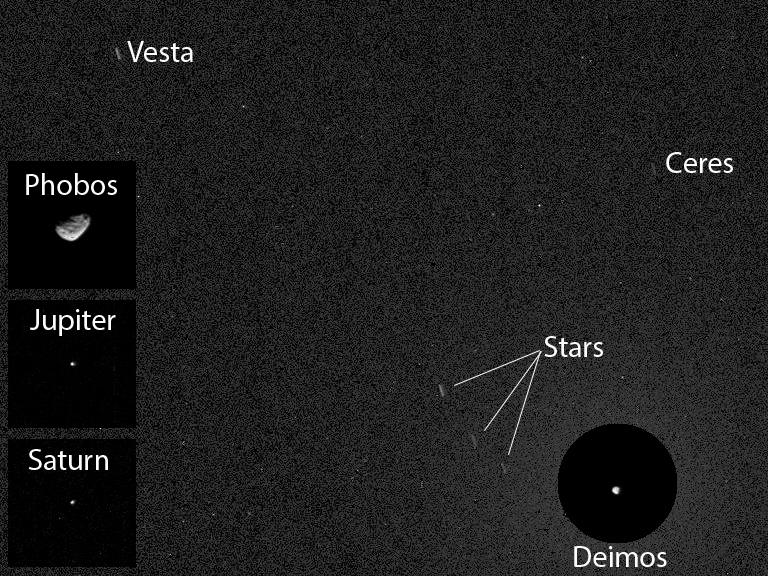
It's time to be a good environmentalist and reuse the space news leftovers meme.  This week, after sharing the best of last week's space news from Overnight News Digest: Science Saturday (100% of California in drought) in Nourish: Growing lettuce on the ISS, Large meteor explosions more common than thought, and Earth Day on and above the planet, I still have a full meal of leftovers to serve before I collect this week's space news.  Nourish your curiosity (or be nourished by Curiosity, as the case may be) on them, beginning with NASA via Science Daily: Asteroids as seen from Mars -- A Curiosity rover first published April 24, 2014.
A new image from NASA's Curiosity Mars rover is the first ever from the surface of Mars to show an asteroid, and it shows two: Ceres and Vesta. These two -- the largest and third-largest bodies in the asteroid belt between Mars and Jupiter -- are the destinations of NASA's Dawn mission. Dawn orbited Vesta in 2011 and 2012, and is on its way to begin orbiting Ceres next year. Ceres is a dwarf planet, as well as an asteroid.
Here's the image.


Cool.

That's the most recent news.  For what's still to come, JPL/NASA presents LDSD: We Brake for Mars.

NASA tests a supersonic parachute under Mars-like conditions for future exploration.
Follow over the jump for Earth from space and space research that helps people on Earth.

Friday, February 7, 2014

Giant African Snails returning to Florida


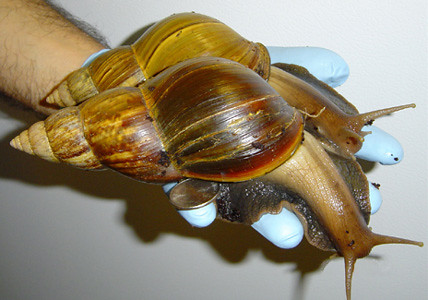
It's time for an update to Giant African Snails invading Latin America.  These animals have now returned to Florida after an earlier invasion was repelled.  Matt Simon of Wired tells the story of both invasions in Absurd Creature of the Week: Foot-Long, Sex-Crazed Snails That Pierce Tires and Devour Houses
Ah, the innocence of children. So free of corruption and cynicism, so sweet and sincere. Laughing and playing and introducing supremely destructive monster snails to Florida, where the beasts eat almost anything that’s green and then crap all over houses — quite literally laying waste to whole neighborhoods.

This actually happened in the 1960s, when a boy vacationing with his family in Hawaii had pocketed a few giant African land snails (Lissachatina fulica), a mollusk that grows to a foot long and a full pound. Hawaii had been battling the pest, and so too would Florida, where the boy returned with his new friends. Once home, he quickly grew bored of the snails and handed them over to his grandmother, who set them free in her backyard.

What ensued was an invasion by rapidly reproducing critters that have over the last century spread out of their native East Africa into tropical climes all over the world, from Asia to South America, as stowaways on ships or as pets brought home by people with a thing for snails. In Florida, eradication took seven years. Other places, like Brazil, have not been so lucky in their efforts.
At least the first invasion had a happy ending for Florida, if not for the snails.  Follow over the jump for the tale of the second invasion.

Friday, February 22, 2013

WNWO-TV adds to local coverage of Russian meteor

In Coverage of the meteor on the local news, I included clips from three of the four local and regional stations I follow on YouTube, WXYZ in Detroit, WOOD-TV in Grand Rapids, and WCPO in Cincinnati.  Today, the fourth one, WNWO-TV in Toledo, finally added its take on the event in Local reaction to meteorite dangers.

People's eyes are to the skies following the cosmic collision in Russia when a meteorite blew up in the day time skies on Friday.

This has raised the question of just how safe are we from meteors and asteroids hurdling towards earth.
Adam Mann of Wired details one way of moving Earth-crossing objects so they don't collide with us in How to Deflect Killer Asteroids With Spray Paint
A fresh paint job might be all that’s needed to prevent a giant asteroid from raining destruction upon our planet.

Though strange-sounding, the strategy would make use of a real-world phenomenon known as the Yarkovsky effect, named for the Russian engineer who discovered it in 1902. The effect results from the fact that asteroids heat up as they bask in the sun’s light.

“The coat of paint would be a very thin, almost like a Saran Wrap layer,” said aerospace engineer David Hyland of Texas A&M, who leads a team that has been studying this method for several years. “If we push it in the right direction, we can get the asteroid to cease crossing Earth’s orbit and completely eliminate the threat.”
That qualifies as an answer to the reporter's query about non-Bruce Willis/Deep Impact ways of solving the problem, one I'm all in favor of.  As I wrote over at Kunstler's blog Monday:
There are more ways for civilization to end than resource depletion and pollution, and an asteroid impact is one of them. Just in case modern technological civilization does survive the Long Emergency, preparing for such an event might be a good idea.

Wednesday, February 20, 2013

Stocks climbing a wall of worry with lots to worry about

With stocks reaching new multi-year highs, it's time to do an update of Math and the market.  First, Bloomberg Businessweek with the headline and highlights of the trading day.

U.S. Stocks Rise to Five-Year Highs Amid Merger Optimism
U.S. stocks advanced, sending benchmark indexes to their highest levels in five years, on increasing optimism over dealmaking and a report showing rising investor confidence in Germany.
...
The Standard & Poor’s 500 Index increased 0.7 percent to 1,530.94 at 4 p.m. in New York. The Dow Jones Industrial Average advanced 53.91 points, or 0.4 percent, to 14,035.67. Both indexes closed at their highest levels since October 2007. About 6.5 billion shares exchanged hands on U.S. exchanges, 6.5 percent above the three-month average. U.S. equity markets were closed yesterday for the Presidents Day holiday.
...
The S&P 500 completed its seventh consecutive weekly advance on Feb. 15, climbing 0.1 percent for the five days amid optimism over corporate merger activity and better-than- estimated economic data. The benchmark gauge is 2.2 percent below its 2007 all-time high of 1,565.15, while the Dow is 0.9 percent from its record high of 14,164.53.
I might be wrong about what I said last time.
I'm wary of this being as good news as people think it is.  The last time I recall hearing so much optimism was in June 2005.  The news on the radio trumpted record home sales and prices.  I took it as a sign of a market top and immediately drove to the nearest real estate office to my home in the Irish Hills and listed my house for sale.  The house sold in April 2006 and closed in May 2006, just as the bottom was about to fall out.  That was good news for both me and the deer.  That experience makes me suspect we're near a market top for now and that the Dow is more likely to drop 1,000 points than it is to rise to a new nominal record.
The Dow still hasn't reached a new nominal record, so the market could still sputter out just short of the level, although I'm beginning to suspect it might just make it and then start declining as a result of the sequester that will result if the latest installment of the Satan Sandwich/Fiscal Bluff isn't resolved.

On the other hand, I still stand by my conclusion.
A lot of the fundamental issues are still there, including overconfidence, greed, and lack of regulation.
Follow over the jump for the latest research about these topics.

Saturday, February 9, 2013

Updates on Nemo and Super Bowl blackout

Two updates, first on Nemo and then on the Super Bowl blackout.

Here's the latest on the storm from USA Today as reprinted in the Detroit Free Press.

'Nemo' blizzard turns deadly; massive power outages in Northeast
By Gary Strauss, Doyle Rice and Kevin McCoy
February 9, 2013
A deadly blizzard of epic proportions pounded the Northeast, already bringing more than 3 feet of snow to some areas and cutting power to 650,000 homes and businesses.

More than 3 feet had fallen on central Connecticut by Saturday afternoon, and areas of southeastern Massachusetts, Rhode Island and New Hampshire notched 2 feet or more of snow — as the storm began to wane.

The storm is being blamed on at least six deaths, three in Canada and three in the USA. A 74-year-old man died after being struck by a car in Poughkeepsie, N.Y.; the driver said she lost control in the snowy conditions, police said. A second New Yorker, 23, died when a tractor he was using to plow his driveway went off the edge of the road. And a pedestrian was struck by a vehicle and killed Friday night in Connecticut, police said.
The storm may be a disaster, but the naming was a success, as documented in Naming Nemo: How the Storm Got Its Name by Larry O'Hanlon at Discovery News.
Back in October 2012, everybody was poohooing The Weather Channel’s (TWC) plan to start giving names to significant winter storms. Now it looks like a large number of reports on the storm, dubbed Nemo by TWC, have adopted the name (not all, by any means, but lots, including Discovery News).

What happened? I’ll say it in three words: search engine optimization. Despite very reasonable arguments against the naming of winter storms by many meteorologists, we are seeing them adopted anyway.
Finally, another take on the Super Bowl blackout from Wired.

How Much Gasoline Would It Take to Power the Superdome?
By Rhett Allain
02.04.13
Surely you are aware that there was a power issue during Super Bowl XLVVII in the Superdome. So, some of the lights went out near the beginning of the second half of the game.

I’m not entirely sure there is a backup generator for the Superdome, but what if there is? What if the power went out and they wanted to continue the Super Bowl using a generator. How fast would that thing use gasoline?
The answer is one tanker truck per hour and a half.  That deserves last month's Nablopomo badge.


Friday, August 10, 2012

FBI declares ICP and Juggalos a gang; ICP sues

Here's a story about the intersection of crime and pop music I originally posted it to unfunny_fandom on JournalFen that definitely fits this blog's point of view, "a science fiction slant and a Detroit perspective." The premise is definitely science-fictional and Insane Clown Posse hail from Detroit.

I present to you some unfunny about a fandom that does unfunny things in a funny way--Juggalos. It seems that the fans of Insane Clown Posse have become decidedly unfunny to law enforcement and the FBI has made some Foolish Ballistic Insinuations as a consequence.

Last fall, the FBI included Juggalos in their National Gang Assessment for 2011 (PDF). On pages 22 and 23, the FBI lists them under "non-traditional gangs," calling them a "loosely-organized hybrid gang." Some of the criminal activities carried out by ICP fans appear in this section, along with a photo of a Juggalo with a gun that the FBI took from the ATF (trigger warning for descriptions of violence).


At first, the inclusion of Juggalos in the FBI's list was mocked by Spencer Ackerman at Wired, who observed "[t]he FBI has recently had difficulty distinguishing ordinary American Muslims from terrorists; now it appears it has a similar problem distinguishing teenage fads from criminal conspiracies." As recently as Thursday, the Village Voice posted that people thought the FBI report was an example of "another example of a federal agency looking foolish for its cultural ineptitude." That was until the U.S. Marshal Service issued a press release listing the fugitives added to New Mexico's Most Wanted.
Mark Anthony Carslon A.K.A. Mark Carlton is wanted on two felony warrants for failing to comply with the terms of probation both on underlying armed robbery cases. Carlson is a member of the Insane Clown Posse “Juggalo” gang. The “Juggalos” were recently classified as a gang by the Albuquerque Police Department Gang unit and it is believed that Carlson is still actively committing armed robberies in the Albuquerque Metro area.
Bolding from The Village Voice, who also reproduced Carlson's wanted poster, which listed his criminal affiliation as "Insane Clown Posse 'Juggalo'." Poster over the jump.

Tuesday, January 31, 2012

Peak Oil in Wired and Forbes

I posted the following in Overnight News Digest: Science Saturday (Science of Conflict edition) over at Daily Kos. Instead of including it in a sustainability news linkspam, even as the top story, I decided it deserved a post of its own.

Ars Technica via Wired: Researchers Argue Peak Oil Is Here, Bringing Permanent Volatility
By John Timmer, Ars Technica
January 26, 2012
The global production of oil has remained relatively flat since 2005 and peaked in 2008, declining ever since even as demand has continued to increase. The result has been wild fluctuations in the price of oil as small changes in demand set off large shocks in the system.

In Wednesday’s issue of Nature, James Murray of University of Washington and David King of Oxford University argue this sort of volatility is what we can expect going forward, and we’re likely to face it with other fossil fuels as well.

The notion of peak oil is fairly simple: Oil is a finite resource and at some point we simply won’t be able to extract as much as we once did. There is no getting around that limit for any finite resource. The issue that has made peak oil contentious, however, is the debate over when we might actually hit it. Murray and King are not the first to conclude that we’ve already passed the peak. Even as prices have climbed by about 15 percent per year since 2005, production has remained largely flat.
...
“We are not running out of oil,” the authors argue, “but we are running out of oil that can be produced easily and cheaply.”
It's not just the scientists in Nature and the geeks in Ars Technica and Wired that are recognizing that peak (conventional) oil is here. The hard-headed businessmen at Forbes have realized this, too.

The End of Elastic Oil
By Tim Conrad
January 26, 2012
The last ten years have brought a structural change to the world oil market, with changes in demand increasingly playing a role in maintaining the supply/demand balance. These changes will come at an increasingly onerous cost to our economy unless we take steps to make our demand for oil more flexible.

We’re not running out of oil. There’s still plenty of oil still in the ground. Oil which was previously too expensive to exploit becomes economic with a rising oil price. To the uncritical observer, it might seem as if there is nothing to worry about in the oil market.

Unfortunately, there is something to worry about, at least if we want a healthy economy. The new oil reserves we’re now exploiting are not only more expensive to develop, but they also take much longer between the time the first well is drilled and the when the first oil is produced. That means it takes longer for oil supply to respond to changes in price.

In economic terms, the oil supply is becoming less elastic as new oil supplies come increasingly from unconventional oil. Elasticity is the term economists use to describe how much supply or demand responds to changes in price. If a small change in price produces a large change in demand, demand is said to be elastic. If a large change in price produces a small change in supply, then supply is said to be inelastic.
The Forbes article isn't explictly about Peak Oil, but it does discuss what happens when supply has reached the bumpy plateau and what can be done about it. One of the best lines involves reducing demand by living closer to work, including the line "the most fuel-efficient vehicle is a moving van." I resemble that remark.
From 2000-2004, I regularly put 40,000 miles on my car. In 2005, I began driving 1000 miles a week when school was in session to three different colleges and a tutoring service. Then on the weekends, I'd judge marching bands or cover drum and bugle corps shows. From May 2005 to May 2006, I drove 48,000 miles. That was the year I put my house up for sale, stopped seeing my long-distance girlfriend, and eventually sold my house. In June, I moved to the middle of my jobs and cut my driving down to 700 miles a week. Then I changed one of my jobsites and cut it down to 500 miles a week. Then I got a full-time job and quit my part-time jobs and dropped to 300 miles a week. Finally, we moved and I now drive 70 miles a week. I'm so close to work I could ride a bike on a good day.
I still haven't put another 1000 miles on my car since my last update. That was in September. Look for the next one within a week.

Sunday, January 29, 2012

Feds find Volt's battery safe

In Good automotive news to begin 2012, I embedded a WXYZ-TV video on YouTube reporting that the issues with the Volt's battery have been resolved and suggesting that the car will be found safe to drive. Last week WXYZ followed up.


The Chevy Volt was on the hot seat during a hearing about the recent fires following crash tests.
The fossil fools behind the GOP are again attacking the green energy agenda of the current administration and making false claims that the Volt is not a market-based solution. As the reporter pointed out, the Volt was approved for production before the bailout and government takeover, which worked out rather well, thank you very much. So much for that claim!

As for the safety concerns, I'll let Wired take over for me.

Feds Say Volt Is Safe, Close Battery Inquiry
By Chuck Squatriglia
January 20, 2012
Federal regulators have closed their investigation into the Chevrolet Volt, saying they are satisfied with the steps General Motors has taken to protect the car’s lithium-ion battery and minimize the risk of a fire in the days and weeks after a severe crash.

The National Highway Traffic Safety Administration posted an explanation and summary of its inquiry on Friday and announced the conclusion of the investigation it launched Nov. 25.

“The agency’s investigation has concluded that no discernible defect trend exists and that the vehicle modifications recently developed by General Motors reduce the potential for battery intrusion resulting from side impacts,” the feds said in a statement.

The statement adds, “Based on the available data, NHTSA does not believe that Chevy Volts or other electric vehicles pose a greater risk of fire than gasoline-powered vehicles.”
A battery is no worse and probably much better than a gas tank for immediate fire risk. Also, electrical fires in cars are nothing new. In fact, I lost a car to electrical issues 28 years ago.*  Therefore, I'm less than impressed with the argument that the Volt is any more dangerous than anything I've been driving for the last 30+ years.  In fact, it's probably safer!**