A blog about societal, cultural, and civilizational collapse, and how to stave it off or survive it. Named after the legendary character "Crazy Eddie" in Larry Niven and Jerry Pournelle's "The Mote in God's Eye." Expect news and views about culture, politics, economics, technology, and science fiction.
Could mosquitoes be the key to fighting deadly diseases?
In Medellín, Colombia, a mosquito factory breeds millions of mosquitoes every week… on purpose. Why? To stop the spread of dengue, a mosquito-borne disease infecting millions of people each year.
At the World Mosquito Program, scientists infect Aedes aegypti mosquitoes with a naturally occurring bacterium called Wolbachia, which blocks their ability to transmit viruses like dengue, Zika, yellow fever, and chikungunya. Once released, these mosquitoes breed with wild populations and spread Wolbachia, reducing disease transmission between humans.
But not everyone is convinced. Wolbachia doesn’t work the same way in every context. The effects vary by mosquito species, environment, and virus. So –while promising– this approach isn’t without its own risks. Can biocontrol outsmart one of the deadliest animals on Earth, or are we venturing into ecological territory we don’t fully understand?
The mosquito factory should look familiar to long-time readers, as the third video in Using biotechnology to eliminate and control mosquitoes for an early celebration of World Mosquito Day explained it. I'm recycling my reaction from three years ago: "Using one parasite that doesn't affect humans to reduce the ability of an insect to spread a parasite harmful to humans — clever! It's also not forever in the same way genetic modification is. Fine by me."
As for Jason Rasgon's doubts and criticisms, I'm filing them under two of Commoner's Laws, "Everything is connected to everything else" and "There is no free lunch." Compared to genetically engineering the mosquitos, I think infecting them with Wolbachia is an example of a third law, "Nature knows best."
By the way, I've never mentioned cane toads on this blog before, but they're one of the organisms my students use for their answers to a question on the final exam for my organismal biology class. Since I just graded those exams yesterday, cane toads are fresh on my mind. That's a story my students tell me.
I've often heard that EVERYONE thinks they're an above average driver. Well, I wanted to look at data to see if it's actually true, share research on how the Dunning-Kruger effect impacts driving, and look at wider consequences on our transportation system.
I've been blogging for 15 years and I've never mentioned the Dunning-Kruger effect until now? I'm amazed. I've had so many opportunities to apply it, especially during two administrations of "only the best people." *Snort*
That written, I'm not surprised at either people's inflated self-assessments of their driving skills or how poor they really are. I wish I weren't surprised that the people who did the worst actually upgraded their self-assessments after doing poorly. I guess they thought they did better than they expected. And I have to share the road with them? Ugh.
That's the general driving situation. Follow over the jump for my personal driving update.
For generations, we’ve been pumping water out of the ground assuming it would last forever. But, it’s running out. And a new study shows how global “peak water” could be just around the corner. In this episode, we’ll find out WHEN and WHERE peak water is expected to hit.
Groundwater depletion is only one of the effects May describes and I list as a result of over-pumping groundwater. So are subsidence, saltwater contamination, contamination from other surface sources, and decreased recharge of surface water from groundwater, which results in loss of riparian (streamside) vegetation, among other undesirable things. That makes this video one of the stories I tell my students. It also means that, if I show it to them, this entry becomes another instance of blogging as professional development.
I close by noting that I had heard that Indonesia was building a new capital city, but I didn't know why until I watched this video — subsidence exacerbated by sea level rise. That means I learned something new, and it's always a good day when that happens.
That's a wrap for today's post. Stay tuned for tomorrow's educational entry, which will be a CityNerd video about drivers and a drivingupdate, since Pearl will pass 70,000 miles today.
Just like the Critics Choice Super Awards, where I predicted Dune: Part Two would win and it did, I wrote "the fans will vote for Dune: Part Two." They did and it won. Congratulations!
I completely blew the next two categories.
While Doctor Who “Dot and Bubble” and all of Star Trek: Lower Decks Season 5 earned nominations at the Nebula Awards, since both franchises have two nominees, they might suffer from vote splitting. If so, it will open the door for either Agatha All Along or Fallout, winners of Best Superhero Television Series and Best Science Fiction Television Series at the Saturn Awards, respectively, to walk through and claim the rocket trophy. If so, I think it will be Fallout. If not, then I predict it will be the Doctor Who episode, “Dot and Bubble.”
Nope, the fans not only rallied around Star Trek: Lower Decks, they picked a favorite episode. Star Trek: Lower Decks: "The New Next Generation" may not win an Emmy Award — I still expect it will be Love, Death & Robots or Arcane, both of which have won juried Emmy Awards already — but it won a Hugo Award. This is another case where I'm glad to be wrong.
I blew the next category by completely missing it. Comics Beat reported "Ryan North and Chris Fenoglio‘s choose-your-own-adventure book Lower Decks: Warp Your Own Way won Best Graphic Story or Comic" in STAR TREK: LOWER DECKS bows out with two Hugo Awards. Congratulations!
I also blew game or interactive work.
1000xRESIST was the only game nominated at the Hugo Awards also nominated at the Nebula Awards, but I don't think that will sway the fans because they probably weren't playing it. Instead, they'll vote for a game they actually played. Based on watching streamers on Twitch, I think the most played games in this field were Dragon Age: The Veilguard and The Legend of Zelda: Echoes of Wisdom. Between those two, I'd vote for Dragon Age: The Veilguard, as popular and fun as the Zelda games are.
I was right that 1000xRESIST wouldn't win, but neither of my choices won. I may be following the wrong Twitch streamers, but I don't recall any of them playing Caves of Qud, which won. Surprise and congratulations!
I stated my preferences for one last category.
I'm making an observation on Best Related Work before I conclude this entry. I suspect r/Fantasy’s 2024 Bingo Reading Challenge will win, but I'm rooting for “The Spectacular Failure of the Star Wars Hotel” by Jenny Nicholson. It's her second Hugo nomination, and it examines an experiment that apparently succeeded critically but definitely failed commercially. Since Disney is in business to make money, it closed.
Neither won. Instead, Speculative Whiteness: Science Fiction and the Alt-Right by Jordan S. Carroll did. I'm not surprised. The Hugo Awards successfully fought off the Rabid Puppies, but they have infected the rest of society. File that under winning the battle, but (so far) losing the war. Sigh.
That's a wrap for today's post. I already have educational entries planned for Monday and Tuesday, followed by World Mosquito Day on Wednesday. Stay tuned.
There's a strange bee called the alkali bee. And in one small valley in Washington, it's worth its weight in gold.
In Walla Walla Valley, farmers depend on alkali bees, a native species essential to one of the country’s most overlooked crops: alfalfa seed. In fact, the work of these tiny pollinators generates millions of dollars in agricultural revenue. Unlike honey bees, alkali bees take a pollen-packed smack to the face without hesitation, powering through millions of flowers with speed and precision. But alkali bees can’t be boxed, transported, or bought. They nest in the ground, require salt-crusted soil, precise irrigation, and near-perfect conditions to thrive.
In this episode of Human Footprint, Shane Campbell-Staton visits the only place on Earth where solitary, ground-nesting bees are managed for large-scale agriculture. He meets third-generation farmer Mark Wagoner and entomologist Doug Walsh, who’ve each played a role in transforming this agricultural landscape into a living partnership with native pollinators.
Shane uncovers the extraordinary steps to keep these bees alive: building salt-encrusted bee beds, spraying pesticides late at night, and even rerouting a state highway. But supporting alkali bees is more than just innovative farming, it’s a glimpse into what it might take to protect WILD pollinators in a world built for honey bees.
This video ties into Vox explains 'What we get wrong about saving the bees' for World Honey Bee Day. According to the video description, "There are 20,000 other species of bees in the world — over 4,000 in the United States. They’re incredibly diverse, unique, and also important for pollination." Alkali bees fit that description perfectly. They also serve as an example of one of Commoner's Laws, "Nature knows best." That's a law I would like to cite more often.
Anand Varma shakes things up in his photography by studying the life of a honey bee and creating a story that most humans have never seen before!
I'm a zoologist and I've never seen honey bee metamorphosis before, so I'm sure most humans haven't seen it, either. File this under "It's a good day when I learn something new."
This episode of Photographer was nominated for Outstanding Science and Technology Documentary at the News & Doc Emmy Awards, but didn't win, although another episode won Outstanding Nature Documentary. Follow over the jump for the winner of Outstanding Science and Technology Documentary.
Conan O'Brien: The Kennedy Center Mark Twain Prize for American Humor (Netflix)
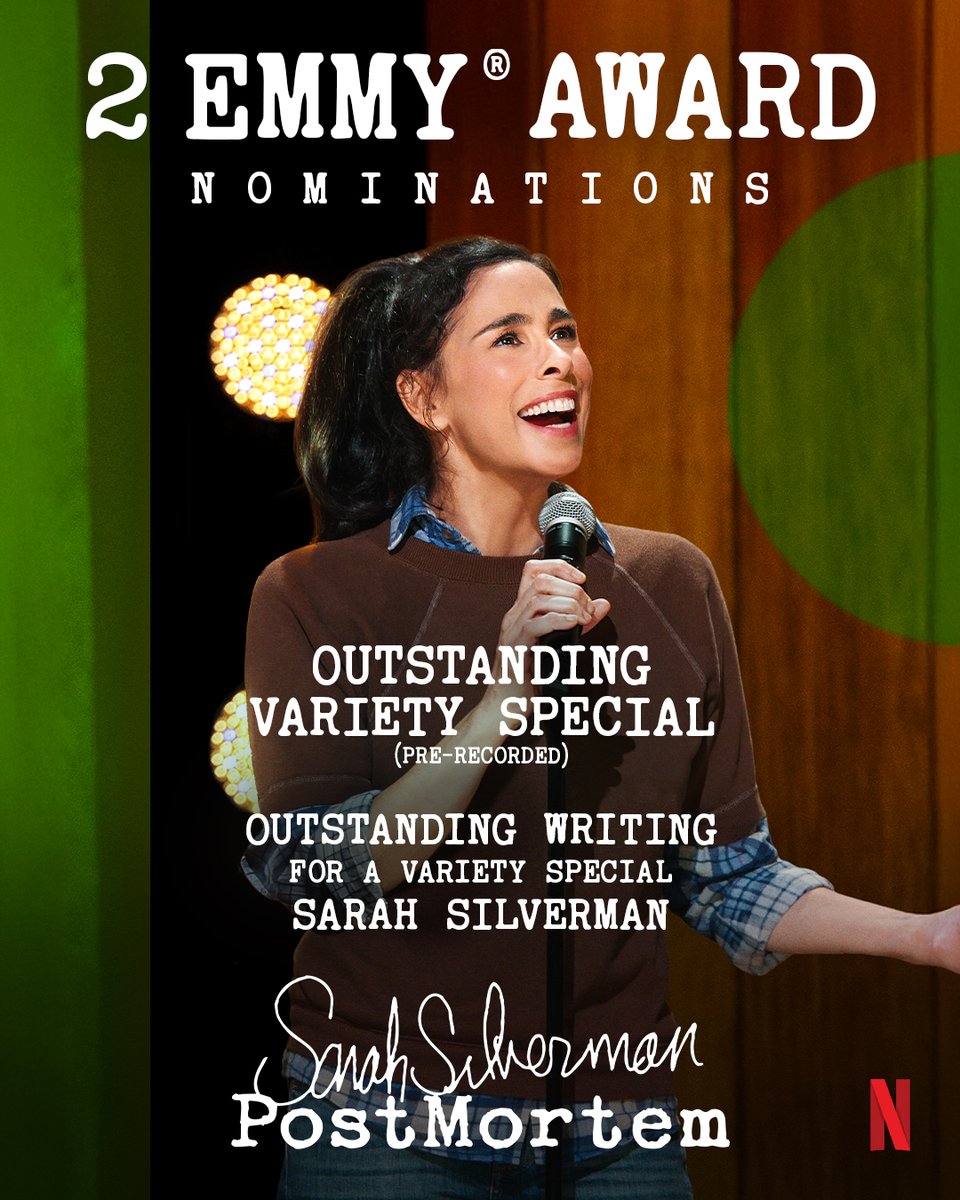
Sarah Silverman: PostMortem (Netflix)
Your Friend, Nate Bargatze (Netflix)
Your Friend, Nate Bargatze leads with three nominations, followed by Ali Wong: Single Lady, Bill Burr: Drop Dead Years, Conan O'Brien: The Kennedy Center Mark Twain Prize for American Humor, and Sarah Silverman: PostMortem at two each, then Adam Sandler: Love You with only this one. Gold Derby's odds give a different order, with every editor and expert along with 81.1% of users choosing Conan O'Brien: The Kennedy Center Mark Twain Prize for American Humor to win. Critics Choice and Golden Globe winner Ali Wong: Single Lady sits in second with the support of 12.9% of users, followed by Adam Sandler: Love You at 2.7%, Your Friend, Nate Bargatze at 1.5%, Sarah Silverman: PostMortem at 1.1%, and Bill Burr: Drop Dead Years at 0.8%. Based on these odds, whoever wins, Netflix will, too.
Outstanding Writing for a Variety Special
Conan O'Brien: The Kennedy Center Mark Twain Prize for American Humor – Jon Macks, Chris Convy, Lauren Greenberg, Skyler Higley, Ian Karmel and Sean O'Connor (Netflix)
Cunk on Life – Charlie Brooker, Ben Caudell, Erika Ehler, Charlie George, Eli Goldstone, Jason Hazeley, Lucia Keskin, Diane Morgan, Joel Morris and Michael Odewale (Netflix)
Sarah Silverman: PostMortem – Sarah Silverman (Netflix)
SNL50: The Anniversary Special – James Anderson, Dan Bulla, Megan Callahan-Shah, Michael Che, Mikey Day, Mike DiCenzo, James Downey, Tina Fey, Jimmy Fowlie, Alison Gates, Sudi Green, Jack Handey, Steve Higgins, Colin Jost, Erik Kenward, Dennis McNicholas, Seth Meyers, Lorne Michaels, John Mulaney, Jake Nordwind, Ceara O'Sullivan, Josh Patten, Paula Pell, Simon Rich, Pete Schultz, Streeter Seidell, Emily Spivey, Kent Sublette, Bryan Tucker and Auguste White (NBC)
Your Friend, Nate Bargatze – Nate Bargatze (Netflix)
SNL50: The Anniversary Special would definitely win a game of "one of these things is not like the others" in this field, as it's the only live variety special and non-Netflix show nominated. The prognosticators at Gold Derby think it will win the award, too, as 83.3% of experts, 75% of editors, and 84.1% of users have picked it. Conan O'Brien: The Kennedy Center Mark Twain Prize for American Humor sits in second with the support of 16.7% of experts, 25% of editors, and 6.0% of users, followed by Cunk on Life with 5.6% of users, Your Friend, Nate Bargatze with 2.8%, and Sarah Silverman: PostMortem with 1.6%. Note that the writing teams rank higher than the solo writer-performers. Also, Silverman may be last, but she's featured because she's the one nominee running a campaign whose image I haven't already used mentioning this category. Consider it a consolation prize.
Outstanding Picture Editing for Variety Programming
Ali Wong: Single Lady – Sean Hubbert (Netflix)
Bill Burr: Drop Dead Years – Kelly Lyon (Hulu)
Conan O'Brien: The Kennedy Center Mark Twain Prize for American Humor – Bill DeRonde and Timothy Schultz (Netflix)
Cunk on Life – Damon Tai and Jason Boxall (Netflix)
Your Friend, Nate Bargatze – Sean Hubbert (Netflix)
On the other hand, I'm featuring Ali Wong because her special was the only one nominated by the American Cinema Editors, so it's my pick to win.
That's a wrap for today's installment and also a wrap for all the program categories at the Creative Arts Emmy Awards except Emerging Media. I might cover those when I blog about live variety specials. That won't be until next week. In the meantime, stay tuned for World Honey Bee Day tomorrow, the Hugo Award winners for the Sunday entertainment feature, something educational on Monday and maybe Tuesday, and World Mosquito Day on Wednesday. I have my blogging cut out for me.
Previous posts about the 77th Primetime Emmy Awards
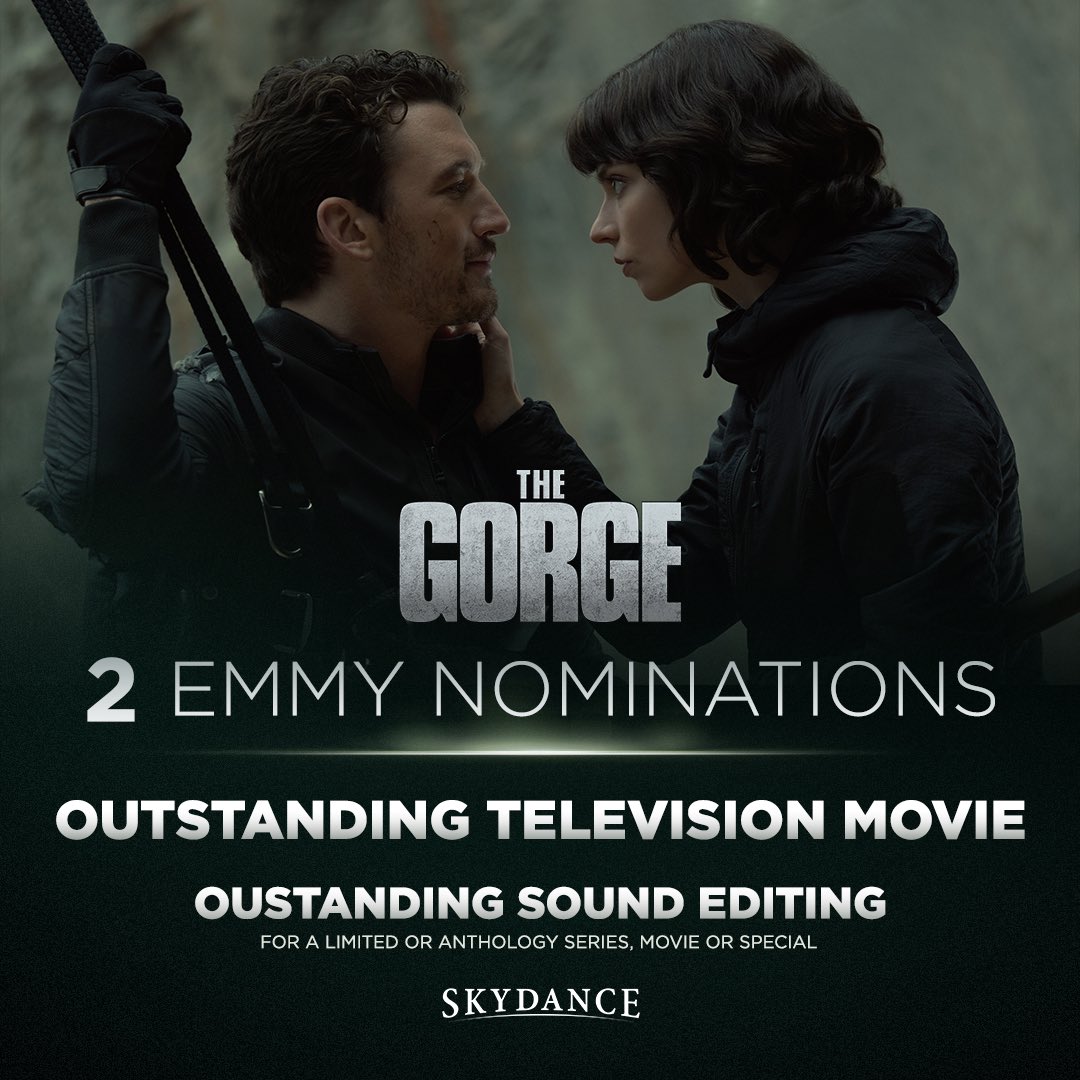
The Gorge is the only television movie with a second nomination, but it's in last place in Gold Derby's odds. Every expert and editor along with 85.6% of users prefer Rebel Ridge. The remaining users are split among Bridget Jones: Mad About the Boy with 8.6%, Mountainhead with 2.2%, and Nonnas and The Gorge tied at 1.8% each. The Gorge probably has a better chance of winning an Emmy in the next category.
Outstanding Sound Editing for a Limited or Anthology Series, Movie or Special
Adolescence: "Episode 1" – James Drake, Michele Woods, Emma Butt, Rob Davidson, Jessica Watkins, Oli Ferris, and Sue Harding (Netflix)
Black Mirror: "USS Callister: Into Infinity" – Tom Jenkins, Alex Sawyer, James Hayday, Rob Davidson, Arthur Graley, Poppy Kavanagh, Oliver Ferris, and Sue Harding (Netflix)
The Gorge – Ethan Van der Ryn, Erik Aadahl, Paul Hackner, Darren Maynard, David Farmer, Frederic Dubois, David V. Butler, Stephanie Brown, Jonathan Greasley, Jason W. Jennings, Nolan McNaughton, and Sally Boldt (Apple TV+)
The Penguin: "After Hours" – Rich Bologna, Larry Zipf, Michael McMenomy, Angela Organ, Tony Martinez, Wyatt Sprague, Diego Perez, Matt Haasch, Ben Holiday, Luke Dennis, and Gareth Rhys Jones (HBO)
Star Trek: Section 31 – Matthew E. Taylor, Michael Schapiro, Austin Olivia Kendrick, Sebastian Sheehan Visconti, Sean Heissinger, Andrew Twite, Alex Pugh, Kip Smedley, Deron Street, Clay Weber, Moira Marquis, Alyson Moore, and Katie Rose (Paramount+)
That's a wrap for today's post. Stay tuned to see if I continue this series tomorrow, likely with the nominees for Outstanding Variety Special (Pre-Recorded).
Previous posts about the 77th Primetime Emmy Awards
Beneath the streets of Los Angeles lies one of the most prolific fossil sites in the world. At the La Brea Tar Pits, millions of fossils including giant sloths, dire wolves, saber-toothed cats, and mammoths have surfaced from ancient asphalt, offering a rare glimpse into a vanished world.
In this episode of Human Footprint, Shane Campbell-Staton joins paleontologist Emily Lindsey to investigate the sudden disappearance of North America’s megafauna around 13,000 years ago. Together, they follow the trail of ancient life through radiocarbon dating, fossil excavations, and lake-bottom sediment cores.
For decades, scientists debated whether climate change or human hunters were to blame. But new evidence points to a more complex and unsettling cause: a dangerous combination of warming temperatures, ecological disruption, and the spread of fires… ignited by us.
This isn’t just a story about extinction. It’s a glimpse of how past crises mirror the present, and a warning about where we could be headed next.
When I was doing my research at the Tar Pits 40 years ago, I became quite familiar with the competing hypotheses of climatechange and human overhunting (Paul Martin's overkill hypothesis) causing the terminal Pleistocene extinctions of New World megafauna. However, I also realized that overkill didn't replicate perfectly around the world. Humans arrived earlier in Australia than in the Americas, but it took thousands of years for the Australian megafauna to go extinct. The same was true in northern Eurasia, which had other humans, the Neanderthals and Denisovans, already living there for hundreds of thousands of years before modern humans arrived. And, of course, where the megafauna had co-evolved with human ancestors in Africa and southern Asia, most of the large animals survived into the present. I resolved these data by synthesizing them; late Pleistocene extinctions happened during the first episodes of major climate change after modern humans were first present. The mechanism I had in mind was that climate change stressed the populations of megafauna, which then couldn't withstand human hunting. That ancient humans could make the effects of climate change worse never occurred to me. As Shane Campbell-Staton said, "That is a plot twist I wasn't expecting."
Just because I wasn't expecting it either doesn't mean I don't accept it. I do. After all, I've been watching the fire season expand in California over the past 15 years. I even ask my students two questions about in the worksheet for Chasing Ice: "1. Chasing Ice opens with a montage of natural disasters. Name three of them." One of them is a wildfire. "How many months has the fire season increased in the American southwest since the 1980s?" The answer is two months, although last year's California fire season extended about four months into January, which I recounted in PBS Terra tells 'The REAL Story of the LA Fires | Full Documentary' for Flashback Friday. As Campbell-Staton said, this is uncomfortably familiar.
[P]rocesses that happened in the past are likely to repeat in the future, so understanding the past is essential for preparation. This is a key takeaway from uniformitarianism, the concept that everything we see in nature is the result of everyday processes occurring over sufficient time, which is boiled down to "the present is the key to the past." It also means that the past is the key to the future.
File all the above under "it's a always a good day when I learn something new."
I also felt a lot of nostalgia seeing where I spent much of four years, but this entry has gone on long enough. Time to wrap it up. Stay tuned for another entry about the Creative Arts Emmy Awards.
Arcane, Love, Death & Robots, and The Simpsons all have two nominations, while Bob's Burgers and Common Side Effects have just this one. Gold Derby's odds break the tie at the top as all experts, three-quarters of editors, and 88.2% of users have chosen 2022 winnerArcane to return to the podium next month. The other quarter of the editors and 6.3% of users picked 2023 winner The Simpsons to walk off with the statuette. The long-shot picks are Bob's Burgers with 2.8% of users, Common Side Effects with 1.7% of users, and Love, Death & Robots in last with 1.0% of users. Love, Death & Robots will have to get its Emmy elsewhere.
Outstanding Character Voice-Over Performance
Julie Andrews – Bridgerton: "Into The Light" as Lady Whistledown (Netflix)
Hank Azaria – The Simpsons: "Abe League of Their Moe" as Moe Szyslak (FOX)
Maya Rudolph – Big Mouth: "Why Do We Go Through Puberty?" as Connie the Hormone Monstress (Netflix)
Alan Tudyk – Andor: "Who Else Knows?" as K-2SO (Disney+)
Jeffrey Wright – What If...?: "What If... 1872?" as The Watcher (Disney+)
Steven Yeun – Invincible: "What Have I Done?" as Mark Grayson / Invincible (Prime Video)
Gold Derby expects Maya Rudolph to win for the fifth time since 2020 with the support of 85.7% of experts, all editors, and 72.2% of users. Alan Tudyk, who would be one of two nominees who would win a game of "one of these things is not like the others" because he's in a live-action show, sits in second with 14.3% of experts and 13.2% of users. Julie Andrews would be the other contestant in "one of these things is not like the others" and has 8.3% backing her. Steven Yuen has the support of 4.9% of users, while Hank Azaria and Jeffrey Wright are tied at 0.7% of users apiece.
Outstanding Sound Editing for an Animated Program
Arcane: "The Dirt Under Your Nails" – Brad Beaumont, Eliot Connors, Stephen P. Robinson, Janet "PJ" Pascual, Dan O'Connell, and John Cucci (Netflix)
Love, Death & Robots: "400 Boys" – Brad North, Craig Henighan, Dawn Lunsford, Jeff Charbonneau, and Alicia Stevens (Netflix)
Secret Level: "Warhammer 40,000: They Shall Know No Fear" – Matt Yocum, Brad North, Nolan McNaughton, Ryan Sullivan, Joseph Fraioli, Christopher Battaglia, Harry Cohen, Matt Manselle, Matt Tesley, and Brian Straub (Prime Video)
Star Trek: Lower Decks: "The New Next Generation" – James Lucero, Drew Guy, Konrad Piñon, James Singleton, John Wynn, Michael Britt, and Amber Funk (Paramount+)
What If...?: "What If... 1872?" – Mac Smith, Vanessa Lapato, Alyssa Nevarez, Steve Bissinger, Derek McGinley, Anele Onyekwere, Carl Sealove, Andrea Stelter Gard, and Sean England (Disney+)
Gold Derby does not have odds for this category, which is new, having been split off from comedy. My pick is the last animation winner, Love, Death & Robots, although both Arcane and Star Trek: Lower Decks are previous nominees.
Claire’s has filed for its second bankruptcy in seven years. Despite attempts to modernize, the company has not been able to overcome challenges including stiff competition from players like Shein, Temu, and TikTok Shop and increased costs related to tariffs. Watch the video to learn about the rise and fall of long-time American mall favorite Claire’s.
Competition with Shein, Temu, and TikTok Shop and tariffs — the first formed a major reason behind Forever 21filing for bankruptcy and closing all U.S. stores while the second contributed to Joann and At Home filing for bankruptcy. They may have been the first chains that blamed those factors, but they won't be the last. Of course, private equity played a part in the story, but CNBC didn't identify them as the cause of the debt Claire's couldn't pay. I may have to wait until Company Man or Bright Sun Films cover the chain to confirm that. Retail Archaeology? Erik examined the first bankruptcy seven years ago. I'll get to that.
As for what the future holds, the following graphic shows that Claire's is in bad company.
I already mentioned Joann and Forever 21. Add in PartyCity, Rite Aid, Tuesday Morning, Rue21, and Z Gallerie, and the list becomes a who's who of chains that no longer have physical locations in the U.S. or, in the case of Rite Aid, will soon close them. At least David's Bridal and True Religion Apparel still have stores open, but 20% odds are not good.
In this episode we take a look at Claire's, a retailer that operates in 95% of malls in the United States. In March of 2018 Claire's filed for chapter 11 bankruptcy protection.
That was fun, if not all that informative. Still, better late than never.
I expect to see more about Claire's from the usual sources. When I do, I'll post it here. In the meantime, stay tuned for the next installment about EmmyAwardsnominees.