A blog about societal, cultural, and civilizational collapse, and how to stave it off or survive it. Named after the legendary character "Crazy Eddie" in Larry Niven and Jerry Pournelle's "The Mote in God's Eye." Expect news and views about culture, politics, economics, technology, and science fiction.
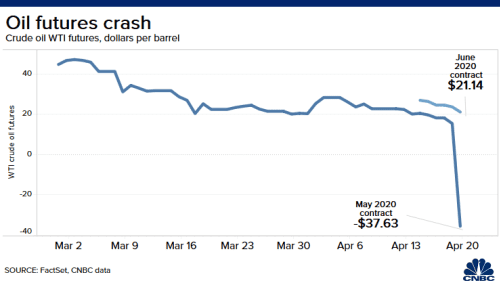
Something happened yesterday that I expectedwould never happen, oil dropping to or even below 1998 levels of $10-$20 a barrel.* In fact, it fell so far below that price that people holding oil contracts had to pay others to take it off their hands. CNBC has the story yesterday in Crude settles at -$37 a barrel in worst day ever.
Oil goes negative for the first time ever. Now what? With CNBC's Melissa Lee and the Fast Money traders, Guy Adami, Tim Seymour, Karen Finerman and Dan Nathan.
Wow, do her guests love Melissa Lee! On a more serious note, my understanding of why oil fell to negative levels is that the people and institutions holding the oil contracts would actually have to take possession of the oil when the contracts came due. Since they were only doing it for an investment and not for actual consumption, that's not what they really wanted to do. They needed to get rid of the oil to someone who could store it until it's refined and used. The problem is that there isn't much storage left as people aren't consuming oil to move around, so they had to pay people to take the oil instead of selling it and getting the money.
Follow over the jump for a more entertaining and professionally produced version of the explanation I wrote along with what the lower oil prices mean for consumers and a footnote.
Pearl rolled over 41,000 miles on July 17th and Snow Bear passed 3,000 miles yesterday, July 20th, so it's time for an update on oil and gas prices plus a double driving update.*
Prices at the pump are higher than they were last summer and President Trump is demanding oil prices be cut to bring them down. Ali Velshi breaks down how this could actually cost Americans a lot of jobs.
Crude oil, particularly West Texas Intermediate (WTI), fell below $70 after the May update, but were starting to rise again in late June, when Velshi reported on the story. They continued to rise into early July, when CBS This Morning asked What's behind the spike in gas prices?
Gas prices this Fourth of July are expected to be the highest in four years because of the rising cost of oil. One reason for the increase is a smaller-than-expected production boost by OPEC, the group of oil producing nations. Patrick DeHaan, head of petroleum analysis at GasBuddy, joins "CBS This Morning" to discuss what's behind the price increase.
Donald Trump jawboning the Saudis didn't have quite the effect he hoped, at least in the short term, as WTI soared above its highs in May. That continued the next week, as seen when Fox Business examined the economic impact of rising gas prices.
OPIS chief oil analyst Tom Kloza on the outlook for oil prices
The expiring U.S. West Texas Intermediate (WTI) crude for August delivery settled up $1.00 at $70.46 a barrel, while the more liquid September contract rose 2 cents to $68.26 a barrel. U.S. crude ended the week down nearly 1 percent.
Brent crude settled up 49 cents at $73.07 a barrel. Brent fell 3.1 percent in the week.
The decline in oil prices, which I usually see as a positive, was not the result of good news, as the Reuters article noted.
Lower oil demand in the United States and China caused by an economic slowdown due to the trade spat between the two countries would likely weigh heavily on markets, some analysts said.
“The impact on world economic growth of a levy of this magnitude will be severe and will likely have a strong negative impact on markets,” said Olaf van den Heuvel, chief investment officer at Aegon Asset Management.
Once again, Trump is doing things that increase the likelihood of the U.S. entering recession in the next year.†
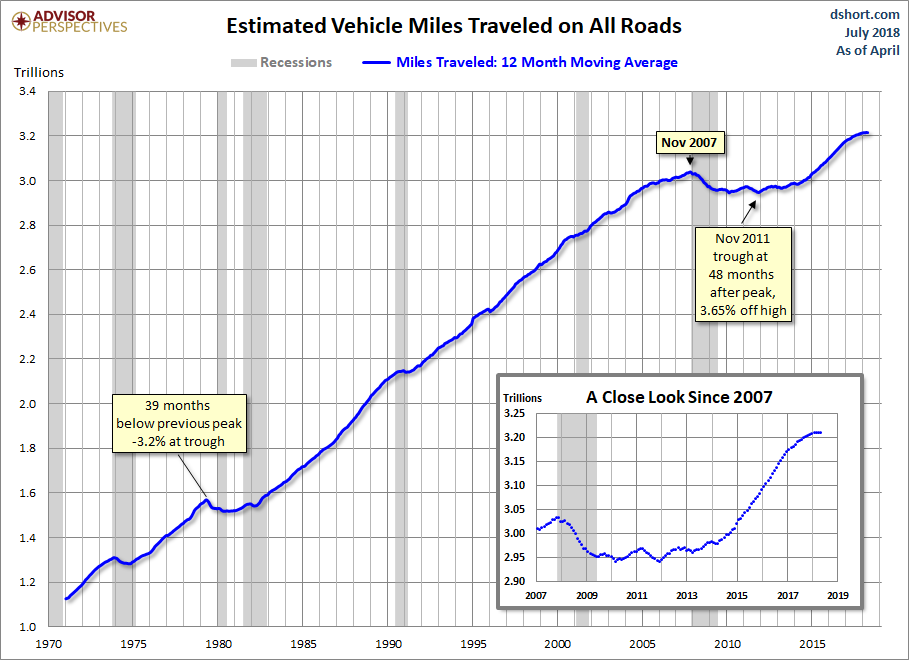
Speaking of which, an indicator that I've been following since before I started writing this blog has turned negative. Doug Short, quoting the U.S. Department of Transportation, reported on cumulative miles driven on July 2, 2018.
"Travel on all roads and streets changed by -0.2% (-0.5 billion vehicle miles) for April 2018 as compared with April 2017. Travel for the month is estimated to be 272.4 billion vehicle miles." The 12-month moving average was down 0.02% month-over-month and up 0.8% year-over-year. If we factor in population growth, the 12-month MA of the civilian population-adjusted data (age 16-and-over) is down 0.09% month-over-month and down 0.2% year-over-year.
On can see the recent decline in total miles driven in the U.S. on the following chart, especially in the inset "A Close Look Since 2007."
Higher gas prices are finally making people drive less. Fortunately, Amazon is making it easier for people to shop from home, allow retail sales to contine rising. That alone might keep the economy afloat longer than it would have otherwise.
Looks like my wife and I are contributing to the trend of increased driving. That might increase more, as oil and gas prices are down year over year, but that's a story for another entry.
Max Wolff, 55 Institutional, and Phillip Streible, RJO Futures, discusses the energy space with Courtney Reagan.
Oil-Price.Net shows today's close for WTI at $44.74, up more than a dollar from the $43.03 of three days ago, but it's still down year-over-year as well as down ~13.5% since the beginning of the year. That will result in lower gas prices, even with summer driving season in full swing. CNN Money reported on that last week in Summer gas prices dip to 12-year low.
The drop in the cost of oil has been a happy surprise for drivers, who are enjoying the cheapest gas prices at the start of summer in 12 years.
Twelve years ago was 2005, the year that conventional oil production began to peak. All of the unconventional oil that has been brought to market during the past few years is responsible for this price drop, a phenomenon I reported in Supply and demand still work for oil.
The number of Americans traveling by car for the Fourth of July holiday will hit a record high this year, fueled by a growing economy and relatively low gasoline prices, the nation's largest motorists' advocacy group said on Thursday. The forecast for strong driving numbers will be welcomed by U.S. refiners, which are banking on summer driving season to draw down high product inventories and resurrect margins from seasonal lows. The average U.S. price for regular gasoline was $2.28 per gallon on Wednesday, down slightly from $2.32 a year ago, according to AAA.
GasBuddy lists the U.S. average at $2.25 and the Detroit average at $2.34, both of which are down year-over-year.
Speaking of Supply and demand still work for oil, I am no longer confident in my long-standing prediction that the U.S. will head into recession by the end of this year. The lower gas prices, continuing low unemployment rate, and near-record-high stock indices all suggest that the U.S. economy is not headed for recession in the next six months. I'm delaying my prediction by one Friedman Unit, which is six months, so the deadline for the U.S. heading into recession is now one year from tomorrow. Enjoy the expansion while it lasts.
Thursday the 13th, Pearl the Prius turned over another 1,000 miles for the odometer to read 33,000 miles. That means it's time for another driving update.
It's been 56 days since Pearl passed 32,000 miles on February 16th. That translates to an average of 17.86 miles per day or 544.64 miles per standard month of 30.5 days. That's much less than the average of 24.39 miles per day and 743.9 miles per month of the last update. It's also in the range of 16.95 miles per day or 516.95 miles per standard month that I was driving the car between November and January. However, it is more than the 15.85 miles per day I had been averaging when I posted Driving update for March 2017: Dez. The week off from work at the beginning of March wasn't enough to keep my mileage down. However, it was exactly what I drove the same time last year, when I averaged 17.86 miles per day or 544.6 miles per standard month. At least I'm not up year over year for the same month!
I expect my miles will be less at the next update, as I will be off for the first week of May, after which I will be driving to fewer meetings and will no longer be teaching at the more distant campus. Then again, I expected that last year, but ended up driving more because Dez was in the shop for a week. Here's to hoping that doesn't happen again.
On a related note, the fear premium from the Syria missile strike hasn't kept building, but it hasn't abated either. Oil-Price.Net lists Friday's closings for WTI as $53.18 and Brent as $55.89. Both are up a little since last week's $52.24 for WTI and $55.24 for Brent, but down from earlier in the week, when Reuters reported WTI at $53.76 and Brent at $56.65. As for retail gas prices, Gas Buddy calculated the average price of unleaded regular in metro Detroit as $2.52, down a penny from last week. Some price spike!
Normally, I'd tell my readers to stay tuned for the Sunday entertainment post, but tomorrow is also Easter, which will probably take priority unless I find an entertainment angle for the holiday. That could still happen.
I haven't posted an update on oil prices since Supply and demand still work for oil last October. My last gas price report here came even longer ago than that in June's Oil falls after Brexit vote, pushing prices even lower. That's because local gas prices have been relatively stable, world oil prices have been rising so slowly as to be boring, and the election and subsequent transition have been much better shiny objects. That changed Thursday night, when Trump ordered a cruise missile strike on Syria. That event has had predictable effects on oil markets, as CNN reported yesterday morning in Oil prices leap after US missile strike.
Crude oil prices spiked after the US launched missile strikes against Syria. CNN's Paula Hancocks reports.
Oil prices rose on Friday, trading near a one-month high and closing the week up 3 percent after the United States fired missiles at a Syrian government air base, raising concern that the conflict could spread in the oil-rich region. ... Brent crude futures settled up 35 cents at $55.24. Brent reached a session high of $56.08, the highest since March 7, shortly after the U.S. missile strike was announced. For the week, Brent was up 4.4 percent.
U.S. West Texas Intermediate (WTI) crude futures were up 54 cents at $52.24 a barrel, off the session high of $52.94.
The wholesale price spike has already had an effect on retail gas prices, as Fox 4 in Ft. Myers, Florida, reported in Gas Prices Rise after Syrian Airstrike.
Overnight, U.S. gas prices went up 3 cents.
I saw the effects of the price spike when I drove through my old neighborhood yesterday to buy gas. The two stations down the street (the third has been demolished) were selling regular at $2.49, while the one at the corner near my old house was offering the same grade at $2.29. After using my rewards card, I was able to buy it as $2.26. Of course I filled up, since I expected prices to rise. That may have been premature. Three hours later, the two stations down the street dropped their prices 14 cents to $2.35. Given my four years of close observation of the three stations' interactions, that was very unusual; normally, the corner station with the high price lowered it to remain competitive. That behavior, which has all three stations selling well below the Detroit average of $2.53, suggests that the spike may be just that, a temporary panic-driven rise.
I'll keep watching the situation. If both Syria and the oil markets remain volatile, I'll report on them. Until then, stay tuned for Sunday's entertainment feature, when I plan on writing about the HugoAwards.
In the short term, the only good news out of all this is that oil will become cheaper. When the dollar rises, oil nearly always falls. I'll cover that in tomorrow's entry.
When I last looked at the oil markets in WXYZ on rising gas prices for May, I reported WTI at $47.75 and Brent at $48.72 on May 20 after peaking on May 18, when WTI hit $48.95 and Brent hit $49.85. WTI stayed below $50 until June 3, when it broke above $50 before setting its high for the year so far at $51.84 on June 8. It promptly fell, dropping below $50 on June 10 and staying there until Thursday, when it closed at $50.11. Then Leave won Thursday's vote.
Oil prices dropped Friday but erased some overnight losses after the U.K.’s vote to leave the European Union triggered a selloff across markets.
U.S. oil prices settled down $2.47, or 4.9%, at $47.64 a barrel on the New York Mercantile Exchange, after falling as low as $46.70 a barrel in overnight trading. Brent, the global benchmark, had traded as low as $47.54 a barrel but settled down $2.50, or 4.9%, at $48.41 a barrel on ICE Futures Europe.
Both contracts posted their biggest one-day percentage declines since February.
For this weekend, at least, both crude oil futures are below where they were a month ago.
As the video reported, Gas Buddy listed the Detroit average at $2.51 and the Michigan average at $2.52 on Wednesday. Today, those numbers have fallen to $2.49 for Detroit and $2.48 for Michigan. True, they are higher than the previous report's $2.35 even with oil essentially the same or lower, but that's the effect of driving season, which always pushes prices up. On the bright side, local retail prices are lower than they were on June 11, when the Detroit average peaked at $2.72 and the Michigan average fell off a plateau at $2.76. They're also cheaper than this time last year, when regular was selling between $2.93 and $2.97.
As for what the future holds, Oil-Price.Net lists RBOB at $1.52, which is not only down 5.15% from Thursday's close, but also more than a dime lower than its $1.64 last month. I expect retail gas prices will continue to drop this coming week before rising during the 4th of July weekend. Then they'll start their long slide down for the rest of the year. Maybe I'll break out Limbo Kitty next month.
I predicted "that price increases will likely stall out next week, at least until the Memorial Day weekend" in WXYZ on rising gas prices for May. That didn't happen. Instead, shows that the Detroit average jumped 12 cents to $2.47 on top of the previous week's 11 cent rise. That was enough to prompt Governor Rick Snyder to declare an energy emergency, as WOOD-TV reported day before yesterday.
Gov. Rick Snyder issued the order as the state faces a potential gasoline shortage ahead of the long Memorial Day weekend.
I share Patrick DeHaan's skepticism about the effectiveness and timing of the order. I expect the price increase to moderate before the weekend as well.
Governor Rick Snyder has declared an energy emergency to combat rising gas prices going into the Memorial Day weekend.
People look and sound a little worried, but only a little. This is more of an inconvenience than an emergency.
As for the situation after the holiday weekend, I expect prices to continue rising. Oil-Price.Net lists yesterday's closing prices for WTI as $49.56 and Brent as $49.74. Not only are those both above last Friday's $47.75 and $48.72 for Brent, WTI has set a new high for the year, while Brent is only a few cents below its high for the year, which it set last Wednesday, when WTI hit $48.95 and Brent hit $49.85. The only good news is that RBOB closed yesterday at $1.64, exactly the same as it was last Friday and still two cents lower than its peak earlier this year at $1.66, a nine-month high. That's probably why the U.S. average has only moved up a few cents from $2.28 to $2.31 over the past week. It's also why I expect prices at the pump to decline a bit when the refinery and pipeline issues are fixed before rising again in late June and early July.
Drivers in metro Detroit may have noticed gas prices spiking in the area by nearly 20 cents in some places.
That price rise is showing up only weakly at the stations in my old neighborhood. GasBuddy shows that regular has risen from $2.27 to $2.32 for the corner station and $2.29 for the stations down the street.
The Wall Street Journal reported higher prices than last week, listing Friday's closes for WTI at $47.75 and Brent at $48.72, both higher than the $46.21 and $47.83 a week ago today . The good news is that both are lower than yesterday's prices, which are still on Oil-Price.Net, $48.16 for WTI and $48.81 for Brent, which were only a few cents below their closes on Wednesday, the highest of the year, when WTI hit $48.95 and Brent hit $49.85. Credit firefighters keeping the wildfire from Alberta's oil sands for that change in the direction of oil prices.
RBOB has also risen week over week from $1.58 at the end of April through $1.59 last week to $1.64 today. Like crude oil, that's lower than its peak earlier this year at $1.66, a nine-month high.
The decline at the end of the week in energy futures suggests that price increases will likely stall out next week, at least until the Memorial Day weekend. That should come as good news after the Detroit average jumping more than a dime from last week's $2.24 to $2.35 while the US average climbed from $2.22 to $2.28 over the same period. On and especially after Memorial Day, I expect the seasonal increase from driving season will push prices up regardless of the price of oil. The only question is how fast and how high.
A year ago Friday, I wrote Gas in stasis for now as oil rises off bottom. At that time, "the corner station had lowered its price to $2.49, while the open stations down the street were still selling regular for $2.39." Last Thursday, I drove past those stations for what might be the last time this month, and saw that all of them were selling regular at $2.27. Not only is gas still cheaper than it was this time last year, it's lower than it was at the end of April, when the "corner station was selling gas for $2.29, while the two stations down the street were higher for once at $2.32." Good news, but it may not last for long. Bonddad wrote last week that Oil's Weekly Technical Picture Is Improving.
Above is a weekly chart of West Texas Intermediate Crude. The following are important technical developments:
1.) Prices moved above the 10, 20 and 50 day EMA. These averages will now provide technical support rather than resistance. 2.) While momentum is still negative, it is rising and about to cross over the very important "0" level. 3.) Volume is high. Volume spiked when prices fell into the mid-20s. This could represent a selling climax. Additionally, volume continues to increase as prices climb. 4.) Prices moved through the downward sloping trend line that that connects the mid-2015 and 4Q15 price highs. 5.) Prices remain in an uptrend.
In other words, expect oil to keep rising, adding to the usual price increase because of driving season.
Oil-Price.Net confirms the increase shown above, listing Friday's closes for WTI at $46.21 and Brent at $47.83. WTI is above the $45.92 close at the end of April, while Brent is slightly below the $48.13 it sold for two weeks ago. RBOB has also risen slightly from $1.58 at the end of April to $1.59 now. GasBuddy supports the trend, showing the Detroit average rising from $2.21 two weeks ago to $2.24 today.
My reaction to the above data was to fill up Dez yesterday at a station that was selling regular for $2.18 and midgrade for $2.48. I don't expect gas will get any cheaper between now and July.
Dez turned over 51,000 miles on Wednesday April 27th, exactly six weeks after she passed 50,000 miles on March 16th. That puts it right on the schedule I expected in this month's update for Pearl when I wrote I'll see how much the household is adding to the total when I update Dez at the end of the month." That means my wife and I drove her car an average of 23.81 miles per day or 726.2 miles per standard month. That's a lot more than the 9.9 miles/per day or 302.0 (301.98) miles per standard month we drove it between December and March and even more than the 16.67 miles per day or 508.33 miles per standard month we drove the car between October and December. What increased the mileage so dramatically? Simple--my wife took the car in for service, then drove to see our daughter in Chicago. As I wrote in December, "sustainability is a priority, but so is family, and driving while gas is cheap makes keeping in touch more practical."
Combined with the 17.86 miles per day or 544.6 miles per standard month I drove Pearl this month, my wife and I drove a total average of 40.48 miles per day and 1270.8 miles per month. WOW! For once, we really are contributing to the trend of increased driving by Americans, as shown by this graph from Doug Short.
"Travel on all roads and streets changed by 5.6% (12.4 billion vehicle miles) for February 2016 as compared with February 2015." The less volatile 12-month moving average was up 0.39% month-over-month and 3.0% year-over-year.
As for what the immediate future holds, expect less driving for Pearl over the summer as I have fewer meetings to attend, I drive to only the nearest campus to teach, and I walk more as the weather improves. That the sidewalk has been extended on the way to the nearest store will help, as does my having a Fitbit. Nothing like monitoring my activity to induce me to walk more.
Dez will probably be more in line with the 16.67 miles per day or 508.33 miles per standard month she logged between October and December. Consequently, the family will drive a little less next time.
I noted that "Pearl turned over another 1000 miles yesterday, so a post about that is still on tap for Saturday" in Climate for the fifth year of Crazy Eddie's Motie News. It's now Saturday, so it's time to update my driving diary, which is one of the ways I monitor my consumption.
Pearl the Prius turned over 26,000 miles on Wednesday the 13th, exactly eight weeks or 56 days since she passed 25,000 miles on Wednesday February 17th. That translates into 17.86 miles per day or 544.6 miles per standard month. That's more than the 15.87 miles/day and 484.13 miles/month I drove her between December and February, but more in line with the 17.54 miles/day and 535.09 miles/standard month I drove her between October and December. Again, I returned to work, complete with all the driving to meetings. In fact, I'm surprised I didn't drive much more, as I now have two more meetings per month to attend.* Even so, I'm still adding to the increase in miles driven as reported by the U.S. Department of Transportation as quoted by Calculated Risk: DOT: Vehicle Miles Driven increased 2.0% year-over-year in January.
The Department of Transportation (DOT) reported today:
Travel on all roads and streets changed by 2.0% (4.8 billion vehicle miles) for January 2016 as compared with January 2015.
Travel for the month is estimated to be 240.7 billion vehicle miles.
The seasonally adjusted vehicle miles traveled for January 2016 is 264.3 billion miles, a 2.7% (7.0 billion vehicle miles) increase over January 2015. It also represents a -0.8% change (-2.1 billion vehicle miles) compared with December 2015.
The following graph shows the rolling 12 month total vehicle miles driven to remove the seasonal factors.
The rolling 12 month total is moving up - mostly due to lower gasoline prices - after moving sideways for several years.
I'll see how much the household is adding to the total when I update Dez at the end of the month.
Speaking of lower gas prices, follow over the jump for the latest on them.
Gas prices in metro Detroit are on the rise, with some stations having prices at more than $2 per gallon.
That would have been the perfect video to use with my blog entry. Oh, well, better late than never.
The irony is that GasBuddy lists the prices as unchanged or even down for the stations in my old neighborhood. The corner station dropped its price from $2.15, like the one in the video, to $1.93, while the two stations down the street held steady at $1.90. So much for that charge into No Mans Land! Even more ironic, the Detroit average for regular has also gone sideways at $1.97. So has the national average, which is still at $2.05. Rising gas prices? April Fools!
I gave a hint this might happen during my last report.
While the retail environment is pushing the price a the pump up, the wholesale environment is not. Oil-Price.Net shows yesterday's closes for WTI at $38.28 and Brent at $39.14, about $2 less than the $40.20 and $41.54 of two weeks ago. Also, RBOB fell more than a penny to $1.45. Those trends should moderate the rate of increase.
Oil has continued to fall. Oil-Price.Net lists yesterday's closes for WTI at $35.89 and Brent at $37.87, another drop of about $2. Also, it shows RBOB at $1.38. As long as these trends continue, prices at the pump will rise little if at all, and may even drop for a bit.
When I last posted about gas prices, I wrote that the annual gas price rise had begun. Then, the stations in my old neighborhood were selling regular for $1.66. I decided to wait, as I thought gas should have been cheaper and thought it might even go down. The next week proved me right, as I found those same stations selling regular for $1.50. I filled up. Two weeks later, which was last week, they were selling the same grade for $1.73. I decided I didn't need gas enough to buy and waited. This week, the price went up to $1.78. Given what the local price environment looked like, I decided it was a reasonable price for the time of year and filled up my tank again.
Was I right to think so? GasBuddy says yes, as the Detroit average has been $1.96 all week. The metro average may not be rising, but the national average is moving north of $1.98.
The metro Detroit average has only increased by a penny to $1.97, but the local price in my old neighborhood has continued to creep up. Yesterday, the two stations down the street from the corner station were both selling regular at $1.90. That's seven cents lower than the average, but thirteen cents more than two weeks ago. However, both were a quarter below the corner station, which was advertising regular for $2.15. Welcome to No Mans Land! Meanwhile, the national average rose to $2.05. Expect the seasonal gas price rise to continue.
That's the bad news. The good news is that gas is 59 cents lower than it was this time last year.
While the retail environment is pushing the price a the pump up, the wholesale environment is not. Oil-Price.Net shows yesterday's closes for WTI at $38.28 and Brent at $39.14, about $2 less than the $40.20 and $41.54 of two weeks ago. Also, RBOB fell more than a penny to $1.45. Those trends should moderate the rate of increase.
Follow over the jump for how falling oil prices fit into the larger market picture.
After observing that Americans are driving more in Driving update for February 2016: Pearl, I wrote that I'd wait to see if both drivers in the family were contributing:
I'll see if my wife is reinforcing the trend or bucking it when I report on Dez later this month or sometime in March.
My wife's car Dez rolled over 50,000 miles on Wednesday, March 16. She even sent me a text with a screenshot of the odometer at 50,001 miles, which inspired my choice of illustration for this entry. How sweet!
Dez passed 49,000 on December 6, which was 101 days earlier. That translates into 9.9 miles/per day or 302.0 (301.98) miles per standard month. It's a lot less than the 16.67 miles per day or 508.33 miles per standard month we drove the car between October and December, but only slightl more than both the 9.71 miles/day and 296.1 miles/standard month my wife and I drove the car between June and October. The difference? My wife hasn't driven to Chicago to see our daughter yet this year, cutting down her driving. She's not the one in the family contributing to the nation driving more.
Travel on all roads and streets changed by 4.2% (10.6 billion vehicle miles) for December 2015 as compared with December 2014.
Travel for the month is estimated to be 264.2 billion vehicle miles.
The seasonally adjusted vehicle miles traveled for December 2015 is 268.5 billion miles, a 4.0% (10.4 billion vehicle miles) increase over December 2014. It also represents a 1.4% change (3.7 billion vehicle miles) compared with November 2015.
Of course, the important statistic is how much we are driving our cars. The last time I estimated our combined mileage was in the Driving update for December 2015: Pearl. Then, we drove a combined average of 34.21 miles/day and 1043.42 miles/month. This time, I'm combining Dez's 9.9 miles/per day or 302.0 (301.98) miles per month with Pearl's 15.87 miles/day and 484.13 miles/month to total 25.77 miles/day and 786.11 miles/month. That's much less than in December and even less than August's 26.95 miles/day and 822.0 miles/month. We are definitely doing our part to counteract the trend!
Two weeks ago, I called a bottom for the gas price in my old neighborhood at $1.39. Last week, I reported that the stations in my old neighborhood had reached that level and could go lower. They most likely didn't, as GasBuddy shows that the Detroit average for regular hit a low of $1.44/gallon a week ago on the 11th and promptly started rising. Looks like I got the low exactly right. Lucky me.
The Detroit average is now $1.66, which is exactly the price that I saw when I passed by the stations in my old neighborhood yesterday. Unlike the past two weeks, I didn't top off Pearl's tank, as I thought the price was higher than it needed to be. Given that the stations are usually a dime below the metro area average, so they should be at $1.56, and some nearby stations are selling regular for $1.49, I'm probably right. I'll wait until next week, when I will need gas, and hope that the cheaper gas elsewhere hasn't disappeared.
Crude futures have also gone up, as Oil-Price.Net lists yesterday's closes for WTI at $30.77 and Brent at $34.28, three and four dollars higher, respectively, than the $27.94 and $30.32 the two futures were at last week. Even more importantly for retail gas prices, RBOB has jumped 18 cents from last week's $0.90 to yesterday's $1.08. Falling gas prices are over for the season.
Follow over the jump for one reason the price environment has changed.
I might have been too confident about the level of the floor under gas prices at the end of Limbo bar now at $1.45.
As for how low gas might go, I think the bottom is $1.39. There's not much lower gas can go and not much time left before the seasonal gas price rise begins. I expect that should begin after Valentine's Day.
Yesterday, the corner station had already dropped its price to $1.42, while a station a mile away had lowered its cash price to $1.39, $1.29 with a car wash. Normally, I'd call a bottom, but it looks like I might have to wait, as WOOD-TV reported two days ago MI gas prices hit lowest level since 2003.
GasBuddy.com senior petroleum analyst Patrick DeHaan says gas prices could dip to $.99 per gallon in the Midwest.
The fall is continuing as I type this. GasBuddy shows the same station that I topped off Pearl has already dropped its price to $1.39 and stations within a mile are selling regular for $1.33. It could go lower, as the Detroit average is now $1.46 and falling; at least one station in the metro area has a posted price for regular of $1.06. Wow, I never thought I'd see prices that low again!
Crude futures are not at record lows, but they are close, as Oil-Price.Net lists yesterday's closes for WTI at $27.94 and Brent at $30.32. Even more importantly for retail gas prices, RBOB is at $0.90, nearly a dime lower than it was on Friday. Those low wholesale prices will allow the price at the pump to continue falling for at least a week.
Follow over the jump for the 2016 energy forecast.
I drove past the corner station in my old neighborhood yesterday, and saw it was selling regular for $1.58. That made me expect that it was undercutting the two stations down the street by a penny. When I approached them, I saw that their posted price for regular was $1.55. That was enough to get me to stop and top off Pearl; the car may not have needed gas for another two weeks, but by then regular could be selling for $1.79 or higher. I'd rather save the money now.
I also thought that the price might be the low for the year, but acknowledged that I could be wrong.
While I have my doubts that the price will be this low when I next need to fill up my car, the price is actually on the high side of where the stations could be and the trend is currently heading down. GasBuddy lists the Detroit average as $1.53. These stations could undercut the average by as much as a dime. If so, that would make gas as cheap as it was during the depths of the Great Recession, back in late 2008 and early 2009.
I was. On Thursday, I drove past those same stations and saw they were selling regular for $1.48. Yesterday, I checked GasBuddy and it listed their price as $1.45. Gas now is as cheap as it was seven years ago.
As for whether the price could go down more, the answer is still yes. Nearby stations are selling regular for as low as $1.41 cash (the stations in the old neighborhood sell gas at the same price for both cash and credit). Also, the Detroit average is now $1.52 and still falling. There is pressure on the stations in my old neighborhood to match the competition and be a dime lower than the metro Detroit average.
Also, Oil-Price.Net reported that yesterday's close for RBI was $0.99, down a penny from Tuesday's close. Oil may be up slightly with WTI at $30.89 and Brent at $34.06, but it's RBI that matters for the short-term price of gasoline. As I wrote last time, "Gas might just continue dropping if that's the wholesale price on the spot market."
As for how low gas might go, I think the bottom is $1.39. There's not much lower gas can go and not much time left before the seasonal gas price rise begins. I expect that should begin after Valentine's Day.
Stay tuned for another Examiner.com article and the Sunday entertainment entry.
Yesterday, the two stations down the street from the corner in my old neighborhood were selling regular for $1.65. That's eight cents lower than the last time I checked, when the same stations were selling regular for $1.73.
Will it go lower? At those stations, probably, as Gas Buddy lists the Detroit average as even lower at $1.62, although it is rising from $1.59 a couple of days ago. So the second question becomes, "will I see that lower price?" Probably not, so this might be Limbo Kitty's last dance until fall.
The answer to both questions ended up being yes. I drove past the corner station in my old neighborhood yesterday, and saw it was selling regular for $1.58. That made me expect that it was undercutting the two stations down the street by a penny. When I approached them, I saw that their posted price for regular was $1.55. That was enough to get me to stop and top off Pearl; the car may not have needed gas for another two weeks, but by then regular could be selling for $1.79 or higher. I'd rather save the money now.
While I have my doubts that the price will be this low when I next need to fill up my car, the price is actually on the high side of where the stations could be and the trend is currently heading down. GasBuddy lists the Detroit average as $1.53. These stations could undercut the average by as much as a dime. If so, that would make gas as cheap as it was during the depths of the Great Recession, back in late 2008 and early 2009.
Oil-Price.Net shows that oil is still cheaper now than it was back then with WTI closing yesterday at $29.88, again below $30, and Brent settling at $32.72. The site also is also reporting RBI at $1.00, down 8.21% from the day before. Gas might just continue dropping if that's the wholesale price on the spot market.
Oil rose on Wednesday, paring earlier losses after Russia reiterated its openness to talking with OPEC about output cuts, which helped revive hope among investors that the world's largest producers could act to boost prices.
Russian Foreign Minister Sergei Lavrov said if there is consensus among the Organization of the Petroleum Exporting Countries and non-OPEC members to meet, "then we will meet".
This helped push the price of oil, which had been set for a third day of declines after data on Tuesday showed another big build in U.S. inventories, off the day's lows.
In the great game of Chicken being played by the oil-producing countries, Russia just flinched. It wants to steer away from a crash with Saudi Arabia, which has pushed its gas pedal to the floor and is showing no signs of wavering.
Limbo Kitty makes his first appearance of the year as regular gas in my old neighborhood drops below the $1.69 of last November, when Michigan had the cheapest gas in the U.S. Yesterday, the two stations down the street from the corner in my old neighborhood were selling regular for $1.65. That's eight cents lower than the last time I checked, when the same stations were selling regular for $1.73.
Will it go lower? At those stations, probably, as Gas Buddy lists the Detroit average as even lower at $1.62, although it is rising from $1.59 a couple of days ago. So the second question becomes, "will I see that lower price?" Probably not, so this might be Limbo Kitty's last dance until fall. Just the same, I shouldn't be too sad, as gas was a dime cheaper than it was the same time last year and twenty-four cents cheaper than a year ago today, making them the cheapest in the history of this blog.
The seasonal gas price rise should start any day now, but it won't be because oil is more expensive. Follow over the jump for two stories from Reuters and a video from the Wall Street Journal on oil prices.
I opened Regular falls below $2.00 in metro Detroit before Thanksgiving as predicted by forecasting that gas would fall to $1.75 by Christmas, either as the average price in my old neighborhood as as the Detroit average from GasBuddy. The first happened this weekend as the price in my old neighborhood was $1.69 at all three stations on Tuesday. The second nearly happened, as the average was $1.79 Tuesday morning and is $1.78 now. I'll claim credit for being right 23 days early.
I ended with a weak prediction that "Limbo Kitty might be getting quite a workout this winter." So far, that hasn't happened, at least for gasoline, as the cheapest I've seen the stations in my old neighborhood since was $1.73 on Tuesday when I filled up Pearl, and the Detroit average never quite hit $1.75. Oil prices, however, have been another story, as Reuters reported yesterday morning in Oil's slide below $30 sends shockwaves far and wide.
U.S. oil stumbled below $30 for the first time in 12 years to levels that threaten the survival of many U.S. shale firms, spur more belt-tightening by oil majors and spell more pain for crude-producing nations and regions.
A seven-day losing streak fueled by concerns about a continued supply glut and fragile demand from China, the world's No. 2 consumer, wiped out almost a fifth of crude prices this year and 70 percent since mid-2014.
Traders have all but given up attempting to predict where the new-year rout will end, with momentum-driven dealing and overwhelmingly bearish sentiment engulfing the market. Some analysts warned of $20 a barrel; Standard Chartered said fund selling may not relent until it reaches $10.
In 2003, he thought oil would return to 1998 levels within a decade and devised an investment scheme based on that prediction. I told him that would never happen and that he shouldn't include that in his next book. His response was that it only had to work once. I told it would only work once if he was lucky. After a dozen years, I'm still right; oil prices never dropped that low again.
It might just happen in the next year. If so, I can still say I was right.*
Enough bragging. How low did oil go on Tuesday?
The U.S. West Texas Intermediate crude (WTI) benchmark briefly touched a low of $29.93, which was last seen in December 2003.
Yowza! I never thought I'd see prices that low again, not unless the U.S. was in a deep recession, which were aren't--yet.
What about Wednesday? Follow over the jump for yesterday's closes.