Showing posts with label census. Show all posts

Saturday, April 16, 2022

U.S. life expectancy continued falling in 2021, a pandemic update

While I've mentioned the pandemic in passing several times this month and last, I haven't made it a focus of any single post since Vox explains 'How American conservatives turned against the vaccine,' a pandemic update two months ago. It's time to rectify that omission in the context of revisiting the largest drop in life expectancy since World War II. Watch U.S. life expectancy drops in 2021 from WISH-TV in Indianapolis, Indiana.


WISH-TV didn't provide a video description, so I'm quoting The Hill.
A study by researchers at the Urban Institute, the University of Colorado and Virginia Commonwealth University (VCU) estimated that the U.S. life expectancy dropped last year to 76.6 years, down more than two years from the rate in 2019. At the same time, life expectancy rates in other wealthy countries increased between 2020 and 2021, after registering a smaller decrease the year before.

“While other high-income countries saw their life expectancy increase in 2021, recovering about half their losses, U.S. life expectancy continued to fall,” VCU sociologist Steven Woolf, one of the study’s authors, said in a statement. “This speaks volumes about the life consequences of how the U.S. handled the pandemic, and in a country where the U.S. Constitution and the 10th Amendment grant public health authority to the states, I believe the U.S. catastrophe speaks volumes about the policies and behaviors of U.S. governors — at least some of them.”

Life expectancy has dropped the most in recent years among Hispanic and Black populations, which researchers attributed to “the legacy of systemic racism and inadequacies in the U.S. handling of the pandemic.”

Ryan Masters, a sociologist at the University of Colorado and the study’s lead author, said high rates of obesity and heart disease made the U.S. population more vulnerable to the coronavirus pandemic than populations in other wealthy countries.
As I wrote last year, "the pandemic is responsible for most of the drop, [but] other causes, like the opioid epidemic and systemic racism making the pandemic worse for minorities, played roles in lowering life expectancy." All of this is still true, which is why I also wrote "returning to the pre-pandemic normal isn't good enough."

Follow over the jump for total U.S. deaths last year and the effect on the populations of states.

Friday, February 18, 2022

FiveThirtyEight and Sabato's Crystal Ball examine Congressional redistricting in New York State

I haven't written about redistricting since Brenda Lawrence announces retirement from Congress and Rashida Tlaib announces run for her new district, the latest in Congressional musical chairs from Michigan, which itself was the first I'd used the label since 2020. It's time to revisit the subject beginning with FiveThirtyEight's video New York’s Gerrymander Might Change Which Party Picks Up Seats In The Midterms.

Senior elections analyst Nathaniel Rakich breaks down how New York state was able to pass its Democratically gerrymandered congressional map and what it could mean for the 2022 midterm race.
Larry Sabato's Crystal Ball at the University of Virginia Center for Politics had its own analysis as part of Democrats’ Position Improves in Redistricting Tally by Kyle Kondik and J. Miles Coleman.
Democrats enacted an aggressive gerrymander of their own in New York, which we will analyze in some depth below.
...
Though New York had a newly-formed independent commission to oversee the line drawing this cycle, the legislature retained the power to draw the lines itself. As expected, Democratic legislators ended up doing just that, and Gov. Kathy Hochul (D-NY) made good on her earlier suggestion that she’d use the redistricting process to boost her party’s prospects.

Hochul’s approach is a departure from that of her predecessor, former Democratic Gov. Andrew Cuomo. A decade ago, he seemed intent on taking the high road, and publicly decried gerrymandering — Republicans also still controlled the state Senate back then, meaning that neither side could dominate the process. As a result, New York ended up going with a court-drawn map for the decade. But this round, New York supplanted Illinois as the largest state where Democrats had a free hand in drawing a map, although some Republicans may complain that California’s independent commission made consistently pro-Democratic choices.

While New York lost a district — had it counted just 89 more residents in the last census, it would have retained all its seats — Democrats seem likely to come out ahead. If the Democratic plan pans out as intended, the number of Republicans in the New York delegation will shrink from 8 of 27 to 4 of 26.
Hearing Andrew Rakich and reading Kondik and Coleman makes me glad that Michigan's independent redistricting commission was able to agree on its maps for the state's legislative and Congressional districts. At least that part of the reform has worked so far, but I'm not celebrating until the maps survive all the court challenges they face.

Also, it shows how important the U.S. Census is. Just 89 more New Yorkers to retain a Congressional seat? Yikes!

Follow over the jump for more from Sabato's Crystal Ball along with my commentary.

Wednesday, September 2, 2020

CNBC explains how gerrymandering works and what can be done about it

While redistricting and gerrymandering have been major subjects on this blog ever since its first week, I haven't written about it this year. The 2020 election, COVID-19 pandemic, and Retail Apocalypse have kept me so busy, I can barely squeeze in the Emmy Awards. That means I need to make the time. Yesterday, CNBC made it easy for me, when it uploaded How Does Gerrymandering Work?

Both Democrats and Republicans are raising millions of dollars this election cycle to flip state legislatures and have an advantage in redistricting come 2021. Redistricting is the process mandated by the constitution to ensure fair representation as the population changes. When abused, this is called gerrymandering. These gerrymandered maps can discriminate on the basis of party, race or other pieces of identity politics. Watch the video to find out how gerrymandering works and why one expert called it "the biggest and boldest investment in modern American politics."
It's been a while since I posted a good explanation of how gerrymandering works, so embedding this video helps my new readers understand and my old readers remember. In addition, it updates the situation and includes remedies, like the independent commission approved by Michigan voters in 2018, ranked-choice voting, and multi-member districts. I'm in favor of all of these reforms, but independent redistricting commisions would probably be the least disruptive of elections themselves, while multi-member districts can discriminate against racial and ethnic minorities, thus potentially creating as many problems as they solve.

CNBC has more videos on topics of interest to myself and my readers. I'll see how many of them I can use. Stay tuned.

Monday, December 9, 2019

John Oliver worries about the U.S. Census


I've been writing about the U.S. Census ever since the second post on this blog, so it should come as no surprise that I would eventually post The Census: Last Week Tonight with John Oliver (HBO) from the final show of the year.

John Oliver discusses the census, why it matters, and the consequences of an undercount.
Yikes!  Unfortunately, none of this is a surprise to me.  Other than making it funny, Oliver delivers the same information that Vox did when it explained why the 2020 Census is at risk.  That means I have the same reaction, which I'll be a good environmentalist and recycle.
This hits home for a number of reasons, not least of which is that I moonlighted as a census taker in 2000 and Kenneth Prewitt was the head of the Census Bureau then.  While I've mentioned several times that I was a National Park Ranger and have posted entries about the census several times, this is the first time I've mentioned my last federal government job.  It's about time.

On a less personal note, I agree with Vox that this is bad for democracy, bad for understanding the country through data, and potentially bad for immigrants.  What good will it do to reform redistricting to reduce gerrymandering if the data being used is flawed?
Fortunately, the citizenship question will not be on the census.  That's the best news about the census since I wrote about it last in February 2018.

Friday, February 9, 2018

Vox explains why the 2020 Census is at risk


When I wrote "expect more reality," I was hoping for more posts like SpaceX launches Falcon Heavy as Colbert crowns Musk 'King Nerd', but I was expecting more posts like today, in which Vox reports The 2020 census is in serious trouble.

Problems have plagued the US Census Bureau in recent decades.
...
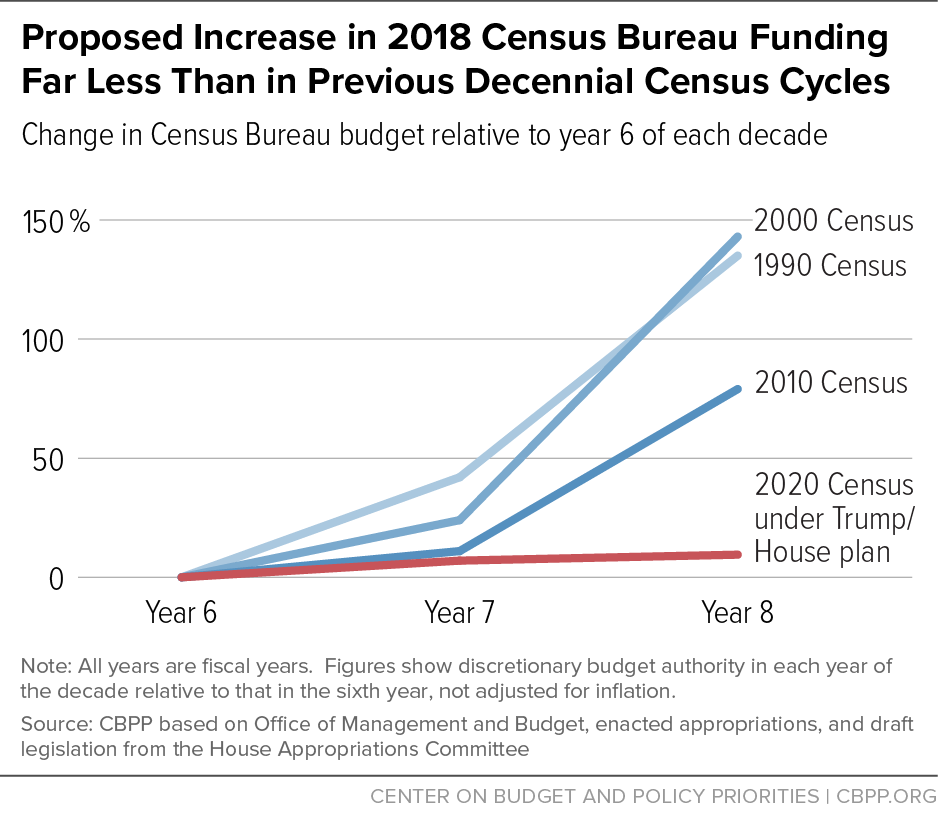
The 2020 census was added to the Government Accountability Office’s list of programs with a high-risk of failure. And failing to accurately count the population would threaten the integrity of the country’s most authoritative dataset that drives public policy.

Because the census is used in for a myriad of democratic functions, it’s important that the US gets it right. But now the Department of Justice has proposed to change the 2020 form, which could create further problems for the bureau.
This hits home for a number of reasons, not least of which is that I moonlighted as a census taker in 2000 and Kenneth Prewitt was the head of the Census Bureau then.  While I've mentioned several times that I was a National Park Ranger and have posted entries about the census several times, this is the first time I've mentioned my last federal government job.  It's about time.

On a less personal note, I agree with Vox that this is bad for democracy, bad for understanding the country through data, and potentially bad for immigrants.  What good will it do to reform redistricting to reduce gerrymandering if the data being used is flawed?

As for identifying citizens and making it easier to remove them, it reminds me of something I said to my students in June 2015.  One of them asked if the U.S. would ever institute restrictions on births like China has.  I responded that doing so would spark riots.  Instead, the United States would be far more likely to restrict immigration and harass immigrants who were already here.  The next week, Trump declared his candidacy by attacking Mexicans.  One of his first actions as President was to declare a travel ban.  Sometimes, I don't like being right.

Wednesday, May 25, 2016

Census finds Detroit still shrinking in mid-decade estimate


Last week, the Census Bureau released its annual population estimates for 2015.  The results were generally predictable and so were the reactions.  WXYZ's response was to report Detroit out of top 20 cities.

Detroit's population decline has now pushed it out of the top 20 cities.
While the ongoing story of Detroit shrinking is the same one that I've been covering since the second post on this blog, I'm glad to note the good news that Downtown, Midtown, and the riverfront are growing and the rate of population loss is slowing.  When I wrote "It's an exciting time to live here, and I wouldn't miss it for the world" in April 2011, this is the kind of development, pun intended, I was hoping for.

MLive also covered this story, noting Denver knocks Detroit off list of 20 most populous U.S. cities and provided the following table.


Detroit didn't just fall behind Denver last year, it dropped below Seattle, too.  El Paso passed Detroit a year earlier.  The next cities to grow larger than Detroit proper will be Washington D.C. and Boston.

Not all the population news was bad, that is, if one favors population growth.  Fox 47 reported Lansing's Population is Growing.

Most cities in Michigan are losing population. But Lansing is one of the few that's actually growing.
Lansing is not alone.  MLive published a slideshow listing the five biggest gainers and losers in the state.  It lists Macomb Township, Novi, Shelby Township, Dearborn, and Southfield in the top five, along with Clinton Township and Canton Township gaining more than 3,000 people since 2010, followed by Lyon Township, which had the highest five-year percentage population growth rate of any municipality in the state, then Hamtramck, Pontiac, Sterling Heights, Farmington Hills, Birmingham, Rochester Hills, and Troy.  Detroit may be shrinking, but its suburbs are still booming.

So is Grand Rapids, as MLive reported.
Among Michigan's six cities with more than 100,000 people, Grand Rapids saw the biggest increase. Its population was estimated at 195,097 in 2015 -- up 848 people from the previous year.

Since 2010, Grand Rapids' population has increased by 7,043 people, or 3.7 percent. The only other place in Michigan with a bigger increase during that same period is Macomb Township, which grew by 7,299 people.
That growth is showing up in a boom in housing downtown, as WOOD-TV reported Downtown GR in the middle of ‘gangbuster economic moment’.

It doesn’t take an expert to look around and see the cranes dotting the Grand Rapids skyline and realize we are a growing city.
Detroit isn't the only big city in Michigan experiencing a revival of urban living.  As for a goal of 10,000 housing units in downtown Grand Rapids, that's ambitious, but I'm still in favor of it.  It will reduce sprawl and all its ills.

For more on this story, MLive has an interactive map showing population gain and loss for all municipalities in Michigan.  Have fun playing with it; you might learn something.

Thursday, January 9, 2014

U.S. Population growth slowing down

I opened and closed A new year in space and other space and astronomy news by looking ahead to writing about population.
After two snow days, today is now the first day of classes for the new semester.  Normally, I'd post something related to my teaching; in fact, I have two articles about population that would serve nicely.
...
Stay tuned for more, including the population stories I promised at the beginning of this entry.
It's time to follow through.

In tonight's installment, I have two articles from the Washington Post conveying news that doesn't surprised me.  First, Population gains at near-historic lows
By Carol Morello
Published: December 30
The population of the United States is growing more slowly than it has since the Great Depression in what demographers say is a reflection of the recession’s lingering effects on people’s behavior.

New population estimates released Monday by the Census Bureau show the nation added about 2.2 million residents in 2013. On New Year’s Day, the census projected, the U.S. population will surpass 317 million people, a one-year increase of 0.7 percent.

The last time the nation grew at a slower pace was in the heart of the Great Depression, from 1932 to 1937, according to an analysis by demographer William Frey of the Brookings Institution.
I could see this coming more than two years ago, when I posted Next Media Animation thinks low birth rates in the U.S. and China aren't all good.  Take it away, LiAnn!
US birth rates have been falling ever since the recession started, and studies show that this year they've fallen even more! In 2007, there were over 4.3 million babies born, the most ever. It's supposed to go up every year. But now it's down to 4 million. This year, young women from their teens to early 20s have the lowest birth rate ever!
She's right; the economy is the best form of birth control.

A companion article, Census: North Dakota, South and West adding population fastest, includes interactive maps of population growth by percentage and absolute number for every state.  Here's the non-interactive map of percent population group from that article.


Note the dark green for North Dakota.
North Dakota...added 22,000 residents over the past year. That was a 3.1 percent population increase, the highest of any state in the country, fueled by an energy boom in the Bakken oil fields that has pushed the state’s unemployment rate down to 2.6 percent.
The next the fastest percentage growth occured in Utah, which increased its population just 1.6%, just over half of North Dakota's.  The difference there is that people are moving to North Dakota; they're being born in Utah.  Texas came in third with 1.5%, where both births and immigration are likely equally responsible.

What about the states with the greatest absolute growth?
Texas added more residents, 387,000, than any other state, the estimates show. California, which added 332,000 residents over the past year, is the first state to top 38 million in population.
...
And despite news reports last week that suggested New York could lose its position as the nation’s third-largest state to Florida, the Census Bureau said the Empire State kept its narrow lead. New York had 19,651,127 residents as of this July, the estimates show, fewer than 100,000 ahead of Florida’s 19,552,860 residents. Florida grew by 1.2 percent, adding 232,000 residents over the last year, while New York added just 75,000 people — an increase of 0.4 percent. Those trends suggest Florida will surpass New York in the 2014 estimates.
After Florida, it's a long way down to North Carolina in fourth with 99,696 new residents.

As for Michigan, the Great Lakes State actually gained population last year, with 13,103 new residents for a growth rate of 0.1%.  It's not much, but it beats being the only state to lose population in the 2010 census.

I have another article about population growth slowing down in the rest of the world, but I'll save that for another entry.

Monday, June 20, 2011

It's redistricting time!


WOOD-TV 8 on YouTube: The Michigan Republicans released their plan to redraw congressional districts
Royal Oak Patch: Levin, Peters Slam Republicans for 'Gerrymandered' Plan for New Districts
Under the GOP proposal released Friday, the Royal Oak and Bloomfield Township Democrats would be put in the same district.
By Beth Reeber Valone

A Republican proposal for redistricting Michigan's U.S. Congressional districts would have the entire city represented by one congressman rather than two and lumps those current two reps – Democrats Sander Levin and Gary Peters – into one redrawn 9th District.

The plan released Friday essentially moves Peters of Bloomfield Township into the redrawn district of Royal Oak's Levin, which is mostly Levin's current 12th District of Macomb County with a small portion of Oakland County.
...
Peters and Levin quickly issued a joint statement Friday blasting the Republicans for the most “shamelessly partisan” plan the state has ever seen:

“Instead of drawing fair lines that follow community and county borders in a logical way, the Republican legislature has drafted a map so skewed that it exploits every trick in the book to gerrymander districts in ways that benefit Republican incumbents," the Congressmen's statement said. "The legislature and Governor Snyder should reject this gerrymandered map and draw congressional boundaries in a way that puts Michigan voters’ interests squarely ahead of flagrant partisan advantage."
I've seen this movie before. In 2002, the Republicans in the state legislature dealt with Michigan's losing a U.S. House seat by pitting the most junior Democratic Representative, Lynn Rivers, against the Dean of the House, John Dingell. Rivers was the only Democrat elected to the U.S. House in the Republican wave election of 1994, so they had it in for her. What happened then was that neither Rivers nor Dingell backed down, so they faced each other in a primary. I was rooting for Rivers, as she had been my representative when I lived in Ann Arbor, but I couldn't vote for her, as I was living in Lenawee County, which was in the 7th District. She could have used my vote, as she lost.

As for what's going to happen here, I'm taking a wait-and-see approach. I worked on Peters' campaign last year, but I've been holding off on contributing to him for 2012 until the dust has settled from redistricting. Because I like both candidates, I'm hoping the two of them make a decision for me so that I don't have to. Otherwise, I'm faced with a quandry. Do I support Peters because I've worked for him before and I think he's better for the future of the party in Michigan (he's the second youngest member of the Michigan Democratic Caucus in the U.S. House) or do I support Levin because he's more progressive and would be favored in what is really his old district? I don't know yet.

Allow me this aside about Rivers' election in 1994. It was a choice between her and a young Republican activist. My ex-wife, a staunch Republican, put pressure on me to not vote for Rivers. Her political motto was "No Dumb-dumb-crats in this house!" I really preferred Rivers, who was familiar to me because of her service on the Ann Arbor School Board, but decided to honor the letter of my ex-wife's demand by deliberately throwing a away my vote by casting it for the Libertarian candidate in the race. After we walked out of the polling place, she asked, "You didn't vote for any Democrats, did you?" I could truthfully answer yes. Not having to pull stunts like that is one of many good reasons I'm happy to no longer be married to that woman!

Aside over. I'm not the only one taking a wait-and-see attitude. According to the Detroit News, Peters' opponent in 2010 is as well.
Republican Andrew "Rocky" Raczkowski , who narrowly lost to U.S. Rep. Gary Peters in November, isn't so sure about running again for Congress in 2012.

"We'll see what happens," Raczkowski told Insider, noting he's focusing on his family.

Peters, D-Bloomfield Township, defeated Raczkowski 50 percent to 47 percent in November. Raczkowski said in January he'd "absolutely" try for a rematch if there is a winnable district after remapping.

Now, as Michigan lawmakers are redrawing the 15 congressional district lines to 14 due to population losses, the 9th District is looking like a political firestorm. A GOP draft plan first published by The News showed Peters' Oakland County district combining with that of Rep. Sander Levin, D-Royal Oak, setting the stage for a possible incumbent showdown.

One likely Republican challenger, state Rep. Marty Knollenberg, is interested in taking back the seat lost by his father Joe in 2008. Knollenberg also sits on the state House's redistricting committee that helps redraw the district lines.
I don't think Marty McFly is going to take back the 9th District from either Democrat.

Redistricting is creating lesser controversies in state races as well.

Detroit News: GOP's Senate redistricting map weakens Detroit, Wayne County
Paul Egan/ Detroit News Lansing Bureau
Lansing — A loss of clout for Detroit and Wayne County is reflected in the Michigan Senate redistricting map drawn by state Republicans.

The map, first published and reported on by The News this morning, was released by the Michigan Senate shortly after noon today. It would result in significant changes in the boundary lines of most of the state's 38 Senate districts. Since the GOP controls both chambers of the Legislature and has a majority of nominees on the Michigan Supreme Court that could ultimately decide the issue, the map could closely reflect the changes ultimately made to account for population losses and shifts documented in the recent census.

Wayne County would drop to seven senators, from eight.

And for the first time, no Senate district would be wholly contained within the boundaries of the city of Detroit, meaning it would be possible to have a Michigan Legislature with no Detroit senators. The current Senate has four senators from Detroit, which over the last decade saw its population drop by 25 percent, from about 950,000 to less than 715,000.
The shoes aren't finished dropping. The Democrats will release their plan today. Good luck getting that one passed.

And, yes, I changed my mind from yesterday, when I thought I'd do the other story and save this one for later. It turns out this was the story that was ready, not the other one. I'll tackle that one later.

ETA: For my previous post on redistricting, click here and scroll down to the bottom of the post to the last article of the leftover linkspam. There you will find a link to an Oakland Press article and video explaining the process.

Saturday, May 14, 2011

Sustainability news linkspam for the week ending 5/14/11, Part 1


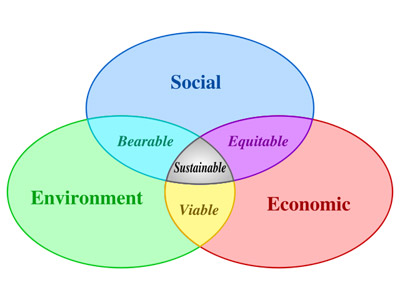
All of this edition is concerned with the economic part of sustainability, either because the articles are from commercial sources except for the headliner, which is from an economics blog. Just the same, one can see the overlap between economics and environment (read as technology) on one hand, and economics and society (mostly culture) on the other. As for a linkspam with less of a bleed-through of economics into other categories, with clearer environmental and social sections, stay tuned for part 2, which will be from university press releases--no "Maybe" about it!

Zero Hedge: Slow Relief at the Pump As Gasoline Decouples From Crude Oil
By EconMatters
In the two weeks ending Friday, May 13, Brent dropped about 10% to close at $113.83 a barrel on ICE, while WTI plunged 12% to $99.65 a barrel at Nymex, and RBOB gasolne futures for June also lost 8% to around $3.0766 a gallon.
...
The price tumble was big enough to trigger a five-minute halt in trading of crude oil, heating oil and gasoline for the first time in over two years on Wednesday. May 11 at CME electronic trading platform.

With the record retreat in crude oil prices, many consumers are expecting ‘some big retail price drops’ in time for Memorial Day weekend. After all, crude oil accounts for more than two thirds (68.3%) of the price in a gallon of gasoline as of March 2011, according to the U.S. Energy Department.

Crude oil and gasoline prices typically trend in tandem on the same set of market fundamentals, but this time around, the decoupling of gasoline and crude oil would mean gasoline prices may be harder to drop.
More news after the jump.

Friday, May 6, 2011

Grand Rapids Sustainability Video spam courtesty of WOOD-TV

Time to look at the other side of the state, which had its own share of sustainability related stories this week.

First, the stories before the drop in oil prices yesterday


Gasoline averaged around $4.29 per gallon in West Michigan on Tuesday night, but there are several ways to avoid paying the wholesale price.


The Rapid millage passed narrowly Tuesday night, with the final margin just 136 votes.


A narrow election win gave the Rapid the OK to grow and add routes, stops and jobs.


It was by no means a mandate, but supporters did manage to get out enough votes to pay for additional bus service in six Kent County communities.

Downtown Grand Rapids bucked the city's trend of population loss over the past decade, with a roughly 31% jump in population between 2000 and 2010, according to a 24 Hour News 8 analysis of Kent County census tracts.
See a common theme? I do.

Next, the stories after oil prices dropped.


It almost never happens. But used cars today are likely worth more than they were about one year ago, experts told 24 Hour News 8 on Thursday.
Patrick DeHaan of gasbuddy.com told 24 Hour News 8 it appears prices have peaked for the foreseeable future.

As American businesses added more than 268,000 jobs in April, there are signs of job growth in West Michigan.
Notice a difference? I do, too.

And now, something that is green on the one hand and light and fluffy on the other.

Bring home a beautiful flowering basket for Mom for her special day with great deals from Countryside Greenhouse
Happy Mother's Day!

Sunday, April 24, 2011

The Census on vacancy rates plus the Good, the Bad, and the Ugly about March 2011 real estate in Metro Detroit

It's been more than a month since I promised you all an analysis of the Census for Detroit. I haven't exactly followed through, even though the Census figured in several posts since then, so it's high time I bring you some more news inspired by the Census, even if it is a bit old.

Detroit News: Empty homes dot Oakland County's upscale suburbs
Laura Berman
Last Updated: April 07. 2011 5:47PM
Numbers don't lie: They tell unpleasant stories, including new census numbers pinpointing high vacancy rates in some of Oakland County's most elite suburbs.

The half-secret behind many of the well-maintained facades and manicured lawns of some of the area's most lavish properties is that nobody's home.

Birmingham (9.4 percent) and Bloomfield Hills (10.2 percent) showed vacancy rates significantly higher than 10 years ago. Those rates are similar to Detroit's vacancy rate a decade ago.
Those of you from metro Detroit reading this entry should understand exactly what this means. For those reading who are not familiar with the area, these two towns are very upscale suburbs, the equivalent of Beverly Hills and Westwood/Bel-Air in Los Angeles. Imagine those areas with 9-10% vacancy rates. That would be very distressing.
Tiny Lake Angelus, with 132 households in north Oakland County, is historically a pocket of the county's wealth. Always private, the census takers also found that 13.2 percent of the residences were unoccupied. Vacancies in Farmington Hills were 6.8 percent, up from 3.3 percent in 2000.
The first one--eep! This enclave of Richistan is not doing well at all! The second shows that things are bad, but that areas that are more solidly middle-class instead of rich, people are staying in their homes if they can.
"One of the striking things is that the foreclosure crisis has hit parts of Oakland County that we would have thought are untouchable," said Andy Meisner, Oakland County treasurer.
This is one of the signs that things are not business as usual (BAU), nor are they going to be for the foreseeable future. Too bad. In a BAU climate, I'd be very optimistic about an economic recovery around here. There's nothing a lot of energy for economic activity wouldn't fix. But this isn't BAU, so I'm not very optimistic about BAU solutions.

Back to the article.
Vacancy is a distress signal and communities try to hide the red flags of emptiness. Owners — even banks — maintain the lawns and exteriors, and when they don't, neighbors call the city.

"Even our blight is better," quipped Annabel Cohen, a Bloomfield Township homeowner who hasn't noticed any deterioration.
Snerk You wish. Also, let's see how long that lasts.
Others aren't as chipper, saying that as the crisis goes on, homeowners are more likely to be as distressed as their unsold properties.
Lots more at the link in the headline. I will passon on one bit of advice from the article before moving on--watch the lawns this summer to see which houses are really occupied, and which are just being kept up to look that way by the bank. Also, keep in mind that those figures are from a year ago. Things could be worse by now. Or, they could be better.

The Detroit Free Press has more articles about the real estate situation here in Metro Detoit. I'll give the good, the bad, and the ugly. First the bad.

Metro Detroit home sales dip 7% in March
10:05 AM, Apr. 11, 2011
BY GRETA GUEST, DETROIT FREE PRESS BUSINESS WRITER
Metro Detroit home sales sank by 7% in March with only Macomb County showing positive traction in a continually weak housing market.
...
Macomb County had 912 sales last month, up 6.4% from 857 a year ago. Livingston County sales were down to 198, a 10.4% drop from 221; Oakland County sales were 1,416, a 6.5% drop from 1,515; and Wayne County sales were at 1,868, or 12.5% down from 2,134 in March 2010.
Now the good hidden in the bad.
Metro Detroit's home prices sink
Apr. 12, 2011
BY GRETA GUEST, DETROIT FREE PRESS BUSINESS WRITER
Median home sale prices were down 13.3% in metro Detroit to $58,000 last month, compared with $66,900 in March 2010. Prices were down in all counties, but sales prices in the city of Detroit rose by 10%, to a median of $8,505 from $7,725.
Prices are also down, but note the price rise in Detroit proper. That's an early sign of a possible recovery, even if it's starting at a very low level. In a BAU environment, I'd say that the local market is very close to a bottom. The BAU people agree.
Kathy Coon, broker/owner of Real Living Great Lakes in Rochester Hills, said that prices are coming up despite the March readings.

"Once the appraisers see what is going on in the market, the prices will start coming back up," she said. "The good houses right now are selling really quickly, those that are priced right and in good condition. We are seeing the good foreclosures selling really quickly with multiple offers."

Inventory of homes on the market has fallen by 17% in the last year, with 23,630 houses for sale in metro Detroit in March, compared with 28,486 a year ago.

Karen Kage, CEO of Realcomp, said that inventory levels are low now. Of the 32,317 homes on the market throughout southeast Michigan and the Thumb areas covered by Realcomp, fewer than 5,000 are foreclosures.
Speaking of foreclosures, here's the ugly.

Foreclosures rise during March in Michigan
Apr. 14, 2011
BY GRETA GUEST, DETROIT FREE PRESS BUSINESS WRITER
In Michigan, foreclosure filings rose in March by 4.37% from February and fell 17.4% from March 2010. The state ranked fifth for its foreclosure rate of one filing for every 311 households last month. Total filings for March in Michigan were at 14,615.
The bad news is that foreclosures are up from the month before. The good news is that they are down year-over-year. As I wrote above, in a BAU environment, this would be very good news. These are not normal times, so don't assume BAU will continue to apply, as much as we'd like it to.

I have more Census news to bring you, but I'll save that for a future post.

Monday, April 11, 2011

Shrinking Detroit in the New York Times by way of the Columbus Dispatch

Detroit Where the Weak are Killed and EatenApril2011Badge

N.Y. Times via Columbus Dispatch: Reversing Detroit
Fast-shrinking Motor City plans best way to manage population loss
Sunday, April 10, 2011 03:18 AM
By Monica Davey
New York Times News Service


DETROIT — When Marja M. Winters was studying urban planning in graduate school, she learned the art and science of helping cities grow.

Now, Winters, a native of Detroit and deputy director of the city’s planning and development department, finds herself in an unexpected role, one that no school would have thought to prepare her for: She is sorting out how to help her hometown shrink, by working through difficult decisions that will determine which neighborhoods can be saved and which cannot.

“It was always this notion that the population of the world continues to grow, and more and more people want to live in cities,” Winters, 33, said about her courses at the University of Michigan. “The reality is very different. Who knew?”
Actually, the reality isn't that different from what Ms. Winters was taught. The population is growing, as it's projected to reach 7 billion this year, and 9 billion by 2050 (but read what I tell my students about this projection). At the same time, urbanization is continuing; about half the world's population is already living in cities and the percentage is expected to increase throughout the century. It's still the case in the United States as well. Even though the proportion of people who live in what the Census calls Metropolitan Statisical Areas has remained pretty constant at ~80% for the past 40 years, the population of the country is still growing, so more people are still living in cities now than 40 years ago.

The problem is that Michigan is the only state in the Union that has lost population. Even if the proportion of people living in cities here has remained the same, the number in most cities in the state will decrease, which has happened. The real problem is that most of those people who lived in Detroit 10 years ago still live in cities; they just don't live in Detroit. A lot of them have moved to the suburbs, and a lot have joined the exodus out of state. The result is a lot of abandoned houses and a lot of empty land.

First, the empty houses. From the NYT via the Columbus Dispatch:


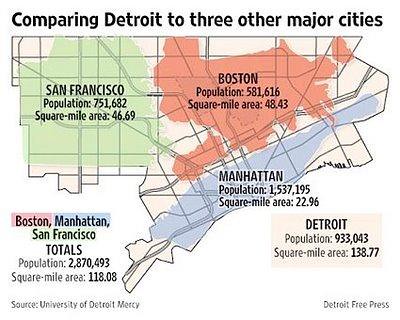
Now the empty land, which is the size of the outline of San Francisco inside the city limits of Detroit. From the Detroit Free Press via New Geography.

detroitmap1

So, how is Ms. Winters going to deal with this issue?

Puzzling through the best way to downsize a city is not unheard of (it has been considered in Youngstown, Ohio, and Flint, Mich.). And Mayor Dave Bing has made it a top priority to deal with Detroit’s fast-sinking population and crumbling infrastructure by steering those who remain into fewer neighborhoods, rather than leaving them scattered throughout the 139-square-mile city, whose boundaries made more sense when twice as many people lived here 40 years ago.

Actually carrying out such an effort, particularly in a city as vast as Detroit, is like solving a complicated set of interwoven puzzles, as Winters has discovered over many long days and some nights poring over thousands of pages of maps and statistics in her 23rd-floor downtown office.

How to reconfigure roads, bus lines, police districts? How to encourage people — there is no power of eminent domain to force them — to move out of the worst neighborhoods and into better ones?

Later this month, a team that includes Winters is expected to present a proposed — and certain to be highly controversial — map to guide investment in each of the city’s neighborhoods. A final plan for a remade city is expected by year’s end.
Stay tuned for that plan. I'll be sure to blog about it.

There's much more of that article.  Be sure to read all of it.

Meta note: I know in my previous post that I would continue analyzing Contemplating the Hedgehog, but it's not every day that the New York Times covers exactly those aspects of Detroit that I cover in this blog. Better yet, it was picked up by the Columbus Dispatch, which doesn't have the 20 article limit before hitting a paywall that the New York Times has.  Also, a friend of mine in Columbus posted the link on my Facebook wall.  Who am I to refuse a good story when it's dumped in my lap?

In short, I'll get around to the series sooner rather than later. Unless LiveJournal completely disappears because of a DDoS attack (in Soviet Russia, LiveJournal trolls you!), it's not going anywhere.

ETA: Welcome to all of you from Clusterfuck Nation. I have a follow-up to this post here.

Wednesday, April 6, 2011

Model D Media on Detroit, Ground Zero of the post-industrial future

Detroit Where the Weak are Killed and EatenApril2011Badge


Today, Model D Media reminded me why it is one of my favorite news sources in Detroit, and why I should read it more often. True, they have all kinds of great food stories from the past week on their front page right now, which I'll post about in the very near future, such as tomorrow. But that's not why. Instead, the managing editor posted a great statement about the potential of Detroit.

Editor's notebook: The death and life of a great American city
Walter Wasacz | Tuesday, April 05, 2011

While census workers did their job we did ours: produced ideas, converting them into real action. Detroit's creative juices have been flowing over the past decade. Managing editor Walter Wasacz says hang on, this is just the beginning of a long, wild ride into the unknown.
"A long, wild ride into the unknown"--and that's exactly what we're all embarking on, whether we live in Detroit, Los Angeles, or anywhere else in the world, including the readers from Canada, Australia, India, China, the Russian Republic, or Yemen who have stopped by this past week. Yes, folks, I see you. The difference is that Detroit knows this, even if the rest of you don't, and we're likely to arrive at the future first. As I'm fond of typing out, "Welcome to Detroit, Ground Zero of the post-industrial future."

What I posted above was just the teaser. Here are the highlights of what Wasacz wrote in the editorial itself.

When the census numbers for Detroit were released late last month -- not good numbers, as we all know; horrible numbers, in fact -- no one in my heavily Detroit-centric world panicked. Quite the opposite happened. Every conversation I had about it spun the statistical information on its head, taking the news not as a foreshadowing of the city's decline and fall (as did national media en masse, including the cynically misinformed Wall Street Journal and even the usually on-target New York Times, whose reporter appeared to seek out only the most dour, hysterical and self-loathing among us for reaction quotes) but as validation of what many of us have been doing for the past decade in a place where vast open space -- physical, psychological, psychogeographical -- was growing before our eyes.

Doing what, exactly? Cobbling together ideas, converting them into action, quickly; filling in the gaps, making dots, connecting dots, pouring foundations, taking risks; discarding old models that don't work, finding new models, engaging urban life on various fronts, catalyzing neighborhood and community life; having fun on top it all.
Walter is a motie man after my own heart when it comes to the future of Detroit--another Crazy Eddie.

On this level of furious engagement, the Detroit of the first decade of the new century became for the first time in my memory that most coveted of urbanist dreams: a 24 hour city...Different, twisted, character-rich, unique. Without aspiration to be anything but Detroit itself.
Now, that's not my dream of Detroit, but it is an exciting one. It certainly will draw in the people from other big cities who want to settle what has become an urban frontier. The revival of the City of Detroit proper isn't going to come from suburbanites moving back into the city, not at first. It's going to come from trendsetters from outside discovering the place--and they're already starting.

Walter isn't done yet. Here's my favorite paragraph of the editorial.

But we are simply traveling at incredible speed -- the fastest and most interesting spurts of ground-up growth in my lifetime have occurred in the past 10 years -- in exploring multiple new narratives that have little to do with the ersatz Motor City. Seeds for the economic diversity we've craved but never had are being planted. Creative entrepreneurship is being rewarded. Discussion of mass transit has passed from the imaginary to the real. Detroit as the non-motorized city, a pedestrian utopia for cyclist and walkers? Well, yes, it's on the cusp.
A couple of years ago, I ran into a fellow in Buffalo Wild Wings in Brighton, that outpost of people who fled Detroit and hate what it has become, but who have perversely managed to turn Livingston County, the fastest growing large county in the state for four decades running, into the farthest west part of the Detroit Metropolitan Statistical Area. Sorry, former neighbors, you left Detroit and ended up bringing it with you. Anyway, he found out that I was from California and wondered why I live here. That's really a long story, but to make it short, I tell him that Michigan in general and metro Detroit in particular has more environmental promise than problems, while California in general and Los Angeles in particular has more environmental problems than promise. Walter seems to agree.

It feels good, it is good, but think of it as just the launchpad in getting to the elusive tipping point. The best news to scrape from Detroit's premature obituary is that there is plenty of work to go around, for all who want to jump in and grab a piece of the unknown. No over-saturation of anything (or anyone) anywhere in sight, your desire matched by the results of over 300 years of doers, growers and innovators. Where better to make your claim on history than here?
As I tell my students, great things are going to happen here, and they're going to happen here first. Whatever Detroit devises as the solutions for North America's problems will be exported to the rest of the continent. It's an exciting time to live here, and I wouldn't miss it for the world.

Sunday, March 27, 2011

Late Night Motie News Linkspam


The inaugural Late Night Motie News Linkspam proved to be more popular than the post about the census figures for Detroit before that, bucking the trend of lower pageviews throughout the week. Since it seems to have worked, I'll do it again, this time with relevant stories that I posted earlier tonight to Overnight News Digest: Science Saturday on Daily Kos. Hey, I'm an environmentalist; I recycle.

Food


Purdue University: Purdue center to seek solutions to enhance global food security
March 24, 2011

WEST LAFAYETTE, Ind. – Purdue University has established the Center for Global Food Security to take up one of the world's most pressing challenges: getting enough food to people who need it the most today and producing enough to meet even greater demand in years to come.

The center, a year in the making, has begun operations at the university's Discovery Park, a $500 million complex of organizations leading large-scale collaborative research efforts on campus.

"We are looking not only at food, agriculture and natural resource solutions for today but also for future generations," said the center's executive director, Gebisa Ejeta, Distinguished Professor of Agronomy and a 2009 World Food Prize laureate. "We must define what our legacy will be."

The issue of food security is a deepening global concern as the need for more food continues to increase with a rapidly growing world population. About 1 billion of the world's nearly 7 billion people suffer from chronic hunger because of economic, social, political and environmental conditions. Scientists project that agriculture will need to double plant and animal production by 2050, producing it more efficiently and safely on less farmland, to meet the needs of a population expected to reach 9 billion people.
This is the second article I've posted on this subject from Purdue University. I'm going to have to pay more attention to their work on the subject.

As for the population figures, I tell my students that we're going to reach that 9 billion if we're lucky. If we're really lucky, we'll hit 9 billion and have a slow controlled decline. If we're not so lucky, we'll hit 9 billion and start to crash. If we're unlucky, we won't get to 9 billion. Somewhere between 7 and 8 billion, we'll stall out and crash. That's the future I'm trying to avoid.

Purdue University: Purdue students create new products from corn and soybeans
March 23, 2011

WEST LAFAYETTE, Ind. – Teams of Purdue University students who developed a soy-based denture adhesive and a liquid bandage out of corn have won the top prizes in the annual Student Soybean and Corn Innovation Contests.

The awards were announced at a banquet Wednesday night (March 23) at the Indiana Roof Ballroom in Indianapolis.

The competition, sponsored by the Indiana Soybean Alliance and the Indiana Corn Marketing Council, teaches students how to be innovative entrepreneurs with corn and soybeans.

"The versatility of corn and soybeans is limitless, and these competitions serve as a showcase not only for the potential new uses of crops grown here in Indiana but also for the students who put their time, effort and talent into their projects," said Jane Ade Stevens, executive director for both the corn and soybean checkoff organizations.
The flip side of Purdue's concern with food is that it's very much in the pocket of industrial agriculture, and this article shows that relationship in unapologetic detail. Honestly, I find Michigan State University, where there is a program in organic agriculture that was created by student demand, to have a more progressive perspective, and MSU is also a land-grant agricultural college.

Energy


University of Michigan: Unemployment rate and cost of gas predict fuel economy of purchased vehicles
March 23, 2011

ANN ARBOR, Mich.—Average fuel economy of purchased new vehicles has increased by more than 12 percent since late 2007, due mainly to high unemployment and gas prices, according to a University of Michigan study.

The average fuel economy of purchased new light-duty vehicles (cars, pickup trucks, minivans and SUVs) improved from 20.1 mpg in October 2007 to 22.6 mpg in February 2011—the highest it has ever been.

A new report by Michael Sivak and Brandon Schoettle of the U-M Transportation Research Institute found that the national unemployment rate (currently just below 9 percent) and the price of gasoline (currently above $3.50 a gallon) together account for 83 percent of the variance in the average fuel economy of new cars purchased.
See, people really are responding to price signals!

Speaking of buying cars, it's time to tell another story I tell my students.

Back in 2002, my previous car was getting long in the tooth, so I started thinking about replacing it. My son suggested I buy an Aztek. At first, I liked the idea, as it was a rugged, outdoorsy car, which fit my self-image. Then I looked at the car. I could see all kinds of places for food and drink, storage for camping gear and coolers, and rear seats that folded down to make a bed. I then realized that my son was trying to convince me to buy a party-mobile that he could borrow! I might have actually gone along with this idea, but then I looked at the car's gas mileage--24 highway and 16 city. While gas was cheap then, I knew that, within the lifetime of the next car I would buy, it wouldn't be. I also was living 70 miles from my work. I didn't like the idea of trading in a car that got 40 miles to the gallon on the highway for one that was about half as efficient, especially when I knew I'd be paying a lot more for gas. So, I didn't buy an Aztek.

When I needed to buy a car, I got a Kia instead. It got 32 miles to the gallon, but it was an automatic. I was willing to sacrifice a few miles to the gallon so that my left foot and right hand could rest. Yeah, I'm a sucker for convenience, too.

Purdue University: Purdue, General Atomics team develops lightweight, portable power using hydrogen fuel pellets
March 21, 2011

WEST LAFAYETTE, Ind. — Purdue University researchers have collaborated with scientists at General Atomics to create safe and efficient pellets to power hydrogen fuel cells that can run an array of portable electronic devices.

The technology will be on display in Indianapolis as part of Purdue Day at the Statehouse from 10 a.m. to 2 p.m. Tuesday (March 22) in the Statehouse Rotunda.

The marble-sized fuel pellets, which contain a solid compound that gives off hydrogen when heated, overcome the historic challenges in using hydrogen as a fuel, said P.V. Ramachandran, the Purdue professor of chemistry who led the research.

"Hydrogen gas takes up a lot of space, is unstable and unsafe to transport," Ramachandran said. "We've developed a way to use a very stable and safe compound that can release pure hydrogen gas on demand without any toxic or corrosive byproducts."
Anyone who thinks this is a way to have "hydrogen powered cars" is fooling themselves. Hydrogen is a net energy loser.

Politics


University of Wisconsin: New software will help Wisconsin communities redraw their electoral maps
by Bob Mitchell
March 21, 2011

With a few quick, deft movements of mouse and keyboard, Jim Beaudoin reorganized voting in Columbia County.

He collapsed 31 supervisory districts into two big ones, then grabbed a city block here, a rural block there, dragging them from one district to the other to balance the populations. Finally, he zoomed in to do similar surgery on wards and aldermanic districts. With that, he was done.

"I now have the perfect redistricting plan," he says with a smile.

This isn't exactly how things will go next month when Wisconsin's local officials begin the once-a-decade chore of adjusting voting districts. Local staff won't work this fast, or with such a heavy hand. But most of them will be using the same point-and-click, drag-and-drop technology, which Beaudoin, an applications developer with the University of Wisconsin-Madison Applied Population Laboratory and UW-Extension, has spent more than two years creating.
What is this article doing here? It isn't about collapse!

Remember what I wrote in my first post on this blog:

One of the common themes of this blog will be explaining how global, national, and local events and politics are about various factions fighting to maintain their shares of a shrinking pie--one they openly deny is shrinking. Once you recognize that's what's going on, a lot of mystifying events become much more understandable.
Redistricting is one of the prime examples of what I'm talking about, and the most obvious. It's going to be especially true here in Michigan. Expect a lot of posts about redistricting in the near future, some of them as part of my series on the 2010 Census.

That's it for tonight's news.

Wednesday, March 23, 2011

Today's Motie News from Detroit: Video report on Census

Detroit Where the Weak are Killed and Eaten

I know I promised you all an update on the Census last night; instead, I decided to play a game of Civilization with my wife. (I can't be all SRS BZNS all the time).  I achieved a space race victory in 1983.  If humans had done that in real life, we'd have already reached Alpha Centauri by now.   For my troubles, I received a ranking of "Ivan the Terrible"--probably the worst of the competent leaders listed in the game.  That's what I get for playing on Chieftain.

Enough about losing myself in fantasy.  Time to snap back to reality.  Oh there goes gravity...

The Detroit Free Press has a series of articles on the subject (scroll down and look at all the latest links; even I find the number amazing), that I'll get around to analyzing all the rest of this week. Right now, I don't have the time to do even one of them justice.  I'll be lazy and let the WXYZ do the talking for me.  This is also a test of how video embeding works here.  Here goes nothing.


Looks like I managed to kill two birds with that stone.  Time to go to work.

Tuesday, March 22, 2011

Today's Motie News from Detroit--Early Edition

Detroit Where the Weak are Killed and Eaten


Earlier today, the Detroit Free Press asked Michigan Census due today: Will Detroit drop under 800,000?

Key questions in the data include:

• Will Detroit’s population slip below 800,000 residents for the first time in 100 years?
• Which local communities managed to buck the trend and grow?
• How has the diversity of the suburbs and the city changed?
• What percentage of Michigan houses are still occupied?
They just got their answer.

Census 2010: Detroit population plummets to 713,000, lowest since 1910

Census figures were released to the Free Press by a government source who asked not be identified because the data has not been released publicly. The figures also show Wayne County’s population stands at 1,820,584. Oakland County stands at 1,202,362 and Macomb stands at 840,978.
This is a breaking story. I'll have an update overnight tonight when the official figures come in.

On another note, greetings to all of you coming here from Clusterfuck Nation! I had no idea so many of you would drop on by from a single link in his comments. You managed to overwhelm all of my friends from Livejournal.  I know I promised all of you a review of Kunstler's site in my comments, but today isn't the day for that review. It's not that I don't have a lot to say about him; I do, but I can always repackage my opinions on a slow news day.  Today is not a slow news day.