A blog about societal, cultural, and civilizational collapse, and how to stave it off or survive it. Named after the legendary character "Crazy Eddie" in Larry Niven and Jerry Pournelle's "The Mote in God's Eye." Expect news and views about culture, politics, economics, technology, and science fiction.
New CDC data suggests Americans are living longer, with experts pointing to declining overdose deaths, improved cancer survival rates, and continued recovery from the COVID era. Family medicine physician Dr. Jessica Gray explains the latest longevity trends.
Dr. Anthony Fauci testified before the Senate in the GOP's hyperpartisan investigation into his "megalomania" and alleged mishandling of Covid, despite the fact that Trump admitted to having “a lot of respect for Dr. Fauci” during the pandemic. Jordan Klepper gets into the hearing’s biggest moments, including Fauci repeatedly invoking the Fifth Amendment, Senator Josh Hawley invoking Fauci’s diary entries, and one Instagram commenter invoking the eggplant emoji.
I'll get back to Brainworm later. Time to return to the hearing and its coverage on Fox News, which is all in on "the Wuhan lab-leak hypothesis." I last discussed that in 2021 and have ignored it since, as I don't want to contribute to the acceptance of what I think is a conspiracy theory. That isn't stopping the Fox News anchors or their guests, particularly ex-coach, current Senator, and likely future Governor Tommy Tuberville, who, if he wants to cite one unofficial idea, might as well cite another, "16 million to 28.1 million with the most likely figure being 21 million, 3.1 times the total of official deaths." It would scare people even more than 9 million and it has better support than the lab-leak hypothesis, which I think is based on xenophobia, partisan wishful thinking, and a questionable intelligence report not supported by scientists. It doesn't help that Fox News undercuts that position by their consistent underplaying of COVID-19. Logic and reason are not their strong suit, but I wrote that the late Jerry Pournelle, himself a conservative, described conservatives as irrational fifteen years ago, so I shouldn't be surprised.
I couldn't agree more that staff cuts at Health and Human Services, the CDC, and NIH are among the reasons the U.S. is "losing a diarrhea war with lettuce." That deserves its own post, but not today. Instead, I'm moving on to Desi Lydic Foxsplains Anthony Fauci's Pandemic Diary | The Daily Show.
Fox News got a hold of Anthony Fauci's Covid-era diary, and Desi Lydic is ready to Foxsplain every evil detail.
HAHAHAHA! All except the lettuce being from Michigan — that hits too close to home, literally.
America might be getting sick of RFK Jr. as health secretary, but much like the worm in his brain, he doesn't appear to be going anywhere. While you won't find his brand of non-professional medical advice on "Grey's Anatomy" or "The Pitt," you can find it on a bold new medical drama: RFK Hospital.
On the one hand, HAHAHAHA! On the other, this is the kind of health care leader Fauci's enemies want to listen to. I'd rather follow Fauci.
Speaking of following, continue over the jump for The Daily Show's Emmy nominations.
Today's evergreen educational entry features Bankrupt - Cicis Pizza by Bright Sun Films, a tale of the Retail Apocalypse.
Starting in the mid 1980's, Cicis Pizza was always the go-to pizza restaurant for cheap bites and great value. With their no-frills locations, cheap prices and innovative buffet concept, the restaurant became a massive success with hundreds of locations across the country. However, things have changed and following a bankruptcy, their once dominating presence has been severely diminished. Join me as we find out why.
As user
tcbgarage2845 wrote in his comment, "Private equity, Leveraged buyouts, Covid 19 and Chapter 11 bankruptcy! The whole gang is here." Indeed.
As I've written several times, no bankrupt company's story is complete without both Bright Sun Films and Company Man making videos about it, so I'm sharing Company Man Mike asking The Decline of CiCi's Pizza...What Happened?
Cici's pizza has been on the decline for more than a decade now. What was once the 5th largest pizza chain in the U.S. has fallen to number 10. This video takes a look at how they grew so large and theorizes where they went wrong.
There is also an AI-generated video summary.
CiCi's Pizza: from a humble beginning to a top-five pizza chain, this video explores the brand's rise and subsequent decline. The documentary analyzes the company's unique buffet model and its impact on CiCi's growth trajectory. It also examines factors that may have contributed to its recent struggles.
Company Man Mike uploaded this video on October 14, 2020, during the height of the pandemic, yet he didn't mention it. I'm surprised. Also, he produced this before CiCi's declared bankruptcy and before he began creating his lists of reasons for failure. Too bad — those lists are right up with his bar charts and line graphs among my favorite parts of Company Man Mike's videos. At least this video has plenty of those, along with enough shots of the menu items to make me hungry.
That's a wrap for today's lesson showing what not to do in business. Stay tuned for the Sunday entertainment feature.
Humanity's relationship with the bubonic plague is over 5000 years old. That's right, it didn't just suddenly appear (and then disappear) during the infamous Black Death. In fact, you could still catch The Plague, today! Although the bacteria that cause it could give you a different kind of plague, instead...
Hosted by: Madelyn Leembruggen (she/her)
In the middle of her history of the plague, Madelyn Leembruggen mentioned Justinian's plague, which I first mentioned in Pandemics and collapse 13 years ago. My conclusion turned out to be prophetic.
This blog is still about how to avoid the collapse of the current civilization and takes a science-fiction slant on the topic. An asteroid impact is the perfect merger of the two.
So are pandemics. We need to be prepared for them, too.
Volcanoes have caused many devastating disasters over the years, but they're not usually blamed for pandemics. Except that a team of researchers say a volcanic eruption may have caused the Black Death. Here's how.
Hosted by: Hank Green (he/him)
Welcome to one of Commoner's Laws, "Everything is connected to everything else." The next plague pandemic may not need a major volcanic eruption to trigger it. Climatechange or just an extremeweather event might do the trick.
Of course, the most recent pandemic wasn't plague and the next one probably won't be, either. It could be one of the pathogens mentioned in 7 Deadly Epidemics You Didn’t Know Existed.
From the non-bubonic plague that killed a Welsh king, to the deadliest pestilence in 16th century Mexico, to a pandemic we're currently in the middle of (No, it's not coronavirus), here are 7 disease outbreaks spanning roughly 25,000 years of human history that you probably haven't heard of.
As the world marks World AIDS Day, researchers note the four decades battling the disease have proven crucial in battling the COVID-19 pandemic. Kiet Do reports. (12/1/21)
I was expecting another take on CNBC explains how HIV research led to COVID-19 vaccines for World AIDS Day, a double pandemic update. Instead, I found out how experts applied public health lessons learned from the AIDS pandemic to COVID-19. That made the video worth watching. As a bonus, I probably have only one degree of separation from Dr. Sarah Ruddman and Dr. Marty Fenstersheib because the ex-girlfriend I most often mention here was working for the Santa Clara County Health Department last I checked, which was before the COVID-19 pandemic. They almost certainly know her and she would certainly know who they are. By the way, Dr. Fenstersheib's predictions about the disease persisting and people needing a booster shot for COVID-19 every year have proven to be true. We should listen to him.
Jennifer Lotito, President and Chief Operating Officer, (RED) joins CBS New York to discuss World AIDS Day, which is on December 1.
Lotito offered both facts and action, even if that action was shopping. People will be shopping today anyway, so they might as well do it for a good cause.
Monday will mark the 37th World AIDS Day, which was started in 1988 by the World Health Organization to raise awareness and understanding of the global AIDS pandemic.
I relate to Lynn Kid. She said that it's important that she not allow a disease control her and that she's way more than HIV. I feel the same about diabetes. It may "be a central organizing fact of my life," but it's not everything about me.
The value of a dime doesn’t stretch as far as it did in 1976 when the state's bottle deposit law was initiated, but for many Michiganders, returning beverage containers to get their 10 cents back sure adds up.
The anchor said "just over 70% of bottles and cans were returned" last year. To be precise, it was 70.4%, as this graph from Axios Detroit shows.
Tessa Kresch examined how the deposit isn't as much of an incentive as it used to be because of inflation but found a counter-example in Mildred Griffin, who still redeems her deposits. Kresh also examined possible reforms, from streamlining the process to expanding it. What she ignored was the effect of the COVID-19 pandemic. Many retailers stopped accepting can and bottle returns in 2020. As a result, many cans and bottles were thrown away, recycled at curbside, or stashed for future redeeming when conditions returned to normal. I still have cans and bottles to recycle from 2020 in my garage, which I've gradually been returning. One of the reasons is the lack of universal redemption; I can only return cans and bottles to outlets that sell them, so it's inconvenient to redeem store brands or brands only carried at a few chains. Most of the cans and bottles still in my garage fit in those categories.
I'm adding lower can and bottle return rates to the list of behavior changes in 'The Pandemic Made People Worse Drivers,' a driving update. A lot of people just got out of the habit and never got back in. I can't entirely blame the pandemic; the Axios graph shows that return rates had been slipping throughout the 2010s from the mid 90s to ~89 in 2019 before dropping like a rock to the low 70s in 2020, never to recover. As I first wrote in April 2020, the pandemic accelerated existing trends, including this one. A few of the bad behaviors are returning to pre-pandemic levels; I hope bottle returns do, too.
That's a wrap for today's sustainabilityholiday. Stay tuned for the Sunday entertainment feature, when I plan on examining GRAMMY nominees.
Deep in Siberia’s permafrost, scientists have revived “zombie viruses” that have been frozen for tens of thousands of years — and headlines warn they could spark the next pandemic. In this episode of Howtown, we investigate the real science behind these ancient microbes: what’s actually being found in the Arctic, how giant viruses like Pithovirus sibericum survive for millennia, and whether thawing permafrost could ever release a pathogen capable of infecting humans. From mammoth carcasses to anthrax outbreaks to the relatively recent discovery of enormous amoeba-infecting viruses, this video breaks down the five steps any ancient microbe would need to start a pandemic — and why the truth is more fascinating than frightening.
This is the flip side of Vox explains how thawing permafrost is already releasing dangerous diseases. Vox's video said it was possible. Adam Cole and Joss Fong came to the conclusion that, in this case, the answer is no. The giant viruses revived from the permafrost infect amoebas, not animals, so they are not able to infect humans. Also, the viruses that can infect humans and then spread from human to human are not able to survive being frozen. Yes, anthrax and Clostridium can survive as spores for centuries (the Clostridium toxins that killed the rhinos in The Last Rhinos: A New Hope came from buried cattle corpses), but they don't spread from person to person, so no pandemic.
The national chain of restaurants has been having trouble over the past few years. This video explores what has been happening with Cracker Barrel.
Company Man Mike held off on compiling one of his trademark lists until the end. Here it is.
Looks like things were going great for Cracker Barrel until the pandemic, which exposed the weaknesses in its business model, reliance on older customers. That doomed Stein Mart, whose customers "weren't going out or working because they are the ones most vulnerable to the pandemic." The same turned out to be true for Cracker Barrel. Trying to attract younger patrons didn't work well, either. They liked the nostalgia factor as well.
After backing away from a controversial logo rebrand loudly opposed by many right-wing influencers, Cracker Barrel also quietly made changes to its website this week. The Tennessee-based roadside restaurant chain deleted a dedicated “Pride page” and scrubbed references to employee resource groups, including its LGBTQ+ and Diversity, Equity, Inclusion and Belonging groups, from another part of its website.
“On behalf of Cracker Barrel’s LGBTQ+ Alliance & DEIB Team, we want to celebrate YOU for being YOU. It is our greatest Mission to ensure that Pleasing People means ‘all people,’” Cracker Barrel’s now-deleted Pride page read, according to a CNN review of the Wayback Machine.
CNN business and tech writer Claire Duffy reports.
The NFL season kicked off tonight between the Dallas Cowboys and the Philadelphia Eagles, Donald Trump went after Rosie O’Donnell and threatened to take away her American citizenship, the MAGA mouth-breathers were all up in arms about Cracker Barrel changing their logo, Kim Jong Un reportedly brought his own personal toilet with him on his trip to Beijing, Trump is constantly blabbing about all of the wars he stopped, Ted Cruz popped on Newsmax yesterday to show off his authentic and not-at-all unconvincing accent, the surgeon general of Florida announced that they are doing away with vaccine mandates, and even though Robert F Kennedy Jr. and Dr. Oz claim to be against big pharma, they never miss an opportunity to cash in.
Welcome back, Jimmy, your fans, including me, missed you.
That's a wrap. Stay tuned to see if I write this year's version of Star Trek vs. Star Wars at the 2024 Emmy Awards for Star Trek Day so I can cover Andor's Creative Arts Emmy nominations or post the video from Weathered on PBS Terra that I was originally planning on posting today.
Happy Flashback Friday! For reasons I'll explain at the next Wayback Wednesday, I've changed today's post from the blog's year on Instagram and Threads to Howtown asking How accurate was the Covid death count?
After four years and dozens of studies, we know everything we're going to know about the death toll of the Covid pandemic.
Contrary to the conspiracy theorists and denialists, examination of excess deaths shows that, if anything, the U.S. undercounted COVID-19 deaths during the pandemic, although it was probably not that big and got smaller as the pandemic went on. On the other hand, I've always been skeptical that India had fewer people die from the disease than the U.S. The official number is 533,623. The polling data indicates 3.2 million deaths, although it could be as low as 3.1 million or as high as 3.4 million, at least six times higher than the official count. That, I believe. I also believe the actual global death toll is in the range of 16 million to 28.1 million with the most likely figure being 21 million, 3.1 times the total of official deaths. It also puts the death toll at the low end of the range for the 1918-1920 flu epidemic, "17 million to 50 million,[6][7] and possibly as high as 100 million, making it the deadliest pandemic in history." By the way, that last link shows an estimate of 27 million COVID-19 deaths. Yikes!
John Oliver discusses the budget and staffing cuts being made to public health agencies in the U.S. under RFK Jr.’s new leadership, the many ways those cuts will impact all of us, and how WWII really ended. Trust us, it’s not how you think.
I'm repeating what I wrote earlier this month: "If I have to concentrate on criticizing any of Trump's Cabinet Secretaries, it will be RFK Jr. I'm a scientist and he's the biggest threat to science of anyone actually confirmed by the Senate..." I don't find his statement that "Our purpose is not to reduce any level of scientific research that is important" reassuring. I don't trust his judgment of what's scientifically important, especially in the context of cutting funding to diabetes research at the University of Michigan. That's doublypersonal!
Oliver and his writers also demonstrated how cuts at and by HHS pose short- and long-term threats to health. Bird flu and measles, both of which Oliver addresses later in the video, come to mind on top of the example of lead paint. It's not just in drinking water!
Vox showed its viewers how RFK Jr. could mess things up. Oliver shows how he already is. As Oliver quoted the experts, "This is a disaster. People will die because of the mistakes we're making right now." I'm calling for his impeachment and removal, because I'm sure he won't resign and doubt Donald "Hoover Cleveland" Trump will fire him because of what he's doing to science and public health.* Hoover Cleveland will only do the right thing for the wrong reasons. Even so, that will take until 2027 because the House won't have a Democratic majority until then. Sigh.
Stay tuned for Wayback Wednesday tomorrow.
*Trump supporters like the Archdruid and his readers actually approve of what he's doing. I have another post planned about them.
The new US secretary of Health and Human Services has a long history of spreading misinformation about vaccines.
...
Robert F. Kennedy Jr. has been called the most unqualified health secretary in the history of the US. Before his confirmation, over 22,000 doctors signed a letter urging the Senate to reject his appointment. During the confirmation hearing several senators grilled him on his concerning history related to vaccine misinformation: things like his founding of an anti-vax organization, his concerning anti-vax rhetoric, and his history of suing vaccine manufacturers, something he stands to make a lot of money doing.
The former environmental lawyer was propelled to the nation’s highest health office largely by the “MAHA” movement, a play on Trump’s “Make America Great Again” slogan (“Make America Healthy Again”). As health secretary, Kennedy wants to solve the chronic disease epidemic in the US, which plenty of doctors can get behind. The issue is that he aims to do it at the expense of infectious disease research. And therein lies the problem. Most people can agree when he says things like “I’m supportive of vaccines” and “I want good science.” The trouble is that his definition of “good” is, well — let’s call it historically shaky. In March, he appointed a well-known vaccine skeptic to head a study on the long-debunked potential link between vaccines and autism.
So what’s next? Can RFK Jr. take away vaccines that are already on the market? It’s unlikely, but he doesn’t need to. Kennedy sits at the helm of the very department he’s been undermining for years. In that position, the power he has over vaccine policy isn’t limitless, but the changes he can make could ripple for decades.
If I have to concentrate on criticizing any of Trump's Cabinet Secretaries, it will be RFK Jr. I'm a scientist and he's the biggest threat to science of anyone actually confirmed by the Senate (Elon Musk as the effective head of DOGE may be just as big right now, but he's not Senate-confirmed and probably isn't there for the long term). Vox's video helps me by showing how and why he can threaten health research and policy.
Plus, why Utah banned fluoride in public drinking water and the potential fallout from the FDA’s top vaccine official’s resignation.
Utah answered no to 'Should fluoride be in our water?' I hope that doesn't adversely affect my mom, sister, and nephew who live there. Also, the Reduction In Force (RIF) of 20,000 HHS employees shows how both RFK Jr. and Musk combine to be threats to health and science.
The measles outbreak in Texas continues to spread, with 422 cases reported since January, an increase of 22 cases since Friday. Most cases are in West Texas, where one child has died. Dallas County Health and Human Services has cut 21 workers, including 10 temporary workers, leading to the cancellation of 15 vaccine events, including measles vaccination clinics. These cuts are part of the Trump administration's effort to reduce federal spending.
Birdflu may be a bigger potential threat, but measles is a menace right now.
Seriously, that supposed ideological diversity probably comes from former Democrats Tulsi Gabbard and RFK Jr., who I called cases of failing upwards. I thought I was done with both of them when they dropped out of the 2020 and 2024 Presidential contests, respectively. Instead, I could be writing about them for the next four years. Ugh. At least my readers and I have Randy and others to keep us sane. May they be like Ben Carson AKA Doctor Pyramid, about whom I ended up writing "At least you were too boring to write about for the past four [years]" after Carson's service as HUD Secretary. May we be so lucky with Gabbard and RFK Jr.
So far, they've been making news. At least they're not boring.
Follow over the jump for the top post of mine about RFK Jr. during the 14th year of this blog.
COVID-19 was declared a global pandemic five years ago, when offices emptied, schools went virtual and social gatherings were canceled. How do Americans feel about its impact today?
CBS New York prepared two graphics summarizing the Pew Research Center's findings.
Yeah, that looks about right. In addition, Alec Tyson from Pew mentioned one other bad effect, student achievement suffering from not being in school during the worst of the pandemic. I still see signs of pandemic disruption among my students five years later. The flip side is what was bad for children, working from home, was and still is good for a lot of adults.
Pew also examined Americans' attitudes about a future outbreak.
I don't know whether these findings make me feel encouraged or discouraged. I suppose I could say the country could do better, but the backlash to the pandemic response, including election of the current administration, might make it do worse. Sigh.
Five years ago this week, the World Health Organization called the COVID-19 outbreak a pandemic. In the United States, officials declared a national emergency, triggering travel bans for non-U.S. citizens and shutdowns nationwide. Now, many who lived through the pandemic, including those who treated infected patients, are still dealing with the fallout. Ali Rogin reports.
Those were heart-breaking stories, which Dr. Sasha McBain identified as expressions of grief. They make me glad my wife and I got through the pandemic relatively unscathed. I'm also happy to hear Dr. Fritz Francois describe how NYU Langone Health was prompted by Hurricane Sandy to prepare for unexpected or exceptional events. In particular, I was impressed that they ran an exercise for an outbreak of MERS. Both MERS and COVID-19 are zoonotic coronavirus diseases, so I'm sure much of the MERS responses carried over to COVID-19. Good work!
Some Trump voters regret sending him back to the White House because he's doing nothing to lower prices on everyday items like coffee and potato chips, and there's a new medicine that might extend your dog's lifespan by years.
Elon Musk is still going with his Chainsaw Massacre of our federal workforce, Guillermo lists the five things he did at work this week, a group of Republican Senators met privately with the White House to complain about Elon’s impulsive and haphazard cuts, companies owned by Elon Musk have been the recipients of more than $30 billion from our government, Trump is now hocking dollar bills made of gold, and he is meeting with President Zelensky of Ukraine to discuss what is being called a “reconstruction investment fund,” Attorney General Pamela Bondi announced that a list of Epstein clients and his flight logs would be released today (they were not), instead they released a binder full of information everyone already had, people keep forgetting that Trump and Epstein were good friends, and in honor of the Oscars we took to Hollywood Blvd for a new edition of “Breaking the News.”
You pointed out four years ago that Elon Musk's fortune and the success of his companies were both built on government subsidies. American liberals may not have liked Musk for being a billionaire, but they generally quietly ignored what you pointed out as long as they thought he was on their side. Now that he is trying to buy Twitter, potentially ruining their venue for activism and entertainment, then announced that he wasn't on their side, they are all over that fact. They've also called into question the purported technological achievements of his companies and realized a lot of their value springs from faith in Musk himself. His companies' stock prices are now collapsing, which was one of the "black swan" events Lathechuck postulated in the comments four years ago. I don't suppose you are surprised by any of this, are you?
He wasn't. In fact, he joked that he was bored by it. Just the same, liberals and progressives were right about his effect on X, the site formerly known as Twitter. It's one of the main reasons we've moved to Bluesky.
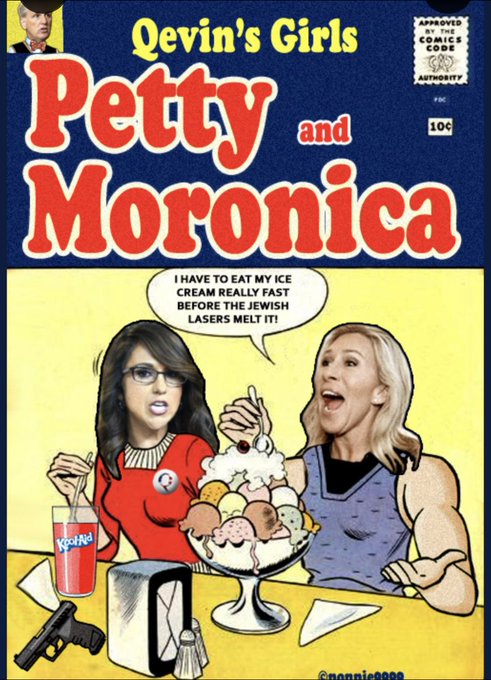
[O]ne of the recurring themes in the comments to No More Mister Nice Blog, particularly from Yastreblyansky at The Rectification of Names, that a lot of the "working class" supporters of Trump based on their educational levels are actually small business owners, the petite bourgeoisie. Lauren Boebert and Marjorie Taylor Greene come to mind. Both were small business owners before being elected to Congress, which adds new meaning to "petty bourgeoisie."
Desi Lydic rates the Democratic Party's methods of opposing Trump on the cringe-o-meter: from off-key protest chants to interpretive dance to podcasts. Plus, with so many Dems saying "F**k Trump," Grace Kuhlenschmidt thinks that might just be a great idea.
Scientists are starting to find a strange connection between neurodegenerative diseases like Alzheimer's, Parkinson's, ALS, MS, and dementia. They all seem to follow on the heels of common but severe infections. And that means we might be able to stop them.
Hosted by: Savannah Geary (they/them)
This story looks familiar, because it's similar to the one told in SciShow asks 'Could a Vaccine Prevent Type 1 Diabetes?' for World Diabetes Day; an infection triggers a pathological response by the body, sometimes years later. That's the bad news. The good news is that prevention already exists in the vaccines for flu, shingles, and pneumonia. Unfortunately, a segment of the population turned against the COVID-19 vaccine and there is evidence that vaccine hesitancy has spread beyond SARS-CoV-2 to other viruses. That's a story that deserves its own entry, especially because it's topical and can develop more before I share it next month. That's only three days away, so my readers may not have to wait long. Stay tuned.
This video explores what has gone wrong with one of the country's biggest fabric and craft stores.
As I customarily do for Company Man Mike's videos, I'm displaying his complete list.
"Less sewing" is a phrase I've never written here before; the closest I've come is using less and sewing at opposite ends of 'Fahrenheit 11/9' wins three Razzie Awards, two for Donald Trump and one for Kellyanne Conway, but not together, so that's a false positive. Also, while I've been been blogging about women's careers since Mother's Day 2012 and have been writing about how women (and men) shop since 2009 (reproduced in 2011), I don't know if I've connected the effect of women entering the workforce on shopping before. It was about time.
Competition is a common theme, although Joann's story didn't mention the usual suspects of Amazon and Walmart; instead, it was Michael's and Hobby Lobby.* Joann's vanquished their competitors in the fabric business, so their competition is in crafts.
"External factors" were very much the same for Joann as it was for Big Lots! Both thrived during the pandemic because people were at home, then suffered once people returned to work. Ironic.
On the other hand, inventory fits the pandemic narrative of disruptedsupply chains compounded by tariffs. At least it's not Big Lots! issues with inventory tracking and billing. I'd never seen that before!
Company Man Mike's video came out nearly a month ago and the story has developed since then. For that, I'm turning to Jen of Sewing Report LIVE for JOANN Bankruptcy Auction...Who Won + What's Next?
Day 2 update of the JOANN bankruptcy sale auction at Kirkland & Ellis LLP. The winning bidder is GA JOANN Retail Partnership, LLC (partnership between Great American Group + term lenders). Next up is the bankruptcy court sale hearing on February 26, where the judge has to approve the sale of assets to the winning bidder.
Great American Group CEO Scott Carpenter said during the auction call most JOANN stores will stay open until the end of May and every item in every store will be discounted. They are working on a multi-million dollar retention plan for company employees, with 90% of that budget going to stores. Fresh inventory should soon be rolling out to locations.
Disclaimer: I am NOT an attorney, this is obviously not legal expertise.
Looks like all stores will close and the inventory will be liquidated by the end of May. That will be an especially sad day for people who sew clothes and costumes.
*I'd love to write a "Decline of Hobby Lobby...What Happened?" post, but their customer base may support them as much as they do Walmart, for reasons I like even less. Instead, I might have to settle for Hobby Lobby - The Controversial History. Sigh.
Short answer — not yet, but we need to pay attention. All the virus requires to become dangerous to people is the ability to be transmitted from human to human. Should it recombine with a human flu strain, it could acquire that ability. Then it's time to start worrying.
Cows in North America are getting bird flu. What happened? How did we get here? And is this the next pandemic? In this deep dive narrative history of avian influenza, SciShow takes on these questions.
Correction:
38:50 This video's consultants should be listed as Kelly Hills MPH and Dr. Nicholas Evans
This is a fascinating history of not only bird flu, but other flu pandemics, SARS, and COVID-19. I am a paleontologist, so I appreciate the historical and comparative approach to science this video took. I also learned a lot of new things from this video, so it's a good day. While I won't show this to my students — it's 30 minutes too long — I can definitely incorporate some of its facts into my lecture on flu and other viruses. This includes the following image, which updates one I used to show my students.
Welcome to blogging as professional development.
By the way, listening to Dr. Pardis Sabeti mention leadership, gaining trust, and fighting misinformation as important for fighting pandemics reminds me that Hoover Cleveland shares an Ig Nobel Prize for Medical Education with "Jair Bolsonaro of Brazil, Boris Johnson of the United Kingdom, Narendra Modi of India, Andrés Manuel López Obrador of Mexico, Alexander Lukashenko of Belarus...Recep Tayyip Erdogan of Turkey, Vladimir Putin of Russia, and Gurbanguly Berdimuhamedow of Turkmenistan, for using the COVID-19 viral pandemic to teach the world that politicians can have a more immediate effect on life and death than scientists and doctors can."
While funny and worth pointing out when Hoover Cleveland says he wants a Nobel Peace Prize, these people are not good company and this award is not a good sign for the near future. Who knows, maybe he'll win an Ig Nobel Peace Prize for his designs on Greenland and Canada or an Ig Nobel Economics Prize for tariffs. We'll find out this fall.
Stay tuned for the Sunday entertainment feature. What can I write about awards season that is worth sharing next month?
In 2021, at the height of the Covid-19 pandemic, avian flu began aggressively circulating in wildlife. Dead and sick birds began showing up on shorelines. Poultry farms were forced to cull millions of animals, often in horrific ways, to help stop the spread. Egg prices skyrocketed. Farmers lost millions of dollars. The problem doesn’t stop with birds; avian flu has also been found in a wide range of mammals. More than 24,000 sea lions in South America have reportedly died from it. Then, on January 6, 2025, the US reported the first human death. It’s an alarming development, but fortunately an outlier. The truth is avian flu still poses little threat to humans. But if we’re not worried now, when should we be?
Short answer — not yet, but we need to pay attention. All the virus requires to become dangerous to people is the ability to be transmitted from human to human. Should it recombine with a human flu strain, it could acquire that ability. Then it's time to start worrying.
During 2024, the average price of a dozen large, Grade A eggs jumped 65 percent. The USDA predicts prices will go up another 20 percent this year. A big reason for these sky-high prices: the bird flu outbreak that started in 2022. John Yang speaks with livestock economist David Anderson and virologist Angela Rasmussen for more.
Both my wife and I have had trouble even finding the eggs we normally buy on store shelves. I went to Kroger last week and found almost none of the premium egg brands. Kroger had plenty of the store brand eggs, though, and I bought a carton. My wife found no actual eggs at Whole Foods, so she bought store brand liquid eggs. This is an annoyance and inconvenience, but it's not an actual threat.
That completes this outbreak update. Stay tuned for more politics, most likely filtered through comedy. I need to laugh because it hurts too much to cry.
Klepper and Kosta are covering Governor Hochul's stopping congestionpricing. That's a subject that deserves another post. Maybe if or when CityNerd uploads a video about it.
I was told traffic is worse than it's ever been, especially in New York City. So I went on a research expeditions to find out if it's actually true, and if so — given how many people are working from home and how much vacant office space there is these days — WHY?
This entire video is an exercise in three of Commoner's Laws: "Everything Is Connected to Everything Else" — changes in one part of the transportation system, in this case people moving from transit for commuting to private vehicles for non-work trips, affect the rest of the transportation system, which leads to "Everything Must Go Somewhere" and "There Is No Such Thing as a Free Lunch" — all those personal vehicle trips have to go somewhere, causing more traffic congestion, and working from home has unforeseen costs, like more non-work trips and longer trips to work when people do commute because of moving away from work. Where's "Nature Knows Best?" Sorry, walking doesn't seem to enter into the equation, although horse-drawn carriages merit a mention for historical comparisons and bicycling barely makes a mark on the pie charts.
The pandemic also appears in the story, serving as another instance of "Everything Is Connected to Everything Else" and "There Is No Such Thing as a Free Lunch." Fear of infection seems to be a big driver, pun intended, of shifting people in general and New Yorkers in particular from transit ridership to work from home, with personal car use for non-commuting trips. This connects back to "perceived safety" near the beginning of the video; people working from home don't seem to be factoring in the risks of driving. As I wrote in CityNerd explains 'All the Ways Car Dependency Is Wrecking Us', 46,980 Americans died in traffic accidents during 2021 and one million died worldwide.
Randy's plug of Ground News reminds me of what I wrote in Future Proof examines 'The RISE and FALL of Malls in America,' a tale of the Retail Apocalypse, "the paid promotion by Ground News reminds me that I promised a comparison and contrast between AllSides and the Media Bias Chart three years ago." I still haven't done that, but it really is time. Maybe when I make my monthly page view goal and write evergreen entries near the end of the month.
That would make a good post to share next month. Stay tuned to see if I actually write it.
I have a work project due by the end of this month. Maybe after I get that done. Otherwise, I have in penciled in for the last week of February, when I'm off from work. In the meantime, stay tuned for more evergreen entries worth sharing next month through the end of January.
One of the country's biggest closeout retailers has filed for bankruptcy and nearly shut down entirely. This video tries to identify the biggest reasons behind the struggles of Big Lots.
Here is Company Man Mike's four reasons for the failure of Big Lots!
What struck me most about this list is how much Big Lots! thrived during the pandemic because of the chain's shift to selling more furniture. As I wrote in 2020, "If one has to shelter in place, then one might [as well] find a better place to find shelter." That, or make one's existing shelter a better place through new furniture. Unfortunately, furniture is a durable good, so once the demand was met, sales collapsed once the public health emergency ended, leaving Big Lots! holding the bag. It makes me wonder how well Zoom is doing. Better than Big Lots! I'm sure.
No bankrupt company's story seems to be complete without videos from both Company Man and Bright Sun Films. I'm awaiting Jake Williams' contribution to this tale. In the meantime, he just uploaded a documentary about Payless Shoesource, which would be a good subject for a Wayback Wednesday, Throwback Thursday, or Flashback Friday. Stay tuned.