A blog about societal, cultural, and civilizational collapse, and how to stave it off or survive it. Named after the legendary character "Crazy Eddie" in Larry Niven and Jerry Pournelle's "The Mote in God's Eye." Expect news and views about culture, politics, economics, technology, and science fiction.
John Oliver discusses how the Supreme Court has paved the way for the redrawing of congressional maps across the country, and what it means for the midterm elections. Plus, an urgent update on Gavin Newsom’s summer reading.
As for the Supreme Court's opinion on the Voting Rights Act, I wrote "the conservative majority of the Supreme Court shot multiracial democracy in America in the leg, if not an even more vital part of the body. The bullet is still traveling, injuring tissues and organs on its way." Oliver documents the damage, which isn't done yet.
I close by agreeing that all options should be on the table, especially Supreme Court reform. That might have to wait until 2029, when both houses of Congress and the White House are controlled by Democrats. To get there, "people in favor of multiracial democracy are going to have to vote in large enough numbers this fall and in 2028 to overwhelm the forces trying to send the U.S. back 60 years or more. May we succeed."
“Lyin’ Eyes” was written by Don Henley and Glenn Frey, released by California’s rock legends The Eagles in 1975. It was apparently inspired by their visions of many beautiful younger women with older husbands in Los Angeles, who they imagined leading double lives and lying and cheating. So it’s a story about moral reprobates, hypocrisy, double standards, and virtual self-prostitution, which made it perfect to adapt to address J.D. Vance’s latest foray into European politics.
Plenty of muck-stirrers had already sought to whip up anger and outrage in the wake of the tragic murder of Henry Nowak, and the horrendous footage and troubling backstory. These included Nigel Farage, Tommy Robinson, Rupert Lowe, and Elon Musk. But Vance – who had met several of the more disturbing UK ‘politicians’ last summer – in his inimitable style took things to a new level.
Vance showed wanton disregard for the grieving Nowak family’s own stated request: “We do not want his death to be used to create further division, hatred, or tension.” He shared footage of the eighteen-year-old’s ghastly final moments, let down by mistakes by British police officers under huge stress, and crassly linked it to fears about migration, civilisational collapse, hatred, invasion and anger. It was a sick message that has been amplified on Twitter/X and, at point of writing, has over 10m views.
We didn’t even have time to get into the hypocrisy of casting stones across the Atlantic by this administration or this chameleon. But the song’s intended to express that the behaviours, ideologies and values that Vance and his ilk embody, particularly in this tragic moment, are anathema to most in the UK, and we suspect most Europeans. They are like a cancerous cell in the tissue of what we understand being ‘civilised’ means, and they are threatening to metastasise.
The Voting Rights Act of 1965 is a very big deal. It transformed America, marking the end of the Jim Crow era and effectively banning racial discrimination in elections. Finally fulfilling the promise of a multiracial democracy, Black voter registration increased, and political representation across the nation better reflected America’s diverse population.
60 years later, a key pillar of the Voting Rights Act is at risk of being erased. In a 6-3 ruling, the Supreme Court has sided with the plaintiffs in a redistricting case out of Louisiana called Louisiana v. Callais. The case focused on Louisiana’s legislative maps, which were amended after a 2022 lawsuit in which civil rights groups and community members sued the state of Louisiana, claiming the maps drawn after the 2020 census didn’t properly reflect Louisiana’s Black population.
Once the new map with two majority-Black districts passed in the Louisiana state legislature in 2024, a group of “non African-American voters” filed a lawsuit that alleged the new map was unconstitutional and racially gerrymandered, intended to cut white voters out of power. Following the Supreme Court ruling, Louisiana must redraw that map.
What happens next could ignite a widespread gerrymandering effort that would alter electoral maps across red states and have major effects on minority political representation in the United States at every level of government.
I haven't blogged about the Voting Rights Act since 2023's FiveThirtyEight asks 'How Impactful Was This Supreme Court Term?'* Then, I wrote, "I think America dodged two bullets to democracy in the decisions about the Voting Rights Act and the 'Independent State Legislature Theory.'" I can't write that today; the conservative majority of the Supreme Court shot multiracial democracy in America in the leg, if not an even more vital part of the body. The bullet is still traveling, injuring tissues and organs on its way. MS NOW documents the damage in ‘They’re fighting hard because we were winning’: Stacey Abrams on GOP gerrymandering surge.
“They want our weariness to turn into paralysis.” This week, The Supreme Court delivered a massive new blow to the Voting Rights Act that greenlights GOP gerrymandering efforts. Stacey Abrams joins The Weekend to break down what comes next, where we have seen these actions before in authoritarian regimes throughout history, and how to use people power to brace against fascism.
In response to Jonathan Capehart, Jacqueline Alemany, and Eugene Daniels, the hosts of The Weekend, outlining Louisiana suspending its primary election and the legislatures of Alabama, Mississippi, and Tennessee going into special sessions to redistrict their states, Stacey Abrams outlined an ambitious pro-democracy agenda. I'm here for all of it.
For decades, Section 2 of the Voting Rights Act acted as a guardrail, preventing Republican-led state legislatures from carving Black voters out of political power. But, in the words of Justice Elena Kagan, the Court’s ruling in Louisiana v. Callais has weakened the provision to “all but a dead letter.” MS NOW legal analyst Melissa Murray and President & CEO of Democracy Forward, Skye Perryman join “The Weekend” to discuss.
I agree with Skye Perryman; people in favor of multiracial democracy are going to have to vote in large enough numbers this fall and in 2028 to overwhelm the forces trying to send the U.S. back 60 years or more. May we succeed.
That's a wrap for today's topical post. Stay tuned for highlights of tonight's Saturday Night Live as today's Sunday entertainment feature.
*The video in that entry has been made private, just like every video I've embedded from FiveThirtyEight. Disney/ABC didn't just disband the unit, it hid its history. That's a great loss that makes me sad, angry, and powerless. I don't know what news consumers can do to get it back. Sigh.
Instead of exploring fiction for today's Sunday entertainment feature, I'm celebrating the best of nonfiction in television by beginning my examination of this year's 47th News & Documentary Emmy® Awards Nominees with the nominees for Outstanding Science and Technology Documentary, as I did last year.
Outstanding Science and Technology Documentary
Critical Condition: Health in Black America NOVA | GBH [A NOVA Production | Firelight Films] The Memory of Darkness, Light, and Ice
Metamorph Films, LLC Operation Space Station
NOVA | GBH [A NOVA Production | Blink Films | France Télévisions] Sally
Muck Media [Story Syndicate | National Geographic Documentary Films] Titan: The Oceangate Submersible Disaster
Netflix [Netflix | Diamond Docs | Story Syndicate]
Sally leads this field with three nominations as the preview image shows, Outstanding Science and Technology Documentary, Outstanding Direction: Documentary, and Outstanding Art Direction / Set Decoration / Scenic Design: Documentary. The rest of the nominees for this category have only this one nomination. On this basis, I'm considering Sally to be the favorite for this award. Time to watch the trailers to see if they confirm my impression, staring with SALLY | Official Trailer | National Geographic Documentary Films.
Sally Ride became the first American woman to blast off into space, but beneath her unflappable composure, she carried a secret. Revealing the romance and sacrifices of their 27 years together, Sally’s life partner, Tam O’Shaughnessy, tells the full story of this complicated and iconic astronaut for the first time. From National Geographic Documentary Films, SALLY is directed by Emmy Award-winning filmmaker Cristina Costantini.
That was inspiring. I'm looking forward to announcing any Emmy Awards it wins in June, Pride Month.
If the ice sheet covering Greenland melts, global sea levels would rise 21 feet, profoundly impacting our planet. How, why, and when could this happen? Scientists have recently found lost sediment from a forgotten secret sub-ice Cold War base in the Arctic that holds clues about a time when the Greenland Ice Sheet had receded. THE MEMORY OF DARKNESS, LIGHT, AND ICE is a 60-minute documentary film about the discovery of this precious sediment core, which holds the key to crucial science around the melting Greenland Ice Sheet (GrIS) and the future of sea level rise across the globe.
Watching this trailer reminds me that I showed Chasing Ice to my students last week and this is week is Earth Week, making this a good movie to recommend to my students. Welcome to blogging as professional development. It also makes me think that it's the strongest competitor to Sally. Last year, I thought that the "Hunt for the Oldest DNA" episode of NOVA on PBS had the strongest science of all the nominees, but didn't have the best chance of winning. Surprise, it won! That could happen here.
The second nominated episode of NOVA is "Operation Space Station: High-Risk Build." Watch its official promotional video from NOVA PBS Official, How Astronauts Avoided Disaster Building the International Space Station | NOVA | PBS. The field for this category wouldn't be complete without a NOVA episode, and this year's slate has two. Good showing for NOVA!
A dangerous spacewalk, a toxic leak, and a breathtaking view of Earth.
Astronauts faced a life-threatening challenge during construction of the International Space Station.
Sitting in sunlight to evaporate the ammonia serves as a good example of one of Commoner's Laws, "Nature knows best." Environmental content in space!
Titan: The OceanGate Submersible Disaster examines CEO Stockton Rush’s quest to become the next billionaire innovator and the doomed underwater endeavor that called into question the price of ambition in the depths of the ocean.
The Titan submersible’s ill-fated journey to the ruins of the Titanic dominated headlines in June 2023, yet the shocking decisions that led to the disaster have never been revealed like this before.
This could just as easily have been nominated for business documentary as for science and technology. It's also Sally's chief competition for its journalistic value and public interest; the trailers for both have more than two million views, with Sally slightly ahead. In contrast, the trailers for the rest of the nominees have several thousand views at most. I still think Sally is the favorite, but now I have a better grasp of its chances.
Follow over the jump for Sally's other two nominations and some of the most read entries about the Emmy Awards last year.
John Oliver discusses J.D. Vance, what he really believes, who he is without Donald Trump, and – most importantly – what he looks like without a beard.
Vance's opportunism and misogyny shine right through this satirical biography. As for Hillbilly Elegy, it's one of the rare films that earned both Oscar and Razzie nominations. While I'm not sure about Glenn Close's Razzie nomination (fortunately, she didn't win), I am sure about Worst Screenplay, which earned Vanessa Taylor, but not Vance, a nomination. I think leaving Vance off the nomination was an oversight.
John Oliver certainly had something to say about Hillbilly Elegy, including Glenn Close's Razzie nomination; maybe she did deserve it, although I'm still glad she didn't win. As for Vance's opportunism, that shines through even brighter. On the other hand, different bigotries eclipse his misogyny, especially racism and anti-immigrant sentiment, never mind that Vance's wife Usha is the daughter of Indian immigrants.
Vance would be less erratic (mercurial would be a polite way of saying it) and not driven by Hoover Cleveland's obsessions with tariffs, grifts, and revenge, but he'd be more likely to implement the parts of Project 2025 that Hoover Cleveland hasn't yet. He'd also be more under the influence of Palantir founder Peter Thiel, his pet bad philosopher Curtis Yarvin, and Palantir CEO Alex Karp. They're the sources of what I called "cyberpunk villain ideas straight out of SnowCrash..." Vance can certainly learn new tricks, but I worry about the ones Thiel, Yarvin, and Karp could teach him. They might be worse.
As for Trump AKA Hoover Cleveland repeating the fiction of Haitian immigrants eating pets, it's another example of his vulnerability toconspiracy theories. He still hasn't learned that the voices he's listening to aren't reliable sources. This includes JD Vance.
That hasn't stopped Hoover Harding Cleveland from listening to them.
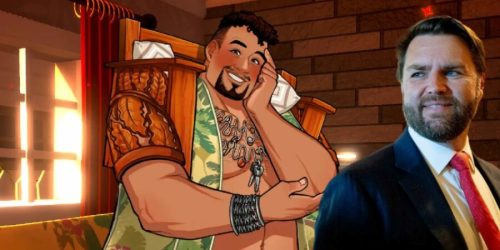
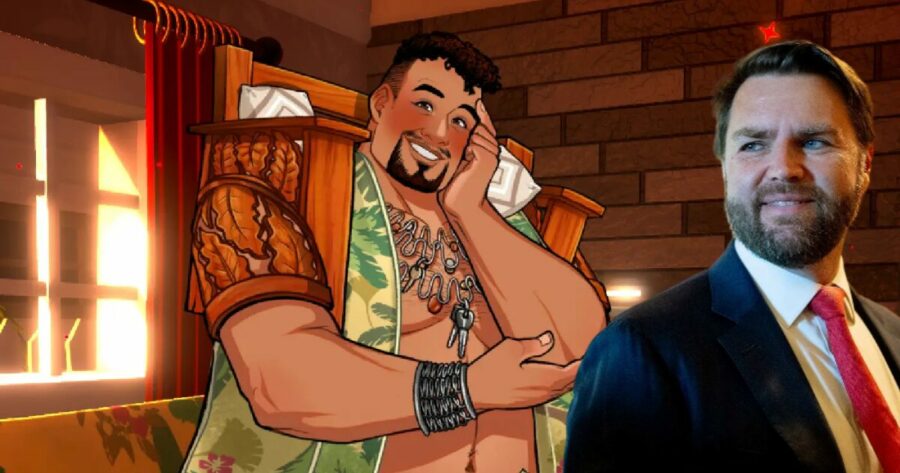
As for the meme with JD Vance making love to a couch, it reminds me that there is a game called Date Everything! Everything includes a couch named Koa, and there is already a meme of it/him with Vance.
A comedy sketch about Vance wouldn't be complete without a couch joke!
The Critics Choice Association (CCA) unveiled the winners of the Tenth Annual Critics Choice Documentary Awards at a gala event in New York City. The Perfect Neighbor won the top award of the evening, Best Documentary Feature. The film also took home awards in four other categories including Best Director for Geeta Gandbhir, Best Editing for Viridiana Lieberman, Best Archival Documentary, and Best True Crime Documentary.
The only category I clearly called for The Perfect Neighbor was Best True Crime Documentary. I thought it was a co-favorite with Riefenstahl and Orwell: 2+2=5 for Best Director, so no clear call, picked Orwell: 2+2=5 to win Best Documentary and Best Archival Documentary, and made no call for Best Editing, although I'm not surprised; editing is what makes a good archival documentary. Just the same, congratulations and good luck at next year's Emmy Awards, either as Outstanding Crime and Justice Documentary at the News & Doc Emmy Awards or Outstanding Documentary or Nonfiction Special/Exceptional Merit in Documentary Filmmaking at the Primetime Creative Arts Emmy Awards...
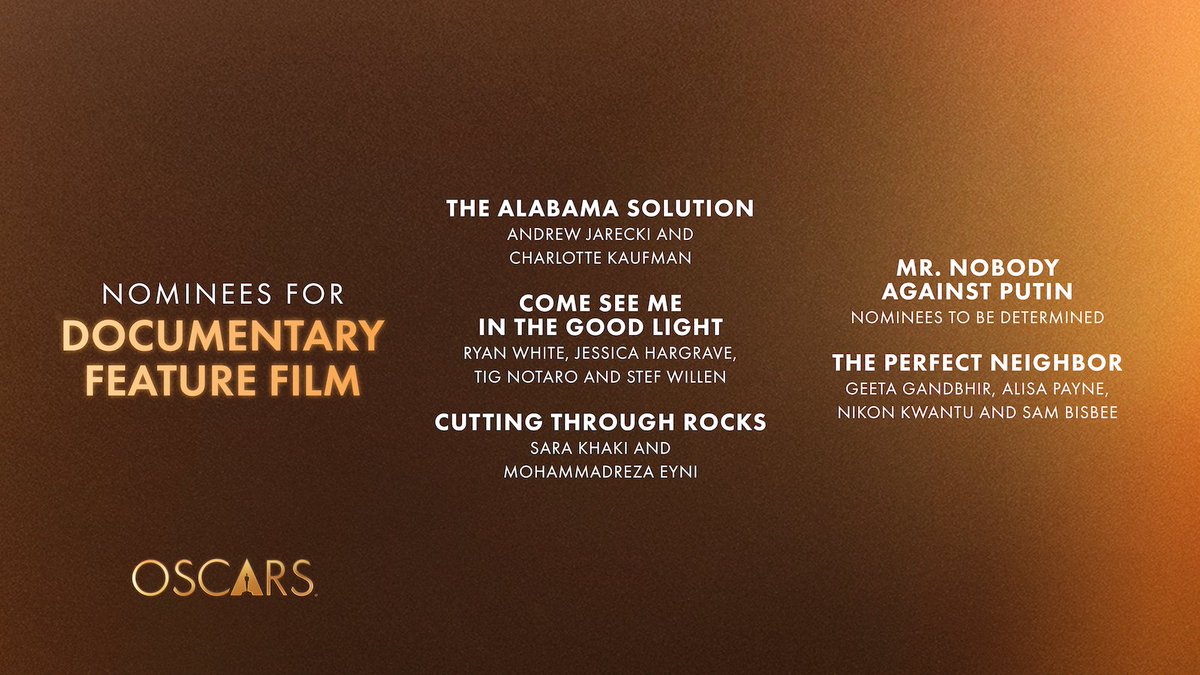
The trophy for Best Political Documentary was awarded to The Alabama Solution.
While I thought The Alabama Solution could win, I also thought Orwell: 2+2=5 would win. Nope. Just the same, congratulations and good luck at the relevant Emmy Awards next year.
Neither The Perfect Neighbor nor The Alabama Solution will be nominated at either Emmy Awards because both earned nominations at the Academy Awards, disqualifying them for Emmy consideration. I'm not the least bit upset; this is exactly the kind of wrong I'd like to be. Also, congratulations to the producers and directors of both movies. I'm thrilled for them!
Now that the nominees have been announced, what are their Gold Derby odds? The Perfect Neighbor leads with every expert, 33.3% of editors, and 90.4% of users picking it to win. The Alabama Solution sits in second because it has the support of 5.4% of users and 16.7% of editors. Mr. Nobody Against Putin is actually the other top choice of editors at 33.3%, but only 2.3% of users, placing it third in the odds. Come See Me in the Good Light is currently in fourth as the selection of the remaining 16.7% of editors and 1.0% of users. Cutting Through Rocks has the remaining 0.9% of users. I have the feeling that the editors will consolidate around one or two nominees once the PGA Awards, DGA Awards, and BAFTA Awards have been presented. The Perfect Neighbor is the only Oscar-nominated documentary nominated or longlisted at all of them.
One woman. Dozens of 911 calls. And a close-knit neighborhood caught in a nightmare. What begins as one woman’s relentless harassment of children spirals into a shocking act of violence. Captured through gripping police bodycam footage, The Perfect Neighbor - Winner of the Sundance Film Festival’s Directing Award - delivers a hauntingly powerful experience that keeps you on edge from start to finish.
Yikes! This looks like a real-life version of multi-Razzie nominee Karen. That movie was about racism and harassment, and it's even uglier when it's fact instead of fiction.
Follow over the jump for the trailers of the other four nominees.
Dr. Z is in the middle of a series about Kong and has a review of Godzilla x Kong: The New Empire up, which I'm saving until she finishes her series. I'm an environmentalist. I don't just recycle, I conserve my resources!
In this episode, we explore the legacy of the monumental 1933 film, King Kong, its groundbreaking special effects, and the complex racial and colonial undertones that continue to shape our understanding of this timeless classic.
Be sure and check back with us for our next episode, which will explore Kong in modern times!
Since his 1933 movie debut, King Kong’s impact on our culture has been persistent. For nearly a century, Kong’s story has changed to reflect, and sometimes comment on, our society’s issues with racism, sexism, and fear of the unknown. Let’s talk about how well this iconic monster’s evolution keeps up with our changing times.
Dr. Z's comment about Peter Jackson's island inhabitants being the most violent in the franchise brings back my impression of them when I watched his King Kong in the theater 20 years ago; they reminded me of his orcs from The Lord of the Rings movies. Less than human, indeed!
October 26th is National Pumpkin Day!
Marlo Anderson tells us all about this national day.
I'm a biologist, and I can confirm that pumpkins are fruits, just like tomatoes. Both pumpkins, along with all other gourds and squashes, including cucumbers and melons, and tomatoes are berries. We just eat them like vegetables. So concludes the science lesson for today.
Stay tuned for more Halloween posts through the end of the month plus a bonus Day of the Dead entry. Trick or treat!
Native American history didn’t begin in 1492, and it didn’t end in 1900. It stretches back thousands and thousands of years and extends into the present – and the future – of the United States. In our first episode of Crash Course Native American History, we’ll explore why and how we plan to tell this history.
My first encounter with the word Mazama, the genus name for brockets, was for the stratovolcano that stood where Crater Lake now sits in its caldera. I originally thought the name was the original Native American one for the now imploded mountain and the deer was named after it. Not at all! The direction of the name runs the other way, from the deer through a mountaineering club with the name, who took it to mean mountain goat instead of brocket, which is what Mazama means in Spanish as well as at least one Native American language that borrowed it from the Aztec language Nahuatl, to the prehistoric mountain, as they named it after themselves. If your series on deer hadn't inspired me to do this research, I may never have found any of this out! By the way, since I'm also a geologist and lecture on Crater Lake in my classes, I can use this information when I teach. Thank you!
I now tell the story found in Wikipedia, of a battle between Llao and Skell, thanks to reading a blog about biology, not geology. This wasn't the only story I tell my students I changed while teaching from home. Not commuting during the COVID-19 pandemic gave me time to check my facts, as did realizing my students were doing a lot of their own research. I could tell they were reading Wikipedia and didn't want some student contradicting me in front of the class!
What is tribal sovereignty? In this episode of Crash Course Native American History, we’ll explore how tribes can and can’t govern themselves, and why sovereignty isn’t something the U.S. ever gave to tribes — it’s an inherent right they already had.
"Isn't the legal system fun?" *snork* At least this video confirmed that what I knew about "dependent sovereignty," a term I first heard on CBC 30+ years ago, was correct. Native American tribes can't wage war, engage in diplomacy with foreign nations, or print/mint their own currency. That's worth knowing. What I didn't knew already was that the Chinook are not currently a federally recognized tribe. They should be.
From sports mascots to “the First Thanksgiving,” bland representations of Native Americans are everywhere. In this episode of Crash Course Native American History, we’ll tackle common myths and misconceptions about Native people and uncover the truth behind tribal casinos, government handouts, and more.
I enjoyed seeing all these myths busted.
There are 15 more episodes and counting, but I'm conserving those resources, so that's a wrap for today. Stay tuned as I plan on resuming my Emmy winners coverage tomorrow with the winner of Outstanding Commercial.
President Trump is using the government shutdown to punish anyone who didn't vote for him, J.D. Vance loves memes so we made a special one just for him, and Stephen Colbert checks in on some well-known people who are dipping their toes in the artificial intelligence pool.
As for the meme with JD Vance making love to a couch, it reminds me that there is a game called Date Everything! Everything includes a couch named Koa, and there is already a meme of it/him with Vance.
Dude, you'd be better off with Betty the bed. She looks more comfortable.
Although the federal government has shut down, President Trump's deportations and troop deployments to American cities will proceed without pause. In Washington, Democratic leaders played Vice President Vance for laughs and told reporters they won't give in to Republican pressure to let healthcare subsidies expire.
The shutdown is revealing what Hoover Cleveland and his administration considers to be essential services. Priorities.
Follow over the jump for more from The Daily Show, Seth Meyers, and Jimmy Kimmel.
John Oliver discusses the massive problems caused by gang databases, how people wind up on them, and why nobody looks good in lime green. You might think you’re pulling it off but trust us, you’re not.
The opening minutes are giving me flashbacks to what I wrote in 'Last Week Tonight' examines 'Trump & Deportations' for Wayback Wednesday: "Donald 'Hoover Cleveland' Trump insisting that the photoshopped 'MS-13' on Kilmar Abrego Garcia's hand is real reminds me of what I've written before, 'the voices in his head are not reliable sources. Neither are the real people he listens to.'" Based on what Oliver and his researchers and writers found out, the gang databases aren't all that reliable or helpful, either. Oh, and kudos to Oliver and his producers for getting LV to sing the chorus from "Gangster's Paradise" to conclude the segment.
Confederate General Edmund Kirby Smith fleeing to Mexico after surrendering is an amusing fact I'd missed in previous tellings of the story. It didn't appear in KPRC 2 Click2Houston's Celebrating Juneteenth In Galveston: Birthplace Of Freedom.
Big celebrations are underway here in Galveston, the birthplace of Juneteenth.
Former President Joe Biden, who signed the law making Juneteenth a federal holiday, coming to Galveston to celebrate, makes for an appropriate closing of the circle. That written, the story of Juneteenth continues, as MSNBC tells in 'History is being challenged': Rev. Al slams DEI attacks on Juneteenth holiday.
Thursday, June 19 marks the Juneteenth holiday, the day in 1865 when enslaved African-Americans in Galveston, Texas learned they were free. The Rev. Al Sharpton and Maura Gay discuss.
I'm continuing my coverage of the News & Doc Emmy Awards for today's Sunday entertainment feature by examining the nominees for Outstanding Arts and Culture Documentary. Unlike the other categories I've examined so far, there is no clear leader. On the one hand, King Coal has three nominations, including Outstanding Writing - Documentary and Outstanding Cinematography – Documentary, the most of any in the field. On the other, Hollywood Black's other nomination is for Best Documentary, which gives the film at least as much weight as King Coal's three nominations and more weight than Madu's second nomination for Outstanding Direction – Documentary. The other nominees, As We Speak: Rap Music on Trial and Butterfly in the Sky, have only this one nomination, so I'd be surprised if they could overcome the three entries with more nominations.
A lyrical tapestry of a place and people, King Coal meditates on the complex history and future of the coal industry, the communities it has shaped, and the myths it has created. The film reshapes the boundaries of documentary filmmaking and transcends time and place, untangling the pain from the beauty, and illuminating the innately human capacity for imagination and change.
This definitely emphasizes the culture in "arts and culture."
Inspired by the book from historian Donald Bogle, this four-part docuseries, directed by Justin Simien, chronicles a century of the Black experience in Hollywood. By unearthing personal stories from actors, writers, directors, and producers who fought for their place on the page, behind the camera, and on the screen, the series provides a critical reexamination of a quintessentially American story—in brilliant color.
The star power alone would push this over the top at the Creative Arts Emmy Awards, but that Television Academy isn't the one voting. The television academy containing the journalists and documentarians is. They might do so based on their own criteria. Remember, electorates matter.
Madu follows 12-year-old Anthony Madu as he leaves his family and community in Nigeria to study at one of the most prestigious ballet schools in the world in England. Having never left his home outside of Lagos, Anthony finds himself thrust into a new world where his wildest dreams are suddenly within reach. His courageous journey is a story of extraordinary obstacles as he searches for belonging and acceptance, a family far away, and unexpected challenges that could impact his future. Forming a rich and immersive tapestry told on multiple continents, MADU introduces the world to a boy chasing a dream of inspiration that will resonate with us all.
This looks positive and inspiring in a way that neither King Coal nor Hollywood Black are. It might upset both on that basis alone.
An exploration of the weaponization of rap lyrics in the US criminal justice system. The documentary follows rap artist Kemba as he journeys through meccas of hip-hop, building the case for rap lyrics and black artist protection via intimate conversations with rappers, academics, politicians, legal experts, and music industry executives.
This could easily have been a nominee for Outstanding Crime and Justice Documentary. Since that category covers both Love Canal and Alex Jones, I plan on blogging about it. Also, this is an MTV documentary. I've learned never to underestimate MTV documentaries.
For 26 seasons, Reading Rainbow met young viewers in their living rooms, whisking them away on far-off adventures into the boundless world of books. Inspiring and nostalgic, Butterfly in the Sky takes audiences behind the scenes of this beloved PBS children’s series and tells the story of its iconic host LeVar Burton, giving an inside look at the challenges he and the show's creators faced in cultivating a love of reading through television. Reliving the show’s legacy is a refreshing return to the written page. But you don’t have to take our word for it.
Featuring LeVar Burton, (Reading Rainbow Host), Whoopi Goldberg (Guest Star), Jason Reynolds (Former National Ambassador for Young People's Literature), Twila Liggett (Reading Rainbow Co-creator), Larry Lancit & Cecily Truett Lancit (Reading Rainbow Co-Creators), Tony Buttino (Reading Rainbow Co-creator), Steve Horelick (Reading Rainbow Composer), Ed & Orly Wiseman (Reading Rainbow Director / Producer) and also staff who worked on Reading Rainbow and kids who were featured on the show during the it’s illustrious 26-year run.
This looks just as positive and uplifting as Madu and even more relevant to an American electorate. That might pull votes away from Madu, but not enough for Butterfly in the Sky to win.
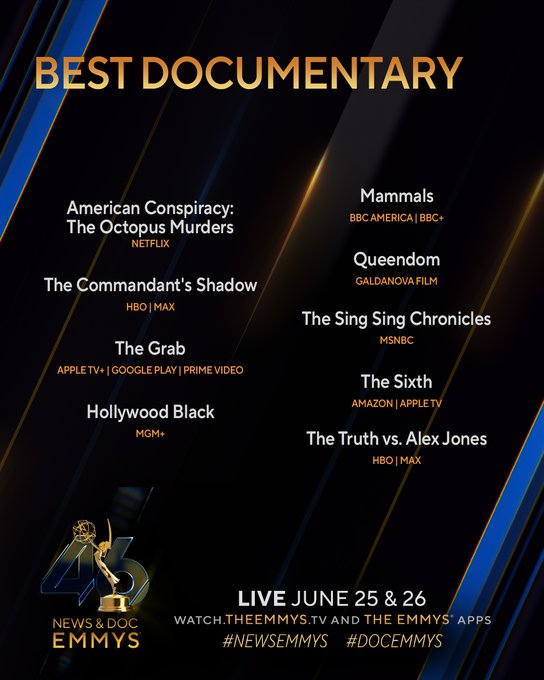
For the first time in this series, I'm examining the nominees for Best Documentary. I've been holding off because the category has nine nominees this year. The Grab leads with four nominations, followed by American Conspiracy: The Octopus Murders and Mammals with three each, Hollywood Black, The Sixth, and The Truth vs. Alex Jones, all with two, and The Commandant's Shadow, Queendom, and The Sing Sing Chronicles with just this one. The Grab and American Conspiracy: The Octopus Murders are facing off for Outstanding Investigative Documentary, The Sixth leads the nominees for Outstanding Politics and Government Documentary, The Truth vs. Alex Jones is contending with Poisoned Ground: The Tragedy at Love Canal for Outstanding Crime and Justice Documentary, and Mammals leads the rest of the field without a subject area nomination. That's four more opportunities to examine the nominees, after which I'll make my call.
Follow over the jump for the craft categories for King Coal and Madu I've covered already.
Apollo 13: Survival has the most nominations among the nominees in this category with four. As the preview image shows, they are Outstanding Editing – Documentary, Outstanding Sound – Documentary, and Scenic Design – Documentary in addition to Outstanding Science and Technology Documentary. Because of that, it's my pick to win. Then again, Good Night Oppy had six nominations and was my pick to win this category two years ago, but it lost to How to Survive a Pandemic while still winning Outstanding Sound and Outstanding Writing: Documentary. I hope that doesn't happen to Apollo 13: Survival, whose trailer I'm sharing.
Using original footage and interviews, this documentary tells the nail-biting story of Apollo 13 and the struggle to bring its astronauts safely home.
The next most nominated documentary in this category is The Space Race from National Geographic, which earned two nominations, Outstanding Science and Technology Documentary and Outstanding Writing – Documentary. Based on that criterion, it's the main competition for Apollo 13: Survival. Here's its trailer.
"The Space Race" uncovers the little-known stories of the first Black pilots, engineers and scientists that became astronauts. "The Space Race" will debut on National Geographic on February 12 before streaming on Disney+ and Hulu the following day.
That's an important story to tell, and I'm glad it included the contributions of Nichelle Nichols to recruiting astronauts of color in general and African-Americans in particular. I'm not sure it will beat Apollo 13: Survival.
The remaining three nominees have only this nomination. The first in alphabetical order is the "Anand Varma: Hidden Wonders" episode of Photographer on National Geographic. I'm sharing the clip It Looks Like a Velociraptor Foot in lieu of a proper trailer.
Anand Varma captures the development and heartbeat of a chicken embryo within an unshelled yolk. The first trial failing, the photographer eventually succeeds to the stage of what to him looks like the foot of a dinosaur.
Check out the full episode of Photographer, Season 1 Episode 2, "Anand Varma: Hidden Wonders" on Disney+! Anand figures out how to photograph an egg developing into a baby chick.
I include embryology in my lectures about evolution, so I might show this to my students. National Geographic has another clip from the show about honeybees that I might use for World Bee Day or World Honey Bee Day.
Two decades ago, Eske Willerslev had a radical idea: Could DNA, the fragile chemical code of life, survive intact in frozen sediment for millennia? Fellow scientists called him crazy, but the Danish biologist set out to prove everybody wrong, and his perseverance paid off.
This is the only episode of NOVA nominated and I agree it's probably the best one of 2024. It's also the nominee with the most important science. That written, it's not likely to win the most votes, since most of the electorate will judge the nominees for their cinematic and journalistic merit, not their scientific value. As I reiterate nearly every time I write about awards shows, electorates matter.
I circle back to Netflix for the final nominee, What's Next? The Future with Bill Gates. Watch its trailer.
In What’s Next? The Future with Bill Gates, the tech visionary and global health and climate philanthropist invites viewers to join him on a learning journey to explore pressing issues facing our world today. Across five episodes, Gates delves into the promise and risks of artificial intelligence; the pervasive challenge of misinformation and the underlying complexity of defining truth in an era of social media; the scale of the climate crisis and the potential of cutting-edge technologies to solve it; the injustice of income inequality and the opportunities to tackle poverty; and how science and innovation is leading to cures for deadly diseases. Featuring insights and commentary from some of the world’s most renowned scientists, politicians, thinkers, journalists, medical professionals, artists and more, and executive produced by Oscar winner Morgan Neville (20 Feet From Stardom), What’s Next? offers a glimpse into a more promising and equitable future.
I have two reactions. First, Bill Gates is a Crazy Eddie. That's a compliment coming from me. Second, of all the nominees with just this one nomination, it's the one most likely to upset Apollo 13: Survival.
Follow over the jump for the rest of the nominations for Apollo 13: Survival and The Space Race along with the most viewed entries about awards shows posted between March 21, 2024 and March 20, 2025, the blogging year just ended.
We often hear industry and political leaders talk about how we need to balance the economy with the environment. The thinking goes something like this: environmental destruction is necessary to earn a living and make the things we need. But is this really true? Dr. Rae Wynn-Grant explores how we can approach the economy and the environment differently.
This video reinforces a point I've been making since the first year of the blog and even before that in my environmental science classes: "economy is dependent on society, which is in turn dependent on the environment. Without an environment, there is no society. Without a society, there is no economy."
...
I think the system needs to be reformed; the status quo is unsustainable, while scrapping our food, energy, and economic systems and starting over would be too disruptive.
This video provides an idea of how those reforms could work. It's also one I could show my students. Welcome to blogging as professional development.
Dr. Rae Wynn-Grant also pointed out the inequitable distribution of both harms and benefits from economic activity using the example of the port district of Wilmington in Los Angeles, which I can add as an example of environmentalracism. What struck me as hard as the life expectancy of residents of the port neighborhoods of San Pedro, Wilmington, and West Long Beach being eight years lower than Los Angeles County as a whole is that more people died from air pollution in L.A. County than from traffic accidents and crime combined. Yikes! Am I glad I moved out of there!
Follow over the jump for how today's top post earned its page views.
Americans don’t agree on whether being born here should make you a citizen. That’s not new.
...
On the first day of Donald Trump’s second presidential term, he signed an executive order about an old American rule: that with very few exceptions, anyone born here is a citizen. Trump’s order stated that the rule, which comes from the 14th Amendment to the Constitution, should no longer apply to the children of those in the United States illegally or temporarily. Within a few weeks that order had been blocked by multiple federal judges — but it was a temporary resolution, with the ultimate outcome yet to be determined, probably by the Supreme Court.
The US is far from the only country in the world that offers unconditional birthright citizenship. While it’s uncommon in Europe, Asia, and Africa, it’s very common among Western Hemisphere countries, partly because of their history as colonies populated mostly by settlers. But of the many countries with birthright citizenship in the world, the US is by far the largest, with hundreds of thousands of baby citizens born here every year to noncitizen parents. Those numbers naturally raise the question: Is this what birthright citizenship was meant for? And why do we have birthright citizenship in the first place?
The short answer is that birthright citizenship in the US came about as a way of granting citizenship after the American Civil War to the large population of formerly enslaved Black people. But that raises a different question: How did a law intended for Black Americans end up creating hundreds of thousands of new US citizens born to immigrant parents every year? In this video we trace that history, answer that question, and look at a few of the times that the US has actually had this argument before. Today’s concerns over birthright citizenship may feel specific to our particular immigration debate. They’re actually not.
As Vox points out, this is an old debate, one that goes back to the adoption of the 14th Amendment and it always turns out the same way; people born here, other than children of diplomats, residents of American Samoa, and formerly Native Americans — I don't know if we've ever had children of enemy aliens occupying American soil other than Japanese in the Philippines, and I don't know if the Filipinos were American citizens back then — are citizens.* Just the same, that didn't stop The Heritage Foundation from proposing ending birthright citizenship in Project 2025. Here's the list of proposed actions from that document Digby embedded in Incomplete Cheat Sheet. "End birth right citizenship" is fourth from the bottom.
Look at the list and notice how many of these Hoover Cleveland is already trying to enact. It's not as if people like Digby and me didn't do our best to warn Americans!
Enough serious business. Stay tuned for PurimandHoli, kicking off a string of holidays.
*Residents of American Samoa are American nationals, but not citizens; they do not automatically become full U.S. citizens when moving to the U.S. like residents of Puerto Rico and other U.S. territories.
October 27th, 2024. Before the 2024 election, John Oliver discusses Donald Trump’s promises to carry out mass deportations, what some of his supporters might not realize about the details of those plans, and – shockingly – how Bill O’Reilly still has a show.
Oliver pretty thoroughly debunks mass deportation's supposed effects on jobs, housing, and crime. I didn't know until I watched that deportations result in lower employment for native-born Americans, not higher employment, although I knew that there are some jobs most people born in this country won't do. I don't have to look any farther than Hoover Cleveland's current and former wives. His two longest marriages were (and still are) to immigrants, while his shortest was to Marla Maples, who was born in the U.S.
Speaking of jobs Americans won't do, I'm surprised so much of the construction workforce consists of undocumented immigrants. Yes, there were a lot of immigrants building the L.A. Subway when I was working there 36 years ago, but they were a minority, so I know there are Americans who were willing to build things. Still, removing more than a million workers, especially when unemployment is already low, is going to reduce the ability to build more homes and apartments, impacting the supply. As for reducing demand, it might make rental properties more affordable, although I'm skeptical it will get the landlords to sell at reduced prices to improve home ownership. My mom owns rental property, and that's not how she would operate.
CNN's Kaitlan Collins (Chloe Fineman) checks in with Kamala Harris (Maya Rudolph) and Donald Trump's (James Austin Johnson) campaigns on the eve of the 2024 election.
Weekend Update anchors Colin Jost and Michael Che tackle the week's biggest news, like a comedian at Trump's Madison Square Garden rally calling Puerto Rico a "floating pile of garbage."
As I wrote yesterday, "all the garbage references...came out of Trump's rally at Madison Square Garden. That deserves a post of its own, but I don't know if I will have time before Tuesday." Thanks to Weekend Update, I don't think I have to write it.
Weekend Update anchors Colin Jost and Michael Che tackle the week's biggest news, like Sean "Diddy" Combs facing a new lawsuit.
I take perverse pleasure in Michael Che just skipping over the Dodgers winning the World Series. I also enjoyed Colin Jost turning the tables on Che; usually Jost the butt of the joke.
The news about Disney and Diddy — never thought you'd see those together — qualified this post as the Sunday entertainment feature, but follow over the jump for more entertainment news.*
How did Native Americans end up on Reservations? We explore the complicated relationship between the Indian Nations and the United States of America. This episode unpacks the legacy of Treaties and their effect on modern legislation. We answer the most important question: why do Native Americans continue to live and grow their families there?
Watch Tai Leclaire breakdown all you need to know about the Reservation system and why “Rez Life” is critical to the Native American experience.
That's a fascinating exploration of the history of reservations and how reality ended up not matching what was promised in the treaties. I can see why so many people have watched it.
What’s the deal with “Pretendians”? Tai Leclare and experts dissect what it really means to be Native—whether it’s blood, initiation, or just a claim. This episode digs deep into the complexities of identity and last names in Indian Country.
I really wanted to put this first, but it didn't feel quite right to begin this entry with the last video posted. Still, excellent question, one that hits close to home, as "My wife, my ex-girlfriend, and my ex-wife all have Native American ancestry. At least two of them would qualify as Native Americans under U.S. government policy, and one of them is enrolled as a Cherokee..."
Why aren’t Native people– and their stories – ever the crux of your favorite films?
From films used as a tool of genocidal propaganda, to award-winning Indigenous stories in Hollywood, how far has Indigenous media representation come and where is it headed?
Tai Leclaire and experts track the past, present and future of Indigenous entertainment– and how the media and bias prevents Native people from telling their own stories.
While I haven't watched Reservation Dogs yet, I did blog about its Golden Globes and Emmy nominations, so it's on my list. The same is true of Prey, which I haven't watched (yet) but whose Emmy and Saturn Award nomination I covered. On the other hand, my wife and I have watched both seasons so far of Dark Winds, which was also nominated for a Saturn Award, and are looking forward to season three.
Today, many Native Americans live in food apartheid and insecurity.
But it wasn't always this way. Once, their lands were abundant with nutritious food sources—corn, bison, potatoes, squash, and more.
So… what happened?
Forced relocation meant that entire Indigenous food systems were ripped away. This triggered a public health crisis and forced a dependence on government rations that just can’t compare.
I blogged about fooddeserts when I began this blog. It's about time I resumed.
This final entry reminds me that Wednesday is both National Fossil Day and World Food Day. PBS Eons videos about the prehistory of food, anyone? Stay tuned.
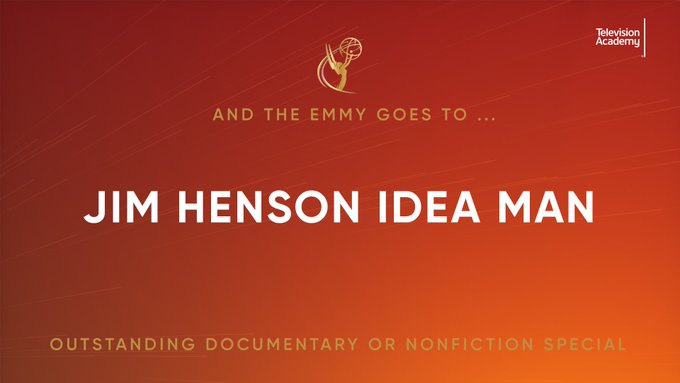
Now for the Gold Derby odds. The editors and top 24 users agree that Jim Henson Idea Man is the favorite with five of twelve editors and 21 of the users voting for it. The experts aren't on board that bandwagon, as only one expert voted for Jim Henson Idea Man.
The editors and the users were right while the experts weren't. Some experts! This is one of the reasons I pay more attention to the editors.
Now for the categories below the line, beginning with Outstanding Picture Editing for a Nonfiction Program.
Other than The Jinx - Part Two, the nominees are all archival documentaries about entertainment. That's both good and bad. On the one hand, if the voters all coalesce on one choice, it will win. On the other, they might end up splitting their votes so The Jinx - Part Two wins. Right now, I can't tell.
The voters lined up behind Jim Henson Idea Man for this award, like they did for Outstanding Music Composition for a Documentary Series or Special (Original Dramatic Score), a category I passed on other than to say about its score that "I like the variety of emotions in this track!" I then talked about all the rest of the composers because I know them and some of them have paid attention to me instead of discussing the merits of their music. Oops. May I not make that mistake again. I'm sharing David Fleming (Best Music Composition, 'Jim Henson Idea Man') 2024 Emmys press room interview to make up for it.
David Fleming won Best Music Composition (Documentary) for "Jim Henson Idea Man" at the 2024 Creative Arts Emmys.
Now I know to take Fleming seriously.
When I looked at Outstanding Sound Editing for a Nonfiction or Reality Program, I observed "I find it interesting that the one category where I could find a promotional image for the film. I hope that confidence isn't misplaced." It wasn't. Jim Henson Idea Man won.
Combined with the juried award for Outstanding Motion Design it won before Saturday's ceremony, Jim Henson Idea Man went home with five Emmy Awards, more than any other documentary or nonfiction nominee. Congratulations!
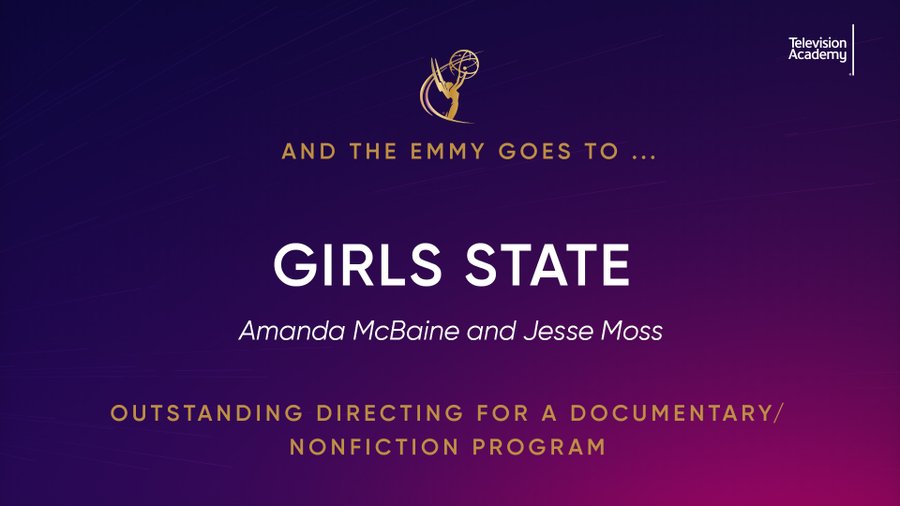
I thought Outstanding Directing for a Documentary/Nonfiction Program would be between Ron Howard and Rob Reiner, the two biggest names among the nominees. Instead, Amanda McBaine and Jesse Moss won for Girls State. This is a case where I'm glad to be wrong. On the other hand, I was right about Outstanding Cinematography for a Nonfiction Program: "This is one case where I think Girls State has a better chance than Jim Henson Idea Man because it has more original photography instead of archival footage...Good luck, Amanda, Jesse, and Laura!" All three won. Congratulations!
Follow over the jump for the other documentary or nonfiction winners.