Pearl rolled over 41,000 miles on July 17th and Snow Bear passed 3,000 miles yesterday, July 20th, so it's time for an update on oil and gas prices plus a double driving update.*
I left off with crude oil prices over $70 per barrel back in May. Ali Velshi on MSNBC updated his viewers a month later with President Donald Trump Demanding Cut In Oil Prices To Lower Gas Prices.
Prices at the pump are higher than they were last summer and President Trump is demanding oil prices be cut to bring them down. Ali Velshi breaks down how this could actually cost Americans a lot of jobs.Crude oil, particularly West Texas Intermediate (WTI), fell below $70 after the May update, but were starting to rise again in late June, when Velshi reported on the story. They continued to rise into early July, when CBS This Morning asked What's behind the spike in gas prices?
Gas prices this Fourth of July are expected to be the highest in four years because of the rising cost of oil. One reason for the increase is a smaller-than-expected production boost by OPEC, the group of oil producing nations. Patrick DeHaan, head of petroleum analysis at GasBuddy, joins "CBS This Morning" to discuss what's behind the price increase.Donald Trump jawboning the Saudis didn't have quite the effect he hoped, at least in the short term, as WTI soared above its highs in May. That continued the next week, as seen when Fox Business examined the economic impact of rising gas prices.
OPIS chief oil analyst Tom Kloza on the outlook for oil prices
Crude oil prices have since declined, but remain above $70 per barrel, as Reuters reported yesterday.
The expiring U.S. West Texas Intermediate (WTI) crude for August delivery settled up $1.00 at $70.46 a barrel, while the more liquid September contract rose 2 cents to $68.26 a barrel. U.S. crude ended the week down nearly 1 percent.The decline in oil prices, which I usually see as a positive, was not the result of good news, as the Reuters article noted.
Brent crude settled up 49 cents at $73.07 a barrel. Brent fell 3.1 percent in the week.
Lower oil demand in the United States and China caused by an economic slowdown due to the trade spat between the two countries would likely weigh heavily on markets, some analysts said.Once again, Trump is doing things that increase the likelihood of the U.S. entering recession in the next year.†
“The impact on world economic growth of a levy of this magnitude will be severe and will likely have a strong negative impact on markets,” said Olaf van den Heuvel, chief investment officer at Aegon Asset Management.
Speaking of which, an indicator that I've been following since before I started writing this blog has turned negative. Doug Short, quoting the U.S. Department of Transportation, reported on cumulative miles driven on July 2, 2018.
"Travel on all roads and streets changed by -0.2% (-0.5 billion vehicle miles) for April 2018 as compared with April 2017. Travel for the month is estimated to be 272.4 billion vehicle miles." The 12-month moving average was down 0.02% month-over-month and up 0.8% year-over-year. If we factor in population growth, the 12-month MA of the civilian population-adjusted data (age 16-and-over) is down 0.09% month-over-month and down 0.2% year-over-year.On can see the recent decline in total miles driven in the U.S. on the following chart, especially in the inset "A Close Look Since 2007."
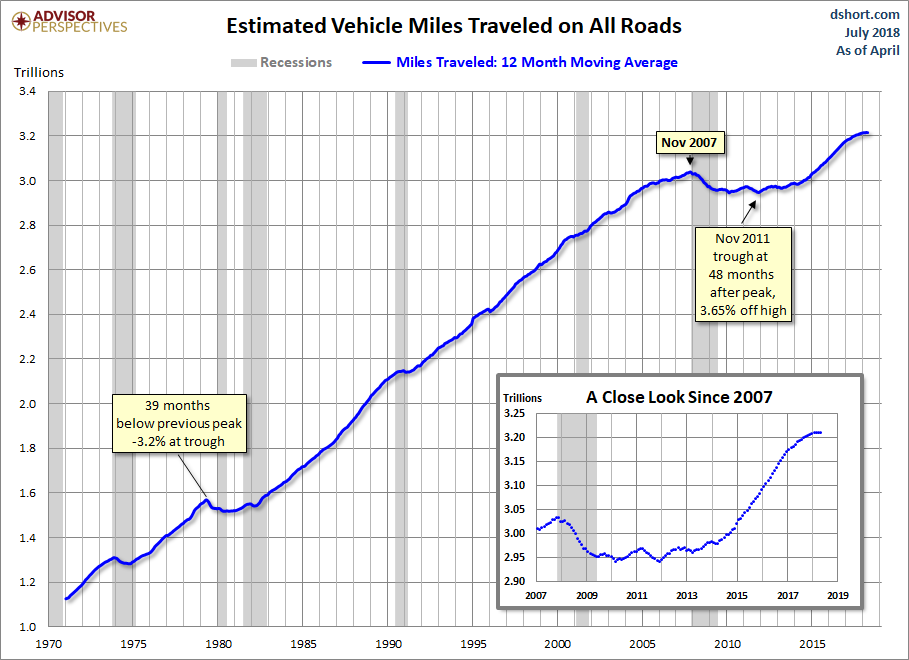
Higher gas prices are finally making people drive less. Fortunately, Amazon is making it easier for people to shop from home, allow retail sales to contine rising. That alone might keep the economy afloat longer than it would have otherwise.
It could be a lot worse. WPLG Local 10 in Miami reported last week Flights canceled to Haiti amid protests over gas prices.
U.S. airlines announced Saturday that the companies had halted all flights to Haiti amid violent protests on the island over rising fuel prices.That was on July 7th. A week later, the Miami Herald reported Haiti’s government falls one week after unpopular fuel price hike led to riots. Yikes! That's something right out of "The End of Suburbia."
Enough of the oil situation. Follow over the jump for my usual analysis of my family's driving habits.

