Showing posts with label oil. Show all posts

Monday, October 5, 2026

The Marsh Family sings 'Gasoline'

Today's shorter post begins with "Gasoline" - Marsh Family parody of "Jolene" by Dolly Parton, on the rising cost of fuel & inflation.

This week the average price of diesel in UK petrol stations rose above £2.00 a litre for the first time, just one of many consequences of the surge in worldwide prices caused by the Iran war. Donald Trump and his policies are also hammering his own electorate in the inflated costs at the pump and in the grocery store. So we figured we'd put a parody together to reflect on this, and to give us the chance to sing an all-time classic Dolly Parton number. She was lost to the world a few weeks ago, leaving the planet much diminished in sparkle and heart, but still able to celebrate her incredible legacy of musical belters and of philanthropy, warmth, and support (especially for education and charities). "Jolene" was recorded in Nashville, Tennessee in 1973, its desperate lyrics apparently based on a true story, and also written by Parton within a day or so of another of the most expressive tracks in the country genre, "I Will Always Love You"! Alfie's back at uni now, but found a moment to post-record the bass to give it some umph!
Time for some math. One pound sterling converts to $1.32, so that's $2.64 per liter. There are 3.78541 liters per gallon, so that's $9.99 per gallon for diesel. Yikes! They're having it worse than we are, although they are used to higher fuel prices, and it's not their doing. As I wrote in Stewart, Meyers, and Kimmel take closer looks at Xi's state visit plus 'The Daily Show's and Kimmel's Emmys and recycled in Silly and serious closer looks at taxpayer-funded campaign ads from Seth Meyers and Leeja Miller:
As for Republicans opposing the war and distancing themselves from Pervert Hoover, I think that's as much because of the war's effect on fuel prices as anything else. I lived through the stagflation of the 1970s and today looks a lot like 50 years ago. It reminds me that people get more upset about inflation than unemployment. That's one of the reasons I used to be all over gas prices; they affect people's mood and political choices, as the GOP is figuring out and Pervert Hoover is ignoring. I think he's too focused on the third thing he cares about after self-aggrandizement and self-enrichment, revenge. He can't get over how Iran has frustrated him.
And everyone is paying for it.

Also, like The Marsh Family sings 'Stormtroops and Freikorps Again', this song is a tribute to a recently passed artist, in this case Dolly Parton.

The Marsh Family also sings original songs. I'm embedding one, "Fingertips" (Official Music Video) - by The Marsh Family.

The official music video for The Marsh Family - FINGERTIPS.

We are releasing it on World Suicide Prevention Day (10th September), and wish to point viewers to the vital work of The Samaritans (here in the UK and Ireland). We're supporting their vision and their vital efforts to provide a 24/7 listening service - so that whatever challenges someone might be facing, they can find a moment of genuine human connection, and a safe, judgement free, confidential space to be heard.
...
The song is from our debut album "Hollow Chapters" which came out in March 2026 and has been in the UK Folk Album Charts for six months. Thanks to everyone who supported the project on Kickstarter and Patreon.
This was also a fundraiser for Suicide Prevention Month. The link to it is at the video itself on YouTube.

That's a wrap for today. Stay tuned for another brief entry tomorrow.

Saturday, May 9, 2026

Company Man, Bright Sun Films, and Business Insider ask 'The Decline of Spirit Airlines...What Happened??'

Sunday, I wrote, "I now have Spirit Airlines going bankrupt, again, and shutting down operations on my to-do list." Fortunately, it only took Company Man a week to produce and upload The Decline of Spirit Airlines...What Happened??

The controversial airline has shut down. This video outlines five of the biggest reasons behind its collapse.
Here is Company Man Mike's list of reasons for its failure.


I'm going to take Company Man's suggestion and embed Spirit Airlines - Why They're Hated to elaborate on his first point, negative reputation.

Spirit Airlines is among the most disliked companies out there. This video profiles the company while attempting to identify the reasons behind all the hatred.
Its bad reputation is the reason why the only times I've mentioned Spirit Airlines on this blog was when they were the butt of jokes on SNL, Jimmy Kimmel, and SNL again, the first two for rescue attempts and the final time for its failure. Sorry, no Daily Show. Since Company Man likes lists, here's the one he created for this video.


Fees and cost cutting tie into the first list's second point about tough competition, but the advertising alone would have made the company into a joke. Who needs late night comedians to make fun of you when your ad agency does the work for them?

I often write that no bankrupt company's story is complete without both Company Man and Bright Sun Films making videos about them. It turns out Jake Williams of Bright Sun Films already uploaded Bankrupt - Spirit Airlines last year.
 
Formed from a humble air carrier operation in 1990, Spirit Airlines has gone onto pioneer the ultra low cost budget carrier model in America, becoming known (perhaps infamously) as the cheapest airline in the skies. However, times have changed and their business model is now looking like a liability rather than an asset. Join me today as we find how this notable airline went from billions in revenue, to bankruptcy in just a few years.
It's always a good day when I learn something new and, between Jake and Company Man Mike, I learned that Spirit Airlines began as a Michigan company, they flew Airbus planes, that the company began their expansion by taking advantage of other air carriers' troubles because conflict in the Middle East caused high oil prices, and the last flight originated in Detroit, where the company began. That makes today a very good day!

Both Company Man Mike and Jake Williams looked back. Business Insider looked ahead in The Rise And Fall Of Spirit Airlines.

For 34 years, Spirit Airlines made waves with its rock-bottom fares, racy advertising, and bright yellow planes. At its peak, it was the largest ultra-low-cost carrier in the US, selling flights to Florida for $39. But in May 2026, Spirit shut down completely. It canceled 9,000 flights and left staff with little information. So what happened to the low-cost behemoth? And what does its sudden closure mean for cheap airfare in America?
Other than more professional production values and journalists on-screen, Business Insider added little to the story of Spirit Airlines' rise, but it added quite a bit to the fall and everything to the impact. Donald "Hoover Harding Cleveland" Trump causing Spirit's troubles by attacking Iran, raising oil prices, then offering to bail out the airline serves as an example of everything Trump touches dies. This time, it didn't even take a week! As for the grassroots effort to buy the airline, backed by its laid-off employees, I wish it luck, but would be pleasantly very surprised should it succeed. In the meantime, expect higher air fares on the routes Spirit flew.

That's a wrap for what is effectively a business obituary. Stay tuned for Mother's Day.

Saturday, March 28, 2026

Silly and serious closer looks on gas prices, a driving update

I closed Stats for the 15th year of Crazy Eddie's Motie News on Flashback Friday by telling my readers, "Stay tuned for another retrospective, which will also be a driving update, just like last year." Today's topic is the rising price of gas because of the war with Iran. I begin the silly in "silly and serious" by sharing Trump’s Gas Prices Cold Open - SNL.

President Trump (James Austin Johnson) and Pete Hegseth (Colin Jost) address the rising cost of gas in the United States.
Still works, two weeks later. So does Trump Voter Rips Him Over Soaring Gas Prices, MAGA Says High Prices Are a “Sacrifice”: A Closer Look from Late Night with Seth Meyers.

Seth takes a closer look at oil and gas prices continuing to soar amid the war in Iran, while Donald Trump and MAGA now insist that paying higher prices is a patriotic duty.
I'm glad one of Donald "Hoover Harding Cleveland" Trump's voters has figured out what he is. It only took ten years.

Now for a serious update from NewsNation, Market tumbles as gas prices continue to climb | Morning in America, uploaded just this morning.

Wall Street is reacting to the war in the Middle East after stocks tumbled Friday to close at their lowest level in over seven months. The Dow Jones, S&P and Nasdaq have all seen continued declines since the start of "Operation Epic Fury" one month ago. NewsNation’s Alicia Nieves shows “Morning in America with Hena Doba” how the market shifts are driving sticker shock at the gas pump.
Welcome to energy prices as examples of "Everything is connected to everything else" and "There is no free lunch."

That's the big picture. I begin my personal update by sharing that my wife suggested I fill up Pearl the Prius the morning after the initial attack and I did; I've seen this movie before and I knew what was coming. I was only surprised that people weren't panic buying and that prices hadn't risen - yet. I was able to drive on that tank for the past four weeks. I was not looking forward to filling up, but did so anyway after attending the nearest No Kings demonstration today and felt lucky to pay just less than 4.00/gallon. How are gas prices where you are?

Follow over the jump for the rest of my personal driving update and the three most read driving update posts during the 2025-2026 blogging year.

Tuesday, January 6, 2026

Stewart, Colbert, Meyers, and Kimmel take closer looks at Venezuela

I telegraphed today's topic yesterday: "I expect Stephen Colbert, Jon Stewart, Seth Meyers, and Jimmy Kimmel will return tonight. If they do, I'm sure they'll have plenty of things to say about what Donald "Hoover Cleveland" Trump, Pete Hegseth, Marco Rubio, and the rest of Hoover Cleveland's maladministration are doing to and about Venezuela." They did, starting with Trump Kidnaps President Maduro, Targets Venezuelan Oil & Ditches "America First" | The Daily Show.

Jon Stewart dives into the Trump administration’s abduction of Venezuelan President Nicolas Maduro, Trump's collusion with oil companies to exploit Venezuela’s resources, and the emergence of the “Donroe Doctrine" as Trump threatens more international takeovers.
Calling Hegseth "Homelander" is an insult to the role that won Antony Starr both Best Actor in a Superhero Series and Best Villain in a Series. Homelander is more competent. As for calling the justification for the raid on Venezuela "the Donroe Doctrine," that was mockery that Hoover Cleveland thought was catchy, which reminds me of a post of mine on Bluesky.

It also reads like how the U.S. Right appropriated American Exceptionalism because it sounded cool while completely misunderstanding it.

[image or embed]

— Vince Lamb (@vincelamb.bsky.social) January 3, 2026 at 10:55 PM
While I'm on it, here's another.

This looks like a stupid version of Oceania, Eurasia, and Eastasia from "1984." Yet another example of Republicans learning the wrong lessons fom Orwell.

[image or embed]

— Vince Lamb (@vincelamb.bsky.social) January 3, 2026 at 10:46 PM
Stephen had more to say when he asked Did Maduro's Dancing Prompt Trump To Attack Venezuela? | No Regime Change | Another War For Oil.

President Trump may have decided to snatch Venezuela's leader after being enraged by Nicholás Maduro's defiant public dancing, Maduro's VP is currently running the country, and there's no question that the U.S. is seeking to control Venezuela's oil riches.
Like Stephen, I'm old enough to remember the previous times events like these happened. I agree with his sentiment: "Now, invading a country with a mustachioed dictator and saying, 'Don't worry, their oil will pay for this war,' is kind of where I got on this train 20 plus years ago. It didn't work then, and I doubt it's going to work now. And I hope the American people don't fall for this a second time." Same here.

It wouldn't be a closer look without Seth, so here's Trump Says U.S. Will "Run" Venezuela & Take Its Oil, Threatens Colombia, Mexico, Cuba: A Closer Look.

Seth takes a closer look at Trump making history by becoming the first-ever winner of the FIFA Peace Prize to bomb another country and kidnap its leader.
Yeah, Maduro's singing and dancing is bad and ridiculous, but he has better moves than Hoover Cleveland. Is he that petty? Yes. Witness what he and the people around him are saying about the Nobel Peace Prize winner; she'd be invited to run the country if she had declined it and given it to Hoover Cleveland. He's also that transparent, although not in the way usually meant by transparency. Speaking of which, he's not even bothering to hide that it's about oil. Principles? Hah! What are those to Hoover Cleveland?

I turn to Jimmy Kimmel Recaps the Crazy Stuff Trump Did Over the Holidays & Takes Cognitive Test Donny “ACED”, for today's final monologue.

Donald Trump did so much crazy stuff over the last two weeks that it would take a nine part Ken Burns documentary series to cover it, he hosted the lowest rated Kennedy Center Honors telecast ever, he finally broke his silence about the First Lady’s underpants, he posted on Truth social 556 times, he spoke to kids calling into the Santa Tracker Hotline on Christmas, he enlisted Vanilla Ice to perform at his Mar-A-Lago New Years Eve party, Venezuela President Nicolas Maduro and his wife were captured by Delta Force at their home in Caracas and brought to New York, Trump has his eyes set on Greenland, and Jimmy takes a cognitive test that is just like the tests that Trump says he “aced.”
Hoover Cleveland was ridiculously busy over the holidays. At least last year he had the excuse that he was putting together his second administration, but even then his designs on Greenland and Canada made news. He hasn't given up on them.

As for his posting 556 times to Truth Social, including more than 200 on Christmas Eve, I had the following to say on Bluesky:

I used to give out awards for stupid net tricks like this. Google "Wollmann Rubber Turkey."

— Vince Lamb (@vincelamb.bsky.social) December 29, 2025 at 12:34 AM
These are the same awards that included the Kenny McCormick Memorial Medal for losing at least five accounts because of abuse.

I close by returning to The Late Show with A New Dance Craze Sweeps Across The Americas.

This guy will do anything to distract attention from the Epstein Files.
Stephen mentioned the Epstein Files, but you know what no one mentioned? The fifth anniversary of January 6th. I might do that tomorrow. Stay tuned.

Monday, February 3, 2025

MSNBC explains 'Trump’s tariffs will cost you. Here’s how'

I promised a topical post today and I'm delivering. Today's topic: tariffs! I begin with Ali Velshi on MSNBC telling his viewers Trump’s tariffs will cost you. Here’s how.

Trump’s tariffs against the United States’ three largest trading partners, Canada, Mexico, and China are now in effect. These taxes levied on imported goods are not paid by the exporting country, but rather a cost that is passed on to the American consumer. Now, products like electronics, cars, denim, home goods, and food could see an increase in price.
Velshi presented a lot of statistics, especially about energy, including oil, and food. A dozen years ago, I found energy and food were among the top two labels on this blog, so of course I found them interesting. I might find them useful. Welcome to blogging as professional development.

MSNBC presented the Canadian side in ‘Utter madness’: Canadian PM candidate slams Trump's tariffs.

Canadian PM candidate Chrystia Freeland joins Morning Joe to discuss how Trump's tariffs are impacting Canada and the U.S.
Chrystia Freeland, who I'm rooting for to replace Trudeau as Canadian PM, says the tariffs are being imposed for no reason. I'd say no good reason, as she stumbled upon what I suspect is the real reason, Trump's designs on Greenland and Canada. Many of the horse loose in the hospital's supporters say he's a "peace president." In reality, he's an imperialist who just has his sights set closer to home.* Vladimir Putin must be pleased. His bad bromance is paying off.

Speaking of closer to home, House member warns Trump's tariffs could impact Michigan auto plants.

A second judge is blocking Trump's federal aid funding freeze. Rep. Haley Stevens, D-Mich., joins Way Too Early to react to this news and to Trump's tariffs on Canada, Mexico and China.
Stevens represents the district literally across the street from me and is a friend of mine on Facebook. She's someone I listen to and I think my readers should, too.

I'm sure I'll revisit this topic and other current events tomorrow through comedy. Stay tuned.

*Hoover Cleveland's threats to buy Greenland, invade Panama to seize the canal, and subjugate Canada and Mexico remind me of a proposal Elon Musk's grandfather supported, the North American Technate. I don't think that's a coincidence. I also think this is a topic for another time.

Thursday, April 18, 2024

CityNerd mocks 'Long Beach's Innovative Approach to Climate Change' for Throwback Thursday

For Throwback Thursday, I'm sharing CityNerd's latest, Long Beach's Innovative Approach to Climate Change.

Long Beach, California. Home of one of the busiest container ports in the world, expensive housing, a very long beach, and...over 2500 active oil wells. Yes, you heard that right.
I worked on the construction of L.A.'s subway, which intersected with the Long Beach light rail on the south side of downtown. At that time, the line's northern terminus was at that intersection. I'm glad to read that it was extended into the San Gabriel Valley to become the longest light rail line in the world.

As for all the oil wells, I'm not surprised. I grew up in Los Angeles and just accepted the pump jacks, which my family called grasshoppers, as part of the landscape. I expect a lot of them will be pumping oil for decades to come, regardless of how bad fossil fuels are for the environment in general and climate change in particular.

That's it for the current post. Follow over the jump for a retrospective of the top post featuring CityNerd from the 13th year of Crazy Eddie's Motie News.

Thursday, March 2, 2023

CNBC explains 'How Big Oil More Than Doubled Their Profits In 2022'

I'm returning to 'Why is everything getting so expensive?' CNBC gave me the opportunity to repeat my some of my points with support when it uploaded How Big Oil More Than Doubled Their Profits In 2022 today.

As oil prices skyrocketed, companies such as ExxonMobil, Royal Dutch Shell, Chevron, TotalEnergies and BP more than doubled their profits in 2022 from the year-earlier period. That result spurred a backlash, though, with President Joe Biden calling the profits “a windfall of Russia's invasion of Ukraine.” He also criticized Big Oil for investing too little in domestic production. But industry officials countered, saying they found Biden’s message to be a paradox. On the one hand he was advocating for a move toward a society of lower carbon emissions while on the other hand he wanted oil companies to increase production.
Now to be a good environmentalist and recycle one of my reactions to last month's post.
In addition to being callous, the advocates of "too much money chasing too few goods" usually aren't as vocal about making more goods, which leads directly to supply shocks, the second explanation for inflation. I've written about supply shocks to explain the causes and effects of the chip shortage, baby formula shortage, and gas prices. That works very well as an explanation for why specific goods increase in price, but other than energy prices, which affect the prices of everything else, it doesn't work as a general explanation.
High oil prices are a major way that energy costs propagate through the economy, so they do have a general effect on inflation. The reasons for the supply shock and the oil companies' reactions to it also illustrate some of my other points.
I'm an environmentalist who thinks over-consumption is a problem, but deliberately increasing suffering to destroy demand is not the way I want to do this. I'd prefer greater efficiency to reduce waste and a more educated populace who will choose to consume more responsibly and sustainably. Inflation while keeping people employed might actually help that goal.
Some of those advocating for "less money" to fight inflation might say that allowing inflation is also increasing suffering, but I think allowing moderate levels of inflation is both less deliberate and less cruel than causing a recession to reduce demand. Let prices send an accurate signal of costs to give people a reason to change on their own.

That leads to asking how accurate the price signal really is, especially if companies are not just passing their increased costs on to their customers, but increasing profits as well instead of increasing supply.
Companies investing in their factories or other facilities and hiring more employees and paying them better would also help with increasing supply of goods and services, as well as induce more people to join the labor force...Instead, they are engaging in massive markups, i.e., profiteering, and sending the increased profits to their investors and executives. This is normal capitalist behavior, but that doesn't mean it's desirable.
The oil companies were doing exactly this last year. Their defenses are that their profits are driven by oil prices, which traders set, not the companies, and that they are just making up for low profits and outright losses during 2020, when Oil fell below $0.00 for the first time ever. Also, CNBC showed that oil production is increasing, so the oil companies are doing what President Biden has asked for, although U.S. oil production hasn't recovered to pre-pandemic levels yet. At least Biden did what he could to increase oil supply by releasing oil from the strategic petroleum reserve. Here's to oil prices falling enough that the federal government doesn't lose money when it replenishes the reserve.

The last point I want to recycle is that Democrats are returning to a favorite target by calling for windfall profit taxes and increased production at the same time.
PBS is showing both sides trying to score political points, Democrats against big corporations and Republicans against environmental regulation. It's no surprise that I'm on the Democrats' side on this. However, if CNBC is correct about gasoline and diesel retailers being reluctant about lowering prices at the pump so that they can recoup losses incurred on the way up, then gas station owners are to blame for the continued high cost of fuel. That would mean beating up on local small businesses. I don't think that would play well for either party's politicians, who would rather be seen as defending the public against big business or "big government."
Republican politicians didn't show up in CNBC's video, but the American Petroleum Institute (API), which made a cameo in "An Inconvenient Truth," did a good job of expressing their position. Maybe that's because the API is feeding the GOP their talking points. Despite what Ron DeSantis has done to Disney, this is one way the Republicans are still the business-friendly party.

Enough of the economy for now. Stay tuned for World Wildlife Day.

Friday, August 12, 2022

Average gas price falls below $4.00, a driving update

I begin today's driving update with a report on falling gas prices. The Today Show is up first with Gas Prices Fall Below $4 But Housing, Food Prices Continue To Climb.

The national gas average dipped below $4 for the first time since March on Thursday, signaling record inflation could be cooling off. NBC’s Tom Costello reports for TODAY.
That was good news for the consumer on gas prices, but bad news about other goods, indicating continuing high inflation. That's a topic I'm very likely to return to.*

Newsy dug deeper into the reasons for the fall in gas prices along with a warning that the drop might not last in Gas Prices Have Dropped, But The Relief Might Not Stick.

Though gas prices are going down, the war in Ukraine, higher demand or hurricanes could impact the trend.
The U.S. has been lucky, as NOAA predicted another above average Atlantic hurricane season for 2022 but no named hurricane has formed yet, just three tropical storms. Don't worry, or do worry, as the case may be, as the heart of hurricane season is yet to come and the various forecasting agencies are still predicting a more active than average season.

The guest in CNBC Television's Cinquegrana: There's still a little more downside for gas prices before it pauses and maybe reverses expressed both relief that no hurricane has hit the oil-producing and refining part of the U.S. Gulf Coast and worry that one could.

OPIS chief oil analyst Denton Cinquegrana discusses the move in retail gas prices below $4 a gallon for the first time in months, and what risks lie ahead for the energy market.
I'll be sure to keep an eye on the weather for this reason and others.

Follow over the jump for my personal driving update.

Tuesday, May 10, 2022

Newsy asks 'Are High Gas Prices Pushing People To Electric Vehicles?'

I have good news and bad news about rising gas prices. The good news is that it is one of the factors convincing Americans to buy electric vehicles. Newsy found that as part of the answer to Are High Gas Prices Pushing People To Electric Vehicles?

Electric vehicles are becoming a larger share of the U.S. car market, pushed both by consumer demand and federal policy changes. #NewsyInTheLoop shares why more people are going electric and the obstacles some automakers and potential buyers are seeing along the way.
It certainly convinced my daughter. She saw $6/gallon gas in Hollywood last fall and decided to buy an EV. I approve.

The response by Congressional Democrats like Chuck Schumer is a continuation of what I described last month.
PBS is showing both sides trying to score political points, Democrats against big corporations and Republicans against environmental regulation. It's no surprise that I'm on the Democrats' side on this. However, if CNBC is correct about gasoline and diesel retailers being reluctant about lowering prices at the pump so that they can recoup losses incurred on the way up, then gas station owners are to blame for the continued high cost of fuel. That would mean beating up on local small businesses. I don't think that would play well for either party's politicians, who would rather be seen as defending the public against big business or "big government."
WXYZ examines the role of gas station owners in actually trying to keep prices down in Stations say they are losing money as gas hits record prices in Michigan.

We are not trying to get into the Guinness Book of World Records, but here we are paying a record $4.32 a gallon in Michigan for gas. AAA reports prices in Michigan hit a new high on May 9.
Gas retailers should be selling regular at $4.45 to break even, so they're selling at a loss to keep customers coming in. That's the good news. The bad news is they will keep the price of gas high once crude oil and wholesale gas prices start falling in late July and August. WDIV looks at that price trajectory and the reasons behind it in Michigan gas prices hit new record high.

Help Me Hank is on the mission to figure out why gas prices are soaring.
I'm not surprised.
The other is increased demand in the face of lower supply, something I've worried about for a while, most recently in Oil falls below $0.00 for the first time ever, when I wrote "the collapse in oil prices will lead to oil company bankruptcies, which will decrease competition and lead to higher prices in the future." Those higher prices because of decreased competition and restrained supply have arrived and I think they will last at least until next year. Get used to them.
I agree that $5.00/gallon regular gasoline is coming to Michigan by Memorial Day. I'm glad I drive a Prius.

By the way, high gas prices have increased reader interest in a decade-old post with a catchy title, Hard times plus rising gas prices equals gas thefts. That's because gas thefts are becoming a big problem again. Maybe I should write about it. Stay tuned.

Saturday, April 9, 2022

CNBC explains 'Why Russia’s War Drove Up U.S. Gas Prices'

One of the top posts last year was Trevor Noah and 'The Daily Show' explain why gas prices are so high, so I'm following my usual pattern of following a silly explanation with a serious one. Watch CNBC explain Why Russia’s War Drove Up U.S. Gas Prices.

Gasoline prices rose to record highs in the United States after Russia invaded Ukraine. But the U.S. is the largest oil producer in the world and imports very little petroleum from Russia. So why did prices jump?

Because oil is a global commodity and supply or demand shocks can reverberate around the world. There are also other factors that have made it challenging for oil producers to respond - foreign and domestic U.S. producers have been pulling back production in recent years. A series of boom and bust cycles and the effects of the coronavirus pandemic have drained the industry of qualified personnel and made companies wary of big investments.
That's such a good explanation of oil production, refining, distribution, and markets that I'm tempted to show it to my students, especially since I'm lecturing on energy and mineral resources in my environmental science classes right now and will soon be doing the same in my geology classes. I don't know if I'll have the time. Instead, I'm sharing it with my readers, who I hope learn something from it. I know I did, which was about the mismatch between the oil the U.S. produces and what our refineries require. I did not know that until recently.

By the way, Calculated Risk not only keeps track of the trade deficit, but breaks out the contribution of petroleum and petroleum products to the trade deficit.


For the past two to three years, petroleum has contributed little or none to the trade deficit and actually produced a small surplus during 2020, in contrast to the twenty years before that, where it made up a significant portion of the trade deficit. That's why I'm not as concerned about oil prices causing a recession now as I was in 2001 or 2008 (or will be again by the end of this decade). Then, a lot of the money being spent on petroleum was leaving the country, which will reduce GDP even without decreased economic activity. Enough of that will technically tip the country in to recession. Most of the money being spent on petroleum now stays in the U.S., which won't reduce GDP directly, although it will cause other economic hardships and move enough money around in ways that could cause a recession indirectly. PBS NewsHour updates the effects in U.S. lawmakers grill oil executives about sharp rise in gas prices.

Since Russia’s invasion of Ukraine, fuel prices have shot up and stayed high. Lawmakers on Capitol Hill Wednesday were laying blame for rising gas prices on executives from BP, Chevron, Shell, ExxonMobil and others. Meanwhile, everyday Americans are feeling the pressure. Amna Nawaz reports.
PBS is showing both sides trying to score political points, Democrats against big corporations and Republicans against environmental regulation. It's no surprise that I'm on the Democrats' side on this. However, if CNBC is correct about gasoline and diesel retailers being reluctant about lowering prices at the pump so that they can recoup losses incurred on the way up, then gas station owners are to blame for the continued high cost of fuel. That would mean beating up on local small businesses. I don't think that would play well for either party's politicians, who would rather be seen as defending the public against big business or "big government." That doesn't mean it can't be done. Bill Schuette did exactly that in Michigan ten, nine, and seven years ago. It didn't help him much, as he lost to Gretchen Whitmer for Michigan Governor. That might serve as a bad example that Congress doesn't want to follow, even when both parties are upset about gas prices as they continue to drop.

Follow over the jump for a brief retrospective.

Saturday, February 26, 2022

PBS Terra and CNBC explain methane and how to reduce its emissions

I concluded UN report predicts wildfires could increase 50% by 2100 "I plan on following up on the methane emissions mentioned in the PBS NewsHour report." I begin with PBS Terra asking This Explosive Gas Is Heating Our Planet. Can We Capture It?

Methane is a molecule that causes a bit of a conundrum: On the one hand, it’s a fuel that burns cleaner than coal or oil (it could be a bridge fuel to reach a renewable energy future, some believe). On the other hand, it’s a greenhouse gas that’s 86 times more potent than carbon dioxide, according to the Intergovernmental Panel on Climate Change. Controlling methane leaks and emissions, both climate scientists and activists say, is crucial for controlling global climate change.

Hosts Caitlin Saks and Arlo Perez Esquivel investigate this tricky molecule -- and its dancing abilities -- by tracing it to its source, both in nature and in the city. And they meet with Boston University’s Nathan Phillips and MIT’s Desiree Plata to figure out exactly why this molecule is so efficient at heating both our homes and our planet—and how scientists are trying to stem the flow of the molecule into the atmosphere.
That's a good description of methane and the problems it causes, although it concentrates on leaks from gas pipes as a human-caused source of methane and wetlands as natural sources, giving short shrift to other sources. It also focuses on plugging leaks on pipes and reducing climate change in general as solutions, as melting permafrost releases methane, as solutions.

So, what is the U.S. government doing about the problem? CNBC has two videos about that. First, the big picture from World leaders commit to curbing methane emissions.

CNBC's Diana Olick joins Shep Smith to report on world leaders' promise to curb greenhouse gas emissions at the COP26 climate conference in Glasgow, Scotland.
While I would have liked to have seen more commitment to reducing carbon dioxide, I'll take reducing methane emissions, conserving ecosystems as carbon sinks, and promoting green technology as necessary if not sufficient steps to reduce climate change. As I wrote in CNBC explains 'Why The U.S. Has A Massive Lithium Supply Problem', "I'm not going to discourage people from investing in green energy. The world needs those people to do something useful with their money."

Speaking of doing something useful with money, CNBC addressed one particular source of methane emissions and what is being done about it in Why The U.S. Has Millions Of Leaking Oil And Gas Wells.

Scattered throughout the U.S. are millions of old oil and gas wells with no known operator. They’re a major source of methane emissions and can leak contaminants into the groundwater. But it’s hard to locate these wells, as many were drilled before modern mapping and recordkeeping technologies became widespread. It’s going to cost billions to clean them up, but for the first time there’s major federal funding devoted to doing just that.
The program to cap abandoned oil and gas wells is not only putting money where the Biden Administration's mouth is about climate change, but also a good example of the green parts of the bipartisan infrastructure bill. It's still not enough for me to post Professor Farnsworth, but it's a start.

Now I can type that I'm done examining climate change for February. Stay tuned for the Sunday entertainment feature followed by a post about the Russian invasion of Ukraine for the final post of the month. What, did you think I would ignore a war? Not a chance!

Saturday, November 20, 2021

Trevor Noah and 'The Daily Show' explain why gas prices are so high

I explained that CNBC's explanation of 'Why Gas Prices In The U.S. Vary' was incomplete.
That's a very good explanation of why gas prices are different from state to state and region to region in the U.S., although it captures only part of the reason. The other is increased demand in the face of lower supply, something I've worried about for a while, most recently in Oil falls below $0.00 for the first time ever, when I wrote "the collapse in oil prices will lead to oil company bankruptcies, which will decrease competition and lead to higher prices in the future." Those higher prices because of decreased competition and restrained supply have arrived and I think they will last at least until next year. Get used to them.
The Daily Show with Trevor Noah focused on the reason why gas supplies are constrained in The Real Reason Gas Prices Are So Damn High | The Daily Show.

Why have gas prices increased so dramatically, and why does it seem so hard to fix this issue? Find out in another edition of Getting Back to Normal-ish.
That's pretty much it. The U.S. is unable to pump as much oil now as before the pandemic, in part because it's going to take a while to reopen the old wells that will still yield oil and drill new wells to replace those that can't. In addition, I predicted that oil production would start decreasing about now in The tax bill and the U.S. economy in 2018 and beyond.
Beginning in 2020, it's predicted to decline. That will cause oil prices to increase from 2021 to 2029 unless more oil is imported, which will reduce GDP as the money leaves the country, or Americans decrease their consumption.
Oil and gasoline prices are increasing as I predicted four years ago, more or less on schedule. Speaking of my predictions, I remarked on another in my comment to What We Can Still Accomplish at Ecosophia in July.
As for the upcoming oil price spike, that's been associated with recessions in the U.S. since the country hit peak conventional production in 1971. At first, the current recession seemed to have severed that link, but now we are going to get it as a result of supply destruction because of lowered demand and prices (even negative prices for oil futures last year) followed by a spike in demand because of recovery. The causation between high oil prices and hard times may be reversed, but the correlation will survive. Now let's see if it takes another six years like it did between 2008 and 2014 for high prices to prompt more supply coming online or if supply of petroleum and natural gas liquids finally has peaked.
I suspect it may take even less time for oil prices to fall, but not to where they were during or before the pandemic. That may not happen until the next recession, which I still think will happen around 2027. As I wrote about high and increasing prices for gas and other goods, get used to them.

Tuesday, November 16, 2021

CNBC explains 'Why Gas Prices In The U.S. Vary'

I used to be all over gasoline prices on this blog, but then gas prices fell and I moved away from the corner gas station. Consequently, I no longer saw changes in gas prices in my neighborhood (the closest gas stations are now a mile away, instead of around the corner) and moved on to other subjects. Now that gas prices are rising during the time of year when they should be falling, I'm returning to the topic with CNBC explaining Why Gas Prices In The U.S. Vary

As of October 4, 2021, the average price for a gallon of gasoline in the United States reached about $3.19. A closer look at the costs of a single gallon of fuel can be even more revealing. The refinery count in the United States has shrunk dramatically over the last several decades. That means the country relies on an ever-smaller number of ever-larger plants and is more vulnerable to supply constraints in the wake of outages.
That's a very good explanation of why gas prices are different from state to state and region to region in the U.S., although it captures only part of the reason. The other is increased demand in the face of lower supply, something I've worried about for a while, most recently in Oil falls below $0.00 for the first time ever, when I wrote "the collapse in oil prices will lead to oil company bankruptcies, which will decrease competition and lead to higher prices in the future." Those higher prices because of decreased competition and restrained supply have arrived and I think they will last at least until next year.  Get used to them.

Thursday, September 23, 2021

Colbert and Kimmel kick off Climate Night

After all the serious takes on the IPCC report that warned 'code red for humanity' including SciShow says 'There’s Hope in the Latest Climate Report', Greta Thunberg reflects on three years of climate activism, and SciShow describes what a 2°C warmer world would look like, it's time to examine the issue through comedy. The late night talk show hosts thought so, too, and eight of them had climate-themed shows for Climate Night. This included "The Late Show with Stephen Colbert," who listed all the shows in the opening of his monologue last night, Aging Politicians And Meat Eaters Stand In The Way Of America's Climate Progress.

Can eight late night shows combine forces to end the climate crisis in one night? Probably not. But it's worth a shot! Join Stephen Colbert as he takes a look at the big problems facing our planet, and some ways to fix them, in this special #ClimateNight monologue.
It felt good to laugh at the problem, mostly because it hurts too much to cry.

As he announced, Stephen returned with Is Systemic Climate Action Possible? Stephen Seek[s] Guidance From Mama Earth.

Is there any point in taking individual actions to combat climate change when big corporations account for 20% of global carbon emissions? Stephen checks in with Mother Earth in search of some comfort and advice.
Cartoon Mama Earth gave some good advice about sustainable actions to take, although she was both gloomy and sanguine, but not wrong, about humanity's fate.

The other monologue I'm sharing tonight is Jimmy Kimmel & Fellow Late Night Shows Team Up for a Climate Change Intervention.

We teamed up with all the other late night shows to address climate change and the apocalypse that will follow if we continue to do nothing about it. Jimmy talks about all the shortages that could happen as a result of climate change, it becoming a partisan issue, many prominent Republicans continuing to deny there is problem, the Biden Administration being on track to approve more oil and gas leases than any year of the Trump Administration, energy company ConocoPhillips' contract to drill oil on the tundra in Northern Alaska, misinformation about individual "carbon footprints," and we invited some real climate scientists back to the show with a new message and warning. Our greatest chance at doing even part of what needs to be done right now is to tell our reps to PASS the "Build Back Better" plan. Call this number: (202) 224-3121 #ClimateNight
I've mentioned how climate change will affect coffee at least twice, but this is the first funny look at that outcome. It won't be the last.

Jimmy K. featured one of my favorite climate scientists in Dr. Katharine Hayhoe Teaches Us How to Talk to People Who Don’t Believe in Climate Change.

Climate Scientist Dr. Hayhoe talks about living in Texas, how the issue of climate change became Republican vs Democrat, which groups of Americans we need to target to make change, fossil fuel companies paying to spread disinformation, how to communicate with someone who doesn’t believe in climate change, and her new book "Saving Us: A Climate Scientist’s Case for Hope and Healing In A Divided World."
I'm a big fan of Dr. Hayhoe, so I'm glad Jimmy K. interviewed her. I hope people listen to her advice.

I'll have more Climate Night clips this week. Stay tuned.

Thursday, June 10, 2021

JBS paid $11 million while the FBI recovered much of the Colonial Pipeline ransom

In a report by the Associated Press reprinted in the Detroit News, cyberattack victim JBS confirms it paid $11M ransom in cyberattack. Yikes! That's the bad news. The good news is that a few days ago, the FBI recovered $2.3 million in bitcoin paid by Colonial Pipeline after being attacked by ransomware. I'll get into the details of the latest in these related stories after I share the latest general overview of the subject from CNBC, Why The U.S. Can't Stop Cyber Attacks.

U.S. recently faced a series of ransomware attacks on critical infrastructure like the Colonial Pipeline, the city of Tulsa, and JBS, the worlds largest meat producer. Ransomware, a program that hackers use to hold digital information hostage, has become the top choice of malware for criminals. In 2020, the total amount of ransom paid by the victims reached nearly $350 million worth of cryptocurrency, most of them in bitcoin. So what led to the rise of ransomware in the U.S. and what makes it so difficult to fight?

The May 7 ransomware attack on the Colonial Pipeline “is probably the most significant ransomware attack on one of our critical infrastructures ever,” said Rep. John Katko, R-N.Y. And shortly after the pipeline was hit, the U.S. faced more ransomware attacks — targeting cities, ferries and even a meat plant.

“Although ransomware has really been around since 2013, it has not yet been seriously taken in terms of something that could impact critical infrastructure,” said Vanessa Pegueros, chief trust and security officer at OneLogin.
Like the other CNBC mini-documentaries I share, this one does a good job of explaining the issue with high production values. It also answers its own question.
These groups have become increasingly bold, showing off bundles of cash and fancy sports cars. That’s because tracking, arresting and bringing these hackers to justice is often incredibly difficult.

“A lot of these organizations are allowed to essentially operate freely within Russia or other former Soviet states as long as they don’t hit anybody within that country,” [Marc] Bleicher said. “So unless there’s a cooperation at the political level there, I don’t see this going away anytime soon.”
Putin's hackers and agents have graduated from being trolls who weaponize social media, spread disinformation, and hack into political campaigns. As 21st Century criminal gangs, they are now engaging in industrial sabotage, a threat to the nation's infrastructure and a national security issue.

Bloomberg Markets and Finance covered both the JBS and Colonial Pipeline stories in JBS Paid $11 Million in Bitcoin to Hackers.

Jun.09 -- JBS USA has confirmed it paid the equivalent of $11 million in bitcoin to hackers that targeted and crippled its business last week. Separately, U.S. regulators have slammed Colonial Pipeline Co.’s cybersecurity practices after it paid $4.4 million in bitcoin in its own ransomware attack. Bloomberg’s Kartikay Mehrotra reports on “Bloomberg Daybreak: Asia.”
Kartikay Mehrotra told pretty much the same story as CNBC, that the FBI followed the money and exploited the hackers sloppy security to retrieve most of the ransom. That's rare, but at least it's possible, which is good news.

I conclude today's entry with another ransomware story, U.S. transit agencies targeted in recent wave of cyberattacks from CBS News.

Two new cyberattacks targeted U.S. transit agencies. New York's Metropolitan Transit Authority and a Massachusetts ferry service both said their systems were recently compromised by hackers following Monday's attacks on the world's largest meat processing company, JBS SA. CBS News chief Justice and Homeland Security correspondent Jeff Pegues reports on the response from Washington, and CBSN technology reporter Dan Patterson joined Tanya Rivero to discuss.
While I'm calling these criminal gangs an outgrowth of Putin's hackers and agents, they are really independent organized crime groups acting with the Russian government's tacit approval. In addition, Russia isn't the only country hosting these criminal gangs; China is as well, although the group that attacked New York's subway system may be state associated. Those are government and industry issues. For individuals, follow the advice given by Dan Patterson to keep your data secure. Be careful and good luck!

Friday, May 14, 2021

Trevor Noah explains ransomware

After the serious examination of Responses to Colonial Pipeline ransomware attack include government action and panic buying, it's time for a funny one. Fortunately, The Daily Show with Trevor Noah uploaded What Is Ransomware? - If You Don’t Know, Now You Know last night, making it easy for me.

After a ransomware hack devastated the east coast’s gasoline supply, let’s take a look at what ransomware is, how it works, and why the only solution is to go on airplane mode.
That was a better summary of the issues involved, energy, oil, infrastructure, technology, cybersecurity, and crime, than I put together yesterday from serious news sources. To paraphrase what I wrote two years ago and repeated the last time I embedded an If You Don't Know, Now You Know segment, I learned more from ten minutes of reporting laced with comedy than I would have from ten minutes of straight reporting. I hope my readers did, too.

Thursday, May 13, 2021

Responses to Colonial Pipeline ransomware attack include government action and panic buying

While I've been busy blogging about Liz Cheney, another news story was happening that I would have jumped on as the kind of shiny object I couldn't resist, Cyber Attack Forces Major Gas And Diesel Pipeline Shutdown. Take it away, TODAY Show!

Colonial Pipeline was forced to temporarily shut down all operations in its system spanning from Texas to New Jersey after a major cyberattack involving ransomware. The company transports more than 100 million gallons of refined products per day, and the attack is leading to fears of a spike in gas prices. NBC’s Kathy Park reports for Sunday TODAY.
This story checks off a bunch of boxes for me: energy, oil, infrastructure, technology, cybersecurity, and crime. Higher oil prices because of attack on Saudi facility plus driving update for Pearl on Talk Like A Pirate Day from 2019 didn't hit that many!

Park's report concluded by looking at the effect on consumers, a topic I will return to shortly. ABC News put the ransomware attack in the context of other cyberattacks in Major fuel pipeline forced to shut down after cyber attack.

The pipeline supplies 45% of the East Coast’s fuel products, including gasoline, diesel and home heating oil.
While I've written about cybersecurity occasionally here, most recently in '60 Minutes' interviews Chris Krebs and more about election cybersecurity for Cyber Monday, I think I've mentioned "securing utilities from cyber attacks" only once in 2003 Blackout still being studied seven years ago. That was regarding electrical generating plants and transmission lines, but it was still energy infrastructure so the same principles apply.

CBNC identified the people responsible in Hacker group allegedly behind pipeline ransomware attack posts statement.

CNBC's Eamon Javers reports on new details in the ransomware attack on Colonial Pipeline.
Russian criminals are behind this. Why am I not surprised? My response to this news was a snarky tweet. It could be even more absurd. With a name like "Darkside," the appropriate people to send in might be Luke Skywalker or Superman.

Follow over the jump for more reaction to Russian ransomware shutting down the Colonial Pipeline.

Monday, August 24, 2020

Massive California fires and two tropical storms in the Gulf of Mexico, two climate-fueled weather disasters


Although I last blogged explicitly about the climate in Vox describes how climate change is brewing a crisis for coffee growing and current weather events in Michigan flooded while Trump tweeted then refused to wear a mask on camera, I have covered two of my "favorite" climate-aggravated natural disasters, hurricanes and wildfires, little if at all this year. The closest I came to the latter was Russell Crowe, Joaquin Phoenix, and others highlight Australian fires and climate change at the Golden Globes, which was an entertainment story first and an environmental story second. I have my opportunity to write about both today, as both fires and tropical storms are in the news. I begin with Good Morning America reporting Nearly 1M acres burned in California wildfires.

The massive deadly infernos have become the second and third largest fires in state history and as firefighters work tirelessly, businesses in Santa Cruz are being looted.
ABC News proper has more in California fire disaster death toll rises.

Hundreds of National Guard soldiers are training to help understaffed firefighters as wildfires burn more than a million acres. ABC’s Mona Kosar Abdi reports.
That ex-girlfriend I mention from time to time lives in the fire area. I hope she and her husband are O.K. and their house survives.

I know what it feels like to have fire this close, something I wrote about two years ago in California's Camp and Woolsey fires air pollution seen from space and felt on ground. I saw the damage up close in January 2019, when my mom and I drove from her California house to the sea and back. Once we hit the burnt area, we didn't leave it until we got to Malibu; the fire burned all the way to the coast. I was astounded. It's one thing to watch the news reports; it's another to see it up close and in person.

Follow over the jump for the stories about tropical storms Laura and Marco.

Tuesday, April 21, 2020

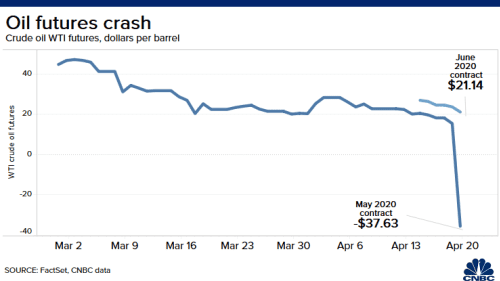
Oil falls below $0.00 for the first time ever


Something happened yesterday that I expected would never happen, oil dropping to or even below 1998 levels of $10-$20 a barrel.*  In fact, it fell so far below that price that people holding oil contracts had to pay others to take it off their hands.  CNBC has the story yesterday in Crude settles at -$37 a barrel in worst day ever.

Oil goes negative for the first time ever. Now what? With CNBC's Melissa Lee and the Fast Money traders, Guy Adami, Tim Seymour, Karen Finerman and Dan Nathan.
Wow, do her guests love Melissa Lee!  On a more serious note, my understanding of why oil fell to negative levels is that the people and institutions holding the oil contracts would actually have to take possession of the oil when the contracts came due.  Since they were only doing it for an investment and not for actual consumption, that's not what they really wanted to do.  They needed to get rid of the oil to someone who could store it until it's refined and used.  The problem is that there isn't much storage left as people aren't consuming oil to move around, so they had to pay people to take the oil instead of selling it and getting the money.

I'm an example of people driving a lot less and reducing consumption.  In January, I expected to write the next driving update in early April.  It's now late April and I've driven so little since Michigan colleges and universities suspended in-person classes in March that I may not write that update until June.  The silver lining is that the coronavirus response has reduced air pollution.  The bad news is that unemployment is up dramatically, which will reduce consumption in and of itself.

Follow over the jump for a more entertaining and professionally produced version of the explanation I wrote along with what the lower oil prices mean for consumers and a footnote.

Thursday, September 19, 2019

Higher oil prices because of attack on Saudi facility plus driving update for Pearl on Talk Like A Pirate Day


Happy Talk Like a Pirate Day!  Appropriately enough, my car Pearl, short for The Black Pearl, Jack Sparrow's ship, passed 48,000 miles on Monday, September 16.  That means it's time for a combined energy and driving update along with a celebration of the fake holiday.  I'll begin with three videos from CNBC about the effects of an attack on an Aramco oil facility that took out 5% of the world's oil supply above the jump followed by the driving update and a song for Talk Like A Pirate Day below the jump.

The first video from Monday is Oil prices soar after attack on Saudi Arabia oil facilities.

Drone strikes attacked an oil processing facility at Abqaiq and the nearby Khurais oil field on Saturday, knocking out 5.7 million barrels of daily crude production — or 50% of the kingdom's oil output. CNBC's Hadley Gamble reports from Riyadh.
I commented about this attack in response to A View from the Brink at Kunstler's blog.
I was reminded of what you said in "The End of Suburbia" about "all it takes is 50 pounds of plastic explosive and a camel to take out a pipeline."  This is very similar, although it was some cheap drones and a facility more sophisticated than a mere pipeline.  Still, the concept applies.

All this takes place as the United States is fixing to tip into recession anyway, something the yield curve, "the chart that predicts recessions" is already telling us.  A good old-fashioned oil price shock would do the trick.
On that note, the next video CNBC uploaded on the story was Expect oil prices to go even higher, says Again Capital's John Kilduff.

Amy Jaffe, Council on Foreign Relations, and John Kilduff, Again Capital, join "The Exchange" to discuss the price of oil soaring following attacks on Saudi oil facilities.
In addition to a yield curve inversion, which has already happened, a large prolonged oil price spike is one of the phenomena I told my readers to watch out for in The tax bill and the U.S. economy in 2018 and beyond almost two years ago: "The second is a rapid rise in oil prices, which has occurred either slightly in advance or concurrently with every recession since 1973."  Whether this price spike is big enough or will last long enough remains to be seen, but if so, that's another recession warning.

I concluded my comment at Kunstler's blog by noting the latest bad news for brick-and-mortar stores: "Meanwhile, the Retail Apocalypse rolls on, as GameStop announced it was losing money and closing stores."  It turned out that Tuesday's video on the story bore directly on the Retail Apocalypse, as CNBC uploaded Amazon is the biggest loser from higher oil prices: Smead Capital's Bill Smead.

Bill Smead of Smead Capital Management, joins 'The Exchange' to discuss the momentum vs. value stocks and who stands to lose the most from higher oil prices.
While I'm sure higher oil prices passed on as higher delivery costs will hurt Amazon's profitability, I don't think it will hurt the company enough to slow down the effect of online retail on their brick-and-mortar competitors, who also have to pay for increased transportation and delivery charges.

Follow over the jump for the driving update and a celebration of Talk Like A Pirate Day.