Showing posts with label Media Matters. Show all posts

Saturday, December 27, 2014

Ebola best and worst for 2014


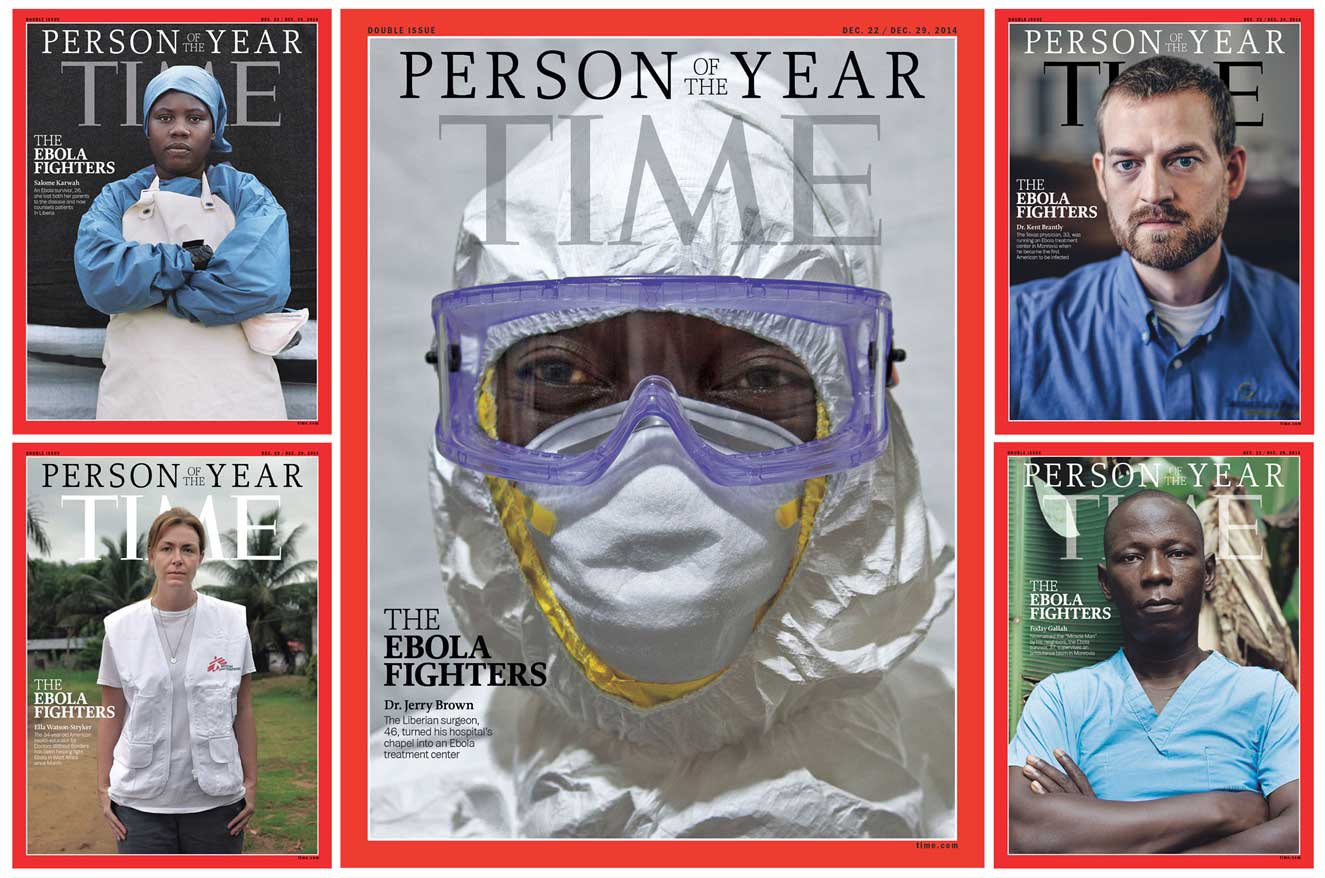
The Ebola epidemic brought on the best and worst in people this year.  The best was recognized by Time Magazine, who designated The Ebola Fighters as "The Person of the Year."
The ones who answered the call
By David von Drehle, with Aryn Baker / Liberia
Dec. 10, 2014

On the outskirts of Monrovia, the capital of Liberia, on grassy land among palm trees and tropical hardwoods, stands a cluster of one-story bungalows painted cheerful yellow with blue trim. This is the campus of Eternal Love Winning Africa, a nondenominational Christian mission, comprising a school, a radio station and a hospital. It was here that Dr. Jerry Brown, the hospital’s medical director, first heard in March that the fearsome Ebola virus had gained a toehold in his country. Patients with the rare and deadly disease were turning up at a clinic in Lofa County—part of the West African borderlands where Liberia meets Guinea and Sierra Leone. “It was then that we really started panicking,” says Brown.

Even in ordinary circumstances, the doctor’s workday was a constant buzz of people seeking answers: Can you help with this diagnosis? Would you have a look at this X-ray? What do you make of this rash? Inevitably, Brown would raise his eyebrows and crease his forehead as if surprised that anyone would think he might know the answer. Just as inevitably, he would have one.

Ebola was different. On this subject, Brown had more questions than answers. He knew the virus was contagious and highly lethal—fatal in up to 90% of cases. But why was it in Liberia? Previous Ebola outbreaks had been primarily in remote Central Africa. Could the disease be contained in the rural north? The membrane between countryside and city in Liberia was highly porous; people flowed into Monrovia in pursuit of jobs or trade and flowed back to their villages, families and friends. “Sooner or later,” Brown remembers thinking, “it might reach us.” And what then? A poor nation still shaky after years of civil war, Liberia—population 4 million-plus—had just a handful of ambulances in operation. How could Liberia possibly deal with Ebola?
It also brought out the worst or, at least, the most mendacity in people.  Follow over the jump for how misinformation about Ebola was recognized as the lie of the year and which person spreading that misinformation was recognized as singled out for doing so.

Monday, November 4, 2013

Hurricane Sandy anniversary and other climate news from campuses on the campaign trail

I concluded PBS NewsHour on Hurricane Sandy one year later by writing, "I'll have more about the anniversary of Sandy's landfall from Columbia University and other sources after Midnight.  Stay tuned."  As promised, here it is.

I begin with this video from PBS NewsHour, which features a Columbia University faculty member, so I decided it counts.

Climate Change, Hurricane Sandy and How to Cope

Klaus Jacob, a special research scientist with the Lamont-Doherty Earth Observatory, explains how climate change will turn events like Hurricane Sandy into more frequent and more disastrous events."One weather event like Sandy does not make climate change. But it is a symptom with many other events that will show yes there is something going [on] and we call it climate change," Jacob said.
Columbia University proper had even more about the occasion in Hurricane Sandy, One Year Later.
October 29, 2013
The year since Hurricane Sandy blew ashore in the New York area has been one of rebuilding and searching for how best to prevent the level of destruction and death it brought with it.

Columbia, with experts across multiple schools and disciplines and broad expertise in climate science, has played an important role in the recovery. “We have 700 people in the Earth Institute working on this,” said Steve Cohen, the institute’s executive director. “The Lamont Doherty Observatory has close to 100 doctoral level scientists working on this all the time.”

Columbia students and staffers helped communities rebuild. Scores of Columbia scientists have been explaining the causes behind the storm in hundreds of media interviews. Columbia professors serve on government panels that study how to prevent future damage and make recommendations to elected officials on preparedness and infrastructure changes.
Follow over the jump for more Hurricane Sandy and other climate news from Boston University via its NPR station WBUR, Columbia University, Rutgers University, and New York University, all of which I shared in Overnight News Digest: Science Saturday (Eclipse, Sandy Anniversary, and Fall Back), plus one story I was planning on including in that diary on Daily Kos but left out by mistake.