A blog about societal, cultural, and civilizational collapse, and how to stave it off or survive it. Named after the legendary character "Crazy Eddie" in Larry Niven and Jerry Pournelle's "The Mote in God's Eye." Expect news and views about culture, politics, economics, technology, and science fiction.
What is the Tully Monster? It might be a vertebrate, or it might not, but scientists have unable to agree for 70 years.
The first time I saw the Tully Monster, it was as a painting on the side of a U-Haul as the Illinois State Fossil. Wooster College has the image.
That's an unusual claim to fame. Since then, I've been curious about it, so of course I featured this video today. As for it being either a chordate or a mollusk, well, it would be even weirder than a conodont as a chordate and among the weirdest mollusks.
The Cretaceous Period is famous for enormous ocean-dwelling beasts. New research shows it boasted the biggest octopuses, and maybe the biggest invertebrates, of all time.
Hosted by: Savannah Geary (they/them)
Yikes! And I thought the Mesozoic oceans, particularly during the Cretaceous, were dangerous and scary enough. Oh, and the Tully Monster makes a cameo here.
400 million years ago, Prototaxites might have towered high above all other terrestrial life. Ever since its discovery, we've been trying to figure out what this massive ancient organism could possibly have been. For a while the leading theory was that it was a fungus, but recent studies suggest Prototaxites might have been something we've never seen before...
Hosted by: Savannah Geary (they/them)
I showed a PBS Eons video about Prototaxites to my organismal biology students as an example of ancient fungus. If I were to ever teach that class again, I'd have to remove it. Good thing I'm retiring!
For some reason, hurricanes are terrified of South America. In fact, as long as we’ve been keeping track, it’s only EVER been hit by ONE! Hurricane Catarina was the hurricane that, according to meteorology, never should have happened. So how did it? On this episode of Weathered, we take a tour of hurricane regions around the world to answer that question. And we find out what Catarina can teach us about how hurricanes really work, and how they’re changing.
Catarina features in An Inconvenient Truth as a possible example of climatechange affecting hurricanes, typhoons, cyclones, and tropical storms: "Explain how the 2004-2005 hurricane seasons fit with predictions based on global warming." That no hurricane has formed in the South Atlantic since shows that it was most likely a fluke and may have nothing to do with climate change. That doesn't detract from what Maiya May and other meteorologist learned from it nor from the other predictions, that hurricanes will get stronger and rising sea levels will increase the amount of storm surge, making coastal flooding worse. That's the answer to a question I ask in Chasing Ice, which replaced An Inconvenient Truth: "What effect will rising sea level have on hurricanes and typhoons?" California is seeing that right now as a result of ElNiño amplifying the waves of Tropical Storm Rachel, something I'll mention to my students next week.
In my Environmental Science class, the lab I run is one to introduce my students to the metric system, which many of my students struggle with. In fact, their issues with it are such that I tell my students a joke about it. "There are only three groups of students in community college who understand the metric system, the science nerds, the foreign students, and the drug dealers." That never fails to get a laugh.
My job would be a lot easier and I could cover something else if the United States fully adopted the metric system.
My joke has changed a little over the past 13 years, as some gamers also understand the metric system thanks to their games using it, but my opinion hasn't.
On the 1st of September, Drexel University made the announcement that they plan to permanently close the Academy of Natural Sciences; the oldest natural history museum in all of the Americas. The news came as a shock to everyone from locals to the the staff of the museum themselves who learned about closure on the same day as everyone else. Now the fate of this historic institution and the millions of rare and valuable artifacts within it hang in the balance. Join me as we fight back against this attack on science and help save the Academy.
...
HOW TO SAVE THE ACADEMY:
Step 1: Go to this link https://save-the-academy.org/...
The page at the link urges people to complete five actions, the first of which is sign a petition.
I've signed and so have 108,090 others. The last on the list is "share your story." That's what this blog is about. I'm recycling part of a comment I left on George Morgan Davis (1938 – 2024): The Director’s Cut to kick off my personal story.
On the one hand, may George Davis rest in peace. I have at least one story about the Council of Systematic Malacologists, where I first met George, and the San Diego Natural History Museum that I did not want to commit to paper or pixels while he was alive. On the other, the same instincts that guided George in that tale would be useful. Have you heard that Drexel University, which took over the Academy of Natural Sciences of Philadelphia and turned it into the Academy of Natural Sciences of Drexel University, has decided to shut it down by the end of the month? If George were still with us, he'd be fighting that decision. I located your blog and the PDF you linked to while searching to see if George was still around. He's not, but I'm glad I found your blog.
When I wrote "Sometimes, people with less than pure motives get results, a topic on my to-do list," in 'Mr. Scorsese' and 'The Librarians' both Emmy winners, George Davis, who was curator of malacology at the Academy of Natural Sciences when I knew him in the late 1980s and early 1990s, was one of the people I was thinking about. Now's not the time to tell that story.*
Instead, I'm telling another story, that of Joseph Leidy, who "named the holotype specimen of Hadrosaurus foulkii, which was recovered from the marl pits of Haddonfield, New Jersey" and "also described the holotype specimens of Arctodus (A. pristinus), the dire wolf (Aenocyon dirus), and the American lion (Panthera atrox), among many others." I have connections to all these extinct animals, which Leidy described at the Academy of Natural Sciences.
One of the fiberglass dinosaurs at Pre-Historic Forest, where I worked as a tour guide and consultant, was Hadrosaurus foulkii. It was the high point, literally, as its statue stood at the top of the trail, of the walking tour. I could have used more information about the creature as the first dinosaur described from the United States. It would have been been more informative than making a bad joke about New Jersey (If it were described today, it might have been called Sopranosaurus, to which a heckler once responded "What about Hoffasaurus?" My retort was "You know where you can find Jimmy Hoffa? In the Yellow Pages under concrete." That joke has extra resonance now that I live three miles from where he disappeared.)
I've mentioned several times that I did my M.S. research at Rancho La Brea, where Arctodus in the form of A. simus), the dire wolf (Aenocyon dirus), and the American lion (Panthera atrox all occur. I haven't mentioned Actodus, known as the giant short-faced bear, on this blog before, but I have written about direwolves and American lions, so both are still relevant to me 40 years later. It would be a huge loss to science that I would feel personally if anything happened to the holotypes of these organisms, especially if it were because the museum closed and the specimens were lost.
I could go on with the stories of Edward Drinker Cope, Thomas Say, and Henry Augustus Pilsbry, all of whom were important scientists who worked in my areas of expertise and all of whom did their research at the Academy of Natural Sciences, but it's time to wrap up this post. Maybe later.
The Academy of Natural Sciences has an offer from the William Penn Foundation to keep its doors open for at least one year, but Drexel University, who owns the museum, said it is still deciding what the historic museum’s future will be, NBC10’s Andrew Rowan has the story.
When I signed the petition, I added the comment that Drexel should accept the William Penn Foundation's offer. I'll tell the university president and head of the board of directors the same thing. I hope my readers do, too.
Mel Brooks: The 99 Year Old Man! and Ocean with David Attenborough co-lead with six nominations each, followed by John Candy: I Like Me with five nominations and Marty, Life Is Short tied with My Mom Jayne: A Film by Mariska Hargitay at three. Normally, I'd consider Mel Brooks: The 99 Year Old Man! and Ocean with David Attenborough to be co-favorites, but the experts, editors, and users at Gold Derby disagree. They think John Candy: I Like Me and My Mom Jayne: A Film by Mariska Hargitay to be the favorites, with 50.0% of experts, 28.6% of editors, and 61.0% of users picking the former, while 50.0% of experts, 57.1% of editors, and 26.3% of users choosing the latter. Normally, I'd favor the editors over the experts except one of the experts picking John Candy: I Like Me is Joyce Eng, whose opinion I trust. The remaining editor(s), 14.3%, are currently voting for Ocean with David Attenborough along with 3.5% of users. The rest of the users are split between Marty, Life Is Short with 6.2% and Mel Brooks: The 99 Year Old Man! with 3.0%. I've often written that, all things being equal, the Emmy electorate will vote for a good story about themselves. The corollary is that they will vote for a nominee about a dead celebrity over a living one. The prognosticators at Gold Derby seem to agree. Again, electorates matter.
By the time of the Saturday ceremony, most of the professionals lined up behind My Mom Jayne: A Film by Mariska Hargitay with 58.8% of the experts and 50.0% of editors, along with 34.6% of users. The majority of users, 55.9%, joined by 41.2% of experts and 37.5% of editors, stuck with John Candy: I Like Me. The remaining 12.5% of editors held their position with Ocean with David Attenborough. The professionals called it. Watch Documentary Or Nonfiction Special: 78th Emmy Awards.
The team from My Mom Jayne: A Film By Mariska Hargitay accepts the Emmy for Documentary Or Nonfiction Special at the 78th Emmy Awards.
Congratulations!
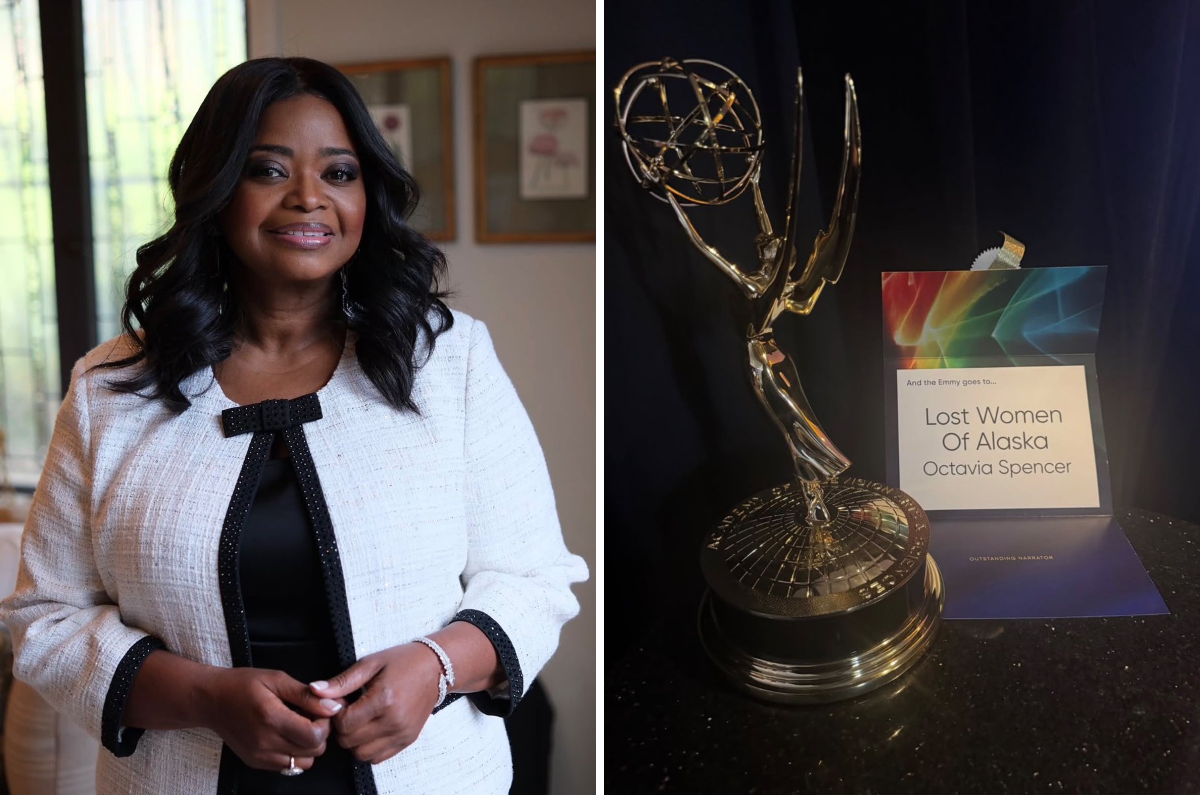
Outstanding Narrator
Sir David Attenborough – A Gorilla Story: Told by David Attenborough (Netflix)
Sir David Attenborough – Ocean with David Attenborough (Nat Geo)
Jodie Foster – Breakdown: 1975 (Netflix)
Werner Herzog – Ghost Elephants (Nat Geo)
Octavia Spencer – Lost Women of Alaska: "The Missing" (Investigation Discovery)
The experts, editors, and users disagree about the odds in this category, too, with 87.5% of experts and 83.0% of users but only 28.6% of editors electing for Sir David in Ocean with David Attenborough, 42.9% of editors along with 12.5% of experts and 9.4% of users choosing Octavia Spencer, and the remaining 28.6% of editors along with 2.9% of users on board with Warner Herzog. The remaining users split between Jodie Foster at 2.6% and Sir David's other nomination at 2.1%. Let's see who switches first, the experts or the editors.
The editors lost their nerve by the time of the ceremony, as 66.7% of them joined 88.9% of the experts and 82.3% of users in selecting Sir David, while only 11.1% of both experts and editors along with 11.3% stuck with Octavia Spencer. More editors, 22.2%, wanted Werner Herzog to win! The editors should have held fast, as Spencer won. Watch Narrator: 78th Emmy Awards.
Octavia Spencer accepts the Emmy for Narrator at the 78th Emmy Awards.
Congratulations to Spencer, who now has an Emmy to go along with her Oscar.
I also listed the other nominations for Ocean with David Attenborough.
The answer seems to be a very English version of "as little as necessary." Too bad we don't live in a world as idyllic, but Middle-Earth in general and The Shire in particular are fantasy lands, as Robert himself points out.
In this edition of IDTIMWYTIM, Hank explains why the common understanding of "equinox" is wrong, what the equinox actually is, and then rages a little against astronomers and their stupid confusing Latin terms.
Science! Also, look how young Hank is.
That's a wrap for today's triple holiday. Stay tuned for continuing Emmy Award winner coverage.
The Trump administration said it would stop funding the Arctic Report Card, the longstanding effort to collect research on how the fastest-warming place on Earth is changing. It's the latest in a series of moves by the administration to curtail scientific research into the impacts of climate change. William Brangham discussed more with glaciologist Twila Moon, the Arctic Report Card's editor.
PBS NewsHour has another segment on how scientists are fighting the effects of climatechange. Stay tuned to see if I feature it or return to Emmy Awards coverage tomorrow.
At a time when the impact of climate change is undeniable, some researchers suggest we need to start work on far more ambitious approaches for tackling these problems. These proposals are often referred to as geoengineering. Science correspondent Miles O’Brien looks at one such concept to deal with the melting of glaciers and sea ice. It's for our series, Tipping Point.
As for building an underwater barrier to keep out the warm water to slow the melting of Thwaites Glacier to melt it from below, that also strikes me as overly ambitious and impractical, although I think it would have less potential for unintended side effects than other geoengineeringprojects. I've been worried about those since Greenfinger, which I wrote on January 2, 2013. Coincidentally, that's World Science Fiction Day. Sometimes, I stumble over a holiday long before I know about it!
This year is becoming one of the worst for U.S. wildfires in at least a decade. There have been more fires and more acreage burned at this point in the year compared to any in the last ten. With fire seasons growing longer, early detection is critical. Special correspondent Ben Tracy of Climate Central reports on how AI is being used to spot fires faster. It's part of our series, Tipping Point.
Oh, good, a story about how technology in general and AI in particular are helping fight fires and other weather-related disasters! Not everything about AI is bad!
As the country celebrates its 250th anniversary, rising seas and coastal erosion are putting some of America’s most historic places at risk. For our ongoing series, Tipping Point, special correspondent Ben Tracy with Climate Central reports from Jamestown, Virginia, where archaeologists are racing to uncover America’s past before it’s washed away.
I've mentionedseveraltimes that "I worked as a Park Naturalist (the type of Ranger most visitors see) at Channel Islands National Park during the summer of 1986," now 40 years ago, so this story hits close to home. Here's to preserving or at least salvaging as much of our country's natural and historic heritage as we can before it sinks beneath the waves.
PBS NewsHour has more, but I'm stopping here to eat lunch and grade papers. It's final exam time, so stay tuned for more relatively brief entries until next Wednesday.
Mosquitoes impact public health on a global scale and are considered the deadliest creatures on earth due to their spread of mosquito-borne diseases such as West Nile virus, dengue, Zika, and malaria.
It doesn't have sharp teeth or claws, but the mosquito kills more people than any other animal on Earth. As the climate warms, mosquito season is lasting longer, giving them more time to spread dangerous diseases. Ben Tracy with Climate Central reports on why the insects are thriving, and the surprising way scientists are fighting back.
I'm recycling what I wrote last year for my reaction.
"Using one parasite that doesn't affect humans to reduce the ability of an insect to spread a parasite harmful to humans — clever! It's also not forever in the same way genetic modification is. Fine by me"...I think infecting them with Wolbachia is an example of a third law, "Nature knows best."
The technology has advanced so that it runs by mail order. Progress (and convenient, too).
That's a wrap for today's biodiversityholiday. PBS NewsHour has another segment on how scientists are fighting the effects of climatechange. Stay tuned to see if I feature it or return to Emmy Awards coverage tomorrow.
The 2026 El Niño could be the strongest we’ve ever seen. And to understand its potential impacts, we’ll take a trip back in time to 1877. That El Niño triggered one of the most devastating natural disasters in human history. What could this one do?
Yikes! This is the first I've learned about the famines of 1877 and 1878, so it shocks me that they were so deadly. That the British Empire made things worse was the least surprising part of the story; Infidel753 and I had the following exchange in the comments to SciShow warns 'The Potato Famine Could Happen Again'.
Infidel753: Obviously any threat to the world's third-largest food crop is a serious concern, but this video hugely understates how much the Irish potato famine was exacerbated by politics. "Unhelpful policies adopted by their neighbors in the UK" doesn't begin to cover it. At that time Ireland was completely under British rule (part of the British Empire), a colonial possession under the heel of a government the Irish had no say in. The conservative British government at the time refused to provide any help at all to the starving Irish, partly motivated by racism (Celtic people were thought of as a different race at the time) and partly by a pull-yourselves-up-by-your-bootstraps Ayn-Rand-like mentality which was common in the ruling class at the time (this was later applied during a famine in British-ruled India, with equally disastrous results).
If the colonial government had merely provided the normal level of food aid typical of what governments do in such situations, most of the deaths would have been prevented. If such potato crop failures were to occur today, presumably modern governments would do their job and provide help to the affected people.
Me: Thanks for adding the needed context to the video. Yes, the British/English made things much worse by continuing to use Ireland as a resource colony throughout the famine, including making the Irish pay their rent in wheat and Ireland being a net exporter of food. They also exported those policies to the rest of the British Empire, as you pointed out. What they did in India, they did it in Ireland first.
[P]rocesses that happened in the past are likely to repeat in the future, so understanding the past is essential for preparation. This is a key takeaway from uniformitarianism, the concept that everything we see in nature is the result of everyday processes occurring over sufficient time, which is boiled down to "the present is the key to the past." It also means that the past is the key to the future.
File all the above under "it's a always a good day when I learn something new."
On June 11, the National Oceanic and Atmospheric Administration issued an El Niño advisory after temperatures in the equatorial Pacific Ocean remained higher than average for several months. Declaring an El Niño isn’t out of the ordinary, as they happen in cycles every two to seven years. But this one could be extraordinary.
Some are calling it a “Super” or “Godzilla” El Niño, and the NOAA predicts an 81 percent chance that it could develop to a “very strong” level, rivaling the historic and devastating El Niños of 1982-1983 and 1997-1998. Experts are predicting it will likely reach its peak this winter and into 2027, bringing heat, rainfall, and other potential extreme weather events.
But even with that foresight and climate models that can confidently predict what might be in store, we still face a test of what could potentially be the strongest El Niño ever recorded and the wild weather that comes with it. We spoke with atmospheric scientists and meteorologists to find out how a Super El Niño forms, why it changes global climate, and what we should expect in the coming months.
Sean talks with journalist David Wallace-Wells about a looming climate event that could make 2027 one of the hottest years ever recorded. They discuss the return of El Niño, why some scientists are calling it a “Godzilla El Niño,” and what it could reveal about the future of global warming. They also explore climate adaptation, political complacency, extreme weather, technological progress, and whether humanity is prepared for the world it’s creating.
Usually, I blog about entertainment to take a break from serious subjects. I can't be all DOOM all the time. Today, I'm taking a break from awards shows to share SciShow and Hank Green telling the tale of The Time England Ran Out of Bones.
Britain's population exploded during the Industrial Revolution. To sustain that growth, they needed a lot of food and, therefore, a lot of fertilizer. Their ports were clogged with boatloads of imported poop and bones from all over the world, until they discovered a rock that was the best fertilizer of all. Ever since, our entire global food system has precariously teetered on access to a precious fossil resource: phosphorus.
A fact I repeat to my environmental science students is that synthetic fertilizers are responsible for growing enough crops to feed at least one billion people and are the number one reason for increased crop production. It turns out I may have been understating their importance...fertilizers have helped feed billions. The BBC went farther, quoting Svein Tore Holsether, head of fertilizer company Yara, reporting that "He pointed out that half of the world's food production is dependent on fertiliser." That was in the context of the Russian invasion of Ukraine, about which Holsether told the BBC "Putin has weaponised energy and they're weaponising food as well." Yikes! That's a topic that deserves its own post.
This isn't that post. Darn.
SciShow did make up for a deficit I noticed three years ago.
SciShow didn't even mention the effects of excess fertilizer washing into the environment and causing eutrophication. That's a word I've never used on this blog before, which means I need to write a post about that, too.
Hank and SciShow at least included this effect as an result of (over)fertilizing crops. Count this as a down payment on that promise.
Hank pointed out that the current major sources of phosphorus are nonrenewable and will run out. That's something I've told my students, but it's not going to be fixed until we approach the production peak, much like petroleum. That might happen as soon as the middle of this century. I might not see that happen, but my students will, so they're the ones who will have to deal with it. In the meantime, they can watch this video and turn in a summary for extra credit. Welcome to blogging as professional development.
I'm running behind on grading papers and not feeling like writing the next installment of the Critics Choice Super Awards today, so change of plans, I'm embedding SciShow's Ontario is Getting Taller instead.
Tens of thousands of years ago, large portions of North America and Europe were blanketed in ice. Although these glaciers have been gone a long time, they continue to shape our landscapes in some surprising ways.
There is also an AI summary.
Tom Lum explores how ancient glaciers fundamentally reshaped the Earth's landscape. From the formation of majestic fjords and the fertile soil of the American Midwest to ongoing geological shifts like isostatic rebound, this episode examines the enduring, transformative impact these massive ice sheets continue to have on our planet today.
I just finished lecturing and testing on glaciers and glacial features or I'd show this to my geology students. Maybe next semester, which should be my last.
I'm still going to blog about the Super Awards, so stay tuned.
In 2027, the Artemis III mission will practice docking the Orion spacecraft with two lunar landers in low Earth orbit. On future Artemis missions, landers will bring astronauts to the lunar surface. While Artemis III will not land on the Moon, it will test the complex capabilities we need to return humanity there — this time to stay.
NASA astronauts Randy Bresnik, Frank Rubio, and Andre Douglas will join European Space Agency astronaut Luca Parmitano on this historic mission.
Another step toward one of the most complex spaceflight missions in history, NASA provided updates on Artemis III and announced crew members for the test flight. Planned to launch in 2027, the mission will practice docking the Orion spacecraft with two lunar landers in low Earth orbit.
On future missions, including Artemis IV in 2028, landers will bring astronauts to the lunar surface. While Artemis III will not land on the Moon, it will test the complex capabilities we need to return humanity there — this time to stay.
Crew assignments are as follows:
• NASA astronaut Randy Bresnik, commander
• ESA (European Space Agency) astronaut Luca Parmitano, pilot
• NASA astronaut Andre Douglas, mission specialist
• NASA astronaut Frank Rubio, mission specialist
• NASA astronaut Bob Hines, backup crew member
Both of those look good, as expected for successfull PR, but it's not all smooth flying. Artemis III depends on launches by SpaceX and Blue Origin and both are having their issues, as PBS NewHour explained in How a Blue Origin rocket explosion could impact NASA's moon mission.
Blue Origin’s New Glenn rocket exploded on the launchpad during a test in Cape Canaveral on Thursday. The company, owned by Jeff Bezos, said no one was injured and all personnel were accounted for. But the rocket has a crucial role in NASA’s Artemis program to return American astronauts to the surface of the moon. Amna Nawaz discussed its significance with science correspondent Miles O’Brien.
Early this January, I wrote, "Starship is running behind schedule and holding up a lunar landing, so I'm rooting for Blue Origin to either win the contract or inspire SpaceX to get its act together in time." Looks like Blue Origin has to get its act together, too.
66 million years ago a giant space rock crashed into our planet and killed the dinosaurs. In the span of just four decades, we’ve gone from not knowing there was a space rock at all to knowing exactly where that planet-killer came from.
I've been following this story for as long as I've been a geologist, but I still learned new things from this video, or at least was reminded of things I'd forgotten, like Luis Alvarez having earned a Nobel Prize in Physics. I will say I was skeptical at first, but by the time I earned my M.S., I was convinced.
A giant asteroid impact ended the age of the dinosaurs 66 million years ago. How did this mass extinction play out, moment by moment? In this video we meet a geologist who has explored the asteroid crater and learn what the rocks tell us about the last days of the dinosaurs. It was pretty bad!
Not only did Dr. Joe Hanson and Sean Gulick describe the details of what we now know about the Chicxulub impact and its effects, Joe concluded with a "so what" message. Unlike the dinosaurs, we have a choice.
That's a wrap for June's blogging. Stay tuned for Canada Day to begin July.
It's considered to be one of only two inland temperate rainforests in the world. This forest contains a diversity of rare species and ancient trees. The Weather Network's Mia Gordon shares five facts about this rare ecosystem.
Take a walk through BC's ancient, globally unique Inland Temperate Rainforest with veteran conservationist Craig Pettitt of the Valhalla Wilderness Society. These forests and the mountain caribou they support are endangered by clearcut logging, which continues despite the urging of a recent provincial commission to protect what remains of our old growth. Pettitt describes Valhalla's thoughtful plan to do just that, through the formation of three new provincial parks which would link up with existing protected areas to create intact wildlife corridors and ecological connectivity. Learn how you can take action now to save the Inland Temperate Rainforest and mountain caribou at VWS.org
This video is about preserving the remnants of the ecosystem in British Columbia. I'm not a resident of that province or of Canada, but those of my readers who are can act as Craig Pettitt requests. Now I feel like I should see what, if anything, is being done to preserve the U.S. portion of the inland rainforest. Next year.
Think dad jokes are just a phase? Well MRI scans show that becoming a father literally alters a man's neurological blueprint. On Father's Day, we explore the incredible biological upgrade that transforms men into caregivers.
Internet sensation April the Giraffe gave birth to her son, Tajiri, live online in front of millions of people this April. The baby giraffe met his father, Oliver, shortly after, but the two have not seen each other since. This week, at the Animal Adventure Park in Harpursville, New York, the three were reunited. It made for a wonderfully memorable moment and delighted fans all over the world.
Tajiri may be the star, but I'm going to wish Oliver a happy Father's Day and the entire family a happy World Giraffe Day!
Next, the reason both World Giraffe Day and National Seashell Day are today, the Summer Solstice. Watch WMAR-2 News' Science with Stevie: Summer Solstice.
The sun is ready for its big moment in the spotlight! Meteorologist Stevie Daniels talks about the summer solstice in this Science with Stevie segment!
Here's to Stevie becoming a mom next month so her viewers can wish her a happy Mother's Day next year!
It was last year and I normally celebrate it that day to avoid pile-ups like today's, but I wasn't feeling it. I'm also not feeling like turning today into the Sunday entertainment feature. I'll make up for it later in the week, when I plan on sharing a particularly doomy preview of the drum corps season, which begins Friday. In the meantime, stay tuned for World Rainforest Day, Detroit-style Pizza Day, and the first of two WorldUFODays. I love holidays!
The trailer alone demonstrated that Underdogs deserved this nomination. Unfortunately, I doubt it will win this award. It's competing against 2000 Meters to Andriivka with six nominations including Best Documentary, Songs from the Hole with four nominations including Outstanding Arts and Culture Documentary, and The Stringer, also with four nominations including Outstanding Investigative Documentary. I expect grit will win over wit.
I was wrong; wit beat grit in Outstanding Writing: Documentary.
Secrets of the Penguins deserved this nomination, but I doubt it will win. Instead, I think it's between Turning Point: The Vietnam War with five total nominations and Love + War with four nominations. Both are also nominated for Best Documentary. The sounds of combat would probably impress the journalists and documentarians, possibly even more than the sounds of nature or music. If the entertainment professionals in the Creative Arts Emmys were voting, they might give WE WANT THE FUNK! the advantage. Not here; electorates matter.
I think the same of Underdogs' chances for Outstanding Sound: Documentary. Given the competition in its categories, it has an apt title.
Don't even think about getting a bigger boat! Let us know in the comments the largest fish you ever caught.
When Marlo Anderson mentioned that a Danish scientist had figured out that the "dragon's tongues" were really giant sharks teeth in 1666, I thought "that has to be Nicolaus Steno." It was.
In 1667, Danish naturalist Nicolaus Steno made a discovery that forever changed the way we viewed the oceans forever. The fossils were thought to have been the petrified tongues of dragons or snakes, but what Nicolaus realised was the truth was equally, if not far more terrifying. These strange objects were actually the fossilized teeth of the largest shark to have roamed the oceans, the megalodon.
I plan on lecturing on Steno's contributions to geology on Thursday and I will include this factoid. One of my students is really into sharks and he'll enjoy it.
I have more material, but I feel like being a good environmentalist and conserving my resources for next year. May I remember to celebrate on time then. In the meantime, stay tuned for the News & Doc Emmy Awards won by Underdogs for Wayback Wednesday.
There's a lot that unites us as humans. How much we sleep, how much we eat, how much we travel... wait, what? Yeah, turns out that the vast majority of human populations have the same average amount of travel time per day. Here's what the research says about why that is, and how learning this could shape our future.
Hosted by: Madelyn Leembruggen (she/her)
78 minutes? I've been on the low side of that average time for years, but I did enough to contribute to the average 20 years ago, when I drove 48,000 miles in one year and 40,000 miles per year from 2000-2005. I'm glad I'm no longer doing that. Follow over the jump to see how I'm doing now.
Happy Flashback Friday! I promised "Stay tuned for another winner at the News & Doc Emmy Awards along with a retrospective of posts on a related theme" for today and get to both of those after I lead into them beginning with SciShow explaining How Instagram Hacks Your Brain.
Do you feel addicted to social media? You're certainly not alone. Social media and our brains have a messy relationship, and researchers are working hard to understand what's going on, who might be more or less at risk, and why.
Hosted by: Hank Green (he/him)
Can't Look Away: The Case Against Social Media is the Emmy winner I'm featuring today and it's all about how social media algorithms make the platforms addictive and how they especially harm teenagers. Howtown examined another possible cognitive harm in What the actual science says about "brain rot".
Are TikTok, Reels, and YouTube Shorts actually destroying our attention spans, or is “brain rot” just another moral panic? In this video, we dig into the science behind short-form video and attention, from debunking viral goldfish statistics to explaining real cognitive psychology experiments testing analytical thinking and prospective memory. We break down what researchers actually mean by “attention span,” how infinite scroll and autoplay feeds are genuinely different from previous forms of media, and what lab tests can and can’t tell us about the mental effects of short-form video.
As much as I have proclaimed "Behold the power of the YouTube algorithm," I at least had the choice of clicking on the preview of the intriguing video the program presented to me. With YouTube shorts, TikTok, and Instagram reels, the only choice I have is to watch the next video or stop watching unless I see the preview of the short on my YouTube home page, where I still have the choice to click. It's one of the reasons I generally avoid TikTok, the other being the ownership, both old and new. Do I think the format is making me stupid? No, although it's certainly distracting, entertaining, and surprising, especially as Instagram reels, some of which I find educational. That loops back to Hank Green's observation about Instagram hacking my brain. I like closing loops.
The second loop to close is today's featured News & Doc Emmy Award winner.
After I watched Can't Look Away's trailer, I declared, "I don't have to look at the other two trailers; I think this is the winner." I was right; it won. Congratulations!
Follow over the jump for the final loop, today's featured post from the 15th year of Crazy Eddie's Motie News, which was also about a legal action against social media.
The Walt Disney Company earned 21 News & Documentary Emmy® Awards across ABC News and National Geographic, with the award-winning content streaming on Disney+ and Hulu. Following another record-breaking year of 51 nominations — the most ever for the brand — National Geographic took home 13 News & Documentary Emmy Awards, breaking its all time record. This included seven awards for "Trafficked with Mariana Van Zeller," which also stood for the third consecutive year as the most-nominated series ever. "Trafficked with Mariana van Zeller" is an original documentary series that explores the complex and dangerous inner-workings of the global underworld, black and informal markets. Each adventure follows Mariana on a mission to follow the chain of custody of trafficked goods, understand how to obtain the contraband, or see the 360-degree view of the trafficking world from the point of view of the smugglers, law enforcement and those caught in the crossfire.
Award-winning journalist Mariana van Zeller explores the inner-workings of the most dangerous black markets on the planet. In each episode, she investigates a different underworld — from fentanyl and illegal street racing to the smuggling of brides and the rise of militias — to meet the players, learn the business, and better understand the world’s multi-trillion dollar shadow economy.
This trailer earned an Emmy nomination of its own for Outstanding Promotional Announcement: News. Also, eight of the ten episodes promoted earned Emmy Award nominations and six won Emmy Awards, including the one that is the reason for featuring the series today, "Shark Hunters."
Outstanding Climate, Environment or Weather Coverage - "Shark Hunters" **WINNER**
Yes, that's an ocean conservation themed episode. It's also one I can recommend to my students. Welcome to blogging as professional development.
Follow over the jump for the other five Emmy-winning episodes.