A blog about societal, cultural, and civilizational collapse, and how to stave it off or survive it. Named after the legendary character "Crazy Eddie" in Larry Niven and Jerry Pournelle's "The Mote in God's Eye." Expect news and views about culture, politics, economics, technology, and science fiction.
New CDC data suggests Americans are living longer, with experts pointing to declining overdose deaths, improved cancer survival rates, and continued recovery from the COVID era. Family medicine physician Dr. Jessica Gray explains the latest longevity trends.
You've probably heard the claim that there's a link between acetaminophen aka Tylenol and autism. And there are a lot of conflicting takes about what that claim means, which research is “right”, and what different studies really show. So here’s some of the major studies that are being talked about, their shortcomings, and what it means for all the pregnant and autistic people out there.
Hosted by: Savannah Geary
The study that RFK Jr. is citing and which Donald "Hoover Harding Cleveland" Trump is parroting while mispronouncing acetaminophen says yes, but the other studies Savannah Geary describes say no. In addition, Geary does a good job of summarizing the issues with both the existing research and any studies on the subject. It would definitely be unethical to run a randomized clinical trial, which relates to what I told one of my geology classes yesterday about the limits on the experimental method.* There are some hypotheses that just can't be tested using a controlled experiment; those would require the comparative method.
That's a wrap for today. Stay tuned for a more involved post tomorrow as I begin a four-day weekend for MLKDay.
*I was scheduled to give the same lecture to my other geology class today, but the college closed because of weather. Snowday!
For decades, rising carbon emissions have accelerated climate change, but this year marked a critical turning point that could finally reverse that trend. Renewable energy has now graduated beyond the need for subsidies and incentives, emerging as a cheaper alternative to fossil fuels in many countries. News Editor Tim Appenzeller and policy expert Li Shuo describe the economic forces behind this shift, and the obstacles that remain to the continued rise of green energy.
...
1:15 The graph has mislabeled trend lines. "Other renewables" generate more energy than hydropower alone.
[C]onvincing people to be less wasteful, particularly creating less food waste and eating less meat, especially beef, would be helpful. [One] could consider that to be a technology. So is renewable energy. Between the two, it would move Earth Overshoot Day back more than a month. Progress!
Yes, it is, and it's good news I can share with my students. Welcome to blogging as professional development.
Science Magazine's video is shorter and more focused than PBS Terra's, so it's one I'm more likely to show to my students. Again, welcome to blogging as professional development.
Custom gene editing shows promise for ultrarare diseases
New weapons against a sexual scourge
Neurons make a deadly donation to cancer cells
An all-seeing eye on the sky
Face to face with a Denisovan
Large language models do science
Triumph of calculation helps resolve particle mystery
Xenotransplants set new records
Rice that beats the heat
Including the "winner," that's four health stories, two computer science stories, one of which is also a physics story, an astronomy story, an evolution story, a genetics story that touches on climate change, and an energy story that also touches on climate change. Six of these are biology in some form, so these selections please me as a biologist. One of them is also paleontology, so I'm doubly pleased as a paleontologist. All of that is on top of the good sustainability news.
Not all of 2025's science stories were good. Follow over the jump for the bad news this year.
Ahead of Giving Tuesday, Nakia Mills from the Better Business Bureau advises donors to verify charities before donating to ensure their money is used as intended. The BBB recommends checking the accreditation and financial practices of charities on their website as a precautionary measure.
Good advice, the kind I would given about security if I had celebrated Cyber Monday yesterday instead of World AIDS Day.
On Giving Tuesday, donations will be collected for THAW, the Heat and Warmth Fund, to assist people in crisis with utility bills during winter. THAW offers more than just bill assistance, including energy-efficient home improvements as experienced by beneficiary Byron Spivey. Serving families with children, seniors, and veterans, THAW helped 11,000 homes with $10 million last year, with over 80% of donations going directly to services. The organization aims to enhance the long-term health and financial security of Michigan neighborhoods with additional support like home assessments and appliances.
Not only does THAW pay people's utility bills, it pays for energy conservation upgrades. I approve.
Learn more about the mental health benefits of giving ahead of Giving Tuesday. (Dec. 1, 2025)
I used to be a director of a nonprofit. I can tell you that a physical quarter in a Salvation Army kettle will probably be a net benefit, but any online donation less than a dollar will likely cost the charity money in processing fees.
That's a wrap for today. Stay tuned for comedy tomorrow.
As the world marks World AIDS Day, researchers note the four decades battling the disease have proven crucial in battling the COVID-19 pandemic. Kiet Do reports. (12/1/21)
I was expecting another take on CNBC explains how HIV research led to COVID-19 vaccines for World AIDS Day, a double pandemic update. Instead, I found out how experts applied public health lessons learned from the AIDS pandemic to COVID-19. That made the video worth watching. As a bonus, I probably have only one degree of separation from Dr. Sarah Ruddman and Dr. Marty Fenstersheib because the ex-girlfriend I most often mention here was working for the Santa Clara County Health Department last I checked, which was before the COVID-19 pandemic. They almost certainly know her and she would certainly know who they are. By the way, Dr. Fenstersheib's predictions about the disease persisting and people needing a booster shot for COVID-19 every year have proven to be true. We should listen to him.
Jennifer Lotito, President and Chief Operating Officer, (RED) joins CBS New York to discuss World AIDS Day, which is on December 1.
Lotito offered both facts and action, even if that action was shopping. People will be shopping today anyway, so they might as well do it for a good cause.
Monday will mark the 37th World AIDS Day, which was started in 1988 by the World Health Organization to raise awareness and understanding of the global AIDS pandemic.
I relate to Lynn Kid. She said that it's important that she not allow a disease control her and that she's way more than HIV. I feel the same about diabetes. It may "be a central organizing fact of my life," but it's not everything about me.
Could rock music one day replace your insulin injections? Scientists are pioneering music-controlled cells that could provide the perfect dose of insulin for type 1 or type 2 diabetes with just a bit of music. Specifically, Queen's "We Will Rock You." Yes, really.
Hosted by: Reid Reimers
The answer is yes, if you're a mouse. If it works in humans, it will really help people with needle phobias. I'm not one of them. I never had a problem with injecting insulin. It was more work to get used to sticking myself for blood glucose readings, but a good lancing device made it much easier for me. Now, sticking myself eight times a day, four for blood samples and four to inject insulin, makes me feel tougher. I tell people drawing my blood or giving me shots that I stick myself so much, what's another needle? That usually gets a chuckle.
Regular readers know I contracted Type I a year ago — through some undetermined autoimmune disease. Diabetes is not bad, as far as chronic conditions go — no surgery, no radiation, you don’t have to die early, necessarily, if you do what you’re supposed to do. In my case, that means swallow four pills a day, inject long-acting insulin every night and short-acting insulin as needed, should I decide to, say, eat pizza or sushi or some other high-carbohydrate food.
What have I learned from a year of diabetes? The biggest challenge is riding herd on prescriptions. Make friends with your pharmacist. To take insulin, you use an injector pen, which requires disposable needles. A 100-count box of 4 mm, 32 G needles costs about $54 with prescription at Walgreens [CVS wanted to charge over $200]. The pharmacist at Walgreens pointed out that I could buy a box, without prescription, for far less. You can get a box on Amazon for $10. They work fine.
A program I know stresses gratitude, and while I can’t honestly say I’m grateful to have diabetes, I can say that, compared to other ailments that have scythed through friends — cancer, heart failure, lung disease — diabetes is a walk in the park, if you make the effort manage it. I would not have picked diabetes, but diabetes picked me, and I’m rolling with it.
I'm a diabetic and...I consider it to be a central organizing fact of my life. Oddly enough, I think it has focused me and improved my mental health. I now have a real threat to concentrate my attention on and consider every day a small victory over death.
I still do and I agree with Steinberg; it could be a lot worse.
We all picked up new habits during the COVID-19 pandemic. But not all of them stuck. Here's the data on whether we're better or worse drivers, exercisers, social media community members, neighbors, and self carers than during and before lockdown.
In the past week of returning to in-person teaching and resuming my pre-pandemic driving patterns, I've observed several people driving just as Krugman described, weaving in and out of traffic at high speeds. While a few Michigan drivers were doing that all along before the pandemic, I think I've seen more this week than the pre-pandemic average. Based on the data and my personal observations, I agree with Krugman that "the pandemic and its disruptions seem to have done a number on social psychology in many dimensions. The worrisome thing is that troubled behavior seems to be persisting even as the country reopens." Here's to hoping that subsides when the pandemic is over, which itisn't.
I also knew about increased social media use, which persisted, and worse mental health, which the stats say has returned to the pre-pandemic normal. What I didn't know about were the Cannonball Run record, increased drinking, childhood obesity, strokes, and drug deaths, along with worse heart health. I can't say I'm surprised at any of them, except the Cannonball Run. I thought that was only a movie. I'm also relieved that driving is improving and the murder rate is decreasing. It give me hope that the rest of the craziness will subside as well.
That's the general driving situation. Follow over the jump for my personal update.
Could mosquitoes be the key to fighting deadly diseases?
In Medellín, Colombia, a mosquito factory breeds millions of mosquitoes every week… on purpose. Why? To stop the spread of dengue, a mosquito-borne disease infecting millions of people each year.
At the World Mosquito Program, scientists infect Aedes aegypti mosquitoes with a naturally occurring bacterium called Wolbachia, which blocks their ability to transmit viruses like dengue, Zika, yellow fever, and chikungunya. Once released, these mosquitoes breed with wild populations and spread Wolbachia, reducing disease transmission between humans.
But not everyone is convinced. Wolbachia doesn’t work the same way in every context. The effects vary by mosquito species, environment, and virus. So –while promising– this approach isn’t without its own risks. Can biocontrol outsmart one of the deadliest animals on Earth, or are we venturing into ecological territory we don’t fully understand?
The mosquito factory should look familiar to long-time readers, as the third video in Using biotechnology to eliminate and control mosquitoes for an early celebration of World Mosquito Day explained it. I'm recycling my reaction from three years ago: "Using one parasite that doesn't affect humans to reduce the ability of an insect to spread a parasite harmful to humans — clever! It's also not forever in the same way genetic modification is. Fine by me."
As for Jason Rasgon's doubts and criticisms, I'm filing them under two of Commoner's Laws, "Everything is connected to everything else" and "There is no free lunch." Compared to genetically engineering the mosquitos, I think infecting them with Wolbachia is an example of a third law, "Nature knows best."
By the way, I've never mentioned cane toads on this blog before, but they're one of the organisms my students use for their answers to a question on the final exam for my organismal biology class. Since I just graded those exams yesterday, cane toads are fresh on my mind. That's a story my students tell me.
I'm not feeling like continuing my Emmy nominations coverage today.* Instead, I'm writing about something more personal, the pancreas, which SciShow examined in The Organ That Drove a Scientist to Kill.
In 1643, Johann Wirsung was shot and killed outside his home, but not before he named one of the men responsible. One rumor that has emerged over the years is the man was paid by one of Wirsung's former assistants, who claimed Wirsung had taken credit for a discovery the assistant had made: that the pancreas actually does stuff critical to keeping you alive.
I did not know about Johann Wirsung and his research and assassination before. While I did know about some of the other historical figures, like Galen and Andreas Vesalius, I didn't know about their incorrect ideas about the pancreas. Thanks to SciShow, I learned something new, so that makes today a good day.
On the other hand, I covered the story of Sir Frederick Banting in Celebrating 100 years of insulin for World Diabetes Day 2022, which wasn't new to me then, as I wrote "Not only am I an insulin-dependent diabetic, but I read the story of the discovery of insulin in junior high school and wrote a report on it for health class. That was fifty years ago, so I could use a refresher." I still learned something new about Banting and his research from SciShow, namely the fight between Banting and James Collip, which Charles Best broke up, and the drama over Banting and John Macleod's Nobel Prize. Yikes! The story of the pancreas is one of violence and conflict!
SciShow covered another story I heard my first semester at the University of Michigan about the sequencing of human insulin, its reverse translation and transcription into the gene for insulin, and its insertion into bacteria to produce human insulin, which works better than insulin from cows, pigs, and sheep and no animals have to die to produce it. I didn't know that happened in 1978, so I can add that detail when I tell the story to my students. Welcome to blogging as professional development.
I'm a diabetic and I can attest that I think about my condition an average of every 20 minutes throughout the day...I consider it to be a central organizing fact of my life. Oddly enough, I think it has focused me and improved my mental health. I now have a real threat to concentrate my attention on and consider every day a small victory over death.
Not only has the pancreas driven scientists to kill, the pancreas is trying to kill me and millions of others every day. That's what makes this subject personal.
I slept in today and have an appointment this afternoon, so I'm postponing the entry about the nominees for Outstanding Documentary or Nonfiction Special at the Creative Arts Emmy Awards I've already created a preview image for. In its place, I'm sharing Howtown explaining How half the US lost part of their minds.
Leaded gasoline, paint, and pipes left a toxic fingerprint in the baby teeth of half of all Americans — and those tiny clues reveal how silent doses of lead rewired IQ scores, crime rates, and mental health for decades. In this Howtown episode we laser-scan my own baby teeth with “tooth detective” Manish Arora, revisit Herbert Needleman’s 1970s Boston study, and track economist Jessica Reyes’s state-by-state link between tetraethyl lead’s phase-out and the 1990s crime drop. New data from New Zealand’s Dunedin Study (analyzed by Aaron Reuben) show how early exposure still shapes Gen X brains, personalities, and social mobility, framing one of the largest environmental injustices in U.S. history.
The story Adam Cole and Joss Fong told complements the one related in SciShow explains the connection between the age of the Earth and unleaded gasoline plus more about lead with more of an emphasis on how lead affected and still affects public health, long after the U.S. and other countries stopped using leaded gasoline and lead paint. I had no idea how persistent the effects of lead exposure were and still are, including loss of IQ points through adulthood. I also learned how and why lead is so dangerous; it imitates calcium because its ions have the same charge (valence) and nearly the same size, so it gets incorporated in bones and teeth and interferes with nerve function. As I'm fond of writing, it's a good day when I learn something new and I learned a lot of new information from this video.
Speaking of learning new things, I'm trying to figure out when I might show this to my students. Since my students and I live in Michigan, home of the Flint Water Crisis, which Cole and Fong mention, I could show it when I lecture about waterpollution. The video concentrates on leaded gasoline, which is an air pollution problem, so it would make more sense to show it then, especially since I talk about the health effects of air pollution. Besides, that part of the story focuses on the role Charles F. Kettering, who worked for General Motors, played in developing leaded gasoline. That's also a Michigan story. Either way, if I show this video, it will become another example of blogging as professional development.
That's a wrap for today's evergreen environmental topic. Stay tuned to see if I resume my EmmyAwards coverage tomorrow, or postpone it again.
One of the oldest names in weight loss has lost most of its value and filed for bankruptcy. This video explores the brand's history while identifying some of the biggest reasons behind its decline.
As I usually do, I'm sharing Company Man Mike's list.
Rebranding strikes me as a milder version of Hooters' identity crisis with a side helping of external factors including the pandemic — bad timing, indeed! Speaking of external factors, Weight Watchers had been able to weather its competition until weight loss drugs like Ozempic came along. It didn't take them long to drive Weight Watchers into bankruptcy. As I wrote last month, "WeightWatchers decided that if they couldn't beat Ozempic and other weight loss drugs, they'd join them. Too bad things moved so quickly that they were [too] late to that party."
Oprah Winfrey leaving the company followed by its bankruptcy demonstrates that it was the loss of celebrity influence that may have been the last straw. The company had been depending on celebrity endorsers for decades and without its last one, it declined rapidly.
While I've often seen private equity as a cause of debt leading to failure, I've come across stock buybacks by themselves justthreetimes, and only seen both once in the case of Ruby Tuesday. Now I can say I've run across the combination twice.
I close by quoting a comment and my response on last month's post.
fry1laurie: So Weight Watchers is trying to shed 751,471,011.70 pounds (of debt).
Me: Welcome to Crazy Eddie's Motie News! HAHAHA! I'm glad the United Kingdom didn't abandon the pound for the Euro just so you could make this joke!
Stay tuned for the promised next installment in my coverage of the News & Doc Emmy Awards tomorrow, when I plan on examining The Sixth and the rest of the nominees for Outstanding Politics and Government Documentary. I decided blogging about The Sixth on the sixth would be more appropriate than today.
It didn't take long for weight loss drugs like Ozempic to drive Weight Watchers into bankruptcy. Since they operate brick-and-mortar locations, they're now another candidate for my Retail Apocalypse coverage. Add that to my to-do list.
WeightWatchers, a major cultural force that went beyond the fitness space that’s been around for more than 60 years, files for Chapter 11 bankruptcy in a bid to shed more than $1 billion in debt and reposition itself in the industry. “We are going through this transaction to strengthen our financial foundation for WeightWatchers moving forward so that we can innovate and compete and continue to invest in our business,” president and CEO Tara Comonte says. NBC’s Christine Romans reports for TODAY.
WeightWatchers decided that if they couldn't beat Ozempic and other weight loss drugs, they'd join them. Too bad things moved so quickly that they were late to that party.
Weight Watchers, a weight loss program with a history of over 60 years, has entered the Chapter 11 bankruptcy process. WW says services for members will continue.
"All good things come to an end." I don't think WeightWatchers filing for bankruptcy will be the end of the company, at least for now. There will still be a need for its services, as the panelists on The View pointed out in WeightWatchers Files For Bankruptcy.
#TheView co-hosts react to injectable weight loss drugs becoming so popular that WeightWatchers filled for bankruptcy.
The panelists did a good job of humanizing the issue and explaining how weight loss drugs are not the answer for everyone because of affordability and individual reactions to the medications. Behavioral modification, including diet, will still be on the menu, pun intended. At least Donald "Hoover Cleveland" Trump is trying to do something about drug affordability, which I'm adding to ending minting pennies and daylight saving time among his few good ideas. Even a stuck clock is right twice a day, and Hoover Cleveland is definitely a stuck clock.
The new US secretary of Health and Human Services has a long history of spreading misinformation about vaccines.
...
Robert F. Kennedy Jr. has been called the most unqualified health secretary in the history of the US. Before his confirmation, over 22,000 doctors signed a letter urging the Senate to reject his appointment. During the confirmation hearing several senators grilled him on his concerning history related to vaccine misinformation: things like his founding of an anti-vax organization, his concerning anti-vax rhetoric, and his history of suing vaccine manufacturers, something he stands to make a lot of money doing.
The former environmental lawyer was propelled to the nation’s highest health office largely by the “MAHA” movement, a play on Trump’s “Make America Great Again” slogan (“Make America Healthy Again”). As health secretary, Kennedy wants to solve the chronic disease epidemic in the US, which plenty of doctors can get behind. The issue is that he aims to do it at the expense of infectious disease research. And therein lies the problem. Most people can agree when he says things like “I’m supportive of vaccines” and “I want good science.” The trouble is that his definition of “good” is, well — let’s call it historically shaky. In March, he appointed a well-known vaccine skeptic to head a study on the long-debunked potential link between vaccines and autism.
So what’s next? Can RFK Jr. take away vaccines that are already on the market? It’s unlikely, but he doesn’t need to. Kennedy sits at the helm of the very department he’s been undermining for years. In that position, the power he has over vaccine policy isn’t limitless, but the changes he can make could ripple for decades.
If I have to concentrate on criticizing any of Trump's Cabinet Secretaries, it will be RFK Jr. I'm a scientist and he's the biggest threat to science of anyone actually confirmed by the Senate (Elon Musk as the effective head of DOGE may be just as big right now, but he's not Senate-confirmed and probably isn't there for the long term). Vox's video helps me by showing how and why he can threaten health research and policy.
Plus, why Utah banned fluoride in public drinking water and the potential fallout from the FDA’s top vaccine official’s resignation.
Utah answered no to 'Should fluoride be in our water?' I hope that doesn't adversely affect my mom, sister, and nephew who live there. Also, the Reduction In Force (RIF) of 20,000 HHS employees shows how both RFK Jr. and Musk combine to be threats to health and science.
The measles outbreak in Texas continues to spread, with 422 cases reported since January, an increase of 22 cases since Friday. Most cases are in West Texas, where one child has died. Dallas County Health and Human Services has cut 21 workers, including 10 temporary workers, leading to the cancellation of 15 vaccine events, including measles vaccination clinics. These cuts are part of the Trump administration's effort to reduce federal spending.
Birdflu may be a bigger potential threat, but measles is a menace right now.
Seriously, that supposed ideological diversity probably comes from former Democrats Tulsi Gabbard and RFK Jr., who I called cases of failing upwards. I thought I was done with both of them when they dropped out of the 2020 and 2024 Presidential contests, respectively. Instead, I could be writing about them for the next four years. Ugh. At least my readers and I have Randy and others to keep us sane. May they be like Ben Carson AKA Doctor Pyramid, about whom I ended up writing "At least you were too boring to write about for the past four [years]" after Carson's service as HUD Secretary. May we be so lucky with Gabbard and RFK Jr.
So far, they've been making news. At least they're not boring.
Follow over the jump for the top post of mine about RFK Jr. during the 14th year of this blog.
Genetic testing company 23andMe filed for Chapter 11 bankruptcy protection to initiate the process of selling off its assets, while the troubled firm’s co-founder Anne Wojcicki—who was attempting to take 23andMe private—stepped down from her role with the intent to become an outside bidder for the asset sale.
23andMe was one of the hottest startups of the 2000s, once valued at $6 billion. The company’s DNA test kits became a viral sensation and powerful research tool for those hoping to learn more about their ancestry and health. But today, it has lost 98% of its value and is on the verge of being delisted from the Nasdaq after all independent board members resigned, citing frustration with founder Anne Wojcicki’s “strategic differences” in her vision for the company. Meanwhile, 23andMe is sitting on the world’s largest genetic database that it once hoped to leverage for drug development. So what will happen to all that DNA data, and can Wojcicki save the company from collapse by taking it private? Watch the video to find out more.
On the one hand, the situation went from bad to worse since CNBC uploaded the video on October 20, 2024; they didn't even mention bankruptcy as a possibility five months ago. On the other, 23andMe's data apparently became more useful since 2013, the only other time I've mentioned the company, when I quoted an article about a lawsuit claiming the test results were "meaningless."
Forbes and CNBC emphasized the parts of the story important to their readers and viewers, who are investors and others interested in business and the economy. For news more important to consumers, including 23andMe's customers, I turn to NewsNation asking 23andMe files for bankruptcy: What are customers' rights?
23andMe has filed for Chapter 11 bankruptcy, and CEO Anne Wojcicki, whose takeover bid failed, has stepped down. The genetic testing company has more than 15 million customers' genetic data — and California Attorney General Rob Bonta is warning users to purge their data sooner rather than later.
Laura Coordes, a law professor at Arizona State University, joins “NewsNation Now” to discuss what customers should do with their data.
My wife and I bought a pair of test kits before the pandemic, but never turned in our samples and paid the rest of the fee. On the one hand, I'm annoyed that we wasted our money. On the other, we don't have to worry about protecting our data; 23andMe doesn't have it!
At this point, I would write that I would wait for Company Man and Bright Sun Films to cover the company, but I don't have to, as Company Man already asked The Decline of 23andMe...What Happened?
23andMe was once considered one of the most promising companies, but today, it is falling apart. This video attempts to explain the reasons behind the decline.
Here's Company Man Mike's list:
Company Man Mike added the difference in motivations between 23andMe and its customers as a factor to the other four reasons, which Forbes, CNBC, and NewsNation all covered. The company wanted the results to be used to improve their customers' health, while most of the customers were interested in the entertainment value of the results, including learning more about their ancestry. Procrastinating over deciding to pay the premium for the health results was what led to my wife and I not paying for the test at all; we were more interested in our ancestry. Maybe we'll pay for an Ancestry.com test and actually take it.
Now all I have to do is wait to see if Jake Williams of Bright Sun Films covers 23andMe. In the meantime, stay tuned for the first retrospective of the 14th year of Crazy Eddie's Motie News, stats.
COVID-19 was declared a global pandemic five years ago, when offices emptied, schools went virtual and social gatherings were canceled. How do Americans feel about its impact today?
CBS New York prepared two graphics summarizing the Pew Research Center's findings.
Yeah, that looks about right. In addition, Alec Tyson from Pew mentioned one other bad effect, student achievement suffering from not being in school during the worst of the pandemic. I still see signs of pandemic disruption among my students five years later. The flip side is what was bad for children, working from home, was and still is good for a lot of adults.
Pew also examined Americans' attitudes about a future outbreak.
I don't know whether these findings make me feel encouraged or discouraged. I suppose I could say the country could do better, but the backlash to the pandemic response, including election of the current administration, might make it do worse. Sigh.
Five years ago this week, the World Health Organization called the COVID-19 outbreak a pandemic. In the United States, officials declared a national emergency, triggering travel bans for non-U.S. citizens and shutdowns nationwide. Now, many who lived through the pandemic, including those who treated infected patients, are still dealing with the fallout. Ali Rogin reports.
Those were heart-breaking stories, which Dr. Sasha McBain identified as expressions of grief. They make me glad my wife and I got through the pandemic relatively unscathed. I'm also happy to hear Dr. Fritz Francois describe how NYU Langone Health was prompted by Hurricane Sandy to prepare for unexpected or exceptional events. In particular, I was impressed that they ran an exercise for an outbreak of MERS. Both MERS and COVID-19 are zoonotic coronavirus diseases, so I'm sure much of the MERS responses carried over to COVID-19. Good work!
Some Trump voters regret sending him back to the White House because he's doing nothing to lower prices on everyday items like coffee and potato chips, and there's a new medicine that might extend your dog's lifespan by years.
Elon Musk is still going with his Chainsaw Massacre of our federal workforce, Guillermo lists the five things he did at work this week, a group of Republican Senators met privately with the White House to complain about Elon’s impulsive and haphazard cuts, companies owned by Elon Musk have been the recipients of more than $30 billion from our government, Trump is now hocking dollar bills made of gold, and he is meeting with President Zelensky of Ukraine to discuss what is being called a “reconstruction investment fund,” Attorney General Pamela Bondi announced that a list of Epstein clients and his flight logs would be released today (they were not), instead they released a binder full of information everyone already had, people keep forgetting that Trump and Epstein were good friends, and in honor of the Oscars we took to Hollywood Blvd for a new edition of “Breaking the News.”
You pointed out four years ago that Elon Musk's fortune and the success of his companies were both built on government subsidies. American liberals may not have liked Musk for being a billionaire, but they generally quietly ignored what you pointed out as long as they thought he was on their side. Now that he is trying to buy Twitter, potentially ruining their venue for activism and entertainment, then announced that he wasn't on their side, they are all over that fact. They've also called into question the purported technological achievements of his companies and realized a lot of their value springs from faith in Musk himself. His companies' stock prices are now collapsing, which was one of the "black swan" events Lathechuck postulated in the comments four years ago. I don't suppose you are surprised by any of this, are you?
He wasn't. In fact, he joked that he was bored by it. Just the same, liberals and progressives were right about his effect on X, the site formerly known as Twitter. It's one of the main reasons we've moved to Bluesky.
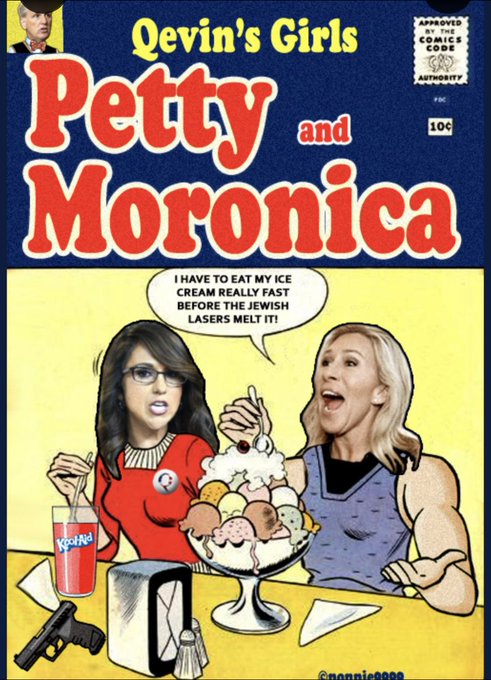
[O]ne of the recurring themes in the comments to No More Mister Nice Blog, particularly from Yastreblyansky at The Rectification of Names, that a lot of the "working class" supporters of Trump based on their educational levels are actually small business owners, the petite bourgeoisie. Lauren Boebert and Marjorie Taylor Greene come to mind. Both were small business owners before being elected to Congress, which adds new meaning to "petty bourgeoisie."
Desi Lydic rates the Democratic Party's methods of opposing Trump on the cringe-o-meter: from off-key protest chants to interpretive dance to podcasts. Plus, with so many Dems saying "F**k Trump," Grace Kuhlenschmidt thinks that might just be a great idea.
Scientists are starting to find a strange connection between neurodegenerative diseases like Alzheimer's, Parkinson's, ALS, MS, and dementia. They all seem to follow on the heels of common but severe infections. And that means we might be able to stop them.
Hosted by: Savannah Geary (they/them)
This story looks familiar, because it's similar to the one told in SciShow asks 'Could a Vaccine Prevent Type 1 Diabetes?' for World Diabetes Day; an infection triggers a pathological response by the body, sometimes years later. That's the bad news. The good news is that prevention already exists in the vaccines for flu, shingles, and pneumonia. Unfortunately, a segment of the population turned against the COVID-19 vaccine and there is evidence that vaccine hesitancy has spread beyond SARS-CoV-2 to other viruses. That's a story that deserves its own entry, especially because it's topical and can develop more before I share it next month. That's only three days away, so my readers may not have to wait long. Stay tuned.
Short answer — not yet, but we need to pay attention. All the virus requires to become dangerous to people is the ability to be transmitted from human to human. Should it recombine with a human flu strain, it could acquire that ability. Then it's time to start worrying.
Cows in North America are getting bird flu. What happened? How did we get here? And is this the next pandemic? In this deep dive narrative history of avian influenza, SciShow takes on these questions.
Correction:
38:50 This video's consultants should be listed as Kelly Hills MPH and Dr. Nicholas Evans
This is a fascinating history of not only bird flu, but other flu pandemics, SARS, and COVID-19. I am a paleontologist, so I appreciate the historical and comparative approach to science this video took. I also learned a lot of new things from this video, so it's a good day. While I won't show this to my students — it's 30 minutes too long — I can definitely incorporate some of its facts into my lecture on flu and other viruses. This includes the following image, which updates one I used to show my students.
Welcome to blogging as professional development.
By the way, listening to Dr. Pardis Sabeti mention leadership, gaining trust, and fighting misinformation as important for fighting pandemics reminds me that Hoover Cleveland shares an Ig Nobel Prize for Medical Education with "Jair Bolsonaro of Brazil, Boris Johnson of the United Kingdom, Narendra Modi of India, Andrés Manuel López Obrador of Mexico, Alexander Lukashenko of Belarus...Recep Tayyip Erdogan of Turkey, Vladimir Putin of Russia, and Gurbanguly Berdimuhamedow of Turkmenistan, for using the COVID-19 viral pandemic to teach the world that politicians can have a more immediate effect on life and death than scientists and doctors can."
While funny and worth pointing out when Hoover Cleveland says he wants a Nobel Peace Prize, these people are not good company and this award is not a good sign for the near future. Who knows, maybe he'll win an Ig Nobel Peace Prize for his designs on Greenland and Canada or an Ig Nobel Economics Prize for tariffs. We'll find out this fall.
Stay tuned for the Sunday entertainment feature. What can I write about awards season that is worth sharing next month?
One of country's the oldest, biggest, and most iconic drugstores has been declining. This video attempts to identify some of the biggest reasons behind the struggles.
As I customarily do for Company Man Mike's videos, I'm displaying his complete list.
"Too many stores" — I guess being the (second) biggest drugstore chain has its disadvantages, one of them being too big when the retail environment changes. I am a paleontologist, so I am quite familiar with that story; being big becomes a disadvantage when the natural environment changes, too — adapt or die.
I'm recycling what I wrote earlier this month about "Pharmacy Operations"...
I learned a lot about the importance of the pharmacy to Walgreens and CVS — 76% of Walgreens in-store sales and 60% of the company's total revenue! Also, CVS is the leading Pharmacy Benefit Manager with CVS Health/Caremark having 34% market share. Since CVS also owns Aetna Insurance, it looks like they profit both coming and going. Near vertical integration, anyone?
...and "Retail Operations."
I'm a diabeticandasthmatic, so I am in my local Walgreens a lot to pick up my prescriptions. I also go there to pick up other supplies, but no longer my blood glucose test strips. I found out CVS had cheaper test strips, so I bought them there until my wife found them on Amazon for even cheaper. We now have them delivered on a regular schedule — price and convenience! That makes us examples of customers shifting their front-of-store shopping to Amazon.
I got some pushback from a commenter at MeWe, who asked skeptically, "Shopping at Amazon?" My wife and I have decided to cut back on our Amazon purchases and will re-evaluate our Amazon Prime membership when it expires this summer. Jeff Bezos rolling over for Hoover Cleveland pissed us off. That deserves its own post.
"Wider Scope" has worked well for CVS, but not so well for Walgreens, which both CNBC and Erik of Retail Archaeology noted. Too bad. That was a good strategy on paper.
"Lawsuits" were among the main causes of Rite Aid declaring bankruptcy, so I shouldn't be surprised they are troubling Walgreens. As I wrote in 2023, "TheRetailApocalypse and theopioidcrisis finally cross paths. After all the years I've written about both, it was time I saw it happen." Now I'm wondering how CVS is handling this issue.
CNBC listed "shrinkage" as an issue for both Walgreens and CVS earlier this month, but I think this is the first time I recall Company Man Mike putting "Theft" as one of a chain's issues. I mentioned shoplifting as contributing to Big Lots! filing for bankruptcy, but discounted it as employee grumbling on Nextdoor. Big Lots! management didn't give that as a reason for the chain going out of business.
Notice what's missing? Private equity, although that could be in Walgreens' future. I hope not.
This concludes today's tale of the Retail Apocalypse. Stay tuned for another evergreen entry tomorrow.