Monday, March 11, 2013

Chinese spies at NASA?


I've bemoaned the lack of competitive spirit between the U.S. and China at least twice.  The first time was in the context of the first female Taikonaut.
The Chinese, at least, are not interested in acting out the tragic science fiction plot of losing the ability to travel to space as a sign of a declining technological civilization. Too bad the idea of competing with the Chinese doesn't seem to inspire Americans the way competing with the Soviets 50 years ago did.
I later repeated it in connection to the death of Neal Armstrong.
I'm sure the Chinese will land on the Moon by the end of this decade, so humanity won't have lost the ability, but the U.S. is not racing to get back there before they do. Here's to hoping that the U.S. doesn't repeat the 21st Century version of the Chinese mistake of sending treasure ships to Africa, then abandoning their exploring and the open ocean technology that made it possible. It took the Chinese 500 years to recover from that misjudgment.
True, Newt Gingrich implicitly wanted to get into a space race with the Chinese, but the whole effort was derided as silly.  Now comes another Republican who is using the Chinese threat to increase funding to NASA.  Here's the report from Marshall Honorof of TechNewsDaily, as reprinted in Space.com.

Congressman Suspects NASA Let in Chinese Spies
Given recent budget cuts, it's refreshing to see a politician lobbying for additional NASA funding. Astrophiles may be less encouraged, however, to learn the rationale behind Congressman Frank Wolf's plea. Wolf claims that a Chinese national with ties to a potentially dangerous organization brought sensitive NASA information back to his native country, and the representative wants to channel resources into tightening security at the space agency.

"I was recently contacted by whistleblowers who provided me with a report alerting me to a very potential situation at NASA Langley Research Center involving a Chinese national who was allegedly provided access and information he should have otherwise been restricted from receiving," said Wolf in a press conference. "It is my understanding that this Chinese national is affiliated with an institution in China that has been designated as an 'entity of concern' by other U.S. government agencies."

The national in question was able to return to China and share the information he learned with others, Wolf said. While NASA itself is not allowed to hire Chinese nationals unless they have U.S. citizenships or green cards, subcontractors that provide the agency with talent may employ whomever they wish.

In addition to security concerns, Wolf cites preserving and growing the American aerospace industry as a reason behind his irritation. "If we can't keep cutting-edge technology protected from espionage, we will never be able to commercialize it and create the jobs our country needs," he said.
I'm skeptical of Wolf's claim about a Chinese spy, but I do agree with him about the importance of space research.  Besides, I'm glad that someone in power takes China's space capabilities and ambitions seriously, although I'm not terribly happy about the possibility of his grandstanding hurting Sino-American cooperation.

Sunday, March 10, 2013

It's Daylight Saving Time in the U.S.

Discovery News on YouTube reminds us of the event and describes its history in Why We Have Daylight Saving Time.

Daylight savings is back! But why do we do it exactly? We've all heard different explanations, so Anthony hit the books in search of a definitive reason why we change our clocks.
Spring ahead, everyone!

Saturday, March 9, 2013

Chinese ASAT hits Russian satellite--six years later

As much as I promote space exploration here as both a measure of the strength of technological civilization and as a way to prepare us to deal with space-based dangers, not all uses of space are good and peaceful.  Leonard David of Space.com has the latest example in Russian Satellite Hit by Debris from Chinese Anti-Satellite Test.
A small Russian spacecraft in orbit appears to have been struck by Chinese space junk from a 2007 anti-satellite test, likely damaging the Russian craft, possibly severely, SPACE.com has learned.

The space collision appears to have occurred on Jan. 22, when a chunk of China's Fengyun 1C satellite, which was intentionally destroyed by that country in a 2007 anti-satellite demonstration, struck the Russian spacecraft, according to an analysis by the Center for Space Standards & Innovation (CSSI) in Colorado Springs, Colorado.

CSSI technical program manager T.S. Kelso reported that the collision involved the Chinese space junk and Russia's small Ball Lens In The Space (BLITS) retroreflector satellite, a 17-pound (7.5 kilograms). The Fengyun 1C satellite debris was created during China's anti-satellite test on Jan. 11, 2007, and has posed a threat to satellites and crewed spacecraft ever since.
On their YouTube channel, Space.com posted the following two videos about the incident.  The first is a silent video showing what happened and the evidence for it.

In 2007, China blew up their FENGYUN 1C polar-orbiting weather satellite. A catalog of the debris path was analyzed by engineers in Moscow and they determined that a piece of the doomed satellite collided with Russia's BLITS satellite in Jan. 2013.
The second reconstructs the original 2007 test.

China's FENGYUN 1C polar-orbiting weather satellite was destroyed during the test of the weapon in 2007. Analytical Graphics created this animation using data tracks of the debris in June 2007.
Militarized space is a sustainability issue, not a sustainable activity.

Another asteroid flyby today

WCPO has the video report.


The asteroid was only discovered Sunday due to its size.

To be honest, that's a sketchy report.  Space.com has more details in Watch Big Asteroid Buzz Earth This Weekend: 2 Live Webcasts.
An asteroid the size of a city block is due to make a close pass by Earth on Saturday (March 9), and you can get a front-row view via two back-to-back webcasts.

The asteroid 2013 ET was discovered March 3 by the Catalina Sky Survey based at the University of Arizona. During the flyby, the space rock will fly within 2.5 times the moon's distance from Earth. On average, the moon is about 238,000 miles (about 383,000 kilometers) from Earth.

Asteroid 2013 ET is about 210 feet by 460 feet (64 meters by 140 m) in size, with some astronomers comparing its width to a football field. Its close approach to Earth comes just days after another space rock, the 33-foot (10 meters) asteroid 2013 EC, buzzed the Earth on Monday (March 4) at a range just inside the moon's orbit.
The article notes why people, as exemplified by the WCPO clip, are interested in this event.
This asteroid pass comes less than a month after two major space rock events: the close flyby of asteroid DA14 near Earth, and the impact of a meteor into Russia. And 2013 ET's approach comes just days after the asteroid 2013 EC flew within 230,000 miles (370,000 km) of Earth early Monday.

"The recent flurry of asteroidal close calls and near misses, including the double whammy of DA14 and the Siberian meteor on February 15, is starting to make our region of space seem like a video game or pinball contest," astronomer Bob Berman, columnist and contributing editor of Astronomy magazine, said in a statement. "This latest interloper arrives just as serious debates are unfolding as to the obvious need for more and better monitoring of potentially hazardous asteroids crossing our orbit — and even whether we should develop a 'deflection' system."
Keep up the good work.  Maybe one day, the U.N. will do something about space rocks the way it is now doing something about space weather.

Friday, March 8, 2013

A video for my biodiversity class on slime molds

Since I've mentioned videos for my geology and environmental science classes this week, I'll continue with this video I plan to show to my biodiversity class this summer.


How Brainless Slime Molds Redefine Intelligence [Video]
Single-celled amoebae can remember, make decisions and anticipate change, urging scientists to rethink intelligent behavior
By Ferris Jabr
November 7, 2012
Gardeners sometimes encounter them in their backyards—spongy yellow masses squatting in the dirt or slowly swallowing wood chips. Hikers often spot them clinging to the sides of rotting logs like spilled bowls of extra cheesy macaroni. In Mexico some people reportedly scrape their tender bodies from trees and rocks and scramble them like eggs. They are slime molds: gelatinous amoebae that have little to do with the kinds of fungal mold that ruin sourdough and pumpernickel. Biologists currently classify slime molds as protists, a taxonomic group reserved for "everything we don't really understand," says Chris Reid of the University of Sydney.

Something scientists have come to understand is that slime molds are much smarter than they look. One species in particular, the SpongeBob SquarePants–yellow Physarum polycephalum, can solve mazes, mimic the layout of man-made transportation networks and choose the healthiest food from a diverse menu—and all this without a brain or nervous system. "Slime molds are redefining what you need to have to qualify as intelligent," Reid says.
This video made me appreciate the adaptations of slime molds a lot more.  I hope it has the same effects on my students.

Meteors, solar flares, and U.N. action

It's time for three videos about risks from space, all of which are from NASA Television on YouTube.

First, here is what NASA has to say about the Russian Meteor in ScienceCasts: What Exploded Over Russia?

Two weeks after an asteroid exploded over Russia's Ural mountains, scientists are making progress understanding the origin and make-up of the unexpected space rock. This week's ScienceCast presents their latest results.
Next, Science@NASA describes the unpredictable nature of the current solar maximum in ScienceCasts: Solar Max Double Peaked.

Something unexpected is happening on the sun. 2013 is supposed to be the year of Solar Max, but solar activity is much lower than expected. At least one leading forecaster expects the sun to rebound with a double-peaked maximum later this year.
The saying is that everyone talks about the weather, but no one does anything about it.  It turns out that isn't true for terrestrial weather any more, so it shouldn't be a surprise that people are preparing for space weather, too as Science@NASA describes in ScienceCasts: Stormy Space Weather.

Forecasters say solar maximum is due in 2013. To prepare, the UN is organizing an international response to stormy space weather.
I describe the protective effects of the atmosphere against both meteors and space weather in my Environmental Science class every semester, so these videos might come in handy.  Also, I'm glad to see the U.N. doing something for the good of all humanity, especially protecting the planet against threats from space.  After all, there are more threats to civilization than resource depletion and pollution.

Thursday, March 7, 2013

S&P advances as Dow has third record in a row

In last night's installment on the rampaging bull market, I decided to shift my attention to the S&P 500.
The Dow may be well-known and flashy, but it's not the best indicator of the strength of the stock market; the S&P 500 is.
...
It looks like I've been using the wrong index to look for a top.  I should be using the S&P 500.  Time to switch my attention.
I may not have long to wait, as Reuters reports.
The Dow and the S&P 500 were both up for their fifth straight days as investors looked for opportunities to buy into the recent rally. However, caution ahead of the jobs report curbed gains and kept the S&P more than 1 percent below its record close.
...
The S&P financial index .SPSY added 0.7 percent and hit an intraday high.
That was not the entire S&P 500, just the financials.  The rest of the index is still 2 percent off its high.according to CNN.  I'll quote CNN lather.  Right now, I'll continue with Reuters.
The Dow Jones industrial average .DJI rose 33.25 points, or 0.23 percent, to 14,329.49, a record closing high. The Standard & Poor's 500 Index .SPX added 2.80 points, or 0.18 percent, to 1,544.26. The Nasdaq Composite Index .IXIC gained 9.72 points, or 0.30 percent, to end at 3,232.09.

During Thursday's session, the Dow climbed as high as 14,354.69 - its third straight intraday record high.

The Dow is up 9.4 percent so far this year, while the S&P 500 is up 8.3 percent.
Now I'll quote CNN for the impetus for a third consecutive record-setting day.
The recent rally has been driven by a series of strong economic reports, particularly related to the job market and manufacturing, said Marc Chandler, strategist for Brown Brothers Harriman.

The U.S. economy has proven itself "fairly resistant to the fiscal cliff and the sequester," he said.

Ahead of Thursday's open, the Department of Labor reported that initial jobless claims fell to 340,000 last week. That was down from an upwardly revised tally of 347,000 the prior week and lower than the 350,000 forecast economists had expected.

This week's report on private-sector job growth from payroll processing firm ADP was also better than expected, raising hopes that Friday's February jobs report, due before the opening bell, would also be strong.

Economists surveyed by CNNMoney expect a gain of 170,000 jobs for the month.
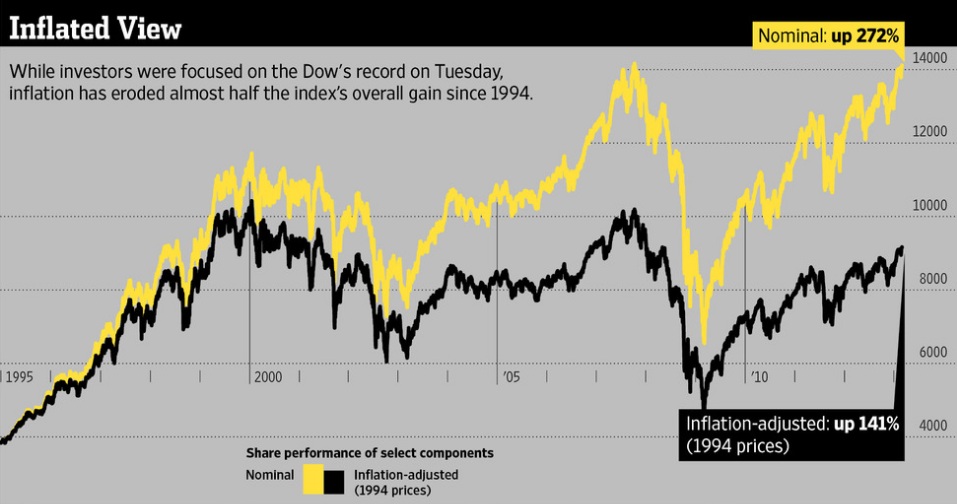
Other than calling for a top, which I'll hold off on until the S&P 500 hits a new nominal high, I'll point out something else.  While the Dow is setting new nominal records, the index itself is not in new territory as far as real values go.  Barry Ritholtz has the graphic.


The current nominal values are nowhere near the peak real values.  That's actually a bullish sign.  The last time the real values approached the previous real-value peak, the bull market ended and the slide into the Great Recession began.

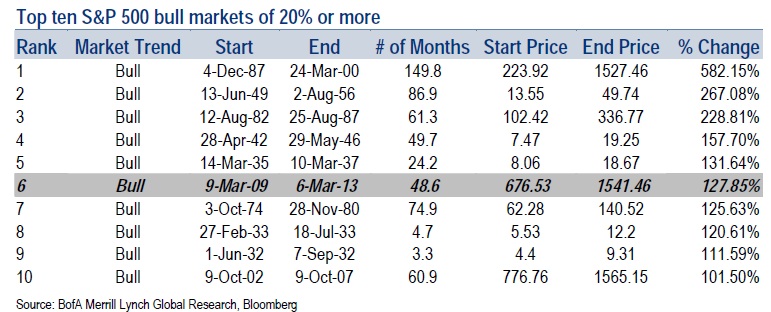
Ritholtz has one more graphic on the topic.  The current bull market in the S&P 500 is one of the top ten in terms of increased value.  Also note that the closing record is less than 24 points away.


It's hard to maintain any short-feeling of DOOM with numbers like these.  The long-term risk is still terrible, but that will be the subject of other posts.

The bull market continues to rampage


Just one day on from Dow at all time high, the DJIA continues to set records, as the Washington Post reported in After a record day, the Dow Jones industrial average keeps climbing on Wall Street.  That's an Associated Press article, so I won't quote it.  Instead, I'll direct your attention to this article from MSN Money: Forget the Dow; watch the S&P 500.
It's grand that the Dow has hit new records, but many market experts see a new high for the S&P 500 confirming the rally's strength. Maybe they're right.

Now that the Dow Jones Industrial Average has broken its 2007 record, the big question is when will the Standard & Poor's 500 Index push to new highs.

The betting is soon, and there's chatter that a new high for the index means the four-year bull rally will continue.

It did not happen on Wednesday. The S&P 500 closed up 2 points to 1,541 but is still 24 points below its 2007 peak close of 1,565.15. The Dow was up 42 points to 14,296, a new closing high; it also set a new intraday high of 14,320.65. The Nasdaq Composite Index slipped 2 points to 3,222.

It makes sense that the S&P would give analysts optimism. The obvious reason is the Dow consists of just 30 stocks; the S&P 500 includes 500 stocks and represents roughly 75% of the entire U.S. stock market capitalization.
The author is on to something.  The Dow may be well-known and flashy, but it's not the best indicator of the strength of the stock market; the S&P 500 is.  It also is less prone to bubbles, as the article describes in this capsule history.
On March 24, 2000 the S&P 500 closed at what was then an all-time high of 1,527.46. It fell for the next two-plus years before bottoming in October 2002 -- as the U.S. stock market was crushed by the dot-com bust and then the aftermath of the Sept. 11, 2011 terror attacks.

The index didn't top its 2000 high until Sept. 27, 2007. Eight sessions later, it peaked and fell 57% over the next 17 months.

Market bulls will say that the Dow offers a different scenario for stocks.

The Dow's new record has been built on low U.S. interest rates, rising profits among most of the Dow companies -- all big multinationals -- and continued cost-cutting that has limited employment growth in their U.S. operations.  The Dow's big run has nonetheless cheered analysts, many of whom believe it suggests the rally has another year or so to run.

That's because the Dow broke its 2000 record close in August 2006 and moved 3,000 points higher over the next 12 months.
It looks like I've been using the wrong index to look for a top.  I should be using the S&P 500.  Time to switch my attention.

Wednesday, March 6, 2013

Examiner.com article on another U-M climate change survey

Here's another examination of risk, this time about climate change.  At least in this case, the news about acceptance is good.

Hurricane Sandy increased the number of people who cited weather changes and severe weather as reasons to accept global warming.
CREDIT: NASA/Getty Images
U-M study: Two-thirds of Americans accept global warming is real
Two-thirds (67%) of all Americans now accept the evidence that global warming is real, according to a study by the University of Michigan released March 4th.  This is the most positive response since Fall 2008, when 72 percent of all Americans surveyed thought that climate change was real, and fifteen percent higher than Spring 2010, when only 52 percent gave a positive response.

Much of the rise came from increasing acceptance among Republicans, 51 percent of whom agreed with the statement that there is "solid evidence that the average temperature of the Earth has been getting warming over the past four decades."  This is the highest level of agreement with that statement among Republicans since Fall 2008, when 53 percent said yes to the survey question, and eighteen percent higher than Spring 2010, when only 33 percent agreed while 55 percent said no.  In contrast, 79 percent of Democrats and 71 percent of independents agreed with the same statement.

In a press release, University of Michigan Professor Barry Rabe, director of the Center for Local, State, and Urban Policy at the Ford School of Government said, "The only individual characteristic that reveals stark differences among Americans regarding the existence of global warming continues to be partisan standing."

This study came on the heels of one released last December showing that a majority of Americans surveyed favored government action to reduce greenhouse gases.  Both reports used information gathered as part of the Fall 2012 climate change survey, one of the National Surveys on Energy and Environment (NSEE).
Click on the link in the headline for more details.

I blogged about the study referenced in the fourth paragraph in Examiner.com article on U-M climate change survey.  As I wrote then, this is good news.  I'm not going to drop Professor Farnsworth on you.  Instead, I'll give you a real life professor, Barry Rabe of the University of Michigan's Ford School of Government, who discusses survey results showing two-thirds of Americans now accept global warming, including a majority of Republicans.  As I wrote, good news!

Tim Walberg lies about voting on VAWA, then covers up the lie

My former U.S. Representative, and that only because I was one of those who voted him out the first time and then moved out of his district before he could return to office the second time, has made the news again, and not in a good way.  Progress Michigan has preserved it from going down the memory hole on YouTube.


Rep. Tim Walberg, in an interview with WTVB-FM, lies about his vote on the Violence Against Women Act. In fact, according to Walberg's own House website, there was no Republican version of VAWA - just an amendment. Although Rep. Walberg voted yes on a Republican amendment to VAWA, he voted against reauthorizing the Violence Against Women Act.

His spokeswoman Sarah Kuziomka later told MIRS that "Congressman Walberg has not been a guest on (WTVB-FM) in over three weeks." The above interview was aired on WTVB-FB on Friday, March 1, following Rep. Walberg's no vote on the reauthorization of VAWA.
Let's go through the offenses.  First, he voted against VAWA.  While it's something I disapprove of, it's not anything that surprises me, given what I know about the man, and it's not anything that his supporters would hold against him.  Then he went on WTVB and lied about his vote.  When he was called about it on Michigan Liberal and Eclectablog, the station pulled down its news story about his appearance.  Walberg's spokesperson then lied about being on WTVB.  And to think that Walberg used to be a minister; he should know better than to commit an offense against the Ninth Commandment.

That's not the first time Walberg's been caught lying about a vote.  Progress for Michigan recalls what he did in 2007.
In Walberg’s first term, he sent a press release bragging about new buses for the Jackson Transportation Authority and a new runway for W.K. Kellogg Airport, which had been included in a bill he voted against. In an editorial, the Battle Creek Enquirer said “it is the height of cynicism for politicians to think they can voice public support for issues and then turn around and vote in opposition.”
Finally, Progress for Michigan called on him to apologize for the lie.
“Rep. Walberg’s tall tales should be saved for bedtime stories to his daughters and granddaughters who he claims to want to protect,” said Jessica Tramontana, Communications Director for Progress Michigan. “Walberg and his staff obviously believe they’re above reproach and can simply lie their way out of any situation. Walberg owes an apology to all Michiganders. We all deserve an honest and straightforward answer from our elected leaders, and shouldn’t have to search so hard for the truth.”
I predict he won't, adding a fourth issue to the list he's already given his next opponent, whoever he or she may be.

Crossposted to Daily Kos as Tim Walberg lies about voting against VAWA, then covers up the lie.