Showing posts with label Scientific American. Show all posts

Tuesday, June 5, 2018

Seeker describes the mind games politicians play to win votes


In the video I embedded in Seeker explains how television entertainment can shape our political opinions, presenter and writer Amy Shira Teitel told viewers to click on a video showing 'the mind games politicians play to win.'  Here is The Mind Games Politicians Use To Win Votes from Seeker/DNews.

Politicians put a lot of work into the way they get votes, and it’s not just by writing a great speech.
Two of the sources for this video deserve closer scrutiny, beginning with Tears and fears: How do emotions change our political attitudes?
"There's been a lot of focus in recent years on emotions and political attitudes, but the ways we, as political scientists, have studied this phenomena have made it hard to draw firm conclusions," said Dr. Jonathan Renshon, from the University of Wisconsin-Madison. "We bypassed many of the methodological problems of previous studies by inducing an emotion unrelated to politics and measuring its effects not with self-reports but with tonic skin conductance."
...
"We found that the anxiety we generated was powerful enough that people couldn't simply turn it off, it carried over to unrelated domains and actually influenced people's political beliefs, particularly their attitudes towards immigrants," concluded Renshon. "This is all the more important as political campaigns become more adept at stimulating and manipulating the emotions of the general public."
The conclusion of this press release leads me to the conclusion of Deep Voice Gives Politicians Electoral Boost by Diana Kwon at Scientific American.
We like to think that we consider our electoral options carefully, and base our decisions on conscious, rational judgments. But it may be a candidate’s height, attractiveness or voice that play outsized roles when we go to the polls.
I'd like to agree with Julia Wilde, the presenter of the video above, that, once we know about the emotional buttons politicians press, we can work to suppress them and pay attention to policy and other rational matters, but I think that's easier said than done.  Keep that in mind this election year, especially all my readers in the eight states going to the polls today for primary elections.  May they at least try to make a rational decision instead of an emotional one when they vote.

Wednesday, December 27, 2017

Neutron star collision detected and other top science stories of 2017


When I posted Gravity waves and other top science stories of 2016, I had no idea that the discoverers of gravity waves would win the Nobel Prize for physics this year, but they did.  Gravity waves are still the number one science story of the year, at least according to the AAAS and Science Magazine, as they named them Breakthrough of the Year, 2017.

Check out what Science's editors deemed the top results of 2017, including our Breakthrough of the Year!
That discovery topped most of the other lists I examined from what I considered reputable sources.  The other stories that Science Magazine placed in this year's top ten that showed up elsewhere were CRISPR and its role in gene therapy, the discovery of the oldest Homo sapiens fossils in Morrocco, and a new endangered species of orangutan.  Stories that Science Magazine did not mention that made many other sources' top science story lists included the Great American Eclipse and the end of the Cassini mission, perhaps because they were not breakthroughs or discoveries, even if both were big news.

Follow over the jump for videos from New Scientist, Curiosity Stream, Science News, and Scientific American on their top science stories of 2017.

Monday, June 19, 2017

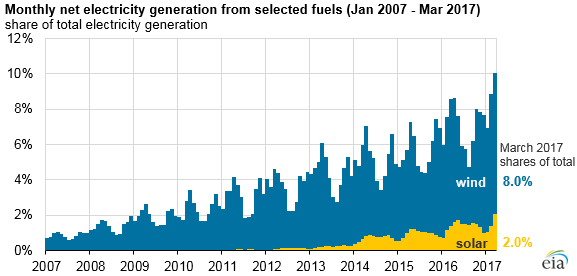
U.S. and U.K. set new solar and wind energy records


I have more good news about renewable energy, which is happening despite Trump pulling the U.S. out of the Paris Climate Agreement to widespread condemnation and ridicule.  Newsy reports US sets new record for wind and solar power use.

For the first time ever, wind and solar power generated 10 percent of U.S. energy for a single month.
Scientific American reported the above, as well as some projections into the future.
The EIA projects that wind and solar will generate 10 percent of U.S. electricity year-round by 2020. But scientists say the country’s power supply could see a larger share of wind and solar by then for at least part of the year.

“I believe that by 2020, we will see the first 15 percent month, possibly a little sooner,” Clack said. “This will partly depend on the weather patterns in the year, but I could see substantial (wind and solar plant) additions before 2020 that will increase production to those levels.”
Scientific American also included some veiled editorial comment as part of its analysis.
The renewables milestone comes amid actions by the Trump administration to turn back federal climate policies intended to cut greenhouse gas emissions by embracing wind, solar and other renewable energy. Trump, who has called climate change a “hoax,” has re-committed the U.S. to coal energy, which was the largest single source of climate pollution in the U.S. until being eclipsed by the transportation sector last year.

Though the federal government is doubling down on coal, electric power companies are embracing less-polluting natural gas, wind and solar power as the cost of generating electricity from those sources falls.

March’s milestone “says that the Trump Administration is living in the last century,” Firestone said.
I agree with this statement.

Follow over the jump for news from across the pond.

Tuesday, October 4, 2016

Warmest August on record so far as carbon dioxide passes 400 ppm 'permanently'


In August, I shared that July 2016 was the hottest month on record yet.  In September, I reported that Detroit just had its warmest summer on record.  Today, it's August 2016 was the hottest August ever.

The past 11 consecutive months have set record temperatures.
That's an understatement, as Climate Central reported.
The unprecedented streak of record-hot months that the world has experienced over more than a year just tacked on one more month: Data released Tuesday by the National Oceanic and Atmospheric Administration showed last month was easily the hottest August on record.

That makes 16 straight record-hot months, unparalleled in NOAA’s 137 years of record-keeping. The previous record streak was only 10 months, set in 1944. NASA’s data, released earlier, also said August was record hot, not to mention tying for the hottest month the planet has ever recorded.
As for the bigger picture...
Though there are still several months left in the year, it is a virtual certainty that 2016 will be the hottest year on record, and by a significant margin. While global temperatures can fluctuate from year to year, 2016 is serving as something of an exclamation point for the long-term trend of warming driven by the buildup of heat-trapping gases in the atmosphere.
Welcome to the 400 PPM world, as Scientific American reported.
In the centuries to come, history books will likely look back on September 2016 as a major milestone for the world’s climate. At a time when atmospheric carbon dioxide is usually at its minimum, the monthly value failed to drop below 400 parts per million.

That all but ensures that 2016 will be the year that carbon dioxide officially passed the symbolic 400 ppm mark, never to return below it in our lifetimes, according to scientists.
Right after the Paris Agreement on Climate being signed on Earth Day, the planet's temperature may blow past the 1.5 degrees Celsius threshold, meaning it was too late.  Yes, this is still a doomer blog.

Monday, April 4, 2016

Happy Square Root Day!


Pi Day isn't the only mathematical holiday this spring.  Fox 4 reminds everyone that it's Square Root Day 4/4/16.


Scientific American has more in It's Square Root Day! Prepare to Be Somewhat Underwhelmed...
Math geeks and those who love them are probably still in withdrawal: Pi Day, the holiday that commemorates everyone’s favorite irrational number, has come and gone, and the next one won’t happen until March 14, 2017—an agonizing 11-plus months in the future.

But wait, you say. Isn’t today another major math-related holiday? Four times four, or 42, is 16, and since today’s date is 4/4/16, this is—wait for it—square root day! It happens every time this sort of configuration rolls around: the last square root day was March 3, 2009, or 3/3/09, and the next will happen on May 5, 2025, or 5/5/25.

Before you get too excited, though, you need to face a sad truth: square root day is a second-rate math holiday at best—it’s like trying to get your pulse pounding over Arbor Day, compared with, say, Christmas or Thanksgiving or any other self-respecting festival.
...
But if you think there’s no such thing as too many math celebrations, Square Root Day is by definition something to celebrate. While you’re at it, you might as well gear up for Fibonacci Day (11/23), Pythagorean Theorem Day (the date varies), and Math Storytelling Day (9/25).

When it comes to math holidays, in short, the fun—such as it is—never stops.
I'm all in favor of geeky fun holidays, even fake ones.

Sunday, June 21, 2015

'The Last Ship' returns and other summer TV fare


If my readers have been counting, I promised three times that I would blog about the season premiere of "The Last Ship" tonight.  I'm making good on that promise, which I first made in the footnote to Razzies and Robocop this past February.
My wife and I are watching "The Last Ship." When I heard it was a Michael Bay show, I knew to expect a lot of action and things being blown up. I have not [been] disappointed.
Some Sunday this summer, I'm going to have to write about "The Last Ship," which is an OK post-apocalyptic drama that probably will seem more relevant and urgent after last year's Ebola epidemic.  For example, in a case of life imitating art, one of the Ebola treatments looked very similar to a treatment for the disease in the TV show.  That's not something I expect out of a Michael Bay production.
In the TV show, the ship's doctor transfuses blood from an immune person picked up during the voyage to the ship's crew who were infected in hopes of transferring her immunity to them.  That's what Scientific American described last summer in Blood Transfusions from Survivors Best Way to Fight Ebola.
Treating Ebola patients with blood transfusions from survivors of the disease should be the immediate priority among all the experimental therapies under consideration for this outbreak, World Health Organization (WHO) experts said Friday after reviewing the status of all the potential experimental therapies and vaccines. “We agreed that whole-blood therapies and convalescent serum may be used to treat Ebola virus disease and that all efforts must be invested into helping affected countries use them safely,” Marie-Paule Kieny, assistant director general for health systems and innovation at WHO told reporters. “This is something that would be ready near term.” None of the considered Ebola regimes have yet been adequately tested in humans.

Because survivors of an Ebola infection would typically have produced effective antibodies against the virus (otherwise they wouldn't have survived), transfusions of their blood into a newly infected individual may help that person survive the often fatal disease. Such blood preparations, drawn from volunteers, could be ready before the end of 2014, according to preliminary WHO estimates put out earlier this week. “We have to change the sense that there is no hope in this situation to a realistic hope,” Kieny said during a press conference Friday. She has called for other countries to help affected west African nations to build their capacity to safely do the blood drawing and preparation for what needs to be reinfused into the patients.
A Google search found that this treatment had been proposed back in 1999.  In that case, it looks less like a case of life imitating art, which it would seem to the uninformed, and more an example of a scriptwriter doing his or her homework.  Given how many examples TV Tropes lists of the show's various kinds of artistic license, I'm pleasantly surprised.  Here's to the show providing more victories of sense over sensation, although given that Michael Bay prefers sensation, I'm only guardedly optimistic.  Given the two trailers below, that's probably the right expectation to have.


When a global pandemic wipes out eighty percent of the planet's population, the crew of a lone naval destroyer must find a way to pull humanity from the brink of extinction.
Follow over the jump for more on this show and the rest of this summer's post-apocalyptic TV offerings, including the surprising addition of "Wayward Pines" to the genre.

Tuesday, January 6, 2015

2014 in space and astronomy


Moving Day is over, so it's time to post from the new house.  To mark the occasion, I'm continuing my series of retrospectives for 2014 with the year in space.  As a firm believer in "if it moves, it leads," I begin this installment with two videos from NASA.  First, 2014 What Happened This Year @NASA

In 2014, NASA took significant steps on the agency’s journey to Mars -- testing cutting-edge technologies and making scientific discoveries while studying our changing Earth and the infinite universe as the agency made progress on the next generation of air travel. Here’s a look at some of the top NASA stories of the year!
That's the long version.  Here's the short version: NASA 2014.

As 2014 comes to a close we look back on a few of the events that took place this year at NASA.
As one can see, NASA accentuated the positive, highlighting the Orion test flight.  That mission contrasts with the two disasters one after another described in a bad week for private space.  Those were not highlights of the year in space, although they were big stories.

Follow over the jump for more about the year in space.

Saturday, January 3, 2015

2014 in biodiversity


It's time to pick up a theme mentioned in The limbo bar drops to $1.95 plus 2014 in energy and environment--not gas prices, but what EcoWatch called "wildlife conservation and loss" along with more positive stories about biodiversity.

Because I believe in "if it moves, it leads," I begin with Discovery News counting down The Weirdest New Species Of 2014.

There were a bunch of animal discoveries in the past year, but these 6 have to be our favorites!
The frog wasn't particularly weird, but I do understand why DNews would find it interesting.

National Geographic News has its own ideas of Top 10 Weirdest Animal Stories of 2014: Editors' Picks.
This was a banner year for the bizarre, with a snake virgin birth, an extremely rare black sea devil, and a real-life unicorn making headlines in Weird & Wild.

Luckily for our fans, we've rounded up our editors' picks of the ten best weird stories of 2014.
Now, those are weird, even if they aren't new species.

Follow over the jump for more stories about biodiversity from 2014.

Tuesday, May 20, 2014

Acorns for food, a nutty idea


Here's an odd food idea by Dawn Starin of Scientific American I originally included in Overnight News Digest: Science Saturday (West Antarctic ice sheet collapsing): Is Reintroducing Acorns into the Human Diet a Nutty Idea?
If harvested sustainably and treated to remove bitter tannins, acorns may once again have a more prominent place in the kitchen

As the world’s breadbaskets strain to meet the demands of the Earth’s growing population, already more than seven billion strong, we could use another nutritional, ecologically friendly food source. Could acorns, the fruits of the oak tree, be the answer? Certainly, they are beginning to draw renewed interest in the hunt for sustainable alternative food sources.

Over the past decade various Web sites, magazines and newspapers have recommended that the occasional acorn-based items be reintroduced into our diets. With a growing interest in foraging for local, edible wild plants, eating new and ever-more exotic food items and the need (both real and imagined) for gluten-free ingredients sweeping through parts of the Western world, is it possible that acorns—small nuts that fit all of these criteria—could be on the verge of a dietary comeback.
More than 15 years ago, I read Jared Diamond's "Guns, Germs, and Steel," where the idea of domesticating oaks was discussed and dismissed.  Here is the reasoning from enotes: Why were almond trees domesticated for consumption but oak trees were not?
Basically, the answer is that bitterness in almonds is controlled by only one gene.  In oak trees, by contrast, the bitterness of acorns is controlled by many genes.

The reason that this is important is because this means that about half of the almonds from a tree that is not bitter will also produce trees that are not bitter.  By contrast, almost all of the acorns from a "good" oak tree would (if you plant them) produce an oak tree whose acorns are bitter.

This means that it would be much easier to selectively breed good almonds than it would be to breed good oaks.  Therefore, people would quit trying to domesticate oaks but would continue to try to domesticate almonds -- they would have a much better chance of success with the almonds.
Also, I recall that Diamond argued that oaks have long generation times and the selection pressures humans were capable of putting them under were less than that of the wild animals that normally eat acorns.  Still, if one could reduce the bitterness by a more expeditious way than grinding the acorns into flour and then leaching the tannins out of them for more than a day, I suppose it could work.  However, oaks will likely remain a wild-collected food source, like morels and truffles, for at least a century, even if they can be successfully turned into food for modern humans.

Thursday, September 5, 2013

Do blackboards make teachers stupid?


Today marks the end of my first week of classes.  To mark the event, here is what should be the last of my series of posts on the  beginning of school.

In last week's Scientific American, Evelyn Lamb (no relation) asked Blackboards Make You Stupid (Or Is It Just Me?)
I just finished my first week teaching after a few years out of the classroom. Whenever I teach, I’m struck by how much detail I need to put in my notes to make sure I don’t say something absolutely ridiculous when I’m in front of the class. Even with careful preparation, I sometimes arrive back at my office wondering why I couldn’t answer a question that perplexed me in class but suddenly seems so simple. The reason? Blackboards make me stupid, and they probably make you stupid too.

A quick search through stock photos reveals that the intelligence-suppressing powers of blackboards are well documented. But the exact amount that a person’s intelligence decreases when he or she stands at the front of a classroom with a blackboard has only recently been determined—by yours truly.

This week, I came up with a preliminary formula that describes the troubling phenomenon of Blackboard Stupidity.
I quit using blackboards when I stopped being a public school teacher 10 years ago.  Instead, I use PowerPoint.  I wonder if I'm risking Death By Power Point.

Friday, June 7, 2013

Radiation on Mars voyage and other space and astronomy news

I've already covered a lot of this past week's space and astronomy news in Another asteroid passed by on Friday and "After Earth" in this installment of Crazy Eddie at the movies, but there was plenty left over.

Several sources covered the impact of radiation on humans during an expedition to Mars.  I begin with Space.com's video: Will Radiation Kill Mars Astronauts?

Astronauts on long interplanetary trips will face at least two kinds of radiation hazards. The Mars Science Lab's Radiation Assessment Detector (RAD) has quantified the risk. Crews could get much more than the current accepted career dose.
Scientific American via Nature (UK) has more in Spacecraft data nails down radiation risk for humans going to Mars
Improved shielding technology could keep exposure within acceptable levels.
Ron Cowen
30 May 2013
Astronauts travelling to Mars on any of the current space-flight vehicles would receive a dose of radiation higher than NASA standards permit, according to a study of the radiation environment inside the craft that carried the Curiosity rover to the planet.

The study, reported in Science, is the first to use radiation data recorded by a robotic craft en route to Mars. It is also the first to rely on measurements from a radiation detector in space that has shielding similar to what might be used on missions carrying humans, says physicist Sheila Thibeault of NASA’s Langley Research Center in Virginia, who was not involved in the study.

Previous calculations of exposure were extrapolations, notes study co-author Cary Zeitlin of the Southwest Research Institute in Boulder, Colorado. Those studies used detectors in space that either had no shielding or were aboard Mars-bound craft whose instruments were not switched on until they reached the planet.
Finally, LeftOfYou on Daily Kos discussed the finding in On Mars: Manned Missions Will be Trickier, More Expensive and Take Longer to Design.

Follow over the jump for general space news, followed by astronomy news from the outer Solar System to the surface of our planet.

Saturday, May 18, 2013

Robots are coming for our jobs

The idea of robots taking our jobs, which bloggers like Chad/escapefromwisconsin at The Hipcrime Vocab and Stuart Saniford at Early Warning have been writing about for years, has popped its head up in mainstream science reporting.  While Chad and Stuart have been pessimistic about the prospects, Discovery News on YouTube takes a more optimistic view in Robots Are Stealing Your Job.

Robots are awesome, but beware: they're after your jobs! Trace looks at the work robots are doing today, that once required a human touch.
I don't think either Chad or Stuart would be so comfortable with the situation.  Instead, they might agree more with Seth Fletcher of Scientific American.

Yes, Robots Are Coming for Our Jobs—Now What?
M.I.T. economist Erik Brynjolfsson explains how technology has affected economic growth and productivity, and how human workers can adapt
Fifteen years ago Deep Blue beat Garry Kasparov in a game of chess, marking the beginning of what Massachusetts Institute of Technology economist Erik Brynjolfsson calls the new machine age—an era driven by exponential growth in computing power. Lately, though, people have been feeling uneasy about the machine age. Pundits and experts seem to agree that the robots are definitely taking our jobs. At last week’s TED conference, Brynjolfsson argued that the new machine age is great for economic growth, but we still have to find a way to coexist with the machines. We asked him to expand on a few points.
...
Throughout most of modern history, productivity and employment have grown side by side. But starting about 15 years ago they started becoming decoupled. Productivity continued to grow, even accelerate, but employment stagnated and even fell, as did median wages for the people who were still working. This was an important milestone, because most economists, including me, used to be of the mind-set that if you just keep increasing productivity, everything else kind of takes care of itself.

But there’s no economic law that says everyone has to benefit equally from increased productivity. It’s entirely possible that some people benefit a lot more than others or that some people are made worse off. And as it turns out, for the past 10 to 15 years it’s gone that way. The pie has gotten bigger but most of the increase in income has gone to less than 1 percent of the population. Those at the 50th percentile or lower have actually done worse in absolute terms.
Chad at The Hipcrime Vocab came to the same conclusion beginning very early in his examination of robots and automation, beginning with What Are People Good For?  As for Stuart, he thinks the loss of jobs to robots will be the major effect of the Singularity, not everyone becoming cyborgs or the machines enslaving or killing off humanity.  Just the same, this is yet another piece of evidence demonstrating that we live in science fiction times.

Monday, April 29, 2013

White House Science Fair and other STEM education news

The featured story for this week's Overnight News Digest: Science Saturday (White House Science Fair) on Daily Kos came from the Washington Post with video from Discovery News on YouTube.

Whiz Kid Inventors Invade The White House

Trace joins President Obama in Washington DC for the 3rd Annual White House Science Fair. Watch as young inventors show off everything from portable windmills to underwater robots!
Robots, biofuel, whiz kids at the White House Science Fair
By Lyndsey Layton
Published: April 22
In his dark blue business suit, President Obama climbed onto a bicycle anchored to the ground outside the White House. He pedaled in his polished dress shoes, generating electricity to run a water sanitation system built by a group of Florida teenagers.

He peered into a flask of green liquid containing a new breed of algae that was created by a 17-year-old Colorado girl who wants to solve the country’s energy problems.

And he shook hands with three small boys from Georgia who dreamed up a system to automatically cool down and hydrate sweating athletes.

“Keep in mind, they’re in third, fourth grade, and they’ve already got this idea,” Obama said. “If you’re inventing stuff in the third grade, what are you going to do by the time you get to college?”
I hope the answer is use science and technology to help with our environmental issues.

Follow over the jump for more stories aabout STEM education from Daily Kos.

Tuesday, April 2, 2013

President Obama and Francis Collins announce BRAIN Initiative

I'll give CNN the honor of presenting the executive summary: Obama wants $100M for brain research.

Supporters say the president's plan will create jobs and help scientists better understand how the brain works.
Follow over the jump for the video of the announcement and news stories both pro and con.

Saturday, March 30, 2013

Climate change: Risks and responses


Time to follow up on Risks from climate change from two weeks ago with more climate change news that I originally posted at Daily Kos.

First, this item from LiveScience, which I first included in Overnight News Digest: Science Saturday (Life possible on ancient Mars).

February 2013 Was World's 9th Warmest on Record
Last month was among the top 10 warmest Februaries for the planet since record keeping began in 1880, U.S. weather officials announced today (March 14).

February 2013 tied with 2003 as the 9th warmest February of the past 133 years, according to scientists with the National Oceanic and Atmospheric Association (NOAA). They calculated last month's globally-averaged temperature at 54.93 degrees Fahrenheit (12.67 degrees Celsius), or 1.03 degrees F (0.57 degrees C), above the 20th century average of 53.9 degrees F (12.1 degrees C).

This means February 2013 was the 336th consecutive month with a global temperature above the 20th century average. The last below-average February, in terms of temperature, was in 1985.
Follow over the jump for more climate news.

Thursday, March 28, 2013

More science and the Satan Sandwich


In Jared Diamond on risk, I repeated something I had written earlier, "I have more to say about the science of the Fiscal Bluff when I have more energy." It turns out that I have more to share on that topic than what Jared Diamond had to say about it. First, here's another article excerpt on the topic from Overnight News Digest: Science Saturday (Fiscal Bluff Bungee Jumping) on Daily Kos.

LiveScience: Psychology of Compromise: Why Congress Fails
Stephanie Pappas, LiveScience Senior Writer
Date: 03 January 2013 Time: 02:33 PM ET
Hyenas do it. Elephants do it. But apparently congressional representatives do not.

"It" would be cooperation, which has been little-seen in Washington during the "fiscal cliff" negotiations. Despite a deadline they themselves set with consequences no one wanted, Democrats and Republicans went down to the wire before passing a bill that averts major cuts and tax increases but sets the stage for more bickering over the raising of the nation's debt limit and other budgetary issues.
...
Why all the rancor? A major contributor is partisan polarization, which political scientists say is at historic levels among the political elite. But simple human psychology may also explain why it's so tough to compromise, with feelings often trumping logic in heated debates.
That's the cause of the Satan Sandwich, which then led to the Fiscal Cliff Bungee Jump, and now to the Sequester. Now for one of the effects, which I included in another diary on Daily Kos, Overnight News Digest: Science Saturday (Life possible on ancient Mars).

Scientific American: Sequestered Science: How Research Got Tied Up with Federal Dollars [Timeline]
By Daisy Yuhas
March 12, 2013
More than 10 U.S. departments and agencies that receive federal funding for scientific research will suffer from budget cuts enacted by the federal government on March 1, aka "the sequester"
Check out the graphic at the link for the full effect of the Sequester on federally funded science research.

Wednesday, March 27, 2013

The present and future of energy

I'm showing my students "The End of Suburbia" this week, which reminds me of the centrality of energy to civilization and the risks of collapse posed by inablity to use it. On that note, here is a review of a talk and the talk itself about the current state of energy generation and how that might look in the future that I first posted in Overnight News Digest: Science Saturday (In Soviet Russia, Space explores you!) on Daily Kos.

Scientific American: Everything is (Old/New) Energy
By Melissa C. Lott
February 12, 2013
The world’s energy is primarily rooted in fossil fuels – oil, natural gas, and coal. Add in nuclear power, and you have the fuels behind the vase majority of the world economy. And, we have not really changed the fundamentals of how we harness energy in over a century.

But, according to Roger Duncan – the former general manager of one of Texas’s major utilities, Austin Energy - this does not mean that our energy systems are stagnant. Rather, these systems are changing fast – from conventional 1-direction energy flows and a disconnected transportation system to a unified energy system.
Here is Duncan at the Texas Renewable Energy Industry Association (TREIA) explaining what he sees as the future of energy.

Webber Energy Group member, Roger Duncan, gives his unique view of the future of energy, renewables, and the Unified Energy System at Texas Renewables Conference 2012.
He should give this talk at TEDx someday. I'm sure he'll get a better reaction from that crowd.

Monday, March 25, 2013

De-extinction: moral imperative or techno-narcissism?

Two weeks ago, TED Talks posted Stewart Brand: The dawn of de-extinction. Are you ready?

Throughout humankind's history, we've driven species after species extinct: the passenger pigeon, the Eastern mountain lion, the dodo .... But now, says Stewart Brand, we have the technology (and the biology) to bring back species that humanity wiped out. So -- should we? Which ones? He asks a big question whose answer is closer than you may think.
Megan Gannon of LiveScience just reported the facts in Reviving the Woolly Mammoth: Will De-Extinction Become Reality?
Biologists briefly brought the extinct Pyrenean ibex back to life in 2003 by creating a clone from a frozen tissue sample harvested before the goat's entire population vanished in 2000. The clone survived just seven minutes after birth, but it gave scientists hope that "de-extinction," once a pipedream, could become a reality.

Ten years later, a group of researchers and conservationists gathered in Washington, D.C., today (March 15) for a forum called TEDxDeExtinction, hosted by the National Geographic Society, to talk about how to revive extinct animals, from the Tasmanian tiger and the saber-toothed tiger to the woolly mammoth and the North American passenger pigeon.

Though scientists don't expect a real-life "Jurassic Park" will ever be on the horizon, a species that died a few tens of thousands of years ago could be resurrected as long as it has enough intact ancient DNA.
Alan Boyle at NBC News included more opinion in his fairly even-handed article Should we revive extinct species? Watch experts debate de-extinction explaining both de-extinction and linking to the conference. In it, science writer Carl Zimmer made a vain wish.
Zimmer said the last thing that Church and his colleagues want is a genetic free-for-all over de-extinction. "They want this to be something where there's a strong consensus," he said. "This is not an off-the-reservation project."
Too late. Very shortly thereafter, the scientific and popular press went wild over it. Follow over the jump for the reaction, both pro and con.

Wednesday, March 20, 2013

China's top six environmental problems

China's air pollution isn't just a problem that is causing trouble with its neighbors, it's a major domestic health issue. It's also only one of six environmental problems the country faces, according to LiveScience.

China's Top 6 Environmental Concerns
China's environmental crises seem to arise on a scale as sweeping and epic as the vast nation itself:

Thousands of dead, bloated pigs floating down the river that supplies Shanghai with its drinking water. Air pollution in Beijing so impenetrable the U.S. Embassy's air quality measuring station can only call it "beyond index." Industrial towns where rates of cancer are so high they're known as "cancer villages."

Compounding these problems is the Chinese government's stony silence about anything that might imperil the country's economic development — including environmental regulation.

But China's increasingly restive population of 1.3 billion people is now starting to demand government action to combat the deadly plagues of pollution and disease that are stalking the 21st century's economic powerhouse.
Follow over the jump for the full listing of all six issues along with recent stories illustrating each one.

Sunday, March 17, 2013

The science of drinking for St. Patrick's Day

I begin with Discovery News' contribution: St. Patrick's Day: Beer Goggles Explained.

Does alcohol help make your date appear more attractive? It certainly seems to help for some! Laci takes a look at the phenomenon of "beer goggles" and whether there's any truth to it all.
Speaking of beer, Jeffrey Kahn of the N.Y. Times brings us How Beer Gave Us Civilization.
HUMAN beings are social animals. But just as important, we are socially constrained as well.

We can probably thank the latter trait for keeping our fledgling species alive at the dawn of man. Five core social instincts, I have argued, gave structure and strength to our primeval herds. They kept us safely codependent with our fellow clan members, assigned us a rank in the pecking order, made sure we all did our chores, discouraged us from offending others, and removed us from this social coil when we became a drag on shared resources.

Thus could our ancient forebears cooperate, prosper, multiply — and pass along their DNA to later generations.
But then, these same lifesaving social instincts didn’t readily lend themselves to exploration, artistic expression, romance, inventiveness and experimentation — the other human drives that make for a vibrant civilization.

To free up those, we needed something that would suppress the rigid social codes that kept our clans safe and alive. We needed something that, on occasion, would let us break free from our biological herd imperative — or at least let us suppress our angst when we did.
Beer isn't the only beverage associated with Ireland.  Whiskey is, too, and Scientific American examines Barreling Ahead: Whiskey-Makers Break Cherished Traditions to Create New Flavors.
Armed with modern analytic tools, distillers are studying the wood in the barrels and experimenting with the aging process. Is nothing sacred?

Master distiller Harlen Wheatley of Buffalo Trace Distillery draws a bourbon whiskey sample out of the barrel and pours it into a brandy snifter glass. Wheatley raises it into the light; the bourbon illuminates with rich colors of caramel, gold, straw yellow and light brown. He tastes the seven-year-old drink known as W. L. Weller and says, "That's really coming along."

As Wheatley moves onto the next barrel, the glass sits in the light, the bourbon shining brightly and illustrating the chemical change wrought by the barrel. After being poured into the barrel, the colorless spirit sat there or "aged" for seven years. The liquid mingled with the wood, giving the bourbon it's color, taste and smell.

A new generation of distillers have begun to break time-honored tradition and tinker with the barrels, relying on science and experimentation to bring new flavors into the spirits. For the bourbon whiskey business, the barrel is everything.
Happy St. Patrick's Day!