A blog about societal, cultural, and civilizational collapse, and how to stave it off or survive it. Named after the legendary character "Crazy Eddie" in Larry Niven and Jerry Pournelle's "The Mote in God's Eye." Expect news and views about culture, politics, economics, technology, and science fiction.
In 2027, the Artemis III mission will practice docking the Orion spacecraft with two lunar landers in low Earth orbit. On future Artemis missions, landers will bring astronauts to the lunar surface. While Artemis III will not land on the Moon, it will test the complex capabilities we need to return humanity there — this time to stay.
NASA astronauts Randy Bresnik, Frank Rubio, and Andre Douglas will join European Space Agency astronaut Luca Parmitano on this historic mission.
Another step toward one of the most complex spaceflight missions in history, NASA provided updates on Artemis III and announced crew members for the test flight. Planned to launch in 2027, the mission will practice docking the Orion spacecraft with two lunar landers in low Earth orbit.
On future missions, including Artemis IV in 2028, landers will bring astronauts to the lunar surface. While Artemis III will not land on the Moon, it will test the complex capabilities we need to return humanity there — this time to stay.
Crew assignments are as follows:
• NASA astronaut Randy Bresnik, commander
• ESA (European Space Agency) astronaut Luca Parmitano, pilot
• NASA astronaut Andre Douglas, mission specialist
• NASA astronaut Frank Rubio, mission specialist
• NASA astronaut Bob Hines, backup crew member
Both of those look good, as expected for successfull PR, but it's not all smooth flying. Artemis III depends on launches by SpaceX and Blue Origin and both are having their issues, as PBS NewHour explained in How a Blue Origin rocket explosion could impact NASA's moon mission.
Blue Origin’s New Glenn rocket exploded on the launchpad during a test in Cape Canaveral on Thursday. The company, owned by Jeff Bezos, said no one was injured and all personnel were accounted for. But the rocket has a crucial role in NASA’s Artemis program to return American astronauts to the surface of the moon. Amna Nawaz discussed its significance with science correspondent Miles O’Brien.
Early this January, I wrote, "Starship is running behind schedule and holding up a lunar landing, so I'm rooting for Blue Origin to either win the contract or inspire SpaceX to get its act together in time." Looks like Blue Origin has to get its act together, too.
Instead of exploring fiction for today's Sunday entertainment feature, I'm celebrating the best of nonfiction in television by beginning my examination of this year's 47th News & Documentary Emmy® Awards Nominees with the nominees for Outstanding Science and Technology Documentary, as I did last year.
Outstanding Science and Technology Documentary
Critical Condition: Health in Black America NOVA | GBH [A NOVA Production | Firelight Films] The Memory of Darkness, Light, and Ice
Metamorph Films, LLC Operation Space Station
NOVA | GBH [A NOVA Production | Blink Films | France Télévisions] Sally
Muck Media [Story Syndicate | National Geographic Documentary Films] Titan: The Oceangate Submersible Disaster
Netflix [Netflix | Diamond Docs | Story Syndicate]
Sally leads this field with three nominations as the preview image shows, Outstanding Science and Technology Documentary, Outstanding Direction: Documentary, and Outstanding Art Direction / Set Decoration / Scenic Design: Documentary. The rest of the nominees for this category have only this one nomination. On this basis, I'm considering Sally to be the favorite for this award. Time to watch the trailers to see if they confirm my impression, staring with SALLY | Official Trailer | National Geographic Documentary Films.
Sally Ride became the first American woman to blast off into space, but beneath her unflappable composure, she carried a secret. Revealing the romance and sacrifices of their 27 years together, Sally’s life partner, Tam O’Shaughnessy, tells the full story of this complicated and iconic astronaut for the first time. From National Geographic Documentary Films, SALLY is directed by Emmy Award-winning filmmaker Cristina Costantini.
That was inspiring. I'm looking forward to announcing any Emmy Awards it wins in June, Pride Month.
If the ice sheet covering Greenland melts, global sea levels would rise 21 feet, profoundly impacting our planet. How, why, and when could this happen? Scientists have recently found lost sediment from a forgotten secret sub-ice Cold War base in the Arctic that holds clues about a time when the Greenland Ice Sheet had receded. THE MEMORY OF DARKNESS, LIGHT, AND ICE is a 60-minute documentary film about the discovery of this precious sediment core, which holds the key to crucial science around the melting Greenland Ice Sheet (GrIS) and the future of sea level rise across the globe.
Watching this trailer reminds me that I showed Chasing Ice to my students last week and this is week is Earth Week, making this a good movie to recommend to my students. Welcome to blogging as professional development. It also makes me think that it's the strongest competitor to Sally. Last year, I thought that the "Hunt for the Oldest DNA" episode of NOVA on PBS had the strongest science of all the nominees, but didn't have the best chance of winning. Surprise, it won! That could happen here.
The second nominated episode of NOVA is "Operation Space Station: High-Risk Build." Watch its official promotional video from NOVA PBS Official, How Astronauts Avoided Disaster Building the International Space Station | NOVA | PBS. The field for this category wouldn't be complete without a NOVA episode, and this year's slate has two. Good showing for NOVA!
A dangerous spacewalk, a toxic leak, and a breathtaking view of Earth.
Astronauts faced a life-threatening challenge during construction of the International Space Station.
Sitting in sunlight to evaporate the ammonia serves as a good example of one of Commoner's Laws, "Nature knows best." Environmental content in space!
Titan: The OceanGate Submersible Disaster examines CEO Stockton Rush’s quest to become the next billionaire innovator and the doomed underwater endeavor that called into question the price of ambition in the depths of the ocean.
The Titan submersible’s ill-fated journey to the ruins of the Titanic dominated headlines in June 2023, yet the shocking decisions that led to the disaster have never been revealed like this before.
This could just as easily have been nominated for business documentary as for science and technology. It's also Sally's chief competition for its journalistic value and public interest; the trailers for both have more than two million views, with Sally slightly ahead. In contrast, the trailers for the rest of the nominees have several thousand views at most. I still think Sally is the favorite, but now I have a better grasp of its chances.
Follow over the jump for Sally's other two nominations and some of the most read entries about the Emmy Awards last year.
From blastoff, to the first lunar orbit in 53 years, to splashdown, CBC News breaks down the biggest moments of the historic Artemis II mission in three minutes.
Why are we going back to the moon with the Artemis Missions? Neil deGrasse Tyson and Chuck Nice explore the history of our trips to the moon during the Apollo Missions and why the US is finally going back.
Tyson and Nice were as entertaining as they were informative. They explained why we went to the Moon in the first place, why we're returningnow, and how both Apollo and Artemis worked. Good work and funny, too!
NASA announced plans to construct a $20 billion base on the moon’s surface over the next seven years, according to its new chief Jared Isaacman. NBC News' Brian Cheung talks to Director of Government Relations for the Planetary Society Jack Kiraly about what this plan could mean for the space industry.
The Planetary Society's Casey Dreier unpacks NASA's ambitious plans to build a permanent base on the moon and what that means for the future of space exploration.
I'm a space enthusiast, so I'm thrilled at this news. I'm also not terribly surprised. I thought space would be one of the few, if not the only, areas where Donald "Hoover Harding Cleveland" Trump would do something I agreed with and was good for the country nine years ago. He delivered, sort of, in his first administration. Just the same, I'm glad NBC and ABC had The Planetary Society comment, not NASA. I trust the civil servants there, but I'm not sure I'd trust its spokespeople, not in this administration.
All this hinges on a successful Artemis II mission, which is scheduled to happen next week. I'll be covering that. In the meantime, stay tuned for stats!
In 2025, we stacked the Artemis II rocket, certified next-generation lunar spacesuits, celebrated 25 years on the International Space Station, and snapped the closest pictures ever taken of the Sun.
We’re not just going back to the Moon in 2026 – we’re paving the way to Mars, exploring the stars, and dominating the skies, setting the stage for a historic year ahead.
It’s going to be a busy year for space exploration with American Astronauts scheduled to make a return visit around the moon, traveling further than any human ever. NBC News’ Tom Costello spoke to the crew.
I wrote "I expected a space race between the U.S. and China over the U.S. returning to the Moon before the Chinese get there" five years ago, and that's exactly what's happening. This time, I'm glad I'm right, because it will get humans back on the Moon and working to get to Mars.
Starship is running behind schedule and holding up a lunar landing, so I'm rooting for Blue Origin to either win the contract or inspire SpaceX to get its act together in time.
The future of NASA's Goddard Space Flight Center appears to be in jeopardy, according to a letter penned by a United States representative on Monday. In the letter, U.S. Rep. Zoe Lofgren, D-California, a ranking member on the Committee on Science, Space, and Technology, brought forth concerns about "disturbing reports" of a potential imminent closure at the Greenbelt campus. The letter, written to Sean Duffy, the U.S. Transportation secretary and acting administrator of NASA, said the possible closure of labs and facilities at the campus "put essential hardware and capabilities at great risk."
This is not good news for space science, including research that would help with exploring the Moon and Mars. Add this to the examples of one of 2025's science breakdowns, "Trump roils U.S. science." Ugh.
*I almost didn't because of what's happening in Venezuela. I decided to go ahead and let the late-night talk show hosts do the work for me tomorrow. Stay tuned.
2025 was a landmark year for Europe in space. From celebrating 50 years of ESA to new missions, scientific breakthroughs, the year reaffirmed Europe’s leadership in science, exploration, climate action and innovation.
At least the European Space Agency is still informing the public. I consider NASA not producing an equivalent video about 2025 for YouTube an example of one of 2025's science breakdowns.
From the 3rd interstellar object to enter our solar system, 3I Atlas, to the potential discovery of life on [M]ars, 2025 was groundbreaking year in space exploration.
This is a song about Jeff Bezos’s launch of six female celebrities into zero gravity this week, via his elite suborbital tourism outfit, Blue Origin. In lots of respects it was very slick, exciting, impressive, and a tribute to technological advances, entrepreneurial investment, and the potential of the human species to navigate new frontiers. In lots of other respects it was a bizarre, vacuous, self-indulgent, problematic, transparent PR stunt hiding behind money, reputations, weird notions of girl power, and leaving in its wake a rather foul taste and lots of environmental damage. While we have no issue with the women involved, their quest for exhilaration and a life-altering opportunity etc., we do have issues with the framing and coverage of this joyride – as many others clearly do.
If you want to celebrate women, progress, science, space travel, and the future, surely there are better models and better mechanisms out there? If you have billions of dollars, surely there are better ways you can spend it?
We chose to adapt the anthemic 2010 song “Firework” by Katy Perry – one of Bezos’s invited trail-blazing space tourists – and whatever you think about her, this is a tough song to deliver live! We shared the relentless belts between the three girls. Apologies we forgot to isolate the clicker so you may get some of that too. The original song (co-written with Ester Dean and producers Stargate and Sandy Vee) was on her biggest album Teenage Dream and is on our pump-up football playlist.
I'm not normally this cynical about space, but I couldn't resist.
That's a wrap for today's look at space. Stay tuned for more year-end retrospectives through New Year's Eve.
I shared this at my DreamWidth, where I wrote "If the National Forest Service had been hiding in the bunker, the National Park Service might have been snotty to it." I know, I worked for the National Park Service.
The “big beautiful bill” is actually the ugliest piece of anti-environmental legislation and deepest cut to Medicaid in our nation’s history. Time to call our senators!
It's too late for the "Big Brutal Bill," but it's not too late to affect theshutdown. I couldn't avoid the subject entirely!
Immediately after WWII, numerous agencies and groups within the United States recognized that space was the next frontier. Plans to conquer that frontier began to proliferate. Some ideas were promising, while others were, perhaps, little more than pipe dreams.
Listening to The History Guy talk about how inter-service rivalries influenced early plans for space and the Moon makes me wonder what the Air Force, Army, and Navy would think of SpaceForce. An idea out of science fiction, no doubt. Then again, so were their plans for space in general and the Moon in particular. Project Horizon strikes me as especially ambitious, much more so than anything proposed for Artemis, the current NASA program to build a Moon base. That, at least, would be for peaceful purposes, including supporting a crewed mission to Mars, not military ones.
The History Guy has more videos about lunar missions, which I'm saving for future posts. I'm an environmentalist; not only do I recycle, I conserve my resources.
That's a wrap for today's holiday. Stay tuned for the next installment of my examination of the Emmynominees.
A ‘daytime fireball’ was caught on video in the sky over South Carolina – causing a sonic boom, according to the American Meteor Society. CNN has reached out to emergency management officials in North Carolina and Tennessee, as well as NASA for comment.
That's quite the meteor! Good thing it mostly created a natural fireworks show, maybe some property damage, and no injuries.
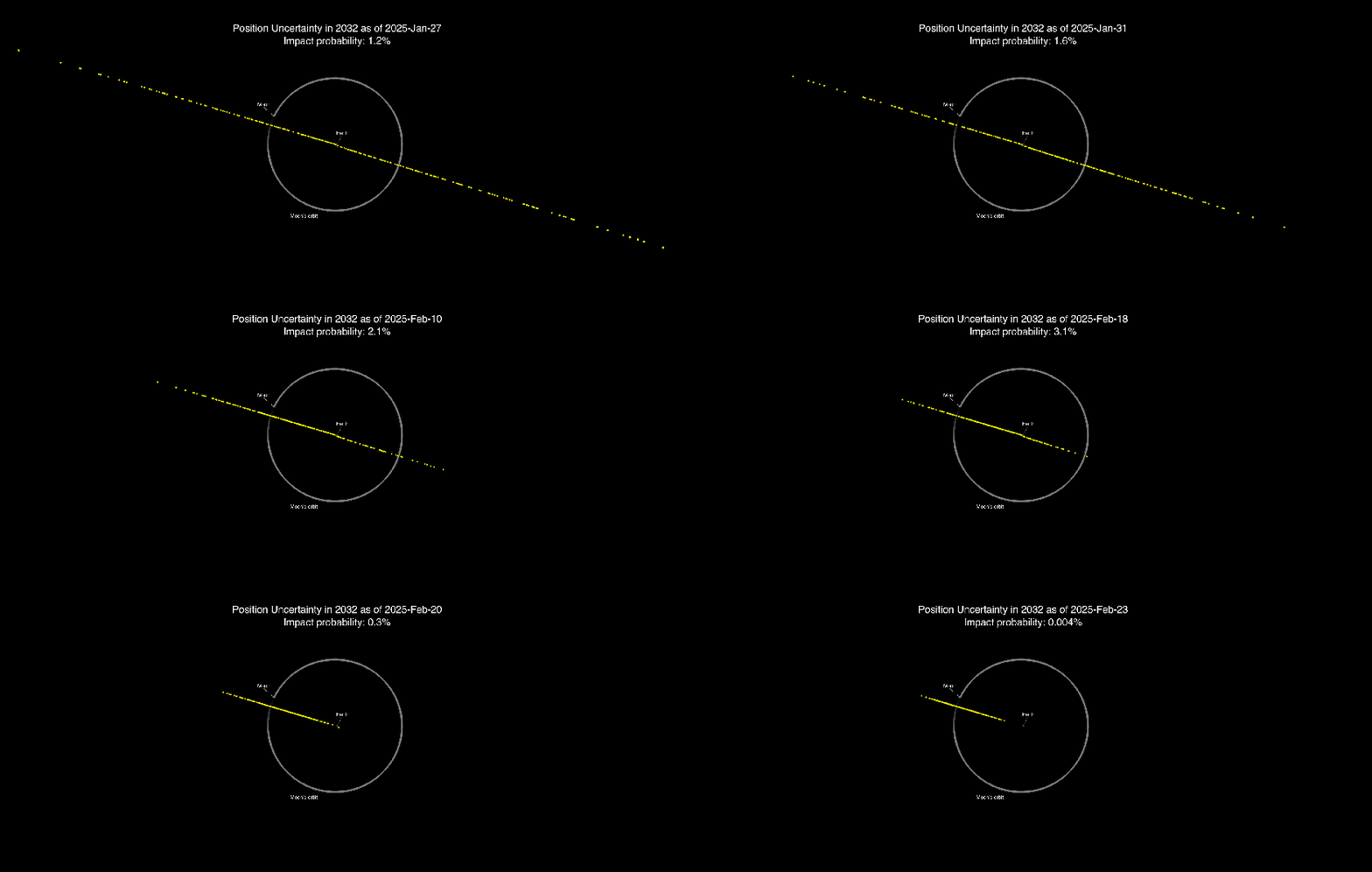
How did asteroid 2024 YR4 go from being the riskiest asteroid ever detected to posing no real threat? First spotted in December 2024, its impact risk initially soared to 2.8%, surpassing previous record-holder Apophis. But thanks to refined observations from our Near-Earth Object Coordination Centre and other institutions, its risk quickly dropped to just 0.001% within days. This dramatic shift follows a well-known pattern—asteroid impact probabilities often rise before plummeting as more data becomes available. Now, nearly all possible impact scenarios have been ruled out, and 2024 YR4 has been safely removed from our risk list.
Democrats can now call the Donald Trump-Republican budget bill a "disgusting abomination" and they’d be quoting Elon Musk every time they do it, says MSNBC’s Lawrence O’Donnell. Now that the budget bill is in the Senate, Lawrence explains that Republican senators are now able to stop the bill or risk Musk funding an opponent in their reelection campaign to the Senate next year.
When I read or heard speculation on when, not if, Donald "Hoover Cleveland" Trump and Elon Musk would have a falling out, the assumption would be that Hoover Cleveland would initiate it. Nope. I guess Musk is the bigger prima donna. Surprise! What's not a surprise is that Musk is doing the right thing for the wrong reasons. What Musk wants will probably make the final result crueler, not kinder.
Elon Musk issued a blistering criticism of the massive Republican bill for President Donald Trump’s agenda Tuesday, posting on X that it is a "disgusting abomination." "I’m sorry, but I just can’t stand it anymore," Musk wrote. "This massive, outrageous, pork-filled Congressional spending bill is a disgusting abomination. The Morning Joe panel discusses.
MSNBC quoted Axios's reporting, which listed four reasons for Musk opposing the budget bill, none of which involve increasing the deficit, and all of which harm him, or at least make him look and feel bad.
That's a wrap for today's topical post. Stay tuned for the next installment in my coverage of the News & Doc Emmy Awards tomorrow, when I plan on examining The Sixth and the rest of the nominees for Outstanding Politics and Government Documentary.
You’ve heard about asteroid 2024 YR4 and we’ve heard your questions — so let’s talk about it. What are the chances it’ll hit Earth? Why do those odds keep changing? And should you be worried? (Spoiler alert: No). Get the facts from a NASA expert and learn how we track asteroids, update predictions, and keep an eye on the skies.
NASA has significantly lowered the risk of near-Earth asteroid 2024 YR4 as an impact threat to Earth for the foreseeable future. When first discovered, asteroid 2024 YR4 had a very small, but notable chance of impacting our planet in 2032. As observations of the asteroid continued to be submitted to the Minor Planet Center, experts at NASA Jet Propulsion Laboratory’s (JPL’s) Center for Near-Earth Object Studies were able to calculate more precise models of the asteroid’s trajectory and now have updated its impact probability on Dec. 22, 2032 to only 0.004% and found there is no significant potential for this asteroid to impact our planet for the next century. The latest observations have further reduced the uncertainty of its future trajectory, and the range of possible locations the asteroid could be on Dec. 22, 2032, has moved farther away from the Earth.
Astronomers using the Gemini South Telescope and W. M. Keck Observatory have determined the shape and origin of asteroid 2024 YR4. It now has a 'few percent' chance of impacting the moon after it was determined that it will most likely not hit Earth, according to NOIR Lab.
As my regular readers might note, no Sunday entertainment feature or highlights of last night's Saturday Night Live today. The blog passed its page view goals for April on Sunday night, so I'll be posting evergreen and holiday content through the end of the month. Stay tuned.
The Artemis II mission, slated to launch early 2026, will fly four astronauts around the Moon. This mission will last for about 10 days and will be the first crewed test flight of the Space Launch System rocket, the Orion spacecraft, and the Exploration Ground Systems at NASA’s Kennedy Space Center Florida needed to support them.
Not only will this mission be the first time in over 50 years that human beings have seen the Moon close-up, Artemis II will also prepare us for future human landings on the Moon starting with the Artemis III mission and help prepare for future missions to Mars.
“We know how to live and work in low Earth orbit. Now, it’s time to go further.” Gateway, humanity’s first lunar space station, will advance science and exploration on and around the Moon as part of NASA’s Artemis campaign. Gateway will also help NASA and its partners test the technologies and operations essential for a sustained presence in deep space, laying the groundwork for the first human mission to Mars. This video brings together insights from the “Houston We Have a Podcast” miniseries on Gateway, “Lunar Space Station 101,” where NASA leaders and astronauts discuss how Gateway will shape the future of space exploration.
Voices featured: NASA astronaut Randy Bresnik, deputy director for NASA's Exploration Operations Office Stephanie Dudley, ESA astronaut Luca Parmitano, and NASA’s Lunar Architecture Lead Shatel Bhakta.
I'm looking forward to Gateway as well. Two space stations, at least as long as the ISS remains in orbit!
From the volcanic fields of Arizona to the lunar-like landscape of Iceland, NASA scientists are actively preparing astronauts and mission support teams for conducting science on the Moon.
Learn about NASA’s rich history of geology training and hear how scientists and engineers are getting ready to bring back samples that will help us learn about the origins of our solar system.
I'm a geologist as well as a paleontologist, so I find this video not just professionally interesting, but thrilling. May it come to pass!
Preparing to orbit and do science on the Moon, investigating how solar wind interacts with Mars, and demonstrating quiet supersonic flight are just a FEW of the milestones we have planned for 2025.
Much of this continues what NASA did in 2024, but that's a good thing. It's also what I'm least worried about with the incoming administration. As I wrote in 2016, "space policy is the one area where Trump might actually be good for the country." I also wrote "It's like hoping for the alternative history in The Man in the High Castle to happen just so there could be commercial SSTs by the early 1960s...The cost would be too high." I fear the cost might be higher this time.
In 1975, 10 European countries came together with a vision to collaborate on key space activities: science and astronomy, launch capabilities and space applications: the European Space Agency, ESA, was born.
In 2025, we mark half a century of joint European achievement – filled with firsts and breakthroughs in science, exploration and technology, and the space infrastructure and economy that power Europe today.
During the past five decades ESA has grown, developing ever bolder and bigger projects and adding more Member States, with Slovenia joining as the latest full Member State in January.
We’ll also celebrate the 50th anniversary of ESA’s Estrack network, 30 years of satellite navigation in Europe and 20 years since ESA launched the first demonstration satellite Giove-A which laid the foundation for the EU’s own satnav constellation Galileo. Other notable celebrations are the 20th anniversary of ESA’s Business Incubation Centres, or BICs, and the 30th year in space for SOHO, the joint ESA and NASA Solar and Heliospheric Observatory.
"In 2025, ESA looks ahead to a busy and exciting year." So do I. To paraphrase what I wrote last year and the year before, here's to 2025 being another great year in space.
Find out more about the NASA missions mentioned in this 2024 year-end highlight video by taking a deep dive with these resources.
The GreatAmericanEclipse wasn't a breakthrough, so Science Magazine didn't cover it, but it was a big science story, and I'm pleased that NASA included it in their year-end summary. It also showed up in NASA Johnson's Space to Ground: 2024.
2024 on the International Space Station was a year filled with excitement, challenges, and milestones as we mark 25 unbroken years of humans living, working, and flying in humanity's home in low-earth orbit.
Seeing the umbra from above added a spectacular dimension to the event!
Controllers have confirmed NASA’s mission to “touch” the Sun survived its record-breaking closest approach to the solar surface on Dec. 24, 2024.
Breaking its previous record by flying just 3.8 million miles above the surface of the Sun, NASA’s Parker Solar Probe hurtled through the solar atmosphere at a blazing 430,000 miles per hour — faster than any human-made object has ever moved. A beacon tone received in the late evening hours of Dec. 26 confirmed the spacecraft had made it through the encounter safely and is operating normally.
This pass, the first of more to come at this distance, allows the spacecraft to conduct unrivaled scientific measurements with the potential to change our understanding of the Sun.
NASA's year in review came out just a little too early to include this feat of science and engineering.
Follow over the jump for space news from both inside and outside the U.S., although the Russian space agency Roscosmos played a supporting role in the ISS highlights.
Aboard the International Space Station, NASA astronauts Suni Williams, Nick Hague, Butch Wilmore, and Don Pettit wish a merry Christmas and a happy holiday season to Earth in a message recorded on Dec. 23, 2024.
The four astronauts are in the middle of a long-duration mission living and working aboard the microgravity laboratory. The goal of their mission is to advance scientific knowledge and demonstrate new technologies for future human and robotic exploration missions as part of NASA’s Moon and Mars exploration approach, including lunar missions through NASA’s Artemis program.
And Merry Christmas to all at NASA along with all my readers!
Large asteroids have struck Earth in the past and they will in the future. Learn about Asteroid Day, a movement that recognizes research on the dangers of Near-Earth Asteroids.
I think that's the most complete story of the origin of Asteroid Day I can remember watching since I started observing it in 2016, which means I learned something new. Any day I learn something new is a good day!
Astronomy Magazine's video mentioned the asteroid that killed off the non-avian dinosaurs 66 million years ago, so I'm using that as an opportunity to have BBC Earth Science ask and answer What Exactly Killed The Dinosaurs?
Since the 1980s, scientists have believed that the main culprit for the dinosaur extinction was an asteroid. It came from the far reaches of the solar system, and was the size of Mount Everest.
I'm a paleontologist and attended graduate school when geologists debated and eventually accepted the asteroid strike as the cause of the terminal Cretaceous mass extinction, so this shaped my ideas about asteroid impacts. I don't particularly want humanity to go the way of the non-avian dinosaurs!
In September 2023, scientists with NASA’s OSIRIS-REx mission will gather in the Utah desert for the arrival of the largest asteroid sample ever received on Earth. “Asteroid City” actors, including Scarlett Johansson, Jason Schwartzman, Maya Hawke, Rupert Friend, Jake Ryan and Jeffrey Wright, join NASA OSIRIS-REx sample expert Dr. Danny Glavin to discuss how studying the asteroid sample will give scientists insight into how the early solar system formed and how life began on Earth.
After a seven-year round trip journey that included mapping Bennu’s surface (a near-Earth asteroid that is no threat to our planet), identifying minerals and chemicals, and collecting a sample from the surface, OSIRIS-REx is on its way back to Earth with more than eight ounces of material.
I have two things to say about Asteroid City. First, why this it here instead of Barbie? Second, the only thing it could win in this field is a game of "one of these things is not like the others."
I now have a third; I enjoyed the cast in this promotional video, although I think they did a better job of increasing the visibility of OSIRIS-REx than promoting the movie. Darn. Speaking of the asteroid return mission, it was one of the first missions shown in 2023 in space from NASA, ESA, Reuters, and PBS NewsHour. I'm looking forward to 2024 in space already.
That's a wrap for June's blogging. Stay tuned for Canada Day to begin July.
A Boeing spacecraft carrying two NASA astronauts is on its historic maiden voyage. The landmark launch kicked off the first crewed test flight of the capsule and marked the culmination of a long and trying development process.
Boeing’s Starliner mission has safely docked with the International Space Station after navigating new issues that cropped up overnight en route to the orbiting laboratory. CNN's Kristin Fisher reports.
Not only am I happy that Starliner successfully docked with the ISS, I'm glad for the astronauts and cosmonauts on the station that they'll be able to recycle their water. I often jokingly gross out my environmental science students by calling water recycling "toilet-to-tap," but in this case it's not only justified, but necessary.
SpaceX achieved a new milestone with its mega Starship rocket, after both the booster and the spacecraft made controlled returns to Earth.
I watched the re-entry live and was amazed that Starship successfully splashed down after one of its flight control surfaces burned through but remained attached. Like the proverbial honey badger, the spaceship didn't seem to care!
China’s Chang’e lunar probe has taken off from the far side of the moon to return back to earth, according to China’s national space agency. If China successfully makes it back to earth, it will be the first country to have gathered samples from the far side of the moon. China’s previous lunar mission, Chang’e 5, gathered samples from the near side of the moon, but collecting samples from the far side has required additional technical know-how as well as operating on more challenging terrain. According to the China National Space Administration (CNSA), Chang’e 6 “withstood the test of high temperature on the far side of the moon."
We have a space race!
I expect to report more on the return to the Moon on Moon Day and recap these missions in this year's edition of 2023 in space. In the meantime, stay tuned for WorldOceansDay.
Will an asteroid ever hit Earth? There are no known impact threats, but tiny meteors burn up in Earth’s atmosphere all the time! NASA asteroid expert Dr. Kelly Fast tells us more. Learn more about NASA’s planetary defense efforts: nasa.gov/planetarydefense
When was the last time an asteroid hit Earth? Small asteroids and other tiny particles bombard our planet daily, but almost all of them burn up safely in the atmosphere. Bigger impacts are extremely rare, but scientists like Marina Brozovic are keeping their eyes on the sky.
Is NASA aware of any Earth-threatening asteroids? Luckily there are no known asteroid threats to Earth for at least 100 years. But that doesn’t mean we’re not looking. Asteroid expert Davide Farnocchia of our@NASAJPL breaks it down.
Does NASA know about ALL the asteroids? We know about the vast majority of larger ones and none of those pose a threat, but space is big, so we're always on the lookout. NASA asteroid expert Dr. Amy Mainzer explains.
The answer is no, not yet, but NASA is working on it.
There are no known threats to Earth, but NASA asteroid expert Dr. Kelly Fast says it’s important to find the asteroids before they find us. That’s why NASA’s Planetary Defense Coordination Office keeps its eyes on the skies.
At 1:47 a.m. EST (6:47 UTC) on Nov. 16, 2022, NASA’s Orion spacecraft launched atop the SLS (Space Launch System) rocket from historic Launch Pad 39B at NASA’s Kennedy Space Center in Florida on a path to the Moon, officially beginning the Artemis I mission.
Over the course of 25.5 days, Orion performed two lunar flybys, coming within 80 miles (129 kilometers) of the lunar surface. At its farthest distance during the mission, Orion traveled nearly 270,000 miles (435,000 kilometers) from our home planet. On Dec. 11, 2022, NASA’s Orion spacecraft successfully completed a parachute-assisted splashdown in the Pacific Ocean at 9:40 a.m. PST (12:40 p.m. EST) as the final major milestone of the Artemis I mission.
Artemis I set new performance records, exceeded efficiency expectations, and established new safety baselines for humans in deep space. This is a prelude to what comes next—following the success of Artemis I, human beings will fly around the Moon on Artemis II.
We have demonstrated our ability to go farther and faster than ever before, opening the door to explore Mars and other destinations throughout the solar system. This is the story of Artemis I.
The Artemis II mission will not happen by this year's NationalMoonDay, but there will be more preparations and there are other Moon missions, so I will have something to blog about.
NASA hosted a news conference from the Johnson Space Center in Houston April 3, 2024, to announce the companies selected to move forward in the development of the Lunar Terrain Vehicle under the LTVS (Lunar Terrain Vehicle Services) contract. The award leverages NASA’s expertise in developing and operating these next generation "Moon buggies" to build commercial capabilities that support scientific discovery and long-term human exploration on the Moon. NASA intends to begin using the LTV for crewed operations during the Artemis V mission on the surface of the Moon.
Artemis V is a long ways off. SpaceX will have to develop a landing vehicle and NASA will have to test it first for Artemis III.
On March 14, 2024, Starship successfully lifted off at 8:25 a.m. CT from Starbase in Texas and went on to accomplish several major milestones and firsts.
Starship's six second stage Raptor engines all started successfully and powered the vehicle to its expected orbit, becoming the first Starship to complete its full-duration ascent burn. Starship went on to experience its first ever entry from space, providing valuable data on heating and vehicle control during hypersonic reentry. Live views of entry were made possible by Starlink terminals operating on Starship.
This rapid iterative development approach has been the basis for all of SpaceX’s major innovative advancements, including Falcon, Dragon, and Starlink. Recursive improvement is essential as we work to build a fully reusable transportation system capable of carrying both crew and cargo to Earth orbit, help humanity return to the Moon, and ultimately travel to Mars and beyond.
SpaceX's powerful Starship system spent roughly an hour in orbit performing test maneuvers for the first time ever. But two simultaneous communications errors means the rocket won't be recoverable.
SpaceX's Starship rocket just reached orbit for the very first time, but now it's gotten lost upon reentry.
...
After conducting a number of maneuvers during the spacecraft's hour-long flight in orbit, mission control reportedly lost contact with Starship as it reentered Earth's atmosphere somewhere over the Indian Ocean.
Starship likely broke up or exploded over the ocean, SpaceX confirmed.
"The team has made the call that the ship has been lost, so no splashdown today," Dan Huot, SpaceX's communications manager, said during the company's livestream of the launch. "But again, just it's incredible to see how much further we got this time around."
Here's to the fourth launch being a complete success from start to finish.
That's a wrap for Yuri's Night, when I celebrate the promise of space. Now stay tuned for Apophis Day, when I report on the perils of space.
During the Cold War, competition between the the United States and the former USSR was fierce, as the two countries rallied for the chance to make history by getting to the moon first. In 1959, the Soviet Union beat the U.S. to become the first nation to reach the surface of the moon with its Luna 2 spacecraft. But, the United States was the first country to put man on the moon in 1969, and to this day is still the only nation to have landed people on the moon. To date, only five nations, the U.S., Russia, China, Japan and India, have completed a successful soft landing on the moon. But bolstered by evidence of the presence of water and other natural resources, many more nations and private companies are now seeking to get to the moon. And whoever is able to establish a significant lunar presence first could have big implications on Earth as well as the cosmos.
I'm glad that Joe Biden's Administration publicly supports the continuation of the Trump Administration's plans for space exploration. As I wrote five years ago and repeated the next year, "space policy is the one area where Trump might actually be good for the country" and "Trump's plan is actually not a bad idea." I was worried that the Biden Administration would dump the one Trump policy I supported along with all the ones I couldn't stand. I'm relieved that they didn't.
File this under "even a stuck clock is right twice a day" and Donald Trump is definitely a stuck clock.
CNN's Christiane Amanpour speaks with NASA deputy administrator Pamela Melroy about the potential that space could be the next platform for war between nations.
Fortunately, Pamela Melroy thinks the answer is no. However, I wonder if she would get the same answer from a high-ranking officer of Space Force. Now I'm tempted to leave that as a suggestion in a comment to the video.
That's it for today's space update. Stay tuned for the highlights of tonight's Saturday Night Live tomorrow.