A blog about societal, cultural, and civilizational collapse, and how to stave it off or survive it. Named after the legendary character "Crazy Eddie" in Larry Niven and Jerry Pournelle's "The Mote in God's Eye." Expect news and views about culture, politics, economics, technology, and science fiction.
Atomic scientists set their 'Doomsday Clock' closer than ever to midnight, citing aggressive behavior by nuclear powers Russia, China and the US, fraying nuclear arms control, conflicts in Ukraine and the Middle East and AI worries among factors driving risks for global disaster.
Since 2012, the Doomsday Clock time has either shifted closer to midnight or stayed the same.
In 2012, the Clock was moved to 5 minutes to midnight.
In 2015, it was moved to 3 minutes.
In 2017, it was moved to 2 ½ minutes.
In 2018, it was moved to 2 minutes.
In 2020, it was moved to 100 seconds.
In 2023, it was moved to 90 seconds.
Last year, it was moved to 89 seconds.
Today, it was moved to 85 seconds to midnight.
Leading experts who study existential risks believe humanity is the closest it has ever been to global catastrophe.
In the Doomsday Clock statement, the Bulletin’s Science and Security Board (SASB) releases side bars on each of the threats the Clock reflects—nuclear risk, climate change, disruptive technologies, and biological threats.
Across the board, excerpts from the SASB’s statement reflect a world that is failing to combat the most consequential threats humanity faces.
From the acceleration of a renewed nuclear arms race to the rise of nationalistic autocracies around the world, 2025 was an exceedingly dangerous year.
But what many don’t realize is that the Doomsday Clock can turn—and has turned—backwards. Eight times, to be exact.
Whether it does so again is up to humanity’s ability to learn from the past and to dedicate our time, effort, and resources to building a future where people can live free from the danger of existential threats.
In the Clock statement, the SASB notes that “national leaders–particularly those in the United States, Russia, and China–must take the lead in finding a path away from the brink” and that “citizens must insist they do so.”
Until that happens…
IT IS 85 SECONDS TO MIDNIGHT.
Those are all the time changes since I began writing this blog in 2011. On the one hand, yay, we've survived this long! On the other, the steady movement of the hands of the clock to midnight since 2012 is depressing and alarming. It's certainly not scaring the people now in power into behaving better.
That's a wrap for today's post. Stay tuned for another brief entry worth sharing next month, which begins Sunday.
Find out more about the NASA missions mentioned in this 2024 year-end highlight video by taking a deep dive with these resources.
The GreatAmericanEclipse wasn't a breakthrough, so Science Magazine didn't cover it, but it was a big science story, and I'm pleased that NASA included it in their year-end summary. It also showed up in NASA Johnson's Space to Ground: 2024.
2024 on the International Space Station was a year filled with excitement, challenges, and milestones as we mark 25 unbroken years of humans living, working, and flying in humanity's home in low-earth orbit.
Seeing the umbra from above added a spectacular dimension to the event!
Controllers have confirmed NASA’s mission to “touch” the Sun survived its record-breaking closest approach to the solar surface on Dec. 24, 2024.
Breaking its previous record by flying just 3.8 million miles above the surface of the Sun, NASA’s Parker Solar Probe hurtled through the solar atmosphere at a blazing 430,000 miles per hour — faster than any human-made object has ever moved. A beacon tone received in the late evening hours of Dec. 26 confirmed the spacecraft had made it through the encounter safely and is operating normally.
This pass, the first of more to come at this distance, allows the spacecraft to conduct unrivaled scientific measurements with the potential to change our understanding of the Sun.
NASA's year in review came out just a little too early to include this feat of science and engineering.
Follow over the jump for space news from both inside and outside the U.S., although the Russian space agency Roscosmos played a supporting role in the ISS highlights.
Juneteenth, also known as Emancipation Day, is observed on June 19 each year. It became a U.S. federal holiday in 2021, following the signing of a bill by President Joe Biden[.]
President Joe Biden signed legislation marking Juneteenth, a day commemorating the end of slavery in the United States, as a federal holiday.
The president signed the Juneteenth National Independence Day Act at 3:30 p.m. on June 17 in the East Room of the White House. Biden and Vice President Kamala Harris also gave remarks on the passage of the bill and the significance of the holiday.
That's a good overview of the holiday as of 2021 with an even better preview image, one so colorful that I originally placed it first.
An historian explains the history and significance of the holiday.
...
Note: This video was previously titled, "Juneteenth, explained." The title has been changed to better reflect the video's content.
When American schoolchildren learn about chattel slavery in the US, we’re often told it ended with Abraham Lincoln’s signature on the Emancipation Proclamation of 1863.
But, as late as June 19, 1865, enslaved people in Texas were still held in bondage. On that date, the Federal troops entered the state and began to punish slave holders and former confederates who refused to obey the law.
“Juneteenth is a deeply emotional moment for enslaved people,” says historian Karlos K. Hill, of the University of Oklahoma.
In Texas and across the country, emancipated African Americans began celebrating annually, with parades, concerts, and picnics. “Being able to go wherever they want and being able to wander about; for enslaved people, it was an expression of their freedom,” says Hill. “Formerly enslaved people celebrating, in public, their newfound freedom, was an act of resistance.”
However, by 1877, the Federal government had largely abandoned the South. The lynching era— when hundreds of African Americans were killed by white mobs each year across the North and the South— began soon after.
Today, Dr. Hill says, commemorating Juneteenth is important for all Americans because it helps us see all the ways that slavery still shapes this country, including, as he says, “the desire to master and dominate black bodies.”
As much as I like Vox's videos, I'm surprised I haven't embedded this one in one of my previous posts. It was about time I did.
NASA’s mission is to explore the unknown in air and space, innovate for the benefit of humanity, and inspire the world through discovery. NASA showed the world that anything is possible in 2023.
That was fun and inspiring, but not as informative as the usual This Year @NASA video. I'm turning to the European Space Agency's 2023: ESA’s year in space for something comparable to what I was hoping for from NASA.
2023’s highlight was the highly anticipated launch of Juice, Europe’s Jupiter Icy Moon Explorer. The Juice spacecraft was placed on course to Jupiter on the second-to-last Ariane 5 launch vehicle in April. After an eight-year journey, Juice will begin observing the giant gas planet and its three large ocean-bearing moons – Ganymede, Calisto and Europa.
I learned a lot from that video and, as I'm fond of writing, it's always a good day when I learn something new.
This year brought incredible discoveries as humanity ventured further into space than ever before.
PBS NewsHour science correspondent Miles O’Brien joins digital video producer Casey Kuhn to talk about those discoveries including the "hum of the universe," the James Webb Space Telescope, and the OSIRIS-REx mission to the asteroid Bennu.
With just hours until the busiest online shopping day of the year, consumers are readying for one more chance to find deep discounts. NBC News’ Brian Cheung has more on the countdown to Cyber Monday deals after a slow start to the season’s brick-and-mortar sales.
Sales up 2.5% over last year looks good until one hears that the increase is due to inflation, not more purchases. Sigh. As Reuters reported in US shoppers hold out for Cyber Monday bargains, consumers responded by holding out for better deals today.
Holiday shoppers in the US are seeking out the best deals and strategically nabbing the deepest discounts ahead of Cyber Monday, according to data from retailer websites aggregated by third parties.
The holiday shopping season is in full swing in the U.S, and consumers are making headlines with their strategic pursuit of the best deals. Black friday saw a remarkable surge in online spending, hitting a staggering $16.4 billion in the U.S. We now gear up for the pinnacle of cyber monday, where a $12 billion e-commerce record is anticipated.
That would be a record, at least in nominal sales. Whether that would be a record in real retail sales remains to be seen.
The bill to suspend the $31.4 trillion debt limit made it through the House of Representatives. The legislation now goes to the Senate, which must enact it and get it to President Joe Biden's desk by June 5 to avoid a crippling US default.
Play up the victory while you can, Pickled Tongue. This isn't the great win you think it is.
The final House vote was 314 to 117, with 149 Republicans and 165 Democrats supporting the measure. In a potentially worrisome sign for the House Republican speaker, Kevin McCarthy, 71 members of his conference opposed the deal that he brokered with President Joe Biden.
...
However, the concessions that McCarthy won fell far short for members of the freedom caucus, who had pushed for steeper spending cuts and much stricter work requirements for benefits programs. They belittled the debt ceiling compromise as a paltry effort to tackle the nation’s debt, which stands at more than $31tn.
...
House freedom caucus members staged one last attempt to block the debt ceiling bill from advancing on Wednesday afternoon, when they opposed a procedural motion prior to the final vote. With 29 Republicans voting against the motion, McCarthy had to rely on Democratic assistance to advance the debt ceiling proposal. In the end, 52 Democrats voted for the motion, setting up the final vote and virtually ensuring the bill’s passage.
Both the support and the opposition were bipartisan, although more Democrats supported the compromise than Republicans. Just the same, the Democrats held their noses to vote yes.
Despite his sharp criticism of McCarthy and his Republican colleagues, Jeffries and the majority of the House Democratic caucus supported the debt ceiling bill. Although they lamented the spending cuts included in the bill, those Democrats argued the crucial importance of avoiding a default outweighed their personal concerns about the legislation.
“Our constitution makes perfectly clear the validity of the public debt of the United States shall not be questioned,” said California representative Nancy Pelosi, the former Democratic House speaker. “While I find this legislation objectionable, it will avert an unprecedented default, which would bring devastation to America’s families.”
But dozens of progressive lawmakers opposed the bill, attacking the spending cuts and new work requirements procured by McCarthy as an affront to the voters who elected them.
“Republicans never cared about reducing the deficit, only about forcing through their anti-working family policy priorities under the threat of a catastrophic default,” said Pramila Jayapal, chair of the Congressional Progressive Caucus. “The deal they passed tonight proves that point, and I could not be part of their extortion scheme.”
Progressives in the Senate, including Senator Bernie Sanders, have echoed that criticism and indicated they plan to oppose the debt ceiling proposal, but the bill still appears likely to become law. The Senate Democratic majority leader, Senator Chuck Schumer of New York, has pledged to act swiftly to take up the bill once it has passed the House. The Senate Republican minority leader, Senator Mitch McConnell of Kentucky, has already indicated he plans to support the proposal as well.
Senator Tim Kaine talks with Alex Wagner about his objection to the inclusion of Mountain Valley Pipeline in the debt ceiling deal and his intention to remove that portion of the bill with an amendment when it comes to the Senate for consideration. While that piece of the deal is seen as a political concession to Joe Manchin, Kaine expresses particular frustration at not being consulted despite the pipeline affecting portions of his state, Virginia.
I don't like the pipeline, either, but I don't think Kaine's attempt to remove it from the bill will succeed. Every Republican plus Joe Manchin will vote against his amendment. If one more Senator joins them, it will fail. If they don't, I expect Vice President Kamala Harris will vote against it, breaking the tie, and it will still fail. After that happens, I also expect Kaine to vote yes on it, and it will go to President Biden to be signed. Crisis averted!
That written, I think this is the 2023 version of 2011's Satan Sandwich. I know it's necessary, but I don't have to like it.
The Doomsday Clock, a symbolic tracker that represents the likelihood of human-made destruction, was updated Tuesday to 90 seconds to midnight—the closest to global catastrophe it’s ever been. It was the first time the clock had been updated since Russia invaded Ukraine on Feb. 24.
Atomic scientists set the 'Doomsday Clock' in 2023 to 90 seconds to midnight – closer than ever before to the threat of complete annihilation of humanity. But what is the Doomsday Clock?
Scientists revealed that the "Doomsday Clock" has been moved up to 90 seconds before midnight — the closest humanity has ever been to armageddon.
Here are past evaluations of how close we are to the end of the world.
The clock has been at 100 seconds to midnight since 2020, so moving the hands ten seconds closer is a big deal and bad news. I wish I could say I am surprised, but between the Russianinvasion of Ukraine and 2022 being the fifth-warmest year on record, demonstrating that climatechange remains a threat, the situation has become more dangerous. While the Reuters video showed clips related to the pandemic, I don't think it factored much into the decision to move the hands closer to midnight. On the other hand, artificial intelligence, depicted as a Boston Dynamics robot "dog" instead of the AI art and writing that is making news, may be causing more anxiety than I think the technology deserves, although I think I should still blog about the latest developments in mimicking human creativity. Just the same, this is one of the rare times when I use the doom label seriously.
So ends January 2023's blogging. Stay tuned for the first post of February.
The last eight years were also the eight warmest recorded.
Since 2021 was the sixth warmest year on record, that means the planet has continued to warm despite last year's continuing La Niña. Even more alarming was that the past eight years have been the eight warmest years on record. Yikes!
NOAA Administrator Rick Spinrad joins ABC News Live to discuss the agency’s new climate report, which concludes 2022 was the third-costliest year for the U.S., among other alarming findings.
In 2022, we launched our mega Moon rocket for the first time – sending the uncrewed Orion spacecraft around the Moon, we kicked off a new era in astronomy with record-breaking new imagery from the Webb Space Telescope, we moved an asteroid in humanity’s first ever planetary defense demonstration and much more. Here’s a look back at those and other things we did, this year @NASA!
This video shows that some of NASA's most important, if less spectacular, work takes place on Earth, not up in space.
Follow over the jump for videos from ESA, Reuters, and SciShow Space.
The world's population has hit eight billion, just 11 years after passing the seven-billion milestone, the United Nations has said.
After a big surge in the middle of the 20th Century, population growth is already slowing down.
It could take 15 years to reach nine billion and the UN doesn't expect to reach 10 billion until 2080.
It's hard to calculate the number of people in the world accurately, and the UN admits its sums could be out by a year or two.
This is very much the message I tell my students about the history and likely future of population growth and its effects on people and the planet. I might just replace the National Geographic video I embedded in both A video gift from a student and Student sustainability video festival 5: previous years' winners I currently have in my lectures with this one, although it lacks the infographics introducing the topics of health, water, and energy (even though the energy stat it cites for energy use was already out of date when the video was produced) that set up the rest of the course. Still, welcome to blogging as professional development.
The BBC video mentioned India's population passing China's, lower fertility rates, an aging population, and strains on infrastructure. All of those are the subjects of Cities under strain as world population hits 8 billion from Reuters.
As the world population touches the 8 billion mark this week, countries like India, the second-most populous country in the world, are faced with the challenges - from creating suitable infrastructure to creating a skilled workforce from the country's youth.
I tell my students that the world is becoming increasingly urbanized at the same time that population is increasing, so population problems will show up as urban problems. India's situation is a perfect example of this. I might add this video to my lectures on population as well. Again, welcome to blogging as professional development.
Another trip around the Sun means another opportunity to celebrate Asteroid Day! On this June 30, let's look at the space rock discoveries made within the last year. Here's a quick recap of the asteroids added to our tracking catalogue in the last 12 months.
That's exactly the kind of summary of asteroid discoveries along with exactly the preview image I want for this entry. Thank you, Science Museum of Virginia! For that, I've now subscribed to your YouTube channel.
NASA’s DART spacecraft began a 10-month journey into space on a mission to demonstrate the world's first planetary defense system. It is designed to deflect an asteroid from a potential doomsday collision with Earth[.]
This is the mission that I featured the past two Asteroid Days and the past two ApophisDays. It's also the mission I'm featuring today that will return its results first. Watch for my post on them, as early as this September or as late as the year in space in December.
Follow over the jump for two more asteroid missions.
Since 1967, the Florida land housing Disney’s theme parks has been governed by the company, allowing it to manage Walt Disney World with little red tape. WSJ’s Robbie Whelan explains the special tax district that a Florida bill would eliminate.
Florida Governor Ron DeSantis signed a bill that strips Disney of self-governing authority at its Orlando-area parks in retaliation for its opposition to a new law that limits the teaching of LGBTQ issues in schools.
Not only did Reuters explain what led up to the revocation of the Reedy Creek Improvement District, but it also showed the spectacle of the right-wing protests of Disney at one of the entrances to the complex. That was one of the things I found surreal.
Orange County, Florida, tax collector Scott Randolph goes through the fallout of Gov. Ron DeSantis' move to dissolve Disney's special self-governing status.
What a mess! Not only did CNN report on the effects of the repeal on services and taxes, it also mentioned the other actions DeSantis wanted passed during the special session, a congressional district map that disenfranchised African-American voters and a repeal of a provision of an anti-censorship bill that exempted Disney — two legislative acts of revenge on the Mouse, not just one! In the bigger picture, the apparent violations of state and federal law in passing the maps that DeSantis wanted over those passed by the Florida Legislature, which he vetoed, are the most important of all of them, but I'm not surprised that attacking Disney got more attention. As I first wrote in 2011, "America is quite clear about its screwed up priorities. My experience has convinced me that the surest way to get Americans to act is to mess with their entertainment." Retaliating against Disney in ways that might affect its ability to provide services for its guests has at least the appearance and maybe even the reality of messing with Americans' entertainment. This might not end well for DeSantis.
Another reason for the attention this story has attracted is its "man bites dog" aspect. Aren't Republicans supposed to be the business-friendly party? Well, they were, but this split has been building for a decade since I wrote about how Newt Gingrich threw big business under the bus while campaigning against Mitt Romney. Ten years later, the rift betweenRepublicans andbig business has opened up wide enough for everyone to see. Who knows? Maybe the Republican Party or at least DeSantis will fall into it. Break out the popcorn.
2021 was the busiest year yet for NASA in low-Earth orbit, we also made progress preparing for a flight test around the Moon, and had a very active year exploring space, studying Earth, testing technologies for next generation aircraft, and much more. Here’s a look back at those and other things we did this year at NASA.
Congratulations to NASA, including on the successful launch of the James Webb Space Telescope, which occurred after the U.S. space agency uploaded this video. I plan on writing an entry about it next year, but I'm moving on to NASA's partner in this and other missions, the European Space Agency (ESA), which uploaded their own summary of their year in space, ESA highlights 2021.
We’re almost ready to say goodbye to 2021, a year in which ESA once more succeeded in continuing operations in a challenging global situation, and creating some important milestones in the field of European spaceflight. As always, ESA has been at the forefront of science, with several science missions en route to their destinations or being prepared for flight, such as BepiColombo, Solar Orbiter, JUICE and ExoMars, and not least rounding off the year with the impending launch of the James Webb Space Telescope. Europe’s Copernicus programme continues to be the largest Earth observation system in the world, and ESA is even preparing more Earth observation missions. In 2021, ESA astronaut Thomas Pesquet carried out his Alpha mission to the Space Station, and Matthias Maurer began his Cosmic Kiss mission, continuing into 2022. As we said farewell to Prof. Jan Wörner, a new Director General took the helm of ESA and we welcomed Dr Josef Aschbacher with his ambition to accelerate the use of space in Europe. Meanwhile, the latest Vega rocket flight has paved the way for the transition to Vega-C, and the new Ariane 6 launchpad was inaugurated.
In addition, the ESA is also involved in the Orion capsule and Artemis mission to return to the Moon and hopefully go on to Mars, another cooperative venture with NASA. May next year's mission help pave the way.
Organizations and people beyond the western space agencies also made news in space this year. Reuters captured some of that in 2021’s space exploration highlights.
NASA's Mars landing, billionaires in space, first Arab woman astronaut and more – here are some of the highlights in space exploration this year.
COVID-19 has torn a particularly lethal path through the one in 10 Americans with diabetes, including many who never caught the virus. That's because when the pandemic hit, people with the chronic disease were already in worse shape than in years.
If I hadn't kept up my diabetes treatment regimen, I could have been one of these three unfortunate people. Their stories help explain why there have been so many excess deaths not attributable to the disease during the pandemic. They also serve as examples for two of Commoner's Laws: Everything is connected to everything else and there is no free lunch. All of the systems in our body are connected to each other and what we do to or for one system will have effects on the rest. Also, isolating ourselves to protect us from the pandemic comes at a price, which we have to pay one way or another, either in continuing our treatment during the pandemic, which I did, or the death and disability described by Reuters.
The three subjects of the Reuters report suffered indirectly from the pandemic, as they didn't catch the disease. KHOU in Houston reported on the effects of catching COVID-19 on diabetics in Keeping diabetes under control during COVID-19 pandemic last December.
Data show diabetics have more severe cases of COVID-19. Doctors say it's more important than ever to keep your diabetes under control.
My wife mentioned how dexamethazone increases blood glucose just last night, so seeing it being mentioned in this video made an impression. Again, there is no free lunch.
Dr. Philip Orlander described how some COVID-19 patients developed diabetes after their infections. Bloomberg Quicktake: Now described that more fully in Doctors Find That Covid Spurs Diabetes: Study from May 2021.
Among Covid-19’s many ripple effects, the worsening of the global diabetes burden could carry a heavy public-health toll. The underlying mechanisms stoking new-onset diabetes aren’t clear, though some doctors suspect the SARS-CoV-2 virus may damage the pancreas, the gland that makes insulin which is needed to convert blood-sugar into energy. Sedentary lifestyles brought on by lockdowns could also be playing a role, as might late diagnoses after people avoided doctors’ offices. Even some children’s mild coronavirus cases can be followed by the swift onset of diabetes, scientists found.
Yikes! That's a frightening example of "everything is connected to everything else." The more I learn about SARS-CoV-2, the scarier the virus becomes!
State officials released a photo of the dangerous insect attacking a wasp nest, asking residents to keep an eye out and report any sightings to the Washington State Department of Agriculture.
As noted in the comments, it's oddly appropriate that Good Morning America reported this story on Friday the 13th. It certainly was an unlucky day for honeybees in the Pacific Northwest.
The first Asian giant hornet nest of the year has been found in Washington state, and plans are being developed to eradicate it, likely next week, the state's agriculture department said.
The report shows the team from the Washington state Department of Agriculture eradicating a nest of Giant Asian Hornets on FoodDay last year, so they have experience. That's a good thing. As I wrote on World Honey Bee Day last year, "For the sake of the bees, I hope Chris Looney and the people who work with him at the Washington state Department of Agriculture succeed in preventing 'murder hornets' from becoming established. Bees have enough problems."
Regular commenter Cleto Safari di Moderna posted a link to The Daily Beast's story about the return of "murder hornets" and asked "I wonder if the 'Killer Bees' would resist the 'Murder Hornets' more effectively than other honeybees?" I couldn't resist answering his question.
Take it from this zoologist, the answer is no. Africanized bees might put up a more aggressive defense of their colony than non-Africanized bees, but it won't be enough as their stings won't be any better at penetrating the Asian Giant Hornet's exoskeleton than any other honeybee. Japanese honeybees know better; they cook the hornets instead.
Watch Hornets from Hell by National Geographic to see that in action.
Japanese giant hornets pack a venomous sting so strong it can dissolve human tissue. But when a hornet scout enters a beehive, watch as the bees turn the tables on their enemy — and literally bake the predator to death!
As Cleto Safari di Moderna responded to my answer, "Mmm...hornet teriyaki..."
Biden’s chief medical adviser discusses the staggering number of lives lost due to the pandemic and how the country will get its vaccine distribution back on track after weather delays.
I agree with Dr. Fauci. I would be very pleasantly surprised if the U.S. achieves herd immunity by April. I think we'll need to keep the rate of vaccinations up until everyone who wants the vaccine gets both doses. As I wrote last week, I expect that will take until the end of July.
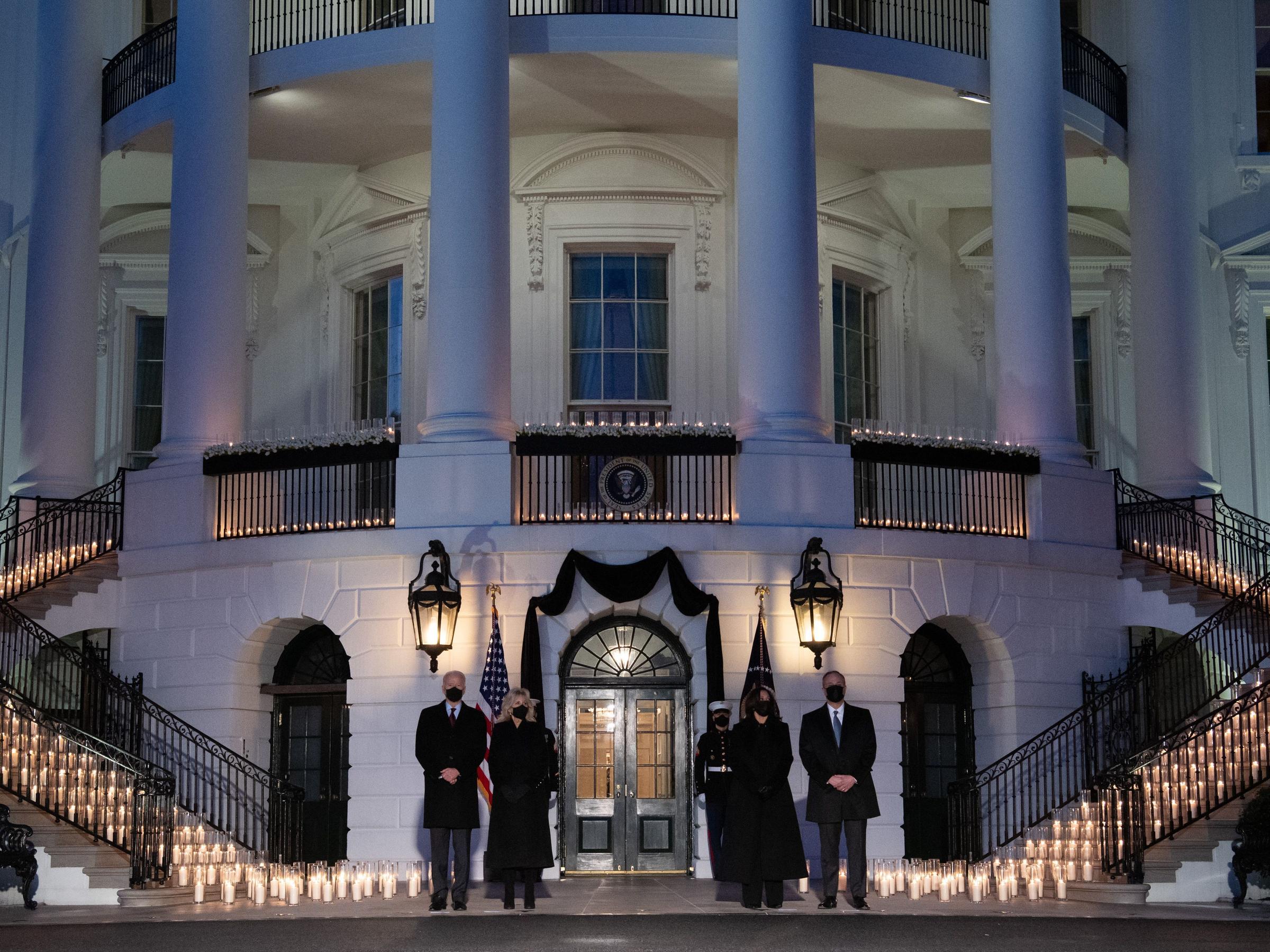
President Joe Biden and Vice President Kamala Harris hold a moment of silence and candle lighting ceremony for the 500,000 Americans dead from COVID-19.
...
The U.S. once again crossed a somber COVID threshold much faster than any country in the world.
Less than a year after the coronavirus outbreak was declared a pandemic, the U.S. recorded its 500,000th death Monday, according to the Johns Hopkins University dashboard. That’s more than twice the COVID-19 fatalities registered in Brazil, which ranks second on the list.
President Joe Biden will hold a moment of silence and a candle-lighting service Monday evening at the White House to mark the enormous loss of life.
The endless hours of toiling amid death and suffering have taken a heavy toll on health care workers, who are exhausted and frustrated with those who won’t follow public health guidelines aimed at curbing transmission of the virus.
The National Rifle Association filed for bankruptcy, a sudden development that could help the gun rights group escape a lawsuit by New York's attorney general seeking its dissolution.
This is not all good news from the perspective of fighting gun violence and the effects of big money in politics, which I'll get to later, but it is a setback for an organization that epitomizes the influence of both gun culture and big money in U.S. politics. As for the NRA calling New York State "corrupt," I think it's projecting, something that the next two videos will show. Instead, I will say that New York State in the person of Attorney General Letitia James is hostile to the NRA, not that I disapprove.
Speaking of the next two videos, both show that the problems that led the NRA to declare bankruptcy have been brewing for years, beginning with CNBC's report How The NRA Ended Up On The Verge Of Bankruptcy from August 2019.
The NRA is mired in controversy. With about 5 million members as of July 2019, the NRA is one of the most powerful special interest groups in the U.S. But, claims of financial wrong doing have led to multiple investigations in Congress and in New York State that are threatening the groups survival. And, while the group did have some money problems in the past, 2016 proved to be a devastating blow to its finances. The NRA reported a staggering $46 million loss.
New York State and the federal government have been sniffing around the NRA and its finances for years. CNBC could see that could be a threat to the organization, one that finally resulted in yesterday's strategic bankruptcy. On the other hand, the bigger the threat, the stronger the NRA's revenues become, as gun sales, memberships, and donations all increase after mass shootings and elections of Democratic Presidents. I expect that will happen again with the election of Joe Biden and Kamala Harris, which is one of the reasons why the NRA's bankruptcy doesn't mean the end of the organization.
As an aside, I left the following in a comment to the video, although I added in the hyperlinks here.
I misread the misspelled sign about defending the Second Amendment at 6:58 as "Second Ammoment." On a whim, I performed a Google search for that phrase and "2nd Ammoment"; Google couldn't find any instances of either. Hey, I came up with something original! From now on, I'm going to say that the NRA is defending American's "Second Ammoment" rights. I hope it catches on."
More recently, Bloomberg Quicktake uploaded How the NRA Shot Itself in the Foot just last November, which also exposes corruption in the NRA.
The National Rifle Association had long been known as one of the most powerful lobbying groups in America. But at the peak of its power, this well-funded ally of the Republican Party has found itself besieged by scandal and legal challenges that could permanently change how it operates.
After starting off very similarly to the CNBC report, Bloomberg's video went into more depth about the structure of the NRA and reported on the recent challenges the NRA has been facing since the CNBC mini-documentary. It also took a more hostile tone, but I think that comes from the top, as Michael Bloomberg has made fighting gun violence one of his major issues. All of those are reasons why I decided to include this video, despite the duplication with CNBC's report.
By the way, the protestors at the NRA news conference after Sandy Hook were from Code Pink, which started off as an anti-war movement. I'm glad to see that they are working against all kinds of violence, especially since they are one of Coffee Party USA's partners. Maybe I should see what they have to say about the NRA's bankruptcy.
Finally, I did say that "this is not all good news from the perspective of fighting gun violence and the effects of big money in politics" later, so it's time for a reaction from The Young Turks, NRA Goes Bankrupt But Don't Get Too Excited Yet.
The NRA has filed for bankruptcy, but the news is complicated. John Iadarola, Ken Klippenstein, and Jordan Uhl discuss on The Young Turks.
The NRA may be finished as a non-profit operating in New York, but I think it will survive and even thrive in Texas when all is said and done. Still, I'll take the small victory.
That's it for a week of serious news. Stay tuned for the Sunday entertainment feature, when I plan on writing about the winners of the Critics Choice Super Awards.
The U.S. House of Representatives overwhelmingly backed a $740 billion defense policy bill that President Trump has pledged to veto, heading toward a confrontation with the Republican president weeks before he is to leave office.
In 1996, in 47 USC 230 (Section 230), Congress said that websites aren’t liable for third party content, even if the third party violates state criminal law.
As much as I find [Kevin] Bollaert’s activities reprehensible, I agree with Goldman. Section 230 of the Communications Decency Act will likely protect him from the harassment and privacy violations, and they should. Then again, I have a dog in this fight, as I’ve been a beneficiary of the third-party protections of the Communications Decency Act. They helped me, and I don’t want them eroded for anyone else, even scum like Ballaert.
That's as much as I have written about the issue in the ten years of the blog. I think that part of federal statute deserves more explanation. Fortunately, Vox uploaded How '90s porn led to the internet's foundational law just last week.
Section 230, explained
In a collaboration with Retro Report, Open Sourced by Vox looks at how today's heated political arguments over censorship and disinformation online began with a 26-word snippet of a law known as Section 230. Both Democrats and Republicans want it changed, but what would that mean for the future of the Internet?
Trump wants to repeal Section 230 so that Twitter and Facebook can't flag his posts, which he considers censorship. Personally, I think that concept of censorship is kooky, but that's not the worst of it. As the Vox video describes, changing that part of the law could cause chaos on the internet, where a lot of commerce happens, to say nothing of free expression like mine. Any change would have to require a lot of thought and care so that companies have protection so long as they exercise responsible and reasonable moderation. Unfortunately, one side of the aisle wants even less moderation. Consequently, I don't think Congress will come up with a solution if the two sides don't agree on the problem. Sigh.
I may have more on this debate, if only to cover the Senate passing the NDAA and Trump deciding whether to follow through on his veto threat. In the meantime, stay tuned for NobelPrizeDay.
Has JCPenney been saved? In this week's episode of Retail Archaeology we take a look at a closing JCPenney at the El Con Center (formerly the El Con Mall) in Tucson, AZ. The El Con Mall is a long dead mall and this JCPenney location is the last part of it that still exists.
A U.S. judge approved a deal that will allow J.C. Penney to emerge from bankruptcy before the upcoming holiday season. The rescue deal is expected to save approximately 60,000 jobs[.]
That's good news, although I share Erik's concerns about whether the mall owners will do the same for other department store chains and if deals like this will make malls and department stores sink together. Only time will tell.
Retail analyst Anthony Chukumba says malls will have to learn to adapt or suffer permanent closures. With the convenience of Amazon, Etsy, and online shopping, mall owners are being forced to get creative. Frank Holland joins Shep Smith to discuss the struggles that face American malls.
When I did the math, 1000 malls minus 25% is 750 malls. That means that the number of malls in the U.S. will be half of the 1,500 in 2012 by 2025. Wow! Looks like I will be busy writing about the retail apocalypse for years to come.
That's it for this year's Black Friday/Buy Nothing Day. Stay tuned for Small BusinessSaturday.
Utah's governor is placing the state under a mask mandate, and now there are concerns about celebrations in the streets and on sports fields. ABC's Alex Presha reports.
The United States became the first nation worldwide since the pandemic began to surpass 10 million coronavirus infections, according to a Reuters tally on Sunday, as the third wave of the COVID-19 virus surges across the nation.
The grim milestone came on the same day as global coronavirus cases exceeded 50 million.
The United states has reported about a million cases in the past 10 days, the highest rate of infections since the nation reported its first novel coronavirus case in Washington state 293 days ago.
The country reported a record 131,420 COVID-19 cases on Saturday and has reported over 100,000 infections five times in the past seven days, according to a Reuters tally.
The U.S. latest reported seven-day average of 105,600 daily cases, ramped up by at least 29%, is more than the combined average for India and France, two of the worst affected countries in Asia and Europe.
More than 237,000 Americans have died of COVID-19 since the illness caused by the coronavirus first emerged in China late last year.
Dr. Richard Besser weighs in on Pfizer's newly announced two-shot vaccine, possible efficacy and production as COVID cases surge in the U.S.
Next summer or fall? That means that my response to my favorite supermarket checker's question "when do [you] think things will return to normal?" as "spring of next year, when a vaccine becomes available" was too optimistic. I wasn't being pessimistic enough!
As multiple states see a rise in COVID-19 cases, hospitalizations and deaths, Cuomo weighs in on what President-elect Biden can do with his coronavirus plan.
Governor Cuomo thinks it's good news-bad news as well, but the bad news is different. He's not confident that the Trump Administration's plan to distribute the vaccine will be sufficient. Based on Trump's handling of the pandemic, I agree. However, if the vaccine is ready for distribution in the summer, then it will be the Biden Administration overseeing it, which I have more confidence in. With Joe Biden creating a COVID-19 task force already, that looks good. Watch COVID-19 task force announced as Biden plans transition to White House from Euronews about that news.
President-elect Joe Biden says dealing with the pandemic will be his top priority - a move backed by the head of the World Health Organization.
I wish Biden luck with this. Not only does he need it, we the American people do, too!