A blog about societal, cultural, and civilizational collapse, and how to stave it off or survive it. Named after the legendary character "Crazy Eddie" in Larry Niven and Jerry Pournelle's "The Mote in God's Eye." Expect news and views about culture, politics, economics, technology, and science fiction.
Markets to offset carbon emissions are now worth about $2 billion annually, and supporters say they're a key tool to address climate change. But carbon credits have also been criticized for being opaque and not reducing emissions nearly enough. Stephanie Sy reports on an effort to boost the integrity of carbon markets and open them up to small landowners. It’s part of our series, Tipping Point.
Carbon offset markets that actually are effective and include a major carbon reservoir — good news!
More than half of the continental U.S. is facing drought conditions. But other parts of the country are facing the opposite problem. Extreme weather conditions can have major impacts on farmers and their crops at a time when they're already facing high production costs. Paul Solman recently traveled to southern Georgia to hear from some of those farmers. It's for our series, Tipping Point.
And the "Godzilla" El Niño is likely to make the situation even worse, if it isn't already.
That's a wrap for today's brief educational entry. Stay tuned for more Emmy Awards coverage tomorrow.
Slight change of plans from yesterday, when I wrote, "I'll probably examine Hurricane Katrina: Race Against Time tomorrow." I decided to highlight the other nominee about Hurricane Katrina, Katrina: Come Hell and High Water, which leads the nominees for Outstanding Social Issue Documentary with three nominations, including Outstanding Direction: Documentary and Outstanding Editing: Documentary in addition to Outstanding Social Issue Documentary. It's followed by The Ride Ahead with two nominations, then Born Poor, Enigma, and Searching for Amani with just this one category nomination. I'm sharing the trailers in that order, beginning with Katrina: Come Hell and High Water | Official Trailer | Netflix.
This is the story of a brutal coastal hurricane turned cataclysmic through human error and neglect. Over the course of a gripping and emotional three episodes, the people of New Orleans recount their past, extoll their present and lean into the future of what they and their beloved city survived and have become 20 years later. The series sets the stage for a tragedy - whose man-made elements expose the systemic governmental neglect that led to the city being defenseless in the face of the storm - and Katrina’s devastating impact that changed New Orleans irreparably. Detailed, harrowing and triumphant first-person accounts and never before seen archive illustrate the magnitude of Katrina, the aftermath of the levees breaking and the bungled recovery.
Katrina was a foreseeable disaster. I remember listening to an NPR story a year or more before Katrina hit explaining how New Orleans' levees were only built to withstand a category three hurricane, so they would fail under a category four or five storm, and describing what would likely happen if — when — one struck. It did. It also mentioned in passing that, while being poor is hard, New Orleans was probably the easiest city to be poor in. Katrina took that away. I've been recommending Hurricane Katrina: Race Against Time to my students. Now I can recommend Katrina: Come Hell and High Water to them, too. Welcome to blogging as professional development.
What does adulthood look like when the world isn’t built for your body?
In THE RIDE AHEAD, Samuel Habib is ready for independence as he turns 21—but every rite of passage is complicated by ableist systems and physical barriers. Facing seizures, inaccessible housing, and degrading encounters, he sets out to find community and answers.
With humor, honesty, and a deep commitment to disability justice, Samuel travels across the U.S. to meet activists and role models who help him reimagine what freedom, adulthood, and love can look like.
A coming-of-age story rooted in interdependence, dignity, and the power of community.
As soon as I read the video description, I thought of Crip Camp: A Disability Revolution. Sure enough, the trailer advertises that the co-director of Crip Camp is involved, as is Judith Heumann, who won Most Compelling Living Subject of a Documentary at the Critics Choice Documentary Awards. The trailer also features some of the animation in the movie, which shows me it deserves its second nomination for Outstanding Graphic Design: Documentary.
Meet Brittany, Johnny and Kaylie, whose journeys — filmed across 14 years — are at the heart of the new documentary "Born Poor." Watch the prologue now.
This journalism is made possible by viewers like you. Support your local PBS station here: https://www.pbs.org/donate
The 90-minute documentary "Born Poor" premieres Tues., Oct. 7, 2025 on @frontline's YouTube channel, in the PBS App, at pbs.org/frontline and on PBS stations. The film follows these three kids from three families across three chapters of their lives — from childhood through the teen years to young adulthood — and offers a powerful, personal and longitudinal look at the realities of growing up in poverty in the U.S.
“Born Poor” is a FRONTLINE production with True Vision Productions. The director is Jezza Neumann. The producers are Jezza Neumann and Lauren Mucciolo. The senior producer is Frank Koughan. The editor-in-chief and executive producer of FRONTLINE is Raney Aronson-Rath.
This looked familiar, but I probably am misremembering FRONTLINE's "Two American Families: 1991-2024," nominated in this category last year. FRONTLINE does good work examining poverty and society.
A thirteen-year-old aspiring journalist investigates his father’s mysterious murder within the boundaries of one of Kenya’s largest wildlife conservancies. As a ravaging drought encroaches, his quest to find the killer shifts and an activist is born as the collateral damage of a warming world is revealed.
Looks like I found another movie I can recommend to my students. Again, welcome to blogging as professional development, even if I'm only planning on teaching one more semester, which begins Monday.
Now to examine the other nominations for Katrina: Come Hell and High Water and The Ride Ahead.
Outstanding Editing: Documentary
Cover-Up Netflix [Plan B | Netflix | Praxis Films] Folktales Loki Films [Fifth Season | Impact Partners | Topic Studios] Katrina: Come Hell and High Water Netflix [Netflix | Message Pictures] Life After Multitude Films | PBS [ITVS] Love + War Little Monster Films [National Geographic] 2000 Meters to Andriivka FRONTLINE FEATURES | PBS [Associated Press] Thoughts & Prayers HBO Documentary Films [Tony Tina] The White House Effect Actual Films | Netflix [Netflix | The Department of Motion Pictures]
I think 2000 Meters to Andriivka is the favorite, if only because it's the only nominee also nominated for Best Editing at the Critics Choice Documentary Awards and I suspect 2000 Meters to Andriivka might sweep its categories.
Sally should just be happy to be nominated in this category. 2000 Meters to Andriivka has six nominations, including Best Documentary. Life After has four, also including Best Documentary, as does The Stringer. Katrina: Come Hell and High Water and Vietnam: The War That Changed America both tied Sally with three. Apocalypse in the Tropics and Music Box: It's Never Over, Jeff Buckley have just this one. Out of this field, 2000 Meters to Andriivka is my provisional favorite.
Outstanding Graphic Design: Documentary
Antidote/Kill List
FRONTLINE FEATURES | PBS [Passion Pictures | Bellingcat] The Gilgo Beach Killer: House of Secrets
Texas Crew Productions [Peacock Original | New York Post Entertainment | G Unit Film & Television, Inc.] The Ride Ahead
LikeRightNow Films Titanic: The Digital Resurrection
Atlantic Productions [National Geographic] Underdogs
Wildstar Films [Maximum Effort | National Geographic] In Waves and War
Studio AKA [Netflix | Actual Films]
This is likely to be Underdogs' best shot to win, but it faces a tough competitor in Titanic: The Digital Resurrection. Either way, National Geographic would win.
The Ride Ahead's animation looks impressive and fun and it advances the narrative well, so I wouldn't count it out.
I found an entry about Hurricane Katrina among the most read during the 15th year of Crazy Eddie's Motie News, so I'm featuring it and another from the back catalog at the intersection of entertainment, climatechange and extremeweather over the jump.
2022 winner Love on the Spectrum leads with five nominations, followed by defending winner Welcome to Wrexham with three, 2021 winner RuPaul's Drag Race: Untucked with two, and newcomers America's Sweethearts: Dallas Cowboys Cheerleaders and The Secret Lives of Mormon Wives with just this one. That's pretty much the order that Gold Derby predicts for the nominees. Half of the experts, 85.7% of the editors, and 77.4% of the users have chosen Love on the Spectrum to walk off the stage with the statuette. The other half of the experts, including Joyce Eng, 14.3% of the editors, and 12.8% of the users expect two-time winner Welcome to Wrexham will repeat. RuPaul's Drag Race: Untucked has the support of 6.8% of users, while long shots The Secret Lives of Mormon Wives and America's Sweethearts: Dallas Cowboys Cheerleaders currently have the votes of 2.2% and 0.8% of users, respectively.
The search for true love continues as newcomers and returning favorites navigate the ups and downs of dating on the autism spectrum.
This is sweet. It is also shot, edited, and scored more like a documentary than a reality show, which shows the fine line between nonfiction and unstructured reality, a line crossed by United Shades of America with W. Kamau Bell in 2023, where Bell found the competition stiffer.
RuPaul’s Drag Race Live Untucked captures what really happens behind the curtain of the hottest show on the Las Vegas Strip. Premieres April 16 on WOW Presents Plus: https://hubs.la/Q03dBxBM0
Welcome to Vegas, baby! Set at the iconic Flamingo Las Vegas, Season 2 of the outrageous, 6-part docu-series stars Drag Race legends: Bosco, Derrick Barry, Kennedy Davenport, Latrice Royale, Lawrence Chaney, Mirage, and Nymphia Wind[.]
Starring Taylor Frankie Paul, Demi Engemann, Jennifer Affleck, Jessi Ngatikaura, Layla Taylor, Mayci Neeley, Mikayla Mathews and Whitney Leavitt.
The scandalous world of a group of Mormon mom influencers implodes when they get caught in the midst of a swinging sex scandal that makes international headlines. Now, their sisterhood is shaken to its core. Faith, friendships, and reputations are all on the line. Will #MomTok be able to survive and continue to give the rulebook a run for its money, or will this group fall from grace?
I'll sum up our reaction by quoting what I wrote in 2016, "My family roots for the U, not the Y!" My nephew even attends the University of Utah. Also, this show gives me another reason to be suspicious of TikTok.
Perfection isn't always perfect. With unfiltered access to the auditions, training camp and full NFL season, this is the Dallas Cowboys Cheerleaders like you've never seen them before. AMERICA'S SWEETHEARTS: Dallas Cowboys Cheerleaders premieres June 20th only on Netflix.
I was wondering if this is connected to Cheer and it is. That's a good sign, although it won't be enough for the show to win this year.
Follow over the jump for the rest of the nominations these shows earned.
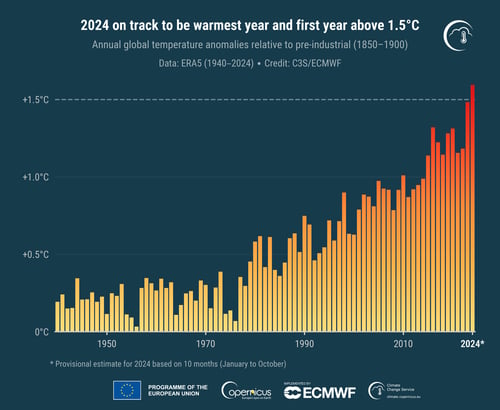
In 2024, billions of people across the world faced climatic conditions that broke record after record: logging ever more highs for heat, floods, storms, fire and drought. As the year drew to a close, the conclusion was both blatant and bleak: 2024 was the hottest year since records began, according to European climate scientists. Story by Alice Brogat, Axelle Simon and Eliza Herbert.
1. Chasing Ice opens with a montage of natural disasters. Name three of them.
The three that come to mind are floods, fires, and droughts. All of those, along with dangerous heatwaves and stronger hurricanes and tropical cyclones, appear in this report. For what it's worth, those are also among the possible answers to a question I ask about Treasures of the Earth:Power: "What are the expected effects of global warming? List three examples." Back to Chasing Ice.
2. How many of the past 20 years, as of 2012, were the hottest on record?
As of 2012, 16 were the hottest on record. According to the image below, it looks like it's now 17, as 1998, 2002, and 2003 fall outside the past 20 years, although the past ten years remain the hottest decade on record.
2024 has been a landmark year for climate change, with record-breaking heat and extreme weather events dominating the globe. From the Sahara’s rare floods to the Arctic’s rapid melting, the planet is feeling the heat. But there’s hope too—renewable energy is booming, and conservation efforts are gaining momentum. Join us as we reflect on the highs and lows of a tumultuous year.
Good news that I can share with my students, but not nearly enough to inspire me to post ProfessorFarnsworth. Still, welcome to blogging as professional development.
So far, this season's 18 named storms, including 11 hurricanes and 5 major hurricanes, have borne out NOAA's 'Most Aggressive Hurricane Season Forecast On Record' for 2024, which predicted 17–25 named storms, 8–13 hurricanes, and 4–7 major hurricanes. I might revisit this and other forecasts next month. Stay tuned.
There's been no change since I wrote this, so I think ABC News's report suffices.
It's early enough that I might post an entry about the year's best TV shows today. Stay tuned to see if I do, followed by the overall year in review for New Year's Eve.
Legend has it that if he sees his shadow then winter will continue for another six weeks but if Punxsutawney Phil does not see his shadow spring will come early.
Woody the Woodchuck made her prediction for the season during the Howell Nature Center’s annual Groundhog Day Celebration on Friday, Feb. 2, 2024.
Woody saw her shadow and was scared back into her den. Rep. Elissa Slotkin was on hand with a proclamation from Congress thanking the Howell Nature Center for it's work for the community.
Woody the Woodchuck, Michigan’s official groundhog who resides at the Howell Nature Center, began forecasting the weather in 1999. Since then, those at the center say she’s had a nearly 70% accuracy rate in her predictions.
This is one of the reasons I pay attention to Woody as well as Phil. Another is that her predictions are for Michigan, where I live, which could have entirely different weather than Pennsylvania, so both animals could be right.
Speaking of Phil, MLive had this to say.
Although he has a much longer track record, Punxsutawney Phil, on average, has only gotten his prediction right 30% of the time in the past 10 years, according to the National Oceanic and Atmospheric Administration’s National Centers for Environmental Information.
“It’s nice to be able to rave that we’re better than Punxsutawney,” Tina Bruce, Howell Nature Center CEO, said. “I just think Woody does a much better job for her residents and her state.”
This year, Phil did not see his shadow from his home in Gobbler’s Knob in Punxsutawney, Pennsylvania meaning he thinks spring is coming early.
While the staff at the Howell Nature Center are actually observing Woody's behavior, I suspect the handlers at Gobbler's Knob are checking the long-range forecast instead. Follow over the jump for NOAA's U.S. climate outlook for February 2024.
I'm in the middle of giving and grading final exams, so I'm posting an entry light on analysis. Watch two videos from PBS Terra on geoengineering, a topic I first explored here in Greenfinger eleven years ago. I begin with the more recent, Geoengineering: The Riskiest Way to Save the Planet.
How do we reduce the impact of climate change, and could geoengineering be the solution? Host Sinead Bovell is joined by sci-fi writer Kim Stanley Robinson and other experts to examine the goal of Global Net Zero Emissions, direct air capture strategies, and why geoengineering is a risky strategy – that may be our only hope.
Kim Stanley Robinson is right about the risks of geoengineering. Geoengineering gone wrong is the premise of Snowpiercer, both the movie and TVshow, after all. He's also right about uncontrolled climate change. Life will persist, but humanity would be clobbered. That's exactly what I tell my students.
This episode of Weathered explores the controversial world of solar geoengineering by injecting sulfate aerosols into the stratosphere, looking at both the controversial promises and profound risks associated with manipulating the Earth's climate. Luke Iseman, the founder of Make Sunsets, tells us about his start up that is already releasing small amounts of sulfur dioxide into our skies. And then we speak with leading scientists from the non-use initiative against solar geoengineering or solar radiation management who warn against the potential dangers of this untested technology. Then we discuss the tragic drought and famine of the 1980s in the Sahel region of Africa and and its likely link to air pollution from the US and Europe. This episode sheds light on the intricate balance of our planet's weather and climate, and the human interventions that could change it forever.
Speaking of stories I tell my students, Mt. Pinatubo is another I include in my lectures. I actually prayed for a milder summer in 1992. Because of the eruption, I got one and regretted it. File that under "be careful what you wish for, you might get it."
Host Pete Davidson takes a moment to speak on the crisis in the Middle East.
I've been avoiding this crisis; some things are too horrible even for me to write about on my doomer blog. They're too horrible for SNL to make jokes about it, either, although not so horrible that they can't tell stories related to it. Note that Weekend Update: Middle East Crisis, Trump Calls Hezbollah “Very Smart” opened with jokes about the reactions to the crisis, not the conflict itself. Those are worth ridiculing.
Weekend Update anchors Colin Jost and Michael Che tackle the week’s biggest news, like Congressman George Santos getting hit with new Federal charges.
The former guy really does like the worst people. Speaking of the worst people, I think it's valid to mention Senator Bob Menendez right after George Santos. I haven't cared for Menendez since his previous run-in with the law, so I think he deserves the mockery.
University of Colorado Boulder football coach Deion Sanders (Kenan Thompson) stops by Weekend Update to discuss his team and career.
I'm enough of a Michigan fan to be pleased to hear my school listed among the undefeated. I'm surprised that the Air Force Academy, which I applied to but was rejected, is also undefeated. That means that Sanders is not even coaching the best college team in his new state. On a more serious note, I'm glad SNL suggested some charities to donate to alleviate the suffering caused by war.
I got one response on the blog's Facebook page for World Croc Day, so take it away National Day Calendar!
Every year on June 17th, World Croc Day highlights the plight of endangered crocodiles. The day also encourages learning more about these amazing reptiles.
...
Crocodiles are easily confused with alligators. There are some differences between the two, however. The primary difference is the shape of their snout. The crocodile’s snout forms a long, pointed V-lie shape. Alligators’ snouts, on the other hand, are more rounded and u-shaped. In addition, crocodiles are usually much larger than alligators. The average alligator weighs about 500 pounds. Crocodiles can reach up to 2,200 pounds! This reptile is also much more aggressive than alligators, which makes them more dangerous.
Crocodiles can be found in nearly every corner of the world. These reptiles are native to both the North and South American continents. They are also found in Africa, Australia, and Asia, but the Florida Everglades is the only place in the world where crocodiles and alligators live together.
I double-checked this distribution fact and found it to be true. The only other place it could happen is along the northernmost stretch of the Mexican Gulf Coast, but there appears to be no overlap between American Alligators and Morelet's Crocodiles there.
Back to National Day Calendar.
There are lots more to learn about crocs, too!
Of all the animals in the world, the crocodile’s bite is the strongest.
There are 15 different species of crocodiles.
Crocodiles can live in both freshwater and saltwater.
They eat fish, birds, and other animals.
Crocodiles can live to be 100, with the oldest crocodile in the world reaching 140.
There is a concern that some species of reptiles are on their way to extinction. Human activity is the primary reason for this. Hunting, pollution, and destroyed habitats are a few reasons crocodiles are endangered.
...
Every year zoos around the world participate in World Croc Day. The largest event is held at The Belize Zoo and Tropical Education Center. Events at the zoo include “croc talks,” crocodile exhibits, face painting, arts & crafts, cool croc encounters, educational seminars, and photo ops.
I found two videos from United States zoos and animal parks celebrating World Croc(odile) Day and both feature feeding time. The first shows the Memphis Zoo celebrating World Crocodile Day.
To celebrate World Crocodile Day, we are taking you behind-the-scenes on the thrilling feedings of our Nile Crocodiles, including Skebanga, the largest Nile Crocodile in North America. You can see them get fed every Saturday at 12:30 PM in Zambezi!
Seeing the crocodiles lunge out of the water is pretty sensational and demonstrates the animal's power.
Today we are celebrating World Croc Day with the biggest Nile Crocodile at Gatorland! Lyle the Nile Crocodile with a little help from our good friends at OmargoshTV! Get ready for some gigantic Nile Crocodile Crunchiness!
One can see the contrast in snout shape between Lyle the Nile Crocodile and the American Aliigators that share his habitat. One can also hear and see the difference in tone between the Memphis Zoo, a public institution dedicated to education and conservation, and Gatorland, a privately owned theme park, which has entertainment at least as high a priority as education and conservation. Still, watching this video made me interested in visiting, which means it's a success.
Sea turtles have graced the oceans for millions of years, evolving resilience to countless challenges. But the dawn of the Anthropocene has brought newer, deadlier threats: millions of tons of plastic, destruction of nesting beaches, light pollution that disorients hatchlings away from the ocean, fishing nets that trap and drown turtles, and boat-propellers that sever their flippers and crack their carapaces. Current estimates suggest that only one in 1,000 to 10,000 hatchlings survive to reach breeding age.
By improving our solid waste management systems, making our fisheries wildlife-friendly, protecting nesting beaches, and reducing our dependence on plastics, we can give these graceful animals a fighting chance at survival, and improve the health of the oceans.
We are all responsible, and our choices can make a big difference.
Every year on June 16th, World Sea Turtle Day highlights the importance of sea turtles. The day also encourages global supporters to dive into the threats that sea turtles face.
...
Did you know that sea turtles have been on the earth for over 100 million years? This means that sea turtles co-existed with dinosaurs. There are seven species of sea turtles. These include green, hawksbill, Kemp’s ridley, leatherback, loggerhead, and the Olive ridley. Of these species of sea turtles, the leatherback is the largest. The leatherback sea turtle weighs anywhere from 550 to 2,000 pounds! This type of sea turtle grows up to six feet in length. Sea turtles live in both cool and warm waters throughout the world. However, the flatback can only be found in Australia.
Sea Turtle Facts
Sea turtles can live between 50 to 100 years.
Some sea turtles travel more than 1,000 miles to return to their nesting ground.
Sea turtles nest multiple times, about two weeks apart, and lay up to 125 eggs per nest.
Most sea turtles nest at night, except for the Kemp’s ridley.
Leatherback sea turtles can dive nearly 4,000 feet into the water.
Unlike other kinds of turtles, sea turtles cannot retreat into their shell.
A large group of nesting sea turtles is called an “arribadas”, which is Spanish for “arrival.”
One more interesting fact is that the temperature of the nest determines the sea turtle’s sex. Male hatchlings are born in cooler temperatures. When temperatures in the next are warm it produces female hatchlings. Fluctuating temperatures produce a mix of male and female baby sea turtles.
Unfortunately, nearly every species of sea turtle is considered endangered. The hawksbills and Kemp’s ridley are both critically endangered. Entanglement in marine debris, destruction of habitats, and poaching for meat and eggs are among the top reasons for their endangerment.
...
In the year 2000, turtle conservation organizations came together to create World Sea Turtle Day. June 16th was chosen to honor the birthday of Dr. Archie Carr, a renowned sea turtle conservationist. Dr. Carr also founded the Sea Turtle Conservancy in Gainesville, Florida.
The University of Florida’s world-renowned sea turtle expert Archie Carr paved the way for sea turtle conservation. For over 30 years, his students have carried on his legacy at the Archie Carr Center for Sea Turtle Research on the UF campus. Now, as sea turtles face modern threats like climate change, a new generation of students are fighting for solutions.
I feel smarter having watched both videos and read National Day Calendar's page. I hope my readers do, too.
I'll return to this and other water stories presently. In the meantime, stay tuned as I continue my celebration of completing another year of blogging and starting another with statistics followed by retrospectives on (Wayback) Wednesdays, (Throwback) Thursdays, (Flashback) Fridays and selected Sundays through the rest of this month and probably all of April.
I'm heartened to see that the western Great Lakes states of Michigan, Minnesota, and Wisconsin, along with Iowa, form the safest region from climate change. Half of the ten safest cities from climate change are in these states. As I wrote the last two times I examined this subject: "I'll take it. It reinforces my feeling that leaving California for Michigan has turned out to be a smart move, literally, the longer I live here." I just wish that the economics were such that people would move here instead of into harm's way. That would make a great subject for another post. Stay tuned.
In a warming world, Michigan stands out as a relative winner. With protection from the Great Lakes, Michigan will be spared from some of the worst effects of climate change, including extreme drought, intensifying hurricanes and wildfires.
Michigan looks increasingly attractive in a country where wildfires turn million-dollar mansions to ash in California, intensifying hurricanes sink homes along Florida’s coasts, and cities like Las Vegas and Phoenix face the alarming reality the Colorado River will no longer sustain them.
This state’s two peninsulas, meanwhile, have ample freshwater – the Great Lakes contain 90% of North America’s supply, lower temperatures, and vast swaths of undeveloped land.
Michigan is a climate haven. MLive's Lindsay Moore explains.
To answer the question MLive asked in both videos — no, literally not "everyone." After all, other states are also climatehavens and they will also receive climate refugees. However, could tens of thousands if not millions move to the Great Lakes State and millions more to other climate havens? Absolutely.
I'm in favor of getting people to move here, both because it's a safer place to live (but not immune from the extremeweather associated with climatechange as the second video mentioned) and because the state has room. Detroit alone lost more than one million people since its 1950 peak and other Michigan citieshave lost people as well, so they alone could take up the slack — that is, if they can become better places to live and work. People moved out of Michigan to seek work, so state and local governments need to work with businesses to promote and create sustainable industries to employ the people who move here and rebuild infrastructure to support them in a warmer and, for Michigan, wetter world. Infrastructure and housingconstruction to accomodate people moving here will provide a lot of jobs by themselves, but that only lasts so long. Ask Las Vegas, for example.
Families explain their stories as they flee climate crises to resettle in Michigan's haven. (Kaytie Boomer, Jacob Hamilton, Sheri McWhirter, Cory Morse, Garret Ellison all with MLive.com)
Note that one family moved to Ann Arbor, a city that I can say from personal experience is already a great place to live and work, and another didn't need to live near work at all, so they could live anywhere. Both of them already had connections to the areas where they relocated, so I expect more of the early wave of migrants will be those already familiar with Michigan. If so, welcome back! Michigan missed you!
Climate Change is increasing the frequency and severity of natural disasters all around the world. And in the United States, more and more people seem to be moving to the places that are projected to be most impacted by climate change, from hazards such as flooding, wildfire, storms, drought and extreme heat; and leaving the most climate-resilient areas. At first glance, this seems like a bizarre and paradoxical trend. So, for this episode of Weathered, we decided to see if we could get to the bottom of it.
We spoke to experts and sifted through lots of data about moving trends and shifting climate patterns to figure out what’s really going on here and what you can do to avoid moving into harm’s way.
While I expected the answer to be one of Florida, the Gulf Coast, or Arizona, all of which are high-risk areas, the answer to the question in the subject line turned out to be Beaufort County, South Carolina. That surprised me, just like Lamoille County, Vermont as the safest place from climate change surprised me. Still, it's enough to discourage me from moving to Arizona or Florida (Texas and Louisiana are not in the cards). On the other hand, I'm heartened to see that the western Great Lakes states of Michigan, Minnesota, and Wisconsin, along with Iowa, form the safest region from climate change. Half of the ten safest cities from climate change are in these states. As I wrote the last two times I examined this subject: "I'll take it. It reinforces my feeling that leaving California for Michigan has turned out to be a smart move, literally, the longer I live here." I just wish that the economics were such that people would move here instead of into harm's way. That would make a great subject for another post. Stay tuned.
The last eight years were also the eight warmest recorded.
Since 2021 was the sixth warmest year on record, that means the planet has continued to warm despite last year's continuing La Niña. Even more alarming was that the past eight years have been the eight warmest years on record. Yikes!
NOAA Administrator Rick Spinrad joins ABC News Live to discuss the agency’s new climate report, which concludes 2022 was the third-costliest year for the U.S., among other alarming findings.
Massive floods have been sweeping the globe lately. British Columbia flood of 2021, Pakistan flood of 2022, Hurricane Ian, New Zealand, Las Vegas, Kentucky, Yellowstone National Park flood, and floods in California are all recent examples of such tragic flooding. And many are blaming climate change. But at the same time, we’re also seeing record lows in rivers and reservoirs all around the world. So what’s really going on here? Is the answer Hadley Cells changing? Is it the moisture capacity of the atmosphere?
In this episode, we try to get to the bottom of this paradox and unravel the role that climate change is truly playing in our increasingly erratic weather and precipitation patterns. We also look at large climatological elements like atmospheric rivers and Hadley cells to see the roles they are playing in these changes. And we look back on the worst flood to ever hit the United States to see what we can learn about our future – the Great Flood of 1862 that submerged much of California, at one point creating a 500 mile lake between Bakersfield and Redding. The California Mega Flood and of course the Las Vegas Flood in 2022.
Each year, flooding kills around 100 Americans and displaces some 75,000 from their homes. And as sea levels rise, storms dump more and more rain, and dams and levees continue aging and increasingly failing, the cost of flooding is increasing in communities all across the country. A recent study shows that, between 1988 and 2017, the average annual cost of flooding in the United States rose by $2.5 billion due to the intensification of precipitation alone. So what do we do?
Well, it’s not an easy question to answer. But there are many innovative solutions that communities are taking, from creating multi-use public green spaces such as parks and football fields that can absorb excess water, to restoring and preserving wetlands. In this episode of Weathered, we also explore cost-effective solutions that you can take to harden your home if you live in a flood prone area.
California is in the grip of a series of dangerous storms, after a week of deadly weather. Some parts of the state saw heavy rain, leading to widespread flooding and landslides, while others were buried in snow.
First responders have had to save several people from quickly rising flood waters, as hundreds of roads transformed into rivers and high winds have torn down structures. Millions have been affected, and it isn't over yet.
Forecasters are warning another atmospheric river of moisture will hit California Monday, bringing what they call a "relentless parade of cyclones" over the next few days.
As severe drought in the West forces states to make drastic water cuts, Las Vegas offers a road map to making the most out of every drop of water. Since 2002, Southern Nevada has cut its Colorado River water use by 26% while its population has grown by 750,000.
The video I embedded in PBS Terra asks 'What Will Life Look Like as MAJOR Rivers Run Dry?' mentioned the water conservation measures Las Vegas was taking before it moved on to more efficient irrigation practices for agriculture, itself an expansion of the policies in Vox asks and answers 'Who's really using up the water in the American West?' I'm glad Las Vegas can serve as good example to Salt Lake City, Phoenix, where my stepdaughter lives, and other cities in the arid and semiarid west and southwest. We could use more good examples. Speaking of which, I might show this to my students as an example of household water conservation. If so, welcome to blogging as professional development.
The Great Salt Lake in Utah is the largest body of water in the western hemisphere without an outlet to the sea. Its levels fluctuate naturally, but scientists say the record-low water levels the lake has seen in recent years are worrying. A megadrought means less precipitation, and a growing population is taking more water before the lake can refill. Stephanie Sy reports.
By the way, this story touches on one of my favorite sayings: "no one, or in this case, no place, is completely useless; it can always be used as a bad example," as well as a story I tell my students about Owens Dry Lake. Here's what Owens Lake looked like before and after its water was diverted.
Striking and an image I should probably add to my lectures. Speaking of which, I show a grayscale version of the following painting, which depicts a steamboat that plied the waters of Owens Lake when it was full of water.
I might replace the grayscale print of this image with this one, although the one I have looks like a photograph, while this is obviously a painting. I'll think about it.
By the way, this is what Owens Lake looks like today.
Yikes! I can see why the residents of greater Salt Lake City don't want this to happen to their lake.
As Utahns look for ways to save the shrinking Great Salt Lake, there are two other salt lakes to our west that we can look to as examples of what to do and what not to do.
I'm glad to see this crisis is prompting more sustainable use of water in Utah.
I have a more positive story about dealing with the drought to share with my readers tomorrow. Stay tuned.
Hint: water scarcity in the Western US has more to do with our diets than our lawns.
...
The Western United States is currently battling the most severe drought in thousands of years. A mix of bad water management policies and manmade climate change has created a situation where water supplies in Western reservoirs are so low, states are being forced to cut their water use.
It’s not hard to find media coverage that focuses on the excesses of residential water use: long showers, swimming pools, lawn watering, at-home car washes. Or in the business sector, like irrigating golf courses or pumping water into hotel fountains in Las Vegas.
But when a team of researchers looked at water use in the West, they uncovered a very different story about where most Western water goes. Their findings may hold the solution to dwindling water supplies in the West.
When I lecture about groundwater in geology and water use in environmental science, I point out that irrigation for agriculture is the number one use of water while showing my students this bar graph.
It takes a lot of water to grow our food, especially in warm, dry climates like the western U.S. The video does such a good job of depicting that I think I'll add it to my lecture.
In a different lecture, I tell my students to reduce meat consumption as part of The Sustainability Dozen. I usually point out how raising animals for meat requires more land than growing crops, increasing environmental impact and potentially reducing the ability to feed a growing population, to say nothing about how beef cattle contribute to climate change. Now I can add water demand to that list. Welcome to blogging as professional development.
The US is hit with floods as Europe faces historic drought
Yikes! That's scary. Good thing Trevor is presenting it as comedy, so I can laugh instead of weeping because I can see the dire message on the hunger stone.
The migratory monarch butterfly (Danaus plexippus plexippus), known for its spectacular annual journey of up to 4,000 kilometres across the Americas, has entered the IUCN Red List of Threatened SpeciesTM as Endangered, threatened by habitat destruction and climate change...
The Endangered migratory monarch butterfly is a subspecies of the monarch butterfly (Danaus plexippus). The native population, known for its migrations from Mexico and California in the winter to summer breeding grounds throughout the United States and Canada, has shrunk by between 22% and 72% over the past decade. Legal and illegal logging and deforestation to make space for agriculture and urban development has already destroyed substantial areas of the butterflies’ winter shelter in Mexico and California, while pesticides and herbicides used in intensive agriculture across the range kill butterflies and milkweed, the host plant that the larvae of the monarch butterfly feed on.
Climate change has significantly impacted the migratory monarch butterfly and is a fast-growing threat; drought limits the growth of milkweed and increases the frequency of catastrophic wildfires, temperature extremes trigger earlier migrations before milkweed is available, while severe weather has killed millions of butterflies.
The western population is at greatest risk of extinction, having declined by an estimated 99.9%, from as many as 10 million to 1,914 butterflies between the 1980s and 2021. The larger eastern population also shrunk by 84% from 1996 to 2014. Concern remains as to whether enough butterflies survive to maintain the populations and prevent extinction.
“It is difficult to watch monarch butterflies and their extraordinary migration teeter on the edge of collapse, but there are signs of hope. So many people and organisations have come together to try and protect this butterfly and its habitats. From planting native milkweed and reducing pesticide use to supporting the protection of overwintering sites and contributing to community science, we all have a role to play in making sure this iconic insect makes a full recovery,” said Anna Walker, member of the IUCN SSC Butterfly and Moth Specialist Group and Species Survival Officer at the New Mexico BioPark Society, who led the monarch butterfly assessment.
Monarch butterflies teetering "on the edge of collapse," added to endangered species list. The migratory monarch is threatened by habitat loss, pesticide and herbicide use, and climate change, but "there are signs of hope!"
"Warranted but precluded" — maybe the IUCN listing will change the U.S. Fish and Wildlife Service's mind. In the meantime, people are taking action independent of government, as shown by two videos. The first comes from CBC News, Monarch butterflies now an endangered species.
The International Union for the Conservation of Nature has added the migratory monarch butterfly to its list of endangered species.
The Canadian government has not yet listed the Monarch as endangered, either. Maybe the IUCN listing will change its mind, too.
The monarch butterfly fluttered a step closer to extinction Thursday, as scientists put the iconic orange-and-black insect on the endangered list because of its fast dwindling numbers.
That was a popular title and description, as WXYZ used both for its own video. Sorry, no embed, as WXYZ disabled it.
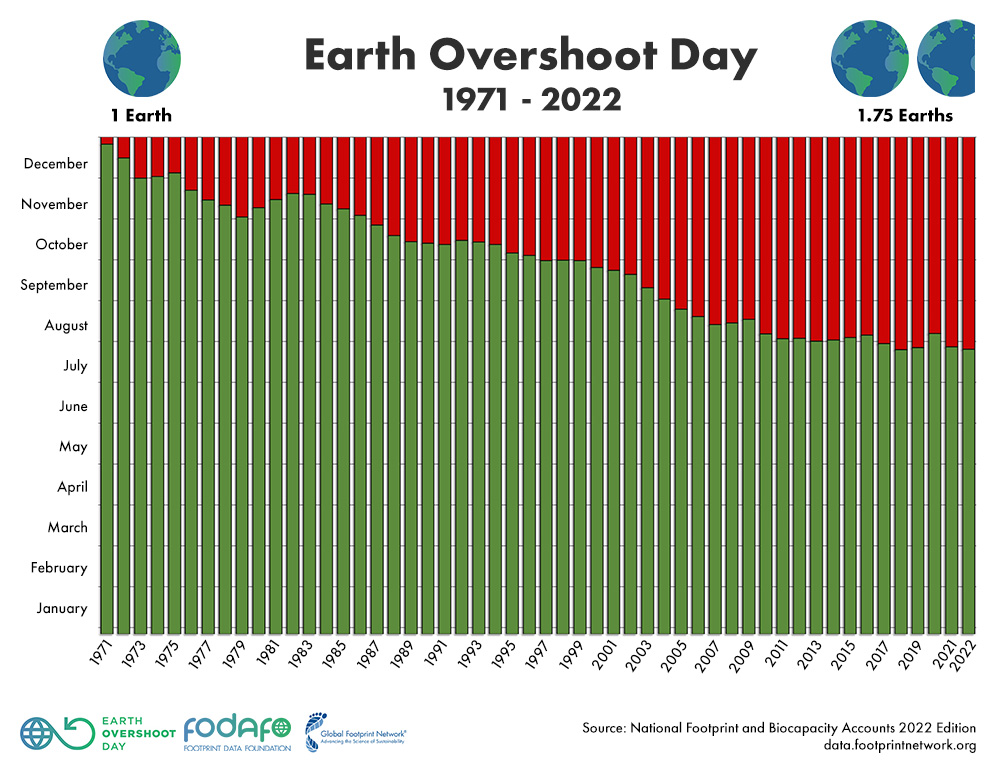
Earth Overshoot Day marks the date when humanity has used all the biological resources that Earth regenerates during the entire year.
While I knew that today was the day when humanity as a whole began using our reserves, our environmental capital or principal, I hadn't heard the total environmental debt our species had racked up before today, 19 years worth of Earth's productive capacity. Yow!
Mankind marks a dubious milestone Thursday, the day by which humanity has consumed all Earth can sustainably produce for this year, with NGOS warning the rest of 2022 will be lived in resource deficit.
Today is a dubious milestone indeed.
Normally, I'd calculate my footprint, but I suspect it won't be any better than last year, if not worse, because of increaseddriving, so I'm sharing the press release from the Global Footprint Network instead.
Earth Overshoot Day 2022 lands on July 28, earlier than last year. Over 50 years of global overshoot have led to a world where aggravated drought and food insecurity are compounded by unseasonably warm temperatures. As the date indicates, humanity continues to widen its annual ecological deficit two years after the pandemic-induced resource-use reductions exceptionally pushed the date back temporarily by 24 days.
“Between the pandemic, wilder weather patterns, and the resurgence or intensification of wars on several continents leading to massive food insecurity, the importance of fostering one’s resource security to support one’s economic prosperity is becoming ever more critical for cities, countries, and business entities,” said Global Footprint Network President Mathis Wackernagel.
Many effective and economically beneficial solutions already exist today to reverse ecological overshoot and support biological regeneration. Opportunities stem from all sectors: commercially available technologies or services, local government’s development strategies, national public policies, or best practices supported by civil society initiatives and academia. The Power of Possibility platform that launched today shows plenty of examples sorted by the five main pillars of intervention: healthy biosphere, energy, food, cities, and population.
For example, moving to smart grids and higher efficiency in our electric systems would #MoveTheDate 21 days. Reducing food waste by half would #MoveTheDate 13 days. Growing trees with other crops on the same land, also known as tree intercropping, would #MoveTheDate 2.1 days, among many others.
Each year, Earth Overshoot Day marks the date when humanity has used all the biological resources that Earth regenerates during the entire year. Humanity currently uses 75% more than what the planet’s ecosystems can regenerate—or “1.75 Earths.” From Earth Overshoot Day until the end of the year, humanity operates on ecological deficit spending. This deficit spending is currently the largest since the world entered into ecological overshoot in the early 1970s, according to the National Footprint & Biocapacity Accounts (NFA) based on UN datasets now produced by FoDaFo and York University.
That's it for today's observance of Earth Overshoot Day. Stay tuned for International Tiger Day tomorrow.