A blog about societal, cultural, and civilizational collapse, and how to stave it off or survive it. Named after the legendary character "Crazy Eddie" in Larry Niven and Jerry Pournelle's "The Mote in God's Eye." Expect news and views about culture, politics, economics, technology, and science fiction.
John Oliver discusses how the Department of Justice has changed since Trump took office for his second term, how the DOJ seems to be acting on his behalf instead of on behalf of the people, and why we need barbers who use scissors instead of their teeth. You’d think that goes without saying, but we’re afraid it might not.
I've been following the protestsagainstICE and the follies around the ReflectingPool, so I'm familiar with DOJ's legal failures involving them. I also read Marcy "Emptywheel" Wheeler, who has a Weaponized DOJ category on her blog, so I've also read about the cases investigating serious crimes that were dropped to concentrate on immigration and Pervert Hoover's political enemies. While I've encountered Harmeet Dhillon's name and office there, I had no idea she and Pervert Hoover had ended the agreement about septic systems in Alabama because of environmental justice and DEI. As an environmentalist who thinks diversity is a strength, I'm offended. Just the same, thanks to Last Week Tonight's researchers for finding the story.
That's a wrap for today's holiday. Tomorrow is WorldElephantDay, so stay tuned to see if I blog about it.
"Patches" with its soaring vocals and soulful energy, and its sad and empathetic storyline about a farmboy from Alabama being given a mission by his dying father, has always been a favourite for us. Sung by the late Clarence Carter - who sadly died just last month, aged 90 - it was written by lead singer of "Chairmen of the Board" General Johnson along with Ron Dunbar in 1970, before Carter turned it in to a blues hit.
We are using it for a much more mundane topic than the affliction of southern rural poverty on a family, which is to reflect on Trump's disastrous ($14m and counting) renovation attempts of the Lincoln Memorial Reflecting Pool in Washington DC, which will now not be complete in time for the anniversary celebrations. The story has travelled around the world and prompted lots of hilarious online memes and commentaries, being such an accessible and colourful microcosm of his presidency and its impact.
One of my favorite versions of "Kodachrome" is from Simon and Garfunkle concert in Central Park, where they mashed it up with "Maybellene". This song parody turns it into "Algae Foam" to continue making fun of Donald Trump's Reflecting Pool debacle.
The Reflecting Pool hasn't made Patrick Fitzgerald forget about the EpsteinFiles.
That's a wrap for today's musical parody post. Stay tuned for InternationalAsteroidDay, the younger but paradoxically more established version of Apophis Day, to close June, and Canada Day to begin July.
Josh Johnson dives into the Scottish takeover of Miami for the World Cup, the flock of tourists visiting D.C.'s bright green reflecting pool, Trump’s security escalation to catch possible pool “vandals,” and whether Trump's pool disaster is karma for trashing Biden and Obama’s previous reflecting pool projects. Plus, conservative media can’t stop talking about the pool, while Michael Kosta can’t stop dreaming about drinking it.
Everything Trump touches dies, including the Reflecting Pool. Then he blames someone else.
That's a wrap for today. Stay tuned for a particularly doomy preview of the drum corps season, which begins tomorrow.
Why does America have a toxic sea… and how did it get there?
The Salton Sea was once one of California’s most vibrant tourist hotspots, a beach teeming with visitors and wildlife. Today it’s a shrinking, toxic lake at the center of a water crisis impacting 40 million people across the Southwest. What happened?
Shane Campbell-Staton visits the Imperial Valley to examine how a desert transformed into America’s vegetable garden, but at serious environmental and social costs. He meets Alex Jack, a third-generation farmer pioneering water-saving techniques to sustain his family’s farm, and Luis Olmedo, a community advocate fighting for the health and rights of migrant workers who harvest the valley’s crops.
The story of the Salton Sea reveals the harsh realities of scarce water, toxic pollution, and a system that doesn’t protect everyone equally. As new water regulations for the Colorado River loom in 2026, this pivotal moment demands a fresh approach to who controls this precious resource, and how it can be allocated more fairly.
I'm old enough to remember when the Salton Sea was the aquatic playground shown in the video and I find it sad that it is now too polluted to still be that. It's now become a place that fits what I wrote in John Oliver examines the UK elections: "One ofmy favorite sayings that I tell my students is 'no one, or in this case, no place, is completely useless; it can always be used as a bad example.'" It also serves as an example of three of Commoner's Laws, "Everything must go somewhere (There is no away)" for agricultural runoff, "There is no free lunch" for growing winter vegetables, and "Everything is connected to everything else" for water use. "Nature knows best?" We should be so lucky.
Follow over the jump for most read posts featuring clips from Human Footprint during the 15th year of Crazy Eddie's Motie News.
We are experiencing a global water crisis: 2.1 billion people still lack access to safely managed drinking water. Despite decades of progress, girls and women are still the hardest hit.
Gender-based inequalities related to the access, use, management and governance of water resources have hindered progress towards fulfilling the human right to water and most Goals of the 2030 Agenda for Sustainable Development.
Titled Water for All People: Equal Rights and Opportunities, the 2026 edition of the United Nations World Water Development Report offers a comprehensive, evidence-based examination of the linkages between, and progress towards, water and gender equality.
Although tangible progress in the provision of water, sanitation and hygiene (WASH) services has been made, significant disparities persist. The poorest and most vulnerable of the world’s population remain the most affected, where women and girls still bear most of the responsibility for securing water to households. This leads to physical and mental stress, limiting their time and opportunities for education, productive work, and social activities.
The UN World Water Development Report 2026, Water for all people: Equal rights and opportunities, emphasizes available data and actionable solutions to promote gender equality throughout the water sector.
I think it's a good idea to combine World Water Day with Women's History Month, even if that wasn't the United Nations' intention. It's a good example of one of Commoner's Laws, "Everything is connected to everything else." The opportunity cost to women and girls who have to spend time fetching water and other water-related tasks also serves as an example of another of Commoner's Laws, "There is no free lunch." This may be the last year I teach environmental science, but it's never too late to learn new facts and ideas I can pass along to students. Welcome to blogging as professional development.
That's a wrap for today. Stay tuned for a brief educational entry tomorrow I can share next month.
The Trump administration released new dietary guidelines that will shape everything from school lunches to medical advice. The guidance puts a bigger emphasis on eating more protein and dairy, something Health Secretary Kennedy has long sought. William Brangham discussed the recommendations with Lindsey Smith Taillie, a nutrition epidemiologist and co-director of the Global Food Research Program.
16. What in ultraprocessed foods drives appetites/overeating?
...
19. How much of U.S. calorie intake comes from ultraprocessed food? France? Brazil? Italy?
I haven't shown Food, Inc. 2 either enough times or that recently to have the answers to both questions memorized in detail, but generally the response to the first involves additives to make ultraprocessed food more appetizing while that for the second is that Americans get the majority of our calories from ultrprocessed food while citizens of the other countries eat much less, generally around a quarter. Americans should eat less ultraprocessed food and more whole foods. Yes, I'm agreeing with RFK Jr. on this issue. File that under a stuck clock being right twice a day, and RFK Jr. is definitely a stuck clock.
That's the good news about the food guidelines. The bad news is the recommendation to eat more meat and dairy. That's not good for either health or the environment. Here are the questions I ask my students about the effects of meat and dairy on the environment.
9. Why are dairy farms moving from Wisconsin to California and Arizona and what are the environmental costs, especially on water? Answer both parts of the question.
...
24. Which food contributes most to climate change?
Dairy production requires a lot of water, which is in short supply in California and Arizona, where dairy farmers are moving to because those states have lower non-water costs. As Smith Taillie mentioned, beef has very high environmental costs, including being the food that contributes most to climate change.
The Secretary of State says America's goal is not to invade Greenland but to purchase it from Denmark, President Trump said he will sell 50 million barrels of Venezuela's oil and that he will determine where the profits go, and the FDA removed its own guidance on how much alcohol is safe to drink on a daily basis.
Ultraprocessed food, meat, and dairy may be more important, but booze is funnier. Why do my readers think I post so many cocktail recipes? Because they're fun; I actually drink very little, as I lost interest in alcohol once I developed diabetes. Priorities.
Speaking of priorities, I have to do some maintainence then go to work to prepare for the new semester. See you all tomorrow!
For generations, we’ve been pumping water out of the ground assuming it would last forever. But, it’s running out. And a new study shows how global “peak water” could be just around the corner. In this episode, we’ll find out WHEN and WHERE peak water is expected to hit.
Groundwater depletion is only one of the effects May describes and I list as a result of over-pumping groundwater. So are subsidence, saltwater contamination, contamination from other surface sources, and decreased recharge of surface water from groundwater, which results in loss of riparian (streamside) vegetation, among other undesirable things. That makes this video one of the stories I tell my students. It also means that, if I show it to them, this entry becomes another instance of blogging as professional development.
I close by noting that I had heard that Indonesia was building a new capital city, but I didn't know why until I watched this video — subsidence exacerbated by sea level rise. That means I learned something new, and it's always a good day when that happens.
That's a wrap for today's post. Stay tuned for tomorrow's educational entry, which will be a CityNerd video about drivers and a drivingupdate, since Pearl will pass 70,000 miles today.
I told my readers to "Stay tuned as I resume my coverage of the News & Doc Emmy Awards" at the end of PBS NewsHour explains 'How Meta's blockbuster antitrust trial could have major implications for big tech' — a Throwback Thursday special, and I'm following through with the nominees for Outstanding Investigative Documentary, which include two of the nominees for Best Documentary. From most to least nominated, they are The Grab with four nominations, American Conspiracy: The Octopus Murders with three, Fault Lines episode "The Night Won't End" with two, and two Frontline episodes, "A Dangerous Assignment: Uncovering Corruption in Maduro’s Venezuela" and "South Korea’s Adoption Reckoning," both with one. I'm sharing their trailers in that order, beginning with The Grab - Official Trailer | Directed by Gabriela Cowperthwaite | Opening June 14 by Magnolia Pictures & Magnet Releasing.
Quietly and seemingly out of sight, governments, private investors and mercenaries are working to seize food and water resources at the expense of entire populations. These groups are establishing themselves as the new OPEC, where the future world powers will be those who control not oil, but food. And it's all beginning to bubble to the surface in real time. Global food prices have hit an all-time high, threatening chaos and violence. Meanwhile China, Russia, the UAE and Wall Street are just a few of the players strategizing within this shocking, shifting geopolitical landscape.
THE GRAB is a global thriller combining hard-hitting journalism from The Center for Investigative Reporting with the compelling character-driven storytelling of director Gabriela Cowperthwaite, taking you around the globe to reveal one of the world’s biggest and least known threats.
Directed by Gabriela Cowperthwaite
This documentary fits the overall theme of this blog and is one I can recommend to my students. Welcome to blogging as professional development. It's also a chance for Gabriela Cowperthwaite to earn the recognition she deserved but didn't get for Blackfish. I hope she, along with the film's producers, researchers, and trailer creators, get it.
Here's the English translation of the Italian video description.
Investigators have no doubts about the death of Danny Casolaro: for them, the journalist found in the bathtub of a hotel room committed suicide. But the reporter's family and colleagues believe it could have been murder. The motive? The investigation he was conducting into a conspiracy he called "Octopus," a secret organization linked to the theft of government spy software, a series of unsolved murders and some of the biggest political scandals of the 20th century. Years later, researcher Christian Hansen tries to reveal the secrets of Casolaro's death, along with the story that cost him his life. Stardust Frames, Duplass Brothers Productions and director Zachary Treitz present this four-part docuseries that tells the mystery that has lasted for decades.
Israel’s bombing campaign continues in Gaza and the humanitarian crisis deepens to catastrophic levels, the Biden administration has not wavered in its support for Israel. United States weapons transfers - from 2,000-pound bombs to artillery shells and tanks - have been a crucial part of the Israeli military campaign. Fault Lines worked with journalists in Gaza to profile three families as they try to survive the war. Together with Airwars, Fault Lines also investigated an air strike on December 11 in north Gaza in which more than 100 people from the same family were killed. Numerous attacks on civilians - including that on Hind Rajab and her relatives in late January - have raised international concern and questions over continuing US support. Fault Lines partnered with Forensic Architecture and Earshot to investigate that attack. From air strikes to field executions, Fault Lines investigates the killings of civilians by the Israeli military in Gaza and the role of the United States in the war.
With the Venezuelan news outlet Armando.info, FRONTLINE investigates the shadowy figure at the heart of a corruption scandal spanning from Venezuela to the U.S. "A Dangerous Assignment: Uncovering Corruption in Maduro’s Venezuela" premieres Tues., May 14, 2024.
FRONTLINE and The Associated Press investigate allegations of fraud and abuse in South Korea’s historic foreign adoption boom.
In a normal year, a Frontline episode would have a better chance of winning; 2024 wasn't a normal year. Also, most of these nominees show that the line between investigative documentaries and crime and justice documentaries is very fine, just like between science and nature documentaries.
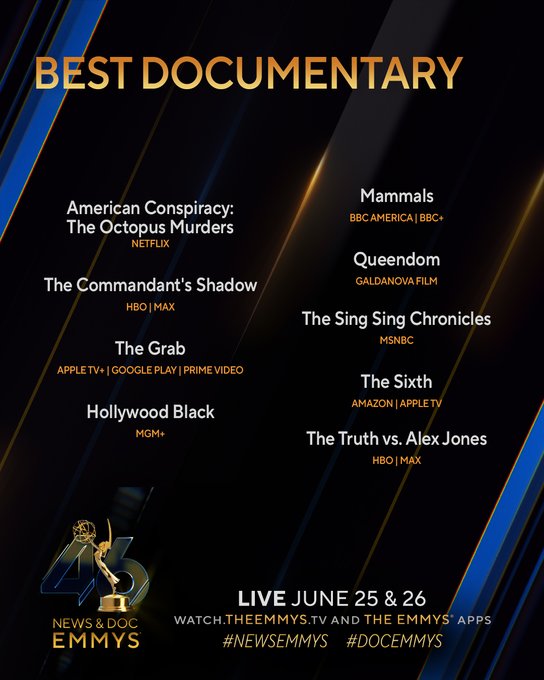
For the first time in this series, I'm examining the nominees for Best Documentary. I've been holding off because the category has nine nominees this year. The Grab leads with four nominations, followed by American Conspiracy: The Octopus Murders and Mammals with three each, Hollywood Black, The Sixth, and The Truth vs. Alex Jones, all with two, and The Commandant's Shadow, Queendom, and The Sing Sing Chronicles with just this one. The Grab and American Conspiracy: The Octopus Murders are facing off for Outstanding Investigative Documentary, The Sixth leads the nominees for Outstanding Politics and Government Documentary, The Truth vs. Alex Jones is contending with Poisoned Ground: The Tragedy at Love Canal for Outstanding Crime and Justice Documentary, and Mammals leads the rest of the field without a subject area nomination. That's four more opportunities to examine the nominees, after which I'll make my call.
Right now, I have The Grab in first, but I'm not making a final call until I write about the rest of the nominees. I'm planning on examining Outstanding Crime and Justice Documentary in the next installment because I have personal and professional interests in both The Truth vs. Alex Jones and Poisoned Ground: The Tragedy at Love Canal, the latter of which I can also recommend to my students. Again, welcome to blogging as professional development.
Follow over the jump for the craft categories in which the nominees for Outstanding Investigative Documentary earned nominations.
Glaciers are more than just giant ice formations—they are dynamic forces of nature that shape our planet and hold the key to our freshwater future. But how do they form? What kinds of glaciers exist around the world? And how is climate change impacting them?
In this video, we take you on a journey through the life cycle of a glacier, from snowflakes to massive ice sheets. You'll discover the different types of glaciers, how they move, and why they are so crucial to Earth's water supply.
Did you know? Glaciers store about 70% of the world’s fresh water! As they melt, they feed rivers and supply drinking water to millions. But with rising global temperatures, many glaciers are shrinking at alarming rates.
Join us as we explore these frozen giants and learn how they connect to our climate, water, and future.
I just finished lecturing on glaciers in my geology classes this week and I could have used this video, as it covers the weakest part of my lecture. Darn. I can still add it to the slideshow and show it for the next four semesters. If so, welcome to blogging as professional development.
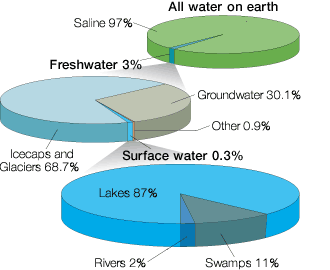
Speaking of professional development, glaciers storing "about 70% of the world’s fresh water" differs from the statistic I've been telling my students for years, which is 79%. I included a pie chart showing that last year. Pacific Water displays a pie chart more consistent with glaciers and ice caps having 70% of the planet's fresh water.
Looks like I'll have to research the reason for the discrepancy. If it's because that much of the planet's glaciers have melted, then the situation has indeed become worse since Chasing Ice.
Follow over the jump for two more videos from the United Nations, specifically UNESCO.
Near the Chesapeake Bay, farms have flourished for hundreds of years on the rich, fertile soil of coastal Maryland. But as sea levels rise, driven in part by climate change, encroaching saltwater is disrupting the livelihoods of many farmers. It's a preview of what other areas near saltwater may soon confront. William Brangham reports for our series on climate change and water, Tipping Point.
As I wrote on my DreamWidth account, "I shared and linked to videos I show my students in The Wall Street Journal explains 'Why America’s Groundwater Is Disappearing'. I don't have one about groundwater contamination, so I might show this one, too." The slide about saltwater contamination of groundwater focuses on overdrafting bringing saltwater closer to the surface and contaminating wells for drinking water, but adding the effects of climate change, rising sea levels, and agriculture contribute new dimensions and connections to the issue, ones I hadn't thought of before. Welcome to blogging as professional development.
The description mentioned groundwater, but the video itself didn't include anything about the subject. Just the same, reading it reminded me that I show a Wall Street Journal video about groundwater depletion to my students and I should embed it here.
Unchecked groundwater use is draining aquifers across the U.S., threatening drinking water supplies and the nation’s status as a food superpower. For example, the Ogallala Aquifer beneath the Great Plains supports about 30% of all U.S. crop and animal production, but in 2022, parts of the water table reached their lowest levels since NASA started measuring two decades ago.
WSJ explains why this crisis is posing an “existential threat” to many communities and looks at how the critical natural resources could be saved.
That gets the point across about groundwater depletion, especially in the Ogallala Aquifer, and sets the stage for the next slide, which is about subsidence and sinkholes. I've been showing those videos to my students for a decade already. Welcome to blogging as professional development.
I don't show the next video, PBS NewsHour's Depletion of major groundwater source threatens Great Plains farming, but if anything happens to The Wall Street Journal's video or I decide not to support the paper (it is a NewsCorp property, after all), it's available as a backup.
In the heart of the country, Great Plains farmers and ranchers produce a quarter of all U.S. crops and 40 percent of its beef. But they rely on a resource that has been slowly drying up, water. Stephanie Sy reports from Kansas for our series on the impact of climate change, Tipping Point.
It's the same basic story with all new characters except for Brownie Wilson, who appears in both videos. PBS also emphasizes the effects of climatechange more and makes even clearer two of Commoner's Laws: "Everything Is Connected to Everything Else" — the economy and society of western Kansas is connected to agriculture, and local agriculture is dependent on groundwater — and "There Is No Free Lunch — over-reliance and overuse of groundwater is already incurring costs. Brant Peterson switching from corn to sorghum could also serve as an example of a third law, "Nature Knows Best," although corn, originally from Mexico and cultivated by Native Americans, comes closer to a native plant than sorghum, which is originally from Africa.
The Wall Street Journal video also mentioned cracks forming in Arizona because of groundwater depletion. PBS Terra's Maiya May addresses this phenomenon in Why Are These Huge Cracks Appearing in the Desert?
In Arizona, fissures are becoming an increasingly common phenomenon due to lack of rain and groundwater depletion. Weathered's Maiya May explains.
Yikes! That might scare my students should I care to replace one of my subsidence videos with it.
Stay tuned as I track down more of my promises for future posts and share them as evergreen entries through the end of the month.
A key promise in Paris’s bid to host the 2024 Summer Olympics was that its famous river, the Seine, would be cleaned up in time to host open water swimming events: the triathlon, para triathlon, and marathon swimming. But swimming has been banned in the Seine for a century because the Paris sewer system is designed to dump wastewater into the river during heavy rain, when the sewers get overwhelmed by stormwater.
When that happens, levels of E. coli, a bacteria associated with fecal matter, spike in the river, making it too contaminated to swim in. In order to make good on its promise to clean the river, Paris officials took on a $1.5 billion USD infrastructure project that includes a massive underground tank and tunnel system meant to hold excess sewage during heavy rain and prevent further contamination of the Seine.
Water quality testing will be done daily ahead of the Olympic games this summer, and Paris officials are hopeful their ambitious plan to host swimming in the famously polluted river will succeed.
I hope the answer was yes.
I'm about to lecture on sewage treatment Monday night, so I'm considering showing this video to my environmental science class as a timely example of why the topic is relevant. The only concern I have is the BetterHelp promotion in the middle. Nearly every comment on the video complained about it, so I'll have to skip past it. I had no idea how many people dislike BetterHelp!
I might return to Olympics-related posts while the Games take place, but probably not tomorrow; I have Emmy nominations penciled in. Stay tuned.
Lawns aren’t natural. Why do so many Americans have them?
...
Grass lawns are so ubiquitous in the US you would assume that they're the most natural and obvious choice for what to put in our yards. But turf grass is not only not native to the US, but it takes a lot of time, money, and resources to maintain.
Today, some cities are offering "cash for grass" programs and giving residents as much as $25,000 to replace their turf grass lawns with more environmentally sustainable options.
But some people still like green grass lawns and enjoy maintaining them, so what should they do? In this video we go through the multitude of options that yard owners have and talk to experts to see what they have to say.
I have a lawn, but I inherited it when I bought the house and I live in Michigan, where I don't have to water it. If I still lived in southern California and owned a house there, I'd have replaced any lawn on the property with something more water-conserving and sustainable, like the landscape Sara Bendrick planted.
How much do you really know about the grass beneath your feet? It turns out, there's a whole lot more to it than meets the tee. Shane ventures beyond the green lawns and learns about the costly and cultural resources at play when it comes to maintaining this so called "crop."
If you're interested in sustainability on the local and personal levels, your biggest obstacles will be homeowners associations, zoning boards, and city councils. Those people will be wedded to business as usual long after it becomes apparent to early adopters that BAU just isn't working any more. Watch those local governing entities hang onto the past like adherents of a cargo cult.
...
When it comes to enforcing business as usual (BAU) norms of middle-class respectability as a way of maintaining property values, Oak Park does not play. Oak Park is so afraid of catching what they think Detroit has, which is blight, that they restrict what property owners can do more than neighboring cities and enforce their will with a vengeance. Put your trash cans out too early or leave them out too long and the police will ticket you. Let your grass grow too high and the city will mow your lawn for you and then bill you. You can only hold two yard sales per year and you have to inform the city in advance. If you want to drink wine while dining in the city, you're out of luck; there are no restaurants with liquor licenses. The list goes on and on.
Of course, the people who live there and like it make a point of saying that the police will arrive before you hang up your call to 911, but all the above is the flip side of what the locals praise as "great city services." I hope their property values and middle-class sensibilities are worth it.
Remember, that controversy was about replacing a lawn with a vegetable garden, something more useful and productive.
Also, watching the scenes of suburbia reminds me that this was the week I used to show The Endof Suburbia and now show Treasuresof the Earth: Power. I no longer require my students to watch James Howard Kunstler and the rest of the Prophets of Doom, but they can still watch The End of Suburbia for extra credit. After all, I conserve my resources.
*I'm also not posting anything involving current events. That's because my blog passed its monthly page view goal just before Noon on Monday, so I'm once again blogging about more evergreen topics that will be good to share in August, like the environmental cost of lawns. This also includes this year's Primetime and Creative Arts Emmy Awards, which will be announced later this morning. Look for me to write about them, beginning with examining how Gold Derby's predictions for Emmy-nominated shows fared tomorrow. Stay tuned.
In a recorded message from New Zealand, actor and ocean activist Jason Momoa said, “the human induced triple planetary crisis of climate change, pollution and biodiversity loss continues to weigh heavily on the ocean ecosystems and the communities that directly depend on it. If we don't change course. The oceans dire state will continue to apply. Doesn't have to be that way. Through reimagining our relationship with the ocean and working together to better understand prioritize and protect it, we can rebuild a preserve that help the ocean both now for future generations. I'm honored to be joining the United Nations family World Oceans Day. Celebrate how wonderful it is to live our blue planet and underscore the importance of prioritizing the oceans help, our own health.”
World Ocean Day is celebrated worldwide on 8 June Every Year.
Award-winning actor, entrepreneur, and filmmaker Jason Momoa has long advocated for environmental issues and social justice. Of Polynesian and Hawaiian descent, he has lent his voice and platform to protecting the oceans and the rights of indigenous peoples and island nations. Momoa's entrepreneurial pursuits focus on advancing sustainable practices, products and packaging, including development of Mananalu, a water packaged in infinitely recyclable aluminum. His passion for environmental conservation is evident through his collaborations with organizations like Ocean Unite, Sustainable Coastlines Hawaii, Lonely Whale, and Kumano I Ke Ala. He advocates for marine protection, coral reef preservation, and global initiatives against plastic pollution and waste. Moreover, in addition to his direct involvement with SDG 14, "Life Below Water," and his profound dedication to ocean health and the protection of marine life, Momoa is actively involved in raising awareness of the issue of intersectional environmentalism and social justice through his production companies, Pride of Gypsies and On The Roam, which produces scripted and unscripted original content, branded content, and product collaborations.
Speaking of Aquaman, I predicted that "I'm looking for Aquaman 2 to earn a nomination at the next EMA Awards" in The 2023-2024 Environmental Media Association Awards nominees. I'm also looking forward to seeing the movie on the next Saturn Awards ballot. Too bad it's almost certain to get crushed by Deadpool & Wolverine. The Marvel streak will continue.
The United Nations features Momoa in more videos, but I'm also being a good environmentalist by conserving my resources for next year, when World Oceans Day will also be the subject of the Sunday entertainment feature. Speaking of which, stay tuned for that tomorrow. Daytime Emmy Awards winners, anyone?
World Water Day falls on Mar 22. It is marked every year by the United Nations (UN) and the world to inspire positive ripple effects to tackle the global water crisis. The theme this year, amid growing concerns over wars, is “Water for Peace”. The UN says water can create peace or spark conflict, playing a critical role in stability and prosperity. CNA's Julie Yoo has the details.
The statistics Julie Yoo cites for the distribution and availability of fresh water are the same ones I tell my students using a graphic similar to this one from PBS.
It certainly puts things in perspective and I hope it makes an impression on my students.
There is a growing risk of conflict over water as climate change takes hold, according to the United Nations, which marks World Water Day on Friday. Meanwhile, aid agency Oxfam accuses global corporations of grabbing water from poorer countries to boost profits. Henry Ridgwell reports from London.
Also, the transfer of water from the global south to the global north reminds me of another story I tell my students, I=P*A*T, "where I is impact, P is population, A is affluence, and T is technology." Affluence increases environmental impact both through the ability to demand resources and the waste that resource use creates. While technology is the only way to reduce the impact from population and affluence through efficiency, it can also make the impact worse. The technologies allowing the international transfer of water through food and other products might just fall into that latter category.
Mexico City, one of the world's most populous cities, could be just months away from running out of water. It’s a crisis brought on by geography, growth and leaky infrastructure, all compounded by the effects of climate change. Journalist Emily Green joins John Yang to discuss the situation.
The irony of this is that Mexico City was built on a lake and much of that water is still under the city. That's another story I tell my students, but I'm saving it for another time.
As the effects of climate change become harder to ignore, there's not a place on the planet that won't feel an impact.
I was a little disappointed that CityNerd didn't include cities in Michigan among his list of climatehavens, so I'm glad to see this video. I'm even more glad because the example of Ari Biswas and his family fit what I wrote in January: "I expect more of the early wave of migrants will be those already familiar with Michigan. If so, welcome back! Michigan missed you!"
In addition, Dr. Jonathan Overpeck mentioned a story I tell my students about the Great Lakes Compact, which forbids exporting water out of the Great Lakes watershed in containers larger than five gallons. In fact, I just told my students about it today. I'm just surprised I never wrote about it here until now.
Since I started making videos about affordable walkability and underrated urbanism, I've gotten several requests to do something specifically around small and mid-sized cities. Well, this video isn't EXACTLY that, but it's adjacent!
It turns out, if my brazen misapplication of the EPA's Climate Resilience Screening Index is to be believed, small and mid-sized cities are going to be pretty good performers under trying climate conditions. So, if you were to pack up all your stuff and move to a place that had the least risk / most resilience, and was STILL a legitimate city, what city would it be? Well, this video has ten ideas for you. Ignore them at your peril!
This is an entirely different list of climatehavens than I've shared before. I'm a little disappointed that it doesn't include cities in Michigan, although it does include Duluth, Minnesota, so the Great Lakes have a destination. I'm a bit surprised at all the locations in the western interior. So were a lot of the viewers, who pointed out the potential issues with water supply for a lot of these towns. It turns out that a lot of the small cities have adequate water, at least for now. Just the same, many of those cities are places I might like to retire to for reasons having more to do with the present climate than the future climate. That they would be good places to live in the future would be a bonus.
On 8 June World Oceans Day will be celebrated worldwide, serving as a poignant reminder of the immense significance of the ocean in our daily lives. The importance of a healthy ocean cannot be overstated. They are home to 80 percent of the animal biomass, serving as a vital source of sustenance, nutrition and livelihoods for millions of people worldwide.
I was right when I wrote "I might have more on the Global Plastic Pollution Treaty as soon as Thursday," as France 24 English covered it right after talking about climatechange and biodiversity. There should be a draft treaty when the delegates meet again in Nairobi later this year.
Video Message by António Guterres, Secretary-General of the United Nations, on World Oceans Day 2023.
Here are the initiatives Secretary-General Guterres listed after declaring that "the tides are changing."
Last year, we adopted an ambitious global target to conserve and manage 30 per cent of land and marine and coastal areas by 2030, as well as a landmark agreement on fisheries subsidies.
At the UN Ocean Conference in Lisbon, the world agreed to push for more positive ocean action.
A global, legally binding agreement to end plastic pollution is under negotiation.
And in March, countries agreed to the historic High Seas Treaty on the conservation and sustainable use of marine biodiversity in areas beyond national jurisdiction.
Realizing the great promise of these initiatives requires collective commitment.
Sustainable Development Goal 14 — to conserve and sustainably use the ocean’s resources — hangs in the balance.
This World Oceans Day, let’s keep pushing for action.
Today and every day, let’s put the ocean first.
As a Crazy Eddie, I approve.
Follow over the jump for two videos I missed from last year's celebration that I found worth watching.
This is indeed bad news for fighting climatechange and could be a precedent that constrains regulations by many branches of government. The good news is that hasn't happened yet...May we continue to be so lucky.
The Supreme Court has again weakened the authority of the Environmental Protection Agency. The case involved the EPA blocking an Idaho couple from building a house near a lake on their property, saying the construction would pollute water protected by the Clean Water Act. William Brangham discussed the case with Coral Davenport.
While the court voted unanimously in favor of the landowners, so that was almost certainly the correct outcome, the opinions supporting that decision are another matter. I am a scientist, not a lawyer, but I think it was possible that the EPA overstepped its authority in this case even with its prior power over wetlands. Instead, it has now lost its ability to regulate half the nation's wetlands. This is great for property owners, but not good for the environment.
Under the Executive Branch, there are 15 departments, each of which is led by an appointed cabinet member. And within those departments, there are more than 400 distinct agencies and sub-agencies. This is the so-called “Administrative State” that the GOP has been pushing to reform for decades. These agencies, among other functions, are the regulatory bodies on which we rely in nearly every aspect of our daily lives. Last week, the Supreme Court accepted a case that has the potential to upend our governments entire regulatory system.
This could be really bad news, even though a decision is not likely to come for a year or so. I'll be following it, so stay tuned.