Showing posts with label Michael Alexander. Show all posts

Tuesday, April 21, 2020

Oil falls below $0.00 for the first time ever


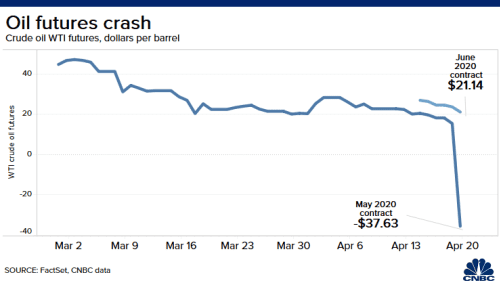
Something happened yesterday that I expected would never happen, oil dropping to or even below 1998 levels of $10-$20 a barrel.*  In fact, it fell so far below that price that people holding oil contracts had to pay others to take it off their hands.  CNBC has the story yesterday in Crude settles at -$37 a barrel in worst day ever.

Oil goes negative for the first time ever. Now what? With CNBC's Melissa Lee and the Fast Money traders, Guy Adami, Tim Seymour, Karen Finerman and Dan Nathan.
Wow, do her guests love Melissa Lee!  On a more serious note, my understanding of why oil fell to negative levels is that the people and institutions holding the oil contracts would actually have to take possession of the oil when the contracts came due.  Since they were only doing it for an investment and not for actual consumption, that's not what they really wanted to do.  They needed to get rid of the oil to someone who could store it until it's refined and used.  The problem is that there isn't much storage left as people aren't consuming oil to move around, so they had to pay people to take the oil instead of selling it and getting the money.

I'm an example of people driving a lot less and reducing consumption.  In January, I expected to write the next driving update in early April.  It's now late April and I've driven so little since Michigan colleges and universities suspended in-person classes in March that I may not write that update until June.  The silver lining is that the coronavirus response has reduced air pollution.  The bad news is that unemployment is up dramatically, which will reduce consumption in and of itself.

Follow over the jump for a more entertaining and professionally produced version of the explanation I wrote along with what the lower oil prices mean for consumers and a footnote.

Monday, August 1, 2016

Stocks resume climbing a wall of worry to hit new highs


I concluded the section before the jump in All Hell breaks loose after the U.K. votes to leave the E.U. with this caveat.
If this continues, and the Dow goes into a correction over the next few months that takes it to below 14,650, it makes both Mike Alexander's prediction of a 10,000 point decline in the Dow by the end of 2018 more likely and my prediction of a recession beginning by the end of 2017 more likely to come true.
That didn't happen.  Instead, this did: Red-hot Dow rises for 9th day in a row.
The stock market is so hot that the Dow just notched a rare nine-day winning streak.

It's only the seventh time since 1980 that the benchmark index has climbed that many days in a row, according to the New York Stock Exchange.

More impressive, the Dow continues to rewrite the record books, closing on Wednesday at yet another fresh all-time high of 18,595.

It's the latest milestone in what has been a wild summer for stocks. Global markets plunged on June 24 after the Brexit referendum in the U.K. spooked investors. But stocks soon raced back emphatically, and just kept rising until they took out the records set in May 2015.

"We're setting new records, but don't forget it took us 14 months to get here," said Art Hogan, chief market strategist at Wunderlich Securities.
That was on July 20th.  Two days later, Barrons reported "The S&P 500 rose 0.6% this week after gaining 0.5% to 2,175.03 today, a new record high."  That's not all, as the last Friday of July saw a new intraday high, as Reuters reported.
Wall Street rose on Friday, with the S&P 500 index hitting a record intraday high for the seventh time this month as gains in technology heavyweights Alphabet and Amazon more than made up for losses in energy shares.

The benchmark index rose as much as 0.3 percent, touching an all-time high of 2,177.09, and completed its fifth straight month of gains.
So, will Mike and I end up being wrong?  Not yet.  Follow over the jump for why.

Friday, June 24, 2016

All Hell breaks loose after the U.K. votes to leave the E.U.


In Brexit vote today, I hoped that the British voted to remain.  They didn't.  As Krugman phrased it, they had a choice between bad and worse and they chose worse.  Two of the headlines from Reuters I read when I woke up this morning explain the reaction.

First, 'Explosive shock' as Britain votes to leave EU, Cameron quits, which is the number one story on the site right now.
Britain voted to leave the European Union, forcing the resignation of Prime Minister David Cameron and dealing the biggest blow to the European project of greater unity since World War Two.

Global financial markets plunged on Friday as results from a referendum showed a 52-48 percent victory for the campaign to leave a bloc Britain joined more than 40 years ago.

The pound fell as much as 10 percent against the dollar to touch levels last seen in 1985, on fears the decision could hit investment in the world's fifth-largest economy, threaten London's role as a global financial capital and usher in months of political uncertainty. The euro slid 3 percent.
Reuters has a strong financial slant to its coverage, which explains the third paragraph.  It also explains the headline to the next story, which is currently the third most read there: World stocks routed as Britain votes for EU exit.
World stocks saw more than $2 trillion wiped off their value on Friday as Britain's vote to leave the European Union triggered 5-10 percent falls across Europe's biggest bourses and a record plunge for sterling.

Such a body blow to global confidence could prevent the Federal Reserve from raising interest rates as planned this year, and might even provoke a new round of emergency policy easing from all the major central banks.

Risk assets were scorched as investors fled to the traditional safe-harbors of top-rated government debt, Japanese yen and gold.

Almost $1 trillion had been lost from European share prices ahead of what is expected to be a nearly 4 percent fall on Wall Street ESc1 when it opens later.

London's FTSE .FTSE dropped almost 5 percent while Frankfurt .GDAXI and Paris .FCHI fell 6 to 8 percent. Italian FTMIB, Spanish .IBEX and European bank stocks .SX7P all headed for their sharpest one-day drops ever.

Worries that other EU states could hold their own referendums were compounded by the fact that markets had rallied on Thursday, seemingly convinced the UK would vote to stay in.
The Dow closed yesterday at 18,011.07 with the S&P 500 ending the day at 2,113.32.  Those are very high numbers, and if the UK had voted to remain, both might have continued on to new highs, beating the record close of 18,312.39 on May 19, 2015.  Instead, expect the Dow dropping to 17,290 and the S&P falling to 2029 by today's close.  In fact, that's already happening, as Wall St. plunges at the open after shock Brexit vote.
U.S. stocks plunged at the open on Friday, with the Dow Jones average falling more than 500 points, after Britain's vote to quit the European Union delivered the biggest blow to the global financial system since the 2008 financial crisis.

Investors worried about the outlook for the world economy sought refuge in the dollar and other safe-harbor assets such as gold and U.S. Treasury bonds, while dumping riskier shares. The yield on the U.S. 10-year bond hit its lowest since 2012.

Banks and tech stocks were among the biggest losers.
If this continues, and the Dow goes into a correction over the next few months that takes it to below 14,650, it makes both Mike Alexander's prediction of a 10,000 point decline in the Dow by the end of 2018 more likely and my prediction of a recession beginning by the end of 2017 more likely to come true.

All the above is just the financial fallout.  Follow over the jump for the political responses.
Thursday, January 14, 2016

Oil falls to 12-year lows, dragging stocks down with it


I bragged about a forecast that came true in Michigan has the cheapest gas in the U.S.
I opened Regular falls below $2.00 in metro Detroit before Thanksgiving as predicted by forecasting that gas would fall to $1.75 by Christmas, either as the average price in my old neighborhood as as the Detroit average from GasBuddy.  The first happened this weekend as the price in my old neighborhood was $1.69 at all three stations on Tuesday.  The second nearly happened, as the average was $1.79 Tuesday morning and is $1.78 now.  I'll claim credit for being right 23 days early.
I ended with a weak prediction that "Limbo Kitty might be getting quite a workout this winter."  So far, that hasn't happened, at least for gasoline, as the cheapest I've seen the stations in my old neighborhood since was $1.73 on Tuesday when I filled up Pearl, and the Detroit average never quite hit $1.75.  Oil prices, however, have been another story, as Reuters reported yesterday morning in Oil's slide below $30 sends shockwaves far and wide.
U.S. oil stumbled below $30 for the first time in 12 years to levels that threaten the survival of many U.S. shale firms, spur more belt-tightening by oil majors and spell more pain for crude-producing nations and regions.

A seven-day losing streak fueled by concerns about a continued supply glut and fragile demand from China, the world's No. 2 consumer, wiped out almost a fifth of crude prices this year and 70 percent since mid-2014.

Traders have all but given up attempting to predict where the new-year rout will end, with momentum-driven dealing and overwhelmingly bearish sentiment engulfing the market. Some analysts warned of $20 a barrel; Standard Chartered said fund selling may not relent until it reaches $10.
$10-$20 oil?  That's the range in which the investment strategy of Mike Alexander's that I mocked in the footnote to Two years on, the stock markets are still setting records will work.
In 2003, he thought oil would return to 1998 levels within a decade and devised an investment scheme based on that prediction.  I told him that would never happen and that he shouldn't include that in his next book.  His response was that it only had to work once.  I told it would only work once if he was lucky.  After a dozen years, I'm still right; oil prices never dropped that low again.
It might just happen in the next year.  If so, I can still say I was right.*

Enough bragging.  How low did oil go on Tuesday?
The U.S. West Texas Intermediate crude (WTI) benchmark briefly touched a low of $29.93, which was last seen in December 2003.
Yowza!  I never thought I'd see prices that low again, not unless the U.S. was in a deep recession, which were aren't--yet.

What about Wednesday?  Follow over the jump for yesterday's closes.

Monday, February 23, 2015

Two years on, the stock markets are still setting records


Two years ago, I predicted one of two futures after the first time I wrote about a record S&P close.
As for what's coming next, either Thursday's action was the top of the market or it's off to the races, and people on Wall Street know it.
For the past two years, it's been off to the races.  Last Friday, the Reuters headline read Dow, S&P 500 close at record highs on Greece debt deal.
The Dow and S&P 500 ended at record highs on Friday while the Nasdaq notched an eighth straight day of gains after Greek and euro zone finance ministers reached a deal to extend heavily indebted Greece's financial rescue by four months.

The agreement removes the immediate risk of Greece running out of money next month and possibly being forced out of the single currency area.

The Nasdaq matched an eight-session winning streak from a year ago and inched closer to its 5,132.52 all-time intraday high, reached in March 2000 just before the dot-com bubble burst. The S&P 500 ended slightly higher for the week as well, its third straight week of gains.
...
All of the S&P 500 sectors ended in positive territory, except energy, which dipped 0.3 percent. Apple, which hit another record closing high, gave the S&P 500 and Nasdaq their biggest boost.

The Dow Jones industrial average rose 154.67 points, or 0.86 percent, to 18,140.44, the S&P 500 gained 12.85 points, or 0.61 percent, to 2,110.3 and the Nasdaq Composite added 31.27 points, or 0.63 percent, to 4,955.97.

For the week, the Dow was up 0.7 percent, the S&P 500 was up 0.6 percent and the Nasdaq was up 1.3 percent.
The NASDAQ has less than 200 points until all three stock indexes have recovered for their previous highs.  Too bad I didn't get in the market back in 2009.  Of course, as pessimistic as I have been the past two years, I probably would have gotten out by now.  Speaking of which, I wrote about someone I was sure would get out of the market soon when the S&P 500 first hit a post-recession high two years ago.  Continue over the jump for my follow-up to that prediction.

Friday, March 29, 2013

The S&P 500 record close has arrived


In case anyone is why I haven't written an entry about the stock market since March 7th, look no farther than my comment at Kunstler's blog Monday for an explanation.
As for compound interest not working because of energy issues, look no farther than the U.S. Treasury notes. The 30-year is offering 3%, and the 10-year only 2%. People who expect a return on their investment just aren't getting it, in more ways than one. I guess that's why they're running up the stock market, although the Ides of March put a knife in the back of the ten-day rally, the longest since 1996. I got bored with that rally after three days, but the bull market might still have another top in it yet.
I was so bored that I saved the following headlines, but didn't bother to blog about them two weeks ago when they were news.

Will the Ides of March Stifle the Rally? (The answer ended up being yes)
Stocks Retreat: Dow Halts 10-Day Winning Streak, but Ends Positive for 4th-Straight Week
Dow Average Snaps Rally as Consumer Confidence Declines
Consumer Sentiment in U.S. Falls to Lowest Point in Year

Just the same, I did save them for future use. Today, the opportunity arrived, as the L.A. Times headline read S&P 500 hits record to cap rally while Reuters stated it more succinctly: S&P 500 ends at record closing high. Follow over the jump for the details.