Showing posts with label Paul Krugman. Show all posts

Friday, August 22, 2025

Howtown asks 'Where does science funding go?'

I am not feeling like writing about the Emmy Award nominees today, so I'm sharing Howtown asking Where does science funding go?


The opening breakdown reminds me of Paul Krugman's observation that "loosely speaking, the post-cold-war federal government is a big pension fund that also happens to have an army." As The Economist's View documented, this later turned into "the US government is 'an insurance company with an army.'" If Adam Cole and Joss Fong had included Medicare and Medicaid in this video, that would have been even more apparent. That's not really their point. That science research spending more than pays for itself, with $1.50 in spending generating $3.15 in economic output and lifting GDP by 4%, but is being cut, is.

The Big Brutal Bill cuts overall science spending by 25% and the National Science Foundation by 57%. The prediction is that it would cause GDP to fall by 3.81%, more than during the Great Recession. That Project 2025 would do this doesn't surprise me; its authors understand power, not economics, and science threatens their power. Meanwhile, the rest of us will suffer.

I'm wrapping up on this depressing note. Stay tuned to see if I continue my Emmy Awards coverage tomorrow.

Friday, September 3, 2021

Americans speeding during the pandemic is increasing traffic deaths, a driving update

I promised a driving update at the end of First 'murder hornet' nest of 2021 eliminated in Washington state. I'll have the particulars for Pearl the Prius over the jump, but first I'm revisiting Most Americans stay home, allowing people to speed on open roads, a driving update for Pearl during June 2020. Since this is a Michigan-based blog, I begin with WOOD-TV reporting Stepped-up enforcement aims to crack down on speeding after alarming rise.

The Michigan State Police is joining law enforcement agencies across the state in cracking down on speeding after reporting an alarming rise in speeding and fatalities since the start of the pandemic.
I expected something like this, as Paul Krugman linked to 2020 Fatality Data Show Increased Traffic Fatalities During Pandemic in the thread beginning with this tweet.
The U.S. Department of Transportation’s National Highway Traffic Safety Administration today released preliminary estimates of crash fatalities in 2020 involving motor vehicle occupants, motorcyclists, and people walking and biking...

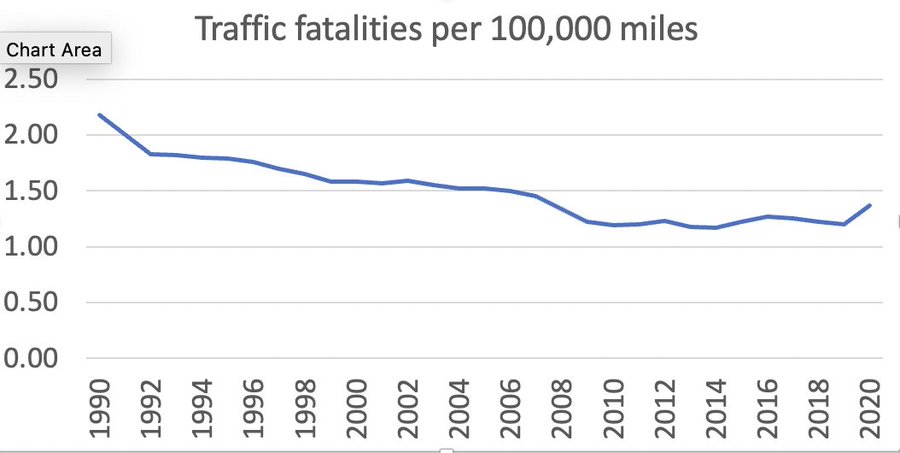
While Americans drove less in 2020 due to the pandemic, NHTSA’s early estimates show that an estimated 38,680 people died in motor vehicle traffic crashes—the largest projected number of fatalities since 2007. This represents an increase of about 7.2 percent as compared to the 36,096 fatalities reported in 2019. Preliminary data from the Federal Highway Administration (FHWA) shows vehicle miles traveled (VMT) in 2020 decreased by about 430.2 billion miles, or about a 13.2-percent decrease. The fatality rate for 2020 was 1.37 fatalities per 100 million VMT, up from 1.11 fatalities per 100 million VMT in 2019. NHTSA’s analysis shows that the main behaviors that drove this increase include: impaired driving, speeding and failure to wear a seat belt.

“Safety is the top priority for the U.S. Department of Transportation. Loss of life is unacceptable on our nation’s roadways and everyone has a role to play in ensuring that they are safe. We intend to use all available tools to reverse these trends and reduce traffic fatalities and injuries,” said Dr. Steven Cliff, NHTSA’s Acting Administrator. “The President’s American Jobs Plan would provide an additional $19 billion in vital funding to improve road safety for all users, including people walking and biking. It will increase funding for existing safety programs and allow for the creation of new ones, with a goal of saving lives.”

NHTSA’s projections show significant increases in fatalities during the third and fourth quarters of 2020 as compared to the corresponding quarters of 2019. NHTSA will continue to carefully analyze various data sources to understand how the risks to vulnerable road users might have changed during 2020 and the contributing factors for the increase.
Krugman also created a chart of traffic fatalities per miles driven from 1990 to 2020.


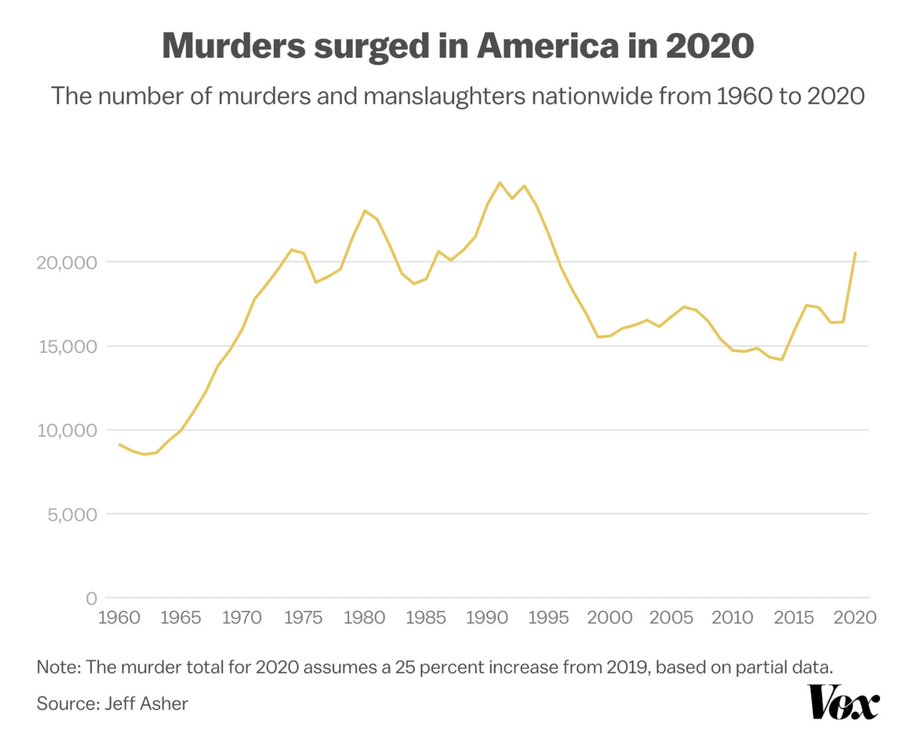
He then compared it to Vox's graph of homicides from 1960 to 2020.


Krugman commented on the parallel between traffic deaths and homicides in the rest of the Twitter thread. In the past week of returning to in-person teaching and resuming my pre-pandemic driving patterns, I've observed several people driving just as Krugman described, weaving in and out of traffic at high speeds. While a few Michigan drivers were doing that all along before the pandemic, I think I've seen more this week than the pre-pandemic average. Based on the data and my personal observations, I agree with Krugman that "the pandemic and its disruptions seem to have done a number on social psychology in many dimensions. The worrisome thing is that troubled behavior seems to be persisting even as the country reopens." Here's to hoping that subsides when the pandemic is over, which it isn't.

Enough of the big picture. Follow over the jump for the numbers about my personal driving.

Monday, August 1, 2016

Stocks resume climbing a wall of worry to hit new highs


I concluded the section before the jump in All Hell breaks loose after the U.K. votes to leave the E.U. with this caveat.
If this continues, and the Dow goes into a correction over the next few months that takes it to below 14,650, it makes both Mike Alexander's prediction of a 10,000 point decline in the Dow by the end of 2018 more likely and my prediction of a recession beginning by the end of 2017 more likely to come true.
That didn't happen.  Instead, this did: Red-hot Dow rises for 9th day in a row.
The stock market is so hot that the Dow just notched a rare nine-day winning streak.

It's only the seventh time since 1980 that the benchmark index has climbed that many days in a row, according to the New York Stock Exchange.

More impressive, the Dow continues to rewrite the record books, closing on Wednesday at yet another fresh all-time high of 18,595.

It's the latest milestone in what has been a wild summer for stocks. Global markets plunged on June 24 after the Brexit referendum in the U.K. spooked investors. But stocks soon raced back emphatically, and just kept rising until they took out the records set in May 2015.

"We're setting new records, but don't forget it took us 14 months to get here," said Art Hogan, chief market strategist at Wunderlich Securities.
That was on July 20th.  Two days later, Barrons reported "The S&P 500 rose 0.6% this week after gaining 0.5% to 2,175.03 today, a new record high."  That's not all, as the last Friday of July saw a new intraday high, as Reuters reported.
Wall Street rose on Friday, with the S&P 500 index hitting a record intraday high for the seventh time this month as gains in technology heavyweights Alphabet and Amazon more than made up for losses in energy shares.

The benchmark index rose as much as 0.3 percent, touching an all-time high of 2,177.09, and completed its fifth straight month of gains.
So, will Mike and I end up being wrong?  Not yet.  Follow over the jump for why.

Thursday, June 23, 2016

Brexit vote today

As I write this, voters all over the United Kingdom are voting on whether to remain in or leave the European Union.  John Oliver explains the issues and offers his pro-remain opinion in Brexit.

Britain could soon vote to leave the European Union. John Oliver enlists a barbershop quartet to propose a smarter option.
Oliver isn't the only public supporter.  Krugman is, too.  However, he's less enthusiastic about it, calling it a choice between bad and worse.  Still, who am I to disagree with both John Oliver and Paul Krugman in a topic that I'm not a bigger expert in than than they are?  So, I hope the British vote to remain.  I'll have to wait until tomorrow to see if they do or choose to leave.

Saturday, December 26, 2015

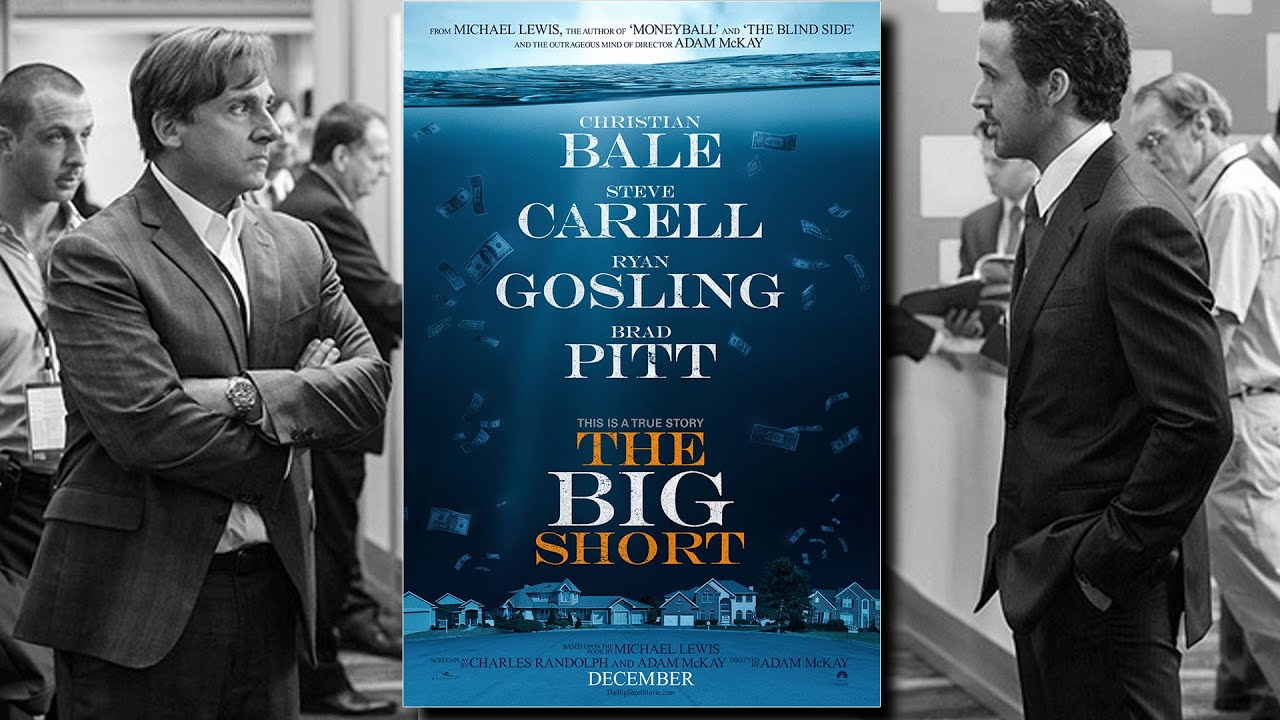
Paul Krugman and the awards shows on 'The Big Short'


I concluded Music for moving pictures at the 58th Grammy Awards by telling my readers "Stay tuned for at least one more entry about entertainment, this time about the Golden Globes."  After being distracted by 'Star Wars: The Force Awakens' among other things, I'm making a down payment on that promise with a movie nominated for several Golden Globe Awards, "The Big Short."  May I not end up undewater at the end of the entry.

Unlike most of the collapse-and-decline-related entertainment I cover here, this film is not science fiction but historical fact.  As for how well it told that recent history, I turn to Paul Krugman and his review in the New York Times, ‘The Big Short,’ Housing Bubbles and Retold Lies.
“The Big Short” is based on the Michael Lewis book of the same name, one of the few real best-sellers to emerge from the financial crisis. I saw an early screening, and I think it does a terrific job of making Wall Street skulduggery entertaining, of exploiting the inherent black humor of how it went down.

The film achieves this feat mainly by personalizing the tale, focusing not on abstractions but on colorful individuals who saw the rot in the system and tried to make money off that realization. Of course, this still requires explaining what it was all about. Yet even the necessary expository set pieces work amazingly well. For example, we learn how dubious loans were repackaged into supposedly safe “collateralized debt obligations” via a segment in which the chef Anthony Bourdain explains how last week’s fish can be disguised as seafood stew.

But you don’t want me to play film critic; you want to know whether the movie got the underlying economic, financial and political story right. And the answer is yes, in all the ways that matter.

I could quibble over a few points: The group of people who recognized that we were experiencing the mother of all housing bubbles, and that this posed big dangers to the real economy, was bigger than the film might lead you to believe. It even included a few (cough) mainstream economists. But it is true that many influential, seemingly authoritative players, from Alan Greenspan on down, insisted not only that there was no bubble but that no bubble was even possible.

And the bubble whose existence they denied really was inflated largely via opaque financial schemes that in many cases amounted to outright fraud — and it is an outrage that basically nobody ended up being punished for those sins aside from innocent bystanders, namely the millions of workers who lost their jobs and the millions of families that lost their homes.
Krugman was one of those economists and so was Robert Schiller, who won a Nobel Prize for his work.  I learned to trust their opinions because they were right.  That's one of the reasons that I sold at the top and was not one of the poor souls who lost his house to foreclosure or was stuck with it when it went underwater.  But enough about me.  What about the movie?
While the movie gets the essentials of the financial crisis right, the true story of what happened is deeply inconvenient to some very rich and powerful people.
...
Sure enough, “The Big Short” has already been the subject of vitriolic attacks in Murdoch-controlled newspapers; if the movie is a commercial success and/or wins awards, expect to see much more.
The movie has earned nominations for not just the Golden Globes, but also the Screen Actors Guild (SAG) awards and the Critics Choice awards.  Follow over the jump for those.

Thursday, December 24, 2015

The smart money is moving from Rubio to Cruz but the endorsements aren't


In a footnote to Ben Carson sings "One Wittle Wee Wee," I wrote that "The smart money is still on Rubio to beat Trump."  That started changing a couple of weeks ago, when Rubio's chances fell below 40% and Cruz passed Trump.  A month ago, PredictWise's aggregate of betting markets gave Rubio a 47% chance of winning the nomination.  Trump was second and well behind at 19% with Cruz at 13% and Bush at 10%.  Monday, Paul Krugman included the above chart in Where’s The Rubiomentum?  As of Wednesday, Cruz continued to gain on Rubio, rising to 27% while Rubio remained at 35% and Trump actually dropped a bit to 23%.  Meanwhile, Bush is still stuck at 10% and Christie has replaced Carson in the top five, improving to 5%.

Krugman expressed his skepticism of Rubio's odds, writing "I’m not a huge believer in prediction markets, which seem more to reflect conventional wisdom than to offer profound insights."*  Just the same, he mentioned that "it’s noteworthy that they are less and less convinced that Rubio is really a front-runner, and now take both Trump and Cruz seriously."  I saw that last month as well and I opined that it's not a good thing.

The bettors may be losing confidence in Rubio, but elected Republican officials aren't.  During the most recent debate, FiveThirtyEight posted this graph showing how many endorsements GOP candidates had earned by debate time.


Rubio has earned even more since then and is within 10 points of Bush.  Meanwhile, Ted Cruz has only been inching up.  The people making wagers may think that Rubio is losing steam, but the party establishment is still boarding the Rubio bandwagon faster than any other candidate.  If one is a fan of "The Party Decides," like the writers at FiveThirtyEight, then this is a good thing for Marco Rubio.  Of course, the party may decide on Cruz.  If so, Krugman is looking forward to the outcome.  As he wrote, "it will be fun watching supposedly moderate Republicans explain why Trump or Cruz are, in the end, better than Hillary."

*Krugman's comment mirrors what Infidel 753 wrote in a response to a comment of mine at his blog.
I don't have the slightest interest in online betting markets on elections. The fact that people are willing to put up money based on their opinions doesn't mean they have any more knowledge or expertise than anyone else -- only that they're probably as dumb as most gamblers are.
I have more confidence in the usefulness of prediction markets, but that's because of my experience with the Iowa Electronic Market, which goes back to 1992.  I've found it very reliable.

Monday, March 9, 2015

Michigan, fattest state to vote Democratic


Last week, Paul Krugman posted two graphs and noted the following in Heavy Politics.
First, yes, there is a clear correlation between obesity and Republican lean at the state level.
...
There are outliers — Utah especially, but also Montana and Wyoming, of which more in a minute, but overall the relationship is really clear. At the county level, the “diabetes belt” — that’s the CDC’s term, not mine — is clearly very Republican.
For another view of the relationship, here is a map of obesity rates among non-Hispanic Whites that Krugman also used.


The trend is clear; states with higher rates of obesity vote Republican in presidential elections.  Only three of the states colored orange voted Democratic in either 2008 or 2012, Indiana, Iowa, and Michigan.  Only one of those states has a higher obesity rate than Michigan, Indiana, and it voted Republican in 2012.  That leaves Michigan as the fattest state to vote Democratic in the past two presidential elections.

That written, all branches of the state's government are controlled by Republicans except for the educational boards.  I wouldn't be so silly as to suggest that our obesity levels have turned us into a purple state and are in danger of turning us into a red one, but there is something going on, the same thing I described in Food Fight: thoughts on liberalism and conservatism.  Krugman himself referred to something similiar when he linked to a Bloomberg article Inside the Powerful Lobby Fighting for Your Right to Eat Pizza.
Other corners of the fast-food industry have folded against public pressure for healthier choices. Not pizza.
That was Bloomberg.  Here's Krugman.
[N]utrition and obesity have become deeply partisan. Big Pizza is now an industry as dedicated to the GOP as coal or tobacco.
People in Michigan love their pizza and that might be part of the problem.

As for what to do about this if one is a Democrat in Michigan, I have this whimsical suggestion: Go on a diet and get someone to diet with you.  That's what I'm doing right now.  Not only will it be good for your health, but it might just be good for the state's politics.

Crossposted to Michigan Liberal.

Tuesday, November 18, 2014

U.S.-China climate deal


I'm in the mood for some good news tonight, so here is something I mentioned at the end of U.S. home ownership rate and me, the U.S.-China climate deal.  Take it away, LiveScience!

US-China Climate Accord Gives Hope for Global Agreement
by Megan Gannon, News Editor
November 13, 2014 07:02am ET
The United States and China surprised climate-policy watchers this week by announcing a rare accord to cut carbon pollution. As details of the agreement are released, experts are hopeful that cooperation between the world's two biggest economies, and two biggest carbon emitters, bodes well for an as-yet elusive global climate pact.

"For many years, the reluctance of the U.S. and China to make strong commitments has been an oft-used excuse by other countries to not take action," said Anthony Leiserowitz, director of the Yale Project on Climate Change Communication.

"In fact, many in the U.S. Congress have resisted taking action because they argued that China wasn't acting," Leiserowitz told Live Science in an email. "And many Chinese leaders have long used the same argument about the United States to avoid making their own commitments. This very public and early agreement by the two largest national emitters in the world should help break the long-standing logjam in the international negotiations."
Not only is this good news, but it's exactly the kind of cooperation I was hoping for when I first called the Sino-American relationship The CoDominion in U.S.-China EcoPartnerships: The CoDominion plans for sustainability and repeated in An update on The CoDominion planning for sustainability.  Given what the rest of the climate news I included in last week's Overnight News Digest: Science Saturday on Daily Kos was like, it comes not a moment too soon.*  I should curb my enthusiasm, as the result is likely to be what Paul Krugman describes in China Deals.
[O]ne of the main arguments the usual suspects make against action — after arguing that it’s all a gigantic hoax, any limits on emissions will destroy the economy, and liberals are ugly — is that nothing the US does can matter, because China will just keep on emitting. Some of us have long argued that this is way too pessimistic — that the advanced countries, if they are willing to limit their own emissions, can have a lot of leverage via the threat of carbon tariffs. But now China is showing itself willing to deal even without that.

So you could say that a major prop of the anti-climate-action campaign has just been knocked away. But as I said, it probably won’t matter; they’ll just come up with another excuse.
I wish Krugman was wrong, but he probably isn't.  Sigh.

*Stay tuned for an entry about these stories.

Tuesday, June 3, 2014

the Hipcrime Vocab: Why Slowing Population Growth is a Problem


Last month, escapefromwisconsin wrote about a Krugman blog post.  Here's the comment I left at his blog:

I just read the blog entry of  Krugman's [you] quoted and was thinking of writing a very similar post with comments from his readers responding to him, much as I did with Blast from the past: Pathology on the Right, a commentary on Krugman's "Two speeches and an editorial" and A Day in Exquisite Insults of Objectivists . Now that you've done it for me, I don't have to. Now I can just direct my readers to you.


Here's the link to his entry:


the Hipcrime Vocab: Why Slowing Population Growth is a Problem: Why is slowing population growth, which we so desperately need, a problem? It's entirely due to the way in which we've set up our e...


Happy reading!

Tuesday, January 21, 2014

'A Steampunk calculator' and six other sustainable technologies from The Archdruid


I've been so busy with other topics that I haven't posted my two most recent conversations with Greer the Archdruid.  Fortunately, as I noted in Putin the Brony on His Little Pony, readers have enjoyed this topics and my stats are doing well.  Just the same, I think it's time to post the latest one, in which I engage Greer on last Wednesday's Seven Sustainable Technologies.

Greer gave me two openings last week.  The first was one that I had responded to before, about how mainstream thought in particular and mainstream economics in general were ignoring our energy issues as a source of our economic problems.
Plenty of explanations have been proposed for the current era of economic unraveling, but I’d like to suggest that the most important factor is the overall decline in the “energy profit” that makes modern economies possible at all.
That gave me an opportunity to be a good environmentalist and recycle a comment I'd left at Kunstler's blog.
One person who should know better, but completely discounts the idea of resource depletion as an important contributor to the current situation is Paul Krugman.  In a New York Review of Books article, Krugman revealed that he was the research assistant for William Nordhaus’ landmark paper, “The Allocation of Energy Resources.” He “spent long hours immured in Yale’s Geology Library, poring over Bureau of Mines circulars and the like.” If someone with his experience with the economy of energy doesn’t get Peak Oil, then it’s probably hopeless for most economists to comprehend the issue. James Hamilton of UC San Diego is about it. That’s why I use people like Jim Kunstler as one of my examples of ecological economists (he's in a film I show my students; if you were, I'd use you instead), and list Krugman among the conventional economists.
Greer didn't respond to that.  The next part was more fruitful.
Speaking of things I tell my students (I teach environmental science, a field that is full of the "bright green" types that you deride as unrealistic), I really like your list of seven sustainable technologies and plan on including them in my teaching.
As a Crazy Eddie, I happen to be one of those "bright green types."*  Fortunately, Greer doesn't know this. Follow over the jump for what did get his attention.

Monday, May 6, 2013

A story and graphs for the new semester

In this morning's entry, I included part of a comment I left over at Kunstler's blog this morning.  There's another part that was appropriate for today.
When I lecture about economic schools of thought, which I'll do next week, as the new semester starts today, I give Paul Krugman as an example of mainstream economics, which discounts resource depletion and pollution. Krugman will at least consider the economic effects of pollution, but I've seen him dismissed the effects of resource depletion. Peak Oil? He's not having it. Go to James Hamilton of Econobrowser for a mainstream economist who will at least look at it.

That same lecture I also talk about environmental economists and ecological economists. The head of Stonyfield Farms gets to be the example for the environmental economists, while Jim is one of my examples of people who follow ecological economics. Without a strong natural environment, there is no society, and without a society, there is no economy. That's the lesson the mainstream economists forget.
That lesson is why I show my students both versions of the sustainability spheres diagram, and point out that the bullseye version is more accurate than the "Mickey Mouse" version.

For a refresher, here they are, the standard "Mickey Mouse" version first and the Bullseye version next.


In that same lecture where I discuss the three main economic worldviews and give examples of people who follow each, I talk about the three kinds of capital, natural, human, and manufactured.  One of my favorite parts involves human capital, where I point out that education is an exercise in improving human capital that bears real world fruit.  I've discussed that before here on Crazy Eddie's Motie News, but I think it's time for an update.

Here's the latest graph on unemployment by educational level from Calculated Risk, which I will use next week.


This graph shows the value of education in economic terms, as protection from unemployment. It definitely grabs the students' attention.  I hope it also gives them some comfort in these uncertain times.

Saturday, December 1, 2012

Nablopomo for December: Work

NaBloPoMo December 2012


What's this month's theme?
WORK.


December kicks off a new addition to the BlogHer conference family -- BlogHer PRO -- and what better way to celebrate it than to consider how work fits into each of our lives?

More and more, the work we do isn't falling into clear-cut, 9-to-5 boundaries. Some work is unpaid but moves us closer to our overall goal. Some work doesn't feel like work at all because it's so much fun.

And, of course, we'll need to spend the month daydreaming your ideal work to make sure you're doing the work you really want to do (and if you're not, maybe January will be a time to start down a new path!).
...
So start thinking about what feels like work and what feels like play. And join us on the BlogHer.com homepage and on Facebook, where we'll be talking about work and sharing career tips daily through midmonth!
This should be easy.  I blog about my work a lot; all one has to do is look at the entries with the tags stories I tell my students, Oakland Community College, and Examiner.com, as well as real life and education.  Look for more of those this month.

Also, I blog about other people's work all the time.  I use the fruits of their labor whenever I quote an article, press release, or blog post.  Speaking of which, I should start quoting The Hipcrime Vocab, Early Warning, and Calculated Risk more often.  The first is very interested in the nature of work (escapefromwisconsin is of the opinion that the 9 to 5 job is both an anomaly and a trap).  The second is interested in the prospects for work (Stuart Saniford thinks that widespread employment is in danger from automation).  The third is just a great source of information about the economy, including employment.  Should I write a sustainability textbook, I'd use Bill McBride's graphs to illustrate it.  Paul Krugman has even more lavish praise.
CR is an example of the sort of economic reporting and analysis people would be following if they really wanted to know what was happening, rather than “reporting” that reinforces their prejudices. (But enter CR’s comment threads at your own risk — the usual suspects show up in force). CR’s analysis, more than anyone else’s, gave me a heads-up on the housing bubble, and has helped me along the way on many other issues.
Oh, yes, I should be quoting Krugman more, too.  Looks like I have my work cut out for me for this month.

Wednesday, October 3, 2012

Consumer confidence up but mostly among Democrats


Last week had good economic news in the form of higher consumer confidence, both nationally and in a key swing state. First, the national news from the University of Michigan.

http://www.ns.umich.edu/new/multimedia/videos/20809-consumer-confidence-posts-a-significant-gain-in-september
September 28, 2012
ANN ARBOR, Mich.—Consumer confidence improved substantially in September due to more favorable prospects for the national economy, according to University of Michigan economist Richard Curtin, director of the Thomson Reuters/University of Michigan Surveys of Consumers.
...
Consumers expect the economy to create more jobs in the year ahead, according to Curtin. The overall rise in confidence was aided by higher stock prices as well as rising home values.

However, the majority of consumers still anticipate very small wage gains and expect somewhat larger price increases during the year ahead, due largely to rising food prices. This means that half of all households anticipate declining living standards as their incomes fail to keep pace with inflation.
In addition to economic growth and more jobs, consumers have become more optimistic about the real estate market. I said it looks like the housing market has bottomed, and consumers seem to believe it.

That's good news for the nation as a whole. What about the news from a key swing state, Florida?

University of Florida: UF: Florida consumer confidence hits five-year high
September 25, 2012.
GAINESVILLE, Fla. — Florida’s September consumer confidence reached a post-recession high of 79 — up three points from a revised August reading of 76, according to a monthly University of Florida survey.

“The last time Florida consumer confidence hit 79 was in October 2007,” said Chris McCarty, director of UF’s Survey Research Center in the Bureau of Economic and Business Research. “At that time, confidence was on its way down as the housing crisis was getting under way. This month’s index comes at a time when the economy is still in recovery.”

The September survey showed increases in all five components that researchers use to assess the collective economic opinion of Floridians.
Even better, especially for President Obama. Rising consumer sentiment would make people more likely to vote for him and less likely to buy into the argument that they're worse off now than they were in 2008. The Florida consumer confidence index shows that people in the Sunshine State think they're better off.

Speaking of politics, what do people's political views have to do with their economic ones? Quite a bit, actually.

Friday, September 21, 2012

The Right learned all the wrong lessons from 1984


Expanding on the theme of the Republican Party having become an authoritarian movement, Paul Krugman makes a comparison to a fictional totalitarian organization in When The Inner Party Believes The Prolefeed
.The “lucky ducky” trope is clearly, obviously nonsense; equally obviously, it was originally created in an effort to dupe people who didn’t know better. It was and is what Orwell called “prolefeed”, junk aimed at the ignorant masses (ignorant by design), the people who are ready to believe at a moment’s notice that we’ve always been at war with Eastasia.

In Orwell’s vision, however, the Party – and especially the Inner Party – wasn’t supposed to consume this same tripe. It was supposed to understand the true Party agenda and vision (a boot stomping on a human face forever).

So it actually is a revelation to see Romney and friends obviously swallowing the prolefeed whole. The news here isn’t really about their lack of empathy; it’s about their raw ignorance.
While I agree with Krugman about the aptness of the comparison, I think he's wrong about the order. I think this is what a faction of the "Inner Party" wanted to believe all along, and now that they've taken over, they're now passing it out as prolefeed. I should know; I was a Republican for 22 years ending in 2000. I remember seeing this meme from the inside even back then.

Above based on a comment I left on Michigan Liberal.

Saturday, September 15, 2012

Four years ago, we were partying like 1929--what a difference today!

The news on Wall Street this week has been the best since the start of the Great Recession. Earlier this week, Krugman posted this chart of the DJIA since the beginning of 2008 in A Vote of Confidence.


That was Wednesday. Since then, it has continued to climb, as Reuters reports in Wall Street ends at multi-year highs on Fed.
U.S. stocks rose for a fourth straight session on Friday to close out the week at nearly five-year highs after the Federal Reserve took bold action to spur the economy, a move that could keep equities buoyed in the coming months.
...
The Dow and the S&P 500 both closed at their highest levels since December 2007, while the Nasdaq ended at the highest since November 2000. The small-cap Russell 2000 .RUT index closed at the highest since April 2011.

The Dow Jones industrial average .DJI ended up 53.51 points, or 0.40 percent, to 13,593.37. The Standard & Poor's 500 Index .SPX closed up 5.78 points, or 0.40 percent, to 1,465.77. The Nasdaq Composite Index .IXIC gained 28.12 points, or 0.89 percent, to 3,183.95.

For the week, the Dow rose 2.2 percent, the S&P climbed 1.9 percent and the Nasdaq added 1.5 percent.

The S&P is now just 6 percent below its all-time closing high of 1,565.15 despite a relatively weak economy and economic risks around the world.
That's quite a change from four years ago today, when Lehman Brothers filed for bankruptcy. From Wikipedia:
Financial services firm Lehman Brothers filed for Chapter 11 bankruptcy protection on September 15, 2008. The filing remains the largest bankruptcy filing in U.S. history, with Lehman holding over $600 billion in assets.
Follow over the jump for a flashback to the eve of the collapse of Lehman Brothers, when I posted Tonight we're gonna party like it's 1929! to the unfunnybusiness community on JournalFen and then reposted it to my LiveJournal.

Thursday, September 6, 2012

National Review ironically reveals another deep truth about the current GOP

Kunstler ranted about the current state of the major parties over at his blog on Monday.
In the vicious vacuum that national party politics has become, the Republicans and Democrats are already dead. They choked to death on the toxic fumes of their own excreta. They are empty, hollow institutions animated only by the parasites that feed on and squirm over the residue of decomposing tissue within the dissolving membranes of their legitimacy. Think of the fabled Koch brothers as botfly larvae and the Securities Industry and Financial Markets Association PAC (SIFMA PAC) as a mass of writhing maggots.
I disagree with him about the state of the Democratic Party, otherwise I wouldn't be a precinct delegate for them,* but I thought he was on track for the GOP.
I think you're onto something, but you may have the wrong metaphor. Think of something much more sinister.

As I tell my liberal friends who keep thinking that the GOP should be dead by now, the GOP as a traditional party engaged in electoral politics is already dead. What it is now, as described by "EscapefromWisconsin" over at the Hipcrime Vocab, is an authoritarian movement. That makes it an undead party in a democratic system. As Bela Lugosi's Dracula said in the eponymous movie, "There are far worse things awaiting Man than Death." Yeah, and one of them has happened to the GOP.
Here's Bela saying that line in a fan video of "Bela Lugosi's Dead."


As if to prove the point, cover of The National Review portrays the Republican ticket in the socialist realist style of Soviet propaganda art.


AmericaBlog pointed out that this was an obvious tribute/imitation to a Soviet propaganda poster.
If you're a student of history, this style will be familiar - it's communist. And this image below is clearly the Soviet propaganda poster the Romney/Ryan image was based on.


There's no way this is a coincidence. Down to the flag it's the same poster. Some of the commenters noted that Romney's and Ryan's arms are suggestive of the hammer and sickle, but the books and architectural plans take the place of the hammer, their curved arms are the sickle.

I get that the National Review thought they were being ironic or satirical, but I'm not sure portraying Romney and Ryan in the guise of America's biggest enemy of the last century is politically wise.
Just as I described in Old man yelling at chair accidentally reveals a deeper truth, people who are supposed to be the messengers of the GOP are unintentionally showing the authoritarian reality behind the party's republican facade.

AmericaBlog is not the only one to notice this. In Republican war on higher education and social science, I quoted Paul Krugman from The New Political Correctness, who remarked about the similarity to the Soviets.
And then there’s the teaching of history. Eric Rauchway has a great post about attacks on the history curriculum, in which even talking about “immigration and ethnicity” or “environmental history” becomes part of a left-wing conspiracy. As he says, he’ll name his new course “US History: The Awesomeness of Awesome Americans.” That, after all, seems to be the only safe kind of thing to say.

Actually, this reminds me of an essay I read a long time ago about Soviet science fiction. The author — if anyone remembers where this came from — noted that most science fiction is about one of two thoughts: “if only”, or “if this goes on”. Both were subversive, from the Soviet point of view: the first implied that things could be better, the second that there was something wrong with the way things are. So stories had to be written about “if only this goes on”, extolling the wonders of being wonderful Soviets.

And now that’s happening in America.
As you can see, I finally got around to presenting more evidence supporting the comparison to the Soviets--and there's plenty were that came from. Until I return to the subject, I'll leave you with "Eye spy the GOP's authoritarian impulses on display."

*That doesn't mean I can't see where he's coming from.  After all, Bill Clinton was able to get a bunch of left-leaning delegates who dislike Simpson-Bowles to cheer for it last night, and President Obama is rumored to be speaking about entitlement reform tonight, another topic that the left doesn't care for much.  Just the same, the Democrats are still a normal party pursuing electoral politics in a democratic system, so they're not undead like the GOP.

Friday, August 17, 2012

Thursday, August 2, 2012

Nablopomo for August: Sweet

NaBloPoMo August 2012

What's this month's theme?
SWEET

That perfect bite of watermelon, that time when a reader left the perfect comment, a picture that a child drew for you: NaBloPoMo is celebrating the sweet things in life this month. In fact, NaBloPoMo is kicking off during a very sweet time of year: the annual BlogHer conference where 4500 people are coming together to meet up with friends and talk blogging. This is the perfect time to jump into daily blogging when the creative juices are running high.

Of course, we're going to have to talk about what qualities make a person be described as "sweet" as well as our favourite candies, the best dessert you ever had, and who is really made of sugar, spice and everything nice.
...
So start thinking about all of your favourite sweet things.
In case you were wondering why I concluded last night's post by observing that the idea of blogging about Ted Cruz's Agenda 21 paranoia for six years "is not sweet," wonder no longer. I was already following the theme.

It turns out that I'm not done with yesterday's entry.
Since Paul Krugman was the one who alerted me to Ted Cruz, I decided to return the favor by leaving this comment on his blog.
Speaking of paranoia striking shallow, do you remember Ted Cruz, who you wrote about in "First, they came for the golf courses"? He managed to survive the Texas senate primary at the end of May. He's in a runoff election for Kay Bailey Hutchinson's U.S. Senate seat in Texas today. Back in May, he lost by 10 percent. As of the most recent poll, he was ahead of his opponent David Dewhurst by 10 percent. The guy who thinks Agenda 21 is a U.N. conspiracy to take away "golf courses, grazing pastures, and paved roads" is likely to be the GOP nominee and therefore the favorite to win in November. He is, as I'm fond of saying one of the GOP's maniacs who are promising people that they can keep their cars, McMansions, and commutes this year. Care to use him to make a point about how crazy the Republican Party has become--again?
Krugman read the comment and published it. It's now up to him to follow through.
This morning, he did. Sweet!

Tee Party
First, they came for the golfers.
So the Republican nominee for Senate in Texas is a man who believes that there is a global plot, led by George Soros, to eliminate golf courses. Also, that states can nullify Acts of Congress.

Politics in the world’s greatest nation.
Never let it be said that Dr. Krugman does not respond to reader requests.

Wednesday, August 1, 2012

Agenda 21 paranoid Ted Cruz won his runoff


Yesterday, I noted that Agenda 21 conspiracy theorist Ted Cruz was leading in the latest polls in his runoff for the Republican nomination to succeed Kay Bailey Hutchison and made the following promise.
Looks like I'm not done with blogging about politicians exploiting Agenda 21 paranoia, even after I said "Goodbye, Gingrich!"
I'll check back after the votes are tallied tonight.
I was right. Cruz won. USA Today reports.
Texas Republicans picked Tea Party-backed candidate Ted Cruz in Tuesday's Senate runoff election, knocking out long-time Lt. Gov. David Dewhurst in a race being watched nationally.
...
Cruz competed against a better funded and known establishment favorite based largely on his appeal to grass-roots conservatives and endorsements from national party leaders including former Alaska governor Sarah Palin and Sen. Jim DeMint, R-S.C.

"What we've found is, if you've got grass-roots energy, all you really need is enough money to get you on the radar," DeMint said.
That was 2 hours ago, when the AP called the race with less than half the precincts reporting. Since then, Cruz's margin has expanded with today's walk-up vote building on the lead he had in the early vote, as the Texas Secretary of State reported at 11:00 PM CDT (Texas local time) that Cruz was leading Dewhurst 56.20% to 43.79% with 86.36% of precincts counted.

As for what this means, I'll let the New York Times explain.
Mr. Cruz, 41, is the latest conservative rebel to bring down an established party leader, tapping into simmering anger and anti-incumbent frustration within the Republican ranks nationwide.

These dissident triumphs include, in this year’s primaries, the defeat of Senator Richard G. Lugar of Indiana by Richard E. Mourdock and Deb Fischer’s win over a veteran Republican for the Senate nomination in Nebraska. They also echo Marco Rubio’s Senate victory in 2010 over a sitting Republican governor, Charlie Crist of Florida.

Mr. Cruz, who is Cuban-American, has drawn comparisons to Mr. Rubio, another 40-something Cuban-American who quickly became an icon of fiscal and religious conservatives around the country. Mr. Cruz’s rapid ascent has already shaken up the Texas Republican Party.

“Mr. Cruz’s success shows that the center of the state party has moved decisively to the right,” said James Henson, a political scientist at University of Texas. “The Republicans are in much more treacherous terrain, not because of threats from Democrats, but threats from within the party.”
Since Paul Krugman was the one who alerted me to Ted Cruz, I decided to return the favor by leaving this comment on his blog.
Speaking of paranoia striking shallow, do you remember Ted Cruz, who you wrote about in "First, they came for the golf courses"? He managed to survive the Texas senate primary at the end of May. He's in a runoff election for Kay Bailey Hutchinson's U.S. Senate seat in Texas today. Back in May, he lost by 10 percent. As of the most recent poll, he was ahead of his opponent David Dewhurst by 10 percent. The guy who thinks Agenda 21 is a U.N. conspiracy to take away "golf courses, grazing pastures, and paved roads" is likely to be the GOP nominee and therefore the favorite to win in November. He is, as I'm fond of saying one of the GOP's maniacs who are promising people that they can keep their cars, McMansions, and commutes this year. Care to use him to make a point about how crazy the Republican Party has become--again?
Krugman read the comment and published it. It's now up to him to follow through.

The good news is that I was proven right. I'll be blogging about Agenda 21 paranoia up through November. The bad news is that he's likely to win, as the N.Y. Times article concludes.
Mr. Cruz is expected to have a large advantage over his Democratic opponent. In the Democratic runoff, which was also held Tuesday, former State Representative Paul Sadler defeated Grady Yarbrough, a retired educator. Texas has not elected a Democrat to the Senate since Lloyd Bentsen in 1988.
I now know how liberal comedians feel about the possibility of a Romney victory.  It is not sweet.

Saturday, June 30, 2012

Republican war on higher education and social science

It's the end of the month, which means it's time to serve up leftovers. Here is a collection of links on a common theme that I've been sitting on this month, waiting for me to post them.

First up, an article from Alternet which looks like conspiracy theory at first, but I thought worth considering. After all, we live in weird times, and as Hunter S. Thompson famously said, when the going gets weird, the weird turn pro.

Alternet: Deciphering Right-Wing Code: What Conservatives Are Really Saying When They Seem to Spew Nonsense
Did Rick Santorum just declare the next right-wing crusade?

Rick Santorum is firing the opening salvos on a conservative war on public higher education.

That was a few months ago. Let's see how that is playing out over the jump.