Showing posts with label New York Times. Show all posts

Saturday, June 28, 2025

'You’re Being Lied To About Voter Fraud. Here’s the Truth,' a double News & Doc Emmy winner

I'm returning to the News & Doc Emmy Awards with a video that won awards in both news and documentary categories, "You’re Being Lied To About Voter Fraud. Here’s the Truth," part of which is on YouTube as I Help Run Elections in My Pennsylvania County. The Right Is Being Lied To. | NYT Opinion.

The United States is closer than ever to achieving the dream it’s been chasing since 1776: an inclusive democracy that lives up to the promise of one person, one vote. But since 2020, election deniers have sought to undermine America’s collective voice with lies about the security of our elections. In the Opinion Video above, Neil Makhija — who will help oversee elections in his county in the battleground state of Pennsylvania — argues that our votes have never been safer or more secure. In fact, someone is more likely to be struck by lightning than to impersonate someone else at a polling site.

But we can’t afford to be complacent. “To protect democracy, we can’t just play defense,” Makhija cautions. “We need to go on offense to expand voting rights and voting access.”
The video is not just well done, it's inspiring. I can see how it won. Speaking of which, here's the tweet announcing its first Emmy Award for Outstanding Graphic Design – News. Now the tweet announcing its second Emmy for Outstanding Art Direction / Set Decoration / Scenic Design – Documentary. I started to cover this category in 'Apollo 13: Survival' leads nominees for Outstanding Science and Technology Documentary at the News & Doc Emmy Awards for Wayback Wednesday.
Apollo 13: Survival is the most nominated entry in Outstanding Art Direction / Set Decoration / Scenic Design – Documentary, which has been separated from Outstanding Lighting Direction. It's followed by Hitler and the Nazis: Evil on Trial from Netflix, Separated from MSNBC, and You're Being Lied To About Voter Fraud. Here's the Truth from The New York Times Opinion, each with two nominations, and Glitter and Greed: The Lisa Frank Story from Prime Video and This Is What a Nuclear Strike Would Feel Like from The New York Times Opinion, both with this one nomination. I don't have an opinion on this, so I'm holding off on making a prediction.
I never returned to this category until now. That's probably a good thing, as I avoided making a bad prediction. Just the same, congratulations to New York Times Opinion, Creative Director Neil Makhija, and Art Directors Jim Batt, Kim Boekbinder, Molly Crabapple!

I expect to cover more News & Doc Emmy Awards winners, but I plan on looking at a different awards show, the Critics Choice Super Awards, for tomorrow's Sunday entertainment feature. Stay tuned.

Previous posts about the 46th News & Doc Emmy Awards

Monday, April 15, 2024

The New York Times explains 'There’s a Tax Season Villain, and It’s Not the I.R.S.' for Tax Day

For Tax Day, I'm sharing There’s a Tax Season Villain, and It’s Not the I.R.S. | NYT Opinion.

It’s the most miserable time of the year: tax season.

Americans are about to spend millions of hours and billions of dollars filing their federal income taxes, and they are pretty sure they know who is responsible for their pain: The misanthropes at the Internal Revenue Service.

But we’re here to convince you that the I.R.S. is not the problem.

Yes, it should be easy to file taxes. And yes, it should be free. That’s how it works in the rest of the developed world, and it could very easily work that way here, too. It is absurd that America’s tax system is so antiquated and complicated that most people must pay someone else to help them pay the government.

So what is standing in the way of progress?

Watch.
I have two things to say about this video. First, I knew I was going to use it today as soon as I saw the preview image. It's Johnny Harris, who demonstrated his skills when he was working for Vox, now working for the New York Times, so I knew the video would be good. Second, I had a good idea who the villain was, and I was not disappointed. May the U.S. finally get a free tax-filing portal. It may be too late today, but maybe next year. Happy Tax Day!

Wednesday, September 27, 2023

Outstanding Live News Special among last categories examined before News & Documentary Emmy Awards ceremonies

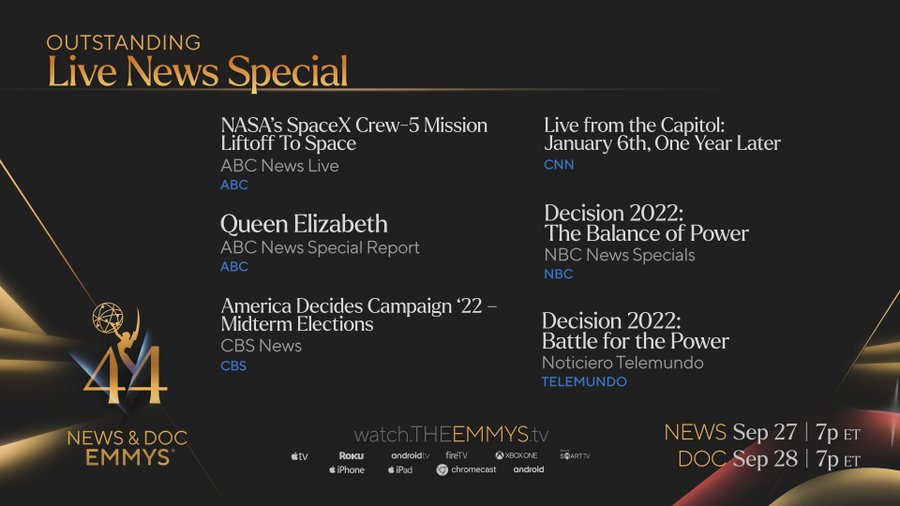
I wrote "I have a graphic for Outstanding Live News Special and I might use it in one final post about the nominees before the News ceremony on Wednesday, September 27th." That's tonight, so I'm using it and two other Twitter graphics before they turn into pumpkins.


I expect the nominee with the most total nominations, CNN's Live from the Capitol: January 6th, One Year Later, will be the one that wins. It earned nominations for Outstanding Direction: News and Technical Excellence: News for three nominations overall. That CNN won this award last year supports my prediction. The only other nominee with another nomination is Noticiero Telemundo's "Decision 2022: Battle for the Power," which is also nominated for Technical Excellence: News, so it's my pick for second place. The rest just have this one nomination, so I am not optimistic about their chances, as much as I'd like one of the two ABC News nominees to win.


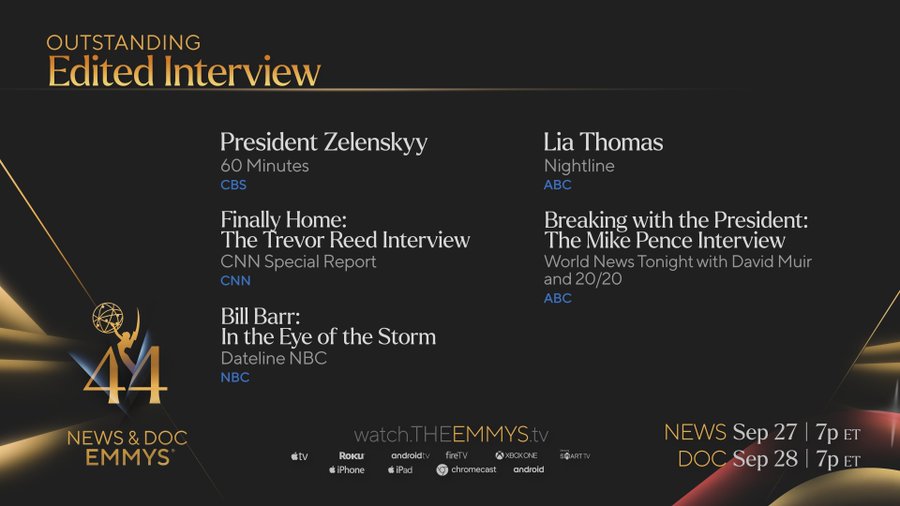
All of these interviews have only this one nomination, so I have to go on prior performance and news judgment to pick a winner. 20/20 won this award last year and Mike Pence breaking with the former guy is definitely newsworthy, so I think it's the favorite. My other pick would be 60 Minutes interviewing President Zelenskyy. I don't think the rest are likely to win, although another interview of Bill Barr shows up in the next category.


Again, all of these interviews have only this one nomination, so I have to go on prior performance and news judgment to pick a winner. The New York Times DealBook Summit won this award last year, so I can't count Andrew Ross Sorkin out, as distasteful as I find his subject, Sam Bankman-Fried, to be. Then again, he indirectly caused my wife and me to lose money, so that might color my judgment. Speaking of which, I think Anderson Cooper's interview of Nancy Pelosi has more news value and is of someone I find more sympathetic, so it's the one I want to win. The journalists who are voting might not agree. Remember, electorates matter.

That's it for my coverage of the nominations. I plan on returning with the winners beginning Friday after looking at either more strike news or the outcome of the second Republican debate. As I wrote yesterday "I'm just not feeling that last one this cycle, so I might skip it." In either event, stay tuned.

Previous posts about the 2023 News & Documentary Emmy Awards

Saturday, September 9, 2023

'Beyond Fentanyl' and 'Vice News Tonight' lead Outstanding Health or Medical Coverage at the News & Doc Emmy Awards


I am resuming my coverage of the News & Doc Emmy Awards with the nominees for Outstanding Health or Medical Coverage.
Outstanding Health or Medical Coverage
Fault Lines
A Toxic Feed: Social Media and Teen Mental Health Al Jazeera International USA
This Is What a Post-Roe Abortion Looks Like The New York Times
VICE News Tonight Beyond Fentanyl Vice
VICE News Tonight Cuba’s Healthcare Crisis Vice
VICE News Tonight Post-Roe America Vice
Not only is VICE News Tonight's "Beyond Fentanyl" the only nominee with another nomination, VICE News Tonight has two other nominees in this category, comprising three of the show's 28 nominations. Based on that criterion, I expect "Beyond Fentanyl" is the favorite to win this category. Vote-splitting among the other nominees from VICE News Tonight might impede its path to the podium, although that could also affect "Post-Roe America" as it contends with This Is What a Post-Roe Abortion Looks Like by The New York Times. Finally, seeing Al Jazeera International USA reminds me that Al Jazeera America's final Emmy nominations were what got me interested in the News & Doc Emmy Awards in the first place.

Now for the other nomination of "Beyond Fentanyl."

Outstanding Editing: News
Caught on Camera, Traced by Phone: The Russian Military Unit That Killed Dozens in Bucha
The New York Times
Trafficked with Mariana van Zeller Cocaine Queens National Geographic
Trafficked with Mariana van Zeller White Supremacy National Geographic
VICE News Tonight Battle for the South of Ukraine Vice
VICE News Tonight Beyond Fentanyl Vice
This category contains two more of VICE News Tonight's nominations, although this is the only nomination earned by "Battle for the South of Ukraine." All of the rest have at least one other nomination. In addition to the nomination for Outstanding Health or Medical Coverage earned by "Beyond Fentanyl," "Caught on Camera, Traced by Phone: The Russian Military Unit That Killed Dozens in Bucha" garnered a nomination for Outstanding Investigative News Coverage: Long Form, Trafficked with Mariana van Zeller's "Cocaine Queens" earned a nomination for Outstanding Writing: News, and Trafficked with Mariana van Zeller's "White Supremacy" has the most, including Outstanding Crime and Justice Coverage and Outstanding Research: News for a total of three. I've already predicted "White Supremacy" will win Outstanding Research: News and I expect it's the favorite to win Outstanding Editing: News, too. It also has the most nominations among the field for Outstanding Crime and Justice Coverage, although ABC's "X / o n e r a t e d – The Murder of Malcolm X and 55 Years to Justice" with two total nominations might give it a run for its money.

I close with Benzo Dope and Tranq: The Next Wave of the Overdose Crisis, the upload title of "Beyond Fentanyl."

More than 100,000 Americans died of a drug overdose in 2021, the worst year on record. The newest wave of the overdose crisis involves man-made chemicals, including animal tranquilizers, that are being combined with fentanyl to make street drugs that are deadlier and more addictive.

With access to an undisguised fentanyl dealer, Beyond Fentanyl looks at how drugs like “benzo dope” and “tranq” are ravaging North American communities and how U.S. policy affected the latest flood of synthetic street drugs.
Last year, I reported CNBC and PBS report record overdose deaths in the U.S. in 2021 as 107,600 Americans died. Last year saw another record, as NPR reported U.S. drug overdose deaths hit a record in 2022 as some states see a big surge.
Drug deaths nationwide hit a new record in 2022. 109,680 people died as the fentanyl crisis continued to deepen, according to preliminary data released by the Centers for Disease Control and Prevention.

Eight states saw drug deaths continue to surge by nine percent or more, with the greatest increases of 21 percent coming in Washington state and Wyoming.

Dr. Nora Volkow, director of the National Institute on Drug Abuse, said it's troubling that deaths continue to rise despite the end of disruptions linked to the COVID pandemic.

"That's a very very high level of overdose deaths," Volkow told NPR.

"One could have expected that as many of the challenges imposed by the COVID pandemic were resolved, we would see a deep dive in the number of overdose deaths. It's concerning we have not seen that."
The opioid crisis is getting worse. The official end of the pandemic hasn't improved this crisis at all.

Stay tuned for another installment of this series tomorrow as the Sunday entertainment feature.

Previous posts about the 2023 News & Documentary Emmy Awards

Thursday, March 3, 2022

The wildlife of the Chernobyl Exclusion Zone for World Wildlife Day 2022

Happy World Wildlife Day! I am taking my cue from the Russian invasion of Ukraine to re-examine the wildlife inhabiting the exclusion zone around Chernobyl. I begin with Channel 4 News in the UK's Chernobyl: inside the exclusion zone.


Channel 4 reuploaded this clip in 2019 and updated the description.
In 2015, we travelled to the Chernobyl exclusion zone. While the accident was a human catastrophe, it's providing scientists a unique living experiment in how nature copes with radiation..
As I wrote in 2015's Radioactive wolves: student sustainability video festival 35, "If anyone wants to see a post-human, post-apocalyptic landscape, one doesn't have to watch 'The Walking Dead.' One simply has to view images of the exclusion zone around Chernobyl."

I knew about the wolves and boars inside the exclusion zone, but the presence of Przewalski's horses and European bison surprised me. It turned out humans deliberately introduced both the horses and the bison, but the latter introduction happened in Belarus and the animals wandered into Ukraine's exclusion zone on their own. The giant catfish surprised me less, as I've seen the effect of people feeding fish in an area protected from fishing. My family used to visit a fish hatchery on vacation and feed them our leftover bait. Those were the largest rainbow trout I've ever seen!

Channel 4 showed that the removal of almost all resident humans has had a positive effect on biodiversity within the exclusion zone. What about the radiation? The Animals of Chernobyl by The New York Times shows the deleterious effects of radiation on the smaller organisms.

Biologist Timothy Mousseau has been studying the lasting effects of radiation on the flora and fauna of Chernobyl, Ukraine.
...
After the Chernobyl disaster humans haven't been allowed to live in the vicinity. That hasn't stopped animals and wildlife from moving into the radioactive area.
While the absence of humans is allowing the megafauna to return and apparently thrive, the smaller organisms, like the insects, spiders, and birds, are showing the effects of the persistent radiation.

Because Science looked at the research in its own smart but sensational way in Did Chernobyl Create Mutant Animals?

It's been over three decades since the nuclear disaster at Chernobyl, and while the area remains unsafe for humans to return for long term inhabitation, the wildlife has remained and undergone its own changes in that time. While many might image that sort of radiation would result in bizarre mutations like two-headed deer or giant insects, could the aftermath of such an event actually be positive for the plants and animals that remained? Kyle ventures into the Exclusion Zone to take a closer look in this week's Because Science!
I'm going to say the same thing about Because Science, which I last embedded here in 2015, that I did about WatchMojo, that it's "high-quality, well-researched clickbait," albeit even better researched. As for the conclusion, I agree with Kyle Hill; it needs more research. Here's to hoping that the war hasn't destroyed the populations of large animals and caused even more devastation than the nuclear accident. I'm not optimistic about that.

That's it for World Wildlife Day. Stay tuned for Marching Music Day tomorrow.

Monday, November 15, 2021

NPR, PBS, and the New York Times ask how to fix recycling for America Recycles Day 2021

Happy America Recycles Day! My catchphrase for today is "America doesn't just need to recycle more, it needs to recycle better." To that end, I'm sharing three videos, beginning with NPR asking and answering Is Recycling Worth It Anymore? The Truth Is Complicated.

America produces more waste per capita than any other country in the world. And recycling, which was once considered the solution to that problem, isn’t really working anymore.

Recycling works, but it’s not magic. As America continues to lead the world in per capita waste production, it’s becoming more and more clear that everybody-- manufacturer and consumers-- “over-believe” in recycling.

This film is based in part on Throughline's podcast episode "The Litter Myth".
Just like I pointed out yesterday on World Diabetes Day, the issues with recycling serve as examples for Commoner's Laws, particularly everything must go somewhere; there is no "away," despite what consumers think. The other three laws apply, too: everything is connected to everything else, there is no free lunch, and nature knows best, which recycling attempts to imitate. The imitation is not perfect, as "there is no waste in nature" but there is still plenty of waste in recycling. PBS shows how humans may better mimic natural processes, at least in terms of the outcome, when it posed the question Recycling plastic has been an uphill challenge. Could chemical recycling change that?

Plastic pollution is a global threat on our lands and seas. Since World War II, we have created over 9 billion cubic tons of it, yet its recycling remains extremely limited. As part of our "Breakthroughs" series, Miles O'Brien looks at new ideas and innovations, such as chemical recycling and urban mining, that may enable better recycling in the future.
Chemical recycling and urban mining are technological solutions. The New York Times has a legal/governmental solution as the answer to Is Your Plastic Actually Being Recycled?

The greatest trick corporations ever played was making us think we could recycle their products.

In the Video Op-Ed above, we debunk a recycling myth that has lulled us into guilt-free consumption for decades.

This holiday season, the United States Postal Service expects to ship almost one billion packages — cardboard boxes full of electronics and fabric and plastic galore. And the Environmental Protection Agency estimates that Americans generate 25 percent more waste in the period between Thanksgiving and New Year’s than during the rest of the year, an additional one million tons per week.

But hey, most of it is recyclable, right?

Well, not really.
While the NPR video pointed out that regulations governing recycling differ from state to state. The New York Times has a national solution for labeling products to show how recyclable they really are, a form of producer responsibility. That definitely will change what goes into recycling bins, but I don't know if the federal government has the power to decide what gets recycled once consumers put items into them. The FTA certainly doesn't. Maybe the EPA has that power, but I don't know. Anyone, anyone, Bueller, anyone?

In the meantime, pay attention to what your local recycling facility actually takes, put that in your recyling bins, and stop "wish-cycling." That doesn't help anyone, including the planet.

I'll return with non-holiday programming tomorrow, unless I succumb to National Fast Food Day. Stay tuned and, unironically, happy America Recycles Day!

Sunday, April 11, 2021

Bill Maher gives the Best Picture nominees at the Oscars two thumbs down for being serious instead of entertaining


I concluded Carbon dioxide at levels not seen for 3.6 million years despite economic slowdown from pandemic by telling my readers "Enough DOOM. Stay tuned for more on the Oscar nominees tomorrow, the Sunday entertainment feature." Once again, I'm featuring something my wife found, New Rule: The Debbies | Real Time with Bill Maher (HBO) in which Bill gets some cheap laughs at Hollywood's expense and demonstrates why he called his old show on ABC "Politically Incorrect."

Bill gives two thumbs down to the trend of virtue-signaling Oscar films.
Bill has a point about the movies the Hollywood creatives in the Motion Picture Academy nominate for awards. They are serious "coffee table" cinema that the entertainment industry wants to show off as serious art. I grew up around these people and they've always been like this, so that's not new. It's just that two trends have made it more apparent this year.

First, the elite and popular tastes have diverged more dramatically this century, so that the last Best Picture winner that was number one at the box office was "The Lord of the Rings: The Return of the King" in 2004 and the last Best Picture winner that was number one at the box office was "Black Panther" in 2019. That they were both speculative fiction films demonstrates that "speculative fiction films have become well-made mainstream entertainment that are also outstanding examples of the movie-making craft, if not great art."

It turns out Hollywood has a business reason for this in addition to an artistic one, to say nothing of snobbery.
“The Oscars aren’t just about the most popular movie,” said Jonathan Kuntz, film historian and lecturer at the U.C.L.A. School of Theater, Film and Television. Instead of mass appeal, the best picture award recognizes intangible qualities such as originality, technical innovation, cultural significance and artistic value.
...
“The Academy Award has always been, since the early days, Hollywood’s way of helping itself in promoting films,” said Mr. Kuntz, explaining why lower-grossing art house films are often favored. “The value of an Oscar to a medium or small film can be great, whereas to a large film, it can be insignificant.”
...
“They want to reward new people and new ideas,” said Mr. Kuntz, which is why best picture rarely goes to reboots or sequels. The first “Star Wars” movie, “A New Hope” (1977), was nominated for best picture, but did not win. The “Star Wars” franchise has enjoyed enormous commercial success since then, but Mr. Kuntz doubted that academy voters would pick a “Star Wars” film for best picture.
...
“The Lord of the Rings: The Return of the King” (2003) is one of the few fantasy movies, and one of few sequels, to win best picture. “In 2001, when the first movie was nominated,” Mr. Kuntz said, “it was considered a major achievement.” He suspects that the reason it took three films for the academy to recognize the trilogy was because of its genre.
So there is a method to Hollywood's madness. I just hope it doesn't backfire.

Second, the pandemic has completely messed up Hollywood's box office and release schedule, so it's almost impossible to really gauge the popularity of movies and a lot of movies that would have been released in theaters ended up delayed, on streaming services, or both, like "Wonder Woman 1984." The following graph from Calculated Risk using Box Office Mojo data shows how the pandemic has caused the domestic box office to crater.


By the way, the uptick at the end of the 2021 series is from "Godzilla vs. Kong," which became the top grossing film so far this year after one week, even though it's also available for subscribers of HBO Max to stream.

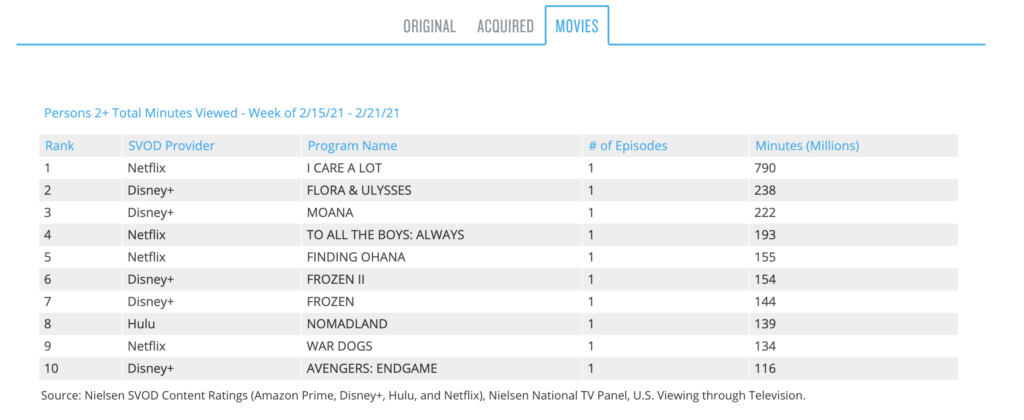
On the other hand, the kind of films that the Motion Picture Academy likes to nominate got released anyway. That made Hollywood's taste for socially conscious Oscar nominees even more prominent this year than in previous years, when there were more popular movies to see in theaters. Just the same, even some of the Oscar nominees have found audiences on streaming, as the following graphic from Cord Cutter News shows.


Yes, "Nomadland," which Bill Maher dumped on, broke into the top ten streaming movies as measured by Nielsen. That's why I think it has a very good shot at winning Best Picture, whether Bill likes it or not. At least we know people, including the Motion Picture Academy members, are watching it.

Finally, Bill mocked the documentaries as the category for serious examination of issues to make people feel bad. As I pointed out in Politics, government, and injustice among the 2021 feature documentary Oscar nominees, while I found little uplifting about "Collective," I thought "Time," "Crip Camp," and "My Octopus Teacher" featured positive stories and "The Mole Agent" to be surprisingly fun. Maybe Bill should watch those for a better movie experience.

That's it for today's entertainment feature. I'll be back tomorrow for Yuri's Night. Stay tuned.

Tuesday, December 22, 2020

'SNL,' Cleveland.com, and John Oliver on pro sports teams dropping offensive Native American names and mascots


I concluded John Oliver on sports for an Opening Day delayed by pandemic by mentioning a possible topic for future blogging.
When the NFL season resumes, I might return to this well, as "Last Week Tonight" has a clip about the Washington pro football franchise, which will no longer go by their offensive name. Stay tuned.
I forgot about that until I watched a clip from Saturday Night Live that wasn't uploaded in time for me to include in 'SNL' opens with Pence getting vaccinated then looks back at Trump's presidency, Weekend Update: Cleveland Indians Name Change and Tom Cruise Covid Rant - SNL.

Weekend Update anchors Colin Jost and Michael Che tackle the week's biggest news, like Jeff Bezos’s ex-wife donating $4 billion to pandemic relief organizations.
I thought there was something missing from "Weekend Update" when I put together Sunday's entry. Now I know what it was.

While SNL's Weekend Update reported dropping the name as news, The Plain Dealer AKA Cleveland.com pointed out that it really wasn't.
Sunday, The New York Times reported that the Cleveland Indians would be changing their nickname, six months after that had already been known.
...
The NYT story said the baseball team would make a formal announcement this week about changing its name, but for the 2021 season it would still use it and current uniforms, while deciding on a new moniker.

Based on the NYT story, many other news organizations, in print, television and social media, also reported for the first time that the Indians were changing their name.

In fact, that had been known since July 2020. Shortly after the Washington Football Team announced it would no longer be using the name “Redskins”, that same month, the Indians announced they were considering dropping their controversial name, just as they had already dropped their even more controversial mascot logo “Chief Wahoo” the year before.
...
Prompted by the NYT story, the Cleveland Indians officially released a statement Monday that they would be selecting a new name, and significantly, that it would have no Native American connections. Which rules out “Tribe.”
Unfortunately, "Tribe" is the first choice with fans, as seen in the graphic below from WKBN, which conducted a poll of its readers.


If the fans have their way, Cleveland's Major League Baseball team could be the Spiders, which was the name of the Cleveland's National League baseball team during the end of the Nineteenth Century, or the Rockers, a reference to the Rock and Roll Hall of Fame. Either would work for me, but let's see if the team's owners agree.

Follow over the jump for the relevant clips from "Last Week Tonight" about the Washington pro football franchise.

Monday, November 2, 2020

The New York Times 'Stressed Election' examines election misinformation and voting rights

I concluded 'This U.S. Election Could Be the Most Secure Yet' says The New York Times 'Stressed Election' with a program note: "I have only two installments of 'Stressed Election' left to post, one on voting rights, which came out at the end of last month, and the final one on disinformation, which I expect will be uploaded next week. I plan on getting to both." With Election Day tomorrow, it's time to get to those videos before they turn into pumpkins. First, the report that I was waiting for last month, How Homegrown Disinformation Could Disrupt This U.S. Election | 2020 Elections.

In 2016, Russia developed a simple, effective playbook to undermine U.S. elections with disinformation on social media. Four years later, Americans are using the same playbook on each other.
One of the producers left the following pinned comment on the YouTube video.
Hello - I’m Isabelle Niu. My colleagues Alex Eaton, Kassie Bracken and I produced this video looking at how domestic disinformation is threatening the U.S. election, four years after Russia developed a playbook to undermine Americans’ faith in the elections using social media. We look at an interesting case study in Kentucky in 2019, where a single tweet that lied about shredding mail-in ballots went viral, and ended up causing real disruptions. Misinformation is likely going to be a recurring problem in U.S. elections going forward. It is important that we understand how it works and what we can do about it.
"Overlordkraken1" was just trolling, but the people who amplified him had an agenda and they didn't care if they were using misinformation created for entertainment to advance it. That makes them agents, not trolls.* To avoid playing their game, I'm sharing the advice I gave in CBS News and CNN Business explain Russian disinformation and how to deal with it.
Think critically about the source of the story; Ask if others are reporting it; Do a reverse image search, as a lot of disinformation, misinformation, and malinformation (thanks, Nina Jankowicz, for introducing me to that word) uses misattributed or manipulated images or video, such as the SWAT team clip in "Plandemic" John Oliver showed in Coronavirus Conspiracy Theories; and, finally, walk away and calm down so the emotion doesn't overwhelm you.
Another author I recommend is Molly McKew at Stand Up Republic, in particular What lessons haven’t we learned since 2016? Lesson 5: Are YOU Disinfo?
First, it matters what narratives you are contributing to online — intentionally or not — and you should be aware not only of where your content comes from, but where it is going.
...
Second, block bots and disruptive or sketchy accounts that follow and promote you, even if they are agreeing with you. Disincentive the lazy-machinery of propaganda and disinformation whenever you can.
...
Third, don’t “follow back” or “friend” automatically. Don’t pass on content on more localized platforms if it is from a source you don’t know. Remember the way you engage with accounts and information builds networks that can be monitored and exploited by others.

Fourth, if you find yourself sharing sympathies or narrative with an identified hostile foreign actor or other malign actor, question why, and what that means. Is there a better way to make your point? Avoid tropes and blanket statements, embrace nuance.

Fifth, just as a refresher to the previous columns in this series — always ask what the purpose of the information in front of you is, and what it aims to achieve. Don’t rage-post. Don’t feel like you too must repost viral content that is divisive and inflammatory. Don’t be a cog in the disinformation machine.
All good advice. Not only will I follow it, I hope my readers do, too.

That was the last video in the series. Now for the first in the series, Why Voting in This U.S. Election Will Not Be Equal | 2020 Elections.

The first episode of our four-part series, Stressed Election, focuses on voter suppression in Georgia, where a growing Black and Latino population is on the precipice of exercising its political voice, if they get the chance to vote.
Like all the rest of the videos in the series, one of the producers wrote a pinned comment about it.
Hi, I'm Alexandra Eaton, one of the producers on this video. My partner, Kassie Bracken, and I have spent the past year exploring what works and what doesn't in the decentralized U.S. election system for a four-part series called Stressed Election. In each episode, we visit a state to explore a problem in detail, and then look at how it affects the nation as a whole.
This video emphasizes what I wrote in Vox explains what long voting lines in the US really mean.
Like climate change, The Supreme Court's ruling on Shelby vs. Holder and its effect on voting rights was an issue before the pandemic and will remain one after the pandemic is over. Unlike climate change, it can be fixed just by passing a law, in this case the one named after the late John Lewis. That won't happen this year, as the bill is being held up in the Senate by Mitch McConnell like so many others. Even if it passed there, President Trump is threatening to veto it. On the other hand, if the House of Representatives, Senate, and White House are all in the hands of Democrats next year, the bill can be reintroduced, passed by both houses, and signed into law. That sounds like a good maybe to me.
Here's to hoping that's the result of this year's election, along with greater acceptance of voting by mail.

*Speaking of agents, follow over the jump for a song and cartoon about them that I'm recycling for this post. After all, I am an environmentalist!

Thursday, October 22, 2020

'This U.S. Election Could Be the Most Secure Yet' says The New York Times 'Stressed Election'

I told my readers to "Stay tuned" to conclude The New York Times 'Stressed Election' visits Michigan to ask 'What's the Problem With Vote-by-Mail?' That's because "This video is part of a four-part series. Two other parts about voting rights and election security are already out with one more installment about disinformation still to come. I plan on posting about all of them." Last night's news that Iran and Russia obtained U.S. voter registration data in effort to influence the election itself influenced me to share something reassuring about the vote count, This U.S. Election Could Be the Most Secure Yet. Here’s Why.

With early voting underway, states are working to reassure voters that their ballots will be counted as cast. Our video shows how states’ responses to Russian hacking and the coronavirus crisis have helped make the election more secure than ever.
One of the producer-narrators left a comment that elaborated on the video.
Hello - I am Kassie Bracken. My colleague Alex Eaton and I produced this video looking at the recent history of our voting systems, and why some experts think this could be the most secure election yet when it comes to technology. It's also a journey showing how paper has come full circle in the past 20 years. Remember the chads in 2000 (if not, you'll learn more about them here)? Well, they set off a chain of events that still resonate in our security today. Voting technology is one important aspect of how we vote — please watch the other episodes in our series "Stressed Election" where we cover the impact of voting laws, voting by mail and the effect of disinformation on our elections.
The good news is that the vote count itself is probably more secure from foreign interference and other hacks. The bad news is that what Iran did was not hacking the vote count or election software. It was a disinformation campaign.
“This data can be used by foreign actors to attempt to communicate false information to registered voters that they hope will cause confusion, sow chaos and undermine your confidence in American democracy.”

Specifically, Ratcliffe said, Iran has been sending “spoofed emails designed to intimidate voters, incite social unrest and damage President” Donald Trump, who is facing former Vice President Joe Biden, the Democratic nominee, in the election.

“Additionally Iran is distributing other content to include a video that implies that individuals could cast fraudulent ballots even from overseas,” he said.

“This video and any claims about such allegedly fraudulent ballots are not true,” Ratcliffe said.

He added that “these actions are desperate attempts by desperate adversaries. Even if the adversaries pursue further attempts to intimidate or attempt to undermine voter confidence, know that our election systems are resilient and you can be confident that your votes are secure.”
That's exactly the message I want to reinforce tonight.

I have only two installments of "Stressed Election" left to post, one on voting rights, which came out at the end of last month, and the final one on disinformation, which I expect will be uploaded next week. I plan on getting to both. In the meantime, stay tuned for National TV Talk Show Day the day after tonight's presidential debate. Drink up!

Wednesday, October 21, 2020

The New York Times 'Stressed Election' visits Michigan to ask 'What's the Problem With Vote-by-Mail?'

I called John Oliver tells his viewers to expect an election month not just an election night "a good summary of all of my concerns about the election that is already in progress." One of those concerns involved voting by mail along with Trump opposing it and trying to sabotage the US Postal Service. The New York Times, in its "Stressed Election" series of video reports, focused on my adopted home state of Michigan when it asked What's the Problem With Vote-by-Mail?

The second episode of our four-part series, Stressed Election, focuses on vote-by-mail, which has become one of the most contentious issues of the 2020 election. In Michigan, a state decided by fewer than 11,000 votes in 2016, a group of bipartisan election officials worry they won’t have the time or resources to ensure results on election night.
This report hearkens back to one of the first entries of mine to focus on the effect the pandemic had on this year's election, Michigan to mail ballots and $400 million for elections in coronavirus stimulus bill update the election news and views for the ninth year of Crazy Eddie's Motie News. There, I wrote "That Michigan will be voting by mail in the May election is good news. Let's hope that, if the pandemic persists, the same will happen for the August and November elections as well." The New York Times showed what happened in August and what is being done to make November's general election run more smoothly. I hope it works.

This video is part of a four-part series. Two other parts about voting rights and election security are already out with one more installment about disinformation still to come. I plan on posting about all of them. Stay tuned.

Wednesday, October 2, 2019

Since Trump is acting like Dr. Evil, it's time to read The Evil Overlord List


The New York Times reminded me yesterday of Adam Serwer's column last year in The Atlantic that The Cruelty Is the Point with the headline Shoot Them in the Legs, Trump Suggested: Inside His Border War.
Privately, the president had often talked about fortifying a border wall with a water-filled trench, stocked with snakes or alligators, prompting aides to seek a cost estimate.
Why am I reminded of villains in movies, from Indiana Jones...


to Captain Hook and the tick-tock crocodile from "Peter Pan"...


and finally Dr. Evil's wish for sharks with laser beams on their heads from "Austin Powers, International Man of Mystery."


There's more, but it's not funny.
He wanted the wall electrified, with spikes on top that could pierce human flesh. After publicly suggesting that soldiers shoot migrants if they threw rocks, the president backed off when his staff told him that was illegal. But later in a meeting, aides recalled, he suggested that they shoot migrants in the legs to slow them down. That’s not allowed either, they told him.
The article described the closest Trump came to getting his wish several paragraphs down.
The happiest he had been with Ms. Nielsen was a few months earlier, when American border agents had fired tear gas into Mexico to try to stop migrants from crossing into the United States. Human rights organizations condemned the move, but Mr. Trump loved it.
It gets more disturbing from there.

That level of cruelty and depravity reminds me of Baron Vladimir Harkonnen from "Dune."  It turns out I found just the image for the resemblance.

Friday, August 23, 2019

So long Seth as Moulton decides to run for re-election to Congress instead


On the heels of Jay Inslee dropping out, CBS News has breaking news about another candidate leaving the Democratic presidential nomination contest, as it reported just last hour Seth Moulton drops out of presidential race.

Seth Moulton is the third Democratic presidential candidate to drop out of the race in the past week. CBSN political reporter Caitlin Huey-Burns has more on the latest developments.
Honestly, I'm surprised it took him this long, as Moulton did not make either of the first two rounds of debates.  For that matter, the reporters and editors at FiveThirtyEight probably aren't surprised either, as they picked Moulton second in their first 2020 drop out draft.  Three down, six to go.
nrakich [Nathaniel Rakich, elections analyst]: OK, with the second overall pick, I choose Rep. Seth Moulton.

sarahf [Sarah Frostenson, politics editor]: He’s still running?
That remark turned into the preview image for the article, which says something.


The chat continued on from there, becoming more serious, if not any less dismissive of Moulton.
nrakich: Haha, indeed. I’m a bit surprised that he is.

He didn’t even qualify for the first two debates, which every other major candidate without a good excuse (i.e., jumped in the race after the qualifying deadline for the first debate) did.

He’s almost certainly not going to make the September debate.

In addition, he reportedly had to let go of half his campaign staffers, indicating his campaign might be in financial trouble.

Finally, although he can legally run for president and for reelection to his House seat at the same time, it’s not a good look.

sarahf: Yeah, I imagine his calculus has to be pretty similar to Eric Swalwell — a House member who also ran for president, but has since dropped out to focus on his 2020 reelection bid.

geoffrey.skelley [Geoffrey Skelley, elections analyst]: All this makes sense to me, though I wonder if Moulton might hang around awhile longer. After all, the candidate filing deadline for Massachusetts isn’t until May 2020, whereas Swalwell had a December 2019 deadline to worry about if he was going to seek reelection.

nrakich: I hear that, Geoffrey, but Moulton is also already attracting primary challengers in the Massachusetts 6th District.

And he was already catching flak back home after he led a failed attempt to deprive Nancy Pelosi of the speakership after Democrats took back the House in 2018.

So I think he’d be smart to focus on his House primary, which I think he could be in real danger of losing.

geoffrey.skelley: But when does he drop out?

nrakich: Yeah, the one thing that gives me pause is the fact that he hasn’t already.

But I would say soon — particularly if he is indeed running out of money.

geoffrey.skelley: Yeah, hard to get people to work for you if you can’t give them a paycheck.
Indeed, which is one of the reasons why I thought John Hickenlooper would leave the presidential contest.  Besides, both of them are better off, both for themselves and the country, running for Congress.

On another note, Talking Points Memo summarized the New York Times article about Moulton dropping out as Moulton Drops Presidential Bid With Warning, Regret.
In an interview with the New York Times, he said that the race is truly between former Vice President Joe Biden and Sens. Elizabeth Warren (D-MA) and Bernie Sanders (I-VT), and warned that “veering too far left” could cost Democrats the White House.

He cited Montana Gov. Steve Bullock, another moderate who also struggled to make the debate stage, as evidence that the primary was pulling candidates further and further left.
Moulton himself serves as an example of the primary campaign pulling candidates to the left, as his ideological scores started off at 20 economic and 85 social in June, moved to 13 economic and 80 social in July, and dropped out at 8 economic and 83 social now.  He shifted left 12 points economically and 3 socially over the space of two months!  Even Moulton, who says doing so is a bad idea, couldn't resist the leftward pull!

I'll have more to say about candidates being pulled to the left later today.  Right now, follow over the jump for the drinks and memes I'm retiring now that Moulton is out of the contest.

Tuesday, April 16, 2019

More candidates releasing tax returns than tax marches this year, it seems


For the past two years, I was able to find lots of news videos of Tax Marches on Tax Day.  This year, either the tax marches themselves or their coverage were way down.  When I looked on YouTube, the only news report I could find on tax protests was Tax Day protest in Binghamton, New York.


I know I promised to write about tax protests today in Vox explains tax reform for Tax Day plus taxes and economics for the eighth year of Crazy Eddie's Motie News, but tax marches and tax protests don't seem to be where the action is.

That is not to say that they didn't have an effect.  One of the focuses of previous Tax Marches was protesting President Trump not releasing his tax returns.  Those protests haven't budged Trump, but they are getting the candidates for the Democratic nomination to release their tax returns.  The most famous is Bernie Sanders.  Watch Bernie Sanders Releases 10 Years Of Tax Returns.

U.S. Democratic presidential contender Bernie Sanders released 10 years of tax returns on Monday, providing details of his growing status as a millionaire fueled by a sharp jump in income from book royalties since his losing 2016 White House run.
I think this is a positive step, but CNN took it as an opportunity for criticism.

Sen. Bernie Sanders (I-VT) released a decade of tax returns, providing new insight into how the senator became a millionaire during his two presidential runs.
Wow.  I wrote "I think they are right to consider CNN biased, but I think it's a personal bias against Trump, not an ideological bias against conservatives" in A comparison of two measures of media bias, the Booman Tribune version of A comparison of two measures of media bias shows readers and viewers respond to both ideology and quality.  I think CNN, or at least Erin Burnett, has a non-partisan but personal bias against Sanders, too.  Her guests showed that, too, as she had Sanders critics from both left and right, befitting Ad Fontes Media's rating of her show as "Neutral or Balanced Bias."

The other candidate who released tax returns this week was Kamala Harris, which Newsy reported in Harris releases 15 years of tax returns.

The 528 pages add up to more than any other 2020 candidate has released so far.
As the image from the New York Times that I used to illustrate this entry shows, the American voters may not be getting transparency on Trump's finances, but we are getting it from at least some of his rivals.  I'll leave it to Congress and the courts to get that from Trump.  He certainly won't do it on his own.

Monday, April 8, 2019

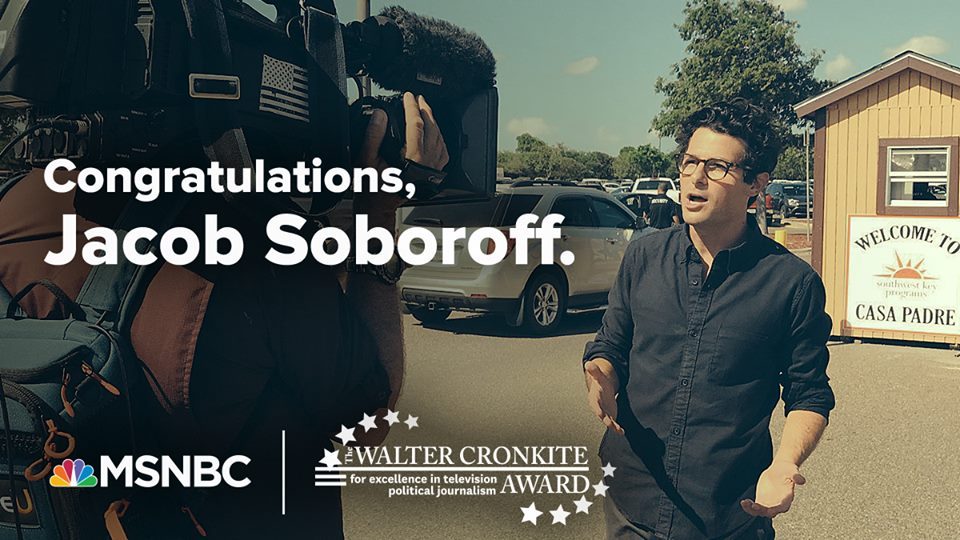
MSNBC's Jacob Soboroff earns a Cronkite Award for coverage of family separation at the border


The resignation of Kirstjen Nielsen yesterday helped me make up my mind about which winner of the Cronkite Awards to feature next.  Watch the University of Southern California Annenberg School for Communication and Journalism's compilation of clips featuring Jacob Soboroff of MSNBC covering the effects of the Trump Administration's family separation policy.

Jacob Soboroff (NBC News/MSNBC) was one of the first national reporters to break the story on conditions of children separated from their parents at the border under the Trump administration’s zero tolerance policy. Though cameras were not allowed into detention centers, Soboroff was able to explain the situation “with clarity and descriptive analysis that was as powerful as any visual,” the judges said. He kept the story on the nation’s agenda, he stayed with the story, and his coverage had impact: it helped push the Trump administration into a rare policy reversal.
Congratulations to Soboroff and keep up the good work documenting this cruel policy.  Unfortunately, this policy may not have been cruel enough for Trump's liking.  As the New York Times warns its readers, Kirstjen Nielsen Enforced Cruelty at the Border. Her Replacement Could Be Worse.
Ms. Nielsen’s departure is seen by some as part of a broader restructuring of her department. Just two days before meeting with the secretary, the president withdrew his nomination for the next head of the Immigration and Customs Enforcement agency, saying that he wanted to go in a “tougher direction.” Presumably he plans to chart a similar course with Ms. Nielsen’s successor.

For now, Ms. Nielsen’s acting replacement will be Kevin McAleenan, the commissioner of Customs and Border Protection. This leaves Homeland Security without a top official at either of its critical immigration agencies. It comes as the swell of migrant families across the border pushes the system toward collapse.

Within this leadership vacuum, it seems likely that more influence will be exerted by Mr. Miller, who inspires and reinforces Mr. Trump’s harshest ideas on immigrants and immigration.

The House speaker, Nancy Pelosi, said of Ms. Nielsen’s departure, “It is deeply alarming that the Trump administration official who put children in cages is reportedly resigning because she is not extreme enough for the White House’s liking.”
If you are someone who thinks that the cruelty of these policies are counterproductive, as I do, you need to be reminded of what Adam Serwer wrote in The Atlantic: The Cruelty Is the Point.  That's a chilling thought.

Previous entries about the Cronkite Awards.

Wednesday, December 12, 2018

PBS Eons on the last time the climate warmed this fast — the Paleocene-Eocene Thermal Maximum


I've been writing a lot about disbelieving climate, change lately.  Tonight, I'm continuing the discussion, but this time, I'm combining it with my professional interest in ancient life to examine the last time climate changed anywhere near as quickly as it is now.  Watch PBS Eons The Last Time the Globe Warmed.

Imagine an enormous, lush rainforest teeming with life...in the Arctic. Well there was a time -- and not too long ago -- when the world warmed more than any human has ever seen. (So far)
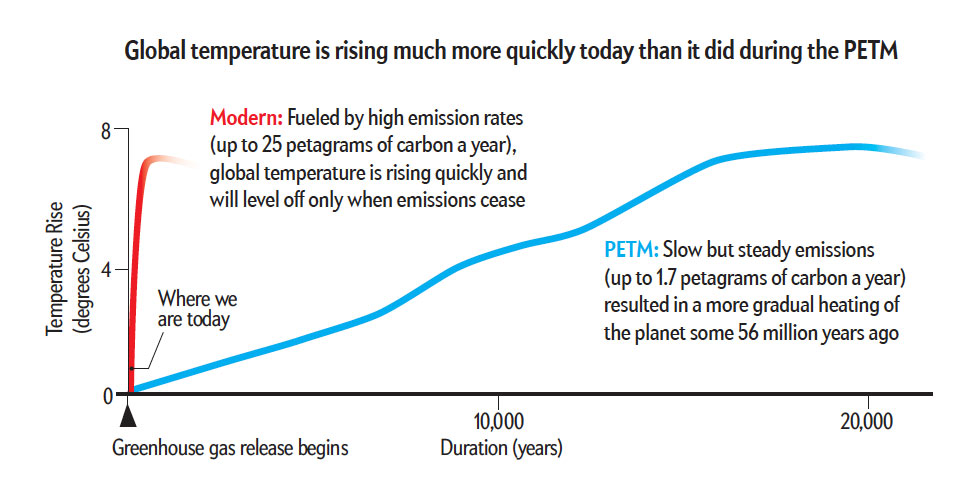
The Paleocene-Eocene Thermal Maximum (PETM) marked the end of an epoch — literally, as it ended the Paleocene with the Eocene beginning when it abated.  New geologic time periods are marked by changes in the fauna and the PETM was no different.  The PETM Wikipedia page includes the following extinctions and originations.
The PETM is accompanied by a mass extinction of 35-50% of benthic foraminifera (especially in deeper waters) over the course of ~1,000 years – the group suffering more than during the dinosaur-slaying K-T extinction...Contrarily, planktonic foraminifera diversified, and dinoflagellates bloomed. Success was also enjoyed by the mammals, who radiated extensively around this time...Humid conditions caused migration of modern Asian mammals northward, dependent on the climatic belts. Uncertainty remains for the timing and tempo of migration.
All of this happened with an event that, as rapid as it was, happened much more slowly than modern climate change.  For the effects of something as severe as what's happening now, I suggest my readers click on the New York Times' The Planet Has Seen Sudden Warming Before. It Wiped Out Almost Everything.
Dr. Deutsch and Justin Penn, a graduate student, recreated the world at the end of the Permian Period with a large-scale computer simulation, complete with a heat-trapping atmosphere and a circulating ocean.

As the Siberian volcanoes flooded the virtual atmosphere with carbon dioxide, the atmosphere warmed. The ocean warmed, too — and according to the model, it began losing oxygen.

Some parts lost more than others. On the surface, for example, fresh oxygen was produced by photosynthetic algae. But as the ocean warmed, its circulatory currents also slowed, the model demonstrated.

Oxygen-poor water settled to the bottom of the oceans, and before long, the deep was gasping.

Rising temperatures and plunging oxygen must have made huge swaths of the oceans uninhabitable. Some species survived here and there. But most disappeared completely.
Eep!  The article notes that humans are releasing cabron dioxide even faster than the Siberian volcanoes did at the end of the Permian, which is known as The Great Dying.  The only saving grace is that we will not release as much carbon dioxide as then.  Still, it looks like I may have to write an entry about The Great Dying as well.  Stay tuned.

Friday, September 28, 2018

14 nominations for 12 reports about Las Vegas Massacre and other mass shootings at the News and Documentary Emmy Awards

I've already promised to write entries about the nominees examining the opoid crisis and the Syrian Civil War.  I plan on writing one about the nominees reporting on mass shootings as well.  Stay tuned.
That was my promise in the footnote to 'Chasing Coral' versus 'Yosemite' — two nominees for Outstanding Nature Documentary both examine climate change, which I wrote in response to mentioning "Tower."
For their third nominated category, both "Chasing Coral" and "Yosemite" are competing for Outstanding Music & Sound along with the HBO Documentary Films "Cries From Syria" and "The Music of Strangers: Yo-Yo Ma and the Silk Road Ensemble" and the "Independent Lens" episode "Tower."  The most formidable overall are "Cries from Syria," which also has nominations for Outstanding Current Affairs Documentary, Outstanding Writing, and Outstanding Research, and "Tower," about the first mass school shooting in U.S. history at the University of Texas, which earned a nomination for Outstanding Historical Documentary as well.
Joining "Tower" in competing for Outstanding Historical Documentary are Independent Lens episode "Birth of a Movement" and the Netflix documentaries "Cuba and the Cameraman," "Let It Fall: Los Angeles: 1982-1992," and "Blood On The Mountain."  Other than "Tower," the only other nominee in this category with a second nomination is "Let It Fall: Los Angeles: 1982-1992," which has a nomination for Outstanding Research.  Based on that and my including it in The most honored political documentaries of 2017 examine crime, injustice, and the Syrian Civil War, I consider it to be the strongest competition to "Tower" for Outstanding Historical Documentary.  As for its chances to win its second nominated category, I'm recycling what I wrote: "I suspect 'The Music of Strangers: Yo-Yo Ma and the Silk Road Ensemble' might be the fiercest competitor for Outstanding Music & Sound; it also earned nominations for Outstanding Arts & Culture Documentary and Outstanding Editing: Documentary."

To get a feel for the documentary and the incident it portrays, watch the trailer from PBS.

Combining archival footage with rotoscopic animation in a dynamic, never-before-seen way, TOWER reveals the action-packed, untold stories of the witnesses, heroes, and survivors of America’s first mass school shooting, at the University of Texas, 1966, when the worst in one man brought out the best in so many others.

Speaking of the nominees for Outstanding Editing: Documentary, one of the two nominated episodes of Showtime's "Active Shooter: America Under Fire" earned a nomination in this category for "Columbine, Colorado," which is about the most infamous mass school shooting of the 20th Century.  Joining it and "The Music of Strangers: Yo-Yo Ma and the Silk Road Ensemble" are RYOT's "Fear Us Women," HBO Documentary Films' "Solitary: Inside Red Onion State Prison," and "Life, Animated."  I've already called "Life, Animated" tough competition, as it is also nominated for Best Documentary and is competing against "The Music of Strangers: Yo-Yo Ma and the Silk Road Ensemble" for Outstanding Arts & Culture Documentary, where I consider "Life, Animated" to be the strongest contender for this award.

The other nominated episode of "Active Shooter: America Under Fire" is "Charleston, South Carolina," which is competing for Outstanding Social Issue Documentary with the "Frontline" episode "Last Days of Solitary," two HBO Documentary Films, "Abortion: Stories Women Tell" and "Unlocking the Cage," and fellow Showtime documentary "Jackson."  I am finding it difficult to handicap this category, as these are the only nominations for each fo these shows.  That written, my sympathies lie with "Unlocking the Cage," which is about animal rights for chimpanzees, which echoes the themes of PETA attempts a science-fiction solution to a real-world issue and The ethics of orcas as entertainment.

As for "Active Shooter: America Under Fire," watch its tralier from Showtime.

The traumatic events of infamous mass shootings and their aftermath.
...
Whether due to acts of terrorism, hate, or mental instability, mass shootings have become all too commonplace. Active Shooter: America Under Fire is a documentary series that examines this disturbing phenomenon from the points of view of victims, family members, emergency medical workers and first responders, who bravely risk their own lives in the face of grave danger. Each episode recounts a specific incident using archival footage and in-depth interviews to shine a spotlight on the traumatic events and their aftermath. The results are powerful, eye-opening, and hopefully change-inducing.
While I find all the above nominees to be deserving, they are not the reason why mass shootings became a top news topic of 2017.  That is because of the Las Vegas Massacre, the coverage of which earned eight nominations for eight entries.  Combined with the two nominations each for "Tower" and "Active Shooter: America Under Fire"  plus nominations for coverage of the Sutherland Springs shooting and the Attack at Fort Lauderdale-Hollywood International Airport, that's a total of fourteen nominations for twelve news and documentary programs, making this the second most nominated news story this year next to the Syrian Civil War with 22 nominations for 14 nominees ETA: 17 nominations for 11 nominees.*  Follow over the jump for my discussion of the nominees covering the Las Vegas Massacre, the Sutherland Springs shooting, and the attack at Fort Lauderdale-Hollywood International Airport.

Tuesday, August 21, 2018

A comparison of two measures of media bias shows readers and viewers respond to both ideology and quality


In Alex Jones removed from Facebook, Apple, YouTube, and Spotify, prompting free speech concerns, I mentioned the Media Bias Chart (above), which rates news sources on their bias and quality.  The next day, FiveThirtyEight displayed another chart about media bias from Nieman Labs that showed Democrats see most news outlets as unbiased. Republicans think they’re almost all biased.  After seeing both, I thought it would be interesting to compare the two to see if they agree and if they share any common patterns.  Besides, I've found it's a good idea to listen when the universe is talking.

The first chart from Nieman Labs displays "'net bias' scores for news organizations: 'the percentage who see each as ‘not biased at all’ or ‘not very biased’ minus the percentage who see each as ‘extremely biased’ or ‘very biased.’ On this measure, positive scores indicate that more people consider the news source unbiased than biased, and negative scores mean more people consider it biased than unbiased.'"


The news sources with positive scores in this study all fit in the green top box of the Media Bias Chart as "fact reporting" and "original fact reporting," although the order differs; the Media Bias Charts ranks the Associated Press highest, followed by ABC News and CBS News, then NPR and PBS, followed by USA Today then The Wall Street Journal.  However, three sources that the Media Bias Chart displays in the green box as quality outlets, NBC News, The New York Times, and The Washington Post, all have negative scores.  Both The New York Times and The Washington Post fall in the "skews liberal" column, while NBC sits at the left end of the three broadcast networks, although still in the "minimal partisan bias or balance of biases" column, so conservatives may see them as biased despite the quality of their reporting.  To test that, I'm sharing charts of the perceived biases of news sources side-by-side with the results from Democrats on the left and Republicans on the right.


Nieman Labs quoted the original study's findings.
“Democrats, including Democratic-leaning independents, tend to see most news organizations as unbiased, except for Fox News, Breitbart News, Mother Jones, the Huffington Post, and Vox,” the authors write. “Republicans, including Republican-leaning independents, tend to see all news organizations as biased. The two exceptions are Fox News and The Wall Street Journal.”
Sure enough, Republicans think that NBC News, The New York Times, and The Washington Post are all very biased, while Democrats consider them relatively unbiased.  In addition, Republicans appear to be picking up the slight differences in bias among other news sources.  Of the outlets with positive ratings, The Wall Street Journal skews conservative, while PBS, CBS News, and ABC News are all arrayed from right-to-left in the top center box, exactly the same order in which Republicans rate them as being biased.  In addition, the Media Bias Charts shows the Associated Press slightly to the left of PBS, which could be enough to flip their order on the chart from Nieman Labs of net bias.  All this is enough to make me conclude that for fact-reporting sources, slight differences in ideological slant are enough to affect their perceived bias by readers and viewers.

For sources that fall in the analysis, opinion, and propaganda boxes, ideological positions appear to be less important than the quality of reporting.  Both Democrats and Republicans think Vox and Mother Jones are biased, but Republicans think that CNN is more biased than either, while Democrats rank it between USA Today and The Wall Street Journal.  Looking at the Media Bias Chart might explain why.  While CNN is only as far left as The New York Times and Washington Post, it straddles the line between fair and unfair interpretations of the news, so its quality of reporting is rated lower than Vox, Mother Jones, and MSNBC, all of which present fair interpretations of news according to the Media Bias Chart while still in the "skews liberal" and "hyper-partisan liberal" columns.  The Republicans seem to pick up on this, rating CNN as the most biased news source, even more so than MSNBC, which makes no effort to hide its liberal leanings, especially in its evening shows.*  Both liberals and conservatives consider The Huffington Post as biased, an assessment the Media Bias Chart agrees with.  It also considers its reporting to be unfair interpretations of the news, so its lower quality places it below CNN on a survey of all respondents.  Finally, the most biased sources overall are Breitbart News and Fox News, which are both "hyper-partisan conservative" and "nonsense damaging to public discourse."  Democrats drive that rating of Fox News, as they consider it the most biased news source, while Republicans consider it the least.  The power of ideology returns!  At least both sides agree that Breitbart is biased.  That's reassuring.

*I think they are right to consider it biased, but I think it's a personal bias against Trump, not an ideological bias against conservatives.