A blog about societal, cultural, and civilizational collapse, and how to stave it off or survive it. Named after the legendary character "Crazy Eddie" in Larry Niven and Jerry Pournelle's "The Mote in God's Eye." Expect news and views about culture, politics, economics, technology, and science fiction.
For the third consecutive year, data from the Michigan Department of Treasury shows the recycling rate for beverage containers has dropped.
I hoped last year that falling can and bottle redeems were one of the bad behaviors prompted by the pandemic and would recover like some of the rest of them. So far, that hasn't happened. Instead, the pre-pandemic decline accelerated by stores not accepting returnables has continued. Sigh.
Michigan’s bottle deposit system is facing renewed scrutiny after the state’s refund rate fell to 69.4% in 2025, which marked its lowest level in decades.
The decline is renewing debate over the policy. Independent grocers say the current system is costly, time-consuming and creates health and safety concerns. Shoppers who rely on the 10-cent deposit say it remains an important incentive to recycle.
The retailers are tired of being responsible for managing returns and are using the decline in redeems to call for reform or repeal of the bottle bill and have either the state or curbside recycling take up the slack. UpNorth Live examines their proposals in Retailers push to move Michigan bottle returns out of stores as bottle law turns 50.
Fifty years ago, Michigan’s bottle return law went into effect and for the past five decades people have been paying and then getting back those dimes for cans.
Participation by consumers is dropping and a growing number of retailers are voicing frustrations with the system in place.
"Back in the 70s and 80s was at 95 percent," said Bill Wild, CEO Midwest Independent Retailers Association.
But these days fewer folks are getting their dimes back.
I'm an environmentalist, so I favor reform over repeal. Follow over the jump for possible reforms.
Detroit isn't having all the fun in the Great Lakes State. WNEM TV5 in Saginaw, Flint, Midland and Bay City reported Juneteenth plans in Flint for 54th year.
Flint Mayor Sheldon Neeley said Flint was the first city in Michigan to officially recognize Juneteenth in 2020, a year before the federal government.
I didn't know that about Flint, so I learned something new. That makes today a good day.
Ahead of Giving Tuesday, Nakia Mills from the Better Business Bureau advises donors to verify charities before donating to ensure their money is used as intended. The BBB recommends checking the accreditation and financial practices of charities on their website as a precautionary measure.
Good advice, the kind I would given about security if I had celebrated Cyber Monday yesterday instead of World AIDS Day.
On Giving Tuesday, donations will be collected for THAW, the Heat and Warmth Fund, to assist people in crisis with utility bills during winter. THAW offers more than just bill assistance, including energy-efficient home improvements as experienced by beneficiary Byron Spivey. Serving families with children, seniors, and veterans, THAW helped 11,000 homes with $10 million last year, with over 80% of donations going directly to services. The organization aims to enhance the long-term health and financial security of Michigan neighborhoods with additional support like home assessments and appliances.
Not only does THAW pay people's utility bills, it pays for energy conservation upgrades. I approve.
Learn more about the mental health benefits of giving ahead of Giving Tuesday. (Dec. 1, 2025)
I used to be a director of a nonprofit. I can tell you that a physical quarter in a Salvation Army kettle will probably be a net benefit, but any online donation less than a dollar will likely cost the charity money in processing fees.
That's a wrap for today. Stay tuned for comedy tomorrow.
The value of a dime doesn’t stretch as far as it did in 1976 when the state's bottle deposit law was initiated, but for many Michiganders, returning beverage containers to get their 10 cents back sure adds up.
The anchor said "just over 70% of bottles and cans were returned" last year. To be precise, it was 70.4%, as this graph from Axios Detroit shows.
Tessa Kresch examined how the deposit isn't as much of an incentive as it used to be because of inflation but found a counter-example in Mildred Griffin, who still redeems her deposits. Kresh also examined possible reforms, from streamlining the process to expanding it. What she ignored was the effect of the COVID-19 pandemic. Many retailers stopped accepting can and bottle returns in 2020. As a result, many cans and bottles were thrown away, recycled at curbside, or stashed for future redeeming when conditions returned to normal. I still have cans and bottles to recycle from 2020 in my garage, which I've gradually been returning. One of the reasons is the lack of universal redemption; I can only return cans and bottles to outlets that sell them, so it's inconvenient to redeem store brands or brands only carried at a few chains. Most of the cans and bottles still in my garage fit in those categories.
I'm adding lower can and bottle return rates to the list of behavior changes in 'The Pandemic Made People Worse Drivers,' a driving update. A lot of people just got out of the habit and never got back in. I can't entirely blame the pandemic; the Axios graph shows that return rates had been slipping throughout the 2010s from the mid 90s to ~89 in 2019 before dropping like a rock to the low 70s in 2020, never to recover. As I first wrote in April 2020, the pandemic accelerated existing trends, including this one. A few of the bad behaviors are returning to pre-pandemic levels; I hope bottle returns do, too.
That's a wrap for today's sustainabilityholiday. Stay tuned for the Sunday entertainment feature, when I plan on examining GRAMMY nominees.
COVID-19 was declared a global pandemic five years ago, when offices emptied, schools went virtual and social gatherings were canceled. How do Americans feel about its impact today?
CBS New York prepared two graphics summarizing the Pew Research Center's findings.
Yeah, that looks about right. In addition, Alec Tyson from Pew mentioned one other bad effect, student achievement suffering from not being in school during the worst of the pandemic. I still see signs of pandemic disruption among my students five years later. The flip side is what was bad for children, working from home, was and still is good for a lot of adults.
Pew also examined Americans' attitudes about a future outbreak.
I don't know whether these findings make me feel encouraged or discouraged. I suppose I could say the country could do better, but the backlash to the pandemic response, including election of the current administration, might make it do worse. Sigh.
Five years ago this week, the World Health Organization called the COVID-19 outbreak a pandemic. In the United States, officials declared a national emergency, triggering travel bans for non-U.S. citizens and shutdowns nationwide. Now, many who lived through the pandemic, including those who treated infected patients, are still dealing with the fallout. Ali Rogin reports.
Those were heart-breaking stories, which Dr. Sasha McBain identified as expressions of grief. They make me glad my wife and I got through the pandemic relatively unscathed. I'm also happy to hear Dr. Fritz Francois describe how NYU Langone Health was prompted by Hurricane Sandy to prepare for unexpected or exceptional events. In particular, I was impressed that they ran an exercise for an outbreak of MERS. Both MERS and COVID-19 are zoonotic coronavirus diseases, so I'm sure much of the MERS responses carried over to COVID-19. Good work!
While all of the families with children in the Jenison High School marching band have been busy fundraising for the last year and a half and preparing for the Macy’s Thanksgiving Day Parade, that effort has been multiplied by three for the Milnamows.
My two sisters and I all marched in band my senior year of high school, so I can relate to that part of their experience, but we were one year apart, so I don't have an insight into being one of triplets unless being one of a set of "Irish triplets" counts. Yeah, I know that's considered offensive, but I have Irish ancestry, so I can say this about myself and my family. That written, good luck to the Milnamows and all the rest of the Jenison High School Marching Band in tomorrow's parade. Michigan represent!
Follow over the jump for more local news coverage, including from two university publicity departments, of the marching bands in tomorrow's parade.
On March 11th, 2020, the World Health Organization declared COVID-19 a global pandemic.
What followed, were travel bans, stay-at-home orders and mandatory masking.
1.[1] million Americans have died from the virus the most of any country in the world and among them, more than 42,000 Michiganders.
Officially, the U.S. has the most deaths from COVID-19 with Worldometer listing 1,148,765, followed by Brazil with 699,310 deaths, and India reporting 530,780. I suspect all of them have under-reported deaths from the disease, but especially India, as I wrote last May: "I was always a little skeptical that India had fewer deaths than the U.S. from the pandemic. An estimate of 4.7 million may be higher than I expected, but I really do think India had more deaths than the U.S.'s 1 million." Still, that's merely a suspicion, not a fact.
On March 10, 2020, Michigan health leaders confirmed the state's first two cases of COVID-19. Three years later, the chief medical executive is reflecting on the pandemic, what has been learned and where we stand today.
I'm glad vaccines and more effective treatments exist to make COVID-19 less dangerous and scary. My wife and I are the beneficiaries of both, as I mentioned in 'The First Wave' wins three News & Documentary Emmy Awards. While we haven't had any lingering symptoms besides modestly lower energy levels and some slight brain fog, there are lots of people who are suffering from worse syndromes. The economy has also not fully recovered, either. Follow over the jump for two reports from outside Michigan about both.
I like this summary of the issue, including the history of changing the clocks and "locking the clock" and the controversy over which time to stay on, standard or daylight saving time. It's the latter that is keeping the House from passing the Sunshine Protection Act. Which would my readers prefer? Answer in the comments, either here or on Facebook.
The previous House of Representatives never did act on the Sunshine Protection Act. Maybe the current Republican House majority might pass it, that is, if they make time for agenda items beyond Twitter hearings and other grievance-driven grandstanding.
The disagreement over which time to settle on, standard time or Daylight Saving Time, stems from competing concerns over health, economics, and personal preference. The science usually supports staying on standard time, as "NOVA" on PBS explains in Why Experts Say Permanent Daylight Saving Time is Unhealthy.
The misalignment of our internal clocks and the sun could result in a handful of heath concerns, experts say.
Springing forward may be annoying for some, but the extra daylight we have during Daylight Saving Time can be great for your health and the community. Here's why.
I just want the twice a year time changing to stop. I'll go with whatever the rest of you decide. Just make a decision!
*I found more and better videos for Daylight Saving Time than for the third year of the pandemic today, which is also why I posted ABC News asks 'Who is Perry Johnson?' I'm hoping to see more videos about three years of COVID-19 in the U.S. tomorrow, which is the actual third anniversary of the WHO declaring it a global pandemic. Stay tuned to see if that happens.
Yes, the speculation about who will succeed Stabenow will be intense over the next two years, but I think it's premature for me to indulge in it today. Still, I look forward to and expect it will be fun. I hope my readers will enjoy it as much as I will.
After announcing Thursday morning that she will not seek reelection, U.S. Sen. Debbie Stabenow said serving Michigan has been “the honor of my life.”
I can't help but note that Senator Stabenow touted her accomplishments in the three largest sectors of Michigan's economy, manufacturing, especially of automobiles, tourism, albeit indirectly through protecting the Great Lakes, and agriculture — especially agriculture. Here's to two more years of her serving Michigan and the country and thanks to her for all she's done and will still do.
On the eve of Giving Tuesday, you may want to take into consideration some tips to make sure your donation is going to a legitimate place. (Nov. 28, 2022)
Donations can make a great impact on someone’s life this Giving Tuesday. NBC10 Responds reporter Valeria Aponte Feliciano has a few tips to help you be sure your money is being used for good during the holiday.
Giving Tuesday is upon us and the season of charitable giving is in full swing.
Celebrated on the Tuesday following Thanksgiving (in the U.S.) and the widely recognized shopping events Black Friday and Cyber Monday, #GivingTuesday kicks off the charitable season, when many focus on their holiday and end-of-year giving.
Since its inaugural year in 2012, #GivingTuesday has become a movement that celebrates and supports giving and philanthropy with events throughout the year and a growing catalog of resources.
So, if you're looking to donate to a local charity, here are some options:
I like this list, which includes food banks like Forgotten Harvest, animal welfare organizations like the Michigan Humane Society, and political advocacy groups like the ACLU of Michigan. As I wrote nine years ago, Detroit has great charities.
After a week of holiday posts, it's time to return to current events. Stay tuned.
I begin my promised posts about the election results with news from my adopted home state of Michigan and start at the top of the ballot with Governor Gretchen Whitmer winning re-election. WOOD-TV used the graphic announcing that news as the preview image for Michigan's Election Day 2022 results.
In addition, Hillary Scholten won Peter Meijer's current seat. That's a relief, as I worried about the tactic used to get her a more favorable opponent after the primary.
Not only did TFG go after Meijer, the DCCC did as well, running ads "attacking" Gibbs as too extreme in the hopes that doing so would make him more attractive to the right-wing of the Republican Party so they would vote for him. On the one hand, that's smart politics, as it makes the seat easier for Hillary Scholten to win in November. On the other, it's punishing a holdout for decency and democracy in the GOP by removing him from Congress. Sigh. It worked last night, but I hope it doesn't backfire in November.
Gov. Gretchen Whitmer is delivering remarks after being the projected winner of the gubernatorial race.
Whitmer was first elected in 2018 after years in the Legislature and has since become a leading voice in the Democratic Party, delivering the party’s response to former President Donald Trump’s State of the Union address in 2020. She has said in interviews that she will not run for president in 2024 even if President Joe Biden doesn’t seek reelection.
Congratulations and go Big Gretch!
Follow over the jump for the rest of the election news from Michigan.
WOOD-TV only had "Aug. 3, 2022" for the video description, so I'm quoting the description for the equivalent video by 13 On Your Side: John Gibbs defeats Rep. Peter Meijer in primary election. "After a single term in the United States Congress, Peter Meijer has conceded the primary election for Michigan's 3rd Congressional District to challenger John Gibbs." I have two things to say about this result. First, as I wrote in Colbert and Meyers take closer looks at replacing Liz Cheney and Arizona audit last year, "this fight is not over conventional ideas of left and right. Instead, it is about loyalty to Trump, which is odd considering that major American political parties generally move away from losing presidential candidates. Not now — the GOP is sticking closer to Trump than ever." That has become even more true since then. Second, no good deed goes unpunished, especially when it involves standing up to TFG.
Michigan held its 2022 primary election on Tuesday, Aug. 2.
Again, the effect TFG has on Republican politics cannot be ignored, both in the contest for the GOP nominee for Governor of Michigan and in the Third Congressional District, where Gibbs beat Meijer. Second, I am not so sure that RashidaTlaib is as liberal as she's being made out. She's part of "The Squad," which the following image from Voteview shows is not as far left as they are portrayed.
As I originally described in a tweet and reproduced on Pinterest, "The Squad's isolation from the rest of the Democratic Caucus is even more apparent in two dimensions. They're way down and to the right of most of the party. Down is also 'liberal,' but not in the way everyone else is." If Janice Winfrey had gotten the nomination and then into Congress, Voteview very likely would have scored her votes as being to the left of Tlaib's and the rest of "The Squad."
That a third of precincts in Detroit may be ineligible for a recount is not good news for anyone having their hopes up that this recount will change the result of the election. If anything, Trump's lead may increase because of it. It also makes me even less enamored of both Janice Winfrey, the Detroit City Clerk, and Cathy M. Garrett, the Wayne County Clerk. Neither one of them appears to be running a tight ship, or otherwise these kinds of irregularities would happen so frequently.
That still seems to be true, six years later. No surprise, I voted for Tlaib.
I'm not surprised that Haley Stevens beat Andy Levin. While I don't live in the 11th Congressional District, my IP address does, so I've been seeing far more ads for Stevens than for Levin, indicating that her campaign and the outside groups supporting her vastly outspent her. It paid off. I'm not sad, as I voted for Levin's primary opponent in 2018, but voted for him in the general election in both 2018 and 2020. I'm not particularly a fan of political dynasties and I'm not shedding a tear over the apparent end of this one.
My last observation on the results is about my neighbor John James handily winning the GOP primary one county over from where he lives, at least for now. I'm not surprised that he won, only by the margin. As I wrote five years ago, "Impressive. The man has a future in politics, even if it won't be in the U.S. Senate."
Not only did TFG go after Meijer, the DCCC did as well, running ads "attacking" Gibbs as too extreme in the hopes that doing so would make him more attractive to the right-wing of the Republican Party so they would vote for him. On the one hand, that's smart politics, as it makes the seat easier for Hillary Scholten to win in November. On the other, it's punishing a holdout for decency and democracy in the GOP by removing him from Congress. Sigh. It worked last night, but I hope it doesn't backfire in November.
You've heard of Black Friday and Cyber Monday – two days of deals and shopping. But Tuesday marks Giving Tuesday, a day that has become one for generosity when people give to their favorite charities.
More Americans than ever say they will spend money at a small neighborhood business on Small Business Saturday.
Millennials strongly support small, locally-owned businesses, while Boomers are only lukewarm about them. Millennials also support minority-owned businesses, which WOOD-TV in Grand Rapids featured in Grand Rapids event to showcase Black-owned small businesses.
The holiday shopping season is about to officially kickoff with Black Friday and Small Business Saturday. (Nov. 25, 2021)
Here's to the event succeeding in promoting small, minority-owned businesses in Grand Rapids! As for the rest of us, "shop small" and "eat local."
The Michigan State Police is joining law enforcement agencies across the state in cracking down on speeding after reporting an alarming rise in speeding and fatalities since the start of the pandemic.
The U.S. Department of Transportation’s National Highway Traffic Safety Administration today released preliminary estimates of crash fatalities in 2020 involving motor vehicle occupants, motorcyclists, and people walking and biking...
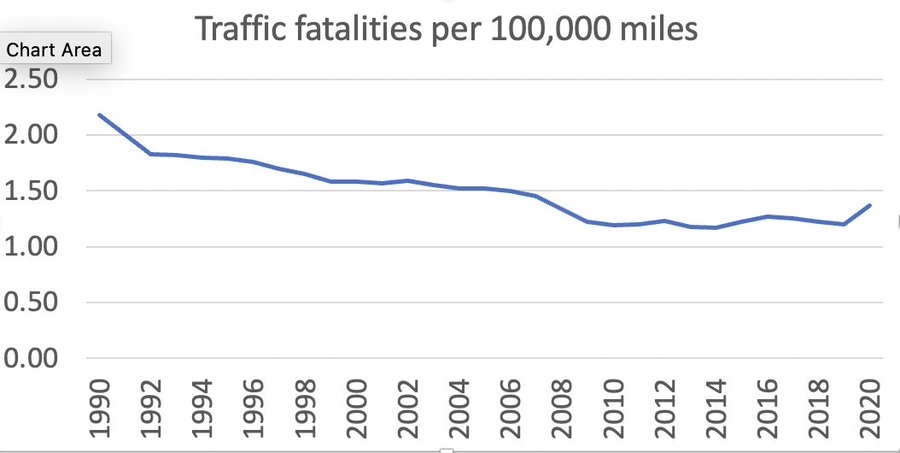
While Americans drove less in 2020 due to the pandemic, NHTSA’s early estimates show that an estimated 38,680 people died in motor vehicle traffic crashes—the largest projected number of fatalities since 2007. This represents an increase of about 7.2 percent as compared to the 36,096 fatalities reported in 2019. Preliminary data from the Federal Highway Administration (FHWA) shows vehicle miles traveled (VMT) in 2020 decreased by about 430.2 billion miles, or about a 13.2-percent decrease. The fatality rate for 2020 was 1.37 fatalities per 100 million VMT, up from 1.11 fatalities per 100 million VMT in 2019. NHTSA’s analysis shows that the main behaviors that drove this increase include: impaired driving, speeding and failure to wear a seat belt.
“Safety is the top priority for the U.S. Department of Transportation. Loss of life is unacceptable on our nation’s roadways and everyone has a role to play in ensuring that they are safe. We intend to use all available tools to reverse these trends and reduce traffic fatalities and injuries,” said Dr. Steven Cliff, NHTSA’s Acting Administrator. “The President’s American Jobs Plan would provide an additional $19 billion in vital funding to improve road safety for all users, including people walking and biking. It will increase funding for existing safety programs and allow for the creation of new ones, with a goal of saving lives.”
NHTSA’s projections show significant increases in fatalities during the third and fourth quarters of 2020 as compared to the corresponding quarters of 2019. NHTSA will continue to carefully analyze various data sources to understand how the risks to vulnerable road users might have changed during 2020 and the contributing factors for the increase.
Krugman also created a chart of traffic fatalities per miles driven from 1990 to 2020.
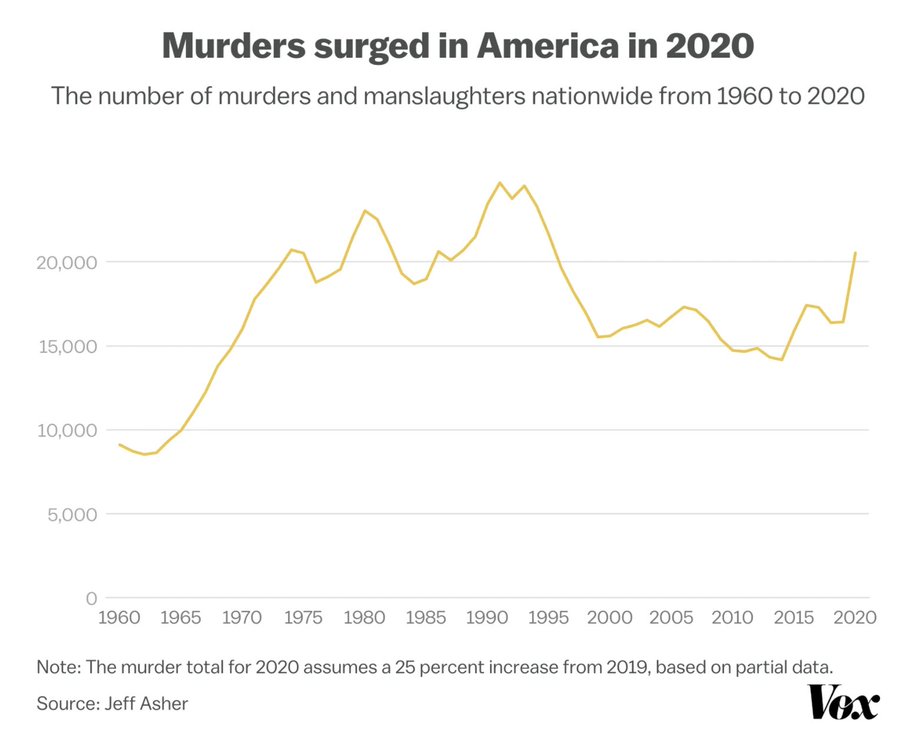
He then compared it to Vox's graph of homicides from 1960 to 2020.
Krugman commented on the parallel between traffic deaths and homicides in the rest of the Twitter thread.
Lots of people blaming Black Lives Matter for the murder surge; good reasons not to buy this, including the fact that red-state cities saw the same surge as blue-state cities. But here's another reason: did BLM cause bad driving? 6/
My point is that the pandemic and its disruptions seem to have done a number on social psychology in many dimensions. The worrisome thing is that troubled behavior seems to be persisting even as the country reopens. 7/
In the past week of returning to in-person teaching and resuming my pre-pandemic driving patterns, I've observed several people driving just as Krugman described, weaving in and out of traffic at high speeds. While a few Michigan drivers were doing that all along before the pandemic, I think I've seen more this week than the pre-pandemic average. Based on the data and my personal observations, I agree with Krugman that "the pandemic and its disruptions seem to have done a number on social psychology in many dimensions. The worrisome thing is that troubled behavior seems to be persisting even as the country reopens." Here's to hoping that subsides when the pandemic is over, which itisn't.
Enough of the big picture. Follow over the jump for the numbers about my personal driving.
Today is the second of two World UFO Days. Why two? National Day Calendar explains.
World UFO Day commemorates two separate dates. The first, on June 24th, recognizes the first widely reported UFO sighting on this same day in 1947 by aviator Kenneth Arnold. On July 2nd, the date commemorates the incident that took place in Roswell, New Mexico, in the same year.
I can see why two different UFO Days; both are important in the early history of the phenomenon and should be recognized. National Day Calendars singled out today's observance by writing "The creators of the July 2nd event launched it to raise awareness of UFO sightings and remove speculation from them." That makes me feel better about postponing my observance from June 24 to today, which I based on reports that the House Intelligence Committee's report on Unidentified Aerial Phenomena (UAPs) would come out later that week. It did, as CNET reported in The Pentagon UFO report explained on June 26.
Are they aliens? Spy planes? What *are* those unidentified aerial phenomena we've been seeing lately? We break down the report commissioned by Congress to get to the bottom of UAPs and the people who report them.
CNET not only presented a good summary of the findings, but also an excellent timeline of how and why this reported ended up being produced. For some reason, I'm not surprised it started off with Marco Rubio adding the request to a budget bill. His doing so adds to the ambivalence I feel about the subject.
On the one hand, I feel the same about addressing the official interest in UFOs as I do about "Fauci's emails and...the Wuhan lab-leak hypothesis, two narratives that I want to give as little attention to as possible." On the other, I have described this blog as having a "science fiction slant" on its Facebook page, so writing about the topic is on brand.
I hope this is a case of a stuck clock still being right twice a day, just as Senator Rubio is on DaylightSaving Time. On the other hand, it might end up being like his positions on gun control and Cuba, which I disagree with. Only time will tell, although the kind of supporters the report has makes me wonder and worry.
Follow over the jump for more news reactions to the report.
Here are some of the rainfall reports we have received over the last 24 hours (most are a 24-hr total). You can see all of our local storm reports here: https://t.co/3SpEJRgSzUpic.twitter.com/W5bTBkTNZN
Wow! I expect more reports of flooding through the weekend. The silver lining is that the heavy and repeared rains should end the mild to moderate drought in SE Michigan.
Authorities in Kalamazoo want residents to pay attention to the water levels around area rivers and creeks as rain, heavy at times, will continue this weekend.
Be careful what you wish for; you might get it, even if it's rain to break a drought.
Meat processing giant JBS has stopped production at at least one U.S. plant after it announced it was the target of an organized cybersecurity attack. (June 1, 2021)
The temporarily closed Green Bay, Wisconsin, plant was among those closed and its sign provided the preview image for Expert: Ag industry not prepared to tackle cyberthreats even though none of the reporting was from there.
Raquel Martin reports from Washington, D.C, on June 2, 2021.
I agree with Susan Duncan of Virginia Tech that the federal government and food processors need to coordinate to protect the food supply. As she said, it's bad enough that there may be food shortages in 30 years because of increased population; we don't need corruption of the technologies used in distribution to make those worse.
President Biden and Press Secretary Jen Psaki weren't the only political figures to comment on the incident. WOOD-TV reported Sen. Peters reacts to recent cyber attacks while the senator was visiting Grand Rapids.
As I pointed out yesterday, this attack shows that the U.S. food system has become a 21st Centurycrime scene, a national security issue, and part of the nation's infrastructure. It always was, but now it's obvious. Criminals overseas and the governments of the countries they operate in recognize this, so it's time we do, too.
Daylight Saving Time (DST) begins tomorrow and, asIhaveforthepastfewyears, I'm documenting efforts to stop the switching back and forth between DST and standard time because of the time change's deleterious health effects. Today, I'm sharing news from Florida, Georgia, Michigan, Nevada, and Pennsylvania. Since I live in Michigan, I begin with WXYZ's Michigan lawmaker introduces bill to end Daylight Saving Time changes.
Get ready to lose an hour this weekend as Daylight Saving Time is almost here, but if one state lawmaker has her way, it could be the last chance in Michigan.
Daylight saving time takes effect early Sunday morning, meaning you'll lose an hour of sleep as we spring ahead.
Hoitinga said she was looking for a State Senator to support her legislation. She might already have one in Jeff Irwin, who I know from covering him for the now-defunct Examiner.com and who I last wrote about when he proposed legalizing marijuana six years ago. I hope they find a way to work together across the partisan divide.
Follow over the jump for stories about ending the switching back and forth from outside Michigan.
Michigan recorded its first two cases of coronavirus on March 10, 2020. This timeline shows how the pandemic played out over the last year in Michigan, along with measures taken by the state government and Governor Gretchen Whitmer to slow the spread of the virus.
The numbers lined up next to the government actions tell quite a story, one of restrictions being imposed and coronavirus infections falling and then being relaxed and the disease returning. I hope people in the state learn from that.
Wednesday marks one year since Michigan's first reported COVID-19 cases, and a year ago, Gov. Gretchen Whitmer declared a state of emergency, which was followed by a slew of executive orders aimed at stopping the spread.
I'll return over the jump with WXYZ's look at the future of the pandemic in Michigan. That's after WDIV/Click on Detroit's retrospective, which examines what Americans in general and Michiganders in particular have already learned about the pandemic and our response in Coronavirus pandemic 1 year later: What we wish we'd known.
Dr. Frank McGeorge discusses the past year of the coronavirus pandemic.
I agree with Dr. McGeorge about the significance of asymptomatic people being infectious and masks preventing spread of the disease. If mask wearing had been recommended earlier and mask production had been ramped up sooner to match the need, millions fewer would likely have avoided infection and many thousands would still be alive.
Follow over the jump for what the present and future might hold in store, even though Dr. Arnold Monto of the University of Michigan reminded WDIV's viewers that the past year was worse than predicted, which means that my readers should take the prognostications with a grain of salt.