A blog about societal, cultural, and civilizational collapse, and how to stave it off or survive it. Named after the legendary character "Crazy Eddie" in Larry Niven and Jerry Pournelle's "The Mote in God's Eye." Expect news and views about culture, politics, economics, technology, and science fiction.
Are sperm counts declining? Are microplastics and pesticides affecting male fertility? Does a low sperm count mean you’ll struggle to have children? Howtown investigates the science behind male infertility and headlines warning of a global “sperm crisis” or “spermageddon.”
With Dr. Esh and researchers Hagai Levine, Shanna Swan, Allan Pacey, and Dolores Lamb, we examine sperm concentration, sperm motility, sperm morphology, and why semen analysis is surprisingly difficult. What do the influential sperm count meta-analyses actually reveal about reproductive health?
A study of nearly 3,000 Swiss men launches our investigation into pesticides, microplastics, plastic additives, flame retardants, and endocrine disruptors. We explore the Seveso dioxin disaster and a Netflix documentary’s experiment in reducing plastic exposure.
We also examine age, smoking, illness, varicoceles, and lifestyle—and what sperm quality can tell us about getting pregnant. Do long-term studies, infertility rates, and time to pregnancy support claims of a worldwide fertility crisis? What remains uncertain?
All three subjects relate to topics I study and teach about, the genetic code, although this was a very novel way of encoding data, evolution, and stratigraphy. I found Joss Fong's artistic representation of James Hutton and John Playfair's work to be particularly striking (and dipping — that's a geologist's pun). However, it was Adam Cole's artwork and subject that prompted me to leave a comment.
This is at least the second time Howtown has featured Ig Nobel Prize winning science. The first was "Tastes like deep time..." where Joss licked an oreodont bone, demonstrating the science behind the 2023 Ig Nobel Prize winner for Chemistry and Geology: "Jan Zalasiewicz of the University of Leicester for explaining why many scientists like to lick rocks." This time, it's Adam adapting the 2015 Ig Nobel Prize in Biology for getting chickens to walk like dinosaurs by putting sticks on their butts. May Howtown investigate more science that makes you laugh, then makes you think!
"Thriller" is a song by Michael Jackson. It was released by Epic Records on November 11, 1983, in the UK and on January 23, 1984, in the US, as the seventh and final single from his sixth album of the same name. "Thriller" is a disco song featuring a synthesizer bassline, lyrics, and sound effects evoking horror films. It includes a spoken-word sequence performed by the horror actor Vincent Price. It was produced by Quincy Jones and written by Rod Temperton, who wanted to write a theatrical song to suit Jackson's love of film.
"Du Hast" is a song by German metal band Rammstein. It was released as the second single from their second album Sehnsucht (1997). It has appeared on numerous soundtracks for films, most notably The Matrix: Music from the Motion Picture, How High, and the home video CKY2K. It is featured in the music video games Guitar Hero 5 and Rock Band 3. The guitar riff is similar to Ministry's "Just One Fix". The music was written by keyboardist Flake and guitarist Richard Kruspe. The intro section and the verses were a combination of a synth sequence by Flake and a guitar riff by Kruspe, and the chorus was written around a chord sequence by Flake.
"Somebody's Watching Me" is the debut single written, co-produced, and performed by American singer Rockwell, released by Motown in December 1983. Serving as the lead single from Rockwell's debut studio album of the same name (1984), it features uncredited guest vocals by Michael Jackson, additional backing vocals by Jermaine Jackson, and co-production from Curtis Anthony Nolan.
I had been wishing Broken Peach would redo "Thriller" for Halloween since 2017 as I wrote in 2019.
Of course, the ultimate Michael Jackson song for Halloween is "Thriller," which Broken Peach also sings...Two years ago, I left [this] request in a comment on this video: "I have a suggestion for you all. Next Halloween, dress up like zombies and sing 'Thriller' again."
It only took nine years, but it finally happened.
Broken Peach also donned their skull makeup for a series of songs this spring that they called "Old Skull" (Old School). Follow over the jump.
Narb: But [what] I really want you to blog about is Yo-Yo Ma's playing LoTR music with the Michigan Marching Band on Saturday!
All my favorite things rolled into one (except for beer).
Me: I just watched that show on YouTube. Yes, I plan on doing just that later this week. The 25th anniversary of the first Lord of the Rings movie is right up my alley.
Music Selections:
Prologue: One Ring to Rule Them All from Lord of the Rings: The Fellowship of the Ring - composed by Howard Shore
Concerning Hobbits from Lord of the Rings: The Fellowship of the Ring - composed by Howard Shore
A Shortcut to Mushrooms from Lord of the Rings: The Fellowship of the Ring - composed by Howard Shore
Riders of Rohan from Lord of the Rings: The Two Towers - composed by Howard Shore
Isengard Unleashed from Lord of the Rings: The Two Towers - composed by Howard Shore
Musical Arrangements by Scott Boerma, Richard Frey, and Chuck Ricotta
Flag Choreography by Joan Noble-Pruett
Drill by Richard Frey
“You shall not pass,” …up the chance to watch as the MMB performs Howard Shore’s score from Lord of the Rings with special guest soloist Yo-Yo Ma. This Saturday, we celebrate the 25th anniversary of Lord of the Rings: The Fellowship of the Ring with music arranged from the film series, originally composed by Howard Shore.
One does not simply walk into Kinnick Stadium… we march! Today’s halftime show celebrates 25 years of the Lord of the Rings films, featuring the iconic music of Howard Shore.
Iowa won the football game, but Michigan won the halftime.
Stay tuned for a more serious post tomorrow or Saturday, whichever day I don't dedicate to the winner of Outstanding Commercial at the Emmy Awards.
On the 1st of September, Drexel University made the announcement that they plan to permanently close the Academy of Natural Sciences; the oldest natural history museum in all of the Americas. The news came as a shock to everyone from locals to the the staff of the museum themselves who learned about closure on the same day as everyone else. Now the fate of this historic institution and the millions of rare and valuable artifacts within it hang in the balance. Join me as we fight back against this attack on science and help save the Academy.
...
HOW TO SAVE THE ACADEMY:
Step 1: Go to this link https://save-the-academy.org/...
The page at the link urges people to complete five actions, the first of which is sign a petition.
I've signed and so have 108,090 others. The last on the list is "share your story." That's what this blog is about. I'm recycling part of a comment I left on George Morgan Davis (1938 – 2024): The Director’s Cut to kick off my personal story.
On the one hand, may George Davis rest in peace. I have at least one story about the Council of Systematic Malacologists, where I first met George, and the San Diego Natural History Museum that I did not want to commit to paper or pixels while he was alive. On the other, the same instincts that guided George in that tale would be useful. Have you heard that Drexel University, which took over the Academy of Natural Sciences of Philadelphia and turned it into the Academy of Natural Sciences of Drexel University, has decided to shut it down by the end of the month? If George were still with us, he'd be fighting that decision. I located your blog and the PDF you linked to while searching to see if George was still around. He's not, but I'm glad I found your blog.
When I wrote "Sometimes, people with less than pure motives get results, a topic on my to-do list," in 'Mr. Scorsese' and 'The Librarians' both Emmy winners, George Davis, who was curator of malacology at the Academy of Natural Sciences when I knew him in the late 1980s and early 1990s, was one of the people I was thinking about. Now's not the time to tell that story.*
Instead, I'm telling another story, that of Joseph Leidy, who "named the holotype specimen of Hadrosaurus foulkii, which was recovered from the marl pits of Haddonfield, New Jersey" and "also described the holotype specimens of Arctodus (A. pristinus), the dire wolf (Aenocyon dirus), and the American lion (Panthera atrox), among many others." I have connections to all these extinct animals, which Leidy described at the Academy of Natural Sciences.
One of the fiberglass dinosaurs at Pre-Historic Forest, where I worked as a tour guide and consultant, was Hadrosaurus foulkii. It was the high point, literally, as its statue stood at the top of the trail, of the walking tour. I could have used more information about the creature as the first dinosaur described from the United States. It would have been been more informative than making a bad joke about New Jersey (If it were described today, it might have been called Sopranosaurus, to which a heckler once responded "What about Hoffasaurus?" My retort was "You know where you can find Jimmy Hoffa? In the Yellow Pages under concrete." That joke has extra resonance now that I live three miles from where he disappeared.)
I've mentioned several times that I did my M.S. research at Rancho La Brea, where Arctodus in the form of A. simus), the dire wolf (Aenocyon dirus), and the American lion (Panthera atrox all occur. I haven't mentioned Actodus, known as the giant short-faced bear, on this blog before, but I have written about direwolves and American lions, so both are still relevant to me 40 years later. It would be a huge loss to science that I would feel personally if anything happened to the holotypes of these organisms, especially if it were because the museum closed and the specimens were lost.
I could go on with the stories of Edward Drinker Cope, Thomas Say, and Henry Augustus Pilsbry, all of whom were important scientists who worked in my areas of expertise and all of whom did their research at the Academy of Natural Sciences, but it's time to wrap up this post. Maybe later.
The Academy of Natural Sciences has an offer from the William Penn Foundation to keep its doors open for at least one year, but Drexel University, who owns the museum, said it is still deciding what the historic museum’s future will be, NBC10’s Andrew Rowan has the story.
When I signed the petition, I added the comment that Drexel should accept the William Penn Foundation's offer. I'll tell the university president and head of the board of directors the same thing. I hope my readers do, too.
The 2026 El Niño could be the strongest we’ve ever seen. And to understand its potential impacts, we’ll take a trip back in time to 1877. That El Niño triggered one of the most devastating natural disasters in human history. What could this one do?
Yikes! This is the first I've learned about the famines of 1877 and 1878, so it shocks me that they were so deadly. That the British Empire made things worse was the least surprising part of the story; Infidel753 and I had the following exchange in the comments to SciShow warns 'The Potato Famine Could Happen Again'.
Infidel753: Obviously any threat to the world's third-largest food crop is a serious concern, but this video hugely understates how much the Irish potato famine was exacerbated by politics. "Unhelpful policies adopted by their neighbors in the UK" doesn't begin to cover it. At that time Ireland was completely under British rule (part of the British Empire), a colonial possession under the heel of a government the Irish had no say in. The conservative British government at the time refused to provide any help at all to the starving Irish, partly motivated by racism (Celtic people were thought of as a different race at the time) and partly by a pull-yourselves-up-by-your-bootstraps Ayn-Rand-like mentality which was common in the ruling class at the time (this was later applied during a famine in British-ruled India, with equally disastrous results).
If the colonial government had merely provided the normal level of food aid typical of what governments do in such situations, most of the deaths would have been prevented. If such potato crop failures were to occur today, presumably modern governments would do their job and provide help to the affected people.
Me: Thanks for adding the needed context to the video. Yes, the British/English made things much worse by continuing to use Ireland as a resource colony throughout the famine, including making the Irish pay their rent in wheat and Ireland being a net exporter of food. They also exported those policies to the rest of the British Empire, as you pointed out. What they did in India, they did it in Ireland first.
[P]rocesses that happened in the past are likely to repeat in the future, so understanding the past is essential for preparation. This is a key takeaway from uniformitarianism, the concept that everything we see in nature is the result of everyday processes occurring over sufficient time, which is boiled down to "the present is the key to the past." It also means that the past is the key to the future.
File all the above under "it's a always a good day when I learn something new."
On June 11, the National Oceanic and Atmospheric Administration issued an El Niño advisory after temperatures in the equatorial Pacific Ocean remained higher than average for several months. Declaring an El Niño isn’t out of the ordinary, as they happen in cycles every two to seven years. But this one could be extraordinary.
Some are calling it a “Super” or “Godzilla” El Niño, and the NOAA predicts an 81 percent chance that it could develop to a “very strong” level, rivaling the historic and devastating El Niños of 1982-1983 and 1997-1998. Experts are predicting it will likely reach its peak this winter and into 2027, bringing heat, rainfall, and other potential extreme weather events.
But even with that foresight and climate models that can confidently predict what might be in store, we still face a test of what could potentially be the strongest El Niño ever recorded and the wild weather that comes with it. We spoke with atmospheric scientists and meteorologists to find out how a Super El Niño forms, why it changes global climate, and what we should expect in the coming months.
Sean talks with journalist David Wallace-Wells about a looming climate event that could make 2027 one of the hottest years ever recorded. They discuss the return of El Niño, why some scientists are calling it a “Godzilla El Niño,” and what it could reveal about the future of global warming. They also explore climate adaptation, political complacency, extreme weather, technological progress, and whether humanity is prepared for the world it’s creating.
Smartphones and a marked change to our digital media environment are part of the reason for the demographic shift changing our world, including how low birth rates are shrinking the workforce. Chief data reporter John Burn-Murdoch presents his lastest findings on this challenge faced by most nations[.]
There's a lot to chew on here. I've been writing a lot about government policy and economics, but I don't think I've mentioned non-medical technologies in the context of falling birth and fertility rates before. That's certainly a "scifi is now" topic. I also haven't discussed lack of independent housing as a factor in demography, although I've certainly blogged about housing and real estate during the past 15+ years. I think I'll be adding those perspectives to my writing in the future.
By the way, I consider "Pennsylvania economist Jesús Fernandez-Villaverde call[ing] fertility decline the question of our time, with most other problems flowing downstream of it" to be the result of a perspective I criticized in Meditations on sustainability, part 1.
[E]conomy is dependent on society, which is in turn dependent on the environment. Without an environment, there is no society. Without a society, there is no economy. Those relationships put sustainability into perspective. They also show that the emphasis on economy above all is exactly backwards. No wonder we're in trouble.
That written, I'm not surprised the Financial Times would feature it. As I quoted from Yes, Prime Minister, "The Financial Times is read by people who own the country," in this case the U.K., so they would think it salient. As one of the commenters pointed out, "This video is for rich people. Everyone who's is struggling knows why we don't have kids." From my ecological perspective, resource use, if not outright depletion, and waste production, as exemplified by fossilfuels and climatechange are the primary problems and everything flows downhill from them. As a biologist, I think limited resources primarily define carrying capacity, the maximum sustainable size of a population, and we should be examining those, especially their connections to the issues the economists identify.
The world is having fewer children and the pace of decline is happening much faster than expected. The reasons are complex and varied, from a lack of affordable housing to a lack of suitable partners. But could smartphones and modern tech be part of the problem? DW speaks to AI researcher Connor Leahy about how digital life may be reshaping relationships.
I was wondering if someone would bring up dating apps, the obvious technological solution to people finding partners, and Connor Leahy pointed out that their incentive is to keep people on the app, not find a permanent partner. Now I'm wondering if government matchmaking services are in our future. I suspect that would not be an unadulterated good and other causes would have to be addressed for them to be effective.
For what it's worth, the commenters to the video were hostile to the question, but I think that's because DW News didn't present the data supporting the inference, not that it helped the Financial Times video that much. Their commenters weren't as mean, but they were certainly skeptical. I'm not one of them; I think the researchers are onto something, at least as a contributing factor for the last 20 years.
The U.S. fertility rate is at an all-time low, according to recent data from the Centers for Disease Control and Prevention. Researchers say this is part of a larger downward trend. Since 2007, the number of Americans having babies has dropped 23%, well below the replacement level, meaning not enough are being born to replace those who die. William Brangham discussed more with Brian Mann of NPR.
PBS NewsHour broadcast this segment and then uploaded it one month before the study on smartphones and birthrates came out, so it didn't include its findings. In that light, the decline in teen pregnancy might be less a result of good policy and more the effects of smartphones. That doesn't make it any less of an accomplishment, just an accidental one.
Reading this would be enough to make me drink if my diabetes hadn't made me lose interest in drinking, so it's time to celebrate with Michigan Public saying .
Inspired by Tracy Samilton's recent trip to Cuba, Tammy Coxen whipped up this stellar mojito - which we might claim is one of the tastiest in Michigan. Samilton explored the Michigan-Cuba connection during her time in Havana, so Coxen used white rum from the Ann Arbor Distilling Company to bring some Michigan flavor to this drink perfect for warmer weather. Cheers!
That's a wrap for today's double celebration. Stay tuned for the Sunday entertainment feature. I have an awards show my readers can vote in for free, as long as they are interested in horror and horror-adjacent science fictionmovies and television.
This video chronicles the Top 12-scoring percussion sections of junior drum & bugle corps hailing from CANADA under the “tick” system (1983 and prior).
Ranking is by average score of DCI Finals Week, in order to take into account all end-of-season performances.
The scope of this video covers only DCI competition, as access to Canadian contest recaps is limited.
I thanked the uploader.
Good work, Tumour! I'm planning on featuring this video for my Canada Day post next week, so thanks for putting it together. Are you going to make a top 12 Canadian corps under the build up system after you finish the top 12 most legendary drumlines series? If so, I'll feature in next year's Canada Day post!
He answered he would, so I expect to feature his second video about Canadian drumlines next year.
Follow over the jump for corps representing the pre-DCI era, and the decades from the 1980s to today.
When you look at Federally declared disasters across the U.S., there’s a surprising blank spot in the Southwest region. What’s up with that? Is the Southwest really a safe haven from natural disasters? Or is there a more sinister explanation for this giant hole in the map? On this episode of Weathered, we talk to the folks who made this map, and some of the world’s leading experts on climate risk to find out what’s really going on.
My wife and I watched this video together on the big-screen TV in our bedroom. I guessed the lack of natural disasters in the American Southwest was because there aren't a lot of people there and that the dark secret was the heat. The first guess wasn't true; the Phoenix–Mesa–Chandler, AZ MSA has an estimated population of 5,228,938 while the Las Vegas–Henderson–North Las Vegas, NV MSA has an estimated population of 2,407,226.
The second guess was dead on. That's no surprise, as I blogged about Phoenix being the hottest city in the U.S. in 2021 and mentioned its record heat in 2023twice. What is surprising is that heat waves don't count as federal natural disasters covered by FEMA. The commenters found the reason dismaying: "You don't get disaster declarations for mortality. You only do it for economics." Ecurewitz responded "That’s the most American statement ever." RandomAngle9 commented "The fact that heat doesn't 'qualify' as a disaster because it doesn't destroy buildings, only people, says everything about how we value human life in policy." Speaking of policy, Florida banning municipalities from protecting workers from heat shows that DeSantis wasn't only bad on COVID-19. He and the rest of the Republicans on Florida are bad on climate and weather, too.
Today's evergreen educational entry features Bankrupt - Cicis Pizza by Bright Sun Films, a tale of the Retail Apocalypse.
Starting in the mid 1980's, Cicis Pizza was always the go-to pizza restaurant for cheap bites and great value. With their no-frills locations, cheap prices and innovative buffet concept, the restaurant became a massive success with hundreds of locations across the country. However, things have changed and following a bankruptcy, their once dominating presence has been severely diminished. Join me as we find out why.
As user
tcbgarage2845 wrote in his comment, "Private equity, Leveraged buyouts, Covid 19 and Chapter 11 bankruptcy! The whole gang is here." Indeed.
As I've written several times, no bankrupt company's story is complete without both Bright Sun Films and Company Man making videos about it, so I'm sharing Company Man Mike asking The Decline of CiCi's Pizza...What Happened?
Cici's pizza has been on the decline for more than a decade now. What was once the 5th largest pizza chain in the U.S. has fallen to number 10. This video takes a look at how they grew so large and theorizes where they went wrong.
There is also an AI-generated video summary.
CiCi's Pizza: from a humble beginning to a top-five pizza chain, this video explores the brand's rise and subsequent decline. The documentary analyzes the company's unique buffet model and its impact on CiCi's growth trajectory. It also examines factors that may have contributed to its recent struggles.
Company Man Mike uploaded this video on October 14, 2020, during the height of the pandemic, yet he didn't mention it. I'm surprised. Also, he produced this before CiCi's declared bankruptcy and before he began creating his lists of reasons for failure. Too bad — those lists are right up with his bar charts and line graphs among my favorite parts of Company Man Mike's videos. At least this video has plenty of those, along with enough shots of the menu items to make me hungry.
That's a wrap for today's lesson showing what not to do in business. Stay tuned for the Sunday entertainment feature.
I'm returning to the News & Doc Emmy Awards for this week's Sunday entertainment feature with the category I was originally planning on covering the day I posted 'Katrina: Come Hell and High Water' leads social issue documentaries at the News & Doc Emmy Awards for Flashback Friday, Outstanding Historical Documentary. Turning Point: The Vietnam War leads this category with five nominations, including Best Documentary. It's followed by Hurricane Katrina: Race Against Time with four, also including Best Documentary, Vietnam: The War That Changed America with three, then Becoming Katharine Graham, Becoming Thurgood: America's Social Architect, The Disappearance of Miss Scott, and Simon Schama: The Holocaust, 80 Years On, all tied at one with just this nomination. I'm sharing their trailers in that order, beginning with Turning Point: The Vietnam War | Official Trailer | Netflix.
From Luminant Media and director Brian Knappenberger, Turning Point: The Vietnam War offers an unfiltered look at one of the most defining and divisive conflicts in modern history and the profound, lasting impact it has had on America’s global identity and on the lives of countless people. Following in the footsteps of Turning Point: The Bomb and the Cold War and Turning Point: 9/11 and the War On Terror, this five episode docuseries showcases a war that was more than just a military failure; it was a political and cultural reckoning that reshaped America, exposed deep divisions at home and shattered trust in the government. With unprecedented access to CBS News archives, rare Vietnamese footage, declassified government records and previously unearthed White House recordings, the series spans nearly two decades and three different presidential administrations, amplifying often overlooked perspectives. As both America and Vietnam mark the 50th anniversary of the Fall of Saigon, Turning Point: The Vietnam War offers a timely exploration of how the war’s unresolved wounds, unlearned lessons, and enduring consequences continue to shape the world today.
I'm having flashbacks to my childhood seeing reports from Vietnam on the evening news as I watch this trailer. I'm sure anyone else old enough is, too. Since this is the most nominated entry in this category, it's the one most likely to win, although it's not the one I'm rooting for. That distinction goes to Hurricane Katrina: Race Against Time | Official Trailer | National Geographic, which I recommend to my students. Welcome to blogging as professional development.
Told in unflinching, moment-by-moment detail, HURRICANE KATRINA: RACE AGAINST TIME transports viewers into the chaos that engulfed New Orleans as one of the deadliest catastrophes in U.S. history unfolded—capturing the fear, heroism and resilience of those who fought to survive the storm and its aftermath. With the clear-eyed perspective of two decades of hindsight, this gripping historical record corrects persistent false narratives and exposes how a natural disaster became a national tragedy. Grounded in gut-wrenching eyewitness testimony from survivors, first responders and officials, and brought to life with immersive archival footage, the series is an unparalleled, emotionally raw examination of the storm’s personal, political and societal fallout. From the Oscar®- and Emmy®-winning producers at Lightbox and acclaimed filmmaker Ryan Coogler and his production company, Proximity Media, and directed by Oscar-nominated Traci A. Curry, this landmark documentary series arrives in time to mark the 20th anniversary of Hurricane Katrina.
I can see why this trailer earned a nomination for Outstanding Promotional Announcement: Documentary. It looks like it was created by the same team that produced the Emmy-winning trailer for 9/11: One Day in America, so I have it penciled in as my co-favorite for Outstanding Promotional Announcement: Documentary along with Love + War. As for it winning Outstanding Historical Documentary, its best hope is that Turning Point: The Vietnam War splits its votes with VIETNAM: THE WAR THAT CHANGED AMERICA | Official Trailer | Apple TV+.
With never-before-seen archival footage, Vietnam: The War that Changed America tells the story of the war through the eyes and memories of the people who lived it — 50 years later.
Narrated by Ethan Hawke, this six-part docu-series premieres January 31 on Apple TV+.
The reunion of old friends, first-person accounts, and rarely seen footage paint an extraordinary and deeply profound picture of what it was like to live through one of history’s longest wars. Narrated by Ethan Hawke.
Some of the featured voices include: Bill Broyles, a celebrated Hollywood screenwriter and Lieutenant in the war who reunites with a member of his platoon after 50 years; Hilary Brown, ABC News’ first female foreign correspondent who covered the fall of Saigon firsthand; Melvin Pender, the Olympic gold-medal winning runner who competed in 1968 between tours in Vietnam; soldiers from the Viet Cong who fought in the Tet Offensive, including the first Viet Cong woman in her district to shoot down an enemy aircraft; a veteran who thought his life was over, forced to parachute into the Ho Chi Minh trail, who reunites with the man who rescued him; and Vietnamese civilians who witnessed and fled from the war.
"Vietnam: The War That Changed America” is produced for Apple TV+ by the BAFTA and Emmy Award-winning team at 72 Films, directed by Rob Coldstream (“John Lennon: Murder Without a Trial”) and produced by Caroline Marsden (“9/11: One Day in America”), with executive producers David Glover ("9/11: One Day in America”) and Mark Raphael (“Crime and Punishment”). This series marks the second collaboration for Apple TV+ and 72 Films, following the launch of “John Lennon: Murder Without a Trial” last year.
This looks like a more personal examination of the Vietnam War than Turning Point: The Vietnam War, which took more of a big picture look at the conflict.
The story of a woman’s evolution from a self-proclaimed “doormat-wife” into one of the most powerful newspaper publishers of the 20th century. Becoming Katharine Graham is now streaming on Prime Video.
This is a documentary about journalism and many of the voters are journalists. However, they are television journalists while this is a story about print. Turning Point: The Vietnam War features the power of television reporting and that alone is enough to make the difference. As I'm fond of writing about awards shows, electorates matter.
Explore the life and legacy of the nation’s first African American Supreme Court justice. The film follows Justice Marshall, known as “Mr. Civil Rights,” from his legal career with the NAACP to his 1967 appointment to the nation’s highest court.
The Disappearance of Miss Scott chronicles Hazel Scott’s meteoric rise as a jazz talent and major Hollywood star before being blacklisted during the Red Scare. Hazel Scott was one of the most revered stars of the early 20th century. Not only was Scott a beloved musical sensation, but she also channeled her talents into Hollywood stardom, becoming the first Black American to host their own television show.
Discover her storied life, from her childhood as a musical prodigy in Trinidad to her prolific career on stage and the silver screen in the new documentary American Masters – The Disappearance of Miss Scott, premiering nationwide Friday, February 21 at 9 p.m. ET on PBS (check local listings), pbs.org/americanmasters and the PBS App in honor of Black History Month. Watch the first three minutes of the film in this official preview.
This is another documentary that could have been nominated for Outstanding Arts and Culture Documentary, showing why I cover entertainment like I do. It's important.
Renowned historian Simon Schama, a lifelong documenter of Jewish history, examines the Holocaust as a worldwide crime and its lasting impact today, 80 years after the liberation of Auschwitz, in this deeply personal film.
As James Faulkner wrote, "The past is never dead. It's not even past." That's why history is important.
2000 Meters to Andriivka leads with six nominations, Turning Point: The Vietnam War follows with five nominations, Hurricane Katrina: Race Against Time, Life After, and Love + War tie at four nominations, and Black Snow and Union tie at this one nomination. I had 2000 Meters to Andriivka penciled in to win this category because of its awards history, especially its wins at the DGA and WGA Awards, but seeing it lead this category, if not all nominees, in nominations inks that prediction in.
This nomination will help 2000 Meters to Andriivka win best Current Affairs Documentary, unless it boosts Life After, and either Turning Point: The Vietnam War or Hurricane Katrina: Race Against Time win Outstanding Historical Documentary. It might help Love + War win one of its other categories, but it's a dead end for Black Snow and Union; both are extreme long shots at winning this category and have no other nominations.
Outstanding Research: Documentary
The American Revolution Florentine Films | PBS [WETA-TV] Hurricane Katrina: Race Against Time Lightbox [Proximity Media | National Geographic] Oklahoma City Bombing: One Day in America 72 Films [National Geographic] The Strike UPHSF LLC The Stringer Netflix [LinLay Productions | Netflix | VII Foundation | XRM Media] Syria’s Detainee Files FRONTLINE | PBS [BBC] Turning Point: The Vietnam War Netflix [Luminant Media | Netflix] The White House Effect Actual Films | Netflix [Netflix | The Department of Motion Pictures]
Turning Point: The Vietnam War leads this category with five nominations, followed by Hurricane Katrina: Race Against Time and The Stringer tied at four, then The Strike with three, Syria's Detainee Files and The White House Effect tied with two, then The American Revolution tied with Oklahoma City Bombing: One Day in America at just this one. That there are so many nominees indicates that this is a very competitive category, so I won't designate a favorite right now. Just the same, I'm noting that The American Revolution earning just this one nomination here suggests to me that it's eligible for the Creative Arts Emmy Awards, so I expect it to be nominated there, too. That happened for The U.S. and the Holocaust, so I've seen it happen before.
After today, I'm penciling in Turning Point: The Vietnam War as the favorite.
Sally should just be happy to be nominated in this category. 2000 Meters to Andriivka has six nominations, including Best Documentary. Life After has four, also including Best Documentary, as does The Stringer. Katrina: Come Hell and High Water and Vietnam: The War That Changed America both tied Sally with three. Apocalypse in the Tropics and Music Box: It's Never Over, Jeff Buckley have just this one. Out of this field, 2000 Meters to Andriivka is my provisional favorite.
Secrets of the Penguins deserved this nomination, but I doubt it will win. Instead, I think it's between Turning Point: The Vietnam War with five total nominations and Love + War with four nominations. Both are also nominated for Best Documentary. The sounds of combat would probably impress the journalists and documentarians, possibly even more than the sounds of nature or music. If the entertainment professionals in the Creative Arts Emmys were voting, they might give WE WANT THE FUNK! the advantage. Not here; electorates matter.
I think the same of Underdogs' chances for Outstanding Sound: Documentary. Given the competition in its categories, it has an apt title.
I haven't changed my mind, but let's see how I feel after watching the war documentaries.
Now I have to watch Love + War before the ceremony on May 28th.
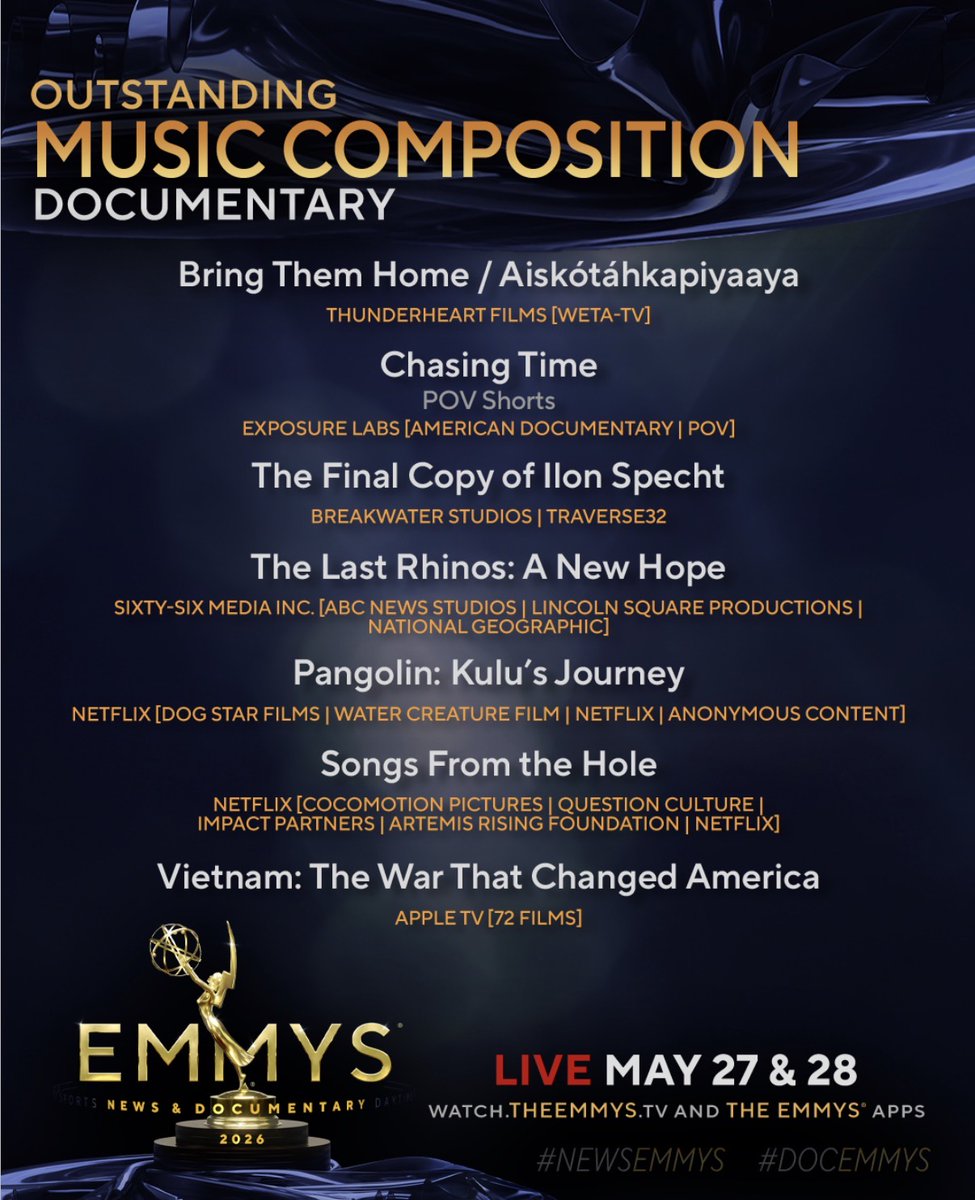
This is the second nominated category for both The Last Rhinos: A New Hope and Pangolin: Kulu's Journey. Without listening to the score, I can't make an accurate assessment of the music. That written, my gut feels that it's between Vietnam: The War That Changed America and Chasing Time. The former has three nominations and the latter is the first short documentary I recall having a second nomination at these awards. Also, Exposure Labs has a strong track record with music, with Chasing Ice earning an Oscar nomination for its song and Chasing Coral earning a nomination for Music & Sound.
I've changed my mind. I now think that Songs from the Hole is the favorite. The journalists and documentarians might just vote for JJ’88. The composers might not, but I suspect there aren't a lot of them in this Televison Academy, especially voting for the News & Doc Emmy Awards.
The composers might want to vote for one of their own, which JJ'88 almost certainly isn't.
I close the nominations for Turning Point: The Vietnam War and Hurricane Katrina: Race Against Time with two categories I haven't blogged about.
Outstanding Lighting Direction: Documentary
American Manhunt: Osama bin Laden Netflix [The Cut | Tillerman Films | Ventureland | Netflix] Cold Case: The Tylenol Murders Netflix [Third Eye Motion Picture Company | Netflix | Radical Media | MA Productions | Silvio Films] Hollywood Hustler: Glitz, Glam, Scam Library Films [Amazon MGM Studios | Library FIlms | Vice Studios | Article 19 Films] Lockerbie: The Bombing of Pan Am 103 Mindhouse Production [Sky Studios | CNN Original Series] Turning Point: The Vietnam War Netflix [Luminant Media | Netflix]
It's Turning Point: The Vietnam War versus a bunch of documentaries with just this one nomination. Somehow, I don't think that will help it, especially if 2000 Meters to Andriivka sweeps, which I expect. The News & Doc electorate isn't into consolation prizes, but they have surprised me by going against the most nominated entry before.
Outstanding Promotional Announcement: Documentary
Chris Hemsworth: A Road Trip to Remember National Geographic [Mattock] LOVE+WAR Trailer Love + War
National Geographic [Mark Woollen & Associates] NATURE Season 44 Trailer Nature
PBS [The WNET Group] Race Against Time Trailer Hurricane Katrina: Race Against Time National Geographic [Buddha Jones] Trailer In Waves and War
Actual Films | NETFLIX [Netflix | Participant | Chicago Media Project]
I need to watch Love + War before the 28th to call this category, too.
Follow over the jump for the most active shares about the News & Doc Emmy Awards on social media during the 15th year of Crazy Eddie's Motie News.
In part 2 of this series exploring controversy in DCI, we take a close look at the Boston Crusaders, and specifically the time they decided to call out DCI to their faces... some would say at the cost of competitive success!
I am quite familiar with "Napoleon's" proposals. I wrote for Drum Corps Worldfrom 1996 to 2008 and wrote twoarticles about them. One led directly to the other and the outcome disgusted me. Both also led to the G7 proposal, so I wasn't surprised it elicited such a public backlash. CNN even reported on it! "Napoleon" wanted more mainstream media attention for the activity and he got it, twice. He should have been more careful what he wished for.
We're about to change the rules.
Animal Farm — A Cautionary Tail. Takes over theaters May 1, 2026.
...
Starring Seth Rogen, Gaten Matarazzo, Steve Buscemi, Glenn Close, Laverne Cox, Kieran Culkin, Woody Harrelson, Jim Parsons, Andy Serkis, Kathleen Turner & Iman Vellani
Perfect timing!
Follow over the jump for last year's top posts featuring drum corps, nearly all of which were also top posts on Facebook.
Something unexpected and potentially irreversible is changing Antarctica and scientists finally know why.
Over the past few decades, researchers have tracked the mysterious growth and sharp decline in sea ice in Antarctica. But a few years ago a troubling discovery was made that could upend global ocean circulation, push one species of penguin to extinction, and change our planet’s climate forever.
In this episode of Weathered, Maiya May looks into the role sea ice plays in our global climate, and the threat that its disappearance poses to our natural world.
From emperor penguins, to sea level rise, to the slowing of the AMOC, these seemingly inconsequential chunks of floating ice could hold the key to our survival. And their loss could be a sign that we’ve crossed a tipping point in an already delicate region of our planet.
Climate scientists and oceanographers have been so concerned about the AMOCweakening and collapsing because of the Greenland ice sheet melting that we've ignored the threat to the Global Conveyor Belt current from melting in Antarctica. We can't do that anymore, not once the Antarctic sea ice began to shrink the same way that Arctic sea ice had been for decades. At least Antarctic sea ice growing will no longer be a viable climate change denial talking point. Small favors.
Follow over the jump for the most read and active posts about climate change and extreme weather during the 15th year of Crazy Eddie's Motie News.
Happy Easter and First Contact Day! No one responded at all, let alone no, to my parting question, "Star Trek Easter eggs, anyone?" I'm taking that as a tacit yes for the topic of today's Sunday entertainment feature.
Dr. Kovich's office in Star Trek: Discovery is full of Easter eggs referencing the entire franchise of Star Trek. From a vintage bottle of Chateau Picard wine and Geordi's VISOR, Dr. Kovich's office reveals a lot about his mysterious role in Star Trek: Discovery.
Those are the serious Easter eggs in a dramatic series. Now for some funny ones in a comedy, Star Trek: Lower Decks. Watch as Rodenberry BEAM asks Can You Spot These Hidden Star Trek Jokes?
Every episode of Star Trek: Lower Decks is FULL of easter eggs, references, and inside jokes about the franchise... but did you catch them all? It's time to rank some of our favorite inside jokes from STLD, especially from season 4... from the most obvious to the most obscure.
Those are some deep cuts! The writers of Star Trek: Lower Decks were willing to go a long way for a laugh.
In this video, I dive deep into the 32nd-century Academy to find every callback to the Delta Quadrant. From the return of Robert Picardo as the EMH Doctor to the long-awaited promotion of Admiral Harry Kim, Starfleet Academy is full of Star Trek: Voyager lore. We also look at hidden references to Janeway, Neelix’s lung maggots, and the legal legacy of the 'Author, Author' court case.
That was worth watching, even though I'm not optimistic about The Sci-Fi Feminist uploading a part two. My wife and I enjoyed Starfleet Academy, but it was canceled after season two. Darn.
Follow over the jump for a retrospective of the most read entries about holidays from the back catalog during the 15th year of Crazy Eddie's Motie News.
As of 11:59 PM EDT March 20, 2026, this blog had a lifetime total of 10,896,134 page views, 6,536 posts, and 4,274 comments. Minus the 5,222,122 page views, 6,168 total posts, and 4,180 comments as of just before March 21, 2025, that means this blog earned 5,674,012 page views and 94 published comments on 368 posts during the 365 days of the 15th year of Crazy Eddie's Motie News. My calculated page views round to the ~5,670,000 page views Blogger's counter showed during the past twelve months. I can't ask for any better given the level of precision available, so not only closer than last year, but as exact as I could measure. On the other hand, the 94 published comments are not at all close to the 125 comments Blogger showed on my dashboard. On the other hand, I can account for the 31 comment difference; all of them are spam that was never published or retroactively unpublished. The stats worked out this year!
Last year's trend of increasing page views continued. Not only did this past year's 5,674,012 page views on 368 posts during 365 days beat the year before's 758,914 page views on 370 posts during 365 days, it beat the year before that's 419,300 page views on 641,234 page views on 380 posts during 366 days. It also exceeded the page views during the entire preceding 14 years. Wow! I had written "May the trend" of "working less hard for more page views" continue, but this was beyond any of my expectations. The blog averaged 15,418.51 page views per post and 15,545.24 page views per day. That's nearly eight times as much as the 2,051.12 page views per post and 2,079.22 page views per day during the 14th year of the blog, the 1,687.46 page views per post and 1,752.01 page views per day the blog earned between March 21, 2023 and March 20, 2024 and the 1,106.33 page views per post and 1,148.77 page views per day between March 21, 2022 and March 20, 2023. I'm not expecting the trend of increasing page views per post and day to continue. I'd just be happy if the 16th year exceeds the 14th.
Both the published and total comments decreased from 123 to 94 and either 154 or 133 to 125, respectively. The published number is still above the 78 of two years ago, but the raw number has decreased from 199 through either 154 or 133 to 125. Since I don't have comment goals, I'm not concerned.
As for my commenters who aren't spammers, I'd like to thank them, beginning with continuing commenters Infidel753, Paul W., and Steve in Manhattan. I also want to welcome back K-dog and Degringolade, who didn't comment last year. Keep up the good work! I also want to thank Richard, Glen Tomkins, and fry1laurie for making their first posts here. Stick around! The exception is Riverboat Grambler, who pissed me off. Don't come back, Grumbler! Unfortunately, I seem to have lost longtime commenters Nebris, the first commenter on my blog, and Friend of the Court. In addition, last year's first-time commenters John R. Christiansen, E.A. Blair, and Steven C. Di Pietro didn't return. Come back, I miss you!
Follow over the jump for the rest of the analysis.
Some parents are concerned (or thrilled?) that their kids might be developing an Australian accent from watching Bluey... but is that really possible? How much of our language acquisition comes from TV anyway?
This was the perfect video to upload on World Television Day, as it shows the significance of television to society. Since no one else has mentioned it, a belated happy World Television Day to Erica/Dr. B., all of the Storied crew, and viewers!
I knew then that I would be sharing this video today.
By the way, I recommend reading the comments, which are full of Australians saying it was time Australia struck back at the U.S. for all the Americanisms introduced through television. TV can change the way you speak!
That's a wrap for today's holiday about the effect of technology on society. Stay tuned for an evergreen educational entry tomorrow.
While the evolution of the butthole was a major breakthrough in animal development, its story might actually end with redefining what it means to have a butthole at all.
Corrections: 06:10 Starfish are actually deuterostomes! Earthworms are protostomes.
06:18 Earthworms are actually protostomes! Starfish are deuterostomes.
I left two comments on this video. First, "It's literally a fundamental question, as fundament means buttocks or anus in addition to the foundation or basis of something." Second, "It took me five days to realize that you uploaded this on World Toilet Day. To be fair, it seems that no one else noticed that, either, so I think I'll be the first to wish Kallie, the rest of the Eons crew, and the viewers a belated happy World Toilet Day!" I knew then that I would be posting it today.
That's a wrap for PBS Eons doing for bathroom humor what it did for stoner jokes, telling the smartest ones on YouTube. Stay tuned for an evergreen educational post followed by a Storied video for WorldTelevisionDay.
Native American history didn’t begin in 1492, and it didn’t end in 1900. It stretches back thousands and thousands of years and extends into the present – and the future – of the United States. In our first episode of Crash Course Native American History, we’ll explore why and how we plan to tell this history.
My first encounter with the word Mazama, the genus name for brockets, was for the stratovolcano that stood where Crater Lake now sits in its caldera. I originally thought the name was the original Native American one for the now imploded mountain and the deer was named after it. Not at all! The direction of the name runs the other way, from the deer through a mountaineering club with the name, who took it to mean mountain goat instead of brocket, which is what Mazama means in Spanish as well as at least one Native American language that borrowed it from the Aztec language Nahuatl, to the prehistoric mountain, as they named it after themselves. If your series on deer hadn't inspired me to do this research, I may never have found any of this out! By the way, since I'm also a geologist and lecture on Crater Lake in my classes, I can use this information when I teach. Thank you!
I now tell the story found in Wikipedia, of a battle between Llao and Skell, thanks to reading a blog about biology, not geology. This wasn't the only story I tell my students I changed while teaching from home. Not commuting during the COVID-19 pandemic gave me time to check my facts, as did realizing my students were doing a lot of their own research. I could tell they were reading Wikipedia and didn't want some student contradicting me in front of the class!
What is tribal sovereignty? In this episode of Crash Course Native American History, we’ll explore how tribes can and can’t govern themselves, and why sovereignty isn’t something the U.S. ever gave to tribes — it’s an inherent right they already had.
"Isn't the legal system fun?" *snork* At least this video confirmed that what I knew about "dependent sovereignty," a term I first heard on CBC 30+ years ago, was correct. Native American tribes can't wage war, engage in diplomacy with foreign nations, or print/mint their own currency. That's worth knowing. What I didn't knew already was that the Chinook are not currently a federally recognized tribe. They should be.
From sports mascots to “the First Thanksgiving,” bland representations of Native Americans are everywhere. In this episode of Crash Course Native American History, we’ll tackle common myths and misconceptions about Native people and uncover the truth behind tribal casinos, government handouts, and more.
I enjoyed seeing all these myths busted.
There are 15 more episodes and counting, but I'm conserving those resources, so that's a wrap for today. Stay tuned as I plan on resuming my Emmy winners coverage tomorrow with the winner of Outstanding Commercial.
There's only one way to drive directly between Michigan's peninsulas, and it requires crossing this absolute feat of engineering. This is the story of the longest suspension bridge in the Western Hemisphere: the one, the only, the Mackinac Bridge.
I'll let essemque explain why this is appropriate for Labor Day: "I love that this went live just days before the annual Labor Day walk where the bridge is opened to pedestrians (one way from north to south) for a morning!" The timing turned out to be fortuitous, as Alexis responded, "It wasn't intentional timing, but I am also glad it worked out that way!" Sometimes it's better to be lucky than good.
That's a wrap for today. I plan on covering casting categories at the Emmy Awards tomorrow, so stay tuned and enjoy the holiday!
The Big One is coming and it could be far worse than anyone imagined.
The Cascadia Subduction Zone, just off the Pacific Northwest coast, is building toward a massive earthquake and tsunami. But new research reveals an even more terrifying possibility: widespread toxic spills, infrastructure collapse, wildfires, and deadly gas plumes. All triggered by a single seismic event.
In this episode of Weathered, we dig into the science behind the Cascadia Megaquake, why the Pacific Northwest is especially vulnerable, and how climate change could make it worse. We explore what you can do to stay safe and why your community might be your best line of defense.
Infidel753: The Portland metro area has two million people and Seattle is even bigger. Even if 125,000 people were killed on the Oregon coast and a similar number on the Washington coast, I would still expect the death toll from structural collapses and fire in Portland and Seattle to be much larger.
Coastal fatalities (Oregon): 4,800 (4,500 from tsumami, 300 from the earthquake itself)
I-5 corridor fatalities (Oregon): 400 (all from earthquake)
Coastal injuries (Oregon): 6,500 (5,000 from earthquake, 1,500 from tsunami)
I-5 corridor injuries (Oregon): 9,000 (all from earthquake)
Homelessness/needing shelter (Oregon): 520,000 (500,000 earthquake, 20,000 tsunami)
Coastal fatalities (Washington): 9,100 (9,000 from tsunami, 100 from earthquake)
I-5 corridor fatalities (Washington): 300-1,600 (300 earthquake, 0-1,300 tsunami)
Coastal injuries (Washington): 5,000 (2,000 earthquake, 3,000 tsunami)
I-5 corridor injuries (Washington): 7,400 (7,000 earthquake, 400 tsunami)
Homelessness/needing shelter (Washington): 415,000 (370,000 earthquake, 45,000 tsunami)
According to these estimates, more people will die from the earthquake along the I-5 corridor than along the coasts in both Oregon and Washington, but far more will die from the tsunami along the coasts alone (13,500) than the total that will die from the shaking throughout both states (1,100). So, no, the official estimates do not support your expectation that "the death toll from structural collapses and fire in Portland and Seattle to be much larger" than tsunami deaths on the Oregon and Washington coasts.
Infidel753: Very interesting links, thank you. I need to think further about this.
Me: Thanks for linking to the sources of these statistics and the blog as a whole in Link round-up for 18 January 2025. I'm glad to have informed you and your readers.
The statistics quoted are from a 2016 document, but the casualty numbers are higher than in the video, 43,800 total deaths and injuries in the document compared to "over 30,000 casualties" (total deaths and injuries) cited by Tina Dura of Virginia Tech. Surviving Cascadia also cites a 2022 study by Patrick Massey for FEMA that projects 1,100 earthquake-related fatalities, 13,000 tsunami-related fatalities, and 24,000 injured. The death count is substantially the same, but the number of injuries is less than the 27,900 predicted in the 2016 estimate, altough the 2022 report was for a February earthquake and tsunami. Casualties could be higher during the peak of tourist season. Cascadia Rising didn't list a dollar amount, but I can believe the video's estimate of $81 billion dollars of damage.
On the other hand, Luke Hanst of Portland State University added up to 2,500 deaths from toxic gas exposure resulting from burning fuel and chemical storage tanks and hundreds of thousands of people affected, adding tens of thousands of injuries. Even adding the 2,500 deaths to the 400 from the earthquake listed above for Oregon's I-5 corridor would not push it above the 4,800 deaths expected along Oregon's coast, but it does make the risk more even as well as much higher along the interior.
The video added two items of scientific interest, the effects of liquefaction and climatechange. I make a big deal of the former when I lecture about earthquakes, especially the 1964 Alaska Good Friday earthquake. I might show this video to my geology students just to reinforce the point. Climate change will make the subsidence along the coast, which the video in January's post showed happening in 1700, even worse.
For what it's worth, I've seen similar, if not the same, findings about lower crime rates and increased cooperation after natural disasters and wrote about them five years ago in Seeker/DNews is optimistic about how people would behave during the apocalypse. As I wrote then, "that's good news, even if it might not be good entertainment."
Still good news.
That concludes the latest installment in this series. Stay tuned for the first Sunday entertainment feature of July. Awardsshows!