A blog about societal, cultural, and civilizational collapse, and how to stave it off or survive it. Named after the legendary character "Crazy Eddie" in Larry Niven and Jerry Pournelle's "The Mote in God's Eye." Expect news and views about culture, politics, economics, technology, and science fiction.
On January 8, 2023, thousands of supporters of Brazil’s right-wing former President Jair Bolsonaro stormed federal buildings in the country’s capital. Their goal? Overthrow the results of an election they claimed was rigged, despite no credible evidence of fraud.
If that sounds familiar, that’s because it is. Brazil’s January 8 looked a lot like the January 6 attack on the US capital, just two years earlier: mob violence, an insurrection, and a defeated leader who refused to concede.
But the aftermath could not be more different. Jair Bolsonaro is now serving a 27-year prison sentence, while Donald Trump is president, again.
So how did two democracies, facing similar threats, end up with such different outcomes? This video explains how Brazil’s democratic system worked to hold “the Trump of the Tropics” accountable and what the US could learn from the aftermath.
Laws and constitutions don't enforce themselves; people have to enforce them. That happened in Brazil. It's not happening, not enough yet, here in the U.S. Time to recycle what I wrote in A meme and a song for Trump's sentencing.
Like Donald Trump's whitewashing and inversion of the attack on the Capitol, the new Big Lie, enough people bought it that Trump got re-elected and he avoided any actual punishment. That jammed "the wheels of justice," dashing my hope that I repeated most recently in Colbert and Kimmel examine Jack Smith's filing: "'The wheels of justice are grinding slowly in this case, but I expect they will indeed grind exceedingly fine.' May they also grind exceedingly fine for Trump and his seditious supporters, if not as slowly." Trump escaped before the wheels finished their work. Sigh.
Unless something extraordinary happens, like the 25th Amendment successfully being invoked, our next opportunity will be the midterm elections in November and a new Congress in January. May we and our democracy survive that long.
This video was inspired by the episodes from Wild Hope, like The Frog Ark about Panamanian frogs, and One Golden Chance about the story behind the golden lion tamarin recovery. Watch those episodes now, and many more from Wild Hope, right here on YouTube-or follow @wildhopetv on Instagram to discover countless more stories of changemakers working to restore biodiversity around the globe. Change is closer than you think.
Even when a species has officially gone extinct, there's sometimes still hope of saving it. Scientists keep insurance populations of endangered animals all over the world with the goal of one day reintroducing them to the wild.
Many of the world's most beloved frogs and amphibians are headed for extinction, but inside "The Ark" in Panama, some of those threatened species are given a fighting chance. Using innovative technology and breakthrough genetics, researchers have ignited a cadre of solutions to save these rare and cherished species.
The Ark at the Smithsonian Tropical Research Institute in Panama houses hundreds of large, captive communities of frogs, some of which no longer exist in the wild. Here, scientists hope to bring these species back from the brink of extinction and solve the world's worst wildlife pandemic: an amphibian-killing fungus known as chytrid.
In a quarantined lab, these biologists bathe frogs in fungicide and hope to spark a viable immune response from the captive animals. Meanwhile, in the field, other researchers use artificial intelligence to listen to frog songs and identify so-called "lost frogs" that survive chytrid in the wild - any of which may hold the key to fighting the disease. Safeguarding a future for frogs isn't easy, but these tactics in Panama have been so successful that they're being replicated in facilities across the globe. The effort may seem monumental, but the safety and preservation of amphibians worldwide hangs in the balance.
This video is a bit on the long side, but I find it both informative and inspiring enough to show my biology students later this semester, when I lecture on chytrid fungi and the effects it has on amphibians. It also reinforces a point I've already made to them, that amphibians are already at the most risk of mass extinction for any group of vertebrates. Only cycads exceed them among major groups of organisms in danger of extinction, another fact I've shared with my biology students. Should I show this video to my biology students, it will become another example of blogging as professional development.
The golden lion tamarin stands as a beacon of hope and survival in the face of extinction after an outbreak of yellow fever led to a loss of nearly a third of their wild population.
In the 1970s, their population dwindled to fewer than 200 individuals. However, a decades-long captive breeding program, spanning 150 zoos globally, successfully reversed their decline. This journey continued as over 800,000 native trees were planted, establishing vital forest corridors to reconnect fragmented landscapes within the unique Atlantic Forest, their sole habitat on Earth.
Regrettably, a recent yellow fever outbreak led to a significant loss of over 1,000 tamarins, imperiling a meticulously managed genetic recovery program. Fortunately, virologist Marcos da Silva Freire pioneered a groundbreaking approach. He rapidly adapted a human vaccine to inoculate almost 400 tamarins, a pioneering endeavor among wild animals. Today, the tamarin population has soared to 4,800 individuals, nearly doubling their numbers before the yellow fever outbreak. This journey from the brink of extinction to recovery exemplifies the potential of conservation and scientific intervention, providing renewed hope for this iconic species' future.
People tend to focus on the Amazonrainforest, but Brazil's coastal rainforest is even more endangered. I first heard about it 35 years ago when I moved to Michigan and the professor of the first class I was a teaching assistant for described how one tree species was saved because it served as a good shade tree for coffee plantations. Otherwise, it would have been logged and possibly exterminated. That's a story someone told me when I was a student.
As John Dean is quoted as saying, "The criminal conduct of Richard Nixon and his top aides...became the blueprint for what no President of the United States should do." Unfortunately, it became the blueprint for what the former guy actually did, resulting in two impeachments and several indictments, beyond what happened to Nixon, who resigned before he could be impeached and was pardoned before he could be indicted.
First, I'm an environmentalist; I recycle. Second, it looks like we learned the wrong lessons from Watergate. The bad actors have learned how to get away with political crime, not that they should behave better. If anything, they're behaving worse and many of us are helping them.
The battle for the soul of America isn’t Right vs. Left. It’s Normal vs. Crazy.
I agree with the general sentiment, even if I'm not down with all the details he uses to support his position. That written, from Bill's lips to our ears.
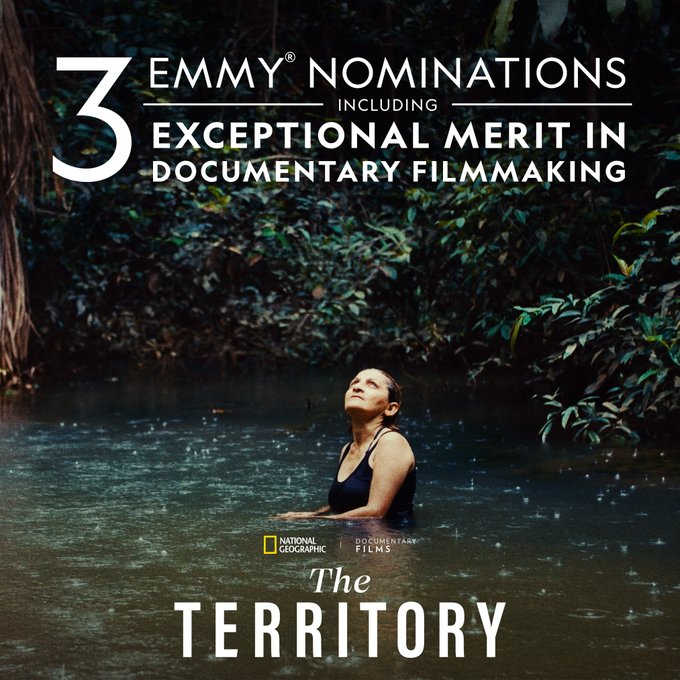
The Territory, from director Alex Pritz, provides an immersive on-the-ground look at the tireless fight of the Indigenous Uru-eu-wau-wau people against the encroaching deforestation brought by farmers and illegal settlers in the Brazilian Amazon.
While that's a good hard-news interview that explores how and why [Alex Pritz] made the documentary, it's also a bit of stealth promotion, as [National Geographic] and ABC are both subsidiaries of Disney. To recycle what I wrote about CNN defending Big Bird, "It's not just news value that's driving it."
Considering that I originally wrote this about a "Nightline" segment, I shouldn't be surprised that it works as well for another "Nightline" segment.
Before I assess the chances for "The Territory" to win its categories, I'm looking at the other nominees for Exceptional Merit In Documentary Filmmaking. Follow over the jump for their trailers, the two other nominations for "The Territory," and one prediction.
On March 11th, 2020, the World Health Organization declared COVID-19 a global pandemic.
What followed, were travel bans, stay-at-home orders and mandatory masking.
1.[1] million Americans have died from the virus the most of any country in the world and among them, more than 42,000 Michiganders.
Officially, the U.S. has the most deaths from COVID-19 with Worldometer listing 1,148,765, followed by Brazil with 699,310 deaths, and India reporting 530,780. I suspect all of them have under-reported deaths from the disease, but especially India, as I wrote last May: "I was always a little skeptical that India had fewer deaths than the U.S. from the pandemic. An estimate of 4.7 million may be higher than I expected, but I really do think India had more deaths than the U.S.'s 1 million." Still, that's merely a suspicion, not a fact.
On March 10, 2020, Michigan health leaders confirmed the state's first two cases of COVID-19. Three years later, the chief medical executive is reflecting on the pandemic, what has been learned and where we stand today.
I'm glad vaccines and more effective treatments exist to make COVID-19 less dangerous and scary. My wife and I are the beneficiaries of both, as I mentioned in 'The First Wave' wins three News & Documentary Emmy Awards. While we haven't had any lingering symptoms besides modestly lower energy levels and some slight brain fog, there are lots of people who are suffering from worse syndromes. The economy has also not fully recovered, either. Follow over the jump for two reports from outside Michigan about both.
Kevin "Pickled Tongue" McCarthy finally won the Speaker's gavel after fifteen ballots in the early hours of Saturday, so it took until last night for the late-night talk show hosts to tell jokes about it.* Too bad "Saturday Night Live" hasn't resumed new shows yet; they'd have had first crack instead the last word.
The former president appeared to help Kevin McCarthy win the Speaker’s gavel on the 15th round of voting, and former presidential advisor Steve Bannon is suspected of involvement in Sunday’s coup attempt in Brazil.
I think Colbert made fun of two deja coups, the soft one in the House chamber and the failed one in Brazil. That reminds me that I should give equal time to Luiz Inácio Lula da Silva after devoting a post to Jair Bolsonaro. Vox has a video about him, too.
Seth takes a closer look at Republicans in the House finally electing Kevin McCarthy as speaker after McCarthy acquiesced to the demands of extreme members in a stunning and humiliating turn of events that nearly led to a physical brawl on the House floor.
Seth, like Stephen, even invoked the Founding Fathers to laugh at the Republicans' spin on the proceedings.
John Oliver discusses Jair Bolsonaro, how he’s run Brazil as president, how far he might go to maintain power after the upcoming election, and, of course, nunchucks.
This sounds familiar and not in a good way. Here's to hoping the Brazilian presidential election has less violence than ours in 2020 and 2021.
John Oliver talks about his Emmy win for Last Week Tonight being presented by Selena Gomez, Steve Martin and Martin Short; shares his reaction to the 10 days of mourning for Queen Elizabeth; and discusses turning down his offer for the Order of the British Empire.
I hadn't heard that Oliver turned down an O.B.E., but I'm not surprised. He'd then be "Sir John" and I have a feeling that would cause a lot of cognitive dissonance. Also, I think he's on to something when he called the cancellation of soccer games but not rugby or cricket matches a form of class warfare. As the snarky saying about soccer and rugby goes, "rugby is a rough game played by gentlemen, while soccer is a gentle game played by ruffians."
On March 3 2021, World Wildlife Day will celebrate forest-based livelihoods and seek to promote forest and forest wildlife management models and practices that accommodate both human well-being and the long-term conservation of forests, forest-dwelling species of wild fauna and flora and the ecosystems they sustain, and promote the value of traditional practices and knowledge that contribute to establishing a more sustainable relationship with these crucial natural systems.
When I searched for videos about the importance of forests, I retrieved Vox's three-part series on the Amazon rainforest from November 2019. The three videos cover nearly all topics mentioned by World Wildlife Day, which is a creation of the United Nations, so I'm sharing them, beginning with The destruction of the Amazon, explained.
This is Part 1 of Vox Atlas: The Amazon, a three-part series about the world's largest rainforest, why it's in jeopardy, and the people trying to save it.
...
The Amazon rainforest has been reduced by about 17% since the 1970s. Cattle ranchers, loggers, and farmers are mostly to blame for the deforestation, but the demand driving them comes from all around the world. Brazil's economy depends on agriculture, especially beef and soy, which is grown on cleared land in the Amazon. Today, president Jair Bolsonaro, is weakening the environmental protections there in order to give agriculture more power. This came to a head when, in summer 2019, more than 30,000 wildfires burned in the Amazon, sparking worldwide outrage.
This video serves as an example of Commoner's Laws in action, especially everything is connected to everything else, in particular how deforestation is connected to the global food system. Another connection is that I recommend Mongabay, one of the sources for Vox's graphs, to my environmental science students as a resource for extra credit.
The Amazon rainforest has faced encroachment and deforestation for a long time. But it wasn’t until Brazil’s military dictatorship came to power in the 1970s that deforestation spiked, becoming a big business in the Amazon. When that expansion reached the state of Acre, it met resistance. Chico Mendes, a rubber tapper from the region, took the fight to protect the Amazon from the depths of the rainforest to the global stage. In the process, he gave his life. But the fight he started lives on.
To understand the history of the Amazon and how Chico Mendes changed the course of that history, watch the video above, our second episode of Atlas’ Amazon miniseries.
It was pretty natural that North America’s manufacturing would be centered on the Great Lakes, as all of the natural resources required for making things out of steel were there–iron ore, coal, and lime–and the entire region was connected by a vast natural waterway, making shipping cheap. All that was needed to make cars was imported rubber.
Once again, this video shows that everything is connected to everything else, in this case, manufacturing, cars, and defense are all connected to rubber and the Amazon rainforest. Part 2 of the series also demonstrates two more of Commoner's Laws, nature knows best and there is no free lunch, which are also two of the lessons from Part 3, Brazil's indigenous land is being invaded.
And the president is part of the problem.
...
Brazil has over 900,000 indigenous people, most of whom live in the Amazon. After centuries of persecution, they were given extensive rights under a new Constitution in the 1980s, including the right to claim and win back their traditional lands. Since then, hundreds of indigenous lands have been demarcated and protected by the Brazilian government.
But in the last few years, those lands have come under attack by landowners, ranchers, loggers, and farmers who want access to the resources inside these indigenous lands. And since Jair Bolsonaro became president, the number of invasions into indigenous lands has skyrocketed.
Much to my surprise, I hadn't watched this video before today. Researching today's entry finally got me to view it and I'm glad I did. Speaking of which, watching this series reminded me of my liberal identity.
You are an Eco-Avenger, also known as an environmentalist or tree hugger. You believe in saving the planet from the clutches of air-fouling, oil-drilling, earth-raping conservative fossil fools.
It also reminds me that authoritarians are a threat to the environment everywhere on the planet, even if they, like Jair Bolsonaro, aren't strictly "fossil fools."
That's it for today's environmental observance. Stay tuned for a celebration of one of my other passions tomorrow, MarchingMusicDay. MarchForth!
June 22 is World Rainforest Day. The day has been set aside to help protect rainforests by raising awareness and encouraging action to protect them.
Organizers of this annual day say 20% of the oxygen we breathe and the freshwater we drink is attributed to rainforests of the Amazon. They absorb carbon dioxide, stabilize climate patterns, and are home to half the world’s plant and animal species. The concern of organizers is that an area the size of 40 football fields is lost every minute of every day.
The first World Rainforest Day was June 22nd, 2017. It was created by a collaboration of groups called the Rainforest Partnership. It is an international non-profit organization based in Austin, Texas and is dedicated to protecting and regenerating tropical rainforests through community-based projects in the Amazon.
Follow over the jump for the videos I found for this international day.
Cities should be a solution not a problem for human beings. The city of Curitiba has demonstrated for the past 40 years how to transform problems into cost-effective solutions that can be applied in most cities around the world.
A Convenient Truth: Urban Solutions from Curitiba, Brazil is an informative, inspirational documentary aimed at sharing ideas to provoke environment-friendly and cost-effective changes in cities worldwide. The documentary focuses on innovations in transportation, recycling, social benefits including affordable housing, seasonal parks, and the processes that transformed Curitiba into one of the most livable cities in the world.
The film includes interviews from world renowned Curitiba's mayors Jaime Lerner and Cassio Tanigushi, as well as other brilliant minds who made Curitiba a world class model.
That's not a bad idea. "End of Suburbia" is a downer and getting dated. I might just replace it with something optimistic about a greener future for cities. After all, I am a Crazy Eddie.