Showing posts with label Nature. Show all posts

Wednesday, April 22, 2026

'Secrets of the Penguins' leads Outstanding Nature Documentaries at the News & Doc Emmy Awards for Earth Day


Happy Earth Day! As I promised thrice, I'm celebrating today by examining the nominees for Outstanding Nature Documentary at the News & Doc Emmy Awards.
Outstanding Nature Documentary
Katavi: Africa's Fallen Paradise
Nature

PBS [THE WNET GROUP | TERRA MATER STUDIOS | SHIBUMI FILMS | ARTE | WDR]
The Last Rhinos: A New Hope
Sixty-Six Media Inc. [ABC News Studios | Lincoln Square Productions | National Geographic]
Secrets of the Penguins
Talesmith [National Geographic]
Shark Whisperer
Netflix [Netflix | Boardwalk Pictures | Underdog Films]
Willow: Diary of a Mountain Lion
Nature

PBS [RHYTHM PRODUCTIONS, LLC | THE WNET GROUP
Secrets of the Penguins leads with three nominations for Outstanding Sound: Documentary and Outstanding Cinematography: Documentary in addition to Best Nature Documentary, followed by The Last Rhinos: A New Hope with two nominations, the other for Outstanding Music Composition: Documentary, then the Nature episodes "Katavi: Africa's Fallen Paradise" and "Willow: Diary of a Mountain Lion," and Shark Whisperer with just this one.  I'm sharing the trailers in this order, beginning with Secrets of the Penguins | Official Trailer | National Geographic.

On the twentieth anniversary of National Geographic’s Academy-Award Winning “March of The Penguins”, SECRETS OF THE PENGUINS changes everything we ever believed to be true. From the Emperor Penguins’ revelatory bonds of friendship to the gritty resolve of Gentoos and Rockhoppers, and the astonishing ingenuity of the migrant penguins that reached deserts and far beyond, their incredible traditions and societies echo ours in ways we never dreamt possible – until now. For over two years, BAFTA and Emmy Award-winning wildlife cinematographer Bertie Gregory collaborates with world leading scientists, using cutting-edge camera technology and unique access to capture three world-first episodes that resonate with our lives like never before. The three-part series is executive produced by National Geographic Explorer-at-Large and Academy Award®-winning filmmaker James Cameron.
This is in the same overall series as Secrets of the Whales, Secrets of the Elephants, and Secrets of the Octopus, all of which earned nominations at the Creative Arts Emmy Awards. That, and its award-winning producer and director, bode well for its award chances at these Emmy Awards.

I'm recycling from Spectacular nature films nominated at the 2025 Critics Choice Documentary Awards for the next nominee.
I couldn't find a trailer for The Last Rhinos: A New Hope, but I did find 66-Day Fetus Of Northern White Rhino Marks A Moment Of Hope For A Species On The Brink from IFLScience, the next best thing.
There are just two northern white rhinos left in the world: Najin and Fatu, a mother and daughter pair. They can’t continue the species alone, but a world-first attempt was made to bring a new northern white rhino calf into the world using frozen samples, in vitro fertilization (IVF), and a surrogate southern white rhino.

That surrogate was called Curra, and the successful world-first attempt at this kind of cross-species IVF was achieved by BioRescue, an initiative developing advanced reproduction technologies for saving critically endangered mammals. Jan Stejskal was one of the people who had just landed in Kenya to check on the status of her pregnancy when they received a worrying call: Curra was sick, and it was happening fast.

They’d never get to check if she was pregnant, as she died within an hour of falling ill. The team would later learn that this was the devastating outcome of a chain of unfortunate events. First, there was the shift in El NiƱo, which caused very heavy rains. Then, those rains washed away the top layer of soil in Kenya, resurrecting mummies that had been stored in the ground for centuries. Inside those carcasses was Clostridia bacteria that can live for 500 years, and that bacteria releases an extremely powerful toxin that can kill a rhino in just 60 minutes.

It was a devastating loss for the BioRescue team and even more so for the guardians who had cared for Curra and the other rhinos on the Ol Pejeta Conservancy in Kenya. There came, however, just one small glimmer of hope.
During an autopsy, the team found a 66-day fetus. It was a male northern white rhino, the last seen since the death of Sudan in 2018. There was nothing that could be done to save Curra or the developing fetus inside her, but it was proof that this kind of IVF was possible – something that had never been proven before.

This story of loss and hope is explored in the new National Geographic film, The Last Rhinos: A New Hope, which premieres Aug. 24 at 8/7c and streams next day on Disney+ and Hulu.
No wonder this earned an EMA Award nomination. I hope it gets nominated at the News and Documentary Emmy Awards next year.
I got my wish!

Now for the Nature episodes, beginning with Katavi – Africa’s fallen Paradise | Terra Mater Studios (Official Trailer) by Terra Mater Studios.

Southern Tanzania. The powerful local tribes of hippo, lion and crocodile struggle for survival while defending their turf from intruders. Only the oldest crocodile matriarch remembers 90 years ago when a similar event occurred…

This allegorical tale offers a fascinating insight into how an animal society can be affected by a changing climate, and how this situation requires new strategies and changed behaviors from everyone to battle despair and to create hope for the future of their lineage…
Yes, this is a Nature episode, but PBS didn't make this trailer, so it looks and sounds distinct. On the other hand, PBS did make the next one, so it's definitely my idea of a Nature promo, Nature | Willow: Diary of a Mountain Lion - Preview from New Mexico PBS.

A unique, non-invasive, mountain lion study uses a giant network of trail cameras scattered throughout Montana's Sapphire Mountains over a decade to piece together the life story of a female mountain lion. This film weaves clips of mountain lions and their complex interactions with each other and the rest of the forest world into a story about life and death that contains never-before-captured events and behaviors at every turn.
National Geographic and Nature on PBS — all this category needs is a Netflix nominee, and it has one in Shark Whisperer | Official Trailer | Netflix.

From the Academy Award®-winning director of My Octopus Teacher comes Shark Whisperer, a provocative and visually arresting documentary that dives into the murky waters of modern conservation, where science, activism, and spectacle collide.

At its center is marine conservationist and social media lightning rod Ocean Ramsey, whose viral videos of swimming freely with sharks have sparked global fascination—and fierce debate. Driven by a desire to leave the cage and decode shark language up close, Ocean strives to connect with these predators on an unprecedented level— hoping to challenge the negative perception of sharks. To her supporters, she’s a fearless advocate giving a voice to misunderstood predators. To her critics, her mission blurs the line between saving the planet and seeking the spotlight.

Through intimate character study and breathtaking underwater cinematography, the film explores the tensions between advocacy and ethics, media influence and ecological integrity. With insight from marine biologists, indigenous knowledge holders, and fellow conservationists—both supportive and dissenting—it paints a nuanced portrait of a polarizing figure and the broader questions she provokes.

This is not just a story about sharks. It’s a story about how we choose to tell stories—about nature, ourselves, and what we’re willing to risk to be heard.
I think the video description is a fair depiction of the subject matter, so I'm not as conflicted about its nomination as I was about Encounters. I was pleased and relieved Science Fair won instead. While I'm rooting for Secrets of the Penguins and The Last Rhinos: A New Hope, in that order, I wouldn't be nearly as perturbed as I would have been if Encounters had won Outstanding Science and Technology Documentary two years ago if Shark Whisperers wins Outstanding Nature Documentary. Fortunately, the metric I use, views of the trailer, favors Secrets of the Penguins over Shark Whisperer; the latter has 454,462 views, while the former has 5,449,091 views. The penguins have the people!

Follow over the jump for the rest of the nominations for Secrets of the Penguins and The Last Rhinos: A New Hope plus more of the most read entries about the Emmy Awards from the 15th year of Crazy Eddie's Motie News.

Saturday, December 6, 2025

Nature on PBS presents 'Learning to Coexist with Detroit's Urban Wildlife'

For today's evergreen educational entry, I'm sharing Nature on PBS's Learning to Coexist with Detroit's Urban Wildlife | WILD HOPE.

As Detroit’s population declined and nature reclaimed the city’s vacant spaces, wild carnivores like coyotes, raccoons, and skunks are now returning and making themselves at home.

Ecologist Nyeema Harris studies how these opportunistic predators and scavengers are adapting to urban life. Through a series of experiments in city parks, and with the aid of camera traps, she's uncovering unexpected interactions — like dogs acting as a buffer with the coyote population — which provide valuable insights into how wildlife navigates urban environments. Her research suggests that peaceful coexistence is achievable when humans make small changes to accommodate their wild neighbors.
My readers should not be surprised that I embedded this video; they should only be surprised that it took me a month to get around to it. It's exactly my kind of content.

Local news has reported relatively recently on Detroit's urban wildlife, including WXYZ explaining Wildlife is making a comeback in urban areas of metro Detroit; here's why in 2022.

Wildlife is making a comeback in metro Detroit, from river otters to foxes and coyotes. Last week, we caught coyotes along Detroit's riverfront, and the wild animals are becoming more brazen. Terry McFadden has been with the Michigan Department of Natural Resources for over 20 years. He said he isn't surprised coyotes are making a comeback in urban areas like Detroit.
I'm not surprised, either. I first posted about urban coyotes in 'Meet the Coywolf': Evolution in action for Darwin Day and coyotes in metro Detroit in Happy Labor Day from metro Detroit plus National Wildlife Day! Both of those were eight years ago. I'm only surprised I was able to find a WXYZ video I could embed. Based on when I started complaining about WXYZ not allowing embedding of its YouTube videos, this was from just before that happened.

I close with one more video about coyotes in metro Detroit, WDIV/Click on Detroit/Local 4 explaining Coyote mating season: What Michiganders should know from January 2024.

Over the next few weeks, it’s coyote breeding season, which means you may see more than usual.
That's a wrap for learning to coexist with Detroit's urban wildlife. Stay tuned for the Sunday entertainment feature.

Wednesday, September 25, 2024

SciShow and Wild Hope describe 'Where Scientists Keep the World's Most Endangered Animals'

I'm returning to the format of SciShow and Wild Hope explain 'How to Save the World from Plastic' by showcasing a SciShow video and the Wild Hope videos that inspired it. I begin with SciShow describing Where Scientists Keep the World's Most Endangered Animals.

This video was inspired by the episodes from Wild Hope, like The Frog Ark about Panamanian frogs, and One Golden Chance about the story behind the golden lion tamarin recovery. Watch those episodes now, and many more from Wild Hope, right here on YouTube-or follow @wildhopetv on Instagram to discover countless more stories of changemakers working to restore biodiversity around the globe. Change is closer than you think.

Even when a species has officially gone extinct, there's sometimes still hope of saving it. Scientists keep insurance populations of endangered animals all over the world with the goal of one day reintroducing them to the wild.

Hosted by: Hank Green (he/him)
The plights of the Panamanian Golden Frog and endemic Hawaiian birds are stories I tell my students. That's why I'm sharing Frogs Are Going Extinct - Here's How We Can Save Them | WILD HOPE first.

Many of the world's most beloved frogs and amphibians are headed for extinction, but inside "The Ark" in Panama, some of those threatened species are given a fighting chance. Using innovative technology and breakthrough genetics, researchers have ignited a cadre of solutions to save these rare and cherished species.

The Ark at the Smithsonian Tropical Research Institute in Panama houses hundreds of large, captive communities of frogs, some of which no longer exist in the wild. Here, scientists hope to bring these species back from the brink of extinction and solve the world's worst wildlife pandemic: an amphibian-killing fungus known as chytrid.

In a quarantined lab, these biologists bathe frogs in fungicide and hope to spark a viable immune response from the captive animals. Meanwhile, in the field, other researchers use artificial intelligence to listen to frog songs and identify so-called "lost frogs" that survive chytrid in the wild - any of which may hold the key to fighting the disease. Safeguarding a future for frogs isn't easy, but these tactics in Panama have been so successful that they're being replicated in facilities across the globe. The effort may seem monumental, but the safety and preservation of amphibians worldwide hangs in the balance.
This video is a bit on the long side, but I find it both informative and inspiring enough to show my biology students later this semester, when I lecture on chytrid fungi and the effects it has on amphibians. It also reinforces a point I've already made to them, that amphibians are already at the most risk of mass extinction for any group of vertebrates. Only cycads exceed them among major groups of organisms in danger of extinction, another fact I've shared with my biology students. Should I show this video to my biology students, it will become another example of blogging as professional development.

For completeness, I'm sharing The historic comeback of golden lion tamarins | WILD HOPE, which SciShow also mentioned.

The golden lion tamarin stands as a beacon of hope and survival in the face of extinction after an outbreak of yellow fever led to a loss of nearly a third of their wild population.

In the 1970s, their population dwindled to fewer than 200 individuals. However, a decades-long captive breeding program, spanning 150 zoos globally, successfully reversed their decline. This journey continued as over 800,000 native trees were planted, establishing vital forest corridors to reconnect fragmented landscapes within the unique Atlantic Forest, their sole habitat on Earth.

Regrettably, a recent yellow fever outbreak led to a significant loss of over 1,000 tamarins, imperiling a meticulously managed genetic recovery program. Fortunately, virologist Marcos da Silva Freire pioneered a groundbreaking approach. He rapidly adapted a human vaccine to inoculate almost 400 tamarins, a pioneering endeavor among wild animals. Today, the tamarin population has soared to 4,800 individuals, nearly doubling their numbers before the yellow fever outbreak. This journey from the brink of extinction to recovery exemplifies the potential of conservation and scientific intervention, providing renewed hope for this iconic species' future.
People tend to focus on the Amazon rainforest, but Brazil's coastal rainforest is even more endangered. I first heard about it 35 years ago when I moved to Michigan and the professor of the first class I was a teaching assistant for described how one tree species was saved because it served as a good shade tree for coffee plantations. Otherwise, it would have been logged and possibly exterminated. That's a story someone told me when I was a student.

That's a wrap for today. I'm thinking of observing a holiday like Paul Bunyan Day tomorrow, National Johnny Appleseed Day. It's that or National Shamu the Whale Day, whichever one I can find a better video for. Stay tuned to see which day I blog about tomorrow.

Monday, September 23, 2024

SciShow and Wild Hope explain 'How to Save the World from Plastic'

I'm returning to topics that will be good to share in October with SciShow explaining How to Save the World from Plastic.

This video was inspired by the episode from Wild Hope: The Great Ocean Cleanup. Watch that episode now, and many more from Wild Hope, right here on YouTube – or follow @wildhopetv on Instagram to discover countless more stories of changemakers working to restore biodiversity around the globe. Change is closer than you think.

We've all heard about microplastics, but where do they come from? And what can we do about ocean plastics? We'll follow a single water bottle on its journey to the Great Pacific Garbage Patch and beyond.

Hosted by: Stefan Chin
It was time for an update on plastic pollution since PBS NewsHour and SciShow explain the difficulties of recycling plastic and plastic pollution and SciShow provided it.

There's more to the story, so I'm embedding the episode Stefan Chin and SciShow referred to, Stopping Ocean Plastic Pollution at its Source | WILD HOPE from Nature on PBS.

Inventor Boyan Slat is on a mission to rid oceans of plastic. His team at The Ocean Cleanup designs and deploys systems that pull trash from the open ocean. Now, he’s stopping the pollution at its source: rivers where plastic is easier to catch, like those in Kingston Harbor, Jamaica.

Each year an estimated four million tons of plastic end up in the world’s oceans, killing thousands of marine creatures and accumulating up the food chain. The plastic gathers in five massive ocean gyres, the largest of which, known as the Great Pacific Garbage Patch, holds 87,000 tons of trash. After years of research, The Ocean Cleanup has created a system that removes 7000 kilograms of trash from the sea every day and a half; the team aims to remove 90% of the Great Pacific Garbage Patch by 2040.

But plastics keep flowing into the ocean, largely from the world’s polluted rivers. In Jamaica, Boyan’s team has teamed up with Alecia Beaufort and a local group cleaning up their waterways. Together, they’ve deployed a new system to trap plastic at the source as it flows downriver during a storm. Their success has inspired others to join the effort, creating a virtuous cycle of citizen action.
While I thought SciShow's video to be informative, I felt Wild Hope's video to be inspiring. Both thought and emotion are necessary for people to act, so I'm glad I found both videos to inspire myself and readers to act.

Since plastic pollution is as much a problem for rivers as it is for oceans, consider today's post to be a late celebration of World Rivers Day.
Every year on the fourth Sunday in September, World Rivers Day highlights the many values of rivers and streams. It’s also a day to encourage the improved stewardship of rivers around the world.
Here's to remembering to celebrate World Rivers Day on time next year. That shouldn't be difficult, as it will fall on a day special to me.

That's a wrap for today's topic. Stay tuned for another entry worth sharing in October tomorrow.

Monday, July 29, 2024

'Incredible Animal Journeys' leads Outstanding Nature Documentaries at the News & Doc Emmy Awards for International Tiger Day


Happy International Tiger Day! As I promised yesterday, I'm examining nominated nature documentaries like I did last year. I'm focusing on the only nominee for Outstanding Nature Documentary with multiple nominations, Incredible Animal Journeys | Official Trailer | National Geographic.

We might think we are the world's greatest explorers, but we're not. INCREDIBLE ANIMAL JOURNEYS narrated by Jeremy Renner premieres Nov. 19th at 9/8c on National Geographic, streams next day on Disney+ and Hulu.
I'm repeating what I wrote yesterday.
Incredible Animal Journeys has four nominations total to be the most nominated member of this field, Outstanding Nature Documentary, Outstanding Cinematography: Documentary, and Outstanding Promotional Announcement: Documentary, in addition to Outstanding Sound: Documentary. It's my preliminary pick for Outstanding Nature Documentary.
I can see why this trailer earned its nomination for Outstanding Promotional Announcement: Documentary. It has a decent chance of winning, too, as 'Super/Natural' won Outstanding Promotional Announcement last year. I'll have more to say after I watch the rest of the nominees in that category.

Follow over the jump for the trailers for the rest of the nominated nature documentaries at the News & Doc Emmy Awards.

Saturday, August 20, 2022

Emmy nominee 'My Garden of a Thousand Bees' for World Honey Bee Day

Happy World Honey Bee Day! As I promised yesterday, I'm writing about award-nominated television documentaries today. I begin with My Garden of a Thousand Bees | PBS Nature Trailer (2021), which my mom told me about and has earned a nomination for Outstanding Nature Documentary at the News & Documentary Emmy Awards.

Taking refuge from the pandemic a wildlife filmmaker sets out to record the incredible variety of wild bees in his small garden, finally developing a close relationship with an individual bee that he has followed over its entire life.

Martin Dohrn is an expert at exploring the macroscopic world; his last project on ants with David Attenborough won awards around the world. This time, he unravels a bee filled universe inhabited by winged creatures of every size and shape. From giant bumblebees to scissor bees the size of a mosquito, he has seen over 60 species of bee in his backyard. As he gets sucked into this world, he narrates with the charm and informative voice of a man obsessed. Filmed with one-of-a-kind lenses forged on his kitchen table, this film illuminates its audience with unique natural history insights, and depths of behaviors never recorded before.
In 'The Beatles: Get Back,' 'We Need to Talk About Cosby,' and 'Stanley Tucci: Searching for Italy' all nominated for five Emmy Awards in nonfiction series, I wrote "Who knows, maybe revisiting the archives was the best thing to do in isolation." For a nature videographer, the best thing to do in isolation was record the nature in his own yard. Considering that wildlife became bolder and more visible during the pandemic, the timing was fortuitous.

The "Nature" episode's page on PBS's website has more.
The documentary, which kicks off Nature’s 40th season on PBS, follows Dohrn during the COVID-19 lockdown of spring and summer 2020, as he becomes bee obsessed and develops relationships with individual bees. Filming more than 60 species of bees, from Britain’s largest bumblebees to scissor bees, which are the size of a mosquito, Dohrn observes how differences in behavior set different species apart from each other. Eventually, he gets so close to the bees, he can identify individuals just by looking at them.

Viewers will marvel at moments timely captured in My Garden of a Thousand Bees, such as bees laying tiny eggs preparing for the next generation, green-fanged spiders feasting on male flower bees and a female yellow-faced bee attacking a Gasteruption wasp to protect her nest. Other fascinating behavior featured in the program includes two male bees fighting each other over a female, different species of bees competing over territory and one busy bee building a nest with a shell and hundreds of sticks. Intrigued by the intelligence of one particular wood-carving leafcutter bee, Dohrn dubs her “Nicky” and sees life at her level as she leaves a lasting legacy in the garden.
That's impressive, but today is dedicated to honeybees, which Seeker examined at the same time "My Garden of a Thousand Bees" was airing, in The Threat to Bees and Our Food Supply.

The European honey bees are crucial to our food systems, but they may soon be under threat from a microscopic pest. So what exactly is this threat?

To learn more about other types of bees, make sure to check out the documentary, "My Garden of a Thousand Bees," streaming now on @Nature on PBS...

It’s no secret, bees are super important. And it’s not just for food sources; bees also keep the health of wild ecosystems in check by pollinating wildflowers, which in turn maintains biodiversity and a thriving terrestrial biomes.

And while all bee species are helpful pollinators, honey bees are CRUCIAL to our own food supply, pollinating close to 90 commercially grown crops in the U.S. But bee populations have been under extreme stresses, from pesticides to the climate crisis, to parasites and diseases.

We are currently losing between 30% and close to 50% of our honeybee colonies every single year. What would be worse in a situation where the balance is already kind of teetering is to add a parasite that we know has a dramatic impact on honeybees.

Unfortunately, that’s exactly the situation all bees are facing. Dr. Sammy Ramsey, a scientist at the USDA, focuses on protecting bees from an emerging threat.
Even Seeker told its viewers to watch this episode, just like my mom told me to. Good for them!

Follow over the jump for its News & Documentary Emmy nomination along with the nominations for other nature documentaries at this year's awards.

Monday, July 18, 2022

Barack Obama nominated for Outstanding Narrator of 'Our Great National Parks' at the 2022 Emmy Awards


I told my readers "I'll return with more entries about Emmy nominees" at the end of 'Teenage Dream' and 'The Lost Class' — two PSAs about gun violence nominated for Outstanding Commercial at the 2022 Emmy Awards. I have a relatively brief update at the intersection of nature series and politics, former President Barack Obama, a two-time Grammy winner, with his second Emmy nomination for Outstanding Narrator of "Our Great National Parks." He's competing against a formidable field as the following image from the Television Academy on Twitter shows.


Former President Obama's stiffest competition is undoubtedly Sir David Attenborough, who has six Emmy Awards to his name, three Creative Arts Emmys for Outstanding Narrator in 2018, 2019, and 2020, and three News and Documentary Emmy Awards, two for Outstanding Nature Programming and one for Outstanding Individual Achievement in a Craft: Writing. Ironically, Obama's first Emmy nomination was for "David Attenborough Meets President Obama" at the News and Documentary Emmy Awards, so the two have a history. These are Lupita Nyong'o and Kareem Abdul-Jabbar's second nominations for Outstanding Narrator at the Emmys, but both lost to Sir David in 2020. While it's his first nomination for Outstanding Narrator, W. Kamau Bell has won three Creative Arts Emmy Awards for "United Shades of America." Bell also earned a nomination in Outstanding Directing for a Documentary/Nonfiction Program for "We Need to Talk About Cosby" as well. That series has a total of four Emmy nominations, which I will write about later. I suspect I'll have the same reaction to it as I did to "Allen v. Farrow" — shocked, saddened, and disgusted.

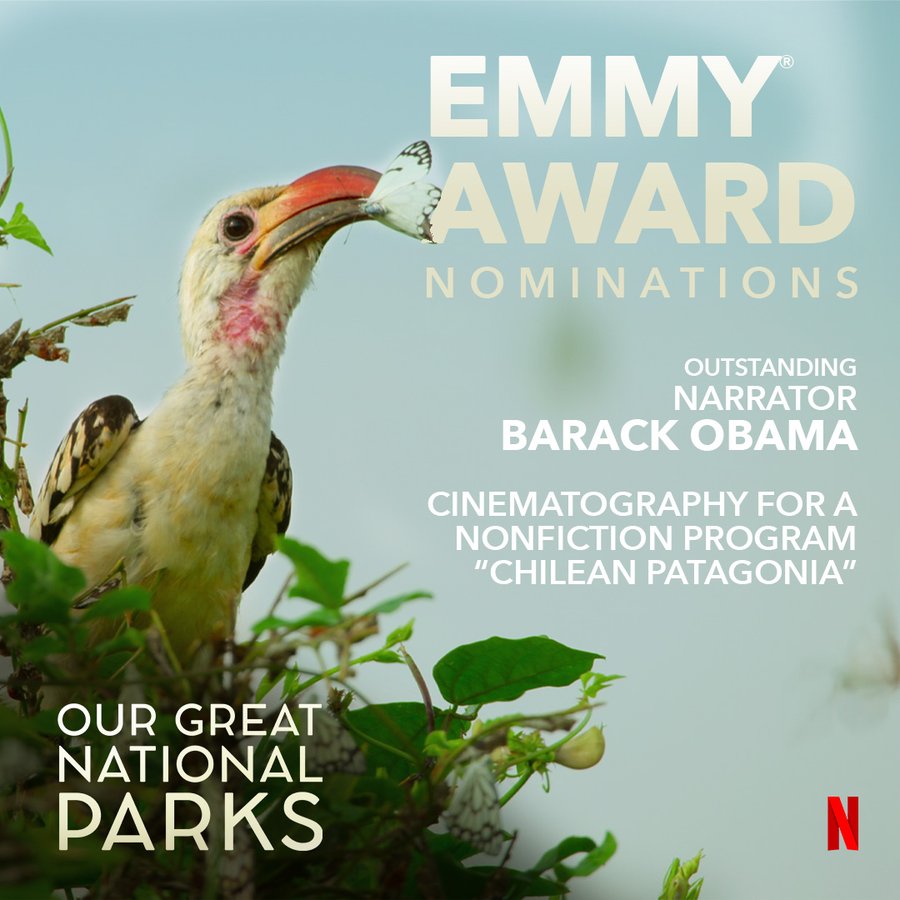
"Our Great National Parks" has a second Emmy nomination, Cinematography for a Nonfiction Program, as this image from a tweet by Higher Ground Media shows.


Here is the entire field.
Outstanding Cinematography for a Nonfiction Program
The Andy Warhol Diaries: "Collab: Andy & Basquiat" – Wolfgang Held (Netflix)
McCartney 3,2,1: "These Things Bring You Together" – Stuart Winecoff (Hulu)
100 Foot Wave: "Chapter IV: Dancing with God" – Mike Prickett, Laurent Pujol (HBO / HBO Max)
Our Great National Parks: "Chilean Patagonia" – Christiaan MuƱoz-Salas, Ignacio Walker (Netflix)
Stanley Tucci: Searching for Italy: "Venice" – Andrew Muggleton (CNN)
We Feed People – Kris Kaczor (Disney+)
All of these nominees have nominations in other categories. "Stanley Tucci: Searching for Italy" has the most nominations with five, including Outstanding Hosted Nonfiction Series or Special, Outstanding Directing for a Documentary/Nonfiction Program, Outstanding Picture Editing for a Nonfiction Program, and Outstanding Sound Mixing for a Nonfiction or Reality Program. "The Andy Warhol Diaries" has four, Outstanding Documentary or Nonfiction Series, Outstanding Directing for a Documentary/Nonfiction Program, and Outstanding Writing for a Nonfiction Program in addition to this category. "McCartney 3,2,1" earned three nominations, including Outstanding Sound Editing for a Nonfiction or Reality Program (Single or Multi-Camera) and Outstanding Sound Mixing for a Nonfiction or Reality Program. Both "100 Foot Wave" and "We Feed People" have two, Outstanding Documentary or Nonfiction Series for the former and Outstanding Documentary or Nonfiction Special for the latter. I will be looking at all of these in upcoming posts, after which I might venture a guess as to the winner.

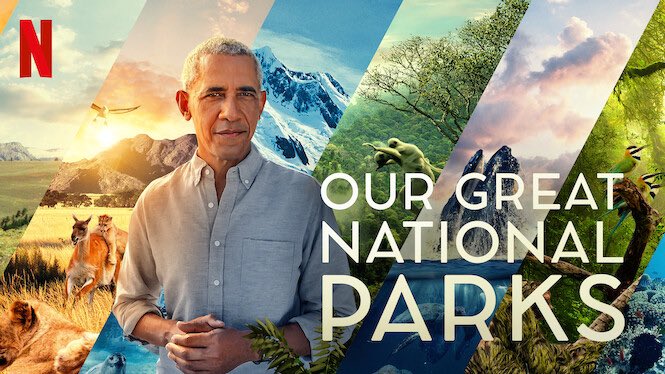
Enough about its nominated categories. It's time to watch President Obama Narrates Our Great National Parks | Official Trailer from Netflix.

An epic five-part series narrated by President Barack Obama that invites viewers to celebrate and discover the power of our planet’s greatest national parks and wild spaces.
...
From the executive producer of Blue Planet II comes OUR GREAT NATIONAL PARKS, a breathtaking five-part series executive produced and narrated by President Barack Obama - who protected more public lands and waters than any other U.S. President in history - that invites viewers to experience nature in the world's most iconic national parks. Spanning five continents, the series brims with wonder, humor, and optimism as each episode tells the story of a national park through the lives of its wildest residents — both big and exceptionally small — and explores our changing relationship with wilderness. Traveling from the waters of Monterey Bay, California, to the bright red soil of Kenya’s Tsavo National Park, the lush rainforests of Indonesia’s Gunung Leuser National Park, the majestic terrain of Chilean Patagonia, and more, OUR GREAT NATIONAL PARKS beckons us to get out and explore, create new ways for these wild places to thrive, and vigorously preserve them for future generations to come. This series is a Wild Space production in association with Higher Ground Productions and Freeborne Media
Wow, that is both beautifully shot and wonderfully narrated. Obama does have a good shot against Sir David!

Factual America interviewed two of the creators in Our Great National Parks | Netflix | Interview with Sophie Todd and James Honeyborne.

Narrated by President Barack Obama, "Our Great National Parks" is a breathtaking Netflix original five-part documentary...

"Our Great National Parks" is a breathtaking Netflix original docuseries, executive produced and narrated by President Barack Obama, who protected more public lands and waters than any other US president in history. President Obama takes us on a journey to experience nature in the world's most iconic national parks, spanning five continents. The series brims with wonder, humour and optimism as each episode tells the story of a national park through the lives of its wildest residents, both big and exceptionally small.

The series explores our changing relationship with wilderness traveling from the waters of Monterey Bay, California to the bright red soil of Kenya's Tsavo National Park, the lush rainforests of Indonesia's Gunung Leuser National Park, the majestic terrain of Chilean Patagonia and more.

Our Great National Parks beckons us to get out and explore, create new ways for these wild places to thrive, and vigorously preserve them for future generations to come.

Acclaimed filmmakers James Honeyborne and Sophie Todd are the executive producer and series producer behind this five-part documentary. They share their experiences making this series and what it was like working with President Barack Obama.

"Not all human ideas are bad. National parks were a human idea. We did that, so we can be a force for good as much as a force for bad." - Sophie Todd
I like that final quote. I might just use it.

I conclude with a complaint of sorts. These are all the nominated nature series at this year's Emmy Awards. Nature series dominated the nonfiction series Emmy nominations only a few years ago. Now, "Our Great National Parks" leads the genre with two nominations and "Serengeti II" and "The Mating Game" have just one each. That's it. "14 Peaks: Nothing Is Impossible" and "100 Foot Wave" both take place in nature and have great scenery shots, but both of them are sports shows at their core. Unstructured reality shows have more about the human struggle against nature, with "Deadliest Catch" and "Live Below Zero" earning two Emmy nominations each, both for Outstanding Cinematography for a Reality Program, where they are competing against "Survivor," and Outstanding Picture Editing for an Unstructured Reality Program, for a total of five. I'll write about them after I examine the rest of the documentary and nonfiction special and series nominees. Stay tuned.

Previous posts about the 2022 Emmy Awards

Friday, May 20, 2022

Should the American Bumblebee be placed on the Endangered Species List for World Bee Day and Endangered Species Day?

Today is both World Bee Day and Endangered Species Day, so I'm focusing on one potentially endangered bee species. Watch Some Want American Bumblebee Added To Endangered Species List from TODAY.

The American bumblebee has declined by nearly 90 percent across the U.S. Now there’s a new push to protect it under the Endangered Species Act. NBC’s Kerry Sanders reports as our series TODAY Climate continues.
While the U.S. hasn't added the American Bumblebee to the national Endangered Species List, at least one state has added it to the state's endangered species list, as WWLP-22News reported in American Bumble Bee was added to the endangered species list nearly three years ago.

The American Bumble Bee was a common sight in Massachusetts more than 50 years ago, but the population's been in steady decline for the last 25 years, and are now found almost exclusively in Franklin and Hampshire counties.
Good for Massachusetts.

The decline of the American Bumblebee is apparently taking another species down with it, as the Center for Biological Diversity described in a press release, Variable Cuckoo Bumblebee Moves One Step Closer to Endangered Species Act Protection.
The U.S. Fish and Wildlife Service announced today that the variable cuckoo bumblebee, a critically imperiled species that has not been observed since 1999, may warrant Endangered Species Act protection. The announcement kicks off a one-year status assessment of the species.

Today’s positive finding comes in response to a petition filed in 2021 by the Center for Biological Diversity. If the variable cuckoo bumblebee gets protected under the Act, it would be the first cuckoo bumblebee listed and the third listed bumblebee after the rusty patched bumblebee and Franklin’s bumblebee.

“These bumblebees need protection urgently, and if the Biden administration acts quickly, we can safeguard this important species before it’s gone forever,” said Jess Tyler, a Center staff scientist who authored the petition. “I’m hopeful that the variable cuckoo bumblebee is still out there, but we need swift federal action to help this species avoid extinction.”

The variable cuckoo bumblebee was once widely found in open grasslands and meadows. While it has lived mainly in the eastern United States, it has also been observed as far southwest as Arizona and as far northeast as New Hampshire. It was last seen in the 1990s in Nebraska, Missouri and Florida. There have been no confirmed observations of this species since 1999.

Cuckoo bumblebees are social parasites that take over the nests of other bumblebees by subduing the resident queen and tricking the host’s worker bees into feeding and caring for the cuckoo bumblebee’s young. In doing so, cuckoo bumblebees help keep host bumblebee populations diverse and healthy, including by reducing disease virulence.

The variable cuckoo bumblebee is entirely dependent on its host species, the American bumblebee, which has declined by an estimated 89%. The Center has also petitioned to list the American bumblebee under the Act and is fighting to get it protected. The variable cuckoo bumblebee and its host are also threatened by multiple concurrent factors that degrade their habitat, including intensive agriculture and pesticides.

The Service will now initiate a scientific status review and public comment period before deciding whether to protect the variable cuckoo bumblebee.

Background

Wild bees are essential to the pollination of wild flowering plants and many flowering crops. North America is home to 46 species of bumblebees, but an increasing number are in trouble. Nearly 1 in 4 bumblebee species is in decline and threatened with extinction in North America.

The variable cuckoo bumblebee is a generalist pollinator and was once found in a wide range of open habitats, including urban areas. Their host species makes its nests in pre-existing cavities, like rodent burrows and rotten logs, or on the surface of the ground in large grass bunches. The variable cuckoo bumblebee is one of a rare group of parasitic cuckoo bumblebees that play important regulatory roles in bumblebee communities and ecosystems.
I just hope it's not too late, as the Variable Cuckoo Bumblebee has not been seen this century and may already be extinct.

Both videos show footage of honeybees instead of bumblebees, who have their own day. Nature on PBS addresses that and mentions one of the other endangered bumblebees, the Rusty-patched Bumblebee, in The Power of Pollinators.

Everyone has heard of honeybees, but what about the 4,000 species of wild, native bees that live alongside honey bees here in North America? These lesser-known, but equally industrious insects not only pollinate our crops but also support healthy, diverse ecosystems across the continent. Unfortunately, many of these native bee species are in trouble. In The Power of Pollinators, entomologist and insect evangelist Dr. Samuel Ramsey showcases the diversity, beauty, and importance of North America’s wild bees, and shares simple steps that everyone can take to help them. Get engaged at www.plantwildflowers.org.
All of this is good information I plan on passing along to my students.

I'm not done with biodiversity, as Sunday is International Day for Biological Diversity. Maybe I can combine my observance with the Sunday entertainment feature. A survey of currently airing nature series, anyone?

Tuesday, September 28, 2021

'The Last Ice' vs. 'Nature: Cuba's Wild Revolution' for Outstanding Nature Documentary at the News & Doc Emmy Awards


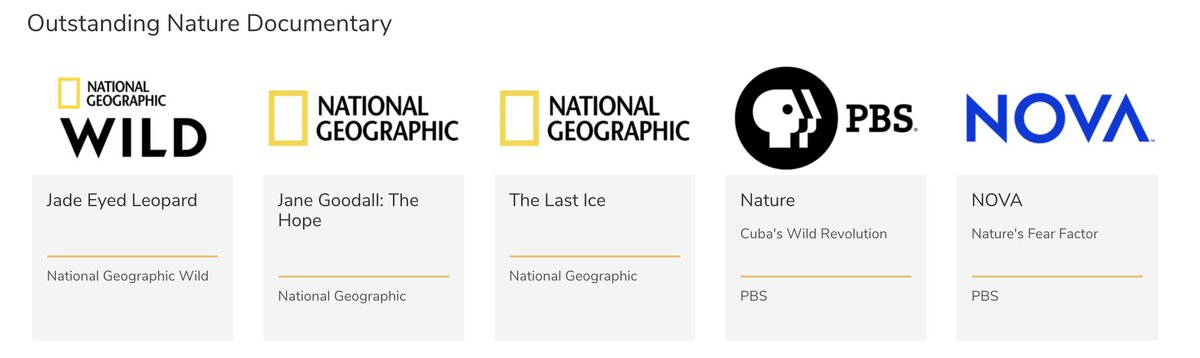
I told my readers "The next installment in this series should be about National Geographic's 'The Last Ice' and the other nominees for Outstanding Nature Documentary. Stay tuned" at the end of 'Human Nature' vs. 'Connected' for Outstanding Science and Technology Documentary at the News & Documentary Emmy Awards. Without any further ado, here are the nominations at the News and Documentary Emmy Awards for "The Last Ice" and its competitors.
Outstanding Nature Documentary

Jade Eyed Leopard (National Geographic Wild)

Jane Goodall: The Hope (National Geographic)


Nature (PBS) Cuba's Wild Revolution

NOVA (PBS)
Nature's Fear Factor

The Last Ice (National Geographic)
Now, The Last Ice | Trailer from National Geographic.

THE LAST ICE tells the story of the Inuit communities fighting to protect the disappearing Arctic that has been their home for centuries. From National Geographic Pristine Seas, THE LAST ICE, premieres on National Geographic Channel this October.
The matchup is between "The Last Ice" and "Nature: Cuba's Wild Revolution," each with three nominations. The spoiler would be National Geographic's "Jade Eyed Leopard" with two nominations. Both of the latter are competing in the next category, which is missing "The Last Ice."

Outstanding Sound

Great Performances (PBS)
Now Hear This: The Schubert Generation

Jade Eyed Leopard (National Geographic) Wild

Alchemy Immersive (Oculus TV)
Micro Monsters with David Attenborough

Miles Davis: Birth of the Cool (PBS)

Nature (PBS)
Cuba's Wild Revolution
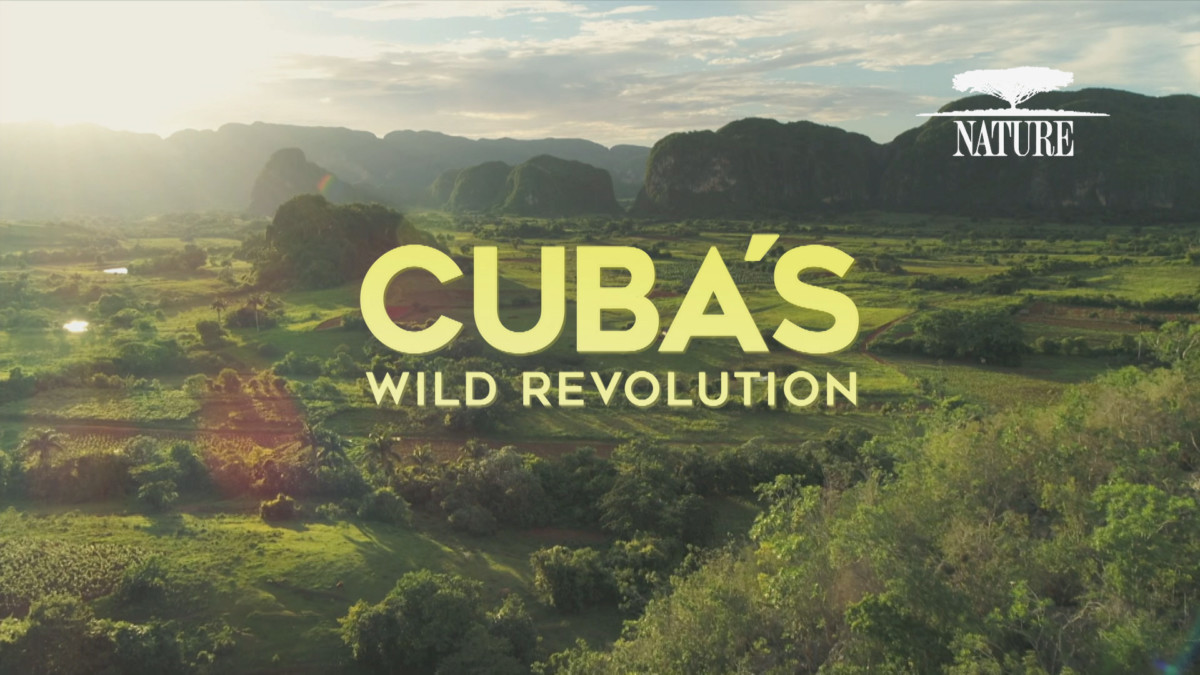
Now the trailers for both of the multiple nominees, beginning with Official Preview | Cuba's Wild Revolution | NATURE | PBS.

Get a glimpse of Cuba’s spectacular wildlife and landscapes, left virtually untouched for 50 years.
...
In the crystal-clear waters of the Caribbean, Cuba is an island teeming with exotic biodiversity: from coral reefs pulsating with life to five-foot-long Cuban rock iguanas. As international relations ease, what will become of this wildlife sanctuary?
Next, a special video from Great Plains Conservation | Jade Eyed Leopard Emmy Nomination.

Last week, our film Jade Eyed Leopard (made for National Geographic) was nominated for two Emmy Awards, and most notably, one Emmy was specifically allocated to Beverly for Best Sound. To record the sound around a leopard, one needs total silence. That can only be found a long way from engines and talking. So thank you again, Olare Motorogi Conservancy and every one of the guides operating in the area, who immediately silenced their guests, and engines, when Beverly hauled out her sound equipment. We could not have done this just a few miles south in the main reserve.

Spending time in these quiet places enriches the soul, allows you to ponder on all things, and here, in the Masai Mara at our camps, do that in style.
This is the first time I've seen a special promotional video by one of the nominees for a News & Documentary Emmy Award nomination. I like the idea, but I am not confident it will be enough to push it over its competition. I think music documentaries have the advantage and "Miles Davis: Birth of the Cool" also has a nomination for Outstanding Arts and Culture Documentary. Even if a nature documentary would win, I would bet on "Cuba's Wild Revolution" over "Jade Eyed Leopard," although I think this video might have swayed a few votes. I consider the wild card to be "Micro Monsters with David Attenborough," which has a second nomination for Outstanding Interactive Media: Documentary.

Follow over the jump for the two other categories in which "The Last Ice" is competing.

Tuesday, October 6, 2020

'Why We Hate,' 'Cosmos,' 'Seven Worlds, One Planet' and 'Life Below Zero' — science and nature winners at the Creative Arts Emmy Awards

I know I told my readers yesterday to " Stay tuned for a drinking game, memes, and drinks for this year's Vice Presidential Debate between Kamala Harris and Mike Pence," but that turns out to be tomorrow, not today. As Rick Perry would say, "oops." Instead, I'm going to continue with my coverage of the winners of the Emmy Awards. Today's installment consists of the science and nature winners at the Creative Arts Emmy Awards other than "Apollo 11," which was the big science winner overall. I begin with "Why We Hate," which I covered in 'Tiger King' vs. 'McMillion$' — big cats and true crime at the Emmy Awards for World Lion Day.

Outstanding Music Composition for a Documentary Series or Special (Original Dramatic Score)

Becoming - Kamasi Washington (Netflix)
Home - Amanda Jones (Episode: "Maine") (Apple TV+)
McMillion$ - Pinar Toprak & Alex Kovacs (Episode: "Episode 1") (HBO)
Tiger King - Mark Mothersbaugh, John Enroth, Albert Fox (Episode: "Not Your Average Joe") (Netflix)
Why We Hate - Laura Karpman (Episode: "Tools & Tactics") (Discovery Channel)
Normally, I'd go with the most famous composer, who is Mark Mothersbaugh for "Tiger King" except that Laura Karpman also has a nomination for Outstanding Original Main Title Theme Music, so I think she's the favorite.
It turned out I was right. Watch the Television Academy's 2020 Creative Arts Emmys: Music Composition for a Documentary Series or Special.

The team from Why We Hate wins the Emmy for Outstanding Music Composition for a Documentary Series or Special (Original Dramatic Score).
Why is this science? Because "Why We Hate" is an application of psychology, which is a science, to solving a problem.* As IMDB describes the show, it's "an exploration into the human condition for hatred and how we can overcome it." Here's to being able to do that.

I covered the next winner in For National Presidential Joke Day, I present the variety talk show nominees at the Emmy Awards.

Outstanding Short Form Nonfiction or Reality Series

Between The Scenes - The Daily Show (Comedy Central)
Full Frontal With Samantha Bee Presents: Pandemic Video Diaries (TBS)
National Geographic Presents Cosmos: Creating Possible Worlds (National Geographic)
Pose: Identity, Family, Community (FX)
RuPaul's Drag Race: Out of the Closet (VH1)
"Creating Saturday Night Live," Last year's winner, is not returning, but last year's nominees "Pose: Identity, Family, Community" and "RuPaul's Drag Race: Out of the Closet" are. On that basis, I consider them the nominal favorites, although I've been finding Samantha Bee's Pandemic Video Diaries to be hilarious and Trevor Noah won his one Emmy Award for "Between The Scenes - The Daily Show." Between the two variety talk nominees, I'd say Noah has the better shot at the award.
Watch 2020 Creative Arts Emmys: Short Form Non-Fiction/Reality Series for the actual winner.

The team from National Geographic wins the Creative Arts Emmy for Outstanding Short Form Non-Fiction/Reality Series.
Shame on me, I didn't even consider "Cosmos: Creating Possible Worlds" for the win, but as a scientist, I should have. I guess my focus on the variety nominees had me looking in the wrong direction. Just the same, congratulations to the show I should have been rooting for all along!

ETA: "Cosmos: Possible Worlds" also won a second Emmy Award for Outstanding Individual Achievement in Animation. Congratulations, again!

Next, a category I covered in 'The Cave' vs. 'American Factory' — Oscar nominees and other documentaries at the Emmy Awards.

Outstanding Narrator

Kareem Abdul-Jabbar on Black Patriots: Heroes of the Revolution (History)
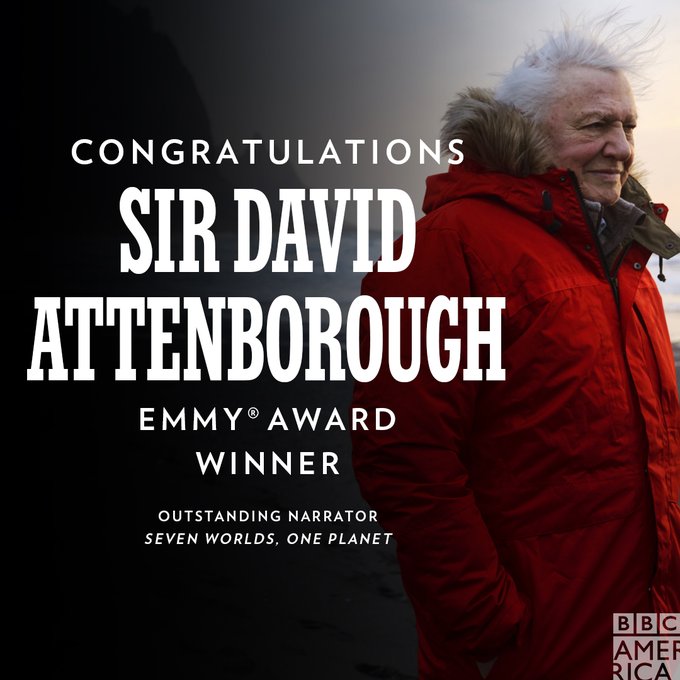
David Attenborough on Seven Worlds, One Planet (Episode: "Antarctica") (BBC America)
Angela Bassett on The Imagineering Story (Episode: "The Happiest Place on Earth") (Disney+)
Chiwetel Ejiofor on The Elephant Queen (Apple TV+)
Lupita Nyong'o on Serengeti (Episode: "Destiny") (Discovery Channel)
What a list of all-star talent! Lupita Nyong'o is an Oscar winner, Angela Bassett is an Oscar nominee and Golden Globes winner, Chiwetel Ejiofor is an Oscar nominee, and David Attenborough is two-time returning winner. On that basis, I'd say Sir David is the nominal favorite, although he's up against stiff competition. The nominee I'd look out for is Nyong'o because "Serengeti" is the only series with two nominations.

That reminds me that I'm used to seeing a lot of nature documentaries nominated at the Emmys, but that's not the case this year. I suspect that's because "Tiger King" sucked up all the oxygen that would normally go to shows about wild animals.
Despite all its nominations, "Tiger King" walked away empty-handed. That's not the case for Sir David. Watch 2020 Creative Arts Emmys: Narrator to see him win.

David Attenborough wins the Emmy for Outstanding Narrator.
Congratulations to the one Emmy winner I know I've met in person!

The last winner is one that I expected, but only by accident was I reminded that it belonged here as much as it did in reality programs.

Outstanding Cinematography for a Reality Program

Cheer (Episode: "Hit Zero") (Netflix)
Life Below Zero (Episode: "The New World") (Nat Geo)
Queer Eye (Episode: "We're in Japan!: Japanese Holiday") (Netflix)
RuPaul's Drag Race (VH1)
Survivor (CBS)
On the other hand, "Life Below Zero" has a decent shot at repeating here, as it won this award last year. I think its strongest competition consists of "Cheer" based on the trailer and "Survivor" based on my experience of watching the show.
2020 Creative Arts Emmys: Cinematography for a Reality Program.

The team from National Geographic wins the Emmy for Outstanding Cinematography for a Reality Program.
Congratulations to the repeat Emmy winners for their outstanding photography of people and the harsh environment they live in!

I conclude this enty with award-winning music from "Why We Hate," Epilogue.


Now stay tuned for the drinking game, drinks, and memes for the vice-presidential debate!

*I have a story about psychology as a science to share, but today's not the day to do it.

Previous posts about the 2020 Primetime and Creative Arts Emmy Awards

Sunday, September 8, 2019

'United Shades of America,' 'Born This Way,' 'Life Below Zero,' 'Deadliest Catch' — unstructured reality shows highlight diversity and nature


I finished 'Anthony Bourdain: Parts Unknown' earns six nominations at the 2019 Creative Arts Emmy Awards for its final season with "Now on to the reality nominees, which do a surprisingly good job of showcasing nature, diversity, and inclusion, as I wrote last year about 'Born This Way,' 'Deadliest Catch,' and 'United Shades of America,' all of which [plus "Life Below Zero"] have been nominated again this year."  Here are their nominations along with their competitors at this year's Creative Arts Emmy Awards.
Outstanding Unstructured Reality Program

Born This Way (A&E)
Deadliest Catch (Discovery Channel)
Life Below Zero (Nat Geo)
RuPaul's Drag Race: Untucked (VH1)
Somebody Feed Phil (Netflix)
United Shades of America with W. Kamau Bell (CNN)
"United Shades of America with W. Kamau Bell" is the two-time returning winner, so it is the nominal favorite to repeat.  In addition, it's my favorite of the field, as Bell examines politics and race relations in America with a light touch.  He's very good at communicating with people who disagree with him, building bridges across racial and political divides.  However, his show has very stiff competition, as "Deadliest Catch" has won twice and "Born This Way" won three years ago.  Also, both shows have three nominations to two for "United Shades of America."  While I'm rooting for Bell's show, I would be O.K. with either of its main competitors winning, as "Deadliest Catch" is as much about nature as it is about the fishermen (and women), while "Born This Way" makes an explicit social point about acceptance of differences and celebrating what makes us all both human and special.  The spoiler could be "Life Below Zero," which also has three nominations and is also about people facing a harsh environment.

Follow over the jump for the other nominations for unstructured reality shows.

Tuesday, September 25, 2018

'Chasing Coral' versus 'Yosemite' — two nominees for Outstanding Nature Documentary both examine climate change


I made an easy prediction in 'Chasing Coral': awards and nominations and looking forward to next year's Emmys 4 last December.
I expect I'll be able to tell my students about "Chasing Coral" earning an Emmy nomination for Outstanding Nature Documentary next summer and its likely win in the fall.  I'm looking forward to that.
That happened, as "Chasing Coral" earned a nomination for Outstanding Nature Documentary at the News and Documentary Emmy Awards along with nominations in two other categories, Best Documentary and Outstanding Music & Sound.  It is competing with "Putin's Revenge" on Frontline, "The Witness" from Independent Lens, "Life, Animated," an Oscar nominee for Documentary Feature in 2017, and "My Love, Don't Cross That River" from POV for Best Documentary.  Out of that field, I'm rooting for "Chasing Coral," but "Life, Animated" is very tough competition.

That written, both "Chasing Coral" and "Last Men in Aleppo" have already won a prestigious award for documentaries, the Peabody Award.  Here is the award profile for "Chasing Coral."
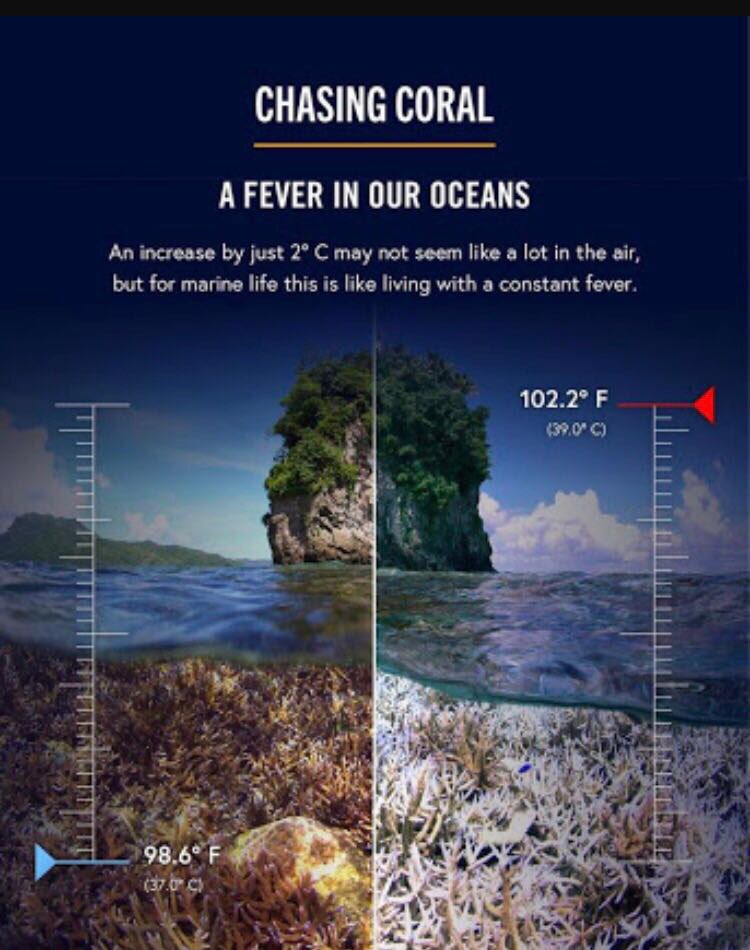
Climate change is often described as a slow-moving catastrophe, a serious yet distant threat. “Chasing Coral,” a Netflix documentary, upends that comfortable premise. As waters warm, coral reefs starve, with massive bleaching events occurring at record pace unseen beneath the waves. Approximately 90 percent of coral reefs may be lost over the coming decades. “Chasing Coral” dramatically illuminates this ongoing disaster, first immersing the audience in the gorgeous and diverse marine world that is the Great Barrier Reef, and then documenting—using underwater time-lapse cameras invented specifically for the project—how vast swaths of it die. The emotional impact is heightened by watching a team of passionate scientists and idealistic young assistants witness the bleaching event, which suggests nothing less than a kind of underwater holocaust. Somehow, in spite of the scope of the tragedy, the documentary nevertheless remains hopeful, calling for engagement and urging action. For bringing climate change and its deadly consequences into sharp and immediate focus, “Chasing Coral” wins a Peabody Award.
And now, director Jeff Orlowski's acceptance speech.

This surprisingly emotional film expertly documents, through time-lapse underwater photographs, the effects of climate change on the rapid decimation of the world’s coral reefs, events known as coral bleaching that affected 29 percent of the shallow-water coral in the Great Barrier Reef in 2016 alone.
"A story that matters because the Earth matters" — indeed, it is.

Follow over the jump for the other nominees competing against "Chasing Coral" in the other two categories.

Sunday, October 8, 2017

Silly Squirrels for Happy Wester 2017!


Happy Wester!*  For my readers who don't yet know the story of Wester, I'm quoting For Winter Solstice 2016, the Archdruid and I discuss Discordianism and fake holidays.
[Me:] Oh, I'm familiar with Discordianism.  I'm single-handedly keeping alive a fake holiday called Wester, which is the first Sunday following the first Full Moon after the Autumnal Equinox.  When I first posted about it, my Discordian friend claimed it for Discordianism.  As far as I'm concerned, it's still a Discordian holiday.
...
[Greer:] Pinku-Sensei, yes, I thought I remembered you were a closet Discordian. Wester is funny; presumably that was the day that some messiah or other descended from the living?
...
[Me:] I agree, Wester is funny.  As for an anointed one descending from the living, sorry, that wasn't part of the Wester story that I heard.  However, the holiday has its own animal mascot, the Wester Squirrel, which goes around and gathers goodies to hide instead of hiding goodies to pass out like the Easter Bunny.
The coversation led to Greer suggesting Norther and Souther with lemming and wombat mascots respectively, suggestions I followed through on -- but that's not the subject of today's post.**  Instead, since I've been featuring the best in last year's nature films and TV shows, I'm continuing on with funny clips of squirrels from nature shows.  I begin with Squirrel Uses 'Walking Dead' Move to Hide from Snakes from Nature on PBS.

Has this squirrel species been watching "The Walking Dead"?
...
In the popular TV series "The Walking Dead" humans can hide from zombies by covering themselves in zombie guts, masking their scent. The California ground squirrel (Otospermophilus beecheyi) uses a similar tactic to hide from a major predator, the rattlesnake, which relies on smell to track down its prey.
Last year, I celebrated Wester with an image of a zombie squirrel.  This year, it's only fitting I post a video of a squirrel using an anti-zombie snake defense.

Since the Wester squirrel takes treats away and hides them, it's also only fitting that I share Squirrel steals a fake nut - Spy in the Wild: Episode 2 Preview - BBC One.

A squirrel uses his intelligence to outwit a nut thief by pretending he's burying a nut.
Serves that squirrel right.  That reminds me, it's time for a Wester blessing.  May the Wester Squirrel not steal anything from you and hide it!

*In the first Happy Wester post here, I passed along the observation that Wester usually falls during the Jewish festival of Sukkot or The Feast of Tabernacles.  This is true this year and my wife and I have been invited to a sukkuh decorating party.  I've never been to one, despite growing up in a Jewish neighborhood.  I've been told it will be fun.

**The next Norther will be January 7, as the full moon falls on New Year's Day, so there will be a Blue Moon on January 31.  Speaking of blue lunar holidays, the first full moon after the 2018 winter solstice will fall on Saturday December 22nd, so there will be a second Norther on December 23.  Blue Norther on Festivus!

Saturday, October 7, 2017

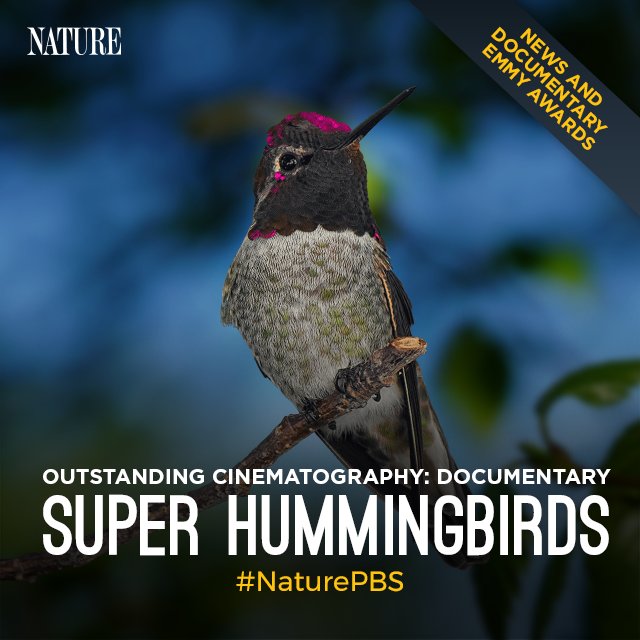
'Nature: Super Hummingbirds' wins Outstanding Cinematography: Documentary


I noted my intentions for today in the introduction to 'Sonic Sea' wins Outstanding Nature Documentary and Outstanding Music and Sound and returned to it to conclude yesterday's entry.
Outstanding Cinematography: Documentary, a category I'll return to tomorrow.
...
I plan on posting more about the other winners in science, nature, health, and the environment tomorrow and next week, continuing with the winner of Outstanding Cinematography: Documentary.  Stay tuned.
The nominee that earned the statue for  was the episode that I featured in Nature documentary nominees are well photographed at the 2017 News and Documentary Emmy Awards, "Nature: Super Hummingbirds."  Here is Katty Kay presenting the award.


To celebrate, here are two clips from Nature on PBS that show both the "super hummingbirds" and the amazing camera work that captured them.  First, Hummingbird's Face Resembles Baby Octopus.

Do female Costa's hummingbirds really find this look attractive?
...
Spring is the time to nest for the Costa's hummingbirds, before the desert gets too hot. Both males and females are looking for a partner, but it's up to him to impress her. Though his back shimmers with green, it’s not until we get her point of view that we see his true splendor. He flexes the iridescent feathers of his mantle until they become a glowing mask of violet.
Next, Hummingbirds Battle in the Air.

Hummingbirds may look cute, but they have a fierce warrior within.
...
Hummingbirds sometimes use their unmatched flying skills for something other than feeding on flowers--for fighting over them. Flowers in full bloom are a call to arms. It’s fight and flight – a display of skill and fiery tempers.
I don't know if I'll use these videos in my classes, but I certainly will recommend this show to my students for extra credit.  In fact, I did so yesterday.

I will return to the winners of the News and Documentary Emmy Awards next week after I wish my readers a Happy Wester tomorrow.  Stay tuned.

Sunday, October 1, 2017

Nature documentary nominees are well photographed at the 2017 News and Documentary Emmy Awards


"It's time to move on to the News and Documentary Emmys, which will be awarded October 5th.  Stay tuned!"  So I finished 'Saturday Night Live' wins big on political satire with nine Emmy Awards.  I'm starting this series by following up on a passage in More nature and science at the Primetime Emmy Awards, which mentioned noted that "Wild New Zealand" was nominated for awards in both the Primetime Emmy Awards and the News and Documentary Emmys, the only show I've found with that distinction.
In the News and Documentary Emmys, the show is nominated for Outstanding Cinematography: Documentary along with four other nature shows, "David Attenborough's Light on Earth," "Desert Warriors: Lions of the Namib," "Forces of Nature," and "Nature: Super Hummingbirds."  I watched the last one at my mom's house in Utah immediately after I watched the Nova episode " Treasures of the Earth: Power."  It deserves its nomination.  As for "Wild New Zealand," its nominations prove it was well-narrated and well-photographed.
"Planet Earth II" won't be the only nature documentary recognized for its spectacular cinematography.

Since I've already featured "Wild New Zealand" in an earlier entry and I've praised "Nature: Super Hummingbirds," I'll write about the latter one first (and the first one last).  Here is the preview from PBS.

Hummingbirds are amazing creatures to behold. They are the tiniest of birds, yet possess natural born super powers that enable them to fly backwards, upside-down, and float in mid-air. Their wings beat faster than the eye can see and the speed at which they travel makes people wonder if it was indeed a hummingbird they actually saw. They also are only found in the Americas. These attributes have both intrigued scientists and made it challenging to study the species, but with the latest high-speed cameras and other technologies, Super Hummingbirds reveals new scientific breakthroughs about these magical birds.
In addition to being nominated for Outstanding Cinematography: Documentary, the Nature episode is nominated for Outstanding Nature Documentary.  So is another nominee, CuriosityStream's "David Attenborough's Light on Earth."

Why do animals produce light of their own? For centuries, we could only marvel at the mystery of bioluminescence. Now we can begin to reveal the amazing truth about these living lights. Sir David Attenborough is our guide, as we venture into a world he describes as "utterly unlike our own".
Yes, Sir David narrates nominees in the News and Documentary Emmys as well.  Follow over the jump for the rest of them as well as the remaining nominees in both Outstanding Cinematography: Documentary and Outstanding Nature Documentary.

Thursday, February 23, 2017

Discovery of seven Earth-like planets announced by NASA


I promised to write about the speculative fiction winners at the Golden Reel Awards for today, but something more important came up.  NASA/JPL announced yesterday NASA & TRAPPIST-1: A Treasure Trove of Planets Found.

Seven Earth-sized planets have been observed by NASA's Spitzer Space Telescope around a tiny, nearby, ultra-cool dwarf star called TRAPPIST-1. Three of these planets are firmly in the habitable zone.

Over 21 days, NASA's Spitzer Space Telescope measured the drop in light as each planet passed in front of the star. Spitzer was able to identify a total of seven rocky worlds, including three in the habitable zone, where liquid water might be found.

The video features interviews with Sean Carey, manager of the Spitzer Science Center, Caltech/IPAC; Nikole Lewis, James Webb Space Telescope project scientist, Space Telescope Science Institute; and Michaƫl Gillon, principal investigator, TRAPPIST, University of Liege, Belgium.

The system has been revealed through observations from NASA's Spitzer Space Telescope and the ground-based TRAPPIST (TRAnsiting Planets and PlanetesImals Small Telescope) telescope, as well as other ground-based observatories. The system was named for the TRAPPIST telescope.
NASA/JPL followed up with TRAPPIST-1: Weirdest habitable worlds.

A new discovery by NASA’s Spitzer Space Telescope has revealed seven Earth-sized planets around the M dwarf star known as TRAPPIST-1. Three of them lie in what is known as the habitable zone -- where there is the potential for liquid water. It is the largest batch of Earth-sized worlds ever discovered in the habitable zone of a single star. While we don’t know if there is life on the TRAPPIST-1 planets, we do know that any life discovered there would likely be very different from life on Earth. It would have to survive the stormy solar flares of an M dwarf, adapt to a planet that might have extreme temperature swings, and thrive in red and infrared light. All seven worlds are early ambassadors of a new generation of planet-hunting targets that promise a new vision of the word “habitable.”
As much as I like comparing possibly habitable exoplanets to those in Niven's Known Space, such as Plateau or Wunderland, I won't be able to do that for this discovery.  The closest analogue is Gummidgy, which orbits CY Aquarii, a much larger star, which in the real world is much farther away, but in the Known Space universe is apparently much closer.  Either way, none of these worlds is Gummidgy.

That written, these planets are already in science fiction, as CNet reports.
While it's a little unusual for a top scientific journal to publish a work of science fiction, Nature is no stranger to the practice. The journal has regularly published a science fiction column since 2007, and the Trappist-1 planets really beg for the sci-fi treatment. The seven planets tightly circling a dim, ultracool dwarf star are much closer to each other than the planets in our solar system, and at least three of them might be just as habitable as Earth.

"The Trappist-1 system, with its short interplanetary distances, makes space opera possible," writes Suhner, who read the research paper before penning her story. "Traveling from Nuwa to Pangu takes a week. A lilliputian system where worlds are like neighboring countries."

Suhner said collaborating with scientists is essential to her work.

"Integrating advanced research into my texts allows me to talk about science while keeping the sense of wonder and awe intact," she wrote in a Nature blog post about the short story. "This is one of the main advantages of science fiction."
That didn't take long at all.

As for the Oscars and other award shows, stay tuned.  I'll get back to them tomorrow.  I do have my priorities.