A blog about societal, cultural, and civilizational collapse, and how to stave it off or survive it. Named after the legendary character "Crazy Eddie" in Larry Niven and Jerry Pournelle's "The Mote in God's Eye." Expect news and views about culture, politics, economics, technology, and science fiction.
Markets to offset carbon emissions are now worth about $2 billion annually, and supporters say they're a key tool to address climate change. But carbon credits have also been criticized for being opaque and not reducing emissions nearly enough. Stephanie Sy reports on an effort to boost the integrity of carbon markets and open them up to small landowners. It’s part of our series, Tipping Point.
Carbon offset markets that actually are effective and include a major carbon reservoir — good news!
More than half of the continental U.S. is facing drought conditions. But other parts of the country are facing the opposite problem. Extreme weather conditions can have major impacts on farmers and their crops at a time when they're already facing high production costs. Paul Solman recently traveled to southern Georgia to hear from some of those farmers. It's for our series, Tipping Point.
And the "Godzilla" El Niño is likely to make the situation even worse, if it isn't already.
That's a wrap for today's brief educational entry. Stay tuned for more Emmy Awards coverage tomorrow.
Usually, I blog about entertainment to take a break from serious subjects. I can't be all DOOM all the time. Today, I'm taking a break from awards shows to share SciShow and Hank Green telling the tale of The Time England Ran Out of Bones.
Britain's population exploded during the Industrial Revolution. To sustain that growth, they needed a lot of food and, therefore, a lot of fertilizer. Their ports were clogged with boatloads of imported poop and bones from all over the world, until they discovered a rock that was the best fertilizer of all. Ever since, our entire global food system has precariously teetered on access to a precious fossil resource: phosphorus.
A fact I repeat to my environmental science students is that synthetic fertilizers are responsible for growing enough crops to feed at least one billion people and are the number one reason for increased crop production. It turns out I may have been understating their importance...fertilizers have helped feed billions. The BBC went farther, quoting Svein Tore Holsether, head of fertilizer company Yara, reporting that "He pointed out that half of the world's food production is dependent on fertiliser." That was in the context of the Russian invasion of Ukraine, about which Holsether told the BBC "Putin has weaponised energy and they're weaponising food as well." Yikes! That's a topic that deserves its own post.
This isn't that post. Darn.
SciShow did make up for a deficit I noticed three years ago.
SciShow didn't even mention the effects of excess fertilizer washing into the environment and causing eutrophication. That's a word I've never used on this blog before, which means I need to write a post about that, too.
Hank and SciShow at least included this effect as an result of (over)fertilizing crops. Count this as a down payment on that promise.
Hank pointed out that the current major sources of phosphorus are nonrenewable and will run out. That's something I've told my students, but it's not going to be fixed until we approach the production peak, much like petroleum. That might happen as soon as the middle of this century. I might not see that happen, but my students will, so they're the ones who will have to deal with it. In the meantime, they can watch this video and turn in a summary for extra credit. Welcome to blogging as professional development.
America’s war on books is more than a war on words. THE LIBRARIANS, a new feature documentary from Academy Award® nominee and Peabody Award winner Kim A. Snyder.
In Texas, the Krause List targets 850 books focused on race and LGBTQIA+ stories – triggering sweeping book bans across the U.S. at an unprecedented rate. As tensions escalate, librarians connect the dots from heated school and library board meetings nationwide to lay bare the underpinnings of extremism fueling the censorship efforts. Despite facing harassment, threats, and laws aimed at criminalizing their work – the librarians’ rallying cry for freedom to read is a chilling cautionary tale.
That's powerful and an example of why I pay attention to awards shows; they bring films and shows to my attention that are worth watching for the subject matter.
A down-on-his luck farmer develops a unique bond with a wounded white stork as he nurses the bird back to health.
This is a film I can recommend to my environmental science students, as it's about both wildlife and farming, two topics in that class. Welcome to blogging as professional development.
Between the two, I think The Tale of Silyan is the favorite. First, it has a second Emmy nomination for Outstanding Cinematography for a Nonfiction Program, which I'll examine over the jump, while The Librarians has only one. Second, it earned a nomination for Best Documentary at the Critics Choice Documentary Awards in addition to Best Cinematography. The Librarians also earned a nomination at the Critics Choice Documentary Awards for Best Political Documentary, but not Best Documentary. Third, The Tale of Silyan earned nominations at the Film Independent Spirit Awards and PGA Awards and wins at the Cinema Eye Honors Awards and Golden Trailer Awards. Yes, the trailer I embedded is a winner in its own right for Best Documentary Subject. Meanwhile, The Librarians earned nominations at the Satellite Awards and Cinema Eye Honors Awards. When the two films earned nominations at the same awards shows, The Tale of Silyan won awards and more and better nominations. Gold Derby hasn't created a predictions page for the Creative Arts Emmy Awards yet, but I don't have to wait until they do; I can tell which nominee is more likely to win, especially since this is a juried award. The experts will prefer the craft and storytelling of The Tale of Silyan over the subject matter of The Librarians.
Follow over the jump for The Tale of Silyan's other nomination.
Tucked into the legislation that ended the longest government shutdown in U.S. history was a provision to change the definition of hemp. It was a small tweak involving minute measurements, but one that could have a huge impact on the booming market for hemp products. Jeffrey Brown reports from Kentucky.
That's a bummer, both for the users and the farmers. I'm going to offer some rare faint praise for Rand Paul, which is that I generally don't agree with his principles, but at least he has some, and this time I actually approve of how he's applying them. May he and others succeed in loosening the regulations on hemp.
Supporters of legal marijuana in Wisconsin have announced a new effort at the state Capitol.
The racial disparity in enforcement is enough to make me support this bill, although I agree that making medical marijuana legal would be a good first step that might actually pass. Some of the commenters mentioned that the bar and tavern owners opposed legalization. Considering that Wisconsin is the drunkest state in the union and seems proud of it, I'm not surprised.
PENNSYLVANIA (WJAC) — Is this the year that Pennsylvania lawmakers legalize the recreational use of marijuana?
Governor Shapiro continues to push for it, but it is still not certain if the legislature will approve it.
State Representative Scott Conklin recently spoke about the fact that all but one of Pennsylvania’s neighboring states have already legalized marijuana. So, will it happen here?
Others in the legislature are not supportive of the idea, for various reasons, including one of the most heard about --- marijuana's possible link to harder drugs.
Raising revenue is one of the most cited reasons by Governor Shapiro and other backers to legalize.
Envisioned as a new cash crop in Pennsylvania, farmers paying a fee, growers’ licenses, tax on sales, all bringing in money, with the Department of Agriculture providing oversight.
I think Pennsylvania is a better bet than Wisconsin, but it's not a sure thing.
That's a wrap for today's sort-of holiday. Stay tuned for a Tuneful Tuesday post featuring the Marsh Family tomorrow, followed by the next episode of my series on the News & Doc Emmy Awards with the nominees for Outstanding Nature Documentary on Wayback Wednesday, which falls on Earth Day.
Why does America have a toxic sea… and how did it get there?
The Salton Sea was once one of California’s most vibrant tourist hotspots, a beach teeming with visitors and wildlife. Today it’s a shrinking, toxic lake at the center of a water crisis impacting 40 million people across the Southwest. What happened?
Shane Campbell-Staton visits the Imperial Valley to examine how a desert transformed into America’s vegetable garden, but at serious environmental and social costs. He meets Alex Jack, a third-generation farmer pioneering water-saving techniques to sustain his family’s farm, and Luis Olmedo, a community advocate fighting for the health and rights of migrant workers who harvest the valley’s crops.
The story of the Salton Sea reveals the harsh realities of scarce water, toxic pollution, and a system that doesn’t protect everyone equally. As new water regulations for the Colorado River loom in 2026, this pivotal moment demands a fresh approach to who controls this precious resource, and how it can be allocated more fairly.
I'm old enough to remember when the Salton Sea was the aquatic playground shown in the video and I find it sad that it is now too polluted to still be that. It's now become a place that fits what I wrote in John Oliver examines the UK elections: "One ofmy favorite sayings that I tell my students is 'no one, or in this case, no place, is completely useless; it can always be used as a bad example.'" It also serves as an example of three of Commoner's Laws, "Everything must go somewhere (There is no away)" for agricultural runoff, "There is no free lunch" for growing winter vegetables, and "Everything is connected to everything else" for water use. "Nature knows best?" We should be so lucky.
Follow over the jump for most read posts featuring clips from Human Footprint during the 15th year of Crazy Eddie's Motie News.
Peaches are one of America’s most recognizable fruits. In the US, hundreds of thousands of tons are produced each year, and the fruit is closely tied to one place in particular: Georgia.
The Georgia peach is on license plates, road signs, and even county names. But today, the state doesn’t grow the most peaches. Not even close.
This video explores how peaches became a state symbol, how that reputation spread through active mythmaking, and why the Georgia peach identity has lasted even as the industry changed.
That was a fascinating video that taught me a lot of new things about peaches, including California being the leading peach-producing state, not Georgia. I doubt California will become the new Peach State; my former home state has better things to brag about.
We all heard the myth while growing up: Carrots are good for your eyesight. Or maybe even: Carrots can make you see in the dark. But where did this myth come from? And is there any basis in science?
It turns out that carrots are chock-full of vitamin A, which is necessary for vision. But most people today get enough vitamin A in their normal diet, and eating an excess of the orange vegetable won’t boost your eyesight or grant you night vision. In fact, consuming more vitamin A than your body can handle (via supplements instead of natural fruits and vegetables) can be detrimental to your health.
The origins of this common myth actually lie in World War II.
During the Blitz (the German Luftwaffe’s bombing campaign against London and other British cities), the British government had several important reasons to persuade both its citizens and the wider world that eating carrots improved eyesight. The Ministry of Information and Ministry of Food worked together to spread some shockingly impactful carrot-based propaganda. And the myth remains prevalent to this day.
Vox producer Nate Krieger spoke to an ophthalmologist and a World War II propaganda historian to get to the bottom of the carrot vision myth. This video explores the impetus behind this strangely targeted propaganda campaign, explains why it was so successful, and reintroduces the world to Dr. Carrot.
The Trump administration released new dietary guidelines that will shape everything from school lunches to medical advice. The guidance puts a bigger emphasis on eating more protein and dairy, something Health Secretary Kennedy has long sought. William Brangham discussed the recommendations with Lindsey Smith Taillie, a nutrition epidemiologist and co-director of the Global Food Research Program.
16. What in ultraprocessed foods drives appetites/overeating?
...
19. How much of U.S. calorie intake comes from ultraprocessed food? France? Brazil? Italy?
I haven't shown Food, Inc. 2 either enough times or that recently to have the answers to both questions memorized in detail, but generally the response to the first involves additives to make ultraprocessed food more appetizing while that for the second is that Americans get the majority of our calories from ultrprocessed food while citizens of the other countries eat much less, generally around a quarter. Americans should eat less ultraprocessed food and more whole foods. Yes, I'm agreeing with RFK Jr. on this issue. File that under a stuck clock being right twice a day, and RFK Jr. is definitely a stuck clock.
That's the good news about the food guidelines. The bad news is the recommendation to eat more meat and dairy. That's not good for either health or the environment. Here are the questions I ask my students about the effects of meat and dairy on the environment.
9. Why are dairy farms moving from Wisconsin to California and Arizona and what are the environmental costs, especially on water? Answer both parts of the question.
...
24. Which food contributes most to climate change?
Dairy production requires a lot of water, which is in short supply in California and Arizona, where dairy farmers are moving to because those states have lower non-water costs. As Smith Taillie mentioned, beef has very high environmental costs, including being the food that contributes most to climate change.
The Secretary of State says America's goal is not to invade Greenland but to purchase it from Denmark, President Trump said he will sell 50 million barrels of Venezuela's oil and that he will determine where the profits go, and the FDA removed its own guidance on how much alcohol is safe to drink on a daily basis.
Ultraprocessed food, meat, and dairy may be more important, but booze is funnier. Why do my readers think I post so many cocktail recipes? Because they're fun; I actually drink very little, as I lost interest in alcohol once I developed diabetes. Priorities.
Speaking of priorities, I have to do some maintainence then go to work to prepare for the new semester. See you all tomorrow!
Today's evergreen educational video is Vox explaining The salmon dilemma.
Earth’s population is growing. We’re expected to have 2 billion more mouths to feed by 2050. But how can we feed all those people in a way that is still sustainable and ethical? Many have argued that aquaculture (or fish farming) is one of the most sustainable ways we can consume animal protein, since it requires less land use. It’s currently the quickest-growing form of food production in the world. But how exactly does it work? And is it really the best path forward?
To find out more, Vox video producer Nate Krieger went down the rabbit hole on salmon aquaculture. Salmon is currently the most popular fish in the US: The average American consumes 3.2 pounds of salmon annually. And over 70% of that salmon comes from farms, totalling 3 million tons of salmon a year.
To understand the impact that the salmon industry is having on our planet and our future, and on the salmon themselves, we spoke to industry insiders, marine biologists, and fish welfare experts.
This is a complicated issue, full of lots of caveats and trade-offs. But the more we know about the food we eat and where it comes from, the more responsible we can be.
Many of the commenters on this video called it superficial and too slanted in favor of salmon aquaculture. Maybe, but I know exactly where in my environmental science course to show it, so this is blogging as professional development about one of the stories I tell my students. The video also applies to one of the questions I ask in 'Food, Inc. 2' worksheet for National Food Day.
28. Why is Bren Smith raising kelp and oysters instead of fish? What are their advantages? Answer both questions.
Fish farming disgusted him. The fish had sea lice and looked miserable and stupid. Also, it was like raising pigs and cattle in a CAFO (Concentrated Animal Feeding Operation). He decide to raise organisms that didn't need to be kept in pens and would improve the environment.
That's a wrap for today. Stay tuned to see if I post another evergreen entry tomorrow or go full holiday for the rest of the week.
There's a strange bee called the alkali bee. And in one small valley in Washington, it's worth its weight in gold.
In Walla Walla Valley, farmers depend on alkali bees, a native species essential to one of the country’s most overlooked crops: alfalfa seed. In fact, the work of these tiny pollinators generates millions of dollars in agricultural revenue. Unlike honey bees, alkali bees take a pollen-packed smack to the face without hesitation, powering through millions of flowers with speed and precision. But alkali bees can’t be boxed, transported, or bought. They nest in the ground, require salt-crusted soil, precise irrigation, and near-perfect conditions to thrive.
In this episode of Human Footprint, Shane Campbell-Staton visits the only place on Earth where solitary, ground-nesting bees are managed for large-scale agriculture. He meets third-generation farmer Mark Wagoner and entomologist Doug Walsh, who’ve each played a role in transforming this agricultural landscape into a living partnership with native pollinators.
Shane uncovers the extraordinary steps to keep these bees alive: building salt-encrusted bee beds, spraying pesticides late at night, and even rerouting a state highway. But supporting alkali bees is more than just innovative farming, it’s a glimpse into what it might take to protect WILD pollinators in a world built for honey bees.
This video ties into Vox explains 'What we get wrong about saving the bees' for World Honey Bee Day. According to the video description, "There are 20,000 other species of bees in the world — over 4,000 in the United States. They’re incredibly diverse, unique, and also important for pollination." Alkali bees fit that description perfectly. They also serve as an example of one of Commoner's Laws, "Nature knows best." That's a law I would like to cite more often.
Anand Varma shakes things up in his photography by studying the life of a honey bee and creating a story that most humans have never seen before!
I'm a zoologist and I've never seen honey bee metamorphosis before, so I'm sure most humans haven't seen it, either. File this under "It's a good day when I learn something new."
This episode of Photographer was nominated for Outstanding Science and Technology Documentary at the News & Doc Emmy Awards, but didn't win, although another episode won Outstanding Nature Documentary. Follow over the jump for the winner of Outstanding Science and Technology Documentary.
The famous Irish Potato Famine was thanks to farming practices and P. infestans (among other things). But are the Colorado Potato Beetle and the climate crisis teaming up to bring about the next potato famine? Here's what research suggests.
No, Niba, you don't need to continue; we get the point. You love potatoes.
The first part of the video is one of the stories I tell my students along with theBananapocalypse, which I've blogged about more often here. On the other hand, I've only mentioned the Irish Potato Famine directly once in Food Day News from Overnight News Digest on Daily Kos 13 years ago and indirectly in Talk like Redd for Talk Like A Pirate Day, when I wrote, "I don't know how to break it to her, but potatoes will cause the Irish a lot of misery about 100 years in the character's future." It was about time I embedded a video about potato blight here, especially one that warns about the catastrophe potentially repeating and connects it to reduced biodiversity in crop plants and climatechange. I only plan on teaching for another year, but I think it might be worth showing to my students. If so, welcome to blogging as professional development.
That's a wrap for today's topic. Stay tuned as I continue my Emmy Awards coverage with the nominees for Outstanding Structured Reality Program tomorrow. Queer Eye vs. Shark Tank!
Every day, airplanes fly over the Panama-Colombia border and drop millions of flies from the sky. It's part of an intense effort to control a deadly pest called screwworms, and believe it or not, it works.
Hosted by: Stefan Chin (he/him)
The tale of screwworm eradication from North America is one I tell my environmental science students every semester in a lecture about pest control in agriculture. I currently have a video about screwworms infesting Key deer, "an endangered subspecies of the white-tailed deer that lives only in the Florida Keys." That makes for an interesting connection between agriculture and wildlife, but it's tangential to the main story. I'm planning on replacing that video with this one, which is the main story. The only element missing from the version I tell already is the part about using Florida as proof of concept by eradicating the flies from the Sunshine State first. Instead, it's Curacao, which makes even more sense than Florida.
The video also introduces a new technology to control screwworms, gene drives. While that will be new to my environmental science students, I've been showing a video about the technique to my organismal biology students for years. I embedded the video in For World Mosquito Day, TED-Ed asks 'Ethical dilemma: Should we get rid of mosquitoes?' My readers who haven't seen it yet can watch it there. Welcome to blogging as professional development.
Stay tuned for more posts I can share next month, as the blog made its page view goals for February on the evening of the 16th. Evergreen entries until the 28th!
In 2021, at the height of the Covid-19 pandemic, avian flu began aggressively circulating in wildlife. Dead and sick birds began showing up on shorelines. Poultry farms were forced to cull millions of animals, often in horrific ways, to help stop the spread. Egg prices skyrocketed. Farmers lost millions of dollars. The problem doesn’t stop with birds; avian flu has also been found in a wide range of mammals. More than 24,000 sea lions in South America have reportedly died from it. Then, on January 6, 2025, the US reported the first human death. It’s an alarming development, but fortunately an outlier. The truth is avian flu still poses little threat to humans. But if we’re not worried now, when should we be?
Short answer — not yet, but we need to pay attention. All the virus requires to become dangerous to people is the ability to be transmitted from human to human. Should it recombine with a human flu strain, it could acquire that ability. Then it's time to start worrying.
During 2024, the average price of a dozen large, Grade A eggs jumped 65 percent. The USDA predicts prices will go up another 20 percent this year. A big reason for these sky-high prices: the bird flu outbreak that started in 2022. John Yang speaks with livestock economist David Anderson and virologist Angela Rasmussen for more.
Both my wife and I have had trouble even finding the eggs we normally buy on store shelves. I went to Kroger last week and found almost none of the premium egg brands. Kroger had plenty of the store brand eggs, though, and I bought a carton. My wife found no actual eggs at Whole Foods, so she bought store brand liquid eggs. This is an annoyance and inconvenience, but it's not an actual threat.
That completes this outbreak update. Stay tuned for more politics, most likely filtered through comedy. I need to laugh because it hurts too much to cry.
Near the Chesapeake Bay, farms have flourished for hundreds of years on the rich, fertile soil of coastal Maryland. But as sea levels rise, driven in part by climate change, encroaching saltwater is disrupting the livelihoods of many farmers. It's a preview of what other areas near saltwater may soon confront. William Brangham reports for our series on climate change and water, Tipping Point.
As I wrote on my DreamWidth account, "I shared and linked to videos I show my students in The Wall Street Journal explains 'Why America’s Groundwater Is Disappearing'. I don't have one about groundwater contamination, so I might show this one, too." The slide about saltwater contamination of groundwater focuses on overdrafting bringing saltwater closer to the surface and contaminating wells for drinking water, but adding the effects of climate change, rising sea levels, and agriculture contribute new dimensions and connections to the issue, ones I hadn't thought of before. Welcome to blogging as professional development.
The description mentioned groundwater, but the video itself didn't include anything about the subject. Just the same, reading it reminded me that I show a Wall Street Journal video about groundwater depletion to my students and I should embed it here.
Unchecked groundwater use is draining aquifers across the U.S., threatening drinking water supplies and the nation’s status as a food superpower. For example, the Ogallala Aquifer beneath the Great Plains supports about 30% of all U.S. crop and animal production, but in 2022, parts of the water table reached their lowest levels since NASA started measuring two decades ago.
WSJ explains why this crisis is posing an “existential threat” to many communities and looks at how the critical natural resources could be saved.
That gets the point across about groundwater depletion, especially in the Ogallala Aquifer, and sets the stage for the next slide, which is about subsidence and sinkholes. I've been showing those videos to my students for a decade already. Welcome to blogging as professional development.
I don't show the next video, PBS NewsHour's Depletion of major groundwater source threatens Great Plains farming, but if anything happens to The Wall Street Journal's video or I decide not to support the paper (it is a NewsCorp property, after all), it's available as a backup.
In the heart of the country, Great Plains farmers and ranchers produce a quarter of all U.S. crops and 40 percent of its beef. But they rely on a resource that has been slowly drying up, water. Stephanie Sy reports from Kansas for our series on the impact of climate change, Tipping Point.
It's the same basic story with all new characters except for Brownie Wilson, who appears in both videos. PBS also emphasizes the effects of climatechange more and makes even clearer two of Commoner's Laws: "Everything Is Connected to Everything Else" — the economy and society of western Kansas is connected to agriculture, and local agriculture is dependent on groundwater — and "There Is No Free Lunch — over-reliance and overuse of groundwater is already incurring costs. Brant Peterson switching from corn to sorghum could also serve as an example of a third law, "Nature Knows Best," although corn, originally from Mexico and cultivated by Native Americans, comes closer to a native plant than sorghum, which is originally from Africa.
The Wall Street Journal video also mentioned cracks forming in Arizona because of groundwater depletion. PBS Terra's Maiya May addresses this phenomenon in Why Are These Huge Cracks Appearing in the Desert?
In Arizona, fissures are becoming an increasingly common phenomenon due to lack of rain and groundwater depletion. Weathered's Maiya May explains.
Yikes! That might scare my students should I care to replace one of my subsidence videos with it.
Stay tuned as I track down more of my promises for future posts and share them as evergreen entries through the end of the month.
HIV infects more than a million people every year worldwide. While decades of research have led to effective treatments and pre-exposure prophylactic (PrEP) drugs that have dramatically reduced the impact of HIV/AIDS epidemic, completely wiping the virus out has remained out of reach. Lenacapavir, a new twice-yearly PrEP injection, may be the solution. Two clinical trials this year showed the drug can offer near complete protection from HIV infection, and the long-lasting effects mean daily pills could be a thing of the past, as long as it is accessible to populations who need it most. Science journalist Jon Cohen, physician-scientist Linda-Gail Bekker, and biochemist Wesley Sundquist describe the history of HIV/AIDS prevention and the unique mechanism that led lenacapavir to be named the 2024 Breakthrough of the Year.
I began the month writing about Freddie Mercury for World AIDS Day, who exemplified the human cost of the disease, so it's only fitting that I begin wrapping up the month and year by examining the science to combat it. I already show a SciShow video to my students about HIV/AIDS treatments, but I might add this to the mix.* I learned something new from it, and it's always a good day when I learn something new. I hope my students will agree.
Unlike last year, my reaction is not being "slightly disappointed" and asking "Wasn't there something more impressive among the runners-up?" I think this is worthy of being Breakthrough of the Year. Just the same, I'm examining the nine runners-up for Breakthrough of the Year along with four breakdowns. Follow over the jump.
Normally, I'd answer the corn questions from the Food, Inc. worksheet, but I did that ten years ago, so I'm not doing it again. Instead, I tell my students that corn, along with E. coli, can be used for examples of three of Commoner's Laws, everything is connected to everything else, there is no such thing as a free lunch, and everything must go somewhere. Excess fertilizer washing off of corn fields causing dead zones works for all three.
While I've been skeptical about corn for fuel since the first year of the blog, I'm even more doubtful about it now. Seeing that it is the number one use of dense corn, although not the majority, is something I suspected but now know for sure. That's a statistic I can tell my students. Also, I did not know that growing corn for fuel has a larger carbon footprint than the equivalent amount of gasoline. It's a good day when I learn something new, and that makes today a good day, even if it's about something bad for the environment.
That concludes today's holiday entry. Stay tuned as I return to spooky season all the way to Day of the Dead.
Usually portrayed as a lanky man wearing a long-handled pot on his head and spreading apple seeds, the real Johnny Appleseed was a shrewd businessman and religious zealot who played an important role in U.S. westward expansion effort. The History Guy explores the reality underlying the character of American folklore. This is the forgotten history of the man, John Chapman, behind the legend of Johnny Appleseed.
Did you ever learn the story of Johnny Appleseed as a child? What did he actually do for the growth of apples in America, and what has this taught us about apple genetics? Join Olivia Gordon for a new apple-tastic episode of SciShow!
First history, then science. That's very much my spin on things.
I conclude by repeating what I'm fond of writing, that I learned a lot from these videos and it's always a good day when I learn something new, so today is already a good day. I hope my readers agree.
As I wrote yesterday, "I'm planning on writing posts with a longer shelf life than the daily or weekly news cycle for the rest of this month." In that vein, I'm sharing PBS Terra's How An Ancient Ocean Shaped US History.
From ancient seas to fertile soils, evolutionary biologist Shane Campbell-Staton explores the remarkable journey that transformed the Cretaceous coastline into the fertile “Black Belt” region of the American South. He joins oceanographer Craig McClain, professor Sven Beckert, and geneticist Steven Micheletti to learn how millions of years of deposits shaped the events of Black American history.
A lesson I teach my geology students is how the underlying rocks and sediments influence how humans use the landscape. The example I use involves stranded shorelines when lake levels were higher during the terminal Pleistocene here in metro Detroit. People like to site cemeteries and parks on them, particularly the shoreline of Lake Whittlesey, map below.
My explanation is that these ancient beaches are elevated benches of sand that are relatively easy to excavate, wide enough for cemeteries, and provide good views. The first two are practical considerations, while I think the last is cultural. We may fancy that the dead would like a vista, but it's really for the living.
I drive this lesson home the Saturday before Halloween, when I lead a field trip past all these cemeteries, calling it a Halloween Graveyard Tour, that ends at a local cider mill. Students enjoy it, as long as they don't get lost, which does happen. I plan on adding addresses and GPS coordinates to the landmarks for future trips so my students stay on course. That's not exactly what I had in mind by incorporating technology into my teaching, but welcome to meeting my students where they are in third decade of the 21st Century.
All of that pales in comparison with the journey through time and space that Shane Campbell-Staton took his viewers through. It shows how connected history, economy, culture, and politics are to the Earth on a scale that dwarfs my example from the end of the Pleistocene to today. It also reminds me of my favorite William Faulkner quote, “The past is never dead. It's not even past.” Faulkner was a Southerner, so he was in a position to know, but even he had no idea how the deep past from the time of the dinosaurs still hasn't died and is still with us.
That written, all of these movies deserve their nominations for their environmental themes, even White Noise, which kicks off with a train wreck releasing hazardous chemicals — sounds familiar, doesn't it, although the movie came out before that particular disaster. Since I voted for it twice, I think Avatar: The Way of Water is the best nominee. I also think it has the strongest environmental themes, so it might just win.
And it did. Congratulations!
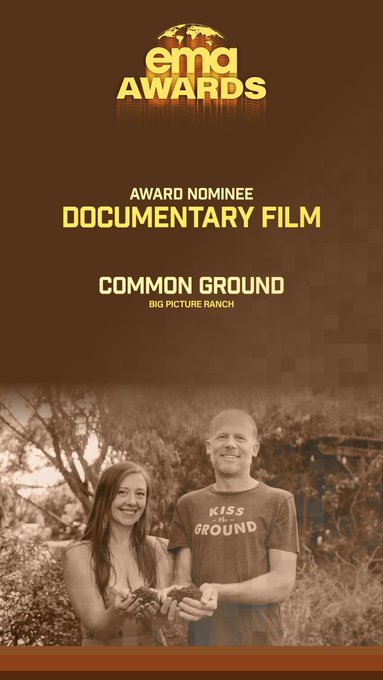
Documentary Film
Deep Rising – The Film Collaborative Common Ground – Big Picture Ranch From Devil’s Breath – MSNBC Films, TIME Studios, Day Zero Productions, Sugar23, Mainstay, P&G Studios, Grain Media, Appian Way
This category alone justifies my coverage of these awards, as it includes three films I can recommend my students watch for extra credit. Welcome to blogging as professional development.
In 2022, I suspected that star power would sway the EMA voters enough for Eating Our Way to Extinction to win. It did, so I'm making the same prediction for Common Ground. Look at all the famous actors named on the poster, including Laura Dern, who is receiving the EMA Ongoing Commitment Award. It's enough to cancel out Jason Momoa as the narrator for Deep Rising, especially since he is also listed for Common Ground, and Leonardo DiCaprio for From Devil’s Breath, which might be the best-crafted of the three.
As I predicted, Common Ground won. Again, congratulations!