Showing posts with label asteroids. Show all posts

Friday, February 7, 2025

A small chance asteroid impacts Earth in 2032

After blogging about tariffs, Musk taking over government computers, mass deportations, Trump's wild idea about Gaza, I'm ready for a different kind of disaster.* The universe provided one in the form of a potential asteroid impact. Watch Global News report Over 1% chance asteroid may hit Earth in 2032, space agency says.

A newly discovered, far-flung asteroid has sparked curiosity and a healthy side of concern among scientists who say the huge rock has the potential to make impact with Earth.

Based on projections, the asteroid, dubbed 2024 YR4, has a little more than one per cent chance of impact with Earth on Dec. 22, 2032.

The asteroid measures between 40 and 90 metres wide (130 and 300 feet) based on estimates from its reflected light.

“An asteroid this size impacts Earth on average every few thousand years and could cause severe damage to a local region,” the European Space Agency (ESA) said in a space safety briefing.
CBS Texas repeated the last sentence in the description of A "city-killer" asteroid has a slim chance to crash into Earth.

"An asteroid this size impacts Earth on average every few thousand years and could cause severe damage to a local region," the European Space Agency said.
The last impact the size of the one that could happen if Asteroid 2024 YR4 enters Earth's atmosphere in seven years was the Tunguska impact on June 30, 1908, which is the event Asteroid Day commemorates. That would be 128 years before a potential impact, not a "few thousand years," but "on average" is doing a lot of work; there is room for a lot of variation.

I close with ABC News (Australia) analyzing the situation in Asteroid with small chance of hitting Earth triggers global defence plan.

Astronomers have spied an asteroid that may be heading for Earth in 2032. While scientists say there is currently no cause for alarm and it will likely pass Earth safely, members of a space mission planning group are meeting this week to work out the next steps. Professor Jonti Horner from the University of Southern Queensland tells The World several factors would come into play, including what the asteroid is made of.
Professor Horner managed to be both scary and reassuring at the same time. Odds are that we'll be O.K. Even if the asteroid impacts the atmosphere, most cases will affect relatively few people. The bad news is that if the asteroid explodes on or above a city, it could kill millions. YIKES!

Oh, and even this story couldn't avoid Elon Musk. Sigh. I was hoping to get away from events on Earth today.

*Disaster literally means "bad star." That's quite on the nose for this story.

Friday, June 30, 2023

'Is NASA Mining Asteroids?' No, but it's studying them for Asteroid Day 2023

Happy International Asteroid Day, the younger but paradoxically more established version of Apophis Day! I'm celebrating by revisiting NASA's asteroid missions for Asteroid Day 2022 beginning with mentions of the Psyche and OSIRIS-REx missions as NASA asks and answers Is NASA Mining Asteroids? We Asked a NASA Expert.

Is NASA mining asteroids? No, we’re not in the business of mining asteroids but we do love to study them.

This year, our #PsycheMission launches to a unique metal-rich asteroid to study what appears to be the exposed nickel-iron core of an early planet, one of the building blocks of our solar system. However, the science we gain from missions like this could one day benefit future humans in cosmic mining and resource endeavors.

And in September, our OSIRIS-REx mission will deliver an asteroid sample back to Earth.
Speaking of OSIRIS-REx, SciShow Space examined its sample collection and future return in The Asteroid That Nearly Swallowed OSIRIS-Rex.

It's always an asteroid heading straight toward us that we worry about, never what happens to us when we head straight toward the asteroid. OSIRIS-REx's experience with Bennu tells us it's worth a thought.
OSIRIS-REx almost sinking into Bennu reminds me that it's the unexpected results that are most interesting. May we get more unexpected results when its sample returns to Earth on September 24, 2023.

Follow over the jump for updates on DART and Lucy, the other missions I covered last year, plus a bonus song.

Thursday, April 13, 2023

'Adam Driver asks NASA about asteroids' for Apophis Day

Happy Apophis Day, when I report on the perils of space! I begin today's entry with Adam Driver Asks NASA About Asteroids.

The dinosaurs went extinct by an asteroid impact many years ago. Here at NASA and around the world, there are teams of experts making sure we can actually do something about it if an asteroid were to ever threaten Earth. We’re studying these rocky, airless remnants to better understand the early formation of our solar system.

“65” actor Adam Driver and NASA Planetary Defender Kelly Fast discuss how we find, track, and monitor near-Earth asteroids, as well as test technologies that could one day be used to prevent a potential impact, should a hazardous asteroid be discovered in the future. The duo also talks about the OSIRIS-REx mission and the asteroid sample the spacecraft will bring to Earth this September.
I enjoyed this cross-promotion of the "65" movie, which I will probably write more about when the next Saturn Awards come around, with NASA's planetary defense work. Star power!

For a slightly more serious take, watch last month's NASA's DART Mission Confirms Crashing Spacecraft into Asteroids Can Deflect Them.

Since NASA’s Double Asteroid Redirection Test (DART) successfully impacted its target on Sept. 26, 2022 – altering the orbit of the asteroid moonlet Dimorphos by a whopping 33 minutes – the DART team has determined that the mission's kinetic impactor technique can be an effective way to change the trajectory of an asteroid.

These findings were published in four papers in the journal Nature on March 1, 2023.
Between yesterday's Stephen Colbert interviews the Artemis II crew for Yuri's Night and today's entry, I've covered two of the top space stories in 2022 has been another great year in space. DART has been as successful in its own way as the James Webb Space Telescope, the top science story of 2022. Here's to hoping humanity builds on DART's success so "Don't Look Up" remains fiction.

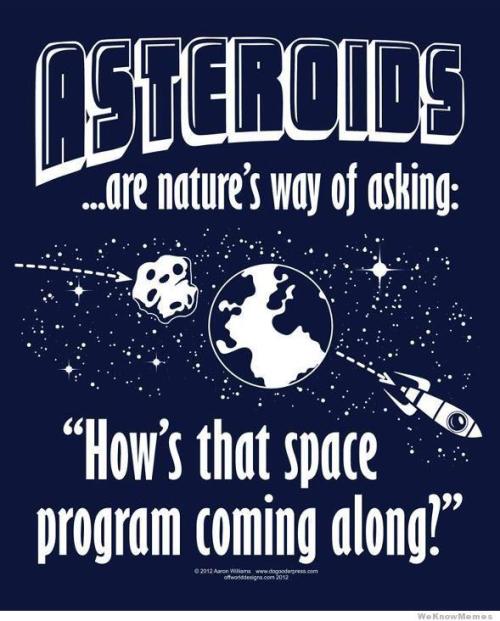
I conclude today's entry with this meme I got from my friend Nebris to remind my readers of the importance of a space program to protect against threats coming from outside the planet.


Stay tuned for a Flashback Friday retrospective tomorrow.

Wednesday, October 28, 2015

Halloween and Friday the 13th bring space visitors


I haven't posted about asteroids and the threat of asteroid collision since July.  Three months later, nature is providing me the opportunity, as two space objects will visit Earth over the next three weeks.

The first is the "Great Pumpkin" asteroid, which will pass by Earth with 300,000 miles on Halloween.  TomoNews US gives its slightly silly take on the story in Halloween asteroid flyby will 'narrowly' miss Earth at the end of October.

MAUI, HAWAII — Scientists at NASA's Pan-STARRS observatory in Hawaii say that an unusually large and fast asteroid will fly by Earth this Halloween. The asteroid, named 2015 TB145, came as a surprise to the scientists, who spotted it less than two weeks ago.

The asteroid's flyby is expected to happen on October 31st, when it will pass within 310,000 miles, or 1.3 lunar distances, from Earth at an "unusually" high velocity of nearly 78,000 miles per hour. 2015 TB145 has an "eccentric" and "high-inclination" orbit, which may explain its late discovery.

Estimated to be between 920 to 2,000 feet in diameter, the asteroid may seem far away enough, but actually it is flying by Earth dangerously close for an object of its size. According to NASA, if an asteroid of its size and velocity was to hit Earth, it would devastating our planet.

Scientists say the next time any celestial object this large will pass by this close to Earth will be in 2027 when the mile-wide AN10 asteroid passes within one lunar distance.
Fortunately, the fly-by will be an exciting near-miss.

The next scary day will be Friday the 13th, which brings its own visitor from space.  Unlike the asteroid, this one will collide with Earth.  Fortunately, it's much smaller and was originally from this planet in the first place.  Teletechnology brings the story of WT1190F, whimsically called "WTF."

WT1190F is predicted to crash into the Indian Ocean on 13 November. The object, dubbed WT1190F, is set to land in the Indian Ocean, around 40 miles (65km) off the southern tip of Sri Lanka, at 6:20 UTC on 13 November. It measures up to 7ft (2 metres) long and it could be a piece of rocket stage from a recent lunar mission, or even part of an Apollo program craft that has been in space for more than 40 years.
This will be much less dangerous than an asteroid impact, although I wouldn't want to be in a boat inside the expected debris field.  Pieces of metal falling at terminal velocity might be terminal for anyone in their way.  Just the same, this will provide a good opportunity for scientists to observe how spacecraft break up in the atmosphere and it will also remove one more piece of space junk.  Good viewing and good riddance!

Monday, July 20, 2015

Asteroid fly-by seen as opportunity not danger


I've mentioned asteroid mining before, but this is the first time it's been the main topic instead of the risk of asteroid collision.  GeoBeats News reports in Asteroid Estimated To Be Worth $5.4 Trillion Will Pass Earth Tonight.

An asteroid believed to contain up to $5.4 trillion worth of platinum will pass relatively close to Earth today. A small asteroid worth up to $5.4 trillion will pass relatively close to Earth tonight.

The asteroid, 2011 UW158, is thought to have a core that contains up to 90 million tons of platinum and other precious materials. The size, makeup and orbit of 2011 UW158 put it on the “short list” of asteroids targeted for robotic mining in the near future, according to the Slooh Community Observatory.

Planetary Resources is an asteroid-mining firm with financial backing from Google executives Eric Schmidt and Larry Page. The company has labeled 2011 UW158 as an ‘X-type’ asteroid suitable for mining and is interested in exploiting the asteroid both for the platinum it contains and possibly water—which may be even more valuable. They’ve catalogued dozens of similar prospects throughout the solar system.

2011 UW158 is about half a mile across and will pass Earth 30 times closer than Mars—or six times further away than the moon—so it won’t be visible to the naked eye.
When I was younger, I wanted to mine the Moon.  I won't be doing that, but I will cheer on the efforts to mine asteroids.  It's exactly the kind of scheme worthy of Crazy Eddie.

Friday, November 15, 2013

U.N. organizing response to asteroid collisions

I've written a lot about the risk of asteroid impact on Earth, a topic made more urgent by the meteor exploding over Russia early this year.  Just last month, for example, I posted both Eclipse and asteroid DOOM and Boston University on how to prevent asteroid impacts on the topic.  All of this takes place against a backdrop of my general anxiety about humanity in general and the U.S. in particular losing its space travel capacity through the decline of global technological civilization.  That's not going away; there are more immediate threats than asteroids.

One good development from earlier this year on this front was the U.N. organizing an international response to stormy space weather.  The U.N. has now stepped up and is trying to do the same thing for asteroid collision.  Discovery News has the story in The UN's Plan To Defend Earth From Asteroids.

The UN has announced it's undertaking the effort to protect the planet from killer asteroids. Trace explains what their plan is if a giant space rock sets it's sights on Earth.
That's good news.  Now, to make sure that there is an economy to support such an endeavor, a society that sees its value, and an environment that can provide for society.  As I wrote more than two years ago, "Without an environment, there is no society.  Without a society, there is no economy."  And without an economy, there is no advanced technology, including the space technology to protect people and their planet from asteroid collisions.