Showing posts with label Apophis Day. Show all posts

Monday, April 13, 2026

Moon safe from 2024 YR4 and fireballs for Apophis Day

It's Apophis Day, when I report on the perils of space. Today, I have good news to follow up on 'NASA Expert Answers Your Questions About Asteroid 2024 YR4' for Apophis Day, when there was a significant chance 2024 YR4 would hit the Moon. Space.com reports No Impact! Famous Asteroid Will Not Smash Into Moon (or Earth).

New James Webb Space Telescope imagery of asteroid 2024 YR4 confirmed that it “will safely pass the Moon at a distance of more than 20,000 km. (~12,427 mlles),” according to the European Space Agency.

It also poses no danger to Earth[.]
As I wrote, good news!

That written, smaller objects have been plowing into Earth, or at least its atmosphere. Follow over the jump for those.

Monday, June 30, 2025

Bolide over southeast U.S. and Asteroid 2024 YR4 update for Asteroid Day and Meteor Watch Day

Happy International Asteroid Day, the younger but paradoxically more established version of Apophis Day! It's also National Meteor Watch Day, so I'm beginning today's post with a spectacular meteor, which CNN reported as Fireball flies across the sky and causes sonic boom on Friday.

A ‘daytime fireball’ was caught on video in the sky over South Carolina – causing a sonic boom, according to the American Meteor Society. CNN has reached out to emergency management officials in North Carolina and Tennessee, as well as NASA for comment.
That's quite the meteor! Good thing it mostly created a natural fireworks show, maybe some property damage, and no injuries.

Now for two updates on Asteroid 2024 YR4, beginning with Global News reporting Asteroid now poses real threat of hitting Moon, NASA warns.

An asteroid once considered a threat to Earth is now on a potential collision course to the Moon.

NASA says the object has just over a four per cent chance of impacting the Moon, seven years from now.

Though the odds may seem small, scientists warn that the damage could be significant.

Vincent McAviney reports on why the space agency says this risk is no longer trivial.
That sounds alarming, if still unlikely. The European Space Agency was a lot calmer in From threat to no sweat: Asteroid 2024 YR4.

How did asteroid 2024 YR4 go from being the riskiest asteroid ever detected to posing no real threat? First spotted in December 2024, its impact risk initially soared to 2.8%, surpassing previous record-holder Apophis. But thanks to refined observations from our Near-Earth Object Coordination Centre and other institutions, its risk quickly dropped to just 0.001% within days. This dramatic shift follows a well-known pattern—asteroid impact probabilities often rise before plummeting as more data becomes available. Now, nearly all possible impact scenarios have been ruled out, and 2024 YR4 has been safely removed from our risk list.
Nothing about a possible impact with the Moon, but NASA's planetary defense blog lists that probability as 4.3%, as Global News reported.

That's a wrap for June's blogging. Stay tuned for Canada Day to begin July.

Sunday, April 13, 2025

'NASA Expert Answers Your Questions About Asteroid 2024 YR4' for Apophis Day

It's Apophis Day, when I report on the perils of space! For this year's observance, I'm returning to A small chance asteroid impacts Earth in 2032. Watch NASA Expert Answers Your Questions About Asteroid 2024 YR4.

You’ve heard about asteroid 2024 YR4 and we’ve heard your questions — so let’s talk about it. What are the chances it’ll hit Earth? Why do those odds keep changing? And should you be worried? (Spoiler alert: No). Get the facts from a NASA expert and learn how we track asteroids, update predictions, and keep an eye on the skies.
The odds have dropped even more, as NASA reported on its planetary defense blog.
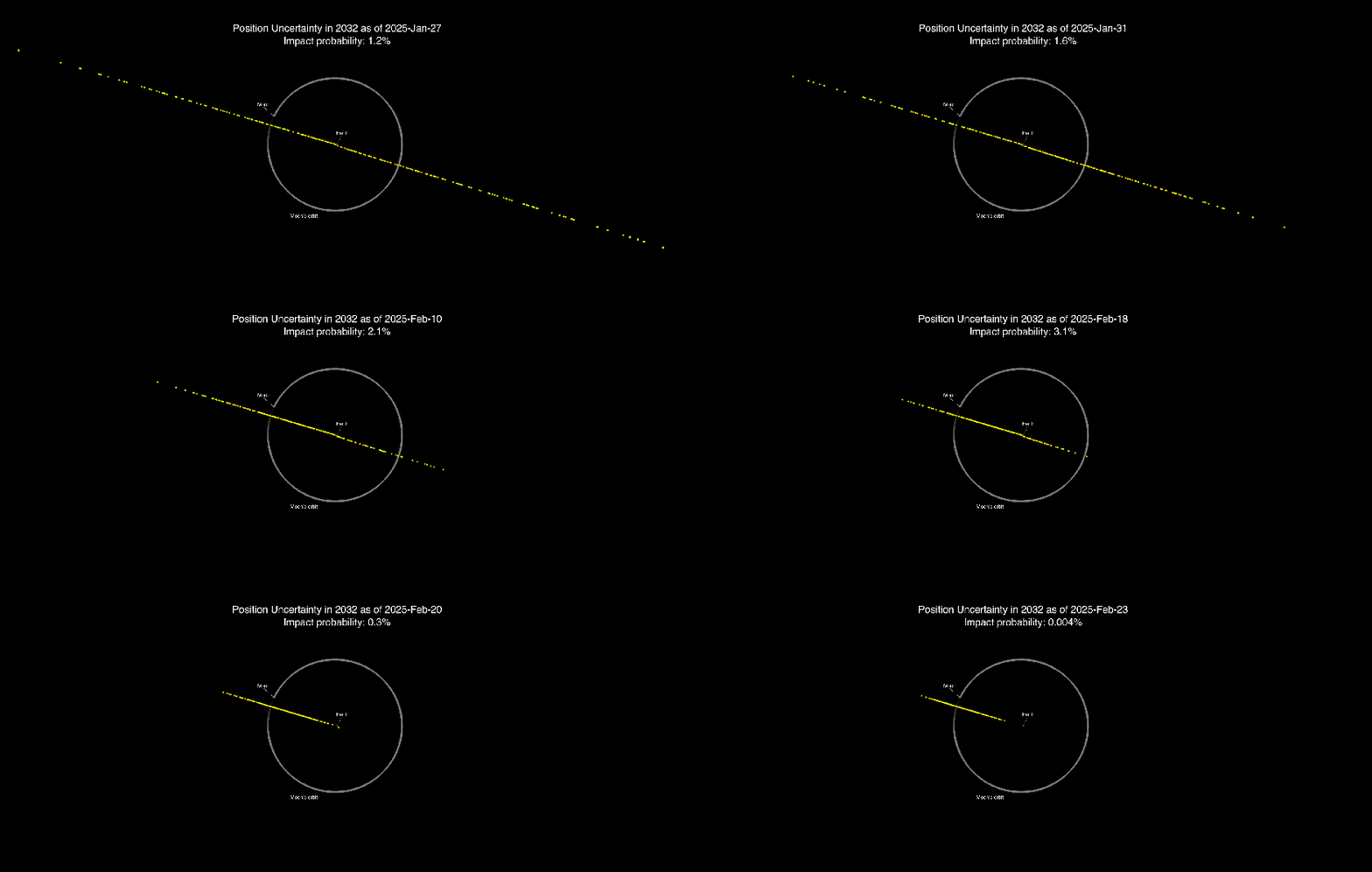
NASA has significantly lowered the risk of near-Earth asteroid 2024 YR4 as an impact threat to Earth for the foreseeable future. When first discovered, asteroid 2024 YR4 had a very small, but notable chance of impacting our planet in 2032. As observations of the asteroid continued to be submitted to the Minor Planet Center, experts at NASA Jet Propulsion Laboratory’s (JPL’s) Center for Near-Earth Object Studies were able to calculate more precise models of the asteroid’s trajectory and now have updated its impact probability on Dec. 22, 2032 to only 0.004% and found there is no significant potential for this asteroid to impact our planet for the next century. The latest observations have further reduced the uncertainty of its future trajectory, and the range of possible locations the asteroid could be on Dec. 22, 2032, has moved farther away from the Earth.

Good news! But..."There still remains a very small chance for asteroid 2024 YR4 to impact the Moon on Dec. 22, 2032. That probability is currently 1.7%." Space.com/VideoFromSpace includes that news in Asteroid 2024 YR4's shape and origin revealed - Small chance it hits the moon!

Astronomers using the Gemini South Telescope and W. M. Keck Observatory have determined the shape and origin of asteroid 2024 YR4. It now has a 'few percent' chance of impacting the moon after it was determined that it will most likely not hit Earth, according to NOIR Lab.
Should there be Artemis and Gateway astronauts on and around the Moon, they'll be at risk. I'm sure NASA and ESA will be prepared. In the meantime, we here on Earth will be safe.

As my regular readers might note, no Sunday entertainment feature or highlights of last night's Saturday Night Live today. The blog passed its page view goals for April on Sunday night, so I'll be posting evergreen and holiday content through the end of the month. Stay tuned.

Friday, February 7, 2025

A small chance asteroid impacts Earth in 2032

After blogging about tariffs, Musk taking over government computers, mass deportations, Trump's wild idea about Gaza, I'm ready for a different kind of disaster.* The universe provided one in the form of a potential asteroid impact. Watch Global News report Over 1% chance asteroid may hit Earth in 2032, space agency says.

A newly discovered, far-flung asteroid has sparked curiosity and a healthy side of concern among scientists who say the huge rock has the potential to make impact with Earth.

Based on projections, the asteroid, dubbed 2024 YR4, has a little more than one per cent chance of impact with Earth on Dec. 22, 2032.

The asteroid measures between 40 and 90 metres wide (130 and 300 feet) based on estimates from its reflected light.

“An asteroid this size impacts Earth on average every few thousand years and could cause severe damage to a local region,” the European Space Agency (ESA) said in a space safety briefing.
CBS Texas repeated the last sentence in the description of A "city-killer" asteroid has a slim chance to crash into Earth.

"An asteroid this size impacts Earth on average every few thousand years and could cause severe damage to a local region," the European Space Agency said.
The last impact the size of the one that could happen if Asteroid 2024 YR4 enters Earth's atmosphere in seven years was the Tunguska impact on June 30, 1908, which is the event Asteroid Day commemorates. That would be 128 years before a potential impact, not a "few thousand years," but "on average" is doing a lot of work; there is room for a lot of variation.

I close with ABC News (Australia) analyzing the situation in Asteroid with small chance of hitting Earth triggers global defence plan.

Astronomers have spied an asteroid that may be heading for Earth in 2032. While scientists say there is currently no cause for alarm and it will likely pass Earth safely, members of a space mission planning group are meeting this week to work out the next steps. Professor Jonti Horner from the University of Southern Queensland tells The World several factors would come into play, including what the asteroid is made of.
Professor Horner managed to be both scary and reassuring at the same time. Odds are that we'll be O.K. Even if the asteroid impacts the atmosphere, most cases will affect relatively few people. The bad news is that if the asteroid explodes on or above a city, it could kill millions. YIKES!

Oh, and even this story couldn't avoid Elon Musk. Sigh. I was hoping to get away from events on Earth today.

*Disaster literally means "bad star." That's quite on the nose for this story.

Sunday, June 30, 2024

Asteroid Day, past, present, and future

Happy International Asteroid Day, the younger but paradoxically more established version of Apophis Day! I begin today's observance with Astronomy Magazine's The Real Reality Show: Asteroid Day.

Large asteroids have struck Earth in the past and they will in the future. Learn about Asteroid Day, a movement that recognizes research on the dangers of Near-Earth Asteroids.
I think that's the most complete story of the origin of Asteroid Day I can remember watching since I started observing it in 2016, which means I learned something new. Any day I learn something new is a good day!

Astronomy Magazine's video mentioned the asteroid that killed off the non-avian dinosaurs 66 million years ago, so I'm using that as an opportunity to have BBC Earth Science ask and answer What Exactly Killed The Dinosaurs?

Since the 1980s, scientists have believed that the main culprit for the dinosaur extinction was an asteroid. It came from the far reaches of the solar system, and was the size of Mount Everest.
I'm a paleontologist and attended graduate school when geologists debated and eventually accepted the asteroid strike as the cause of the terminal Cretaceous mass extinction, so this shaped my ideas about asteroid impacts. I don't particularly want humanity to go the way of the non-avian dinosaurs!

Moving from the past to the future, CTV News reported NASA scientists are studying a massive asteroid hurling towards Earth earlier this month.

NASA scientists are preparing for a massive asteroid that’s hurling towards Earth in the next few years. Joy Malbon explains.
Apophis's first close flyby is only five years away — wow and yikes!

Just so this entry qualifies as the Sunday entertainment feature, I'm sharing ‘Asteroid City’ Cast Asks NASA About OSIRIS-REx Asteroid Mission.

In September 2023, scientists with NASA’s OSIRIS-REx mission will gather in the Utah desert for the arrival of the largest asteroid sample ever received on Earth. “Asteroid City” actors, including Scarlett Johansson, Jason Schwartzman, Maya Hawke, Rupert Friend, Jake Ryan and Jeffrey Wright, join NASA OSIRIS-REx sample expert Dr. Danny Glavin to discuss how studying the asteroid sample will give scientists insight into how the early solar system formed and how life began on Earth.

After a seven-year round trip journey that included mapping Bennu’s surface (a near-Earth asteroid that is no threat to our planet), identifying minerals and chemicals, and collecting a sample from the surface, OSIRIS-REx is on its way back to Earth with more than eight ounces of material.
I'm going to be snarky by repeating what I wrote about the film in 'Mission: Impossible - Dead Reckoning' and 'The Last of Us' lead nominees at the fourth Critics Choice Super Awards.
I have two things to say about Asteroid City. First, why this it here instead of Barbie? Second, the only thing it could win in this field is a game of "one of these things is not like the others."
I now have a third; I enjoyed the cast in this promotional video, although I think they did a better job of increasing the visibility of OSIRIS-REx than promoting the movie. Darn. Speaking of the asteroid return mission, it was one of the first missions shown in 2023 in space from NASA, ESA, Reuters, and PBS NewsHour. I'm looking forward to 2024 in space already.

That's a wrap for June's blogging. Stay tuned for Canada Day to begin July.

Saturday, April 13, 2024

NASA experts answer questions about asteroids for Apophis Day

Yesterday was Yuri's Night, when I celebrate the promise of space. Today is Apophis Day, when I report on the perils of space, especially asteroids. I'm featuring a series from NASA's archives that I could have used in 2022, but Russia's invasion of Ukraine intruded. It's time to make up for a missed opportunity, beginning with Will an Asteroid Ever Hit Earth? We Asked a NASA Scientist.

Will an asteroid ever hit Earth? There are no known impact threats, but tiny meteors burn up in Earth’s atmosphere all the time! NASA asteroid expert Dr. Kelly Fast tells us more. Learn more about NASA’s planetary defense efforts: nasa.gov/planetarydefense
Technically, the answer is yes; small meteors burn up in Earth's atmosphere all the time. That relates to the answer to When Was the Last Time an Asteroid Hit Earth? We Asked a NASA Expert.

When was the last time an asteroid hit Earth? Small asteroids and other tiny particles bombard our planet daily, but almost all of them burn up safely in the atmosphere. Bigger impacts are extremely rare, but scientists like Marina Brozovic are keeping their eyes on the sky.
Again, small particles are hitting the atmosphere, burning up, and falling to the ground all the time. Ones large enough to cause damage and harm people? Marina Brozovic mentioned the last major one, which I blogged about in Russian meteor one year later and In Russia, space explores you! That's a once in a century event, so we're not likely to see another like it this century. That's the point of Is NASA Aware of Any Earth-Threatening Asteroids? We Asked a NASA Expert.

Is NASA aware of any Earth-threatening asteroids? Luckily there are no known asteroid threats to Earth for at least 100 years. But that doesn’t mean we’re not looking. Asteroid expert Davide Farnocchia of our@NASAJPL breaks it down.
That's reassuring. So is Does NASA Know About All the Asteroids? We Asked a NASA Scientist.

Does NASA know about ALL the asteroids? We know about the vast majority of larger ones and none of those pose a threat, but space is big, so we're always on the lookout. NASA asteroid expert Dr. Amy Mainzer explains.
The answer is no, not yet, but NASA is working on it.

Of course, the "so what?" question is What if an Asteroid Were Going to Hit Earth? We Asked a NASA Scientist.

There are no known threats to Earth, but NASA asteroid expert Dr. Kelly Fast says it’s important to find the asteroids before they find us. That’s why NASA’s Planetary Defense Coordination Office keeps its eyes on the skies.
This video explains DART, which was a success and one of the reasons 2022 was another great year in space. Proof of concept!

I will have more about asteroids on Asteroid Day. Until then, stay tuned for this year's edition of Marching music for the Wyoming Democratic Caucuses. Troopers!

Friday, June 30, 2023

'Is NASA Mining Asteroids?' No, but it's studying them for Asteroid Day 2023

Happy International Asteroid Day, the younger but paradoxically more established version of Apophis Day! I'm celebrating by revisiting NASA's asteroid missions for Asteroid Day 2022 beginning with mentions of the Psyche and OSIRIS-REx missions as NASA asks and answers Is NASA Mining Asteroids? We Asked a NASA Expert.

Is NASA mining asteroids? No, we’re not in the business of mining asteroids but we do love to study them.

This year, our #PsycheMission launches to a unique metal-rich asteroid to study what appears to be the exposed nickel-iron core of an early planet, one of the building blocks of our solar system. However, the science we gain from missions like this could one day benefit future humans in cosmic mining and resource endeavors.

And in September, our OSIRIS-REx mission will deliver an asteroid sample back to Earth.
Speaking of OSIRIS-REx, SciShow Space examined its sample collection and future return in The Asteroid That Nearly Swallowed OSIRIS-Rex.

It's always an asteroid heading straight toward us that we worry about, never what happens to us when we head straight toward the asteroid. OSIRIS-REx's experience with Bennu tells us it's worth a thought.
OSIRIS-REx almost sinking into Bennu reminds me that it's the unexpected results that are most interesting. May we get more unexpected results when its sample returns to Earth on September 24, 2023.

Follow over the jump for updates on DART and Lucy, the other missions I covered last year, plus a bonus song.

Thursday, April 13, 2023

'Adam Driver asks NASA about asteroids' for Apophis Day

Happy Apophis Day, when I report on the perils of space! I begin today's entry with Adam Driver Asks NASA About Asteroids.

The dinosaurs went extinct by an asteroid impact many years ago. Here at NASA and around the world, there are teams of experts making sure we can actually do something about it if an asteroid were to ever threaten Earth. We’re studying these rocky, airless remnants to better understand the early formation of our solar system.

“65” actor Adam Driver and NASA Planetary Defender Kelly Fast discuss how we find, track, and monitor near-Earth asteroids, as well as test technologies that could one day be used to prevent a potential impact, should a hazardous asteroid be discovered in the future. The duo also talks about the OSIRIS-REx mission and the asteroid sample the spacecraft will bring to Earth this September.
I enjoyed this cross-promotion of the "65" movie, which I will probably write more about when the next Saturn Awards come around, with NASA's planetary defense work. Star power!

For a slightly more serious take, watch last month's NASA's DART Mission Confirms Crashing Spacecraft into Asteroids Can Deflect Them.

Since NASA’s Double Asteroid Redirection Test (DART) successfully impacted its target on Sept. 26, 2022 – altering the orbit of the asteroid moonlet Dimorphos by a whopping 33 minutes – the DART team has determined that the mission's kinetic impactor technique can be an effective way to change the trajectory of an asteroid.

These findings were published in four papers in the journal Nature on March 1, 2023.
Between yesterday's Stephen Colbert interviews the Artemis II crew for Yuri's Night and today's entry, I've covered two of the top space stories in 2022 has been another great year in space. DART has been as successful in its own way as the James Webb Space Telescope, the top science story of 2022. Here's to hoping humanity builds on DART's success so "Don't Look Up" remains fiction.

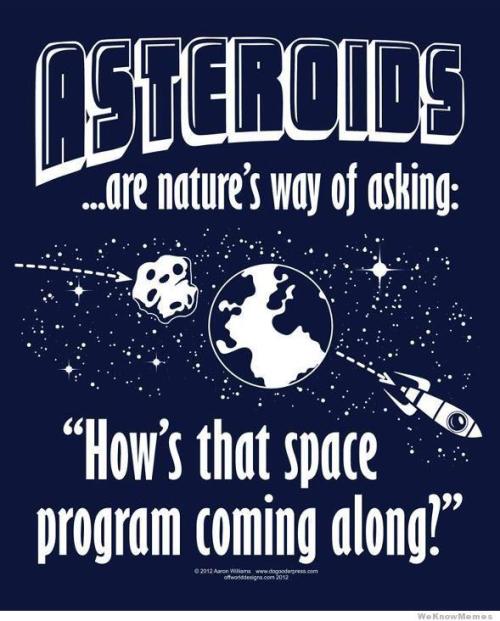
I conclude today's entry with this meme I got from my friend Nebris to remind my readers of the importance of a space program to protect against threats coming from outside the planet.


Stay tuned for a Flashback Friday retrospective tomorrow.

Thursday, June 30, 2022

NASA's asteroid missions for Asteroid Day 2022

Happy International Asteroid Day, the younger but paradoxically more established version of Apophis Day! I begin this year's celebration by sharing Asteroid Day 2022 from Science Museum of Virginia on YouTube.

Another trip around the Sun means another opportunity to celebrate Asteroid Day! On this June 30, let's look at the space rock discoveries made within the last year. Here's a quick recap of the asteroids added to our tracking catalogue in the last 12 months.
That's exactly the kind of summary of asteroid discoveries along with exactly the preview image I want for this entry. Thank you, Science Museum of Virginia! For that, I've now subscribed to your YouTube channel.

Next, I'm sharing videos about three missions NASA is taking or will take to asteroids this year, beginning with Explained: NASA's asteroid-deflecting DART mission from Reuters.

NASA’s DART spacecraft began a 10-month journey into space on a mission to demonstrate the world's first planetary defense system. It is designed to deflect an asteroid from a potential doomsday collision with Earth[.]
This is the mission that I featured the past two Asteroid Days and the past two Apophis Days. It's also the mission I'm featuring today that will return its results first. Watch for my post on them, as early as this September or as late as the year in space in December.

Follow over the jump for two more asteroid missions.

Wednesday, April 13, 2022

Vox explains 'What Russia's war means for the International Space Station' plus DART and Artemis updates

A belated happy Yuri's Night AKA International Day for Human Space Flight! As I wrote five years ago, this is the day of the year when I celebrate the promise of space. Today is Apophis Day, when I report on the perils of space. Vox uploaded a video this morning that exemplifies both, What Russia's war means for the International Space Station, although the threat is to space exploration from Earth, not from space to the planet.

The International Space Station has been orbiting above us for the last 20 years. It’s been home to astronauts from more than a dozen different countries — but mostly Americans and Russians. The two former “Space Race” countries control the main parts of the station. The science done there has required close collaboration and so it’s been largely insulated from politics on Earth.

But Russia’s invasion of Ukraine may change that. The two countries have agreed to cooperate through 2024… but after that, the future of the space station is uncertain.
So far, Putin's war on Ukraine has not had major effects in space, but that could change if the Russians don't extend their involvement in the ISS beyond 2024. It could speed up the decommissioning of the space station, which is currently expected to happen by 2030. At least there are plans for commercial space stations associated with NASA beyond 2030 along with other projects like Artemis.

Now for the usual subject of Apophis Day, the threat of asteroid impact with an update to PBS NOVA asks 'Can Humans Deflect an Asteroid?' for Asteroid Day 2021 from CBC News: NASA spacecraft en route to smash into asteroid.

NASA has launched a spacecraft that will reach an asteroid in 10 months and smash into it — on purpose — to see if it's possible to change the space rock's orbit.
I'm looking forward to the results of DART's collision with Dimorphos later this year. I expect I'll have an update on the mission for Asteroid Day and again after it happens.

I conclude today's post with "Invincible" by Eddie Vedder, featuring NASA's Artemis I Moon Mission (Official Video), a musical update on the Artemis mission.

Grammy-award winning artist Eddie Vedder's "Invincible" video collaboration with NASA is inspired by our Artemis I Moon mission.

The Space Launch System rocket and Orion spacecraft – the only human-rated spacecraft in the world capable of deep-space travel – are planned to lift off from Launch Pad 39B at NASA's Kennedy Space Center for the uncrewed Artemis I mission around the Moon. Through the Artemis missions, NASA will land the first woman and the first person of color on the Moon, paving the way for a long-term lunar presence, and serving as a steppingstone on the way to Mars. This video includes footage of various prelaunch tests, along with animations of launch, the orbit around the Moon, and the return to Earth.
Last year, I featured Lindsey Stirling. This year, Eddie Vedder. Stirling didn't surprise me; she's something of a geek goddess. I had no idea Vedder was this into space!

Sunday, January 9, 2022

Politics, government, and diversity among movie nominees at the 2022 Golden Globes


I told my readers to "Stay tuned for part two featuring the movie nominees, which will be the Sunday entertainment feature" in part 1 yesterday, so here are the film nominations at tonight's ceremony without stars with handicaps of their chances to win along with analyses of their politics and government content served with side helpings of how well they present diversity.

Best Motion Picture: Drama

Belfast
CODA
Dune
King Richard
The Power of the Dog
This category includes both of the most nominated films, "Belfast" and "The Power of the Dog" with seven nominations each. The former is more political, as it takes place in Northern Ireland during the 1960s, when The Troubles started to escalate, while the latter is more personal, although both are primarily family dramas. The same is true of the next most nominated drama film, "King Richard," with four nominations, although it's also a sports story with a strong element of racial diversity, so social commentary is an important element, if not the dominant one. Skipping to the nominee with the fewest nominations, two, "CODA" is another family drama that explores another axis of diversity, ability, and includes social commentary. My personal favorite is "Dune" with three nominations. As I wrote on TV Talk Show Host Day, it features a lot of futuristic politics and political allegory in its science fiction. "Dune" probably also features a racially diverse cast.

I think it's between "Belfast" and "The Power of the Dog" for this award, with the edge going to "Belfast." This is an international film and the Hollywood Foreign Press Association (HFPA) is voting, so I think that might be enough. As I reiterate whenever I write about awards programs, electorates matter. Speaking of which, the Motion Picture Academy might favor "The Power of the Dog" while a vote of the general audience would probably pick "Dune," the only nominee also nominated at the People's Choice Awards.

Best Motion Picture: Musical or Comedy

Cyrano
Don't Look Up
Licorice Pizza
tick, tick... BOOM!
West Side Story
"Don't Look Up," "Licorice Pizza," and "West Side Story" all tie for the most nominated comedy or musical with four nominations each. The most political is "Don't Look Up," which uses a comet impact as a metaphor for the reaction to and inaction about climate change. This is right up my alley and I plan on writing an entry concentrating on the film. While it's my favorite, it's not my pick to win unless the HFPA really wants to make a political statement. Instead, I think "West Side Story" has the inside track. I've heard and read nothing but good things about it other than its disappointing box office and some quibbles about its representation of Puerto Ricans, which still makes it the most diverse among nominated comedies and musicals. That's too bad for "Licorice Pizza," which takes place where I grew up from the perspective of someone near my age at the time and which has a campaign of Los Angeles Mayor as part of the plot. I think I'd like to watch that.

"Cyrano" and "tick, tick... BOOM!" both have two nominations. The former, like "West Side Story," is an updated adaptation of a classic, while the latter is a biography of the creator of "Rent." I think that might play better with the Hollywood creators than it would with the HFPA.

Best Animated Feature

Encanto
Flee
Luca
My Sunny Maad
Raya and the Last Dragon
I decided to move both Best Animated Feature and Best Foreign Language Film up here so that all of nominations of films instead of individuals would all be together at the head of the post instead of being last on the list. I think that gives them the credit they're due.

"Encanto" is the only nominee with more than one nomination in this field, three, so I consider it the odds-on favorite. Its main competition is probably "Flee," which beat "Summer of Soul" at the Gotham Independent Film Awards in the documentary feature category. It's also on the shortlist for Best International Feature Film at the Oscars, making "Flee" a triple threat.

All of the nominees feature diversity, although in the case of "Luca," it's fantastic instead of realistic. "Raya and the Last Dragon" also features fantastic politics and government, while both "Flee" and "My Sunny Maad" have animated takes on the political situation in Afghanistan.

Best Foreign Language Film

Compartment No. 6 (Finland)
Drive My Car (Japan)
The Hand of God (Italy)
A Hero (Iran)
Parallel Mothers (Spain)
Only "Parallel Mothers" has more than one nomination with the other for Best Original Score, so I would say it's the nominal favorite. However, the Motion Picture Academy did not put it on the shortlist for Best International Feature Film, so that might dull its edge. On the other hand, all the rest of the nominees did make that shortlist. Again, electorates matter.

Follow over the jump for the individual nominations, both for actors and the people behind the camera.

Wednesday, June 30, 2021

PBS NOVA asks 'Can Humans Deflect an Asteroid?' for Asteroid Day 2021

Happy International Asteroid Day! I'm observing the younger but more established version of Apophis Day by updating NASA's plans to deflect an asteroid plus what happens if one hits NYC, beginning with PBS NOVA asking Can Humans Deflect an Asteroid? New NASA Mission Aims to Find Out.

NASA’s new spacecraft mission DART will test scientists’ ability to deflect asteroids at risk of colliding with Earth and is scheduled to launch later this year, NASA wrote in an April press release.

“An impact on Earth doesn’t happen very often—that doesn’t mean they don’t happen,” University of Colorado aerospace engineer Paul Sanchez told NOVA. “This isn't the sort of thing that we want to address at the last minute,” NASA Planetary Defense Coordination Office scientist Kelly Fast added.

Sixty-six million years ago, a miles-wide asteroid crashed into Earth, wiping out three-quarters of the world’s plant and animal species, including all non-avian dinosaurs. (The occurrence is now known as the Cretaceous-Paleogene, or K-Pg, event.) And on Jun. 30, 1908, an asteroid streaked over the Siberian sky and exploded, flattening about 80 million trees over an area of 830 square miles of forest and, according to eyewitnesses, killing at least three people. Called the Tunguska event, it’s the most harmful known asteroid-related incident on Earth in recent history.

Today, Space agencies including NASA are confident they’re tracking asteroids big enough to cause a major extinction event. Fortunately, none are headed our way in the foreseeable future. But following asteroids—and learning how to redirect them away from Earth—is important, NASA’s Planetary Defense Coordination Office, which was founded in 2016, believes.

Watch to discover how the Planetary Defense team is taking on this challenge.
That's the latest update on a plan I've been following for years as it comes closer to fruition. NASA scheduled a livestream on YouTube at 1:00 P.M. EDT. I am posting this entry before it starts, but the video of the livestream should still be available to watch after it's over.

Next, SciShow Space reported on the 2019 conference I included in the May 2019 post as The Imaginary Future Asteroid That Hit NYC.

Last week, an asteroid impact drill was conducted, which demonstrated what might happen if an asteroid hit us within the decade. It didn't go quite as well as we would like.
Since USA Today took down the video I embedded two years ago, it's a good thing I found this video and shared it here.

I conclude today's entry with this meme I got from my friend Nebris to remind my readers of the importance of a space program to protect against threats coming from outside the planet.

Tuesday, April 13, 2021

Vice on DART, Harvard on the 'Armageddon causing comet' that killed the dinosaurs, and more asteroid news for Apophis Day

Today is Apophis Day, when I report on the perils of space. In particular, I concentrate on potential threats from asteroids, as the asteroid Apophis will fly by Earth twice on this date, first in 2029 and again in 2036, hence my name for the day. Since I like some hope along with my DOOM, I also write about possible solutions. On that note, watch How NASA Plans to Save Earth from Asteroids | The Space Show by Vice News.

The Double Asteroid Redirection Test is NASA's first test of a "kinetic impactor" that could one day be used to save Earth from an incoming asteroid. Andy Rivkin, an asteroid expert with The Johns Hopkins University Applied Physics Laboratory, explains how to smash into giant space rocks and possibly save human civilization.
The Double Asteroid Redirection Test (DART) mission looks promising. Preparations should be well under way by Asteroid Day, so I expect that I will be writing about the mission again at the end of June.

One of the main reasons asteroids rank so highly among doomsday scenarios is the discovery that an asteroid impact caused the extinction of the non-avian dinosaurs. Dinosaurs and disaster — that's a combination that attracts attention! Harvard University reported a new finding about the Origin of the Armageddon causing comet.

A new theory from Avi Loeb and Amir Siraj explains the origin of the comet that killed the dinosaurs
So a big comet nucleus made of carbonaceous chondrite, not a stony asteroid, hit the Earth 66 million years ago. That shows both the blurriness of the boundary between comets and asteroids and that comets are as big a threat as asteroids. I'll keep that in mind for future posts about asteroids.

Follow over the jump for two more videos reporting the latest news about asteroids.

Tuesday, June 30, 2020

Seeker explains NASA's plans for asteroids on Asteroid Day 2020


Happy International Asteroid Day! To celebrate the today, which I see as the younger but paradoxically more established version of Apophis Day, I'm sharing four videos Seeker posted during the past year about asteroids. The most recent, which was uploaded just yesterday, had Seeker ask If An Asteroid Was Heading For Earth, How Could We Stop it?

NASA and ESA have a unique plan to slam a spacecraft into an asteroid—here’s why.
...
Agencies around the world are working to bring samples of asteroids back to Earth, like NASA’s Osiris-Rex and JAXA’s Hayabusa-2, because bringing a piece back is like looking into a time capsule from the universe. BUT asteroids pose a serious threat to Earth. And ESA and NASA have a unique plan to combat that particular problem: they’re going to slam a spacecraft into an asteroid.

But asteroids also post a serious threat to Earth and so ESA and NASA formed a scientific collaboration known as the Asteroid Impact and Deflection Assessment, or AIDA, to combat this potential problem. The collab consists of two missions: NASA’s Double Asteroid Redirection Test, or DART, and ESA’s Hera Probe.

DART will smash into an asteroid in 2022 helping the AIDA mission study how effective a kinetic impactor would be in asteroid deflection and then four years later the Hera probe will arrive to do some assessments.
As I wrote in a comment at the video, "Perfect video for International Asteroid Day!"

Seeker examined the mission eight months ago in NASA Plans to Slam a Spacecraft Into an Asteroid, which I'm including for completeness.

What if a deadly asteroid was on a collision course to Earth? NASA and the ESA have come up with a solution.
...
Asteroids impacting Earth can be devastating—killing all the dinosaurs in existence level devastating. But even the asteroids that aren’t mass-extinction huge can be a serious threat.

Every few thousand years Earth (a.k.a. you and I) get hit with a massive asteroid the size of the Great Pyramid of Giza, so what is the plan when we get hit with the next asteroid?

We get hit with an asteroid about the size of the Great Pyramid of Giza every few thousand years, and when the next one hits it could cause massive damage to an entire region. So when we spot the next one coming, what’s the plan?

Enter: NASA’s Planetary Defense Coordination office.
As I have written many times about Apophis Day, it's when I observe the perils of space, particularly asteroids. Follow over the jump for the promise of asteroids.

Monday, April 13, 2020

Pandemic effects from and on space, an April asteroid flyby, and NASA at Home for Apophis Day on Monday the 13th

Happy Apophis Day on Monday the 13th!  Normally, I treat this date as "my version of Asteroid Day, when I warn of dangers from space — other than plagues" — and I will do some of that, but, just as yesterday's Yuri's Night entry looked at both the promise and peril of space through the lens of the coronavirus pandemic, so will today's observance of the day I declared in 2012.  As I wrote in Pandemics and collapse in 2013:
This blog is still about how to avoid the collapse of the current civilization and takes a science-fiction slant on the topic.  An asteroid impact is the perfect merger of the two.
So are pandemics.  We need to be prepared for them, too.
My readers don't have to guess which one happened first, as we're living through it and we're finding out that we weren't prepared!  Let that be a lesson to us.

Before I examine hazards from space, Space.com/Video From Space shows its viewers Coronavirus impact seen from space in before and after satellite images.

The coronavirus pandemic has led to a massive decrease in movement of people around the world, which is evident in these satellite images.
I found all of these striking, but particularly the before and after images of Tokyo Disneyland.  When I'm really in an "I can't be all DOOM all the time mood," I de-stress by watching videos about theme parks, particularly Disney's theme parks.  The closure of all of Disney's theme parks at once has really affected those video bloggers and made their videos less stress-relieving.  Escapism doesn't work when you know there was a place to escape to that isn't available any more.*

Video From Space examined both the effects of the pandemic on space travel and an April asteroid flyby in What's Up in Space by Space.com (April 2020).

The Space.com team, like everyone else, may be stuck at home amid the coronavirus pandemic, but space exploration is still going on. Here's what to expect in April with Space.com Editor-in-Chief Tariq Malik and Community Manager Stevie Ward!
Yes, space industries and agencies are having people work from home while keeping essential personnel on site as well as shifting production, too.  Also, the video mentioned an asteroid flyby on April 29th.  Fortunately, it will miss Earth by a safe distance, which Space.com reported today.
"On April 29, asteroid 1998 OR2 will safely pass by 3.9 million miles/6.2 million kilometers," scientists with NASA's Asteroid Watch program said in a Twitter update as they debunked a Daily Express report warning of the flyby. "There is no warning about this asteroid," they added in another Twitter post.
...
"The orbit is well understood and it will pass harmlessly at 16 times the distance to our moon," NASA wrote on Twitter. "No one should have any concern about it."
That's a relief, especially after seeing all the alarmist YouTube videos about the flyby when I searched for asteroids yesterday.  Those alone were enough to make me change the focus of today's post from asteroid impacts to the pandemic.

Speaking of NASA, they opened A Universe of Possibilities to Explore at Home on This Week @NASA – April 3, 2020 with how they are serving the public while people are staying safe at home.

You, plus “NASA at Home” equals a universe of possibilities, the first delivery service selected for our lunar Gateway, and an astronaut added to a future Commercial Crew flight … a few of the stories to tell you about – This Week at NASA!
Virtual field trips and science experiments — I should check them out to see if there are any I can recommend to my students.  Since I can't run my geology field trip in person, I'll have to find one the students can do themselves.  Wish me luck as my students and I stay safe at home.

*For my readers who are wondering how a doomer blogger such as myself came across this community, it's because they form a branch of urban exploration, which also includes all the video bloggers about the Retail Apocalypse.  When I started looking at videos about dead malls, YouTube suggested videos about closed Disney park attractions, so I starting watching them and looking at YouTube's recommendations for those videos.  Behold the power of the YouTube algorithm!

Sunday, June 30, 2019

CBS and Wired report on the Planetary Defense Conference Exercise for Asteroid Day 2019


Happy International Asteroid Day!  To celebrate the event, which I see as the younger but more established version of Apophis Day, I'm sharing two videos about an exercise NASA and other governmental agencies participated in last month called the Planetary Defense Conference Exercise.  CBS Evening News reported How NASA plans to keep an asteroid from hitting Earth as the conference began.

It's unlikely a large asteroid would come speeding toward Earth. But NASA is preparing just in case. Chip Reid explains.
CBS gave a good overview.  Wired went into more depth at the end of the exercise in How Scientists Are Preparing Earth for an Incoming Asteroid.

Some of the world's best scientists are running drills to practice for a near earth object collision. WIRED's Robbie Gonzalez spoke with Cathy Plesko from the Los Alamos National Laboratory, to find out how we would respond to an incoming collision. Would nuclear detonations work? What does a "City Killer" look like? Would impact in the water be worse than impact on land? Find out more from Plesko.
Plesko mentioned Apophis, which will return twice on April 13 in 2029 and 2036.  That's why I call April 13 Apophis Day.  Asteroid Day commemorates an asteroid impact that happened more than 100 years ago.  The Times of India explains in Tunguska event, 1908: Why Asteroid Day is observed on June 30?

The Tunguska event was a large explosion that occurred near the Podkamennaya Tunguska River in Yeniseysk Governorate (now Krasnoyarsk Krai), Russia, on the morning of 30 June 1908. This explosion took place over thinly populated Eastern Siberian Taiga in 2,000 square kilometres (770 square miles) of forest. The explosion is generally credited to the air burst of the meteor. The Tunguska event is the largest impact event on Earth in recorded history. The estimates of the energy of the air burst range from 10–15 megatons of TNT to 30 megatons of TNT. The 15-megaton (Mt) estimate represents an energy about 1,000 times greater than that of the atomic bomb dropped on Hiroshima, Japan in 1945.
Note that the explosive power of the impact that the Planetary Defense Conference was trying to protect Earth from is in the same range as the Tunguska event.  I don't think that's a coincidence.

That's it for June.  Stay tuned for a celebration of Canada Day.

Monday, May 13, 2019

NASA's plans to deflect an asteroid plus what happens if one hits NYC


Happy Monday the 13th!  Because it's exactly one month after Apophis Day, I decided to return to the subject of asteroids and planetary defense instead of posting another Garfield cartoon.  I begin with 7 Ways to Save Earth from a Killer Asteroid from Space.com.

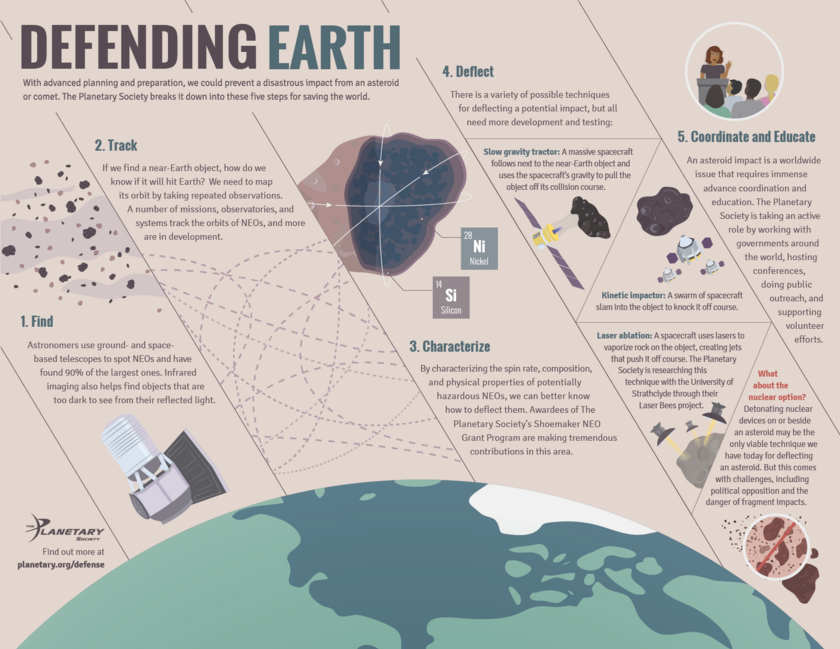
Gravity tractors, rocket engines, lasers, nukes and more could be used to deflect a potentially hazardous asteroid.
One the one hand, as one of the commenters to the video wrote, it's good to have a plan, actually seven of them.  On the other, if none of those work, USA Today describes what could happen in Asteroid simulation sparks scary outcome for New York City

In a NASA simulation of a fictional scenario, New York City was hit with an asteroid packing 1,000 times the destruction of the nuclear bomb dropped on Hiroshima.
The "1,000 times the destruction of the nuclear bomb dropped on Hiroshima" is no exaggeration. The meteor that exploded over Russia six years ago was twenty times more powerful than Hiroshima and that space rock broke up miles up in the atmosphere.  On the other hand, this hypothetical event would be comparable to the impact that created Barringer Crater AKA Meteor Crater in Arizona, which yielded ten megatons when it blew up.

Just the same, it's good to know that NASA is working on a plan to protect Earth from asteroid impact.  That makes for a good opportunity to recycle this meme.

Saturday, April 13, 2019

Massive crater discovered under Greenland for Apophis Day 2019

Stay tuned for this year's celebration of Apophis Day, when I observe the perils of space.  Asteroids!
When I promised my readers that in yesterday's NASA on returning to the Moon for Yuri's Night 2019, I had no idea what I would find.  What a little searching for videos about asteroid impacts posted since Apophis Day 2018 yielded was quite the surprise.  Science Magazine presents an overview of the discovery along with its implications in Massive crater under Greenland's ice points to climate-altering impact in the time of humans.

The 31-kilometer-wide Hiawatha crater may have formed as recently as 12,800 years ago when a 1.5-kilometer asteroid struck Earth.
NASA Goddard has more of the story behind the find as well as more details about the techniques used in Massive Crater Discovered Under Greenland Ice.

In a remote area of northwest Greenland, an international team of scientists has made a stunning discovery, buried beneath a kilometer of ice. It’s a meteor impact crater, 300 meters deep and bigger than Paris or the Beltway around Washington, DC. It is one of the 25 largest known impact craters on Earth, and the first found under any of our planet’s ice sheets. The researchers first spotted the crater in July 2015, while they were inspecting a new map of the topography beneath Greenland's ice sheet that used ice-penetrating radar data primarily from Operation IceBridge, an ongoing NASA airborne mission to track changes in polar ice, and earlier NASA airborne missions in Greenland.
I think this is quite the discovery, but it did not come as a complete surprise.  I wrote about the possibility six years ago in Hot (not): a cold blast from the past.
Ice core data supports ancient space impact idea
By Simon Redfern Reporter, BBC News
August 1, 2013
New data from Greenland ice cores suggest North America may have suffered a large cosmic impact about 12,900 years ago.

A layer of platinum is seen in ice of the same age as a known abrupt climate transition, US scientists report.

The climate flip has previously been linked to the demise of the North American "Clovis" people.

The data seem to back the idea that an impact tipped the climate into a colder phase, a point of current debate.
The tip back to a colder climate is not the issue.  In fact, it's a key point of "An Inconvenient Truth," which I'm showing to my Environmental Science class this week.  Here's the relevant question from the worksheet.
What is the likely effect of the melting of the Greenland ice cap on ocean circulation and global climate?
In the movie, the idea is that the release of meltwater from a large glacial lake diluted the Gulf Stream, causing the water to become less dense and unable to sink to the bottom of the ocean off Greenland, jamming up the global thermohaline circulation and sending the planet back into an ice age for another thousand years.  An analogous melt of water from the Greenland icecap, which is beginning to happen, would do much the same thing, slowing ocean circulation and cooling Europe.  Both of those are indeed taking place.

The effect of the proposed meteor impact would be that the explosion itself caused the flood and then added the cooling effects of all the dust from the impact on top of it.  That doesn't mean that the slowing of the Gulf Stream and cooling of the area around the North Atlantic isn't going to happen; it already is.  Instead, it means that the magnitude of the cooling that results won't be as big as happened 12,900 years ago.  That might actually be a good thing.

Another thing the impact would do would be to lessen the culpability of humans in the extinction of large mammals in North America and Europe at the time.  Humans definitely contributed, but a meteor impact would definitely shift some of the responsibility off of our ancestors.  It would also make the case for the deadliness of asteroid impacts, as if that wasn't already in the news.
It looks like the crater responsible for the layer of platinum may have been found.  Also, I just finished showing "An Inconvenient Truth" to my students this week.  What an interesting coincidence!

That's it for Apophis Day.  Stay tuned for the winners of the 2018 Coffee Party Entertainment Awards for movies.

Saturday, June 30, 2018

For Asteroid Day 2018, Seeker explains NASA's plan to protect Earth


Happy International Asteroid Day!  To celebrate the event, which I see as the established version of Apophis Day, I'm sharing Seeker's video This Massive Asteroid Is Headed for Earth…. What Now?

This is how NASA intends to stop an asteroid before it slams into our planet, potentially ending civilization as we know it.
In case this plan looks familiar, it's basically the same as Vox explains NASA's plan to save Earth from asteroids but reported by people who have a better grasp of science.

That's it for June.  Stay tuned for the first post of July, which will be about Canada Day.

Friday, April 13, 2018

Seeker/DNews on asteroids for Apophis Day 2018


Once again, it's Apophis Day, when I observe the perils of space.  I'm having the same issues with finding videos for today that I did for the seventh anniversary of Fukushima -- too many conspiracy theories about asteroid near misses -- so I'm responding the same way by using older videos from Seeker/DNews.

I begin with How Often Do Asteroids Almost Hit Earth?

Early this week, an asteroid flew right by the Earth, but didn’t hit us. How common is it for objects to fly this close to Earth? Turns out, it’s a lot more common than you’d think.
It was seeing conspiracy theory videos about an asteroid fly-by in February that made me decide to turn to a reliable source that actually paid attention to the science.

A few months later, Seeker/DNews uploaded What Happens When A Meteor Strikes Earth?

Most of the near earth objects that approach Earth burn up in our atmosphere. What happens to the ones that don’t?
Who needs alarmism when the truth is scary enough?

Finally, here is some cool news from last year about an asteroid that isn't going to hit Earth or be seen ever again, An Interstellar Asteroid Just Flew Past Earth, Here’s What You Need to Know.

In October, astronomers observed an interstellar asteroid for the first time. We talked to one of the first to study it, and here’s everything they’ve learned in the months since.
The first thing that struck me is that it looked like the fictional interstellar spacecraft Rama.  Fortunately, it's no such thing.

Enough DOOM.  Tomorrow is another March for Science.  Stay tuned.