Monday, October 10, 2016

Happy Canadian Thanksgiving 2016!


Happy Canadian Thanksgiving!  For this year's celebration, I'm going to pass the mic to Lisa Ryan of New York Magazine, who writes This Canadian Thanksgiving, We Give Thanks for Justin Trudeau.
Today is Canadian Thanksgiving, a day in which our neighbors to the north gorge on pumpkin pie, mashed potatoes, and coma-inducing turkey while subjecting themselves to hours of awkward conversations with relatives. It’s a lot like American Thanksgiving, but everybody is much nicer to each other.

On this joyous occasion, let’s celebrate the Canadian who matters most to us besides Drake: Justin Trudeau. Here’s why we’re thankful for this walking feminist meme.
Among the many reasons listed is "He’s also pro pot."  On that basis alone, Gary Johnson should have been able to name him as a world leader he admires.  Too bad he didn't.

Sunday, October 9, 2016

Drinks for criminal clowns


For entertainment Sunday, I'm going to approach the ongoing creepy clown hysteria sideways instead of head-on by suggesting drink recipes honoring the most famous criminal clowns in modern pop culture, The Joker and Harley Quinn.*

I begin with my usual go-to for drink recipes, Tipsy Bartender, with their recipes for the Clown Prince of Crime and his Princess to mark the release of "Suicide Squad" earlier this year: Suicide Squad Shots.

Suicide Squad Shots....The Joker and Harley Quinn!
...
HARLEY QUINN SHOT
*Blue Layer:
Blue Curacao Syrup
Pina Colada

*White Layer:
Pina Colada Drink
Coconut Rum

*Pink Layer:
Pina Colada
Bubble Gum
White Rum
Strawberry Liqueur
Overproof Rum

Pink Sugar Rimmed Glass!

THE JOKER
*Green Layer:
Melon Liqueur
Coconut Rum

*White Layer:
Pina Colada Drink
Coconut Rum
Overproof Rum

Purple Sugar Rimmed Glass!
Skyy wasn't the only one thinking up drinks for these characters in this movie.**  Follow over the jump for more.

Saturday, October 8, 2016

Kennedy Space Center survives brush with Hurricane Matthew


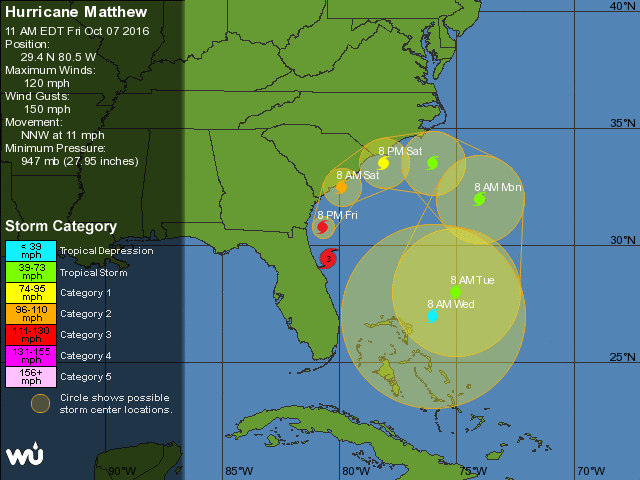
When I looked at Hurricane Matthew's predicted path, two things struck me.  The first was that it was going to graze Cape Canaveral and Kennedy Space Center, putting the ability of the U.S. to launch spacecraft at risk.  Wochit reported on the threat before the storm in Hurricane Matthew To Strike Near Cape Canaveral.

Facilities at the Kennedy Space Center and the Cape Canaveral Air Force Station are bracing for the onslaught of Hurricane Matthew which is expected to reach the area Thursday night and stay until Friday. Matthew has been said to be one of the most powerful storms to threaten Cape Canaveral since the beginning of the space age over 50 years ago. NASA spokesman George Diller said Thursday, "The Kennedy Space Center is now in HURCON 1 status, meaning a hurricane is imminent. Hurricane preparations were completed early last night and remaining employees were sent home.” The National Hurricane Center is predicting dangerous storm surges, heavy rain and 140 mph winds along Florida’s east coast with the eye of the storm passing just off shore or directly over Cape Canaveral.
Fortunately, Wochit was able to report after the storm NASA Survives Brush With Hurricane Matthew.

NASA's Kennedy Space Center and Cape Canaveral just missed getting ht by hurricane Matthew. Workers were able to venture out and do initial damage inspections after. George Diller, from the NASA's Kennedy Space Center, told NBC "It's mostly roof damage and other collateral damage like windows and doors, but no major damage to the major facilities and none to flight hardware" NASA's facilities sit on the coast and were afraid of taking a direct hit from the hurricane which is now a category 5.
Whew.  For more, read NASA Spaceport Weathers Hurricane Matthew as Satellite Reveals Double Eyewall at Space.com.

The other was that the storm would loop around to the south and west after passing the coast of North Carolina.


I found that unusual.  I think I've seen that happen in this area once in 30 years of paying attention to Atlantic hurricanes.  CNN's Chad Myers references Matthew's looping path in Hurricane Matthew weakens to Category 1 storm , posted earlier this morning.

Hurricane Matthew is now a Category 1 storm, with maximum sustained winds at 85 mph, according to the National Hurricane Center.
By the time it finishes its loop, the storm may no longer be dangerous.  That would be good news.

Friday, October 7, 2016

Clinton regains double-digit lead over Trump in Michigan


Last month, the polling news read Clinton lead over Trump shrinking in Michigan.  Eep!  This month, actually yesterday, the same poll gave Clinton an 11% lead over Trump in a four-way poll including both Johnson and Stein.  WXYZ has the story in Clinton leads Trump in new Presidential poll.

Hillary Clinton is now leading Donald Trump by double digits in our newest Presidential poll.
The Detroit Free Press explains how Clinton's lead built back up among key demographic groups in the follow passage from Poll: Clinton takes 11-point lead over Trump in Michigan.
[The previous poll showed] Clinton’s support among black voters in Michigan dropped to 74% —  far below the 95% of support the last Democratic nominee, Obama, got in the last election — and 14% undecided. But this poll showed 86% of black voters supporting her and Trump getting no more than 2% of that vote, despite his outreach in visits to Detroit and Flint. Only 5% of African-American voters remained undecided, the poll said.

Trump’s chances of winning in Michigan and elsewhere are further hurt by an inability to attract more support from white people, as well: The poll indicated that Clinton was essentially tied among whites, with her leading 37%-36, compared to 11% for Johnson and 13% undecided. In the last election, exit polls showed Republican nominee Mitt Romney beating Obama among whites in Michigan by 11 percentage points — and still losing by 9 percentage points overall in the state

Three weeks ago, Trump also had taken a clear step toward neutralizing the gender gap facing his campaign, taking a 5-percentage-point lead among men in Michigan and cutting Clinton’s clear lead among women to 10 percentage points.

In this poll, however —  following Clinton’s debate where she blasted Trump for calling 1996 Miss Universe Alicia Machado “Miss Piggy” and “Miss Housekeeping” —  Clinton had staked a 20-percentage-point margin with women — 48%-28% among the biggest single voting bloc in the state. She has continued to raise issues of Trump criticizing women over their looks on the campaign trail.

And while Clinton had seen a decline in support among voters ages 18-34   in the last Michigan poll, she’s now back where she was with them post-convention, with a 44%-22% lead over Trump and Johnson getting 21%. Clinton also held leads among every other age demographic. In vote-rich metro Detroit, Clinton’s support was back over 50%: She led Trump in Wayne, Oakland and Macomb counties as a bloc by 55%-25%, though Trump still held leads in central, west and northern Michigan.

Trump had been expected to do best with voters with a high school diploma or less education, but after he held a 4-percentage-point edge with those voters last month, Clinton is now ahead. She  had regained a clear lead, 41%-32%. She also reclaimed a lead among self-described independent voters, 27%-24%, though what may be most significant about that group is that their number of undecideds jumped from 20% to 31%; and their support for Johnson dropped, from 23% to 14%, as the third-party nominee had difficulties identifying the war-torn city of Aleppo in Syria and answering a question about foreign leaders.
All good news.  As a result, FiveThirtyEight now lists Clinton's odds of winning Michigan at 86.2%, much higher than the 71.4% probability early in September, although not as good as 93% in August.  Here's to her chances improving!

Thursday, October 6, 2016

Mars landings, real and fictional, for World Space Week


October 4-10 is World Space Week, exactly the kind of event I celebrate on this blog.  To that end, I bring two videos about Mars landings that came out during the past seven days, beginning with Schiaparelli’s descent to Mars from the European Space Agency (There is nothing wrong with your speakers; the video has no sound).

Visualisation of the ExoMars Schiaparelli module entering and descending through the martian atmosphere to land on Mars.

Schiaparelli will enter the atmosphere at about 21 000 km/h and in less than six minutes it will use a heatshield, a parachute and thrusters to slow its descent before touching down in the Meridiani Planum region close to the equator, absorbing the final contact with a crushable structure.

The entire process will take less than six minutes: the animation has been sped up.

Schiaparelli is set to separate from the Trace Gas Orbiter on 16 October, after a seven-month cruise together through space, and will enter the atmosphere on 19 October at 14:42 GMT.
Next, The Late Show with Stephen Colbert opened one of its episodes last week with Stephen Is Already On His Way To Mars.

Now that Elon Musk has unveiled his plan for human colonization of Mars, Stephen imagines what it might be like to be one of the first Earthlings to visit.
To quote Bugs Bunny, "I knew I should have taken that left turn at Albequerque."

Wednesday, October 5, 2016

Supply and demand still work for oil

One of the phenomena that convinced me that Peak Oil was real was not just that oil prices shot up as oil production plateaued in the early 2000s, but also the very long delay between those high prices and new supply coming on to the market.  It was that latter apparent failure of the classical economic story of supply and demand working that made me realize that the world might have hit Hubbert's Peak between 2005 and 2008, exactly as predicted by some of the experts in "The End of Suburbia."  That, and some of the other predictions, particularly Kenneth Deffeyes "list of things"--"seven trillion dollars lost out of the U.S. stock market, two million jobs lost in the United States, federal budget surplus - gone, state budget surpluses - gone, the middle class disappearing"--were what also persuaded me to show the movie to my students.

However, the past two years have made me realize that Hubbert's Peak may have passed for conventional oil only, not for all oil.  Supply finally caught up with and passed demand, causing oil prices to fall, both of which fit the predictions of mainstream economics.  Too see both the increased supply and the lower price, first look at this graph of world oil production from Econbrowser.  The blue line shows the period of the "bumpy plateau" that looked like the one predicted from Peak Oil theory.


Compare with this graph showing the price of West Texas Intermediate (WTI) and Brent Crude from Calculated Risk.


That bump in production above the blue line during the past three years coincides with the drop in price.  That's the good news out of all this.

The bad news is the other side of supply and demand.  When prices fall, supply eventually falls as well.  I've been expecting that to happen since December 2014.  The graph below from Econbrowser shows that it has happened, at least for the U.S.


As a result, U.S. and world production is falling again, so the prices have resumed rising.  Calculated Risk's graph of year-over-year oil prices shows that prices are actually slightly up from a year ago for the first time in more than two years.


The result at ground level is that the downward seasonal pressure on gas prices at the pump is being counteracted by upward pressure from wholesale prices.  I saw that yesterday, when I filled up at one of the stations in my old neighborhood, which was selling regular at $2.27.  Two weeks ago, it was selling regular for $2.10.  The first time I visited the station in August, I bought regular for $2.09.  That's a graph of slightly increasing prices when the usual trend is for falling ones.  Fortunately, prices are still relatively low and I drive a Prius, so I'm not complaining in earnest, as it could be and has been a lot worse.

Another result of the oil price drop that I feared would be financial chaos from the shale oil bubble bursting wiping out the gains to the consumer economy from lower energy prices.  That didn't happen, but trouble with shale oil did counteract the improved situation for the consumer, as this graph from Econbrowser shows.


GDP improved from lower oil prices, but only 0.12% worth.  James Hamilton explained the situation thus.
But gains to consumer spending were mostly offset by a drop in oil-related investment spending. Nonresidential fixed investment had been growing at a 4.3% rate prior to the oil-price drop but has only increased at a 0.8% annual rate since, due to a 50% drop in investment spending in the oil sector.

The U.S. imports 6 million more barrels of crude petroleum and refined products than it exports every day. Between June 2014 and March 2016 the real price of oil declined by 68%. As a net oil importer, the fact that Iraq and Iran are now willing to sell us more oil at a lower price should be good news for the U.S. economy. In idealized economic models, the resources that had been producing oil should now shift to producing other goods, and with the new terms of trade we should as a result be even more productive than before.

But in the real world shifting resources is easier said than done. We now have a large stock of capital that was being used to develop U.S. shale oil, and contrary to the predictions of simple economic models, there is not some other more productive place to use that equipment.
As for my prediction of a recession starting sometime in 2017, I'm even more confident than before.  Now that oil prices are rising, the possibility of an oil-price-shock has increased, especially with this news from Bloomberg: OPEC Agrees to First Oil Output Cut in Eight Years.  If OPEC succeeds in getting Saudi Arabia, Iran, and Iraq on the same page on this, further price increases are inevitable.  If they exceed 50% in one year, so is the oil-price-shock recession.

Tuesday, October 4, 2016

Warmest August on record so far as carbon dioxide passes 400 ppm 'permanently'


In August, I shared that July 2016 was the hottest month on record yet.  In September, I reported that Detroit just had its warmest summer on record.  Today, it's August 2016 was the hottest August ever.

The past 11 consecutive months have set record temperatures.
That's an understatement, as Climate Central reported.
The unprecedented streak of record-hot months that the world has experienced over more than a year just tacked on one more month: Data released Tuesday by the National Oceanic and Atmospheric Administration showed last month was easily the hottest August on record.

That makes 16 straight record-hot months, unparalleled in NOAA’s 137 years of record-keeping. The previous record streak was only 10 months, set in 1944. NASA’s data, released earlier, also said August was record hot, not to mention tying for the hottest month the planet has ever recorded.
As for the bigger picture...
Though there are still several months left in the year, it is a virtual certainty that 2016 will be the hottest year on record, and by a significant margin. While global temperatures can fluctuate from year to year, 2016 is serving as something of an exclamation point for the long-term trend of warming driven by the buildup of heat-trapping gases in the atmosphere.
Welcome to the 400 PPM world, as Scientific American reported.
In the centuries to come, history books will likely look back on September 2016 as a major milestone for the world’s climate. At a time when atmospheric carbon dioxide is usually at its minimum, the monthly value failed to drop below 400 parts per million.

That all but ensures that 2016 will be the year that carbon dioxide officially passed the symbolic 400 ppm mark, never to return below it in our lifetimes, according to scientists.
Right after the Paris Agreement on Climate being signed on Earth Day, the planet's temperature may blow past the 1.5 degrees Celsius threshold, meaning it was too late.  Yes, this is still a doomer blog.

Monday, October 3, 2016

Newspaper endorsements roll in while comedians laugh at Gary Johnson


I wrote 2016 could be a good year for minor party candidates and then made a prediction of what that would most likely look like.
FiveThirtyEight asked Could An Independent Candidate Succeed In 2016?  Of all the answers to the question, I agreed most with Harry Enten, who said "this year pretty much meets all the criteria for at least a moderately successful third-party candidacy."  For me, that means that the Libertarians and possibly the Greens could reach the threshold of five percent of the popular vote to qualify for public financing in 2020.  The Constitution Party does not have ballot access in enough states to meet that criterion.  It's very unlikely that even one of the minor parties will qualify for the debates with the major party candidates.  As Gary Johnson pointed out, that requires fifteen percent in several polls before the debates.   While minor parties have earned Electoral College votes before, that happened when they had concentrated regional strength, such as the Dixiecrats and the American Independent Party, and could win pluralities in three-party contests.  Neither the Libertarians nor the Greens meet that criterion; their support is more diffuse.  Consequently, none of the minor parties will win the presidency, but they'll certainly overperform compared to any election since 2000 and possibly even 1996, but not 1992.  None of these candidates is Ross Perot.  Even he didn't win any Electoral College votes.
So far, those predictions are panning out.  First, Johnson did not get into the debates, as he did not get 15% in the polls in time.  Second, as of today, FiveThirtyEight projects Johnson will earn 7.6% of the vote in November.  That would be the best showing for a minor party candidate since Perot in 1996, but not better; Perot earned 8.4% in that election.  As I wrote, Johnson is not Perot.  Third, FiveThirtyEight is also predicting only a 2.9% probability that Johnson will earn any electoral votes, most likely in his home state of New Mexico.  My forecast, as far as it went, is coming true.  That written, there are two results of Johnson's success that I didn't foresee, the newspaper endorsements and the comedic reaction.

First, the endorsements.  Politico quoted the Chicago Tribune endorsing Gary Johnson for president and listed Johnson's other endorsements.
“We would rather recommend a principled candidate for president — regardless of his or her prospects for victory — than suggest that voters cast ballots for such disappointing major-party candidates,” the editorial board wrote.

“We reject the cliche that a citizen who chooses a principled third-party candidate is squandering his or her vote,” the endorsement continued. “…We offer this endorsement to encourage voters who want to feel comfortable with their choice. Who want to vote for someone they can admire.”
...
It’s the fifth newspaper endorsement that Johnson, who is polling in the single digits, has received from traditionally right-leaning editorial boards. On Thursday, The Detroit News, which has until this year always endorsed Republican candidates for the presidency, endorsed Johnson. The Libertarian candidate also has received endorsements from the New Hampshire Union-Leader, the Richmond Times-Dispatch and the Winston-Salem Journal.
In contrast, the closest Trump has to a major metropolitain newspaper endorsement comes from the New York Post.  Five endorsements to maybe one.  That's not a result I would have expected, even from the Detroit News.  Speaking of which, WXYZ reported on Detroit News endorses Libertarian Gary Johnson for president.  Roll video!


Get used to that clip.  It will show up again and again over the jump as Stephen Colbert, Seth Meyers, Bill Maher, and Sarah Silverman laugh at Johnson.

Sunday, October 2, 2016

Drinking games and drinks for the Vice Presidential Debate


Gentle Readers!  With the Vice Presidential Debate coming this Tuesday night, it's time to join together and play a drinking game.  While the Presidential Debates already have two sets of rules from Drinks and drinking games for Donald Trump and the GOP debates and Drinks for the Democratic debates: Hillary Clinton taken from Paul W.'s You Might Notice a Trend blog, this edition features rules from DebateDrinking.com.  Follow along with the sock puppets as they read the rules!

Rules for the 2016 Presidential Debate Drinking Game as explained by poorly rehearsed puppets.
...
1 - Pick a candidate
2 - Listen for YOUR candidate to say his/her specific words and listen for every candidate to say a community word. If ANY CANDIDATE says a community word, EVERYONE drinks
3 - Because this may be a high scoring game, we define a drink as a gulp of beer or sip of wine or liquor. Know your limits and please drink responsibly.
Here are the words to drink to.

Tim Kaine: Virginia, Guns, *Anything in Spanish*, Middle Class, Military, and Together.

Mike Pence:  Indiana, Second Amendment, Constitution, Budget, Religion, and Shoulders.

Community Words: Governor, TPP, and Reagan.

If my readers don't like the one above, A.M. N.Y. has a different drinking game.
-When Pence describes himself as "a Christian, a conservative and a Republican, in that order," drink.

-When Kaine randomly says a word in Spanish, drink.

-If Pence mentions his former radio show, “The Mike Pence Show,” drink.

-When Kaine says something that sounds like something your dad would say, drink.

-If you start to fall asleep, drink some coffee.

-If Pence diverts a question about how he initially supported Ted Cruz over Donald Trump, drink.

-If Kaine diverts a question about how he said former President Bill Clinton should resign, drink.

-When you start to wish you were watching Joe Biden and Paul Ryan debate, drink.

-If Kaine does an impression of Trump like he did in his DNC speech in July, drink.

-When you think you’re seeing double, it’s time to go to sleep.
I think those are enough rules.  Follow over the jump for the drinks for each candidate.

Saturday, October 1, 2016

PBS Newshour examines gerrymandering in Maryland and North Carolina


This past March, I reported that the second most read post of the fifth year of the blog was WXYZ on redistricting reform.  That examined the possibility of Michigan having a non-partisan commission take over redistricting from the state legislature.  That initiative did not make it to the ballot this year, but the idea is still kicking around, as seen in North Carolina and Maryland challenge gerrymandering from PBS NewsHour.

Gerrymandering -- the practice of drawing districts to benefit one political party over another or to protect an incumbent -- has a long history in the U.S. Special Correspondent Jeff Greenfield reports on reform efforts in Maryland, where one district has been called a “broken-winged pterodactyl,” and in North Carolina, where litigation is challenging partisan redistricting.
For another embed of this video as well as a summary and complete transcript, surf over the NewsHour page at PBS.org.

While both Maryland State Senator Joan Carter Conway, a Democrat, and Republican State Representative David Lewis of North Carolina think that independent commissions are too idealistic and completely non-partisan people don't exist, I'm on the side of Maryland Governor Larry Hogan, who wants an independent redistricting commission for his state.  If its good enough for that Republican governor, it's good enough for Democrats and Republicans in states like Michigan.  I think Arizona, California, Idaho, and Washington all have the right idea.