A blog about societal, cultural, and civilizational collapse, and how to stave it off or survive it. Named after the legendary character "Crazy Eddie" in Larry Niven and Jerry Pournelle's "The Mote in God's Eye." Expect news and views about culture, politics, economics, technology, and science fiction.
Scripps News reporter Ben Schamisso dives into the savory world of Detroit Style Pizza, a culinary marvel that's taking the nation by storm. Revealed by a recent Yelp survey, searches for Detroit-style pizza soared by 26% from 2022 to 2023, signaling its growing popularity among food enthusiasts.
Born in Buddy's Pizzeria, Detroit, in 1946, this distinct pizza variant is celebrated for its crunchy, cheese-laden edges and signature caramelized crust—a testament to its uniqueness. Uncover the rich history, the artful dough preparation process, and the reasons behind its triumph over traditional New York and Chicago pizzas. With its popularity surging by 26% in just the last year, Detroit Style Pizza is swiftly becoming a contender for America’s top pizza choice. Could it be your new favorite?
Talk about a successful marketing campaign! I even succumbed to it. Being a diabetic didn't stop me from buying a frozen Buddy's Pizza Friday and eating it that night for an early celebration. I just made sure to adjust my insulin dose accordingly.
Follow over the jump for today's celebration of Souther, the first Sunday after the first full moon after the Summer Solstice, a holiday created by John Michael Greer, who also designated the wombat as the animal mascot, and National Pink Day, another holiday that shares today.
On America Recycles Day (November 15), EPA recognizes the importance and impact of recycling, which has contributed to American prosperity ...
Speaking of recycling, I'm repeating what I wrote on World Kindness Day: "Videos like this are why I subscribed to the channel and why I'm disappointed that the woman behind the channel no longer makes them. Sigh."
As I promised yesterday, I'm continuing coverage and commentary on the News & Doc Emmy Awards as the Sunday entertainment feature with the nominees for Outstanding Science, Technology or Environmental Coverage.
Outstanding Science, Technology or Environmental Coverage
In Real Life Plastic Time Bomb Newsy Trafficked with Mariana van Zeller Amazon Mafia National Geographic World’s Untold Stories The Brain Collectors CNN VICE News Tonight Where Protecting the Environment Gets You Killed Vice VICE News Tonight ‘They’re Watching Us’: Inside the Company Surveilling Millions of Students Vice
This is the only nomination for each of these stories, so I have to use other criteria to handicap their odds of winning, such as views on YouTube and actually watching them. I begin with In Real Life: Plastic Time Bomb by Newsy, now Scripps News.
Less than 10% of plastic waste ends up recycled, and studies show much of what does go in the recycling bin can actually end up in landfills. In this new episode of "In Real Life," we explore how we can plug the gaps in the global recycling system and travel to Malaysia to see the real impact of the world’s un-recycled waste.
This is a video I can recommend to my students, as it serves as examples of all four of Commoner's Laws: Everything is connected to everything else; there is no away; there is no free lunch; and nature knows best. It's even the right length at 22 minutes, the minimum duration for video extra credit.
This is one of two nominations for Newsy. The other is In Real Life: The New Death, which earned a nomination for Outstanding Soft Feature Story: Long Form. Neither is widely watched. In Real Life: Plastic Time Bomb has 4,167 views while In Real Life: The New Death has even fewer, 2,499 views. That doesn't bode well for either of their chances of winning.
Mariana travels to the Amazon to track down the criminal networks behind a slew of killings and the illegal destruction of the rainforest.
This is another video I can recommend to my students. It's just as strong on the environment as In Real Life: Plastic Time Bomb, even if it's weaker on the science. It, like all the other nominated episodes of Trafficked with Mariana van Zeller, makes up for it by being strong on long-form investigative reporting and crime coverage. In fact, "Fish Pirates" earned a nomination for Outstanding Investigative News Coverage: Long Form as well as Outstanding Writing: News and I've already mentioned that "White Supremacy" has nominations for Outstanding Crime and Justice Coverage, Outstanding Editing: News, and Outstanding Research: News. I will try to get around to covering those categories, if I haven't already, and embedding their videos.
"Amazon Mafia" is nearly two orders of magnitude more popular on YouTube than either of the In Real Life videos with 272,137 views. That's more popular than Where Protecting the Environment Gets You Killed, one of two nominations for VICE News Tonight in this category alone and 28 nominations overall, with 204,354 views.
Around the world, environmental activists are being murdered in growing numbers. They die for defending the land from multinational corporations and governments seeking to exploit natural resources for profit. One of the deadliest countries for environmentalists is Colombia -- a key front in the struggle against climate change.
This video covers very similar territory to "Amazon Mafia" — investigative reporting on crime and the environment in South America, particularly the Amazon rainforest. As such, they are likely to compete with each other more intensely than other nominees in this category. "Amazon Mafia" is more popular and comprehensive, while this report is more focused. It depends what the Emmy voters want, and electorates matter.
Millions of students across the country are being monitored by surveillance tools in the name of school safety. VICE News investigates Gaggle, a company that uses artificial intelligence and human review to detect danger signs in the content kids create on school-issued accounts and devices. Gaggle says it helps schools prevent tragedies and some educators have praised its ability to flag kids in crisis, but critics warn of a potential impact to LGBTQ+ students and increased interactions between kids and law enforcement.
I find myself unable to blog about the shooting at Oxford High School and its ongoing fallout. It's too fast moving and too close to home, literally. I might get to it later, but then again, I didn't blog about the Larry Nassar scandal until 2019.* It may be a while.
Almost two years later, this still hits close to home. Even the door signs are the same as the ones where I work. That's uncanny, but I probably should have expected it. I'm in the same county as Oxford. I'm sure it hits home in other ways for other Americans, as it's about what's happening here, not overseas where America is having an effect, but not an effect directly on Americans. This is affecting Americans.
Also, the video's use of graphics makes the entire video look better produced than its competitors for this award, including "Plastic Time Bomb," which also had good graphics. That helps. Between the subject matter and the better graphics, I think this report can overcome the slightly lower viewership, 202,440 views, than "Amazon Mafia" or "Where Protecting the Environment Gets You Killed."
CNN does not have a video upload of its nominee on YouTube, but it does have World’s Untold Stories: The Brain Collectors on its website. Sorry, no embed and no stats. It is a well-told, if quiet, scientific detective story, but I don't know if it has the emotional impact of "'They’re Watching Us’: Inside the Company Surveilling Millions of Students," which is my pick to win. The best thing it has going for it is that CNN has a constituency that Newsy and Vice don't have, and National Geographic might have for documentaries, but not news. Again, electorates matter.
I'm taking a short break from this series to observe the 22nd anniversary of 9/11 tomorrow. Stay tuned.
Previous posts about the 2023 News & Documentary Emmy Awards
The national gas average dipped below $4 for the first time since March on Thursday, signaling record inflation could be cooling off. NBC’s Tom Costello reports for TODAY.
That was good news for the consumer on gas prices, but bad news about other goods, indicating continuing high inflation. That's a topic I'm very likely to return to.*
OPIS chief oil analyst Denton Cinquegrana discusses the move in retail gas prices below $4 a gallon for the first time in months, and what risks lie ahead for the energy market.
I'll be sure to keep an eye on the weather for this reason and others.
Follow over the jump for my personal driving update.
While the bald eagle population has rebounded from the brink of extinction since the U.S. banned the pesticide DDT in 1972, harmful levels of toxic lead were found in the bones of 46% of bald eagles sampled in 38 states from California to Florida, researchers say.
Similar rates of lead exposure were found in golden eagles, which scientists say means the raptors likely consumed carrion or prey contaminated by lead from ammunition or fishing tackle.
Electric vehicles are becoming a larger share of the U.S. car market, pushed both by consumer demand and federal policy changes. #NewsyInTheLoop shares why more people are going electric and the obstacles some automakers and potential buyers are seeing along the way.
It certainly convinced my daughter. She saw $6/gallon gas in Hollywood last fall and decided to buy an EV. I approve.
The response by Congressional Democrats like Chuck Schumer is a continuation of what I described last month.
PBS is showing both sides trying to score political points, Democrats against big corporations and Republicans against environmental regulation. It's no surprise that I'm on the Democrats' side on this. However, if CNBC is correct about gasoline and diesel retailers being reluctant about lowering prices at the pump so that they can recoup losses incurred on the way up, then gas station owners are to blame for the continued high cost of fuel. That would mean beating up on local small businesses. I don't think that would play well for either party's politicians, who would rather be seen as defending the public against big business or "big government."
We are not trying to get into the Guinness Book of World Records, but here we are paying a record $4.32 a gallon in Michigan for gas. AAA reports prices in Michigan hit a new high on May 9.
Gas retailers should be selling regular at $4.45 to break even, so they're selling at a loss to keep customers coming in. That's the good news. The bad news is they will keep the price of gas high once crude oil and wholesale gas prices start falling in late July and August. WDIV looks at that price trajectory and the reasons behind it in Michigan gas prices hit new record high.
Help Me Hank is on the mission to figure out why gas prices are soaring.
The other is increased demand in the face of lower supply, something I've worried about for a while, most recently in Oil falls below $0.00 for the first time ever, when I wrote "the collapse in oil prices will lead to oil company bankruptcies, which will decrease competition and lead to higher prices in the future." Those higher prices because of decreased competition and restrained supply have arrived and I think they will last at least until next year. Get used to them.
I agree that $5.00/gallon regular gasoline is coming to Michigan by Memorial Day. I'm glad I drive a Prius.
By the way, high gas prices have increased reader interest in a decade-old post with a catchy title, Hard times plus rising gas prices equals gas thefts. That's because gas thefts are becoming a big problem again. Maybe I should write about it. Stay tuned.
For this year's celebration, I'm going to take a different take from years past, when I examined the holiday directly. Instead, I'm using it as an opportunity to update my readers on two factors that affect a country's population, birthrates and death rates, which I examine indirectly through lifeexpectancy. Birth rates have been declining since 2008 and life expectancy has been falling since 2014, which means more people are dying younger. It's time to see if either of those have changed.
The latest numbers from the CDC show that U.S. births continued to fall last year, leading to the fewest number of newborns in 35 years: There were just 3.7 million births in 2019.
Life expectancy for Americans increased a bit in the latest CDC data, reversing a downward trend. The first gain in four years is due in part to a decline in cancer deaths.
That's good news, but I have my doubts that the improvement will survive the pandemic. My readers and I will have to wait until next year to find out.
On the one hand, the U.S. is doing its part to slow down population growth. On the other hand, [this means] a possible shrinking economy in the future, which is bad for business as usual. It's time to be a good environmentalist and recycle what I wrote last year.
I have been in favor of zero population growth for as long as I can remember. However, I'm not sure the U.S. economy is set up for a stable or slowly declining population, a point I made in the Hipcrime Vocab: Why Slowing Population Growth is a Problem. We are going to have to figure how to do so. Otherwise, I might live long enough to experience the wisdom of the saying "Be careful what you wish for; you might get it."
Here's to hoping the U.S. learns how to thread that needle.
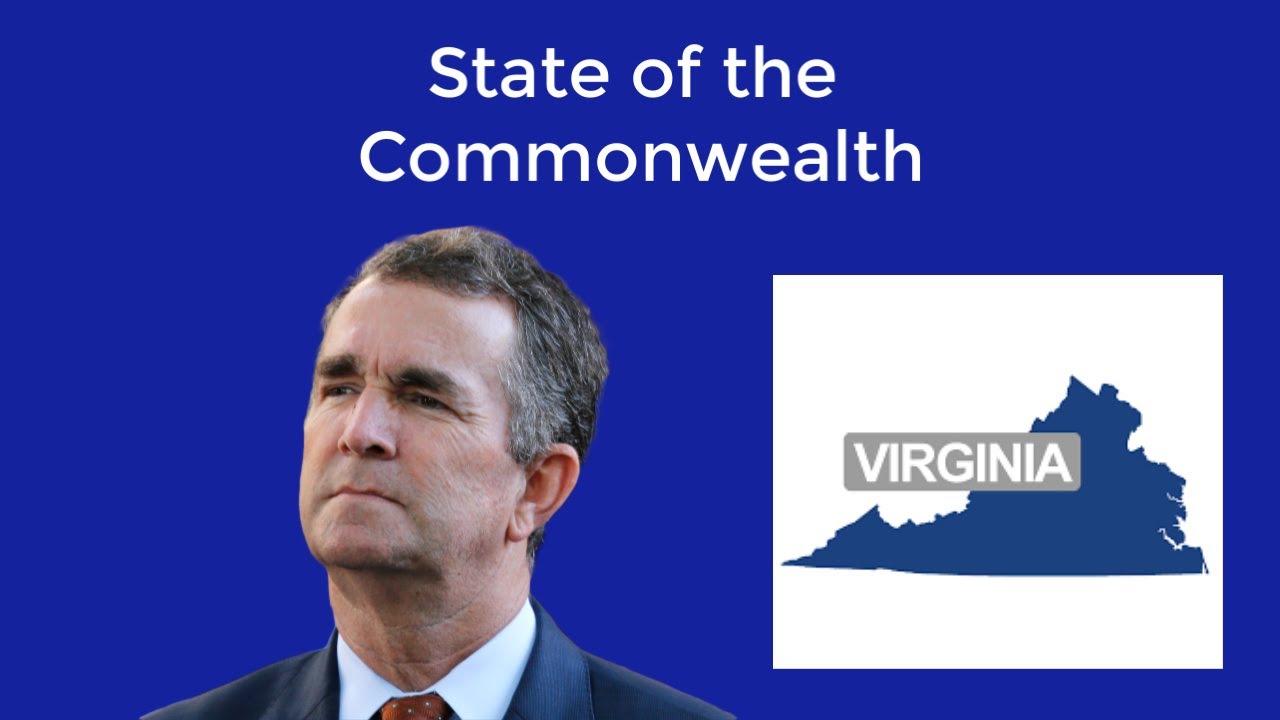
The Virginia governor decriminalized marijuana, made election day a state holiday, pushed back the date of the minimum wage increase and promoted a "clean economy."
Other than delaying the minimum wage increase, I approve of all these laws being enacted. They improve elections, criminal justice, and the environment, all issues I care about. I can even understand delaying Virginia's minimum wage increase even if I disagree with it; no issue is escaping the effects of the COVID-19 pandemic.
Follow over the jump for the rest of the stories about marijuana legalization and decriminalization from the past year.
Now it's up to William Weld to serve as the internal opposition to Trump within the Republican Party. I wish Weld luck, but I don't know if he'll even get enough delegates to earn a speaking spot at the Republican National Convention — this is, if the party bothers to follow their own rules. I'm not optimistic about that, either.
I'm not done with this series, as I missed Bill Weld dropping out on March 18, 2020. My excuse was that I was busy with Vox explains how its viewers and readers can fight the coronavirus. I'll get around to it on Saturday after I post retrospectives for Throwback Thursday and Flashback Friday. In the meantime, on to the conventions (no matter how they will be held) and the general election!
The announcement comes after president cleared the number of delegates needed to be the GOP nominee.
Most Americans dislike Trump, but the overwhelming majority of those who remain in the Republican Party appear to be very enthusiatic about supporting him. Sigh.
Since I never suggested any drinks for him, I don't have to retire any. Besides, there have been four candidates from Massachusetts, so I've suggested, retired, re-used, and re-retired so many drink suggestions for the Bay State that I don't feel like repeating myself. Sometimes, even an environmentalist gets tired of recycling.
On the other hand, I will look at what On The Issues says about Weld's ideological position. It lists Weld as having an economic score of 53 and a social score of 78, which On The Issues considers to be a Progressive Libertarian. That puts him closer to Tulsi Gabbard than to Trump, who has an economic score of 83 and a social score of 20, a Hard-Core Conservative according to On The Issues. I guess that's why the Republicans are enthusiastic about Trump and barely gave Weld the time of day.
That's it for this stage of The Hungry for Power Games or Fury Road to the White House, whichever Colbert meme one wants to use, unless I feel like doing something for the Libertarian or Green Party conventions. Otherwise, I might do it for the general election. We'll see.
I have mixed feelings about Cuomo's postponing New York's presidential primary from April to June. It's probably a good thing from a public health perspective — the pandemic is likely to be subsiding by June — but it may not be great for democracy. In particular, the date set is after the deadline set by the DNC, so New York may get penalized by having fewer delegates accredited. On the gripping hand, if the epidemic has not subsided by July, holding the national convention may be a bad idea as well. Heh, sometimes my conceit of being a Motie pays off.
I was right to wonder about the wisdom of holding the Democratic National Convention in July, as Newsy reported two days ago Democratic National Convention delayed.
The event will now take place in mid-August, not long before the Republicans' convention.
That takes care of both the deadline for selecting delegates, which late primary elections would have run afoul of, and holding the convention before the pandemic subsides. Smart move. I just hope it's enough.
The Democratic Party delaying its convention was among the several effects of the pandemic on the election so far that Washington Week on PBS discussed yesterday. Watch and listen as the panelist ask and answer How will COVID-19 impact the 2020 election?
President Trump said today that he does not support the use of mail-in ballots even though many states postponed elections due to COVID-19. The panel discussed how the virus is already impacting the 2020 election.
Panelists: Yamiche Alcindor of the PBS NewsHour, Peter Baker of The New York Times, and Gerald Seib of The Wall Street Journal.
Since I've expressed my support for voting by mail, it should not surprise my readers that I think President Trump is wrong on this issue, just as he is on many others.
Galen Druke speaks to elections analyst, Geoffrey Skelley, about how the United States have handled elections in times of crisis in the past, from wars to natural disasters.
In short, the United States has faced worse disasters (at least, worse than the U.S. has seen so far from this pandemic, but it's early) including the 1918 flu pandemic, which killed at least 675,000 Americans, and still held elections. I'm confident the country will be able to hold its elections this year, even if the primary elections and Democratic National Convention have been postponed. Democracy may be delayed, but it won't be denied.
I'll cover how this entry got its page views over the jump, but first I'm examining how the Media Bias Chart works. I begin with Newsy's Political media's bias, in a single chart from 2018.
Vanessa Otero set out to rank an ever-growing partisan media landscape, with the belief that an informed public is a better public.
In this video, Vanessa Otero mentioned a revised version of the Media Bias Chart. In Ad Fontes Media Inc.'s Intro to the Media Bias Chart Definitions and Methodology, she explains how the most recent version of the Media Bias Chart works.
If you've seen the Media Bias Chart and wanted to know how we put it together here's a thorough discussion about it. Ad Fontes Media Founder and CEO Vanessa Otero goes over concepts she covers in her public talks.
We'll go through examples of news stories from over the past few weeks that show how coverage of a virus quickly turned into differing left-right narratives in the United States
If you watched all the videos, congratulations! You now have a good education in media literacy.
Instead, it was just over a week later. About time! Seven down, two to go from FiveThirtyEight's second drop out draft in November, although I think Tom Steyer is more likely to drop out soon than Amy Klobuchar, who finished third in New Hampshire and will probably last until Super Tuesday.
In contrast to the messy Iowa caucus, the New Hampshire primary produced clear-cut results. And while they weren't good for Joe Biden's campaign, the Granite State vote tally meant the end of the road for Andrew Yang, Michael Bennet and Deval Patrick.
FuryRoad to the White House? That's a good idea, but I still like TheHungryforPowerGames better. In any event, three candidates are now eliminated from the campaign, at least until one of them gets chosen for a running mate. That's five months off.
Follow over the jump for the drink suggestions and memes I'm retiring now that all three have suspended their campaigns.
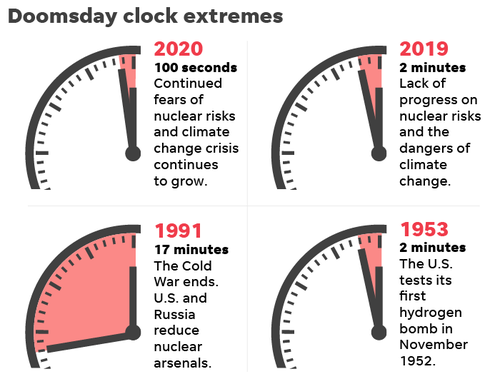
I interrupt my continuing coverage of the impeachment story arc of "TheWorstWing" for the latest on theDoomsdayClock, which The Bulletin of Atomic Scientists moved yesterday to 100 seconds to midnight, the least remaining time ever, so far.
Australia's ongoing bushfire crisis is driving up global carbon dioxide levels according to a UK climate report.
Carbon dioxide is a key measuring stick in scientific projections of global warming.
And the outlook doesn't look good, with a panel of world scientists and leaders saying we're closer than ever to doomsday.
Randolph Nogel reports.
The Australian wildfires are projected to contribute one-fifth of the increase in carbon dioxide this year? Wow! That's an example of a positive feedback loop and those usually lead to catastrophes.
ABC Australia's clip served well as a reaction to this year's announcement. News.com.au uploaded Doomsday Clock: Apocalypse fears over nuclear weapons and climate change yesterday, summarizing the history of the Doomsday Clock and placing the recent movement of the hands of the clock in context.
The Doomsday Clock is now 100 seconds to midnight with scientists blaming nuclear weapons and climate change for the jump forward.
As I mentioned above, the Australians seem to jumping on this news because of the climate change dimension; I've never seen them this interested in the Doomsday Clock before. After all, Australia is the setting of "On the Beach" and "MadMax," both of which share the premise of Australia surviving a nuclear exchange among superpowers, although the survival is only a few years in the first and the "Mad Max" franchise has changed the nature of the apocalypse in its post-apocalyptic setting from nuclear war to, guess what, climate change. The Australians have known for a while which is the greater immediate threat to them.
The more-or-less mainstream news outlet that devoted the most time on YouTube to the announcement was Newsy, which also played up the climate angle in Climate effects on the Doomsday Clock.
For more than a decade, scientists have considered the threats from climate change when they set the symbolic Doomsday Clock.
Of course, nuclear weapons and the threat of nuclear war are still central concerns of the people who set the hands of the Doomsday Clock. One of them speaks about that threat in Wait Just a Minute: Rachel Bronson on the Doomsday Clock from the Chicago Council on Global Affairs.
The Doomsday Clock is now 100 seconds to midnight, the Bulletin of the Atomic Scientists announced this morning. In this episode, Rachel Bronson, president and CEO of the Bulletin, takes a minute to explain how the Doomsday Clock works, examine if nuclear weapons make the world safer, and recommend her favorite movie involving nuclear warfare.
I agree with Bronson about "Dr. Strangelove," but now I'll have to check out "Command and Control," which I don't recall ever hearing about until she mentioned it.
It's time to wake up! As president and commander-in-chief, my foremost responsibility will be to protect the lives, safety and freedom of the American people -- and that means preventing a nuclear holocaust. My personal commitment to you is that on the first day of my presidency, I will contact the leaders of China and Russia to set up a summit to end the new cold war and nuclear arms race, which will inevitably result in a nuclear holocaust.
Wow, Tulsi said a bunch of things I agree with, not least that talking about them makes one sound like a crackpot. Heh. Still, it means that she's a fellow Crazy Eddie. That doesn't mean I'll vote for her. I would rather vote for Andrew Yang, another Crazy Eddie. Even he is a ways down my list.
Four down, five to go. In order of likelihood of suspending their campaigns, FiveThirtyEight listed the remaining five as Cory Booker, Marianne Williamson, Michael Bennet, Tom Steyer, and Amy Klobuchar. I'd prefer Bennet get out next, but I'm afraid it will be Booker.
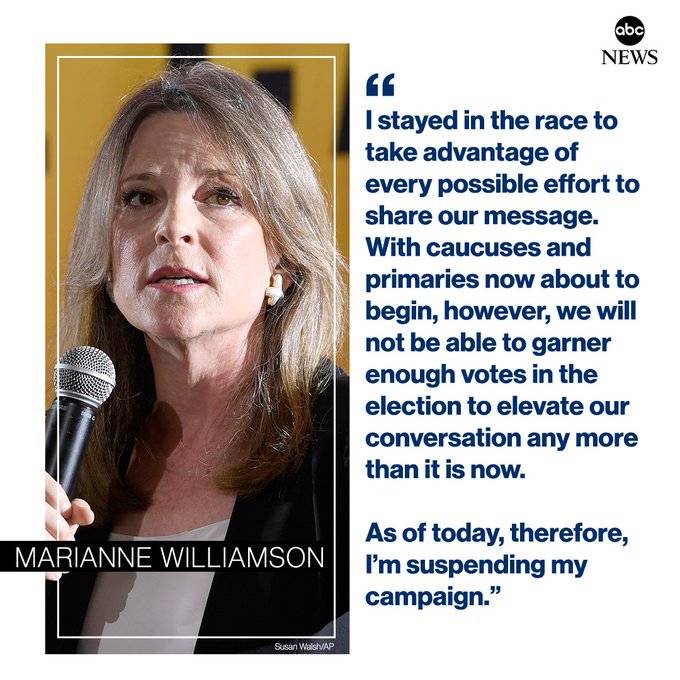
The best-selling author had struggled to gain more than 1% support in the polls since beginning her campaign in early 2019.
If Bennet isn't dropping out, then it may as well be Marianne; I didn't think Williamson had a serious chance from the get-go. Neither did FiveThirtyEight. Here's what they said about her likelihood of dropping out in November.
geoffrey.skelley: So unlike Castro and Booker, my pick is someone who may not be thinking about her political future: Marianne Williamson. And her exit comes down to money, in my mind.
nrakich: Yes, good pick.
geoffrey.skelley: She had about $700,000 in the bank at the end of the third quarter, and a burn rate of nearly 90 percent. This makes me wonder if she can keep things going. I know she has a lot of small-donor potential, but we also haven’t heard her campaign talking about passing debate donor thresholds in a while, either.
sarahf: It does seem as if a lot of the most likely candidates to drop out are the ones with money woes (see O’Rourke, Ryan).
nrakich: And she hasn’t made any debates since the thresholds increased.
geoffrey.skelley: Yeah, the last debate she made was in July. She hit the donor requirements for the September and October debate, but didn’t meet the polling threshold. So it’s hard to imagine her making the November or December debate given that.
nrakich: Yeah, I agree — if Williamson wants to keep running, she’s going to have to run a leaner campaign. We’ll see how much her heart is really set on being president, I guess.
geoffrey.skelley: “Leaner” is probably a good lead-in to some of our next choices, I would guess.
sarahf: I’d argue she had Tulsi-Gabbard energy in terms of building a dedicated following, but I suppose her fan base had its limitations.
With Williamson leaving, half of the women running for President have now dropped out, leaving Elizabeth Warren, Amy Klobuchar, and Tulsi Gabbard. Time to count to see if half the men have dropped out as well; it certainly seems like it. After all eight of the original drop-out draft's nine have dropped out and, not counting Bullock and Bennet, who were picked in both drafts, four of the new seven have stopped running as well. That's 15 out, not counting Swalwell and Gravel, who left the campaign before the first draft. Seventeen minus three is fourteen, which is more than the eleven men I count as still contending for the Democratic nomination, so more than half the men have dropped out already and the first vote isn't for another month. The field is thinning out fast. Five down, four to go.
Follow over the jump for the recipes and memes I'm retiring now that Williamson is waving good-bye to the campaign trail.
I wrote "Now to see if my pick of Julian Castro drops out before or after Steve Bullock and Michael Bennet. My readers and I should find out shortly after the November 13 deadline for the next debate" just above the jump cut in Bye-bye Beto as O'Rourke drops out. I repeated my prediction in the comments to Au revoir Tim Ryan as Ohio Representative retires from race. "As for who's next, I still think it will be one of Bennet, Bullock, or Castro. At least one of them will drop out after they fail to make the next debate." I was close but not correct, as Joe Sestak suspended his campaign before any of them. All was not lost, as Steve Bullock dropped out this morning. Newsy reported on both candidates leaving the contest in Two Democratic presidential candidates drop out.
Former U.S. representative from Pennsylvania Joe Sestak and Gov. Steve Bullock of Montana have announced they are withdrawing from the race.
The field of Democratic candidates seeking the White House has narrowed, with two candidates dropping out of the race.
Neither FiveThirtyEight nor I picked Sestak as one of the first nine to drop out, but they picked Bullock to do so and they keep looking good, as only Michael Bennet, who was the last one picked in FiveThirtyEight's dropout draft, remains. Eight down, one to go from the dropout draft.
As I have with all the rest of the candidates who have fallen in this cycle's version of the Hungry For Power Games, I'm quoting the relevant passage from that article.
nrakich: OK, I’m going to go with the easy pick, then (thanks, Geoffrey!): Montana Gov. Steve Bullock.
sarahf: Ahh!! Stole my pick.
nrakich: Bullock will continue to face a lot of pressure from party elders (and even in his Twitter replies!) to switch to the Senate race.
He’s similar to Hickenlooper in that regard, although frankly I think Democrats’ chances in Colorado’s Senate race don’t change that much if they nominate Hickenlooper vs. someone else. Whereas in Montana, Bullock is legitimately the only candidate who can probably put that Senate seat in play.
Now, like Hickenlooper, Bullock has denied any interest in the Senate.
But maybe, if he doesn’t make the September or October debates, that will change.
He is term-limited as governor, so the alternative is basically to go home and retire.
geoffrey.skelley: But unlike Hickenlooper, Bullock would probably enter a Senate general election in Montana as a clear underdog against Republican Sen. Steve Daines. The state did reelect Democratic Sen. Jon Tester last year, but Tester was an incumbent and it was a favorable environment for a Democrat. And even still, it was close! Bullock probably wouldn’t have as favorable as national environment working in his favor.
The former South Carolina governor said the impeachment inquiry into President Trump has made policy discussion "impossible right now."
NBC News quoted much of Sanford's statement outlining his reasons.
"I am suspending my race for the presidency because impeachment has made my goal of making the debt, deficit and spending issue a part of this presidential debate impossible right now," Sanford said in a statement. "From Day One, I was fully aware of how hard it would be to elevate these issues with a sitting president of my own party ignoring them. Impeachment noise has moved what was hard to herculean as nearly everything in Republican Party politics is currently viewed through the prism of impeachment."
Speaking in New Hampshire, Sanford said he planned to file for the state's Republican primary this week but opted against doing so because "all of the oxygen is leaving the room in terms of meaningful debate whether Republican or Democrat, but particularly on the Republican side, on what comes next in our country on a whole host of issues."
Sanford added that you have "got to be a realist" about a presidential bid.
"And what I did not anticipate is an impeachment," he said. "There have been two of them in the history of our country. You know, Nancy Pelosi, who's a skillful political practitioner, had laid out her cards very carefully, saying, 'I'm not going to do an impeachment.' She was there in the ’90s, when I was there for the last impeachment. But Ukraine came, and here we are."
At first, I thought he was trying to blame the Democrats for his dropping out; instead, he placed more blame on the Republicans than the Democrats for the response to impeachment and gave the Democrats, particularly Nancy Pelosi, some credit for attempting restraint before Trump forced their hands. At least that's different from running out of money or not getting the polls to make the next debate, which were among thereasonswhyalltheDemocratsdroppedout. I have to give him some credit for originality.
While I never got around to suggesting any drink recipes or making memes showing his ideological position, I'll make do with what I already had on hand. Follow over the jump.
I took a humorous look at Mueller's testimony on Thursday, which focused on Mueller not giving the Democrats everything they hoped for while the Republicans tried to discredit him and his investigation. I'm glad I found a way to laugh at Wednesday morning's proceedings; otherwise I'd have been too disappointed.
Former special counsel Robert Mueller says Russia is working to interfere in the 2020 U.S. election right now. He made the remark during his second hearing with the House Intelligence Committee. CBS News intelligence and national security reporter Olivia Gazis joins CBSN to discuss the top moments from Mueller's testimony.
I agree, Mueller was a lot more responsive and demonstrative on the subject of past, present, and future interfering by Russia than he was on Trump and his campaign's possible cooperation with Russia and obstruction of the investigation into it. It's also something that Republicans and Democrats would be able to do something about if Mitch McConnell weren't labeling a bill that pushes for election security as "socialist." Keep that up, Turtle, and I'll start calling you "Moscow Mitch" as well.
Election security was in the news this week, as former special counsel Robert Mueller testified before Congress about the level to which Russia interfered in the 2016 election -- and plans to do it again. Now the Senate Intelligence Committee is releasing its own report on the problem. John Yang talks to the Democracy Fund’s Tammy Patrick about whether U.S. election authorities are prepared.
Both the Mueller report and a new report from the U.S. Senate say Russia interfered in the 2016 election and will try to do so again in 2020.
I'm glad to see Secretary of State Jocelyn Benson on the job. Let's hope she does a good job of protecting Michigan's elections from foreign interference.
I'm not done with this topic, as I plan on posting a humorous entry on it tomorrow featuring Samantha Bee and any other late-night comedians who weighed in on it. Stay tuned.
The former Pennsylvania congressman served in the Navy for 31 years.
Actually, including either Mike Gravel or Wayne Messam, one or the other of whom gets ignored, there are now 25 candidates, not 24. That makes the field even more crowded.
Now that Sestak has announced, it's time to see where he fits with the other candidates ideologically, both at Voteview since he's a former U.S. Representative and at OnTheIssues.org. Voteview lists Sestak's first-dimension DW-Nominate score as -0.271, which was more conservative than 77% of Democrats in the 111th House. It also places him to the right of John Delaney, whose ideology score of -0.276 had made him the most moderate (conservative) former member of the House of Representatives running this year. No longer. However, Sestak is still more liberal than either Amy Klobuchar, who had an ideological score of -0.253 at the start of June, but has moved slightly to her left since with a score of -0.265, and Michael Bennet, who had an ideological score of -0.209 at the start of the month and has also moved slightly to his left to -0.211.*
While Voteview shows Sestak to be a moderate, On The Issues classifies Sestak as a Hard-Core Liberal with an economic score of 8 and a social score of 88. That portrays him as the second most economically liberal candidate next to Bernie Sanders with an economic score of 3 and to the left of Elizabeth Warren, Kamala Harris, Joe Biden, and Amy Klobuchar. His social score ties him with Beto O'Rourke, which means he also has the second highest social score, ranking him under only Sanders and Mike Gravel.
There is as much of a mismatch between On The Issue's rating of Sestak and Voteview's scoring of his votes as there is between Klobuchar's or Cory Booker's scores. This time, I don't think it's the passage of time. Most of the data at On The Issues comes from Sestak's time in Congress, so it's not the result of him moving to the left. Instead, I think it's the topics selected for assessment at Voteview, which probably highlight differences between the parties, as well as their likely non-independence from each other. That I suspect the people choosing the questions and scoring the answers have a Libertarian slant doesn't help. Just the same, it's still the only data that ranks just about all the candidates (Wayne Messam's page is still unscored) until I get the fundraising data next month. Stay tuned.
*Klobuchar moved farther to her left mostly by voting against confirming a bunch of nominees, mostly judges, and a defense construction bill. Voteview apparently scored these votes as making her more liberal economically, even if they don't seem to be explictly about economics.
Sears on Thursday lodged a lawsuit against its former CEO Eddie Lampert and a string of its high-profile past board members, including his former Yale roommate Treasury Secretary Steven Mnuchin, for allegedly stealing billions of dollars from the once-storied retailer.
Why am I not surprised that Mnuchin used to be Fast Eddie Lamprey's roommate? Turns out they stayed close, as RawStory reported that Mnuchin sat on Sears Holdings board from 2005 until he became Treasury Secretary. Fast Eddie even attended Mnuchin's confirmation hearing.
Back to CNBC
Sears’ unsecured creditors repeatedly argued that Lampert was the cause of, not the solution to, Sears’ downfall. They believe that Lampert, along with Sears’ biggest shareholders, unduly benefited from deals that occurred under Lampert’s watch, including its spinoff of Lands’ End in 2014, and the carve out of many of its best properties into Seritage Growth Properties, a real estate investment trust Lampert created a year later.
I'm not surprised at this, either.
So who else was named in the suit?
The suit names numerous defendants besides Lampert and Mnuchin, including two high-profile directors: Bruce Berkowitz, a hedge-fund manager who was a large investor in Sears, and Kunal Kamlani, president of ESL.
And how has Mnuchin responded?
Mnuchin, who resigned from the Sears board when he was nominated to head Treasury, wasn’t immediately available to comment.
If Mnuchin has no comment, I have one from the President, quoted by RawStory.
“Sears has been dying for many years,” Trump told reporters while departing for a tour of the damage wrecked by Hurricane Michael.
“It’s been obviously improperly run for many years and it’s a shame,” Trump added.
Improperly run by his Treasury Secretary and his college roommate — "only the best people." Ha!