Showing posts with label Colorado State University. Show all posts

Friday, December 7, 2018

Lancet reports climate change is a 'medical emergency'


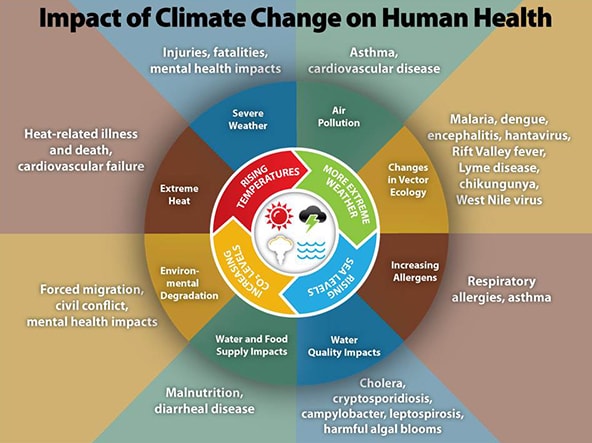
Amongst all the news of Trump disbelieving the National Climate Assessment, the U.N. climate conference in Poland, and U.S. life expectancy dropping for a third straight year, the Lancet published a report on the effects of climate change on human health, which touches on all three topics.  USA Today summarized it in a video: Climate change turning into ‘medical emergency,’ experts say.

Human-caused climate change is turning into a “medical emergency” that could result in death and disease for millions, according to British medical journal, The Lancet.
Researchers from Colorado State University contributed to the report and summarized its main findings as well.
Some of the new health impacts of heat documented in The 2018 Report of The Lancet Countdown on health and climate change include:
  • 157 million more vulnerable people were subjected to a heatwave last year than in 2000, and 18 million more than in 2016.
  • 153 billion hours of work were lost in 2017 due to extreme heat as a result of climate change. China alone lost 21 billion hours, the equivalent of a year’s work for 1.4% of their working population. India lost 75 billion hours, equivalent to 7% of their total working population. New methodologies have captured this data for the first time.
  • Rising ambient temperatures are placing vulnerable populations at increased risks across all regions of the world. Europe and the East Mediterranean are particularly at risk, most likely due to ageing populations living in cities, with 42% and 43% of over 65s vulnerable to heat exposure. Markedly higher than Africa (38%) and southeast Asia (34%).
  • Heat greatly exacerbates urban air pollution, with 97% of cities in low- and middle- income countries not meeting WHO air quality guidelines.
  • Heat stress, an early and severe effect of climate change, is commonplace and we, and the health systems we rely on, are ill equipped to cope.
  • Rising temperatures and unseasonable warmth is responsible for cholera and dengue fever spreading, with vectorial capacity for their transmission increasing across many endemic areas.
  • The mean global temperature change to which humans are exposed is more than double the global average change, with temperatures rising 0·8°C versus 0·3°C.
To read the report at The Lancet, click here.

Speaking of climate change, health, and safety, the death toll for the California's Camp and Woolsey fires is now 88, 85 for the Camp Fire and 3 for the Woolsey Fire.  Welcome to the 400 ppm world.

Thursday, November 6, 2014

Students compare notes about Katrina and Sandy


Last week was the second anniversary of the landfall of Hurricane Sandy, the Frankenstorm.  To mark the occasion, Colorado State University in collaboration with Columbia University issued a press release accompanied by a video.  CSU goes first with NYC, Gulf Coast students compare notes on disastersby Jeff Dodge on October 31, 2014.
A program affiliated with Colorado State University marked the two-year anniversary of Superstorm Sandy in a special way: On Oct. 29, high school students in New York City posed questions about life during and after a catastrophe to a very particular group of experts – high school students in the Gulf Coast who experienced the BP Oil Spill and lived through as many as six hurricanes in the past decade, including Hurricane Katrina in 2005.

Their youth-led rapid video project, “The Katrina/Sandy Youth Dialogue, Part 1,” is a product of the SHOREline program, a national youth-empowerment project developed at Columbia University’s National Center for Disaster Preparedness at the Earth Institute and at the Center for Disaster and Risk Analysis at Colorado State University.
Here's the video from Columbia University on Vimeo: Shoreline - Katrina/Sandy Youth Dialogue Part I.

It has been two years since Superstorm Sandy struck the East Coast and nearly ten years since Hurricane Katrina devastated the Gulf Coast. At SHOREline, we took this moment to reflect upon the issues of response and recovery it raised among the members of our SHOREline network – high school students at five Gulf Coast schools and one New York City school.

How are Katrina and Sandy similar? From the perspective of young people, what can they learn from one another about such catastrophic events? Ninth and tenth graders at NYC’s Urban Assembly School for Emergency Management developed questions that they posed to their Gulf Coast counterparts in Louisiana, Mississippi, and Alabama.
For last year's retrospective, see PBS NewsHour on Hurricane Sandy one year later, then be happy that, as predicted, the U.S. didn't have a severe Atlantic hurricane season this year.

Friday, October 24, 2014

Food news for Food Day 2014


A happy Food Day to all of my readers!  To celebrate the day,* I present a linkspam of food news, beginning with Discovery News asking Are Healthy Foods REALLY More Expensive?

Healthy foods: Are they more expensive than foods that are bad for you? Tara takes a look at some recent research that might confirm this theory.
That's a video I should show my class, especially after they've seen 'Food, Inc.'

Now for something a little less serious from Discovery News, The Surprising Benefit Of Reheating Pasta!

There's nothing better than leftover pasta, and now science has a reason to love it even more! Tara reveals some surprising evidence that cold pasta might be good for your diet!
Cool, but I'm not showing this one to my students.

Follow over the jump for food news from the past two months of Overnight News Digest on Daily Kos.

Friday, October 17, 2014

Biofuel crops can be good for the environment and other biofuels research


Normally, I'm skeptical about biofuels, but that's primarily because the main biofuel in the U.S. is corn ethanol, which I have characterized for years as an energy indepence strategy, not a sustainability strategy.  It doesn't help that pretty much all the increased corn production during the past decade has gone into gas tanks.  In one of the first entries on this blog, I described "converting corn into ethanol" as "a big energy loser."  On the other hand, I followed that by writing that it would be "less of a loser if ethanol comes from cellulose in the stalks and leaves instead of the grain, as cellulosic ethanol requires less fertilizer than grain ethanol."

I'd be even more optimistic if the enthanol and other biofuels came from something other than corn.  Fortunately, two stories I included in last week's Overnight News Digest: Science Saturday (Nobel Prizes 2014) on Daily Kos gave me even more reason for optimism, as they show the biofuel crops can be good for the environment even if they aren't burned for fuel.

First, Liz Ahlberg, writing for the University of Illinois, reported Bioenergy crops could store more carbon in soil.
CHAMPAIGN, Ill. — In addition to providing renewable energy, grass crops like switchgrass and miscanthus could store some of the carbon they pull from the atmosphere in the soil, according to a new study by University of Illinois researchers.

The study compared soil dynamics – the ratio of carbon to nitrogen and microbial activity – of bioenergy crops with that of a standard corn-corn-soybean rotation. They found that in bioenergy crops, a certain threshold of plant matter left in the field after harvest lets much more carbon accumulate in the soil.

Led by civil and environmental engineering professor Praveen Kumar, the researchers published their findings in the journal Environmental Science and Technology.
Next, Kelly April Tyrell, writing for the University of Wisconsin passed along the good news about Balancing birds and biofuels: Grasslands support more species than cornfields.
In Wisconsin, bioenergy is for the birds. Really.

In a study published today in the journal PLOS ONE, University of Wisconsin-Madison and Wisconsin Department of Natural Resources (DNR) scientists examined whether corn and perennial grassland fields in southern Wisconsin could provide both biomass for bioenergy production and bountiful bird habitat.

The research team found that where there are grasslands, there are birds. Grass-and-wildflower-dominated fields supported more than three times as many bird species as cornfields, including 10 imperiled species found only in the grasslands. These grassland fields can also produce ample biomass for renewable fuels.

Monica Turner, UW-Madison professor of zoology, and study lead author Peter Blank, a postdoctoral researcher in her lab, hope the findings help drive decisions that benefit both birds and biofuels, too, by providing information for land managers, farmers, conservationists and policy makers as the bioenergy industry ramps up, particularly in Wisconsin and the central U.S.
Both of those are good news and make me more favorably disposed to (non-corn) biofuels.

Follow over the jump for the biofuel news from Overnight News Digest: Science Saturday (Ebola in the U.S.).

Tuesday, October 14, 2014

Election news from campuses on the campaign trail for October 14


Now that Canadian Thanksgiving is over, it's time to return to the U.S. with the election news from campuses on the campaign trail I included in Overnight News Digest: Science Saturday (Nobel Prizes 2014).  I begin with this press release from the University of Illinois at Chicago: First lady makes campaign stop at UIC by Gary Wisby on October 7, 2014.
First lady Michelle Obama made a political campaign stop at UIC Tuesday, receiving a standing ovation from audience members who remained on their feet throughout her 20-minute speech at the UIC Pavilion.

Her appearance was preceded by a lineup of Illinois Democrats, including Gov. Pat Quinn, Sen. Dick Durbin, Illinois Attorney General Lisa Madigan, Cook County Board President Toni Preckwinkle, Secretary of State Jesse White, Lt. Gov. Sheila Simon and Reps. Danny Davis, Jan Schakowsky and Robin Kelly.

Obama urged a robust voter turnout in the Nov. 4 Illinois elections. "Get the vote out. Start today," she said.
The First Lady stopped by Detroit three days later, as WXYZ reported in First Lady Michelle Obama visits Detroit for campaign rally.


I wouldn't be surprised if she said much the same things here as in Chicago.

That's not the only election news from Michigan.  The University of Michigan announced a Date change for the  U-M Board of Regents candidate forum on October 7, 2014.
DATE: 4 p.m. Friday, Oct. 24, 2014

EVENT: The candidates for Regent of the University of Michigan have been invited to participate in a 75-minute forum. Susan Smith, president of the League of Women Voters of Michigan, will moderate the discussion.

The four major-party candidates have confirmed their participation: Mike Behm, Rob Steele, Ronald Weiser and Regent Kathy White.

Candidate questions will be posed by the League and students at the Ford School of Public Policy. The format will allow for questions from the audience; it is not a debate.
If I were really ambitious, I'd drive out to Ann Arbor to cover the event.  Who knows, since I have a new car, I might just do so.

Follow over the jump for news from Colorado and Massachusetts.

Sunday, September 21, 2014

Climate and environment news from Colorado State University


As the entry that posted yesterday stated, I'm in Colorado on business.  I've already posted the space news from the state's flagship university.  Now it's time to share some stories from its Land Grant university, Colorado State, that I included in Overnight News Digest: Science Saturday (Solar storm and aurora) on Daily Kos.  As today is the People's Climate March, I'll focus on environment and climate stories.  Since I'm in an "I can't be all DOOM all the time" mood, I begin with good news.

Researcher, UN panel find ozone layer on the mend
by Kortny Rolston
September 10, 2014
For years, experts have warned that the Earth’s protective ozone layer is shrinking.

This week, CSU professor A.R. “Ravi” Ravishankara delivered some good news about the fragile shield of stratospheric gas: The ozone layer appears to be recovering.

The discovery was made by a panel of 300 scientists appointed by the United Nations to assess ozone depletion. Ravishankara helped lead the group, which has spent the past four years sifting through and analyzing ozone data and studies.

The panel attributed the turnaround to the “concerted international action” that took place in the wake of the 1987 Montreal Protocol. The agreement called for phasing out the use of chlorofluorocarbons (CFCs) such as Freon and other harmful chemicals in refrigerators, air conditioners, aerosols, foam manufacture, etc., around the world.
This is exactly what the Montreal Protocol was supposed to do.  While the concentration of ozone-destroying gases has been decreasing, it's good to know that the ozone is increasing as well.

Next, a video and article about the subject of today's demonstration, climate.

Colorado State University Team Researches Arctic Soils and Climate Change

Colorado State University Associate Professor Matthew Wallenstein and his research team are studying how soil carbon storage is likely to respond to rapid environmental change.
Is global warming being accelerated in the Arctic?
by Jennifer Dimas
4 Sep, 2014
The soils in the Arctic have banked more carbon over thousands of years than the carbon contained in all of the world’s vegetation and the earth’s atmosphere combined. Why is that important? The Arctic has been taking carbon out of our atmosphere and storing it away in the soil lockbox for tens of thousands of years, until now.

CSU Associate Professor Matthew Wallenstein and his research team are studying how soil carbon storage is likely to respond to rapid environmental change.

“The climate is changing rapidly in the Arctic,” said Wallenstein. “Warming is occurring twice as fast here as in the rest of the world. And the results are visible from space. The short growing season is getting longer, and the plants are getting bigger and greener. What you can’t see from space is that the microbes and other critters that live beneath the surface are waking up too. This “biotic awakening” sounds like a good thing, and it probably is if you are a microbe, but could be bad for us. That’s because these microbes could open this carbon lockbox, releasing some of that banked soil carbon back to the atmosphere as carbon dioxide and methane. Because both of these are greenhouse gasses, that could further accelerate climate warming. There is some evidence that this is already happening. But there is a lot we don’t know, and we can’t really predict how this will play out in the future. That is why we are here.”
This is not good news, but not surprising, either.

Follow over the jump for a video and more environmentally related stories from CSU.