A blog about societal, cultural, and civilizational collapse, and how to stave it off or survive it. Named after the legendary character "Crazy Eddie" in Larry Niven and Jerry Pournelle's "The Mote in God's Eye." Expect news and views about culture, politics, economics, technology, and science fiction.
Elliot Williams, CNN legal commentator and baker extraordinaire, argues that if any ingredient in a cake is underrepresented, the whole thing might literally fall apart. With all of Washington, DC, residents lacking representation, what does that mean for American democracy?
Mmm, cake!
The ACLU of the District of Columbia put together a more serious debunking of arguments against D.C. statehood and a defense of the proposal before Congress in D.C. Statehood IS Constitutional...Here's Why.
Opponents may try to tell you that it is unconstitutional to grant statehood to D.C. This is a myth. This short video walks you through it.
Who am I to argue with the smart lawyers of the ACLU?
Three years ago today, a 15-year-old girl named Greta Thunberg skipped school as part of a climate strike outside the Swedish parliament. Since then, Thunberg has become one of the most recognizable climate activists in the world, and her 'School Strike for Climate' has grown into a global movement. Listen to Thunberg reflect on her legacy thus far.
It's been three years since Greta Thunberg first sat alone outside the Swedish Parliament to call for action on climate change. Now the young activist has become a global voice, continuing to hold world leaders to account on global warming. Six months after President Biden took office, is he doing enough? “This administration is not ready to act as seriously as we need, unfortunately,” Greta Thunberg tells NBC’s Mehdi Hasan.
That written, I encourage Thunberg and heryouthfulfollowers to continue to raise people's awareness and prompt action on the climate. Doing so will change what is possible.
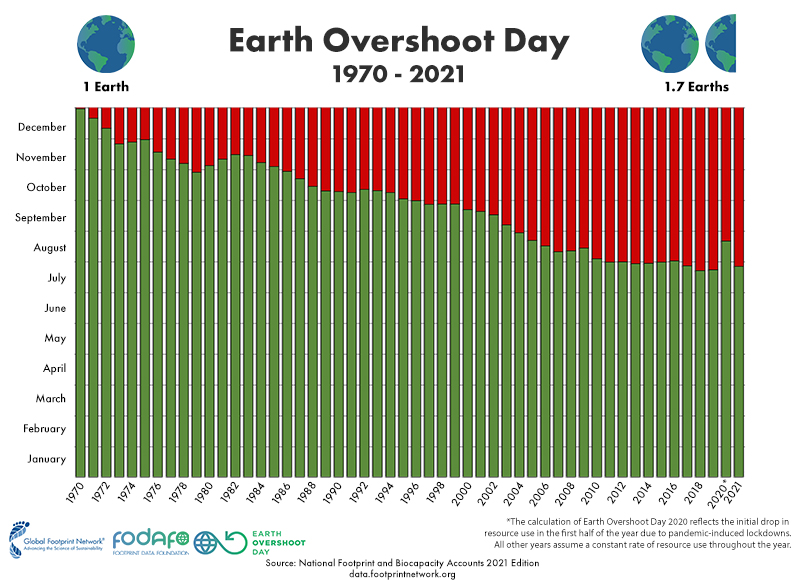
While the video pointed out that earlier recessions had reduced humanity's ecological footprint before, the results has usually delayed Earth Overshoot Day by days, not weeks, if at all, and can be short-lived. The record of past Earth Overshoot Days shows that the Great Recession of 2007-2009 merely stalled the date at August 14th in 2008 and pushed it back 4 days to August 18th in 2009. In 2010, it advanced 11 days to August 7th. The 2001 recession merely slowed down the trend, with the date moving back 1 day from September 22nd to September 23rd. Before that, the Gulf War recession of 1991-1992 held the date at October 12th during 1992-1993. The longest lasting effect was from the double-dip recession (Reagan Recession) of 1980-1982, when it took 5 years for the date to return to November 4th. As for this year, it's the latest date for Earth Overshoot Day since 2005, when it fell on August 25th. I don't expect it will be this late next year.
Earth Overshoot Day 2021 lands on July 29, Councillor Susan Aitken, the Leader of Glasgow City Council, announced today on behalf of Global Footprint Network and the Scottish Environment Protection Agency (SEPA).
Based on previous announcements, today would have tied with 2019 for the earliest Earth Overshoot Day. However, the Global Footprint Network recalculated when previous Earth Overshoot Days actually occurred, so 2017's date was moved up from August 2 to July 30, 2018's shifted from August 1 to July 25, and 2019's advanced from July 29 to July 26, so today is only the third earliest. That's not how I want to "move the date." This year's date moving up more than three weeks also fits the pattern I described last year of relatively rapid recovery of resource use and waste production after recessions. This is one of those times I wish I weren't right.
We’ll have already used up all the resources Earth can naturally reproduce for this year by July 29, researchers say.
...
Every year, researchers calculate the date by which we will use up all the resources the planet is capable of naturally renewing over the entire year. This year's Earth Overshoot Day falls on July 29. That means that 210 days into 2021, we’ll be living on credit or digging into our savings to live and survive on Earth.
Earth Overshoot Day was created by the Global Footprint Network, and it’s determined by measuring biocapacity, the biological capacity of the planet to regenerate natural resources and absorb waste materials.
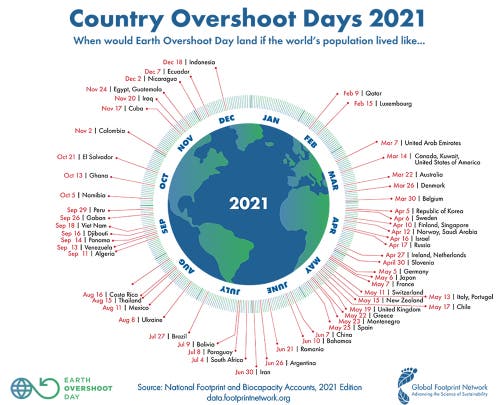
That's a great explanation with a lot of information that I could react to, but I'm confining myself to just three points. First, I'm with Laurel Hanscom that humanity should strive to move the date through choice and design, not by disaster and tragedy. That's part of what makes me a Crazy Eddie. Second, as host Alejandro Alba pointed out, every country has its own overshoot day. He mentioned that the U.S. already passed its overshoot day on March 14, while Indonesia won't reach its overshoot day until December 18. Here's a graphic showing the overshoot days for the rest of the world's countries.
According to this chart, the U.S. isn't the least sustainable. Qatar is with an overshoot day of February 9 this year. Still, that's nothing to celebrate.
Finally, people have to work to move the date by reducing their resource use and waste production. I check my progress by calculating my footprint on this date. Three years ago, it was 3.8. Two years ago, it was 3.5. Last year, it was 2.8. This year, my footprint followed the global trend and returned to 3.5 and a personal overshoot day of April 14. Well, at least I'm still a month later than the average American, but I no longer have the same or smaller footprint as the average German, which fell from 3.2 to 2.9. I'm keeping that goal for next year.
Today is another environmental day that doesn't move around the calendar, so follow over the jump to celebrate it.
Statehood, which has long been the dream of many residents in Washington, is once again being debated for the nation’s capital, and another Flag Day is upon us.
If it turns out statehood is in the cards, the new U.S. flag could look like the banner Mayor Muriel Bowser unveiled two years ago, when she planted 140 of them on Pennsylvania Avenue between the White House and the U.S. Capitol ahead of a congressional hearing on statehood.
It has three horizontal rows with nine stars, three horizontal rows with eight stars and the blessing of Del. Eleanor Holmes Norton, D-D.C., who has — as she has done every year since she took office in 1991 — introduced a D.C. statehood measure.
“I defy you to find a flag that looks all that different from the flag we had when there were 48 states,” Norton said. “Simply adding a star will not have a cosmic change on the flag.”
What did she think of Bowser’s flag?
“I loved it,” Norton said, laughing. “But it was not because the flag stood out in any way.”
“People are going to have to buy new flags,” said D.C. Del. Eleanor Holmes Norton, describing an alternate version of the American flag that has 51 stars.
The extra star, symbolizing her decades-long quest to make the District of Columbia a U.S. state, is hard to notice.
“If you look at it you won’t see much difference,” the Democrat told CQ Roll Call during an interview back in February. “I think I like that, even as I extol, and look forward to, having that extra star.”
In other words, we'd hardly even notice the new flags.
Follow over the jump for two videos describing the cases for and against D.C. statehood.
HappyNobelPrizeDay! Today, the anniversary of Alfred Nobel's death in 1896, is the day the Nobel Prizes for peace, economics, medicine, physics, chemistry, and literature are presented to their recipients. Normally, that ceremony would take place in Stockholm, Sweden, for all the prizes except the peace prize, which would happen in Oslo, Norway, but because of the COVID-19 pandemic, the presentation happened remotely.
This year's Nobel Peace Prize went to the World Food Program, a UN org that combats hunger worldwide by helping feed nearly 100M people across 88 countries.
Bloomberg Quick Take had a worse video, but a better description that expanded on the reasons for the World Food Program earning the award.
The organization is being honored “for its contribution to bettering conditions for peace in conflict-affected areas and for acting as a driving force in efforts to prevent the use of hunger as a weapon of war and conflict,” the Norwegian Nobel Committee said on Friday.
The need for international solidarity and multilateral cooperation is “more conspicuous than ever,” the committee said. The World Food Program is the world’s biggest humanitarian group to specifically address hunger and to work toward food security, it said.
Last year, the World Food Programme helped close to 100 million people in 88 countries in the face of acute food insecurity and hunger. The WFP is also the main body through which the United Nations works toward eradicating hunger as one of the Sustainable Development Goals.
The committee chose to highlight hunger in this year’s peace prize after a deterioration in circumstances over recent years. In 2019, 135 million people suffered from acute hunger, the highest number in many years, it said. Most of the increase was caused by war and armed conflict.
This isn't the first time someone trying to feed the world earned a Nobel Peace Prize. The other that I have mentioned on this blog is NormanBorlaug, who received the Nobel Peace Prize in 1970 for his contributions to the Green Revolution. I teach about both Borlaug and the Green Revolution in my classes. When I return to the classroom, I plan on adding the World Food Program to that lecture.
The Royal Swedish Academy of Sciences cited the pair for improvements to auction theory and inventions of new auction formats.
This video shows that auction theory isn't just an academic interest; it applies directly to government functions as exemplified by the auction of radio frequencies. The airwaves are public property, which is why the government regulates broadcasters through the Federal Communications Commission and auctions off radio frequencies. Auction theory is one way of insuring accountability and transparency in the process.
Follow over the jump for this year's science and literature prize winners.
HappyAmericaRecyclesDay! For this year's celebration, I'm sharing two videos explaining how recycling works, beginning with SciShow's How Recycling Works. Nothing like showing the science and technology of recycling!
Join SciShow as we explore what happens to your stuff after you toss it into the little green bin with the arrows on it.
All of the animation in this video gives an idealized picture, pun intended, of the science and technology behind how recycled materials are sorted. Now This places those in a larger context when it answers What Happens to Your Recycling After It's Collected?
We followed the recycling process from the bins to the plant to understand where our recycling actually goes – here's what happens to your recycling.