Showing posts with label Deutsche Welle. Show all posts

Monday, August 24, 2026

BBC and DW News on the 'Godzilla El Niño'

For today's "short evergreen educational entry," I'm revisiting PBS Terra and Vox explain the forecast 'super El Niño'. I begin with two videos from BBC News, starting with 'Strongest El Niño of the century' is coming. Should we be scared?

El Niño is a natural weather pattern that begins in the Pacific Ocean.

The event developing in 2026 could be the strongest in living memory, according to the Met Office.

But what does it mean, and what will it affect?
The answer to "should we be scared" is yes, at least a little. Calling it a "Godzilla" El Niño will just reinforce that feeling.

The above segment built upon El Niño set to be 'strongest in living memory', says Met Office.

The El Niño event that is developing over the Pacific Ocean is likely to be the strongest in living memory, the Met Office has warned.

The powerful natural climate phenomenon pushes up global temperatures and can increase the risks of extreme weather.

Added to the effects of human-induced climate change, the Met Office is warning that it is "very likely" to mean 2027 is the hottest year on record globally.

There is growing evidence that weather patterns around the world.
Hearing about all the effects El Niño is having on food supply and food prices reminds me of two of Commoner's Laws, "There is no free lunch" and "Everything is connected to everything else." I'll try to remember this when I teach Environmental Science one last time beginning next month.

Speaking of stories I tell my students, looking at the graph showing the effects of El Niño and La Niña on global temperature also reminds me of a question I ask in the worksheet for Chasing Ice, "How is increasing greenhouse gases like using performance-enhancing steroids?" They make extreme events more frequent and stronger. While climate change doesn't make El Niño more frequent, it is making the natural disasters it causes more frequent. Also, climate change is making El Niño at least appear stronger and El Niño is definitely increasing temperatures.

DW News features more expert commentary in A historic El Nino is forming. Here's why scientists are worried.

The UK's Met Office says this year's El Nino could unleash extreme weather, the likes of which the world has not seen in a century. The results could be record-breaking global temperatures in 2027 and a raft of natural disasters. DW's Sarah Kelly talks about the weather phenomenon with Liz Bentley, Chief Executive of the Royal Meteorological Society in the UK and President of the European Meteorological Society.
The graph shows that the Pacific sea surface temperatures are already 2oC above normal and could reach between 3 and 4oC higher than average by the end of the year. Will that be stronger than 1877? Maybe.

All of the above examined the weather globally with a focus on Europe. What about the United States? PBS Terra covers some of that in What El Niño Predicts for Snowfall This Winter.

With El Niño officially here, and predicted to get stronger, let's see how it's going to affect our snow forecast for this winter! Weathered host Maiya May breaks it down.
The pattern predicts less snow here in Michigan and more snow in the mountains of California and the arid Southwest. That's good news for both places, so not everything about El Niño is bad.

That's a wrap for today. Stay tuned for another brief evergreen educational entry tomorrow.

Saturday, July 11, 2026

Drink to smartphones lowering birth rates for World Population Day and National Mojito Day

Happy World Population Day and National Mojito Day! Like last year, I'm combining the two today. I begin the holiday observances with the Financial Times explaining Why birth rates are falling everywhere all at once.

Smartphones and a marked change to our digital media environment are part of the reason for the demographic shift changing our world, including how low birth rates are shrinking the workforce. Chief data reporter John Burn-Murdoch presents his lastest findings on this challenge faced by most nations[.]
There's a lot to chew on here. I've been writing a lot about government policy and economics, but I don't think I've mentioned non-medical technologies in the context of falling birth and fertility rates before. That's certainly a "scifi is now" topic. I also haven't discussed lack of independent housing as a factor in demography, although I've certainly blogged about housing and real estate during the past 15+ years. I think I'll be adding those perspectives to my writing in the future.

By the way, I consider "Pennsylvania economist Jesús Fernandez-Villaverde call[ing] fertility decline the question of our time, with most other problems flowing downstream of it" to be the result of a perspective I criticized in Meditations on sustainability, part 1.
[E]conomy is dependent on society, which is in turn dependent on the environment. Without an environment, there is no society. Without a society, there is no economy. Those relationships put sustainability into perspective. They also show that the emphasis on economy above all is exactly backwards. No wonder we're in trouble.
That written, I'm not surprised the Financial Times would feature it. As I quoted from Yes, Prime Minister, "The Financial Times is read by people who own the country," in this case the U.K., so they would think it salient. As one of the commenters pointed out, "This video is for rich people. Everyone who's is struggling knows why we don't have kids." From my ecological perspective, resource use, if not outright depletion, and waste production, as exemplified by fossil fuels and climate change are the primary problems and everything flows downhill from them. As a biologist, I think limited resources primarily define carrying capacity, the maximum sustainable size of a population, and we should be examining those, especially their connections to the issues the economists identify.

DW News confronted the effect of technology on society directly when it asked Are smartphones killing birth rates worldwide?

The world is having fewer children and the pace of decline is happening much faster than expected. The reasons are complex and varied, from a lack of affordable housing to a lack of suitable partners. But could smartphones and modern tech be part of the problem? DW speaks to AI researcher Connor Leahy about how digital life may be reshaping relationships.
I was wondering if someone would bring up dating apps, the obvious technological solution to people finding partners, and Connor Leahy pointed out that their incentive is to keep people on the app, not find a permanent partner. Now I'm wondering if government matchmaking services are in our future. I suspect that would not be an unadulterated good and other causes would have to be addressed for them to be effective.

For what it's worth, the commenters to the video were hostile to the question, but I think that's because DW News didn't present the data supporting the inference, not that it helped the Financial Times video that much. Their commenters weren't as mean, but they were certainly skeptical. I'm not one of them; I think the researchers are onto something, at least as a contributing factor for the last 20 years.

I return to the U.S. for the third video, PBS NewsHour examining The potential impacts of the U.S. birth rate decline.

The U.S. fertility rate is at an all-time low, according to recent data from the Centers for Disease Control and Prevention. Researchers say this is part of a larger downward trend. Since 2007, the number of Americans having babies has dropped 23%, well below the replacement level, meaning not enough are being born to replace those who die. William Brangham discussed more with Brian Mann of NPR.
PBS NewsHour broadcast this segment and then uploaded it one month before the study on smartphones and birthrates came out, so it didn't include its findings. In that light, the decline in teen pregnancy might be less a result of good policy and more the effects of smartphones. That doesn't make it any less of an accomplishment, just an accidental one.

Reading this would be enough to make me drink if my diabetes hadn't made me lose interest in drinking, so it's time to celebrate with Michigan Public saying .

Inspired by Tracy Samilton's recent trip to Cuba, Tammy Coxen whipped up this stellar mojito - which we might claim is one of the tastiest in Michigan. Samilton explored the Michigan-Cuba connection during her time in Havana, so Coxen used white rum from the Ann Arbor Distilling Company to bring some Michigan flavor to this drink perfect for warmer weather. Cheers!
That's a wrap for today's double celebration. Stay tuned for the Sunday entertainment feature. I have an awards show my readers can vote in for free, as long as they are interested in horror and horror-adjacent science fiction movies and television.

Wednesday, December 10, 2025

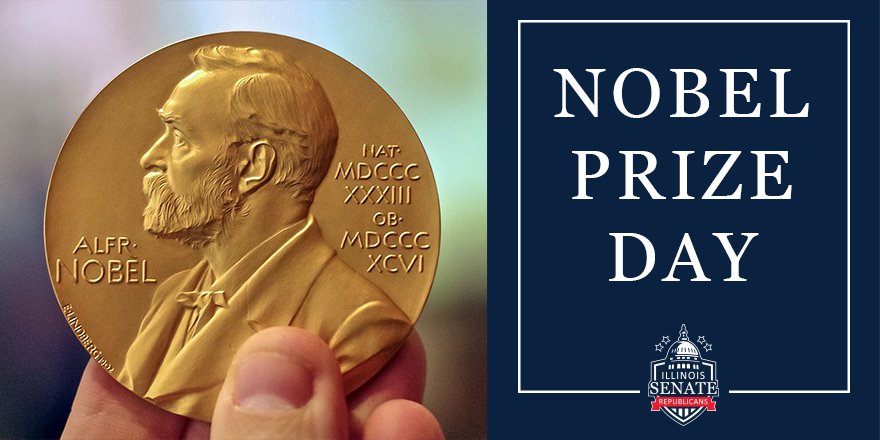
Science, peace, economics, and literature winners for Nobel Prize Day 2025

Happy Nobel Prize Day! I begin today's celebration with BBC News reporting Physics Nobel Prize awarded to three scientists for work on quantum computing.

The Nobel Prize in Physics has been awarded to John Clarke, Michel H. Devoret and John M. Martinis for their work on quantum mechanics that is paving the way for a new generation of very powerful computers.

"There is no advanced technology used today that does not rely on quantum mechanics, including mobile phones, cameras... and fibre optic cables," said the Nobel committee.

The announcement was made by the Royal Swedish Academy of Sciences at a news conference in Stockholm, Sweden.

The three winners will share prize money of 11 million Swedish kronor (£872,000).
Yay, three physicists from the University of California, even if they aren't from my undergraduate alma mater, UCLA!

Next, DW News reporting Nobel Prize in Chemistry awarded "for the development of metal–organic frameworks".

The Royal Swedish Academy of Sciences has decided to award the 2025 Nobel Prize in chemistry to Susumu Kitagawa, Richard Robson and Omar M. Yaghi "for the development of metal–organic frameworks." The new type of molecular architecture developed by the group allows for "large cavities in which molecules can flow in and out. Researchers have used them to harvest water from desert air, extract pollutants from water, capture carbon dioxide and store hydrogen," according to the award-giving body. Their research could provide solutions for combatting climate change.

"A small amount of such material can be almost like Hermione's handbag in Harry Potter. It can store huge amounts of gas in a tiny volume," Heiner Linke, chairman of the Nobel Committee for Chemistry, said during a press conference.
This looks like a very useful discovery. So does the next prize, Nobel Prize for medicine awarded to immune system researchers, as Al Jazeera English reported.

The Nobel Prize in physiology or medicine has been awarded to Mary E Brunkow, Fred Ramsdell and Shimon Sakaguchi for their work on the functioning of the human immune system.
The award, announced by Sweden’s Karolinska Institute on Monday, will be presented to the trio in December for “their groundbreaking discoveries concerning peripheral immune tolerance that prevents the immune system from harming the body”.
The research “relates to how we keep our immune system under control so we can fight all imaginable microbes and still avoid autoimmune disease”, said Marie Wahren-Herlenius, a rheumatology professor at the Karolinska Institute.
The prize of 11 million Swedish kronor ($1.17m) is to be shared equally between Brunkow and Ramsdell, both 64, of the United States and Japan’s Sakaguchi, 74.
The king of Sweden will also present them with gold medals.

Al Jazeera’s Paul Rhys reports from Stockholm.
This advancement could help me personally, as I am a cancer survivor and Type I diabetic, an autoimmune disease. May I live long enough for the science to advance enough to improve my condition.

Follow over the jump for the non-science prizes.

Monday, July 28, 2025

DW News asks 'Earth Overshoot Day: What can we do to try live within the planet’s limits?'

A late Earth Overshoot Day! It snuck up on me this year, as I was expecting it between now and August 1st. Instead, it was on July 24, the earliest ever. That's when DW News uploaded 'Earth Overshoot Day': What can we do to try live within the planet’s limits?

Today marks what one NGO calls 'Earth Overshoot Day'. The Global Footprint Network says that's the day that humans have used more of Earth's resources than the planet can regenerate in a year. Scientists say the date is getting earlier every year. So what can we do to try live within the planet’s limits?
It pleases me to see India used as a good example. It's one of the reasons I show my students Chasing Ice instead of An Inconvenient Sequel: Truth to Power; I didn't like Al Gore bullying the Indian delegation to the Paris Accord negotiations, even though it worked. Go bother the Chinese!

One of the points Beatrice Christofaro makes is about the A in I=P*A*T, "where I is impact, P is population, A is affluence, and T is technology. It's the A and inefficient T that is multiplying the impact of the effect of the relatively small P in the developed world, especially in North America." Deliberately making people less affluent isn't a viable solution; people don't like being poorer and will object. On the other hand, convincing people to be less wasteful, particularly creating less food waste and eating less meat, especially beef, would be helpful. Once could consider that to be a technology. So is renewable energy. Between the two, it would move Earth Overshoot Day back more than a month. Progress!

I close with two videos about Human Footprint beginning with Human Footprint SEASON 2 PREVIEW from AZPM.

Earth has never experienced anything like us: a single species dominating and transforming the planet. Biologist Shane Campbell-Staton travels the globe to explore our Human Footprint and to discover how the things we do reveal who we truly are.
I'm looking forward to seeing more clips from Human Footprint on YouTube and am already planning on embedding the video about mosquitos for World Mosquito Day. In the meantime, I'm sharing a follow-up to 'Human Footprint' on PBS Terra explains 'How Supermarkets Rewired The Planet', Omega Mart on Consumerism and Shopping Habits After Human Footprint Appearance | Nevada Week from Vegas PBS.

PBS’ Human Footprint makes a stop at Omega Mart for its “Shelf Life” episode. We talk to Omega Mart about the experience and the ways the exhibit highlights modern consumerism.
That was wild and even weirder than it looked in the "Shelf Life" episode of Human Footprint. I can now say there there is an intelligent attraction in Las Vegas beyond the sheer spectacle the city is known for.

That's a wrap for today's belated observance of an environmental holiday. Stay tuned as I return to the Emmy Awards with the nominations for Last Week Tonight with John Oliver.

Friday, June 7, 2024

Starliner, Starship, and Chang'e, a week of good space news

This has been a good week in space for the U.S. and China, which makes it a welcome change of pace from the news here on Earth. After all, I can't be all DOOM all the time! I begin the stories of success with CNN reporting Boeing spacecraft carrying two NASA astronauts lifts off in historic launch.

A Boeing spacecraft carrying two NASA astronauts is on its historic maiden voyage. The landmark launch kicked off the first crewed test flight of the capsule and marked the culmination of a long and trying development process.
It's been six years since I posted Commercial spaceflight crews announced and testing for return to Moon as NASA celebrates its 60th anniversary, so it's been quite a wait to get both vehicles off the ground. Yes, SpaceX launched the first crewed mission from U.S. soil since 2011 almost exactly four years ago, but Dragon wasn't supposed to be the only American crewed capsule operating. It's good to have an alternative.

Starliner also passed another important milestone, as CNN showed in Boeing Starliner docks with space station after encountering new issues.

Boeing’s Starliner mission has safely docked with the International Space Station after navigating new issues that cropped up overnight en route to the orbiting laboratory. CNN's Kristin Fisher reports.
Not only am I happy that Starliner successfully docked with the ISS, I'm glad for the astronauts and cosmonauts on the station that they'll be able to recycle their water. I often jokingly gross out my environmental science students by calling water recycling "toilet-to-tap," but in this case it's not only justified, but necessary.

Speaking of SpaceX, Kristin Fisher mentioned the Starship test flight in the first video. WSJ News covered that event as it told its viewers : SpaceX’s Starship Successfully Completes Re-entry and Splashdown.

SpaceX achieved a new milestone with its mega Starship rocket, after both the booster and the spacecraft made controlled returns to Earth.
I watched the re-entry live and was amazed that Starship successfully splashed down after one of its flight control surfaces burned through but remained attached. Like the proverbial honey badger, the spaceship didn't seem to care!

China also reported a success, which DW News shared in China's Chang'e 6 mission travels back to earth from the dark side of the moon.

China’s Chang’e lunar probe has taken off from the far side of the moon to return back to earth, according to China’s national space agency. If China successfully makes it back to earth, it will be the first country to have gathered samples from the far side of the moon. China’s previous lunar mission, Chang’e 5, gathered samples from the near side of the moon, but collecting samples from the far side has required additional technical know-how as well as operating on more challenging terrain. According to the China National Space Administration (CNSA), Chang’e 6 “withstood the test of high temperature on the far side of the moon."
We have a space race!

I expect to report more on the return to the Moon on Moon Day and recap these missions in this year's edition of 2023 in space. In the meantime, stay tuned for World Oceans Day.

Sunday, August 13, 2023

WGA returns to the bargaining table, a strike update

I decided to post a strike update for today's Sunday entertainment feature. Awards shows can wait, just like they are in real life. In fact, "the 75th Emmy Awards will now air on Monday, January 15, 2024." That's a four-month delay.

To make up for that information, I have some encouraging news today, as Yahoo Finance reported Hollywood strikes continue as writers, studios agree to restart negotiations on Friday.

The writers union is returning to the bargaining table, agreeing to restart talks with Hollywood studios. Yahoo Finance Senior Reporter Alexandra Canal joins the Live show to provide an update on the state of the Hollywood strikes and the effect that these strikes are having on major studios like Paramount (PARA) and Disney (DIS).
Yahoo Finance featured a lot more management perspectives than I usually include in these posts. I shouldn't be surprised because they cater to investors. DW News presented more of the writers' side when the service asked Writers return to negotiations: Has their strike been successful?

Writers in Hollywood are resuming negotiations with the studios today. So far, both sides have been far apart with revenue-sharing playing a central role. The head of the Writer's Guild previously said the union wouldn't return to negotiations unless the studios were willing to discuss residual payments on streaming services -- something the studios had said was off the table.
As Dan Garza and his puppet Jeff said, these strikes are affecting everyone in Hollywood, not just the actors and writers, to the tune of $3 billion so far. Not all consequences are bad, at least in the short run, as CNBC explained in Why the WGA strike is helping studios combat financial pressure.

James Stewart, columnist at The New York Times, joins 'Squawk on the Street' to discuss how the ongoing writers' strike is helping studios with cost-cutting measures, the content supply pressures created by the WGA strike, and WGA's return to the negotiating table.
In the long run, the studios will need to settle with the actors and writers so that they can produce more content. Until that content runs out, the strikes are saving them money in the short run. It's going to be quite the balancing act for all parties involved.

Until then, new entertainment content will come from sports. The pros are not on strike and college sports will go on as long as there is no return of the pandemic. I might even resume watching sports in the fall. Until then, my wife and I have lots of shows to watch and video games to play when I'm not working.

I conclude with KCAL reporting WGA: Hollywood studios offer counterproposal, but details withheld.

The Writers Guild of America and representatives of Hollywood studios held their first negotiating session Friday since the union went on strike May 2, and while no specifics were released, the WGA told its members that studios offered a "counterproposal" to union demands.
While I still think these strikes are not ending any time soon, there is at least some progress. Stay tuned.

Saturday, July 8, 2023

Vietnam bans 'Barbie,' the most anticipated film of the year, over map showing Chinese territorial claim

After two days of scary climate change news, I'm in another "I can't be all DOOM all the time" mood, so I'm posting the Sunday entertainment feature a day early because Souther is tomorrow. That written, today's topic seems silly but has a serious component, as Inside Edition reports Margot Robbie’s ‘Barbie’ Movie Banned in Vietnam.

The “Barbie” movie is one of the summer's most highly anticipated movies but it's sparking an unexpected controversy. A map, seen in the film, shows a jagged line off the coast of China that allegedly represents the country's disputed claim to the South China Sea. China claims that everything inside that jagged line is theirs but every other nation that borders the South China Sea disputes that. Now, Vietnam is banning the movie and the Philippines may follow suit. The movie’s producer says the map is only make-believe and was not intended to make any statement about the real world. Inside Edition's Alison Hall has more.
This seems like a tempest in a teapot, but the dispute between China and its neighbors, particularly Vietnam and the Philippines, is deadly serious, as DW News explains in Vietnam bans 'Barbie' movie over map of South China Sea.

Vietnam has banned the movie 'Barbie'. The Margot Robbie starrer was due to be released there on July 21, but won't be released now. State media reported this was because the film included a map showing unilateral Chinese claims in the South China Sea.
Yikes! This explains why the U.S. and Philippines announced four new bases in the country this April. That's quite the reversal of policy after the U.S. abandoned Clark Air Base in 1991 and Naval Base Subic Bay in 1992. That happened because the end of the Cold War and the Philippines' people and government's irritation at the bases becoming attractive nuisances because of the American servicemen's appetite for vice. The eruption of Mt. Pinatubo, a story I tell my students, sped the process along. It looks like the rise of China as a world power and regional threat made the Philippines reconsider the advantages of a U.S. military presence. I don't know if that would ever happen in Vietnam, but stranger things have happened.

Speaking of stranger things, but unfortunately not the Netflix series, this has spilled over into domestic politics, as the Politico article shown in the "Inside Edition" video reported in GOP declares war on ... Barbie.
GOP lawmakers accuse filmmakers of pandering to Chinese censors. But Warner Bros. Film Group, which produced the movie, said Thursday the map is not intended to “make any type of statement.”

Rep. Mike Gallagher (R-Wis.), who leads a select House panel aimed at countering the influence of China, said the map “illustrates the pressure that Hollywood is under to please CCP censors.”

“While it may just be a Barbie map in a Barbie world, the fact that a cartoonish, crayon-scribbled map seems to go out of its way to depict the PRC’s unlawful territorial claims illustrates the pressure that Hollywood is under to please CCP censors,” Gallagher said in a statement to POLITICO. “I hope Warner Brothers clarifies that the map was not intended to endorse any territorial claims and was in fact, the work of a formerly plastic anthropomorphic doll.”

Warner Bros., in its own statement to POLITICO, said there were no geopolitics intended in “Barbie.”

“The map in Barbie Land is a child-like crayon drawing,” a spokesperson for the Warner Bros. Film Group said. “The doodles depict Barbie’s make-believe journey from Barbie Land to the ‘real world.’ It was not intended to make any type of statement.”
Oh, dear dog. Anything to generate outrage along with anti-China and anti-Hollywood sentiment.

This controversy began just after "Barbie" won its first award, even before its release, for Most Anticipated Film at the Hollywood Critics Association Midseason Awards.


"Barbie" beat "Oppenheimer," the runner-up, which it shares a release date with, along with "Dune: Part Two," "Killers of the Flower Moon," and "Mission: Impossible - Dead Reckoning Part One." That's a list of potentially great movies, all of which I expect to see nominated in future awards shows, including the Saturn Awards, which I vote for.

I'm ending this post with an appropriate musical palate cleanser, Barbie Girl - Vintage Beach Boys - Style Aqua Cover ft. Morgan James.


Stay tuned for Souther.

Wednesday, December 28, 2022

2022 in climate and weather from NBC News, DW News, and ABC News

After looking back at science and space during the year about to end, it's time to examine the year in climate and weather. NBC News included most of what I wanted to cover in Our Planet’s Future: Combatting Climate Change, which the network uploaded on Festivus.

2022 was another catastrophic year of extreme weather events fueled by climate change. NBC News correspondent Jacob Soboroff takes a look back at the impacts of those events and looks forward as the world rallies to fight climate change.
Jacob Soboroff and NBC News covered some general environmental news, like cleaning up plastic pollution, in addition to the climate, weather, and energy news. That segment also reminded me of what I wrote in WatchMojo rewound YouTube again, Google's Year in Search, and top memes for New Year's Eve last year.
[T]he host of Mr. Beast looks familiar, even though I didn't know his channel name. The channel I most want to watch of all of them is Mark Rober. His videos look both fun and educational.
Thanks to NBC News covering their #TeamSeas challenge, I finally subscribed to both of their channels.

Soboroff mentioned that the year wasn't over after listing the major U.S. and global weather events, indicating that there could be more in store during the final eight days of the year. He was right. DW News opened Extreme weather events in a changing climate with the winter bomb cyclone that hit over Christmas weekend before recounting the rest of the global natural disasters this year.

Human-made climate change is increasing the frequency and intensity of severe weather. 2022 continued the trend of recent years being the warmest on record. Extreme heat and water events affected many parts of the globe, with the greatest increases in temperature not where you might expect.
Winter Storm Elliot hit me, too, as some of my pipes froze on Christmas Eve. Fortunately, none of them burst and they all thawed out on Christmas. I consider my wife and myself lucky.

Enough doom and gloom. Time for hope as ABC News listed other good news beyond the Inflation Reduction Act in Major milestones in battling climate change seen in 2022.

While saving the climate may be decades away, 2022 saw some major advancements in the battle against climate change.
Good news, everyone, but still not good enough to post Professor Farnsworth. There is still too much bad climate news.

Stay tuned as the retrospectives continue through New Year's Eve.

Friday, August 19, 2022

Using biotechnology to eliminate and control mosquitoes for an early celebration of World Mosquito Day

A happy early World Mosquito Day! I'm celebrating early because tomorrow is also World Honey Bee Day and I thought both days deserved their own entries and the post I am planning for tomorrow is already big enough.

I begin today's early observance with DW Planet A asking We could kill all mosquitoes (but should we?).

Malaria-carrying mosquitoes kill hundreds of thousands of people every year. Scientists have found a way to get rid of them by spreading a gene to wipe out mosquito populations. But is it a good idea?
The experts interviewed by DW Planet A expressed ambivalence about the prospect, although I doubt humans would ever get around to all the thousands of mosquito species. As for using genetic modification on mosquito species that carry diseases other than malaria, that's already happening in the U.S., as Wired reported in Inside the Plan to Release Life-Saving Mosquitoes two months ago.

The Florida Keys Mosquito Control District is turning towards a novel tool to combat harmful insecticide-resistant mosquitoes like the Aedes aegypti. What are they doing exactly? They're releasing millions of genetically modified male mosquitoes engineered to reduce the population of Aedes aegypti. How exactly does this work? We'll break it down.
Not only is Aedes aegypti a disease vector, it's also invasive in the Florida Keys, so eliminating it could restore balance to the ecosystem instead of disturbing it. Good riddance!

One of the goals of the Gates Foundation is the elimination of malaria and parasitic diseases. Bill Gates (or at least the people who run his YouTube channel) uploaded The Mosquito Factory this week, showing a biological control method other than genetic modification.

Inside a two-story brick building in Medellín, Colombia, scientists work long hours in muggy labs breeding millions and millions of mosquitoes. They tend to the insects’ every need as they grow from larvae to pupae to adults, keeping the temperature just right and feeding them generous helpings of fishmeal, sugar, and, of course, blood. Then, they release them across the country to breed with wild mosquitoes that can carry dengue and other viruses threatening to sicken and kill the population of Colombia. This might sound like the beginnings of a Hollywood writer’s horror film plot. But it’s not. This factory is real. And the mosquitoes being released don’t terrorize the local population. Far from it. They’re actually helping to save and improve millions of lives.
Using one parasite that doesn't affect humans to reduce the ability of an insect to spread a parasite harmful to humans — clever! It's also not forever in the same way genetic modification is. Fine by me.

That concludes this year's celebration of World Mosquito Day. Stay tuned for an entry about award-nominated television documentaries for World Honey Bee Day.

Thursday, June 30, 2022

NASA's asteroid missions for Asteroid Day 2022

Happy International Asteroid Day, the younger but paradoxically more established version of Apophis Day! I begin this year's celebration by sharing Asteroid Day 2022 from Science Museum of Virginia on YouTube.

Another trip around the Sun means another opportunity to celebrate Asteroid Day! On this June 30, let's look at the space rock discoveries made within the last year. Here's a quick recap of the asteroids added to our tracking catalogue in the last 12 months.
That's exactly the kind of summary of asteroid discoveries along with exactly the preview image I want for this entry. Thank you, Science Museum of Virginia! For that, I've now subscribed to your YouTube channel.

Next, I'm sharing videos about three missions NASA is taking or will take to asteroids this year, beginning with Explained: NASA's asteroid-deflecting DART mission from Reuters.

NASA’s DART spacecraft began a 10-month journey into space on a mission to demonstrate the world's first planetary defense system. It is designed to deflect an asteroid from a potential doomsday collision with Earth[.]
This is the mission that I featured the past two Asteroid Days and the past two Apophis Days. It's also the mission I'm featuring today that will return its results first. Watch for my post on them, as early as this September or as late as the year in space in December.

Follow over the jump for two more asteroid missions.

Monday, May 23, 2022

DW Planet A and SciShow address the environmental costs of cryptocurrencies

I hinted at my mixed opinion of cryptocurrency in CNBC, The Hill, and Forbes report on the impact of cryptocurrency on the midterms.
I've only mentioned Bitcoin twice on this blog, both times in the context of crime and cybersecurity, although the first time also involved shopping. The same is true of my previous mention of cryptocurrency in general. That's not a great reputation...
Another issue I have with cryptocurrency is its environmental cost. I'm sharing two videos that address that concern and explain how to fix it today, beginning with DW Planet A asking Can Bitcoin clean up toxic waste?

Some new players in the crypto space are using bitcoin mining to clean up toxic waste. So is it possible to “green up” bitcoin’s dirty track record? Can mining digital currency ever actually be good for the environment?
This is a good overview of the environmental problems caused by mining crypto, including efforts by the crypto miners to make their mining at least look more sustainable. That ranges from actually making the process greener to mere greenwashing.

SciShow concentrated more on "proof of work" vs. "proof of stake" when it asked a similar question in Crypto and NFTs Are Environmental Disasters...But Do They Have to Be?

The world of cryptocurrency and NFTs is riddled with controversy, but somewhere amid all of that blockchain there's some reckoning with reality that must be done.
SciShow explained the technology better than DW Planet A, while the latter explained the environmental issues more thoroughly. That's why I embedded both videos.

Both videos also relate to Commoner's Laws: There is no free lunch, there is no away, everything is connected to everything else, and nature knows best, which appears in the first video, relying on renewable energy and energy from waste, as there is no waste in nature.

With this entry, I've addressed one more of the "litany of unpleasant realities" that were "also a list of future blogging topics" from Weekend Update compares this week's headlines to 'Mad Max' on last night's 'SNL', cryptocurrencies. That's now three down.

Friday, December 10, 2021

Journalists, climate modelers, and others recognized for Nobel Prize Day 2021

Happy Nobel Prize Day! As I have the past three years, I begin by recognizing the recipients of the Peace Prize. Watch Why the Nobel Peace Prize was won by 2 journalists, and what that means for press freedom from PBS NewsHour.

The Nobel Committee often likes to make a statement when it awards the Nobel Peace Prize every year, and 2021 is no different. Two journalists, one from the Philippines, the other from Russia, were recipients — at a time when the free press is under global attack, and the truth is hard to find. Nick Schifrin reports.
The Peace Prize recipients generally piss people off and I'm O.K. with that as long they piss off the right people. I think this year's prize qualifies.

Moving on to the sciences, two researchers who work on climate change were among those honored today. Watch DW News report Climate modelers awarded with the 2021 Nobel Prize in Physics.

The 2021 Nobel Prize in Physics has been awarded jointly to Syukuro Manabe, Klaus Hasselmann and Giorgio Parisi for "groundbreaking contributions to our understanding of complex physical systems."

The 2021 Nobel Prize in Physics was awarded to three scientists whose cumulative work can be summed up in two words: Climate change. Half of the prize went to Syukuro Manabe and Klaus Hasselmann "for the physical modeling of Earth’s climate, quantifying variability and reliably predicting global warming." And the other half went to Giorgio Parisi "for the discovery of the interplay of disorder and fluctuations in physical systems from atomic to planetary scales." The Nobel Committee got Parisi on the line from his home in Rome to Stockholm, and when asked whether he had a message for politicians meeting at the COP26 United Nations Climate Change Conference, he said simply: "We have to act now."
I tell my students that modeling was the original scientific method, at least for the oldest science, astronomy, but that it generally doesn't get the respect that controlled experiments do. Now I can tell them that modeling has earned two of its practitioners a Nobel Prize.

Follow over the jump for the rest of this year's Nobel Prize recipients.

Thursday, December 10, 2020

World Food Program wins Peace Prize and the winners for economics, science, and literature on Nobel Prize Day 2020

Happy Nobel Prize Day! Today, the anniversary of Alfred Nobel's death in 1896, is the day the Nobel Prizes for peace, economics, medicine, physics, chemistry, and literature are presented to their recipients. Normally, that ceremony would take place in Stockholm, Sweden, for all the prizes except the peace prize, which would happen in Oslo, Norway, but because of the COVID-19 pandemic, the presentation happened remotely.

I begin today's coverage of the prize winners with World Food Program Wins 2020 Nobel Peace Prize from Now This.

This year's Nobel Peace Prize went to the World Food Program, a UN org that combats hunger worldwide by helping feed nearly 100M people across 88 countries.
Bloomberg Quick Take had a worse video, but a better description that expanded on the reasons for the World Food Program earning the award.
The organization is being honored “for its contribution to bettering conditions for peace in conflict-affected areas and for acting as a driving force in efforts to prevent the use of hunger as a weapon of war and conflict,” the Norwegian Nobel Committee said on Friday.

The need for international solidarity and multilateral cooperation is “more conspicuous than ever,” the committee said. The World Food Program is the world’s biggest humanitarian group to specifically address hunger and to work toward food security, it said.

Last year, the World Food Programme helped close to 100 million people in 88 countries in the face of acute food insecurity and hunger. The WFP is also the main body through which the United Nations works toward eradicating hunger as one of the Sustainable Development Goals.

The committee chose to highlight hunger in this year’s peace prize after a deterioration in circumstances over recent years. In 2019, 135 million people suffered from acute hunger, the highest number in many years, it said. Most of the increase was caused by war and armed conflict.
This isn't the first time someone trying to feed the world earned a Nobel Peace Prize. The other that I have mentioned on this blog is Norman Borlaug, who received the Nobel Peace Prize in 1970 for his contributions to the Green Revolution. I teach about both Borlaug and the Green Revolution in my classes. When I return to the classroom, I plan on adding the World Food Program to that lecture.

I'm continuing with the youngest award, "The Sveriges Riksbank [Swedish Royal Bank] Prize in Economic Sciences in Memory of Alfred Nobel," instituted in 1969. Stanford economists Paul Milgrom and Robert Wilson react to winning the Nobel Prize in economics tells their story.

The Royal Swedish Academy of Sciences cited the pair for improvements to auction theory and inventions of new auction formats.
This video shows that auction theory isn't just an academic interest; it applies directly to government functions as exemplified by the auction of radio frequencies. The airwaves are public property, which is why the government regulates broadcasters through the Federal Communications Commission and auctions off radio frequencies. Auction theory is one way of insuring accountability and transparency in the process.

Follow over the jump for this year's science and literature prize winners.

Friday, June 5, 2020

The effect of the pandemic on the environment for World Environment Day

Happy World Environment Day!*
June 5, every year is celebrated as World Environment Day or WED. The day is set aside to encourage awareness and action to protect the natural environment. It draws attention to environmental issues such as marine pollution, air pollution, deforestation, and wildlife crime such as poaching.

Each year, WED has a new theme that major corporations, communities, governments, and celebrities adopt to advocate environmental causes.
DW opened its video report on today with this year's theme, biodiversity, and the tag line, "time for nature." Watch and listen as the clip asks and answers What effect does the coronavirus pandemic have on pollution and climate change?

The UN has designated today 'World Environment Day' as part of efforts to encourage awareness of global heating and the need to stop climate change. The coronavirus pandemic has led to a huge reduction in pollution and greenhouse gases in some regions as economic activity is suspended to prevent the spread of the disease. But not all environmentalists are optimistic about what this could mean for the future of our planet.
Even though CO2 emissions have slowed worldwide due to coronavirus restrictions, environmentalists fear a spike in waste from protective equipment - which often ends up in the world's oceans and seas.
This video reiterates much of what I covered in Coronavirus response reducing air pollution updates climate change and the environment for the ninth year of Crazy Eddie's Motie News and Pandemic effects from and on space, an April asteroid flyby, and NASA at Home for Apophis Day on Monday the 13th, but the environmental hazard from discarded PPE is a new topic. VOA News covers that in Discarded COVID Gear is a Problem for NYC.

How New York is dealing with health and environmental hazard
Here's something everyone can do to help the environment today — discard your used PPE properly. Don't litter!

Since biodiversity is today's theme and I like to close circles, I return to the original topic in Reuters The race to protect Earth's biodiversity.

Earth risks losing up to a million species due to human activities, scientists have warned, adding that saving biodiversity needs as much focus as climate change.
I agree with this sentiment. While climate change has become the predominant environmental issue of our time, my original environmental cause was biodiversity, especially protecting endangered species, so I think both are equally important. The scientists Reuters cites and I are not alone. We Don't Have Time tweeted a poll asking which crisis was most acute, climate change or biodiversity. As I am writing this, 47.2% responded both are equally acute, 27.4% responded the climate crisis, and 10.3% responded the biodiversity crisis, while 15.1% responded none of them are acute. I wondered what the people who picked that last choice thought and found out they were a bunch of climate change deniers. Why am I not surprised?

*Normally, I'd be celebrating National Donut Day today, but as much as I love food holidays, I think the times require something more serious. Besides, this is a day I should have been celebrating all along.

Tuesday, December 10, 2019

Celebrate achievements in diplomacy, science, economics, and literature on Nobel Prize Day 2019


Happy Nobel Prize Day!  I begin this year's observance the same way I did last year, with the winner of the Peace Prize.  Watch DW News (Deutsche Welle or German Broadcasting) answer Nobel Peace Prize 2019: Who is Abiy Ahmed?

Ethiopian Prime Minister Abiy Ahmed has been announced as the winner of this prestigious award for his work to resolve the border conflict with neighboring Eritrea. Ahmed was up against around 300 nominees. The Norwegian Nobel Committee made the announcement in Oslo. Earlier this week, the Nobel prizes in the fields of Medicine, Physics, Chemistry and Literature were also awarded.
Congratulations to Prime Minister Ahmed and thanks to the Nobel Prize committee to get me to write about East Africa, a region I have generally and probably unjustly ignored.

Follow over the jump for the rest of the laureates.

Saturday, November 9, 2019

For World Freedom Day, Vox and DW News look back at the fall of the Berlin Wall


Happy World Freedom Day!
World Freedom Day on November 9th each year commemorates the fall of the Berlin Wall. This historic event signified the end of communism in Central and Eastern Europe.
Yes, the date of the fall of the Berlin Wall is an actual holiday.  From National Day Calendar.
In 2001, President George Bush proclaimed November 9th as World Freedom Day. The day is a United States Federal observance. Since 2001, each president since George Bush has proclaimed November 9th as World Freedom Day.
National Day Calendar's description even echoes my observation that "the maintenance and expansion of democracy and liberty require constant effort and vigilance; progress will not happen by itself."
Around the world, people’s freedom is still threatened. Many seek to control entire populations. Tyrants threaten violence or manipulate the financial sectors. Whether through political, social, violent pressures, these dictators still exists (sic). This day recognizes the need to continue striving for freedom for everyone.
Looks like I may have added a holiday to the ones I already observe on this blog.

Speaking of adding things, I told my readers to "stay tuned" this morning, as "I plan on posting one more entry on the subject focusing on the key decision by East German politicians, which East German bureaucrats amplified by mishandling it, at least from the perspective of the politicians.  The East German people had other ideas about its implementation."  Follow over the jump for videos from Vox and DW News on the events of 30 years ago today.

Monday, July 22, 2019

Seeker on the U.S. returning to the Moon plus India's moon lander


I made plans at the end of CBS Sunday Morning remembers Apollo 11 50 years later on National Moon Day.
I plan on writing about returning to the Moon, both India's planned unmanned landing and NASA's plans to land humans on the Moon in 2024, after I follow through on my promise to continue blogging about the Saturn Awards nominees and celebrate Souther.  Stay tuned.
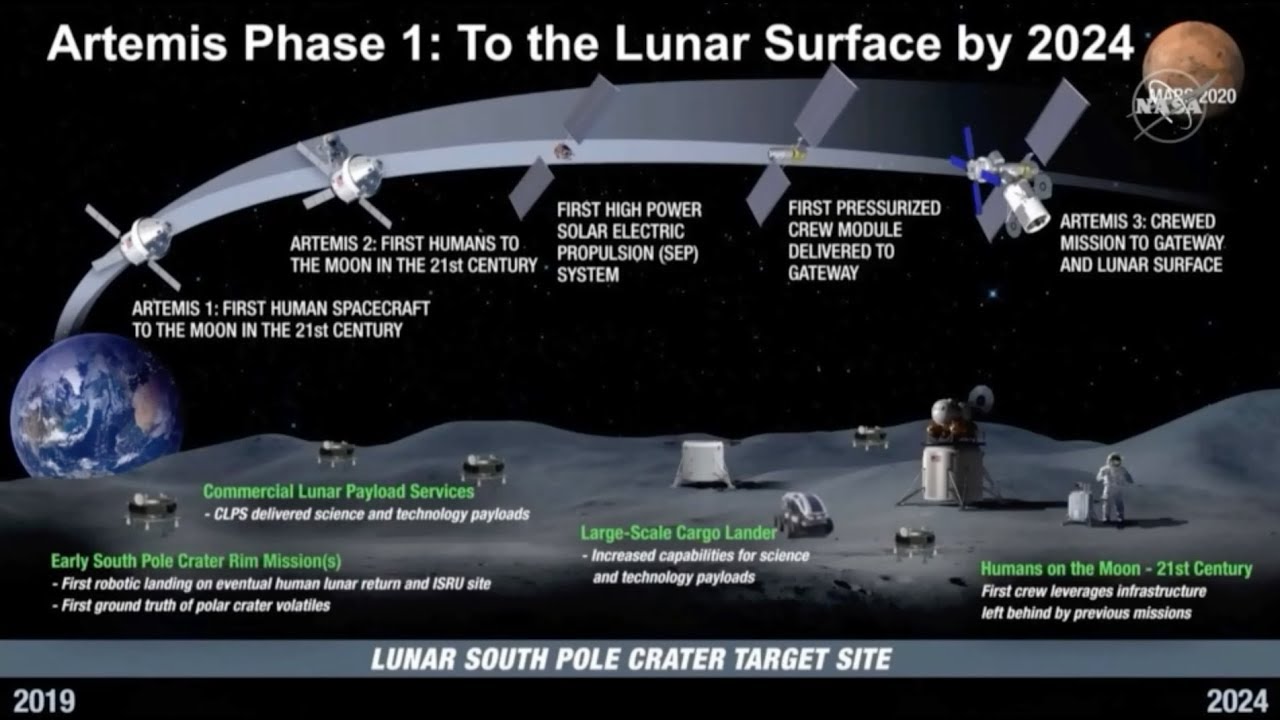
Seeker has videos on both, beginning with NASA’s 2024 Moon Landing Mission Explained | Countdown to Launch.

Fifty years ago, Neil Armstrong took the first steps on the moon. With the announcement of the long awaited Artemis mission, NASA plans to send the first man and woman to the Moon's south pole by 2024.
I hope things go according to the schedule.  Even so, it would mean I'll have been looking forward to this day for 10 years when it happens.

Seeker also covered India's lunar landing mission in India Could Be the First to Land on the Moon’s South Pole.

The Indian Space Research Organization's Chandrayaan-1 was the first to discover water on the moon, and with the Chandrayaan-2, they could be the first to explore the surface on the Moon's south pole. These future discoveries could reveal the evolution of our solar system and beyond.
DW News covered today's launch itself in India moon probe Chandrayaan 2 launches into space.

India is on track to head to the moon today. The rocket that carries the Indian lunar lander Chandrayaan 2 just launched into space. This is India's second attempt to launch the lunar probe after a technical glitch caused the mission to be aborted just one hour before launch last week.
Good luck!

I'm not done with celebrating the 50th anniversary of Apollo 11.  I plan on posting an entry in which I feature videos from both Verge Science and Vintage Space taking the position that the legacy of Apollo is actually hindering U.S. efforts to return to the Moon and go on to Mars.  Stay tuned.

Tuesday, May 21, 2019

A conversation about the Australian election with a reader from Down Under


Bukko Boomeranger and I had quite the conversation about the Australian election in the comments to John Oliver explains trade.  I found it so engrossing that I first responded "Just for you, I might cover it [the Australian election] next week," and finished with "I'll respond to the rest of your comment when I feature it in a post about the Australian elections."  Here are his comments with my responses about ranked-choice voting, mandatory voting, and the outcome of the election.

Here's Bukko's first comment, which he posted before the voting began.
Ah well -- soon off to accost voters (national Parliamentary election today.) It's good fun. Citizens expect to pass through a line of people waving flyers telling them what various parties recommend in Australia's ranked multiple-choice voting system. I try to make it funny, with quips like "If you're sick of the big parties!" or "Who's leaning Green today?" And when the polls close, I'll be "scrutineering." That means watching the Australian Election Commission's paid workers when they unseal the ballot boxes, dump the paper ballots onto a table, sort them by which candidate got the voter's #1 choice, then eliminating the piles with the fewest votes. THOSE ballots are shuffled onto the candidates that each voter marked as their #2 choice, so the person's vote is not entirely ignored. From then, it goes to the top 2 vote-getters, and the winner at that polling station is determined. Combine the results from polling places across the electorate, and bingo! we have a winner. It's pretty quick -- less than 2 hours -- and honest, with observers from Labor, us Greenies, sometimes the Liberals (the conservative party), Socialists or other minor parties looking on. Much better than black box electronic voting. It's one of the reasons I have a bit of faith in this country, because everyone has to vote (or face a small fine) and the counting is done transparently, so who's in Parliament can be said to represent the will of the people.
I knew that Australia had mandatory voting, but I didn't know that the country also had ranked-choice voting.  While I'm not a fan of mandatory voting with fines for not voting, I am in favor of other ways of increasing turnout, particularly by reducing barriers to access.  That's why I was thrilled when Proposal 3 passed here in Michigan allowing same-day registration and no-reason absentee voting.  On the other hand, I am definitely a fan of ranked-choice voting, which I mentioned as an election reform before.  I am so glad to see that it works so smoothly in a major country like Australia.

On the gripping hand (yes, a Motie reference), I'm not sure I'd like to walk through a throng of volunteers trying to get me to vote for their party or candidate on the way to the polling station.  It's bad enough seeing all the lawn signs on the way in, and I'm a fan of lawn signs and have placed them myself the night before an election.

That was about the process.  Follow over the jump for the outcome, which came as a bit of surprise.

Friday, March 15, 2019

Youth Climate Strike on the Ides of March


I knew Wednesday that I would write about something serious today.  I just didn't know what.
There will be little time for DOOM other than this Friday.  Beware The Ides of March!
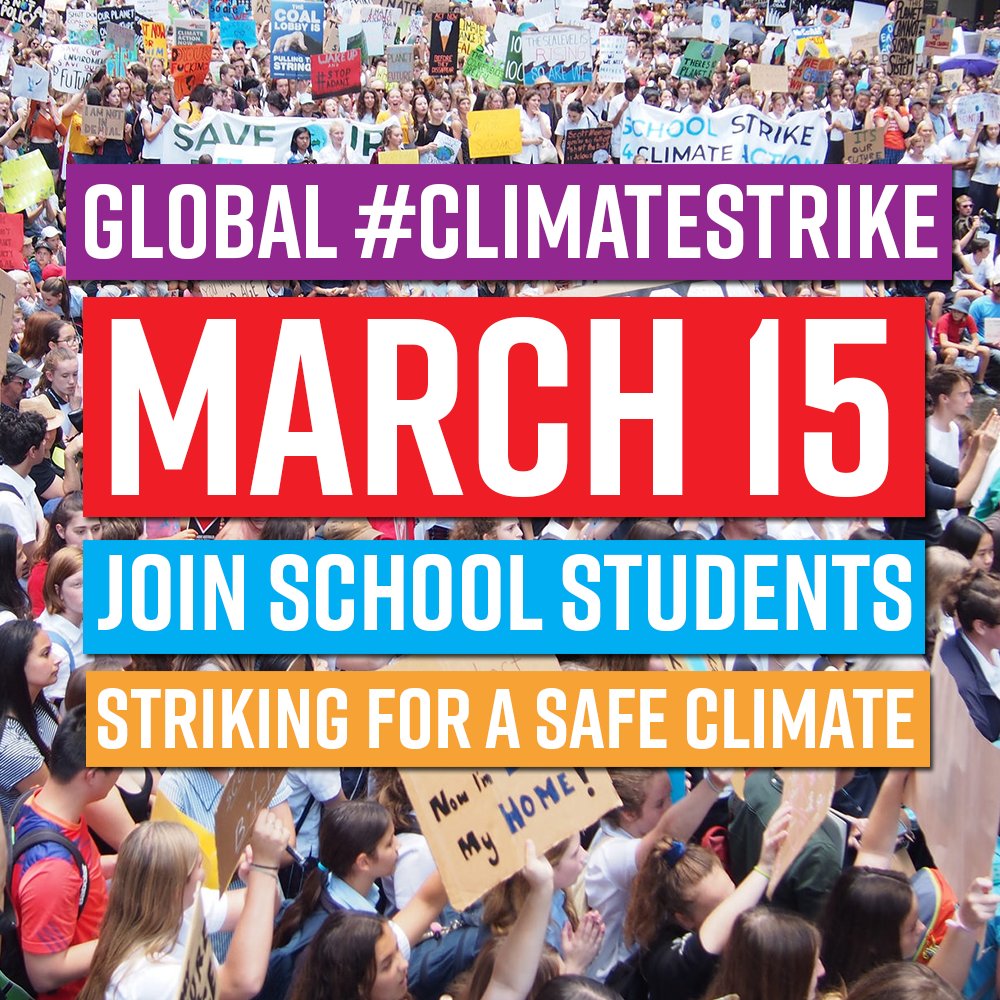
That changed this morning, when I saw that a world-wide event to motivate people to counteract climate change was happening today.  The Years Project has more about it in March 15: Youth Climate Strike.

“Just make a sign and go protest,” says Alexandria Villasenor. On March 15, tens of thousands of kids around the world will be skipping school to fight for their futures.
CBS This Morning featured Miss Villasenor and the Youth Climate Strike in yesterday's Students across the globe to skip school for climate change strike.

Students across America are expected to skip class Friday in the first national school strike over climate change. Similar demonstrations have already swept through Europe and Australia. Friday's protests are planned for more than 130 cities in the U.S. and about 90 countries worldwide. Tony Dokoupil reports.
The other young woman mentioned in the first two videos is Greta Thunberg, who CBS News interviewed yesterday in Teen activist Greta Thunberg on plans for strike against climate change.

Students around the world are planning to skip class Friday to protest for action against climate change. Student activist Greta Thunberg joined CBSN to speak about how her activism has inspired others, and her recent Nobel Peace Prize nomination.
I wish Thunberg luck with her Nobel Peace Prize nomination and the movement she has inspired.

All of the above were in preparation for the Youth Climate Strike.  What about the demonstrations themselves?  Deutsche Welle (German Broadcasting) reported on the protests in Europe and India in 'Fridays for future' marches for climate change going global.

Students in an estimated 100 countries around the world are out on strike today, heeding a call from Swedish climate activist Greta Thunberg. She started a movement called "Fridays for Future" that went global. And today is the biggest day yet for her, and for young activists who have taken her lead.
That's impressive.  I hope the young people protesting change minds and affect behavior.  The climate needs it.

I might follow up on the U.S. demonstrations tomorrow.  Stay tuned.

Sunday, December 9, 2018

A tale of two reports about the state of the climate


I realized today that I wrote a lot about the reaction to the National Climate Assessment but did not look at the report itself.  It's time to correct that oversight by watching Report reveals dire consequences of climate change from CBS News.

A government report released [the] Friday [after Thanksgiving] reveals the dire consequences of climate change. Jeff Berardelli, a CBS News climate and weather contributor, joined CBSN to discuss the report's findings.
That's as bad as anything in the IPCC report that came out earlier this year.  As far as doing something about the situation, another United Nations report came out the next week on progress toward the goals of the Paris Climate Agreement.  It did not have good news.  DW (Deutsche Welle) English uploaded a segment about that in UN climate report warns world lagging on climate goals.

The UN say the world needs to step up its efforts to stop catastrophic climate change, A new report from the United Nations environment agency found greenhouse gas emissions rose in 2017 - after three years of decline. It say the world is losing the race to cap global warming at two degrees Celsius - the target set out in the 2015 Paris climate treaty.
This report came out in advance of COP24, the U.N. climate conference in Poland.  I plan on writing more about that after I post something about the Golden Globes.  After all, it's Sunday, so it's time to kick off awards season with an entertainment feature.