Showing posts with label France 24. Show all posts

Monday, December 30, 2024

'2024 becomes the world's hottest year on record, fueling extreme weather events,' the year in climate and weather

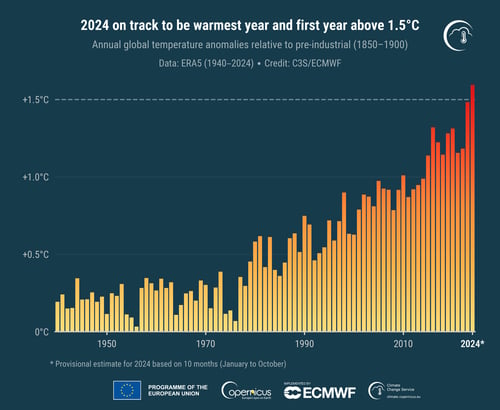
As I promised yesterday, it's time to review the year in climate and weather beginning with France 24 English reporting 2024 becomes the world's hottest year on record, fueling extreme weather events.

In 2024, billions of people across the world faced climatic conditions that broke record after record: logging ever more highs for heat, floods, storms, fire and drought. As the year drew to a close, the conclusion was both blatant and bleak: 2024 was the hottest year since records began, according to European climate scientists. Story by Alice Brogat, Axelle Simon and Eliza Herbert.
Seeing this reminds me of the first two questions I ask my students while watching Chasing Ice.
1. Chasing Ice opens with a montage of natural disasters. Name three of them.
The three that come to mind are floods, fires, and droughts. All of those, along with dangerous heatwaves and stronger hurricanes and tropical cyclones, appear in this report. For what it's worth, those are also among the possible answers to a question I ask about Treasures of the Earth: Power: "What are the expected effects of global warming? List three examples." Back to Chasing Ice.
2. How many of the past 20 years, as of 2012, were the hottest on record?
As of 2012, 16 were the hottest on record. According to the image below, it looks like it's now 17, as 1998, 2002, and 2003 fall outside the past 20 years, although the past ten years remain the hottest decade on record.

Yikes!
First, welcome to the 400 ppm world. Second, are you scared enough by climate change? My readers should be.
Firstpost from India has more, including some good news, in Greening Antarctica, Flooded Sahara: 2024 - Year of Climate Change | Firstpost Earth Year Ender.

2024 has been a landmark year for climate change, with record-breaking heat and extreme weather events dominating the globe. From the Sahara’s rare floods to the Arctic’s rapid melting, the planet is feeling the heat. But there’s hope too—renewable energy is booming, and conservation efforts are gaining momentum. Join us as we reflect on the highs and lows of a tumultuous year.
Good news that I can share with my students, but not nearly enough to inspire me to post Professor Farnsworth. Still, welcome to blogging as professional development.

I conclude with ABC News reporting on the Billion-dollar disasters of 2024.

The National Oceanic and Atmospheric Administration says the total cost of disasters this year was $61.6 billion.
I'm recycling my reaction from 'Weathered: Earth's Extremes' asks 'What Happens When the Land Runs Out?'
I close by recycling another program note from 'The "dirty side" of a hurricane, explained' by Vox.
So far, this season's 18 named storms, including 11 hurricanes and 5 major hurricanes, have borne out NOAA's 'Most Aggressive Hurricane Season Forecast On Record' for 2024, which predicted 17–25 named storms, 8–13 hurricanes, and 4–7 major hurricanes. I might revisit this and other forecasts next month. Stay tuned.
I have two more weeks to do this, so stay tuned for this year's version of 2023 is the hottest year on record and other climate and weather stories. That's when I plan on posting the follow up.
There's been no change since I wrote this, so I think ABC News's report suffices.

It's early enough that I might post an entry about the year's best TV shows today. Stay tuned to see if I do, followed by the overall year in review for New Year's Eve.

Sunday, July 14, 2024

Olympic flame presented to Macron on Bastille Day

Happy Bastille Day, the third patriotic holiday in July I observe on this blog! I begin today's celebration of "Fête Nationale Française" with France 24 English showing Bastille Day parade: Col. Thibault Vallette presents Olympic torch.

France's annual Bastille Day parade wrapped up Sunday with the arrival of the Olympic flame, escorted by riders on horseback, 25 torchbearers, and cadets forming the shapes of the Olympic rings. The main torchbearer is Col. Thibault Vallette, equestrian gold medalist in the 2016 Rio Olympics. Lieutenant-colonel Lucile, Chief operating officer, Land force army command for Europe explains.
I had other plans for today, but saw this story and immediately decided how the Olympics changed the parade to be the theme. That was also the story for France 24 English reporting Bastille Day celebrations: Annual military parade moved due to Olympics.

Thousands of soldiers, sailors, rescuers and medics are marching in Paris Sunday beneath roaring fighter jets to mark Bastille Day. The traditional military parade has however been moved from its traditional route on the Champs Elysees due to preparations to host the Olympic Games, and a smaller military contingent will instead march on the nearby Avenue Foch – one of the most prestigious streets in Paris and one of the most expensive addresses in the world. FRANCE 24’s Sophie Lamotte reports.
At least the parade retained the view of the Arc de Triomphe in the background, even though the participants are marching west by southwest instead of southeast.

France 24 English wrapped up its coverage with French National Day: Bastille Day parade meets Olympic torch relay.

France celebrated military victories of the past at its annual Bastille Day parade Sunday as Paris welcomed the Olympic flame to the city. FRANCE 24's Selina Sykes reports.
Vive la France!

Thursday, June 6, 2024

Biden, Macron, Trudeau, and King Charles observe the 80th anniversary of D-Day

It's the 80th anniversary of D-Day on Throwback Thursday, so I'm sharing videos from the three countries leading the landings plus the host country. I begin today's observance with ABC News video of President Biden speaks in Normandy marking the 80th anniversary of D-Day.

Biden greeted surviving members one-by-one, thanking them for the service on that fateful day.
As an expatriate Californian, who loves entertainment nearly as much as my country and tells my students you can take me out of California but you can't take California out of me, I appreciated the name checks of The Longest Day and Band of Brothers. I'm only surprised he and his speechwriter(s) didn't manage to mention Saving Private Ryan as well. I guess one Tom Hanks show was enough.

I also appreciated how President Biden related D-Day to the present day, especially the domestic fight to protect democracy against authoritarianism at home and foreign aggression in Ukraine. May we be up to the task.

Follow over the jump for videos representing France, Canada, and the United Kingdom at the event.

Sunday, August 13, 2023

WGA returns to the bargaining table, a strike update

I decided to post a strike update for today's Sunday entertainment feature. Awards shows can wait, just like they are in real life. In fact, "the 75th Emmy Awards will now air on Monday, January 15, 2024." That's a four-month delay.

To make up for that information, I have some encouraging news today, as Yahoo Finance reported Hollywood strikes continue as writers, studios agree to restart negotiations on Friday.

The writers union is returning to the bargaining table, agreeing to restart talks with Hollywood studios. Yahoo Finance Senior Reporter Alexandra Canal joins the Live show to provide an update on the state of the Hollywood strikes and the effect that these strikes are having on major studios like Paramount (PARA) and Disney (DIS).
Yahoo Finance featured a lot more management perspectives than I usually include in these posts. I shouldn't be surprised because they cater to investors. DW News presented more of the writers' side when the service asked Writers return to negotiations: Has their strike been successful?

Writers in Hollywood are resuming negotiations with the studios today. So far, both sides have been far apart with revenue-sharing playing a central role. The head of the Writer's Guild previously said the union wouldn't return to negotiations unless the studios were willing to discuss residual payments on streaming services -- something the studios had said was off the table.
As Dan Garza and his puppet Jeff said, these strikes are affecting everyone in Hollywood, not just the actors and writers, to the tune of $3 billion so far. Not all consequences are bad, at least in the short run, as CNBC explained in Why the WGA strike is helping studios combat financial pressure.

James Stewart, columnist at The New York Times, joins 'Squawk on the Street' to discuss how the ongoing writers' strike is helping studios with cost-cutting measures, the content supply pressures created by the WGA strike, and WGA's return to the negotiating table.
In the long run, the studios will need to settle with the actors and writers so that they can produce more content. Until that content runs out, the strikes are saving them money in the short run. It's going to be quite the balancing act for all parties involved.

Until then, new entertainment content will come from sports. The pros are not on strike and college sports will go on as long as there is no return of the pandemic. I might even resume watching sports in the fall. Until then, my wife and I have lots of shows to watch and video games to play when I'm not working.

I conclude with KCAL reporting WGA: Hollywood studios offer counterproposal, but details withheld.

The Writers Guild of America and representatives of Hollywood studios held their first negotiating session Friday since the union went on strike May 2, and while no specifics were released, the WGA told its members that studios offered a "counterproposal" to union demands.
While I still think these strikes are not ending any time soon, there is at least some progress. Stay tuned.

Friday, July 14, 2023

France hosts India on Bastille Day 2023

Happy Bastille Day, the third patriotic holiday in July I observe on this blog! I begin today's celebration of "Fête Nationale Française" with France 24 English asking and answering Bastille Day: What is the meaning of 'Le chant des partisans' ?

France celebrates Bastille Day, which marks the fall of the Bastille prison in 1789, seen as igniting the French Revolution. 'Le chant des partisans' was part of the celebrations. '"Le chant des partisans" is the perfect symbol of resistance during WWII', French Army Major Antoine explains.
I learned something new from this segment and it's always a good day when I learn something new.

India brought its own marching band, which played one of its country's patriotic songs. The Indian Defence Updates channel uploaded Indian Contingent at French Bastille Day Military Parade 2023 featuring that performance.

The Indian military contingent marched to the beats of ‘Sare Jahan Se Accha’ even as a compliment of Rafale fighters of the Indian Air Force (IAF) participated in a flypast over the Champs-Elysees at the Bastille Day Parade. The Punjab Regiment led the march and was followed by the Indian Navy and then the Air Force as the left their mark at the annual parade to mark the historic fall of Bastille in 1789.
The Indian army, navy, and air force units formed the tricolor of the French flag as they marched down the parade route — nice touch!

France 24 English explained the presence of the Indian units in 'The degree of proximity that India and France share on the world stage is virtually unrivalled'.

India is the guest of honor at this year’s Bastille Day parade, with Prime Minister Narendra Modi watching in the VIP tribune alongside French President Emmanuel Macron. About 240 Indian troops led the march down the Champs-Elysees before thousands of French forces, and French-made Indian warplanes joined the traditional flyby above the event. France often showcases international partners on Bastille Day, and the choice of India comes as France looks to further strengthen cooperation on fighting climate change, military sales and the strategic Indo-Pacific region. But human rights were missing from the vast agenda, despite concerns raised by European lawmakers, rights groups and others. Joining FRANCE 24's William Hilderbrandt on Bastille Day is author, economist and commentator on geostrategic affairs Saurav Jha. He is currently the Editor-in-Chief of Delhi Defence Review.
Saurav Jha tried to downplay India as a counterweight to China, but he couldn't avoid the comparisons and contrasts. His point that consumption composes 60% of India's GDP to 30% of China's struck me. What that means is that India is a better market for exporters, which makes it attractive to other countries to not only invest in India to make things, but to sell them, too. That's a selling point.

Follow over the jump for videos about two other holidays that share today with Bastille Day.

Thursday, July 6, 2023

Three hottest days on record this week and it's only Thursday

Climate change is back in the news as France 24 English reported Hottest days on Earth: Third straight day of record-breaking highs across planet this morning.

The last three days marked the hottest days the world has seen -- at least since official record taking began 44 years ago. Scientists though say they were likely the hottest days in centuries and that the record could be broken several more times this year. FRANCE 24's Andrew Hilliar explains.
Chris Hayes on MSNBC reported World records its hottest days ever this week on the first and second days' record average global temperatures last night.

Chris Hayes on the rise of the global temperature: "It's like going from a normal, 98.6 degree body temperature to spiking a 101.3 degree fever. At 101.3 degrees, you are pretty sick—and that metaphor is almost literal because the human body really struggles in high heat."
Bill McKibben's statement that these are the hottest days "since sometime during the last interglacial period 125,000 years ago" reminds me of what I wrote last year: "It's bad enough that we're on track for Pliocene temperatures at current rates of warming." The Sangamonian (in North America) and Eemian (in Europe) would be the first milestones on a temperature journey to 3.6 million years ago, a trip I hope we don't complete.

Speaking of milestones, I'm embedding a tweet from the Keeling Curve Twitter account showing a new atmospheric carbon dioxide record. Welcome to the 400 ppm world.

Thursday, June 8, 2023

Tides are changing for World Oceans Day 2023

Happy World Oceans Day! I've been celebrating this environmental holiday on this blog for ten years, so today marks one full decade of my observing it.

I begin today's tenth anniversary celebration with France 24 English's Climate change: World Oceans Day to mark the significance of the oceans in our daily lives.*

On 8 June World Oceans Day will be celebrated worldwide, serving as a poignant reminder of the immense significance of the ocean in our daily lives. The importance of a healthy ocean cannot be overstated. They are home to 80 percent of the animal biomass, serving as a vital source of sustenance, nutrition and livelihoods for millions of people worldwide.
I was right when I wrote "I might have more on the Global Plastic Pollution Treaty as soon as Thursday," as France 24 English covered it right after talking about climate change and biodiversity. There should be a draft treaty when the delegates meet again in Nairobi later this year.

United Nations Secretary-General António Guterres mentioned the Global Plastic Pollution Treaty in World Oceans Day 2023 (8 June) - United Nations Secretary-General along with other international agreements.

Video Message by António Guterres, Secretary-General of the United Nations, on World Oceans Day 2023.
Here are the initiatives Secretary-General Guterres listed after declaring that "the tides are changing."
Last year, we adopted an ambitious global target to conserve and manage 30 per cent of land and marine and coastal areas by 2030, as well as a landmark agreement on fisheries subsidies.

At the UN Ocean Conference in Lisbon, the world agreed to push for more positive ocean action.

A global, legally binding agreement to end plastic pollution is under negotiation.

And in March, countries agreed to the historic High Seas Treaty on the conservation and sustainable use of marine biodiversity in areas beyond national jurisdiction.

Realizing the great promise of these initiatives requires collective commitment.

Sustainable Development Goal 14 — to conserve and sustainably use the ocean’s resources — hangs in the balance.

This World Oceans Day, let’s keep pushing for action.

Today and every day, let’s put the ocean first.
As a Crazy Eddie, I approve.

Follow over the jump for two videos I missed from last year's celebration that I found worth watching.

Thursday, December 1, 2022

World AIDS Day 2022 from France 24 English and CBS New York


I told my readers that "health coverage will continue [today] on World AIDS Day." I begin with France 24 English on World AIDS Day: Global inequalities pause years of progress on fighting epidemic.*

World AIDS Day is dedicated to raising awareness and remembering those who lost their lives to the illness. Although the world has come a long way in terms of both destigmatising and treating HIV/AIDS, much remains to be done. The United Nations says different forms of inequality are still preventing progress in ending the epidemic. For more, Nathan Lachowsky, assistant public health professor at the University of Victoria, joined us for Perspective.
This video is a reminder that COVID-19 isn't the only pandemic raging; HIV/AIDS has been going for 40+ years. It may serve as an example of how to live with a disease instead of being able to cure and eliminate it. That's part of the message of CBS New York's World AIDS Day honors lost lives and uplifts survivors.

World AIDS Day is an opportunity to uplift the lives of people living with and affected by HIV/AIDS, CBS2's John Dias reports.
On the one hand, Alejandro Santiago's story fulfills my wish: "Here's to World AIDS Day 2022 bringing more good news." On the other, it demonstrates that both COVID-19 and monkeypox have made living with HIV more complicated and diverted both attention and resources to more urgent, if not any more serious, health threats.

I close by hoping that World AIDS Day 2023 brings more good news.

*Once again, France provided the most readers to my blog last month with 15,625 page views to 9,319 from the United States during the past 30 days, so I'm honoring my French readers by leading off with a French news story. Thank you, and keep reading!

Wednesday, August 31, 2022

President Biden on banning assault weapons and funding police in first of three visits to Pennsylvania

I haven't written about guns since 'Teenage Dream' and 'The Lost Class' — two PSAs about gun violence nominated for Outstanding Commercial at the 2022 Emmy Awards a month-and-a-half ago, but the topic is in the news again as CNBC reported in Pres. Biden announces 'Safer America Plan'.

CNBC's Kayla Tausche joins Shep Smith to report on President Biden's unveiling of his 'Safer America Plan, and his challenge to GOP lawmakers who claim to back police, but refuse to condemn the insurrection.
This was a big enough story that France 24 English also covered it in Biden zeroes in on Pennsylvania ahead of midterm elections.

US President Joe Biden will travel three times over the next week to Pennsylvania, including for a speech in Philadelphia Thursday on "the continued battle for the Soul of the Nation," the White House has said. Biden is zeroing in on the northeastern state, where he was born, ahead of midterm elections in November in which his Democratic party will fight to keep control of Congress.
I wish President Biden luck and skill in getting his agenda, whether it's banning assault weapons, funding the police, or keeping Democratic control of Congress. He'll need it.

That ends August's blogging. Stay tuned for the first post of September.

Thursday, July 28, 2022

France 24 English reports on Earth Overshoot Day 2022

Today is Earth Overshoot Day for 2022. France 24 English uploaded two clips about the day, which I'm sharing because they're the largest news source I found reporting on the occasion and because of my many French readers. I begin with Earth Overshoot Day: Humanity used more resources than Earth can generate, which serves as a good overview of the day.

Earth Overshoot Day marks the date when humanity has used all the biological resources that Earth regenerates during the entire year.
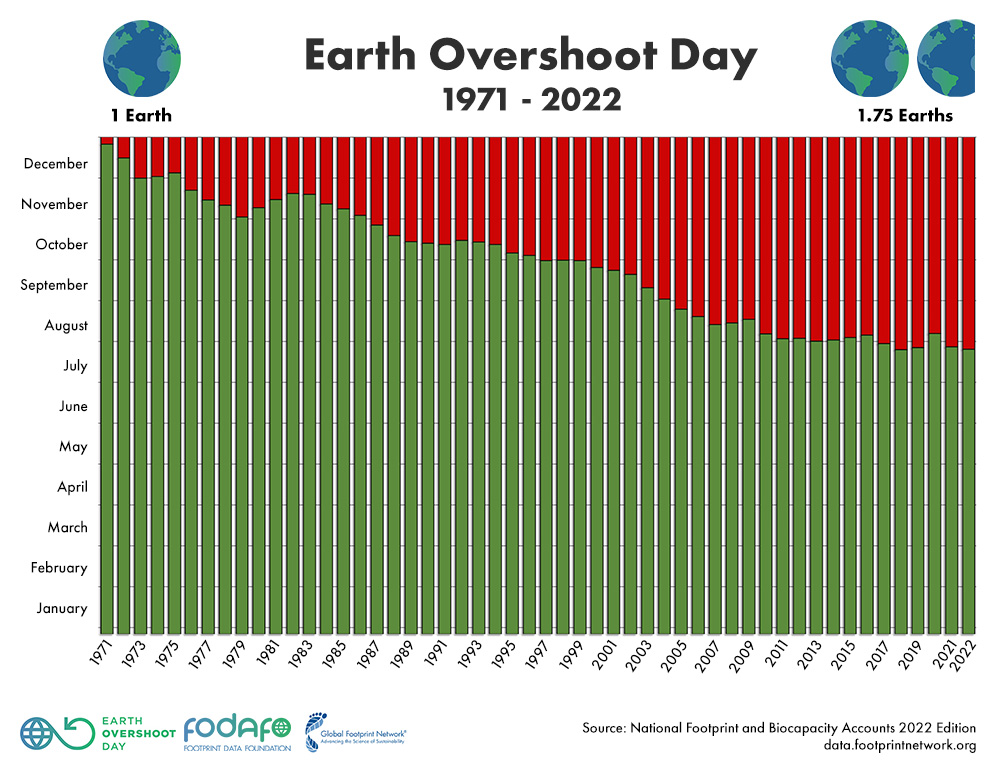
While I knew that today was the day when humanity as a whole began using our reserves, our environmental capital or principal, I hadn't heard the total environmental debt our species had racked up before today, 19 years worth of Earth's productive capacity. Yow!

France 24 English had earlier uploaded an interview of a representative of the Global Footprint Network, which calculates the date every year, ‘Earth Overshoot Day’: Humans surpass what Earth can produce in a year.

Mankind marks a dubious milestone Thursday, the day by which humanity has consumed all Earth can sustainably produce for this year, with NGOS warning the rest of 2022 will be lived in resource deficit.
Today is a dubious milestone indeed.

Normally, I'd calculate my footprint, but I suspect it won't be any better than last year, if not worse, because of increased driving, so I'm sharing the press release from the Global Footprint Network instead.
Earth Overshoot Day 2022 lands on July 28, earlier than last year. Over 50 years of global overshoot have led to a world where aggravated drought and food insecurity are compounded by unseasonably warm temperatures. As the date indicates, humanity continues to widen its annual ecological deficit two years after the pandemic-induced resource-use reductions exceptionally pushed the date back temporarily by 24 days.

“Between the pandemic, wilder weather patterns, and the resurgence or intensification of wars on several continents leading to massive food insecurity, the importance of fostering one’s resource security to support one’s economic prosperity is becoming ever more critical for cities, countries, and business entities,” said Global Footprint Network President Mathis Wackernagel.

Many effective and economically beneficial solutions already exist today to reverse ecological overshoot and support biological regeneration. Opportunities stem from all sectors: commercially available technologies or services, local government’s development strategies, national public policies, or best practices supported by civil society initiatives and academia. The Power of Possibility platform that launched today shows plenty of examples sorted by the five main pillars of intervention: healthy biosphere, energy, food, cities, and population.

For example, moving to smart grids and higher efficiency in our electric systems would #MoveTheDate 21 days. Reducing food waste by half would #MoveTheDate 13 days. Growing trees with other crops on the same land, also known as tree intercropping, would #MoveTheDate 2.1 days, among many others.

Each year, Earth Overshoot Day marks the date when humanity has used all the biological resources that Earth regenerates during the entire year. Humanity currently uses 75% more than what the planet’s ecosystems can regenerate—or “1.75 Earths.” From Earth Overshoot Day until the end of the year, humanity operates on ecological deficit spending. This deficit spending is currently the largest since the world entered into ecological overshoot in the early 1970s, according to the National Footprint & Biocapacity Accounts (NFA) based on UN datasets now produced by FoDaFo and York University.

That's it for today's observance of Earth Overshoot Day. Stay tuned for International Tiger Day tomorrow.

Wednesday, February 9, 2022

Canadian trucker convoy spills over into U.S., blocking Ambassador Bridge between Detroit and Windsor, Ontario

I orginally planned to write about the Oscar nominees for this blog's 5000th post, but a pandemic-related story changed my mind.* I begin with WDIV/Click on Detroit reporting Traffic to Canada blocked at Ambassador Bridge as protest continues.

Traffic heading into Canada is shut down at the Ambassador Bridge as protests continue in Windsor for the second straight night.
That's a surprisingly sympathetic depiction of the protest, one I don't necessarily agree with, especially since I'm on the other side of the issue regarding vaccines and it's causing economic disruption on both sides of the border. France 24 English shows that in Canada 'Freedom convoy': Truck protest leads to halted traffic on key trade bridge.

Canadian lawmakers expressed increasing worry about the economic effects of disruptive demonstrations after the busiest border crossing between the U.S. and Canada became partially blocked by truckers protesting vaccine mandates and other Covid-19 restrictions.
The disruption is even worse in Canada, especially in the nation's capital, Ottawa. We don't have to imagine what that would look like in the U.S., as the Ambassador Bridge blockage shows that it's already here. As I last wrote in Seeker explains the environmental issues and solutions involving rare earth elements, "this touches on [a lesson] I teach my students, all of which connect to Commoner's Laws...everything is connected to everything else, in this case through the global supply chain." WXYZ explained how the blockage of the Ambassador Bridge is affecting the supply chain for auto parts in Day Three: The Ambassador Bridge on the U.S. side remains closed, backups at Blue Water Bridge.

Day Three: The Ambassador Bridge on the U.S. side remains closed, backups at Blue Water Bridge
WXYZ takes this protest seriously and is not that sympathetic to the protesters. In contrast, WDIV/Click on Detroit is more sanguine in Ambassador Bridge protest backups aren't biggest issue for automakers.

Traffic heading to Canada, particularly truck traffic, is delayed and backing up Tuesday (Feb. 8) evening throughout Southeast Michigan. Sky 4 gave a live look in the video player above at the delays near the Ambassador Bridge caused by a Canadian trucker convoy protesting vaccine mandates across the border.
Ah, yes, the chip shortage continues. The diversion of traffic to the Blue Water Bridge between Port Huron and Sarnia and subsequent delay is not causing that, but I'm sure it's not helping.

There's a lot more to this story, including possible U.S. inspiration, funding, and plans to bring it to major U.S. cities including Washington, D.C., so stay tuned.

*That's two days in a row that I've postponed my first Oscar nominations post after writing "stay tuned for the first post about the Oscar nominees" as the conclusion to 'Diana the Musical' leads 2022 Razzies with nine nominations. Man plans and God laughs.

Sunday, July 11, 2021

More on Puerto Rico and statehood vs. independence for National Mojito Day

I told my readers "I might have more tomorrow for Mojito Day, as I ran into several more videos on the subject I want to share," in the middle of An update on Puerto Rican statehood for Piña Colada Day 2021. I begin with France 24 English asking Will Puerto Rico soon become the 51st US state?*

Pedro Pierluisi, who has been governor of #PuertoRico since January 2021, is pushing for the Caribbean archipelago to become the 51st US state. This would put an end to its current status of unincorporated territory and give more rights to its inhabitants. But while the election of Joe #Biden seems to give hope to those who want US statehood, others would prefer Puerto Rico to become completely independent. Our regional correspondents Laurence Cuvillier and Matthieu Comin report.
My longtime readers won't be surprised that the parts about energy and food caught my attention. Hurricane Maria really put energy in the forefront for the island and Samantha Bee looked at the issue in Power to the People | The Great American* Puerto Rico Part 3, one of the videos in the playlist I linked to in Samantha Bee helps update 'Vox on Puerto Rico statehood and John Oliver on territories,' the fourth most read entry of the seventh year of Crazy Eddie's Motie News. I think going solar is the energy path Puerto Rico should take regardless of its choice of status.

As for Puerto Rico producing only 15% of its own food, that's definitely a colonial relationship with the mainland. However, statehood by itself may not improve the situation, as Hawaii also produced only 15% of its own food in 2016 despite being a major agricultural state. That's because most of its farms produced food for export to the mainland and elsewhere. Hawaii's Governor pledged to double local food production by 2020. As correspondent Laurence Cuvillier pointed out, a similar initiative for Puerto Rico shows potential for economic growth. Still, it could be worse; Alaska only produces 4% of its own food, a stat I should tell my students.

CBS News covered much of the same territory, pun intended, in Fighting for Paradise: Puerto Rico's Future, a CBSN Original, late last month.

In the midst of economic, political and climate crises, Puerto Rico has lost nearly 12% of its population over the last decade, mostly to join the 6 million Puerto Rican diaspora now living in the 50 states. Tax incentives meant to lure investments have led some Puerto Ricans to fear that the island is turning into a fiscal paradise for wealthy outsiders, driving even more locals out. Many administrations have pushed for a more prosperous Puerto Rico, but they often blame the territorial status for falling short. Is statehood, independence, or something else the solution? And who gets to decide?

In addition to food, CBS News examined the Puerto Rican government-debt crisis and its effect on the economy. This looks a lot like Michigan's Emergency Financial Manager law and has the same effect on local government. I didn't like it here so I don't like it there.

CBS News has several videos expanding and promoting the documentary, but I'm wrapping up this section instead by repeating what I wrote yesterday: "I have a bad feeling that if the Republicans in Washington D.C. continue to block statehood, sentiment might switch over to free association or outright independence. That would be no be my preferred outcome, but if it's what Puerto Ricans want, then I'll support it, while still being upset at Republicans for making it happen."

Follow over the jump for today's celebration of National Mojito Day.

Sunday, March 21, 2021

Happy International Day of Nowruz and happy 10th birthday of the blog!


Nowruz Mubarak! Happy International Day of Nowruz AKA Persian New Year and happy 10th birthday of the blog!* Since I have concentrated on celebrating this blog's birthday the past three years while downplaying Persian New Year, something I foreshadowed in 2017 when I wrote "I'm going to miss celebrations of Nowruz at The White House," I'm going to reverse my emphasis by sharing material about the holiday first, beginning with BBC News' Nowruz: How 300m people celebrate Persian New Year from 2019.

About 300 million people across the world will celebrate Persian New Year - or Nowruz - on Thursday.

The 3,000-year-old festival begins on the first day of the year in the Iranian calendar, and is also a celebration of Spring.

People in countries including Iran, Tajikistan, Turkey and Iraq will be welcoming the start of the year 1398, explains the BBC's Samar Salekipour.
Since 2019 in the common era calendar was 1398 on the Persian Calendar, that means that that today (or actually yesterday, because the actual celebration is on the Vernal Equinox, not today) is now 1400, the end of one century and the beginning of another. That alone justifies the attention to the holiday that I've neglected to give it the past three years.


The BBC News video did a good job of portraying how Nowruz is celebrated during normal times. These are not normal times. France 24 English shows how people are celebrating Nowruz in Persian New Year Nowruz festivities go online because of the pandemic.


I didn't see a message from The White House, but I did see Prime Minister Trudeau's message on Nowruz, so I'm sharing that.

Prime Minister Justin Trudeau wishes everyone celebrating a happy and healthy Nowruz.
Nowruz Mubarak to you, too, Mr. Prime Minister.


Ten years ago today, I posted First post: Why this blog? Since then, I've written 4,673 entries including this one. That's worthy of a bigger celebration than I'm giving it today. Don't worry. I will give the anniversary the attention I always do, with statistics on Tuesday, followed by retrospectives on (Throwback) Thursdays and (Flashback) Fridays all the way through April. That will begin after I celebrate World Water Day tomorrow. Stay tuned.

*Today is also the 15th birthday of Twitter, sort of. I'll celebrate that event when I write about the blog's year on Twitter next month.

Thursday, December 10, 2020

World Food Program wins Peace Prize and the winners for economics, science, and literature on Nobel Prize Day 2020

Happy Nobel Prize Day! Today, the anniversary of Alfred Nobel's death in 1896, is the day the Nobel Prizes for peace, economics, medicine, physics, chemistry, and literature are presented to their recipients. Normally, that ceremony would take place in Stockholm, Sweden, for all the prizes except the peace prize, which would happen in Oslo, Norway, but because of the COVID-19 pandemic, the presentation happened remotely.

I begin today's coverage of the prize winners with World Food Program Wins 2020 Nobel Peace Prize from Now This.

This year's Nobel Peace Prize went to the World Food Program, a UN org that combats hunger worldwide by helping feed nearly 100M people across 88 countries.
Bloomberg Quick Take had a worse video, but a better description that expanded on the reasons for the World Food Program earning the award.
The organization is being honored “for its contribution to bettering conditions for peace in conflict-affected areas and for acting as a driving force in efforts to prevent the use of hunger as a weapon of war and conflict,” the Norwegian Nobel Committee said on Friday.

The need for international solidarity and multilateral cooperation is “more conspicuous than ever,” the committee said. The World Food Program is the world’s biggest humanitarian group to specifically address hunger and to work toward food security, it said.

Last year, the World Food Programme helped close to 100 million people in 88 countries in the face of acute food insecurity and hunger. The WFP is also the main body through which the United Nations works toward eradicating hunger as one of the Sustainable Development Goals.

The committee chose to highlight hunger in this year’s peace prize after a deterioration in circumstances over recent years. In 2019, 135 million people suffered from acute hunger, the highest number in many years, it said. Most of the increase was caused by war and armed conflict.
This isn't the first time someone trying to feed the world earned a Nobel Peace Prize. The other that I have mentioned on this blog is Norman Borlaug, who received the Nobel Peace Prize in 1970 for his contributions to the Green Revolution. I teach about both Borlaug and the Green Revolution in my classes. When I return to the classroom, I plan on adding the World Food Program to that lecture.

I'm continuing with the youngest award, "The Sveriges Riksbank [Swedish Royal Bank] Prize in Economic Sciences in Memory of Alfred Nobel," instituted in 1969. Stanford economists Paul Milgrom and Robert Wilson react to winning the Nobel Prize in economics tells their story.

The Royal Swedish Academy of Sciences cited the pair for improvements to auction theory and inventions of new auction formats.
This video shows that auction theory isn't just an academic interest; it applies directly to government functions as exemplified by the auction of radio frequencies. The airwaves are public property, which is why the government regulates broadcasters through the Federal Communications Commission and auctions off radio frequencies. Auction theory is one way of insuring accountability and transparency in the process.

Follow over the jump for this year's science and literature prize winners.

Tuesday, December 10, 2019

Celebrate achievements in diplomacy, science, economics, and literature on Nobel Prize Day 2019


Happy Nobel Prize Day!  I begin this year's observance the same way I did last year, with the winner of the Peace Prize.  Watch DW News (Deutsche Welle or German Broadcasting) answer Nobel Peace Prize 2019: Who is Abiy Ahmed?

Ethiopian Prime Minister Abiy Ahmed has been announced as the winner of this prestigious award for his work to resolve the border conflict with neighboring Eritrea. Ahmed was up against around 300 nominees. The Norwegian Nobel Committee made the announcement in Oslo. Earlier this week, the Nobel prizes in the fields of Medicine, Physics, Chemistry and Literature were also awarded.
Congratulations to Prime Minister Ahmed and thanks to the Nobel Prize committee to get me to write about East Africa, a region I have generally and probably unjustly ignored.

Follow over the jump for the rest of the laureates.

Sunday, June 16, 2019

U.S. birth and fertility rates continue falling and setting record lows for Father's Day


Happy Father's Day!  Just as I did last year, I am "writing about the lower birth rate for Father's Day, even though that is usually considered a concern of mothers.*

Just like last year, the birth rate hit another record low, as CBS News reported last month.

America's baby bust isn't over. The nation's birth rates last year reached record lows for women in their teens and 20s, a government report shows, leading to the fewest babies in 32 years. The provisional report, released Wednesday and based on more than 99% of U.S. birth records, found 3.788 million births last year. It was the fourth year the number of births has fallen, the lowest since 1986 and a surprise to some experts given the improving economy.
Gizmodo included even more facts in its article on the subject.
[T]he national birthrate, measured as the number of births per every 1,000 women between the ages of 15 to 44, also took a drop for the fourth year in a row. Overall, the country hasn’t seen this few births since 1986.
...
There’s also been a continuing decline in the fertility rate, defined as the number of children a woman has over her lifetime. In 2018, the rate was 1.72 births per every woman, a decline from 1.76 births in 2017. Experts consider a rate of 2.1 births to be a baseline for ensuring that younger generations can continue to replace the aging population with no problems, a threshold the U.S. has consistently failed to meet for a decade.
I found the CBS News report, while good on the facts, short on analysis.  That's not the case with the following clip from KSNT News from Topeka, Kansas, Report shows U.S birth rate is declining.


In addition to the reasons for the declines among most age groups and increases among older women, the expert from the Cleveland Clinic connects the increase in premature births to the trend towards delayed childbirth.  That's decent analysis of the data.  Still, it misses some of the economic dimensions of both the causes and effects of lower birth and fertility rates.  For those, I turn to Gizmodo.
But there are likely other worrying things that are making pregnancies among women in their 20s less common, namely the lingering after-effects of the Great Recession. Research has consistently linked a struggling economy to fewer births, and in the U.S., this latest decline began in 2008, when the recession hit.

While some people’s financial fortunes (mostly the rich) have since recovered and the economy as a whole is considered healthy, it’s people in their 20s who are often still struggling to stay afloat. And this financial stranglehold is clearly affecting some young adults’ plans for parenthood. A 2018 survey commissioned by the New York Times, for instance, found that nearly two-thirds of adults cited the expenses of child care as a reason for not having children. In fact, it was the most commonly-cited reason.
I first made this point in Next Media Animation thinks low birth rates in the U.S. and China aren't all good eight years ago.  I expected that as the economy improved, birth rates would pick up.  That hasn't happened.

Gizmodo also analyzes the possible effect of lower fertility rates.
Again, as with the birth rate, this isn’t necessarily a doomsday scenario. Many similarly wealthy countries, such as Canada, have rates even lower than that. In some ways, a lower fertility rate could be viewed as a sign that an industrialized country is doing relatively well. It can mean, as mentioned above, that more women have the reproductive freedom to have (or not have) children at their choosing. The closer the birth rate becomes to that of countries like Greece and Japan, though, the more trouble that could spell in the future, with a growing aging population that can strain a country’s resources and labor shortages.
That's a concern elsewhere as well, as France 24 English reported in Drop in world fertility rates leading to 'baby bust' last year.

Women are having fewer babies in developed countries. That's the conclusion of a new global report that warns the current population in some of the world's wealthiest nations can't be maintained at the current birth rate.
I'm ambivalent about this development, as I wrote last year.
I have been in favor of zero population growth for as long as I can remember.  However, I'm not sure the U.S. economy is set up for a stable or slowly declining population, a point I made in the Hipcrime Vocab: Why Slowing Population Growth is a Problem.  We are going to have to figure how to do so.  Otherwise, I might live long enough to experience the wisdom of the saying "Be careful what you wish for; you might get it."
I repeated a similar sentiment in my comment on Going South at Kunstler's blog last month.
It always struck me as odd that, if the economy is supposedly so good with a 50-year low unemployment rate, U.S. birth and fertility rates are falling and the fertility rate is at a record low.  The answer is that, as our host pointed out, the economy isn't actually that good because it's unequally distributed.  On the one hand, it's leading us (as in the U.S.) to do our part to slow the growth of population and affluence, the P and A in I (impact) = P * A * T, where T is technology, which ideally could counteract the effects of the other two variables.  On the other, I and other advocates of zero population growth should be careful what we wish for.  We might not like how we get it.
That includes accepting more immigrants to counteract lower population growth and stagnant or shrinking economies.  I'm O.K. with that, but Trump is in office in large part because many Americans are not.

Enough finding a dark lining in a silver cloud.  It's Sunday, so it's time for an entertainment feature.  As I promised on Mother's Day, "I'm saving Star Wars names for Father's Day.  Stay tuned."

*That written, there are "Men Going Their Own Way" (MGTOW) types who are allies of the men's rights advocates (MRAs) that I criticized in Recycled comments about the men's rights movement that are cheering this development in the comments to the videos I posted because it means men are avoiding marriage, fatherhood, and child rearing and support.  They're not entirely wrong factually, although I think they are wrong morally as well as giving themselves and men in general too much credit.