Showing posts with label eye. Show all posts

Thursday, August 30, 2018

Oil prices going up again because of Iran sanctions, highest gas prices since 2014, and driving update for August 2018: Pearl


Pearl's odometer rolled over 42,000 miles yesterday, so it's time for another driving update.  Before I do, I'm repeating what I did in May, examining the effect of the U.S. leaving Iran nuclear agreement pushes on oil prices.  For that, I turn to Reuters, which reported yesterday Oil rises on Iran sanctions, lower U.S. fuel inventories.
Oil prices rose on Thursday, extending gains on growing evidence of disruptions to crude supply from Iran and Venezuela and after a fall in U.S. crude inventories.

Benchmark Brent crude oil LCOc1 was up 50 cents a barrel at $77.64 by 1130 GMT. U.S. light crude CLc1 was 40 cents higher at $69.91.

Brent has risen by almost 10 percent over the past two weeks on widespread perceptions that the global oil market is tightening and could run short in the next few months as U.S. sanctions restrict crude exports from Iran.

Iranian crude exports are likely to drop to a little more than 2 million barrels per day (bpd) in August, against a peak of 3.1 million bpd in April, as importers bow to American pressure to cut orders.
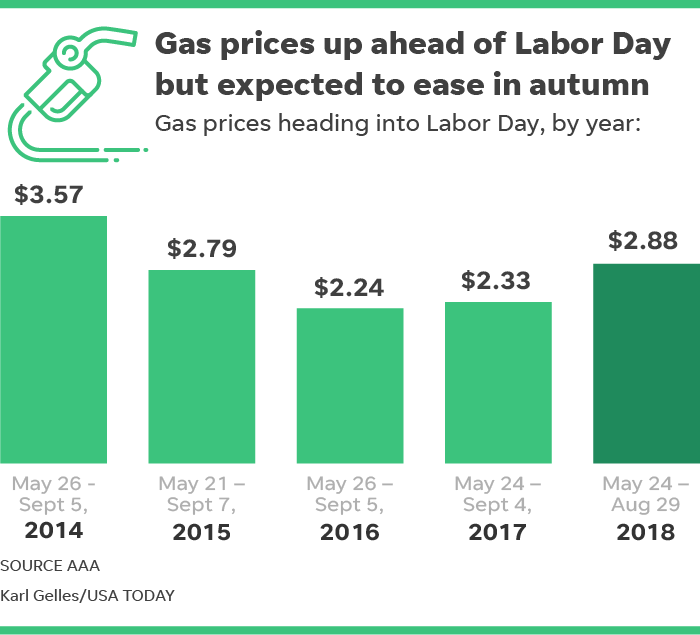
U.S. light crude, also known as West Texas Intermediate (WTI), has been around $70/barrel since May.  The bad news is that is high; the good news is that it hasn't gone higher — yet.  Just the same the result has been the highest gas prices in four years, as USA Today reported this morning in Gas prices: After most expensive summer since 2014, expect some relief at the pump.
Gasoline prices could tick higher heading into the Labor Day weekend, but motorists are expected to get a reprieve this fall.

The coming relief would be welcomed by travelers and commuters, who endured the most expensive summer at the pump since 2014, according to AAA.

As the final busy travel weekend of the summer approaches, Americans are paying about $2.84 a gallon, 46 cents more than a year ago. That amounts to $6.90 extra per 15-gallon tank.

But barring a disruptive hurricane or international incident that could push up energy prices, drivers are likely to pay less at the pump this fall.

AAA is forecasting that prices this autumn could average $2.70, down from a 2018 high of $2.97 around Memorial Day.
As I wrote six years ago, Eye spy the gas price rollercoaster about to coast down like a parachute.  Of course, it does that every autumn, so USA Today and I can predict lower gas prices with confidence.  Doing so won't take away that gas prices this fall will still be higher than during the same season over the past four years.

Now for the driving update.  From July 17th to August 29th spanned 43 days, so I drove Pearl an average of 23.26 miles per day, 709.3 miles per standard month, and 8,488.4 miles per year over that time.  That's a lot more than the 15.15 miles per day, 462.12 miles per standard month, and 5530.3 miles per year I drove her between May and July.  It's also more than the  16.39 miles per day, exactly 500 miles per standard month, and 6905.4 miles per year I drove Pearl during the comparable period last year.  That's because, instead of flying to the Coffee Party USA's annual board retreat, I drove across the state.  In the grand scheme of things, that probably made my carbon footprint lower than if I had flown to Colorado, our usual location for these meetings, but that's just a justification.  Still, that trip did not push my actual miles driven per year above 7,000, as it took 398 days since Pearl passed 35,000 miles on July 27, 2017 until she rolled over 42,000 miles yesterday for averages of 17.59 miles per day, 535.0 miles per month, and 6,419.6 miles per year.  Hah, despite my driving to the other side of Michigan and back, I'm still below my goal of driving an average of 6,500 miles per year.  Success!

Stay tuned for the last post of the month, which will continue the series about this year's Emmy nominees.

Sunday, September 27, 2015

Insane Clown Posse's lawsuit against the FBI will proceed


Three years ago, I wrote FBI declares ICP and Juggalos a gang; ICP sues.  It turned out that headline was premature.  The scary musical clowns from Detroit were just preparing for a suit.  They didn't actually file until January 2014, as this WXYZ video shows.


The case went to court in June 2014.  The ACLU of Michigan reported their side of the procedding in I'm a Juggalo, Not A Gang Member: Update on the Case.

The ACLU of Michigan was in court on Monday, June 23 where a federal judge heard arguments in our lawsuit with the Insane Clown Posse. The lawsuit challenges the FBI's erroneous and arbitrary designation of all fans of ICP, known as Juggalos, as a "hybrid" criminal gang.
The judge dismissed the suit on the grounds that the plaintiffs did not show any damages.  ICP and the ACLU of Michigan appealed the decision.  Two weeks ago, they got good news.  NBC reported Insane Clown Posse Lawsuit Wins Appeal in Suit Against FBI for 'Gang' Designation.
A federal appeals court has ruled in favor of the Insane Clown Posse in their bid to get the FBI to remove the Detroit hip-hop duo's followers — known as "Juggalos" — from a gang list.
...
 The lawsuit, filed in January 2014 with the American Civil Liberties Union of Michigan, was later tossed out by a district court in Michigan after it found the plaintiffs had failed to show they suffered any injuries.

But the federal appeals court on Thursday reversed that district court's decision and ordered that the case be considered.
ICP saw this as a major victory, as seen in Rolling Stone's quote from the band's statement.
“We're thankful that the Juggalo family will finally get their day in court," the duo said in a statement on their official site following Thursday's ruling. "Discrimination against someone based solely upon the type of music they listen to is just flat out wrong and it’s time that the legal system acknowledges that. The FBI's labeling of Juggalos as a gang has wreaked havoc on thousands of lives, resulting in job losses, dismissal from military service, eviction, lost child custody and constant harassment and profiling from law enforcement organizations all across the country."
This could still take a while, as no court date has been set.  Stock up on popcorn, as the suit may be even more entertaining than an ICP concert.

Thursday, April 10, 2014

Social media for the second and third year of Crazy Eddie's Motie News


I concluded Stories I tell my students from the third year of Crazy Eddie's Motie News with an optimistic program note.
I have one more retrospective to write about the third year of this blog and it's about social media.  After that, I have one or two retrospectives remaining to mop up the second year and then I'm done until next March.  I see a light at the end of this tunnel, and it's not an onrushing train!
This year's top entry about social media was We reveal ourselves on Facebook posted on March 22, 2013 with 255 page views, good enough for 20th place among all the entries posted during the third year of this blog.  I didn't bother to promote it at Kunstler's blog when it was new, instead concentrating on all the other entries for the week.  Instead, I waited until I posted in the comments to the first entry using the new format.
“we, in effect, already spy on ourselves and “snitch” on others on Facebook”

Notice that no one, so far, has entered in their Facebook URLs, not even Aimlow Joe, who put in something, but it wasn’t valid. I’m tempted to do so just to be the first here, but I’ll pass. I don’t want to have a first here that badly.

Speaking of which, we reveal more than we know about ourselves based on our Facebook activity.
That effort did get at least 100 page views to the entry.  As for the open commenting system that included Facebook and Twitter, it was replaced by one that required registration within a month.   So much for revealing our social media to each other!

Follow over the jump for the top social media entry of the second year of the blog.

Monday, March 24, 2014

The Deep State spies on itself and others


Kunstler has spent the past week talking about the "Deep State," first in Deep State Descending and again in Deep State Blues.  In both of them, he's complaining about the U.S. role in Ukraine and how Americans are (not) dealing with it.  However, he really doesn't go into the idea of the "Deep State" much beyond using it in the title except for mentioning how the U.S. was involved in destabilizing Ukraine in the first place.*  That meant that he ignored a really good example of the Deep State, a Turkish term for what is otherwise called a "'state within the state'...a political situation in a country when an internal organ ("Deep State"), generally from the armed forces, intelligence agencies, or police, does not respond to the civilian leadership," the alleged spying by the CIA on staff of the Senate Intelligence Agency.  I came across a story about that two Saturdays ago that I included under "Science Crime Scenes" in Overnight News Digest: Science Saturday (Happy Pi Day) on Daily Kos.  Take it away, Temple University!

Temple student exposes alleged spy activities in U.S. Senate
March 12, 2014
A senior journalism student has broken a major, national news story she believes exposes an example of government officials operating secretly, away from the accountability of the public eye.

Ali Watkins, 22, of Fleetwood, Pa., co-wrote a March 4 article for McClatchy DC News that details an apparent feud between the CIA and the Senate Intelligence Committee over a congressional report on the CIA’s “secret detention and interrogation program.” The article cites sources who say the CIA monitored computers Senate aides used to prepare the report.

That story (and several more to come) was the result of tips Watkins received from unnamed sources with whom she has developed trusting relationships since she began reporting for McClatchy’s Washington bureau as an intern in May 2013. Watkins currently freelances for the bureau and hopes to work as a reporter in Washington, D.C., after graduating from the School of Media and Communication in May.
Welcome to the Deep State, Senators.

Follow over the jump for more in this vein, including another example of Green is the New Red and how the Deep State was fought the last time it became an issue.

Wednesday, February 12, 2014

Earth and Moon from Mars and other space and astronomy news


Just like last week, when the real top story for space was NASA and Super Bowl, this week's top story was Space and climate at Sochi followed by NASA on California drought and other drought and water stories.  Even after two entries, there were a lot of space and astronomy stories left.  Since something has to lead, I give the honor to Space.com for Curiosity Sees Earth and Moon From Mars | Video.

The Mars Science Laboratory captured imagery of the brightest object in its twilight sky, Earth and its orbiting Moon. The rover's Mast Camera imaged them on January 31st, 2014, its 529th day on the Red Planet.
That's not scientifically significant, but the image is important for its emotional impact, as it gives another perspective on our home planet.  Besides, it's really cool.

Follow over the jump for more from NASA and Space.com on last week's space and astronomy news.

Monday, December 23, 2013

SciFi is now: Revenge porn, a 21st Century crime


As I wrote in 21st Century crime scenes from KPBS, “We may not have flying cars, but we are starting to have crimes right out of Johnny Mnemonic.”  I also remarked in E-Cigs: A 21st Century health issue, “technology is providing new opportunities to run afoul of the law in ways that were in science fiction 20-30 years ago.”  Here is an ongoing story about one such crime that is being covered by KPBS.

First, the video and story that I included in Overnight News Digest: Science Saturday (Jade Rabbit lands on Moon).

What's Happening Now With San Diego Man's Arrest For Revenge Porn Website

A San Diego man was arrested Tuesday on charges related to operating a revenge porn website. It's the first bust of its kind since California criminalized revenge porn earlier this year.
San Diego Man Arrested In Connection With Revenge Porn Website
By David Wagner
Tuesday, December 10, 2013
Kevin Bollaert, 27, allegedly owned and operated ugotposted.com, one of the most notorious examples of revenge porn. It allowed users — often vindictive ex-boyfriends — to anonymously upload nude photos of women without their consent.

The site connected photos with identifying information about the women pictured, including their names, ages and Facebook profiles. Victims reported being harassed and intimidated by the site's visitors.
Follow over the jump for more.

Sunday, December 22, 2013

SciFi is Now: Minority Report edition


As I wrote in Psychology on Facebook, it’s “Time for another reminder that we reveal ourselves on Facebook and there is no such thing as a free lunch on Facebook.”  In this case, it’s through an article from UCSD that I originally included in Overnight News Digest: Science Saturday (Jade Rabbit lands on Moon) (yes, I’m still catching up from when I was grading) and a video from Discovery News.  I’m reversing my usual order of “if it moves, it leads” by presenting the UCSD press release first.

Hipster, Surfer or Biker? Computers May Soon Be Able to Tell the Difference
Researchers develop algorithm that uses computer vision to identify social groups
By Ioana Patringenaru
December 10, 2013
Are you a hipster, surfer or biker? What is your urban tribe? Your computer may soon be able to tell. Computer scientists at the University of California, San Diego, are developing an algorithm that uses group pictures to determine to which of these groups, or urban tribes, you belong. So far, the algorithm is 48 percent accurate on average. That’s better than chance--which gets answers right only nine percent of the time--but researchers would like the algorithm perform at least as well as humans would.

An algorithm able to identify people’s urban tribes would have a wide range of applications, from generating more relevant search results and ads, to allowing social networks to provide better recommendations and content. There also is a growing interest in analyzing footage from cameras installed in public spaces to identify groups rather than individuals.

Computer scientists presented their findings at the British Machine Vision Conference in the United Kingdom this fall.
Discovery News explains what this means in New Software Tells If You're A Hipster.

There's a new piece of software out there that can identify a whole lot more about you than your name via Facebook. By analyzing a photo of you alone, it can accurately predict intimate details about your life. Anthony explains how it works and if you should fear- or embrace- this new tech.
Welcome to the world of Minority Report, where technology scans you and costumizes ads for you, but also tracks you.  So it’s not your retina, but your photos on social media.  It’s good enough that I can repeat my mantra and then Nebris’s: “We live in Science Fiction times” and “SciFi is Now.”

Sunday, December 15, 2013

Spygames and paranoia 2: The World of Watchcraft


I finished Spygames and paranoia 1: No that's not Cthulhu on the patch by pointing out that people were worrying about the wrong thing.
If they want something to freak out about, it's the spying going on inside the World of Warcraft.  That's real.  It's also silly.  Stay tuned for more on this story.
I then procrastinated more at the end of Forging an Urak-Hai: an educational experience.
I looked for a text story to accompany this video, but instead found Orc And Dagger: U.S. Reportedly Spied On Gamers Online about the story I promised to cover as part two of Spygames and paranoia 1: No that's not Cthulhu on the patch.  I'll use that one in the morning.  Right now, I'm going to bed.  Good night!
Here it is, the morning of the next day, and I've already used that story in Overnight News Digest: Science Saturday (Jade Rabbit lands on Moon), so it's finally time to post it here.

NPR via KPBS: Orc And Dagger: U.S. Reportedly Spied On Gamers Online
Bill Chappell / NPR
Monday, December 9, 2013
U.S. and British intelligence agencies have worked to infiltrate networks of violence-prone individuals who might unite for a common cause. And in some cases, the spies are also targeting networks that aren't regional terrorist cells -- they're online gaming communities, according to the latest revelation from documents given to the media by former NSA contractor Edward Snowden.

"Exploiting Terrorist Use of Games & Virtual Environments" is the name of a 2008 NSA document being cited in coordinated reports out Monday from The Guardian, ProPublica and The New York Times.

The reports describe spy agencies' push to infiltrate systems that allow millions of people to closely collaborate and even exchange money -- all through a veil of alternate identities.

The project involved spies creating identities in networks that include Second Life and World of Warcraft, according to the reports. Another arm of the work is said to have collected massive amounts of data from Microsoft's Xbox Live network and elsewhere.

The effort was not a small one, the news agencies report. In fact, so much anti-terrorism work was being conducted in the virtual worlds that a separate "deconfliction" group was tasked with monitoring spies from the CIA, Pentagon, and FBI so that they wouldn't interfere with -- or waste time spying on -- one another, according to Pro Publica.
This is a silly project for various reasons.  The more serious objections were raised in the New York Times story, summarized here by two reporters having a chat on WOW in character, pun intended.  Follow over the jump for the video.

Saturday, December 14, 2013

Forging an Urak-Hai: an educational experience

I'm still in an "I can't be all DOOM all the time" mood, so I'm responding to another event of yesterday, the premiere of the second Hobbit movie, to present How To Make An Orc Sword For Extra Credit from KPBS.

KPBS arts reporter and resident geek Beth Accomando visits the Grossmont College foundry where one sculpture student was making an orc sword, specifically a Uruk-Hai scimitar.
I looked for a text story to accompany this video, but instead found Orc And Dagger: U.S. Reportedly Spied On Gamers Online about the story I promised to cover as part two of Spygames and paranoia 1: No that's not Cthulhu on the patch.  I'll use that one in the morning.  Right now, I'm going to bed.  Good night!

Wednesday, December 11, 2013

Spygames and paranoia 1: That's not Cthulhu on the patch

I included a story in Overnight News Digest: Science Saturday (Die, Selfish Gene!) that has been inspiring suspicion, if not downright paranoia.  The odd part is that it's the publicity that's doing this as much as the secrecy.  First, here's the U.S. Air Force showing the Atlas V NROL-39 Launch.

The United Launch Alliance (ULA) have launched their Atlas V rocket on the NROL-39 mission for the National Reconnaissance Office. Liftoff from Vandenberg Air Force Base in California was on schedule at the opening of the launch window at 23:13 local time Thursday (07:13 UTC on Friday).
KPBS has more in Atlas V Rocket Launches From California Air Base On Top Secret Mission (Video) By Beth Ford Roth on Friday, December 6, 2013.
A 19-story tall rocket called the Atlas V launched from California's Vandenberg Air Force Base late Thursday night, carrying a top secret payload for the U.S. government's National Reconnaissance Office.

The mystery payload is the size of a loaf of bread, and weighs just 11 pounds, according to American Forces Press Service.
So far, it's a run of the mill reconnaisance mission, although I'm surprised that an Atlas V is launching such a small payload.  According to Wikipedia, the rocket is capable of lifting much larger objects to geosynchronous orbit.*  That's not what's freaking people out.  This is.


That prompted a user on Daily Kos to call it Cthulhu and point it the mission's motto, "Nothing is beyond our reach."  Sorry, that's just an octopus, not Cthulhu, and the motto is just another military badass boast.  That didn't stop people from thinking the worst.

The next day, there was an entire thread about the mission on Daily Kos.  I'm not going to quote any of it; you'll just have to see for yourselves the level of distrust and outright paranoia the patch alone is eliciting.

Yesterday, Elaine Meinel Supkis jumped on the bandwagon with NROL-39: The Evil Octopus Emblem Perfect For Bilderberg Gang Controlling US Citizens.  I'm taking this as yet another sign that Elaine has lost the plot.  Too bad.  Once upon a time, I really enjoyed her writing and was delighted to be in her virtual company.  No longer.

Just the same, I think everyone is going nuts over the symbolism, not the substance.  I'm sure it's another surveillance mission of other countries, not a domestic spying instrument.  If they want something to freak out about, it's the spying going on inside the World of Warcraft.  That's real.  It's also silly.  Stay tuned for more on this story.

ETA: Follow over the jump for some answers to my question about the size of the payload and the nature of the mission.

Sunday, September 30, 2012

Science prizes from the ridiculous to the sublime

It's science award season and the past two Science Saturdays on Daily Kos have reflected that by including stories about the silliest and most respected science prizes. Last week's lead story described the IgNobel Prizes. From the L.A. Times.

Ig Nobel Prizes honor research on why coffee spills when you walk
By Karen Kaplan
September 21, 2012, 1:04 p.m.
The Nobel Prize. The Lasker Prize. The Fields Medal. The MacArthur Fellowships (a.k.a. “the genius grants”). The Kavli Prize. The Ig Nobels.

Among the various awards given for scientific achievement, the Ig Nobels may not be the most coveted — but they’re certainly the most fun. The winners are selected by the Annals of Improbable Research to recognize breakthroughs that first make you laugh, then make you think. “The prizes are intended to celebrate the unusual, honor the imaginative — and spur people's interest in science, medicine, and technology,” according to the organization’s website.

The 2012 Ig Nobels Prizes were handed out Thursday night at Harvard University, a place that knows a thing or two about academic achievement. Winners traveled from as far away as Russia, Japan, Rwanda, France and California to participate in the celebration, and no fewer than five actual Nobel Laureates were on hand to serve as presenters.
My former hometown's newspaper liked the study of coffee spilling, but other news reports preferred the physics of ponytails when writing their headlines.

Of course, the IgNobel Prizes are parodies of the Nobel Prizes. Usually, they're awarded the next week. That's not the case this year, but that didn't prevent people from writing about them. Here's the editor of The Web of Science, which used to be the Science Citation Index, giving his forecast of Nobel Laureates based on how many times their papers have been cited by others.

Huffington Post: Naming the Nobels: Predicting the World's Most Prestigious Prizes in Science
David Pendlebury
Citation Analyst, Thomson Reuters
Posted: 09/28/2012 10:25 pm
In two weeks, the eyes of the world's research community will be fixed firmly on Stockholm for the announcement of the Nobel Prizes. In celebration, Thomson Reuters released its annual list of Citation Laureates, esteemed scientists whose contributions to medicine, physics, chemistry and economics make them likely contenders for a Nobel Prize.

Over a decade ago, Thomson Reuters began publishing its annual list of scientists considered candidates worthy of a Nobel Prize. The primary factor pointing to their nomination was their record of citations in scientific literature. At high frequency, citations are a strong indicator of peer esteem and research influence -- citations represent a formal repayment of intellectual debts by members of the scientific community.
...
Over the years, interest in the Thomson Reuters method of forecasting Nobel Prizes has grown and, in 2002, the company officially began releasing its picks. Since then, 26 Thomson Reuters Citation Laureates have gone on to receive a Nobel Prize. Last year, all nine of the winners in medicine, physics, chemistry, and economics were identified as Thomson Reuters Citation Laureates, either in 2008 or 2010. Thomson Reuters is the only organization to predict the Nobel Prizes quantitatively, and it does so through citation data from its Web of Knowledge research database.
No one had commented on that article when I read it (ETA: and they still haven't). I tried, but the site didn't acknowledge my login. Here's what my comment would have been.
The most fireworks over the winner will be over the Laureate for the Economics Prize, at least among the people on your list. Some political faction will make hay over the choice, while someone else's ox will be gored. People on the political Left should root for Atkinson and Deaton, while those on the Right should root for Ross. That would seem to make Shiller a safe choice, right? Don't count on it. He told the truth about the housing bubble back when people on the Right were denying there was any such thing.

Of course, the firestorm over the Economics prize will be nothing compared to the one over the Peace Prize. That always ticks people off!
The Literature Prize will also cause some controversy, as its much more subjective.

As for the hard science prizes, they're usually pretty boring, at least in terms of dispute over the value of the discovery. About the only one I have any personal interest in is Physiology or Medicine; one of the people named is a professor at UCLA. I'd like to see my undergraduate alma mater earn a Nobel.

Controversy aside, I wouldn't mind Shiller winning the economics prize. I'm more familiar with him than the others, and I actually use his work here from time to time--like right now. Here's the latest Case-Shiller Housing Index, courtesy of Calculated Risk.


Looks like housing prices have finally bottomed. That's good news, so it's time to break out Professor Farnsworth for the second time this month.

Saturday, September 29, 2012

Endeavour's last flight and other space and astronomy news

I've delayed long enough in posting the space and astronomy news from last week's Overnight News Digest: Science Saturday (2012 IgNobel Prizes edition) on Daily Kos, so here it is. The top story is the transcontinental flight of space shuttle Endeavour to its new home in a California museum.

NASA Television on YouTube: Endeavour Goes Cross-Country on This Week @NASA

Atop the Shuttle Carrier Aircraft, Endeavour completes its journey from the Kennedy Space Center in Florida to Los Angeles, where it'll go on display at the California Science Center next month. Also, Shuttle Social, Curiosity Cruises, Helping Hangout, Ride Remembered, and more.
I have more from the University of Arizona on YouTube, which was fortunate enough to have a flyover by request.

Space Shuttle Endeavour Flies Over UA Mall
 
On it's way to retirement at the California Science Center in Los Angeles, the space shuttle Endeavour few over the University of Arizona as thousands of students, faculty and staff looked on. Mark Kelly, the last person to command a mission aboard the shuttle, requested the UA visit in honor of his wife, former Congresswoman Gabrielle Giffords. Viewers on the UA Mall cheered and took photographs of the shuttle as it passed.
This completes the previous chapter in human space flight by the U.S. May there be another one so that our society does not act out the tragic science fiction plot of losing the ability to travel to space as a sign of a declining technological civilization.

More news from the asteroid belt to college campuses over the jump

Social media shaping policy


In last week's Overnight News Digest: Science Saturday (2012 IgNobel Prizes edition) on Daily Kos, I found these two stories about how social media is shaping policy. The first involves the use of social media in diplomacy. My reaction is "about time" considering how important social media was in the Arab Spring and also the current unrest over "The Innocence of Muslims."*

University of Arizona: UA Study Looks at Use of Social Media in Public Diplomacy
School of Journalism
September 17, 2012
The use of social media for the purpose of public diplomacy has increasingly drawn the attention of U.S. diplomacy professionals, observers and political analysts especially after the recent attacks on the U.S. embassies in Egypt and Libya that were triggered by outrage over an anti-Islamic video released on Sept. 11. As more riots are planned in neighboring countries, including Algeria and Yemen, U.S. embassies have used Twitter posts to save face and play defense.

Shahira Fahmy, an associate professor in the University of Arizona School of Journalism, and a colleague from the University of Texas examined foreign public diplomacy specialists’ adoption of social media such as Twitter for public diplomacy purposes. Using a survey of foreign embassies and consulates, their study explored whether effort and performance expectancy, social influence and attitudes, facilitating conditions and perceived credibility might have influenced the adoption of social media in public diplomacy practice.

“The U.S. government and foreign policy analysts have shown great interest and enthusiasm in exploring how to increase the efficiency of using social media for more effective public diplomacy. However, studies on the issue have been rare. By the time my colleague and I initiated this research in 2009, a search in the scholarly database ProQuest with key words ‘diplomacy’ and ‘social media’ or any type of the social media such as ‘blog,’ ‘YouTube,’ ‘Twitter,’ or ‘Wikipedia’ generated no results,” Fahmy said.
The second describes how researchers are monitoring social media for reports of adverse drug reactions. If it improves medical care, I'm all for it.

University of Virginia: Research To Sift Social Media for Early Signs of Adverse Drug Reactions
H. Brevy Cannon
September 20, 2012
The National Science Foundation has awarded a $130,000 grant to a team co-led by University of Virginia professor Ahmed Abbasi to fund research that will analyze social media, including tweets and online discussion forums, to identify adverse drug reactions – a process that promises to be much faster and perhaps also more accurate than the existing methods of identifying such reactions.

Using state-of-the-art data analysis tools, Abbasi, a professor of information technology at U.Va.’s McIntire School of Commerce, and four collaborators at West Virginia University will explore how tens of thousands of pharmaceutical-related comments shared on Web forums, blogs and other social media can be harnessed as an early-warning signal of adverse drug reactions.

Currently, once drugs come to market, the FDA relies upon consumers to report adverse side-effects through physicians and other official reporting channels.
Welcome to the 21st Century; we live in science-fiction times.

Friday, September 28, 2012

The gas price rollercoaster finally descends

In the previous update, I passed on WXYZ's forecast that gas prices would drop during September. It took a while for that prediction to come true, but it finally did.

The corner station's price held steady at $3.99 for a couple of weeks before inching down to $3.98 in the middle of the month, when it remained until about a week ago, when it went down to $3.95. That's not falling like a parachute, that's gliding like a sailplane. Only this week did the price jump out and open its parachute. By Tuesday, the price dropped again to $3.92, which is where it was Wednesday morning when I decided not to fuel up my car, but wait until afternoon. That ended up being a smart decision, as the price fell to $3.85. I filled my tank up only halfway, as I suspected the price would fall even more before I needed to gas up again. That prediction came true even sooner than I expected, as the corner station was selling regular for $3.79 yesterday.

As for whether the price will continue to trend down or reverse course, normally it would continue to fall because summer driving season is over and demand for gas will decrease. These are not normal times. Here's what Bloomberg News had to say about oil prices yesterday.

Oil Recovers From 8-Week Low After U.S. Inventories Drop
Oil rebounded from the lowest close in almost two months and extended gains on speculation that China will take measures to stimulate its economy.
...
Oil for November delivery gained as much as $1.46 to $91.44 a barrel in electronic trading on the New York Mercantile Exchange and was at $91.17 at 1:35 p.m. London time. The contract yesterday fell $1.39 to $89.98, the lowest close since Aug. 2. Prices are down 5.5 percent this month and up 7.3 percent this quarter.
Brent oil for November settlement rose $1.43, or 1.3 percent, to $111.47 a barrel on the London-based ICE Futures Europe exchange. The European benchmark grade’s premium to West Texas Intermediate was at $20.39 after closing yesterday at $20.06, the widest since Aug. 16.
According to the calculator at Econobrowser, a price of $111.47 for Brent crude means that the average price of gas in the U.S. should be $3.62. However, Econobrowser shows the latest price to be $112.37, meaning a price of $3.65. That's still lower than it is now, so expect prices at the pump to sink just a little more, but not much, as the fear premium over Iran is still in effect and U.S. gasoline inventories are down.
Gasoline inventories dropped 481,000 barrels last week, the Energy Department said. They were projected to gain 500,000 barrels, according to the median estimate of 11 analysts in the survey. Distillate supplies, a category that includes heating oil and diesel, declined 482,000 barrels compared with a forecast 500,000 barrel increase in the survey.
That's the bad news. Here's the good news.
U.S. oil production surged last week to the highest level since January 1997 after output rebounded from August shutdowns in the Gulf of Mexico because of Hurricane Isaac. Output rose by 3.7 percent to 6.509 million barrels a day in the week ended Sept. 21, the Energy Department said.

The nation met 83 percent of its energy needs in the first six months of the year, department data show. Imports have declined 3.2 percent from the same period a year earlier.
Everyone listen to Professor Farnsworth.

Thursday, September 27, 2012

Science Fiction, Double Feature, Part 1

I concluded my previous post about Revolution with this footnote.
I also mentioned The Hunger Games. I've read the first book and have the movie recorded. I'll write something after I watch the movie.
My wife and I watched The Hunger Games last night, right after we saw the J.J. Abrams Star Trek movie. It was enough to make me sing "Science fiction, double feature, late night show." Combined with the previous night's viewing of Revolution, we got a good dose of J.J. Abrams and post-apocalyptic science fiction. In fact, Star Trek qualifies as both, just like Revolution. As I responded to a PoliticusUSA article asking "where's my Star Trek future?"
[T]he author is premature in his being disgruntled. After all, the original series is set in 2265 according to Wikipedia. That's 250 years off. We have plenty of time to get there, including a nuclear world war. Memory Alpha, the Star Trek Wiki, has that conflict running from 2026 to 2053. According to the future history of Star Trek, a horrible 21st Century isn't a bug, it's a feature. We might have the Star Trek future he wants after all. We'll just have to suffer for the next 50 years to get there.
Not only is this true of Star Trek as a whole, it's true of this particular movie, as we get to watch the planet Vulcan implode into an artificial black hole at its core. Talk about collapse!

While J.J. Abrams went to great lengths to free his movies from the strictures of Star Trek canon by creating a new timeline that diverged just before Kirk's birth, he also went to great lengths to ensure that the characters would stay as intact as possible. Kirk is just as much a cocky, skirt-chasing wildman as ever (we even get to see him in bed with a green-skinned space babe), if not more so because he's younger and more damaged than the original. It's easy to see this 20-something grow in to the character who inspired "I can't hear you over the sound of how awesome I am" demotivational posters.


McCoy is the same pessimistic curmudgeonly worrywort, just a little younger. Spock is a bit more emotional than the original, highlighting his human side, but he's can be as logical and efficient as ever. It's not a bad change at all. Speaking of changes, Uhuru gets a major personality upgrade, something she needed from the original. She also gets to be Spock's love interest. Are we going to see a love triangle involving Nurse Chapel in this timeline? Another changed character is Scott, who is a little more fun-loving and rambunctuous. I'm not worried about that; he'll have plenty of time to become more dour as the series goes on. While all of the above are interesting differences in the portrayal of the characters, the differences all work.

On the other hand, Sulu and Chekov's characters are more like McCoy--just younger versions of themselves. That's not bad at all. In fact, one of my favorite moments came when Kirk asked Sulu what his hand-to-hand combat skill was. I just about fell off my couch laughing at the response--"Fencing." For someone who had been a Star Trek fan since the series first aired in 1966, it was perfect.


Oh, my!

Finally, I got to see one of my alma maters as Star Fleet Academy. Even before I watched the movie, I just knew that it would feature the Oviatt Library at CSUN. That building was so monumental that the students called in the Soviet Library. I was not disappointed.

CSUN Oviatt Library

As for how I felt about the movie, it left me feeling that the franchise was in good hands--and there will be a next movie in the franchise.


That's it for the first part of the science fiction double feature. The next installment will be about The Hunger Games.

Wednesday, September 26, 2012

A meta update on driving

In my first week of blogging, I related the following story I tell my students to describe the importance of forethought and sustainability considerations in consumption.
Back in 2002, my previous car was getting long in the tooth, so I started thinking about replacing it. My son suggested I buy an Aztek. At first, I liked the idea, as it was a rugged, outdoorsy car, which fit my self-image. Then I looked at the car. I could see all kinds of places for food and drink, storage for camping gear and coolers, and rear seats that folded down to make a bed. I then realized that my son was trying to convince me to buy a party-mobile that he could borrow! I might have actually gone along with this idea, but then I looked at the car's gas mileage--24 highway and 16 city. While gas was cheap then, I knew that, within the lifetime of the next car I would buy, it wouldn't be. I also was living 70 miles from my work. I didn't like the idea of trading in a car that got 40 miles to the gallon on the highway for one that was about half as efficient, especially when I knew I'd be paying a lot more for gas. So, I didn't buy an Aztek.

When I needed to buy a car, I got a Kia instead. It got 32 miles to the gallon, but it was an automatic. I was willing to sacrifice a few miles to the gallon so that my left foot and right hand could rest. Yeah, I'm a sucker for convenience, too.
As it turned out, my prediction was correct.  By May 2004, only two years later and less than a year after I bought the Kia in October 2003, gas had broken through $2.00/gallon.  Right after Hurricane Katrina hit New Orleans at the end of August 2005, gas jumped to $3.00/gallon.  By July 2008, it hit $4.00/gallon for the first time.  That Aztek would have been a disaster, especially since the miles I drove increased dramatically to 48,000 at their peak between May 2005 and May 2006.  Here's the short and long of the story I tell my students about that experience.
Six years ago, I drove 48,000 miles a year. Now I drive less than 10,000. I'm much happier driving much less.
...
From 2000-2004, I regularly put 40,000 miles on my car. In 2005, I began driving 1000 miles a week when school was in session to three different colleges and a tutoring service. Then on the weekends, I'd judge marching bands or cover drum and bugle corps shows. From May 2005 to May 2006, I drove 48,000 miles. That was the year I put my house up for sale, stopped seeing my long-distance girlfriend, and eventually sold my house. In June, I moved to the middle of my jobs and cut my driving down to 700 miles a week. Then I changed one of my jobsites and cut it down to 500 miles a week. Then I got a full-time job and quit my part-time jobs and dropped to 300 miles a week. Finally, we moved and I now drive 70 miles a week. I'm so close to work I could ride a bike on a good day.
I use a quote from a Forbes article to drive home the point: "This is why the most fuel-efficient vehicle is a moving van."  It's also how I'm contributing to the trend that I point out every time I post a driving update here, the decrease in miles driven by Americans since the end of 2007.  Calculated Risk posted an update of that statistic yesterday along with the following graph.


Bill McBride at Calculated Risk analyzed the trends and expected that, despite falling gas prices during July and early August, miles driven would remain depressed, possibly for the forseeable future.
Gasoline prices peaked in April at close to $4.00 per gallon, and then started falling.
Gasoline prices were down in July to an average of $3.50 per gallon according to the EIA. Last year, prices in July averaged $3.70 per gallon - and even with the decline in gasoline prices, miles driven declined year-over-year in July. 
Just looking at gasoline prices suggest miles driven will be down in August too. 
However, as I've mentioned before, gasoline prices are just part of the story. The lack of growth in miles driven over the last 4+ years is probably also due to the lingering effects of the great recession (high unemployment rate and lack of wage growth), the aging of the overall population (over 55 drivers drive fewer miles) and changing driving habits of young drivers. With all these factors, it may be years before we see a new peak in miles driven.
It's already been years since the last peak. The current spell of lower total miles driven is at 56 months and counting. The previous record of 39 months was set in 1982, so we're in uncharted territory. Don't worry, I'm prepared. I even have a quote and cartoon for that.
Hang on for "a long, wild ride into the unknown." May I be up to being a worthy tour guide.


Yes, I used to wear a work uniform like that. Stop laughing.

Tuesday, September 25, 2012

Revolution: A World Made by Hand

I mentioned the TV show Revolution last May,* when I wrote that the trailer looked intriguing. My wife and I finally watched the first two episodes last night, and I have to say that the show lived up to my expectations. I found the characters interesting, the action exciting, if bloody (the show has a TV 14 rating, and deserves it), and the handling of the post-collapse setting fairly realistic. For a taste of the setting, characters, and violence, here's a clip of a particularly dramatic and action-packed scene.

Captain Tom Neville comes to Sylvania Estates in search of Ben Matheson.
As you can see, it pulls no punches.

Even the weird science that underlies the premise has been handled well so far. The show acknowledges that shutting off electricity permanently violates the laws of physics, but notes that if it's man-made, it's not only explainable, but reversible. That premise will be driving the plot for years as the characters pursue their epic quest. It's also what will make this world different from Kunstler's "A World Made by Hand" series, which it strongly resembles on the surface. While I've only read excerpts of his books, I know enough to say that he likes the post-collapse world he's created. I have difficulty imagining him making anyone who wanted to turn the power back on as the heroes of his fiction.

As for the plot, well, this is J.J. Abrams, who created Lost. It took me until the polar bears showed up in that show to realize that I was watching a science fiction program. At least with Revolution, I know it's a science fiction series from the get-go. Also, since this is J.J. Abrams, I'm looking forward to seeing how deep the rabbit hole goes. I'm sure it will take several seasons to get to the bottom, let alone explore all the side tunnels--and there will be side tunnels, as the show's creators and the actors hint to in this promo clip.

Get the lowdown on the premiere episode from the actors and creators of Revolution.
As someone who used to work at a now-closed roadside attraction, I find the abandoned amusement park in the first episode creepy. I should get used to it, as the rest of the first two episodes have lots of derelict vehicles of all kinds littered all over the landscape, to say nothing of all the ghost cities and empty highways.

In case you are wondering, there is already a TVTropes page for the show. Keep an eye on it as the list of tropes and examples expand.

*I also mentioned The Hunger Games. I've read the first book and have the movie recorded. I'll write something after I watch the movie.

Monday, September 24, 2012

Four years ago: The Dark Bailout

Here's another reminder of how things look better than four years ago, when we were partying like 1929.  This is what ABC News posted about an event that happened four years ago tonight.

Bush: Bail Out Economy, or Face 'Long and Painful Recession'
It also came a day after Bush went before the nation to argue for his administration's proposed $700 billion bailout of the financial system, which had been met with skepticism by some in Congress and the American public.

"Our entire economy is in danger," Bush said, urging Congress to take quick action and outlining his rationale for the bailout.

Failing to pass a rescue plan, Bush said, would create the risk of a "long and painful recession" -- meaning more foreclosures, lost jobs, declining home values, business failures, stock losses and difficulty getting loans.
Too late. The market had already slipped into a financial panic and the economy had been in recession since December 2007 and would remain in recession until July 2009. TARP, which is what the bailout would become, wasn't enough to stop what had already started. It was enough to keep overnight credit markets open, thus preventing a complete collapse. This means that the skeptics and critics were both right and wrong. TARP didn't work as advertised, because it was too little, too late, but was adequate to prevent an even bigger disaster. It also, as this cartoon I used to conclude my previous post entry about four years ago, put the taxpayers under water.


I won't bore my readers with the entire speech here.* Instead, I present "The Dark Bailout," which appeared the next day.


As for how things have improved since then, even William Kristol admitted that "Obama Team Has Turned Around" Bush's Financial Meltdown. Yes, really.

*If you're interested, the text of the speech is here and Talking Points Memo has the video here.

Sunday, September 23, 2012

The psychology of campaign ads plus a bad sign for representative democracy

In the tip jar to Overnight News Digest: Science Saturday (2012 IgNobel Prizes edition) on Daily Kos, I included these four items. The first, from Ohio State University, describes how people tune out ads they don't want to pay attention to. It's a good example of "don't confuse me with the 'facts'; my mind's made up."

Zheng Wang, assistant professor of communication at Ohio State University, demonstrates how she and her colleagues measured physiological responses to viewing presidental campaign ads.
Your Body Doesn’t Lie: People Ignore Political Ads of Candidates They Oppose
September 17, 2012
COLUMBUS, Ohio - A recent study examined people’s bodily responses while watching presidential campaign ads - and discovered another way that people avoid political information that challenges their beliefs.

In the last days of the 2008 campaign, researchers had people watch a variety of actual ads for Republican presidential candidate John McCain and his Democratic rival Barack Obama while the viewers’ heart rates, skin conductance and activation of facial muscles were monitored.

The results showed that partisan participants reacted strongly to ads featuring their favored candidate, but barely responded to ads featuring the rival candidate.

In comparison, people who didn’t favor one candidate over the other showed similar physiological response patterns and intensity to ads for both Obama and McCain.
I admit to doing this myself, as I am already tuning out the ads for the positions I disagree with on some of the ballot proposals. While the above is normal, the next pair of articles should give one pause, as they demonstrate that negative ads are becoming less effective for a paradoxical reason, decreased faith in government. It seems that one can't discourage someone who doesn't believe in government in the first place.

University of Florida: Negative political ads pack punch with voters who trust politicians, UF study shows September 18, 2012
GAINESVILLE, Fla. — Contrary to conventional wisdom, negative political advertisements don’t always work as well as some believe. In part, this is because the audience with which they seem to work best — people who think government works — has been shrinking.

In a study presented in September to the American Political Science Association, University of Florida political science professor Stephen Craig and Paulina S. Rippere, a UF doctoral student and faculty member at Flagler College, examined the effect of negative ads on voters with varying levels of trust and confidence in their political leaders. The findings suggest that political trust and political knowledge can play a role in shaping citizens’ reactions to negative campaign appeals.
University of Arizona: Key Undecided, Independent Voters Seek Different Tone for Campaign
Most American voters have lost confidence in the ability of elected officials to solve the problems facing the U.S., finds a new survey commissioned by the National Institute for Civil Discourse.
National Institute for Civil Discourse
September 14, 2012
WASHINGTON, D.C. – A survey commissioned by the National Institute for Civil Discourse, headquartered at the University of Arizona, indicates that a majority of American voters have lost confidence in the ability of elected leaders to solve the problems facing our country. In fact, fewer than one in 10 American voters has “a great deal” of confidence in elected officials to solve the problems of our country – while twice as many say they have no confidence at all.

“We’ve known for some time how dissatisfied the electorate has become with Congress,” said Carolyn Lukensmeyer, the institute’s executive director. “This is the strongest indication we’ve seen that voters think our Congressional leaders are incapable of solving problems.”

Survey respondents identified several underlying causes for the problem-solving paralysis. Most often cited (90 percent) was politicians’ unwillingness to cross party lines, while 83 percent cited the lack of respectful dialogue as an obstacle to solving problems.
In other words, compromise and civility would be good things. Too bad one of the parties has turned into an authoritarian movement, something that precludes either. If the lack of faith in our elected representatives continues, the authoritarian movement might just--paradoxically--succeed.

As for what things would look like if there were more civility, Northern Arizona University is attempting to provide an example.

Statewide forum sets stage for civil discourse on ballot initiatives
September 18, 2012
Arizona voters from all political affiliations are invited to participate in a public forum simulcast around the state that is designed to bring together people with varying opinions to engage in civil dialogue about three upcoming ballot initiatives.

The event, called “Mapping Arizona’s Future,” is being hosted locally by Northern Arizona University’s Philosophy in the Public Interest and Coconino Community College, in collaboration with the non-partisan organization Project Civil Discourse.

“Being able to discuss matters—even potentially controversial ones—with respect and civility allows for better problem-solving and ultimately higher-leveled thinking,” said Leah Bornstein, president of Coconino Community College.
Good luck, NAU. We'll need it.

Saturday, September 22, 2012

Happy Autumnal Equinox!

Solstices and Equinoxes

Washington Post: Autumnal equinox brings first day of fall Saturday morning
Eager to say goodbye to summer once and for all? Say hello to fall: the 2012 autumnal equinox occurs this Saturday, September 22 at 10:49 a.m. (EDT).

As the new season begins, Earth’s axis will be tilted neither away from nor towards the sun, allowing the sun’s direct rays to shine overhead at the equator before moving into the Southern Hemisphere.
In addition to wishing you all a happy equinox, I hope you all enjoy this blog's 700th post.