Showing posts with label NPR. Show all posts

Saturday, July 19, 2025

CBS canceling 'The Late Show with Stephen Colbert' is enough to drive one to drink on National Daiquiri Day

I was planning on continuing my series on the Emmy nominees today with the nominees for Outstanding Documentary or Nonfiction Special today, but I'm just not feeling it.* Instead, I'm writing about what happened to another Emmy nominee this week, The Late Show with Stephen Colbert. On Tuesday, Stephen's show earned two Emmy nominations for Outstanding Talk Series and Outstanding Directing For A Variety Series. Thursday night, Stephen Colbert Announce[d] The Cancellation Of “The Late Show”.

Stephen Colbert tells his audience that the next season of “The Late Show” will be the last, and that the series will end in May 2026.
I'm reminded of what I wrote in 'You're Not Alone' and 'Now What?' Closer looks at Trump's re-election from Colbert, Meyers, 'The Daily Show,' and Kimmel.
Now I'm wondering if people will protect Jimmy, Stephen, Seth, and the rest of the late-night talk show hosts. If so, it would be another example of the surest way to get Americans to act is to mess with their entertainm­ent. As I first wrote in 2011, "America is quite clear about its screwed up priorities­."
Their audiences would likely protect them against direct government action, but not the parent companies of their networks. Other than boycotts, I don't know how their viewers can pressure the media corporations. Being number one in late night certainly didn't help.

Follow over the jump for reactions for CNN, PBS, and MSNBC, plus an observance of National Daiquiri Day.

Saturday, September 9, 2023

'Beyond Fentanyl' and 'Vice News Tonight' lead Outstanding Health or Medical Coverage at the News & Doc Emmy Awards


I am resuming my coverage of the News & Doc Emmy Awards with the nominees for Outstanding Health or Medical Coverage.
Outstanding Health or Medical Coverage
Fault Lines
A Toxic Feed: Social Media and Teen Mental Health Al Jazeera International USA
This Is What a Post-Roe Abortion Looks Like The New York Times
VICE News Tonight Beyond Fentanyl Vice
VICE News Tonight Cuba’s Healthcare Crisis Vice
VICE News Tonight Post-Roe America Vice
Not only is VICE News Tonight's "Beyond Fentanyl" the only nominee with another nomination, VICE News Tonight has two other nominees in this category, comprising three of the show's 28 nominations. Based on that criterion, I expect "Beyond Fentanyl" is the favorite to win this category. Vote-splitting among the other nominees from VICE News Tonight might impede its path to the podium, although that could also affect "Post-Roe America" as it contends with This Is What a Post-Roe Abortion Looks Like by The New York Times. Finally, seeing Al Jazeera International USA reminds me that Al Jazeera America's final Emmy nominations were what got me interested in the News & Doc Emmy Awards in the first place.

Now for the other nomination of "Beyond Fentanyl."

Outstanding Editing: News
Caught on Camera, Traced by Phone: The Russian Military Unit That Killed Dozens in Bucha
The New York Times
Trafficked with Mariana van Zeller Cocaine Queens National Geographic
Trafficked with Mariana van Zeller White Supremacy National Geographic
VICE News Tonight Battle for the South of Ukraine Vice
VICE News Tonight Beyond Fentanyl Vice
This category contains two more of VICE News Tonight's nominations, although this is the only nomination earned by "Battle for the South of Ukraine." All of the rest have at least one other nomination. In addition to the nomination for Outstanding Health or Medical Coverage earned by "Beyond Fentanyl," "Caught on Camera, Traced by Phone: The Russian Military Unit That Killed Dozens in Bucha" garnered a nomination for Outstanding Investigative News Coverage: Long Form, Trafficked with Mariana van Zeller's "Cocaine Queens" earned a nomination for Outstanding Writing: News, and Trafficked with Mariana van Zeller's "White Supremacy" has the most, including Outstanding Crime and Justice Coverage and Outstanding Research: News for a total of three. I've already predicted "White Supremacy" will win Outstanding Research: News and I expect it's the favorite to win Outstanding Editing: News, too. It also has the most nominations among the field for Outstanding Crime and Justice Coverage, although ABC's "X / o n e r a t e d – The Murder of Malcolm X and 55 Years to Justice" with two total nominations might give it a run for its money.

I close with Benzo Dope and Tranq: The Next Wave of the Overdose Crisis, the upload title of "Beyond Fentanyl."

More than 100,000 Americans died of a drug overdose in 2021, the worst year on record. The newest wave of the overdose crisis involves man-made chemicals, including animal tranquilizers, that are being combined with fentanyl to make street drugs that are deadlier and more addictive.

With access to an undisguised fentanyl dealer, Beyond Fentanyl looks at how drugs like “benzo dope” and “tranq” are ravaging North American communities and how U.S. policy affected the latest flood of synthetic street drugs.
Last year, I reported CNBC and PBS report record overdose deaths in the U.S. in 2021 as 107,600 Americans died. Last year saw another record, as NPR reported U.S. drug overdose deaths hit a record in 2022 as some states see a big surge.
Drug deaths nationwide hit a new record in 2022. 109,680 people died as the fentanyl crisis continued to deepen, according to preliminary data released by the Centers for Disease Control and Prevention.

Eight states saw drug deaths continue to surge by nine percent or more, with the greatest increases of 21 percent coming in Washington state and Wyoming.

Dr. Nora Volkow, director of the National Institute on Drug Abuse, said it's troubling that deaths continue to rise despite the end of disruptions linked to the COVID pandemic.

"That's a very very high level of overdose deaths," Volkow told NPR.

"One could have expected that as many of the challenges imposed by the COVID pandemic were resolved, we would see a deep dive in the number of overdose deaths. It's concerning we have not seen that."
The opioid crisis is getting worse. The official end of the pandemic hasn't improved this crisis at all.

Stay tuned for another installment of this series tomorrow as the Sunday entertainment feature.

Previous posts about the 2023 News & Documentary Emmy Awards

Friday, January 14, 2022

Seth Meyers takes closer looks at the week's news while in isolation after testing positive for COVID-19

Shortly after I posted Meyers and Colbert take closer looks at Marjorie Taylor Greene's permanent Twitter suspension and CNN's New Year's Eve party, Seth Meyers tested positive for COVID-19 and canceled the rest of that week's shows. He returned the next week with shows produced remotely while he was in isolation, including three closer look segments. I begin with the most recent, last night's Mike Lindell Wants Everyone in Jail; Kevin McCarthy Stonewalls Jan 6 Probe: A Closer Look.

Seth takes a closer look at House GOP leader Kevin McCarthy saying he will not cooperate with the Jan 6 probe and Mike Lindell’s plan to prove there was fraud in the 2020 election.
Once again, Mike Lindell demostrated why he deserved to win two Razzies, including Worst Film for "Absolute Proof." As for Kevin McCarthy, his clumsy attempt to evade Mike Wallace's questions reminds me that "my nickname for McCarthy is Pickled Tongue after a menu item at the leading Basque restaurant in his home town, a place I know, having lived there, too." Good thing I already have a Pickled Tongue label for him.

Seth hearkened back to two news stories that he used for this week's previous closer looks, Ted Cruz on Fox News and The Former Guy on NPR. Neither of those went well for the interviewees. Follow over the jump to watch those.

Monday, November 15, 2021

NPR, PBS, and the New York Times ask how to fix recycling for America Recycles Day 2021

Happy America Recycles Day! My catchphrase for today is "America doesn't just need to recycle more, it needs to recycle better." To that end, I'm sharing three videos, beginning with NPR asking and answering Is Recycling Worth It Anymore? The Truth Is Complicated.

America produces more waste per capita than any other country in the world. And recycling, which was once considered the solution to that problem, isn’t really working anymore.

Recycling works, but it’s not magic. As America continues to lead the world in per capita waste production, it’s becoming more and more clear that everybody-- manufacturer and consumers-- “over-believe” in recycling.

This film is based in part on Throughline's podcast episode "The Litter Myth".
Just like I pointed out yesterday on World Diabetes Day, the issues with recycling serve as examples for Commoner's Laws, particularly everything must go somewhere; there is no "away," despite what consumers think. The other three laws apply, too: everything is connected to everything else, there is no free lunch, and nature knows best, which recycling attempts to imitate. The imitation is not perfect, as "there is no waste in nature" but there is still plenty of waste in recycling. PBS shows how humans may better mimic natural processes, at least in terms of the outcome, when it posed the question Recycling plastic has been an uphill challenge. Could chemical recycling change that?

Plastic pollution is a global threat on our lands and seas. Since World War II, we have created over 9 billion cubic tons of it, yet its recycling remains extremely limited. As part of our "Breakthroughs" series, Miles O'Brien looks at new ideas and innovations, such as chemical recycling and urban mining, that may enable better recycling in the future.
Chemical recycling and urban mining are technological solutions. The New York Times has a legal/governmental solution as the answer to Is Your Plastic Actually Being Recycled?

The greatest trick corporations ever played was making us think we could recycle their products.

In the Video Op-Ed above, we debunk a recycling myth that has lulled us into guilt-free consumption for decades.

This holiday season, the United States Postal Service expects to ship almost one billion packages — cardboard boxes full of electronics and fabric and plastic galore. And the Environmental Protection Agency estimates that Americans generate 25 percent more waste in the period between Thanksgiving and New Year’s than during the rest of the year, an additional one million tons per week.

But hey, most of it is recyclable, right?

Well, not really.
While the NPR video pointed out that regulations governing recycling differ from state to state. The New York Times has a national solution for labeling products to show how recyclable they really are, a form of producer responsibility. That definitely will change what goes into recycling bins, but I don't know if the federal government has the power to decide what gets recycled once consumers put items into them. The FTA certainly doesn't. Maybe the EPA has that power, but I don't know. Anyone, anyone, Bueller, anyone?

In the meantime, pay attention to what your local recycling facility actually takes, put that in your recyling bins, and stop "wish-cycling." That doesn't help anyone, including the planet.

I'll return with non-holiday programming tomorrow, unless I succumb to National Fast Food Day. Stay tuned and, unironically, happy America Recycles Day!

Thursday, September 2, 2021

John Oliver and NPR explain the Sackler family/Purdue Pharma opioid settlement

This morning, NPR reported The Sacklers, Who Made Billions From OxyContin, Win Immunity From Opioid Lawsuits.
Members of the Sackler family who are at the center of the nation's deadly opioid crisis have won sweeping immunity from opioid lawsuits linked to their privately owned company Purdue Pharma and its OxyContin medication.

Federal Judge Robert Drain approved a bankruptcy settlement on Wednesday that grants the Sacklers "global peace" from any liability for the opioid epidemic.

"This is a bitter result," Drain said. "I believe that at least some of the Sackler parties have liability for those [opioid OxyContin] claims. ... I would have expected a higher settlement."
"A bitter result" that Judge Drain still approved. This came as no surprise to me, as "Last Week Tonight with John Oliver" previewed that clause of the settlement in Opioids III: The Sacklers last month.*

John Oliver explains how the Sackler family has been handling lawsuits related to the opioid crisis, how hard they’ve been fighting to defend their name, and why you should judge the situation for yourself.
On the one hand, the affected states and individuals will get some relief. On the other hand, permanent immunity from future lawsuits looks like a bad legal precedent. So do other parties, as NPR reported.
Critics of this bankruptcy settlement, meanwhile, said they would challenge Drain's confirmation because of the liability releases for the Sacklers.

"This order is insulting to victims of the opioid epidemic who had no voice in these proceedings — and must be appealed," said Washington state Attorney General Bob Ferguson on Twitter.

The U.S. Trustee Program, a division of the Justice Department that serves as a bankruptcy watchdog, also announced that it would seek a stay of Judge Drain's ruling pending the resolution of appeals.
The legal drama will continue even though Judge Drain approved the settlement. Stay tuned.

*Oliver mentioned that this is his show's third episode about opioids. I embedded the first in 'Last Week Tonight with John Oliver' on opioids updates decreasing life expectancy for the eighth year of Crazy Eddie's Motie News. Here's the second, Opioids II, where the Sacklers play a starring role.

Following some recent revelations about the role of large companies in America’s ongoing opioid epidemic, John Oliver takes another look at the crisis.

Wednesday, August 14, 2019

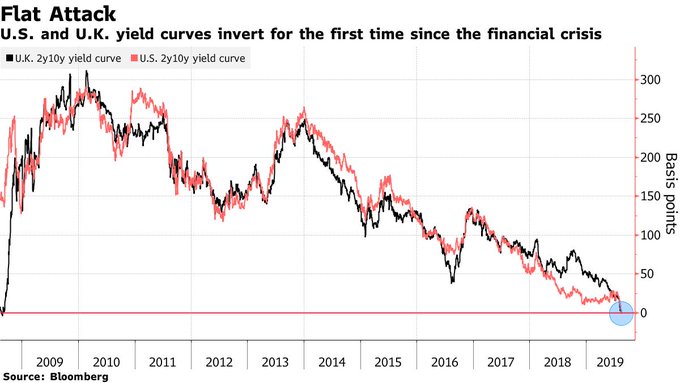
The bond markets give another recession signal as the 2-year and 10-year yield curve inverts


I told my readers to "stay tuned" at the end of The part of the yield curve the Federal Reserve watches just inverted, sending another recession signal back in March.
The economic storm clouds are not just visible on the horizon, but building.  All that I'm waiting for to say that the weather is advancing on us is an inversion of the 2-year and 10-year Treasuries.  When that happens, I'll report it.
It just happened.  CNBC has the story in Bond markets sends (sic) recession warning signal as yield curve inverts.

CNBC's Steve Liesman breaks down why investors are still concerned about falling yields and what it may mean for the economy.
Joe Kernan expressed a lot of wishful thinking about the economy, which Steve Liesman called him out on.  I've complained about Kernan's opinions before along with CNBC's perma-bull editorial stance and this is another instance of both.

Bloomberg Markets and Finance displayed more anxiety than CNBC this morning in Fed Must Act on Inverted Yield Curve, Credit Suisse's Golub Says.

Jonathan Golub, chief U.S. equity strategist at Credit Suisse, discusses the Treasury yield curve, Federal Reserve policy and the U.S. economy. He speaks on "Bloomberg Surveillance."
Both CNBC and Bloomberg think that the Federal Reserve will lower the Fed Funds rate and Golub thinks they should do it ASAP.

Even before the 2-year and 10-year yields inverted, CNBC uploaded The yield curve is a good indicator of a recession, rate strategist says yesterday.

The rally in treasury bonds, which pushes yields lower, continues to fuel investor's angst. Priya Misra, global head of rate strategy at TD Securities, Jack Caffrey, equity portfolio manager at J.P. Morgan Private Bank, and Matt Miskin, co-chief investment strategist at John Hancock Investment Management, join "Squawk Box" to discuss.
Going back even farther, NPR noted in June that the 3-month and 10-year remained inverted for three months in What Just Happened Also Occurred Before The Last 7 U.S. Recessions. Reason To Worry?
But on Sunday, an inauspicious milestone was achieved: The yield curve remained inverted for three months, or an entire quarter, which has for half a century been a clear signal that the economy is heading for recession in the next nine to 18 months, according to Campbell Harvey, a Duke University finance professor who spoke to NPR on Sunday. His research in the mid-1980s first linked yield curve inversions to recessions.

"That has been associated with predicting a recession for the last seven recessions," Harvey said. "From the 1960s, this indicator has been reliable in terms of foretelling a recession, and also importantly, it has not given any false signals yet."
That was after I wrote Experts call for high risk of recession by end of 2020 because of trade policy at the beginning of June.  I'm going to be a good environmentalist and recycle what I wrote then.
I'm going to repeat two points.  One, "when I wrote 'trade, which I haven't written enough about, is likely to be straw that breaks the camel's back of the economic expansion and that a recession is inevitable,' first in I wrote about the yield curve inverting and sending another recession signal and again in MSNBC's 'Morning Joe' and CNBC's 'Fast Money' expound on the U.S.-China trade war and its fallout, that's the kind of effect I was expecting."  Two, "I've been bearish and on recession watch since December 2017 and still stand behind the prediction I made in Ten years ago, we were partying like it was 1929. Are we about to do it again?...'I'm moving my recession call to between July and December 2019.'"  If that happens, it will be closer to December than July, which is only a month away, but I will not revise my forecast until October at the earliest.  I'm even more confident that a recession is coming, even if it takes a bit longer than I expect.

Tuesday, August 13, 2019

Trump administration weakening enforcement of Endangered Species Act


One would think that the United Nations report warning that one million species could go extinct in the next century, which I last mentioned in Verge Science and Depeche Mode on the Insect Apocalypse, would elicit more concern among people and their governments about saving endangered species.  That doesn't seem to be the case in the United States, or at least with the Trump administration, which is thinking of weakening the implementation of the Endangered Species Act (ESA).  WUSA uploaded an editorial on the proposal this morning, Changes coming to The Endangered Species Act.

According to a recent United Nations report, more than 1 million animal and plant species are at a major risk of facing extinction. The Trump administration has announced that it will be making major changes to The Endangered Species Act. Some of these changes include economic costs being considered when determining if a species should be protected and another weakens already existing protections of threatened groups.
The good news is that Trump and the rest of the executive branch can't change the law itself; it can only change how it interprets the act, including the regulations it uses to enforce it.  The bad news is that the executive branch can do a lot with regulations.  NPR has more on that last point in Trump Administration Makes Major Changes To Protections For Endangered Species.
In a move that critics say will hurt plants, animals and other species as they face mounting threats, the Trump administration is making major changes to how the Endangered Species Act is implemented. The U.S. Department of Interior on Monday announced a suite of long-anticipated revisions to the nation's premier wildlife conservation law, which is credited with bringing back the bald eagle and grizzly bears, among other species.
...
One of the changes will allow economic costs to be taken into account while determining whether a species warrants protection. Another will weaken the initial protections given to species deemed to be threatened, one step shy of being endangered.

The changes will apply only to future listing decisions.
...
Many of the changes the Trump administration is rolling out address shared administrative concerns about the act, says Jake Li, the director for biodiversity at the Environmental Policy Innovation Center. Others, he says, are problematic and weaken the bedrock law's effectiveness.

Among them is limiting which habitat — and how much of it — gets considered in determining whether a species is endangered. Land a species currently occupies would be the priority. But wildlife advocates say that could make it harder to account for threats from the warming climate, which has shrunk habitat for some species and will force others to migrate to new areas.
I'm with Jake Li; calculating economic costs, weakening initial protections, and limiting considerations of habitat are all factors that will reduce the ability of the ESA to protect threatened and endangered species, exactly the opposite of what the experts and I think is needed.  Fortunately, these changes are being challenged in court.
Numerous environmental groups and state attorneys general vow to sue the administration over the changes, alleging they are illegal because they're not grounded in scientific evidence.

"We don't take these challenges lightly," said California Attorney General Xavier Becerra during a conference call. "We don't look to pick a fight every time this administration decides to take an action. But we challenge these actions by this administration because it is necessary."
I wish them both skill and luck. They and the organisms the ESA protects will need it.

Wednesday, May 22, 2019

Dressbarn closing all 650 stores, a tale of the Retail Apocalypse


My plans changed since I posted Retail Archeology looks at Family Dollar, a tale of the Retail Apocalypse, which I concluded by writing "Unless something more dramatic intervenes, I know which tale of the Retail Apocalypse I'm telling next."  Something more dramatic just happened, Dressbarn announcing that it will close all 650 of its stores, which my friend John Henry AKA LowGenius brought to my attention on Facebook.  Shopko will have to wait.

I begin with WWLP of Springfield, Massachusetts, reporting Women's clothing chain Dressbarn to close all its 650 stores.

Dressbarn announced Monday that all 650 locations across the U.S. will soon close their doors for good.
NPR has more details.
Ascena Retail Group announced the closure of about 650 stores late Monday, saying the "wind-down" would help the company focus on its more profitable brands.
...
The New Jersey-based women's retailer also owns Ann Taylor, LOFT, Lane Bryant, Lou & Grey, Catherines, Cacique and Justice. The company sold its Maurice brand earlier this month.

The closures could be a blow for some malls across the country where vacancy rates have shot up in recent years, following the shuttering of anchor stores, including Sears, Kmart, and J.C. Penney. In 2018, approximately 9% of storefronts in regional malls remained empty, according to the latest figures from Reis, a real estate research firm.
...
A final Dressbarn shut down date has not been announced. Stores will remain open with no changes to return, refund or gift card policies. About 6,800 people are employed by the chain.
Of course, if I can find a local angle to a story, I will use it.  WXYZ in Detroit provided me one with its man (or in this case, woman) on the street interviews, which the station excels at, in Dressbarn is going out of business.

The retail industry suffered another blow Monday after Dressbarn's parent company announced it was shutting down the clothing chain's operations.
As I wrote in April's 6,000 stores have already announced they are closing in 2019, more than all of 2018, a tale of the Retail Apocalypse, "this year alone I've written about the closing down of Payless ShoeSource, Gymboree, and Charlotte Russe, all of which happened in February and March.  The year is yet young and many more stores and several chains could still go out of business."  Dressbarn has proved my prediction right and it's only been a month.  Just think, there are seven more months to go in the year.  Any of my readers care to guess how many more chains will go out of business?

Friday, March 8, 2019

Record numbers of women running for U.S. President on International Women's Day 2019


Happy International Women's Day!  For today's theme of "Balance for Better," I'm following up the past two year's entries examining record numbers of women running for office, which resulted in record numbers women elected and serving in Congress, by examining the record number of women running for president.
With Democratic Sens. Elizabeth Warren of Massachusetts and Amy Klobuchar of Minnesota launching their presidential bids over the weekend, there are now more women running for a single party’s nomination than ever.

Warren and Klobuchar join fellow Sens. Kamala Harris of California and Kirsten Gillibrand of New York. Altogether, they comprise nearly a fifth of the Democratic women serving in the Senate. Rep. Tulsi Gabbard, D-Hawaii, is in the field, as well. Author Marianne Williamson, who counts Oprah Winfrey as a fan of her books, has also launched a presidential campaign.

Voters who want to see a woman in the White House will have many more candidates to choose from in 2020 compared with past elections. According to the Center for American Women and Politics, or CAWP, at Rutgers University, there has never been more than two women competing at the same time in the Democratic or Republican primaries.
CBS News covered this story last month in Women already making history in 2020 campaign.

Democratic women are already making history as the 2020 presidential race begins to take shape. CBSN political reporter Caitlin Huey-Burns spoke to CBSN about the growing field of female candidates.
Since CBS News uploaded the video, all five major women candidates have entered the contest.  Marie Claire interviewed all of them in One of These Women Could Be Our Next President.

This election season, a history-making, record-setting number of women are attempting to break that highest, hardest glass ceiling: the Oval Office. Marie Claire went to the Capitol and spoke to the women running for President in 2020.
I wish all of them luck, although my favorites are Harris and Warren.*  I may like Jay Inslee for making climate change his signature issue, but I think Harris, Warren, Klobuchar, and Gillebrand have more of a shot than he does; Gabbard, not so much.

I promise to have more on the presidential candidates as the campaign develops.  In the meantime, a final happy International Women's Day!


*Harris needs a label, so I'm creating one for her with this entry.

Tuesday, August 21, 2018

A comparison of two measures of media bias shows readers and viewers respond to both ideology and quality


In Alex Jones removed from Facebook, Apple, YouTube, and Spotify, prompting free speech concerns, I mentioned the Media Bias Chart (above), which rates news sources on their bias and quality.  The next day, FiveThirtyEight displayed another chart about media bias from Nieman Labs that showed Democrats see most news outlets as unbiased. Republicans think they’re almost all biased.  After seeing both, I thought it would be interesting to compare the two to see if they agree and if they share any common patterns.  Besides, I've found it's a good idea to listen when the universe is talking.

The first chart from Nieman Labs displays "'net bias' scores for news organizations: 'the percentage who see each as ‘not biased at all’ or ‘not very biased’ minus the percentage who see each as ‘extremely biased’ or ‘very biased.’ On this measure, positive scores indicate that more people consider the news source unbiased than biased, and negative scores mean more people consider it biased than unbiased.'"


The news sources with positive scores in this study all fit in the green top box of the Media Bias Chart as "fact reporting" and "original fact reporting," although the order differs; the Media Bias Charts ranks the Associated Press highest, followed by ABC News and CBS News, then NPR and PBS, followed by USA Today then The Wall Street Journal.  However, three sources that the Media Bias Chart displays in the green box as quality outlets, NBC News, The New York Times, and The Washington Post, all have negative scores.  Both The New York Times and The Washington Post fall in the "skews liberal" column, while NBC sits at the left end of the three broadcast networks, although still in the "minimal partisan bias or balance of biases" column, so conservatives may see them as biased despite the quality of their reporting.  To test that, I'm sharing charts of the perceived biases of news sources side-by-side with the results from Democrats on the left and Republicans on the right.


Nieman Labs quoted the original study's findings.
“Democrats, including Democratic-leaning independents, tend to see most news organizations as unbiased, except for Fox News, Breitbart News, Mother Jones, the Huffington Post, and Vox,” the authors write. “Republicans, including Republican-leaning independents, tend to see all news organizations as biased. The two exceptions are Fox News and The Wall Street Journal.”
Sure enough, Republicans think that NBC News, The New York Times, and The Washington Post are all very biased, while Democrats consider them relatively unbiased.  In addition, Republicans appear to be picking up the slight differences in bias among other news sources.  Of the outlets with positive ratings, The Wall Street Journal skews conservative, while PBS, CBS News, and ABC News are all arrayed from right-to-left in the top center box, exactly the same order in which Republicans rate them as being biased.  In addition, the Media Bias Charts shows the Associated Press slightly to the left of PBS, which could be enough to flip their order on the chart from Nieman Labs of net bias.  All this is enough to make me conclude that for fact-reporting sources, slight differences in ideological slant are enough to affect their perceived bias by readers and viewers.

For sources that fall in the analysis, opinion, and propaganda boxes, ideological positions appear to be less important than the quality of reporting.  Both Democrats and Republicans think Vox and Mother Jones are biased, but Republicans think that CNN is more biased than either, while Democrats rank it between USA Today and The Wall Street Journal.  Looking at the Media Bias Chart might explain why.  While CNN is only as far left as The New York Times and Washington Post, it straddles the line between fair and unfair interpretations of the news, so its quality of reporting is rated lower than Vox, Mother Jones, and MSNBC, all of which present fair interpretations of news according to the Media Bias Chart while still in the "skews liberal" and "hyper-partisan liberal" columns.  The Republicans seem to pick up on this, rating CNN as the most biased news source, even more so than MSNBC, which makes no effort to hide its liberal leanings, especially in its evening shows.*  Both liberals and conservatives consider The Huffington Post as biased, an assessment the Media Bias Chart agrees with.  It also considers its reporting to be unfair interpretations of the news, so its lower quality places it below CNN on a survey of all respondents.  Finally, the most biased sources overall are Breitbart News and Fox News, which are both "hyper-partisan conservative" and "nonsense damaging to public discourse."  Democrats drive that rating of Fox News, as they consider it the most biased news source, while Republicans consider it the least.  The power of ideology returns!  At least both sides agree that Breitbart is biased.  That's reassuring.

*I think they are right to consider it biased, but I think it's a personal bias against Trump, not an ideological bias against conservatives.

Thursday, March 8, 2018

Record numbers of women running for office on International Women's Day


Happy International Women's Day!  To celebrate this year, I'm expanding on something I reported last year, record numbers of women running for office.  Last year, it was CNN.  This year, it's CBS Evening News.

A record number of women are running for office this year, including nearly 500 who have their sights set on the nation's capital. CBS News' Meg Oliver tells us about two female candidates who are hoping for big wins in Texas, which holds its primary elections Tuesday.
ABC News included a similar story on Nightline that focused even more on women running for Congress in Texas, noting the record numbers.

ABC News' "Nightline" met with three women, who were first time candidates and could make history if they won.
That's what the picture looks like in tight focus.  What about the entire picture?  NPR lists the total numbers of women running for the Senate, House of Representatives, and Governor across the country.
At latest count, 431 women were running for or were likely to run for the House nationwide — 339 Democrats and 92 Republicans. At this point in 2016, there were fewer than half that: 212. Likewise, 50 women are running for or likely to run for Senate, compared with 25 at this point in 2016. Many have not officially filed for office yet — filing deadlines have not occurred in many states. But thus far, this year is on track to break records.
In addition, the article has a graphic showing that 82 women are running for governor this year, up from ~28 four years ago.  One of them is Gretchen Whitmer, who is running for Governor in Michigan.

Democratic Nominee for Governor, Gretchen Whitmer stopped by WBKB to discuss her campaign and the bright future of Michigan.
I'm already planning on voting for her in the August primary so she can get the nomination.  I also plan on voting for other women running for office, so I'll be doing my part to make the political leadership here in Michigan more equal.

Saturday, February 17, 2018

Instructions on how to deal with an active shooter


In the wake of the Parkland school shooting, my students asked me to do something I've never done before in class, explain how to react to an active shooter situation.  I did my best, telling them to try to escape first and giving them the first exit to the room and building and then where to assemble.  I then told them that if they couldn't escape to hide and found the best place in the room to hide.  I then told them to fight back and how to do so.  I mentioned this on my Facebook page and one of my colleagues directed me to this video from Boston College, which the college uses for training.


I'll be showing this to my students in the classes that I haven't given instructions to.  It's something I can do while advocating for Congress to fund gun violence research at the CDC and NIH, which I shared in October in response to the Las Vegas mass shooting, earning the post 8,851 additional raw page views and landing it in first on the all time list with 10,323 raw and 10,091 default page views.*  Despite the popularity of the post, I'm not optimistic about that happening soon in a land that loves guns.  Here's to hoping that changes.  In the meantime, stay safe, everyone.

*That lasted until December, when Vox explains how proportional representation can solve gerrymandering and help minor parties earned 12,750 default and 12,890 raw page views to unseat it. Sic transit gloria mundi.

Friday, March 31, 2017

Flint water lawsuit settled for a late celebration of World Water Day


When I told my readers to "Stay tuned for the last entry of the month," I didn't know what I'd write about, as this has been a news-rich week while I have been looking back at last year's top posts.  I was finally inspired by the confluence of World Water Day, which falls on March 22nd, when I'm normally busy posting statistics for the past year of this blog and a development in the Flint Water Crisis that happened this week.*  WXYZ reports Judge approves plan to fix 18,000 Flint water lines.


NPR has more in Judge Approves $97 Million Settlement To Replace Flint's Water Lines.
In a victory for Flint residents, the state of Michigan has agreed to spend up to $97 million for new water lines in the city of Flint, which has been struggling with a crisis over lead in its water for the past three years.

A federal judge at the U.S. District Court for Michigan's eastern district approved the agreement Tuesday. Within three years, authorities must examine water service lines for at least 18,000 households and replace those made of lead and galvanized steel.

The state is required to allocate $87 million for the pipe replacement, according to the terms of the deal. The money will come from both state and federal funds. The state will also reserve an additional $10 million in case the job requires it.
I haven't written directly about the Flint Water Crisis since WXYZ updated the Flint Water Crisis on Monday last May, although I did mention it in passing on St. Patrick's Day, when MLive featured the bars and restaurants in Flint.  Based on last year's top posts, the election was too much of a shiny object.  It's about time I returned to the subject.  I'm especially glad to bring good news on the story to close out the month.

Follow over the jump for the footnote.

Sunday, February 28, 2016

'Songs about something' and music scores at the Oscars


I recycled Infidel753's comment along with my response at the end of Speculative fiction at the 2016 Razzie Awards.
I hope Lady Gaga wins the best song Oscar, though. I've always liked her. Like Fifty Shades, she offends those people whom, as John Cleese put it, one would truly wish to offend.
Speaking of Lady Gaga, I'll follow up on the music nominees tomorrow.  Stay tuned.
It's tomorrow, so it's time to revisit the nominees for Best Original Song I first mentioned in The songs really are the best part of 'Fifty Shades of Grey'.

First, I invite my readers to Listen To The Oscars’ Best Original Song Nominees along with commentary about each of them from NPR's "Here and Now."  In particular, I want to direct their attention to an observation by guest Mason Daring, a professor of film scoring at Berklee College of Music, a composer of dozens of soundtracks, and a voting member of the music branch.  He noted that this year's batch of nominees had two songs from documentaries (“Til It Happens To You” from “The Hunting Ground” and “Manta Ray” from “Racing Extinction”) but no songs from animated musicals.  He called those two pieces "songs about something" and thought they were the signs of changing times, as he said this was "a year that things matter."  The changing times might affect the chances of what would normally be the favorite, "Writing's on the Wall" from "Spectre," which won the Golden Globe in this category.  Daring opined that a Bond song would normally be a lock, but maybe not this year.

That uncertainty is reflected in the predictions.  FiveThirtyEight included the category in Every Oscar Prediction We Could Find.
Goegan says “Writing’s on the Wall” from “Spectre.” Paddy Power’s favorite is “Til It Happens To You” from “The Hunting Ground,” with 2-to-5 odds.
New York Magazine's Vulture came to a similar conclusion in Vulture’s Final 2016 Oscar Predictions for Every Category.
The best song in this category is "Earned It," but there is no way on Earth that the Academy is going to give an Oscar to Fifty Shades of Grey. Lady Gaga has been promoting her song from The Hunting Ground with a vengeance, and I suspect "Til It Happens to You" has the advantage because of it.
Finally, Predictwise gives Lady Gaga and Diane Warren's song a 68% chance of winning.  "Writing's on the Wall" comes in second at 12%, "Simple Song #3" and "Earned It" are tied at 9%, and "Manta Ray" has a 2% chance of winning.  Based on those odds, plus Lady Gaga's star Power and Warren's many previous nominations with no wins, my head agrees "Til It Happens to You" will win, although my heart is with "Manta Ray" and "Writing's on the Wall."

Follow over the jump for my thoughts on the nominated music scores.

Monday, September 1, 2014

Second outbreak of Ebola in Congo and other Ebola news


This month's Nablopomo theme is Heal.  I'll get around to posting the usual entry about the theme later.  Right now, I'm going to focus on one aspect of that theme, health and disease, and the number one health story I'm covering in this blog is the Ebola outbreak.

I lead with this story from Reuters, which I first posted here as part of War, Death, and Destruction from Reuters for August 25, 2014.  Hey, I'm an environmentalist, I recycle.

Congo declares Ebola outbreak in northern Equateur province
Reporting by Bienvenu-Marie Bakumanya; Writing by Daniel Flynn; Editing by Robin Pomeroy
KINSHASA Sun Aug 24, 2014 5:02pm EDT
(Reuters) - Democratic Republic of Congo declared an Ebola outbreak in its northern Equateur province on Sunday after two out of eight cases tested came back positive for the deadly virus, Health Minister Felix Kabange Numbi said.

A mysterious disease has killed dozens of people in Equateur in recent weeks but the World Health Organization had said on Thursday it was not Ebola.

"I declare an Ebola epidemic in the region of Djera, in the territory of Boende in the province of Equateur," Kabange Numbi told a news conference.
This is likely a second outbreak, not a spread of the original one.

Follow over the fold for Ebola news from Overnight News Digest: Science Saturday (Blair Mountain and Labor Day).

Thursday, June 26, 2014

Great Lakes cities and their roles in the regional economy


I left a variation of a story I tell my students as a comment at Kunsler's blog two weeks ago, a shortened version of how and why Detroit became the Motor City in the context of its place in the Great Lakes regional economy and what might be in store for it in response to a remark by Kunstler.
“I’m convinced that the Great Lakes region will be at the center of an internally-focused North American economy when the hallucination of oil-powered globalism dissolves. Places like Buffalo, Cleveland, and Detroit will have a new life, but not at the scale of the twentieth century”

In my classes, I spend a good chunk of a lecture on the roles of Great Lakes cities. It was pretty natural that North America’s manufacturing would be centered on the Great Lakes, as all of the natural resources required for making things out of steel were there–iron ore, coal, and lime–and the entire region was connected by a vast natural waterway, making shipping cheap. All that was needed to make cars was imported rubber. Detroit ended up with the distinction because of its central location, skilled manufacturing work force, and money looking for something to invest in once the timber boom ended. Now that cars are winding down, the city is looking for something else to make. Urban farming and trade with Canada aren’t enough to support a metropolitan population of four million.

It also helped that all the rest of the Great Lakes cities had something else to do already. Buffalo is a trade center between New York and the Great Lakes to the west. I suppose the Erie Canal might get revived as a functioning trade route in the post-petroleum future. Cleveland was the original oil capital and secondary manufacturing center. Now, it’s trying to become a tourist attraction. I’m not sure what it will do in a future without mass tourism. Toledo is the Glass City, which means its a subsidiary of Detroit. It’s still a trade center where the Maumee enters Lake Erie, but the rest of its future depends on what Detroit does.

As for the cities to the west, Chicago is the ultimate trade center, where the raw materials of the west get sent to the manufacturing centers of the east and the manufactured goods get sent to the west with Chicago profiting as the middleman (think Chicago Board of Trade). There will still be room for such a role in the future, even if it’s smaller. Milwaukee is the place where milk and grain become beer and cheese. Again, that’s useful, but how much of a mass market will there be for it?

All of the above is a story I tell my students that helps them understand their place in the world. Now they have to help create their own story so that they can keep a place in the world.
I transitioned out of that passage by promising to repost it to here in a more refined form.  Honestly, I think it's good enough.  Now follow over the jump for responses to it and to another comment about Detroit I posted this week at Kunstler's blog.

Thursday, April 17, 2014

What The Archdruid ignored in 'Mentats wanted'


In The Archdruid and I talk real estate, I mentioned that I commented about more than just real estate and would talk about it later.
Greer and I got into a side conversation in the comments to Mentats Wanted, Will Train--real estate.  Even though I had plenty of things to say about the main topic, that's what he responded to.
...
I'll get back to the rest of the conversation...later.
As I type this, I'm waiting for the comment about the death of Michael Ruppert I left at Greer's most recent entry, The End of Employment, to make it through moderation.  Waiting is reminding me of the points I made that weren't addressed two weeks ago, so I feel now is an appropriate time to post them.  Follow over the jump.

Thursday, January 16, 2014

'Blackfish' snubbed by Oscars


As I mentioned in last night's Science fiction and fantasy at the Razzies, the nominees for this year's Academy Awards were announced this morning.  Unfortunately, one of the films I was rooting for did not make the cut; Blackfish, which NPR introduced its segment about the film on All Things Considered as "on the short list for nominees for Feature Documentary," did not make the list this morning.  Phooey.  I was hoping it would, if only to keep the conversation going.

Speaking of which, Teresa Wagner left this comment at my original entry about the film.
Thank you for telling your students about Blackfish. You might want to also suggest that they learn who else, beyond one filmmaker, is against the captivity of whales: Who Are Anti-Captivity Activists?
I thanked her, and promised to recycle her video when I next blogged about the movie.  Time to follow through with that promise.

The anti-cap side is driven by the knowledge of leading biologists and cetacean experts, the experience of former trainers and captive animal caretakers, and the determination of ordinary people. Together, we give a voice to the voiceless. Join us!
I'll have more on the Oscar nominees in the categories of sustainability, science fiction, fantasy, and politics later, as well as an examination of how many of them are about crime.  Stay tuned.

Wednesday, January 15, 2014

ISS extended and dead stars in this week's space news


This week's space news report has good news for the ISS.  NASA Television reports that ISS Extended to 2024 on This Week @NASA.

NASA Administrator Charlie Bolden and White House Science Advisor John Holdren, announced that the Obama administration is extending usage of the International Space Station to at least the year 2024. In his blog, Bolden noted that NASA is hopeful and optimistic that our ISS partners will join this extension effort and enable continuation of the groundbreaking research being conducted on the unique orbiting laboratory. Also, International Space Exploration Forum, Cygnus' resupply flight, Super Bowl of Astronomy, 10 years roving Mars, TDRS-L Update and more!
I'm tempted to break out Professor Farnsworth, but decided not to jinx the announcement, so I illustrated this entry with the ISS instead.

Follow over the jump for more astronomy news originally included in Overnight News Digest: Science Saturday (Polar Vortex) on Daily Kos.

Sunday, December 15, 2013

Spygames and paranoia 2: The World of Watchcraft


I finished Spygames and paranoia 1: No that's not Cthulhu on the patch by pointing out that people were worrying about the wrong thing.
If they want something to freak out about, it's the spying going on inside the World of Warcraft.  That's real.  It's also silly.  Stay tuned for more on this story.
I then procrastinated more at the end of Forging an Urak-Hai: an educational experience.
I looked for a text story to accompany this video, but instead found Orc And Dagger: U.S. Reportedly Spied On Gamers Online about the story I promised to cover as part two of Spygames and paranoia 1: No that's not Cthulhu on the patch.  I'll use that one in the morning.  Right now, I'm going to bed.  Good night!
Here it is, the morning of the next day, and I've already used that story in Overnight News Digest: Science Saturday (Jade Rabbit lands on Moon), so it's finally time to post it here.

NPR via KPBS: Orc And Dagger: U.S. Reportedly Spied On Gamers Online
Bill Chappell / NPR
Monday, December 9, 2013
U.S. and British intelligence agencies have worked to infiltrate networks of violence-prone individuals who might unite for a common cause. And in some cases, the spies are also targeting networks that aren't regional terrorist cells -- they're online gaming communities, according to the latest revelation from documents given to the media by former NSA contractor Edward Snowden.

"Exploiting Terrorist Use of Games & Virtual Environments" is the name of a 2008 NSA document being cited in coordinated reports out Monday from The Guardian, ProPublica and The New York Times.

The reports describe spy agencies' push to infiltrate systems that allow millions of people to closely collaborate and even exchange money -- all through a veil of alternate identities.

The project involved spies creating identities in networks that include Second Life and World of Warcraft, according to the reports. Another arm of the work is said to have collected massive amounts of data from Microsoft's Xbox Live network and elsewhere.

The effort was not a small one, the news agencies report. In fact, so much anti-terrorism work was being conducted in the virtual worlds that a separate "deconfliction" group was tasked with monitoring spies from the CIA, Pentagon, and FBI so that they wouldn't interfere with -- or waste time spying on -- one another, according to Pro Publica.
This is a silly project for various reasons.  The more serious objections were raised in the New York Times story, summarized here by two reporters having a chat on WOW in character, pun intended.  Follow over the jump for the video.