Showing posts with label evolution. Show all posts

Saturday, May 16, 2026

SciShow and Hank Green are thinking about domestication

I promised a brief evergreeen educational entry today, so I'm examining three videos on a common theme from SciShow and Hank Green, beginning with Something Strange Is Happening to Raccoons.

You might have heard about a viral study claiming raccoons are domesticating themselves. There's a lot more to the story, though, and it might help us understand what domestication is in the first place.
Raccoons are just taking the first step to being domesticated, which is increased tolerance for humans. That's advantageous to them as wild animals living in urban and suburban areas. They're not alone in adapting to people; "birds change the pitch of their songs [and] city mice have larger brains than country mice" as I first noted nine years ago. Just the same, maybe people, beginning with North Americans, will have raccoons as pets in future centuries. Not now, the raccoons aren't ready.

The above video came a week after Humans Didn't Make Dogs Weird.

Conventional wisdom holds that the huge variety of dogs is just the result of humans breeding them to be that way. But new research suggests that dogs have been weird from the start.
Both natural and artificial selection have to work on pre-existing material. One can't just will a trait from nothing. Even transgenic organisms, like Colossal Bioscience's dire wolves, have to get their traits from somewhere, such as DNA from subfossil remains. Dogs are only so morphologically diverse now because they were already morphologically diverse in the past.

Speaking of dogs, Hank Green, who runs the studio that produces SciShow (also Bizarre Beasts and PBS Eons) uploaded The Weirdest Thing About Dogs (and Cats (and Horses)).

Hank Green explores the evolutionary history behind the unique facial muscles that allow dogs to communicate so expressively with humans. This examination considers how various domestic animals have developed specialized traits to better convey their internal states and bond with their human companions.
Yeah, that's an AI summary, but it works better than the video description Hank wrote. Some of the traits of domesticated mammals are ones that evolved for the benefit of the animal, not bred into it purely for the benefit of humans. This is especially true of dogs' eyebrows, which we like, but which help the dog. This shows our relationship is a mutualism.

I'm lecturing about evolution in my biodiversity class, so I might be able to use one of these videos. Even if I don't, I plan on incorporating the information from them next week. Welcome to blogging as professional development.

That's a wrap for today. Stay tuned for the Sunday entertainment feature.

Sunday, March 15, 2026

SciShow explains 'How the Fall of the Roman Empire Made Animals Smaller' for the Ides of March

Beware the Ides of March! Instead of the Sunday entertainment feature, I'm continuing the theme of death and destruction in the Roman world with SciShow explaining How the Fall of the Roman Empire Made Animals Smaller.

There’s a saying that, when Rome falls, the whole world will fall. Which frankly seems a little melodramatic and egotistical on the part of the Romans. Except that they kinda had a point when you realize the fall of Rome affected basically everything in Europe up to and including /the body size of wild animals/. Here's how the fall of the Roman Empire made animals smaller.

Hosted by: Jaida Elcock (she/her)
The last time I included the blog's description in an entry was PBS Terra lists '5 Warning Signs of Collapse We're Ignoring' plus presidential pets for Presidents Day.
When I created this blog, I called it "A blog about societal, cultural, and civilizational collapse, and how to stave it off or survive it." I've shifted away from that, making this more "A blog about sustainability with a science fiction slant and a Detroit perspective," as it says on the Crazy Eddie's Motie News Facebook page (if you're still on Facebook, please follow), but I've never changed the description here after 15 years. That's because, deep down, I still believe in the mission I set for myself in March 2011.
SciShow's video demonstrates that the collapse of the Western Roman Empire affected not only humans and their domesticated animals, but also the wild animals, mostly mammals, around them. Welcome to one of Commoner's Laws, "Everything is connected to everything else."

I turn to The History Guy for a lesson about the significance of the date, Beware the Ides of March.


He likes alliteration even more than I do! Speaking of alliteration, I can't escape entertainment entirely today, so I'm sharing Vehicle (Remastered) by Ides of March.


Vehicle (Remastered) · Ides Of March

That's a wrap for today's sort of holiday. Stay tuned for an educational post I can share next month followed by a celebration of St. Patrick's Day.

Saturday, February 14, 2026

The History Guy remembers Charles Darwin and chocolate for Valentines Day

A late happy Darwin Day on Valentines Day — two holidays at once! I begin today's double celebration with The History Guy remembering Almost Not History: Darwin and HMS Beagle.

February 12 represents the 214th birthday of Charles Darwin, a scientist whose ideas transformed human understanding of the natural world, and undoubtedly one of the most influential scientists in history. But that history may have been different, as Da[rw]in’s career altering voyage aboard HMS Beagle almost didn’t happen.
First, The History Guy uploaded this video three years ago, so last Thursday was Darwin's 217th birthday. Second, I had no idea Robert Fitzroy, captain of the Beagle, was himself an accomplished scientist. Third, I knew that Fitzroy wanted a gentleman scientist companion, but I didn't know Darwin was essentially his third choice; I certainly didn't know the names of the two men who could have gone in Darwin's place. Still, Darwin turned out to be the best person available. Fourth, the video reminded me that Darwin was the grandson of Josiah Wedgwood, the founder of Wedgwood & Sons; I had heard that before, but couldn't have remembered that off the top of my head. I think I'd heard, but had forgotten, that his uncle Josiah II had finally allowed him to go. While not mentioned in the video, I did know that he married his first cousin, Emma Wedgwood, daughter of Josiah II. Talk about a close family!

By the way, I recall being a member of the Paleontological Research Institute back in the late 1980s. I've long since let my membership lapse, along with the rest of my professional association memberships. I've been concentrating on teaching instead of research the past 30 years and didn't have the time, and sometimes the money, for meetings and membership dues.

The History Guy has several videos about Valentines Day. Today's is Chocolate: A History.

From The History Guy archive for Valentine's Day, a brief history of the food of the Gods.
That was fascinating, from cacao's prehistory in Mesoamerica to today, including mentions of almost all of today's big names in chocolate, including Cadbury, Lindt, Nestle, Hershey, Reese, and Mars — sorry, no Godiva. I learned a lot from both videos, making today a good day. The second video also made me hungry. Lunchtime!

That's a wrap for today's educational holiday post. Stay tuned for the Sunday entertainment feature with the nominees for Best Action/Adventure Film at the Saturn Awards — Mission: Impossible – The Final Reckoning vs. One Battle After Another!

Saturday, December 27, 2025

'How cheap renewable energy is finally flattening emissions' is Science Magazine's 2025 Breakthrough of the Year

I'm beginning my year-end retrospectives with Science Magazine explaining How cheap renewable energy is finally flattening emissions, its 2025 Breakthrough of the Year.

For decades, rising carbon emissions have accelerated climate change, but this year marked a critical turning point that could finally reverse that trend. Renewable energy has now graduated beyond the need for subsidies and incentives, emerging as a cheaper alternative to fossil fuels in many countries. News Editor Tim Appenzeller and policy expert Li Shuo describe the economic forces behind this shift, and the obstacles that remain to the continued rise of green energy.
...
1:15 The graph has mislabeled trend lines. "Other renewables" generate more energy than hydropower alone.
This is the same good news reported in PBS Terra says 'We Just Crossed Our FIRST Tipping Point… And It’s NOT What You Think'.
Unlike passing the other tipping points, like the AMOC, permafrost, West Antarctic ice sheet, and coral reefs, passing the renewable energy tipping point is good news. I wrote about it in DW News asks 'Earth Overshoot Day: What can we do to try live within the planet’s limits?'
[C]onvincing people to be less wasteful, particularly creating less food waste and eating less meat, especially beef, would be helpful. [One] could consider that to be a technology. So is renewable energy. Between the two, it would move Earth Overshoot Day back more than a month. Progress!
Yes, it is, and it's good news I can share with my students. Welcome to blogging as professional development.
Science Magazine's video is shorter and more focused than PBS Terra's, so it's one I'm more likely to show to my students. Again, welcome to blogging as professional development.

Here are the runners-up:
  • Custom gene editing shows promise for ultrarare diseases
  • New weapons against a sexual scourge
  • Neurons make a deadly donation to cancer cells
  • An all-seeing eye on the sky
  • Face to face with a Denisovan
  • Large language models do science
  • Triumph of calculation helps resolve particle mystery
  • Xenotransplants set new records
  • Rice that beats the heat
Including the "winner," that's four health stories, two computer science stories, one of which is also a physics story, an astronomy story, an evolution story, a genetics story that touches on climate change, and an energy story that also touches on climate change. Six of these are biology in some form, so these selections please me as a biologist. One of them is also paleontology, so I'm doubly pleased as a paleontologist. All of that is on top of the good sustainability news.

Not all of 2025's science stories were good. Follow over the jump for the bad news this year.

Wednesday, November 19, 2025

PBS Eons explains 'How Animals Got Butts' for World Toilet Day

Happy World Toilet Day! I'm celebrating with PBS Eons explaining How Animals Got Butts.

While the evolution of the butthole was a major breakthrough in animal development, its story might actually end with redefining what it means to have a butthole at all.

Corrections: 06:10 Starfish are actually deuterostomes! Earthworms are protostomes. 06:18 Earthworms are actually protostomes! Starfish are deuterostomes.
I left two comments on this video. First, "It's literally a fundamental question, as fundament means buttocks or anus in addition to the foundation or basis of something." Second, "It took me five days to realize that you uploaded this on World Toilet Day. To be fair, it seems that no one else noticed that, either, so I think I'll be the first to wish Kallie, the rest of the Eons crew, and the viewers a belated happy World Toilet Day!" I knew then that I would be posting it today.

That's a wrap for PBS Eons doing for bathroom humor what it did for stoner jokes, telling the smartest ones on YouTube. Stay tuned for an evergreen educational post followed by a Storied video for World Television Day.

Friday, October 17, 2025

Howtown explains 'What Quetzalcoatlus was really like' for a late National Fossil Day

I told my readers to "stay tuned" for "a late celebration of National Fossil Day on Friday" at the end of Bright Sun Films 'Bankrupt - Hudson's Bay Company,' a tale of the Retail Apocalypse for Department Store Day, so watch Howtown explain What Quetzalcoatlus was really like.

Quetzalcoatlus, one of the largest known flying animals, survives in science as sixteen wing bones pulled from Cretaceous Big Bend by grad student Doug Lawson in 1971. Paleontologists reverse-engineer the rest of its body by referencing its Azhdarchid cousins like Zhejiangopterus, and Q. lawsoni, making inferences from extant archosaurs like birds and alligators, examining trackways, and modeling their wings in flight software. Still, there's a lot that they don't know about how these giant pterosaurs lived. Thin bone walls, rare 3-D preservation, and million-to-one erosion odds explain why cousins Hatzegopteryx, Arambourgiania, Cryodrakon, and Thanatosdrakon remain fragmentary in the fossil record. The sparse clues they left behind have inspired a wide range of depictions in documentaries over the years, the pinnacle of which was Prehistoric Planet from the BBC's Natural History team.
I'm a paleontologist, as I summarized in 'Human Footprint' on PBS Terra describes 'The Mysterious Mass Extinction Hidden in LA', and I found this video to be a good summary of both how paleontologists work and how organisms become fossils. Joss Fong did her research, and it shows.

Howtown put together a short showing the "wide range of depictions in documentaries over the years," Giant pterosaurs through the years, rated by David Hone.


Not only do the organisms evolve, so do their depictions as scientists learn more about them.

Speaking of how paleontologists recreate extinct organisms, I'm sharing How do they know about dinosaur lips?

"Theropod dinosaur facial reconstruction and the importance of soft tissues in paleobiology." Cullen et al., Science 2023
Science!

That's a wrap for today, but I'm not done with holidays. Stay tuned for a late celebration of National Sports Day with the Emmy Awards for Welcome to Wrexham and Love on the Spectrum tomorrow.

Thursday, September 25, 2025

'America's Great Lost Tree Is Finally Returning,' a story of hope for the American Chestnut

Today's evergreen educational entry features Human Footprint on PBS Terra giving hope for the American Chestnut in America's Great Lost Tree Is Finally Returning.

We used to have BILLIONS of these extraordinary trees. Thanks to a tragic twist of fate, now… there are only 4.

Once towering over eastern U.S. forests, billions of American chestnut trees nourished ecosystems, built homes, and sustained Appalachian communities. But in the early 1900s, a foreign fungus arrived, and within decades, nearly all of them were gone.

However, the species never fully vanished. Its roots still survive underground, sending up sprouts that grow, die, and regrow in an endless cycle. These trees are biologically alive, but with most never reaching maturity, they remain functionally extinct.

In the forests of Pennsylvania, Shane Campbell-Staton joins Sara Fern Fitzsimmons from The American Chestnut Foundation to track this tree’s strange afterlife and learn the science behind its potential revival. With the help of rare surviving trees, selective breeding, and even gene editing, scientists and volunteers are working to breed blight-resistant trees.

The chestnut’s comeback will take time. But researchers are making steady progress towards developing American chestnut trees that survive and thrive in the native range they formerly dominated.
This is a story I tell my students about the importance of biodiversity; the more biodiversity, the more possible ways organisms will be able to meet human needs and wants. If a species becomes extinct, biologically, functionally, or economically, other species will be able to meet the need. We lost American Chestnuts, so we turned to other species. That's a very human-centered explanation, but it's incomplete, both because humans never replaced all the uses they had for American Chestnuts and because other organisms didn't fully replace the trees in their lives, either, as the video points out.

I also use this as an example of the limitations of evolution by natural selection. If a trait needed to meet a challenge doesn't already exist in a population, the population doesn't evolve the trait; it goes extinct. Evolution by natural selection is not like how humans imagine problem solving works; nature does not brainstorm solutions. Instead, it picks up existing solutions off the shelf. For what it's worth, that's mostly what humans do, too. mRNA vaccines started off as possible HIV vaccines before they were used for COVID-19, for example. That didn't prevent the researchers from earning a Nobel Prize.

Back to the video. This is a post-apocalyptic zombie story, at least as far as the trees are concerned, if they were able to have an opinion. With the discovery of apparently immune individuals, humans can help the species recover from its zombie apocalypse. That's a good tale of surviving collapse I can use as an inspiration for us humans.

That's a wrap for today's topic. Stay tuned for another evergreen educational entry tomorrow.

Thursday, February 13, 2025

'Animals Might Be Much Older Than We Thought' for a late Darwin Day

A belated happy Darwin Day!* For today's tale of the scientist credited with formulating the theory of evolution by natural selection, I'm turning once again to PBS Eons mentioning Charles Darwin in Animals Might Be Much Older Than We Thought.

What are animal-like fossils doing in rocks a billion years old, and what does that mean for our understanding of their evolution and geologic time itself? Turns out, there might've been a long, slow-burning fuse that ultimately ignited the Cambrian Explosion.
More than 150 years later, scientists are still answering questions that puzzled Darwin.

Since Kallie Moore mentioned it, here is the video about multicellular Precambrian fossils she recommended, These Fossils Were Supposed To Be Impossible.

Hidden in rocks once thought too old to contain complex life we may have found the animal kingdom’s oldest known predator.
I'm considering showing one of these videos to my Organismal Biology students this summer. If so, welcome to blogging as professional development.

I'm not done with holidays. Stay tuned for Valentines Day. I've had enough of mass shootings. I think I'll turn it into one of my trademark drum corps holidays.

*I got so distracted by the shiny object of bird flu that I forgot about the day until I watched Danny Anduza of Paleontologizing do a Twitch stream about it. Oops!

Wednesday, January 29, 2025

Happy Year of the Wood Snake!

Happy Lunar New Year! So long, Year of the Wood Dragon! Welcome to the Year of the Wood Snake! I begin today's celebration with Lunar New Year 2025: The Year of the Snake explained | ABC NEWS (Australia).

We are saying goodbye to the Year of the Dragon and welcoming the Year of the Snake! What do you know about the Year of the Snake? What is the significance of the snake in Chinese culture and history and how do people in Asian countries celebrate the festival?
This is a return to form for me after last year's drum corps holiday. That written, the host's remarking that snakes are "dangerous and scary animals" that make him "run away screaming" inspires me to put a science spin on this entry with PBS Eons explaining How Snake Venom Sparked An Evolutionary Arms Race.

For some, the rise and spread of venomous elapids was just another challenge to adapt to. For others, it was a catastrophe of almost apocalyptic proportions. And we humans are no exception, because it seems that when elapids slithered onto the ecological scene, not even our ancestors were safe…
Fassscinating. Sssorry, couldn't resssissst.

I also couldn't resist revisiting how Disney celebrates the holiday. Watch Mulan's Lunar New Year Procession Returns to Disney California Adventure for the Year of the Snake from WDW News Today.


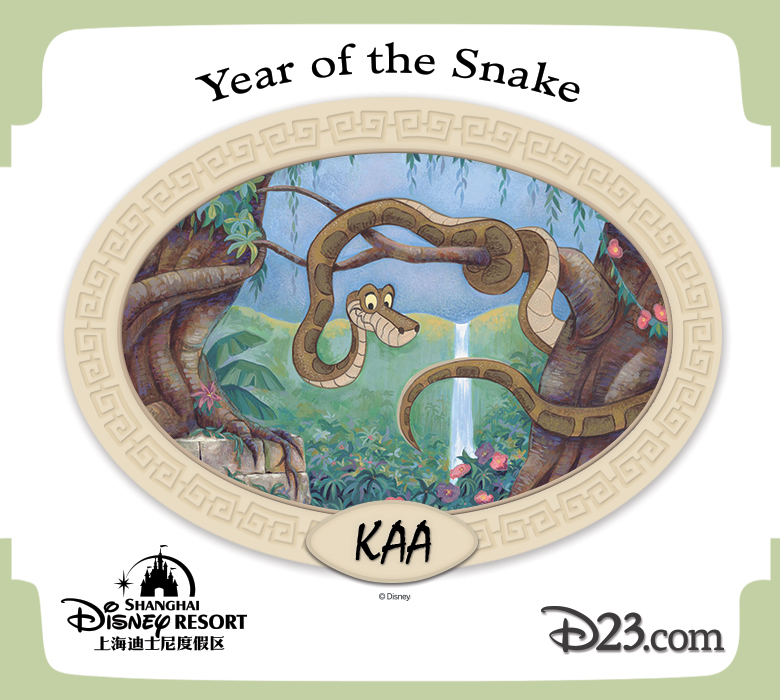
I observed "Eleven years ago, they had Kaa as their character for Year of the Snake" then asked "Anyone care to wager that Kaa repeats?" While Mushu repeated in the parade, Kaa still showed in the merchandise available in Shanghai Disneyland.


Disney's California Adventure opted for a snake coiled to form Mickey Mouse's head.

So, yes and no, but if anyone had taken me up on the bet, they'd have won. After all, I didn't ssspecify which park!

Enough of this year's fessstivities. It's time to conclude this post with the generic greetings I've recycled many times over.

Mandarin: Gong Xi Fa Cai/Xin Nian Kuai Le

Cantonese: Kung Hei Fat Choi
 
Hokkien (Fujian/Taiwanese): Kiong Hee Huat Tsai/Sin Ni khòai lok

Simplified Chinese: 恭喜发财 新年快乐

Traditional Chinese: 恭喜發財 新年快樂

Stay tuned for the Doomsday Clock.

Friday, December 27, 2024

'Can a twice-a-year shot help end the HIV/AIDS epidemic' — Science Magazine's 2024 Breakthrough of the year

I closed yesterday's entry with a program note and a rhetorical question: "Stay tuned for year-end retrospectives. What did you think were the best and worst of 2024?" I didn't get an answer from my readers, so I turn to Science Magazine as it asks Can a twice-a-year shot help end the HIV/AIDS epidemic, 2024's Breakthrough of the Year.

HIV infects more than a million people every year worldwide. While decades of research have led to effective treatments and pre-exposure prophylactic (PrEP) drugs that have dramatically reduced the impact of HIV/AIDS epidemic, completely wiping the virus out has remained out of reach. Lenacapavir, a new twice-yearly PrEP injection, may be the solution. Two clinical trials this year showed the drug can offer near complete protection from HIV infection, and the long-lasting effects mean daily pills could be a thing of the past, as long as it is accessible to populations who need it most. Science journalist Jon Cohen, physician-scientist Linda-Gail Bekker, and biochemist Wesley Sundquist describe the history of HIV/AIDS prevention and the unique mechanism that led lenacapavir to be named the 2024 Breakthrough of the Year.
I began the month writing about Freddie Mercury for World AIDS Day, who exemplified the human cost of the disease, so it's only fitting that I begin wrapping up the month and year by examining the science to combat it. I already show a SciShow video to my students about HIV/AIDS treatments, but I might add this to the mix.* I learned something new from it, and it's always a good day when I learn something new. I hope my students will agree.

Unlike last year, my reaction is not being "slightly disappointed" and asking "Wasn't there something more impressive among the runners-up?" I think this is worthy of being Breakthrough of the Year. Just the same, I'm examining the nine runners-up for Breakthrough of the Year along with four breakdowns. Follow over the jump.

Wednesday, October 16, 2024

PBS Eons on real paleo diets for National Fossil Day on World Food Day

Happy National Fossil Day and World Food Day! As I suggested twice, today's topic is PBS Eons videos about the prehistory of food, beginning with The Risky Paleo Diets of Our Ancestors.

We can track our history of eating just about anything back through the fossil record and see the impact it’s had on our evolution. Throughout time, part of the secret to our success as a species has been our early - and sometimes fatal - experimentation with food.
I couldn't resist revisiting paleo diets, a topic I haven't blogged about in a decade, today. Retrieving this video and the next when searching PBS Eons for "food" made it an easy choice.

Speaking of the next video, here is Why The Paleo Diet Couldn't Save The Neanderthals.

These relatives of ours lived in Eurasia for more than 300,000 years. They were expert toolmakers, using materials like stone, wood, and animal bone. They were also skilled hunters and foragers, and may even have created cave art. So what caused the decline and disappearance of their population? Well, in a way...it could’ve been us. But maybe not in the way you might’ve heard.
Hearing the fates of the Neanderthals from Spain, France, and Belgium reminds me of what I wrote about how Westworld treated evolution.
My wife and I are quite impressed at the depth of the ideas explored in the show. The creators have also done their research. Every time they mention something about evolution in Ford's dialog, they're right. This is especially true about the more disturbing concepts mentioned, like sexual selection contributing to the development of the human mind and what humans did to our nearest relatives. As someone who knows the field, that's both gratifying and unsettling.
"Do you know what happened to the Neanderthals, Bernard? We ate them."
Maybe, but it looks like the Neanderthals were eating each other as much or more than our ancestors were eating them.

Today is also Hagfish Day, so I conclude with Days and Dreams describing Hagfish Day (third Wednesday in October), Activities and How to Celebrate Hagfish Day.

As one of the sea's most hideous creatures, the hagfish represents all nature's bizarre little creatures. Seek out the icky and disgusting on Hagfish Day.
This video even mentions a 300 million year old hagfish fossil, so it connects to today's theme, although it didn't mention that people also eat hagfish. Maybe next year.

That's a wrap for today's multi-holiday post. Stay tuned for a driving update tomorrow, as Pearl's odometer will turn over 66,000 miles today.

Monday, August 12, 2024

Humans affecting elephant evolution for World Elephant Day

Happy World Elephant Day! I decided to celebrate it by returning to the conclusion of Whales and fish, two stories I tell my students with a program note: "PBS Terra has also uploaded a video about the effect of hunting on elephant evolution. Stay tuned to see if I write about it." It only took me 13 months. Watch PBS Terra explain How Humans Are Reshaping Elephant Evolution.

In our first episode of Human Footprint, host and evolutionary biologist Shane Campbell-Staton uncovers the impact of hunting on elephant genetics. From Mozambique's Gorongosa National Park to the scars left on the elephant population, Shane's research is revealing how our actions can change the course of evolution itself.
While this looks like it could be part of Evolution Earth, a nominee for Outstanding Nature Documentaries at the News & Doc Emmy Awards, it's definitely part of Human Footprint, an Emmy-nominated science and technology documentary. It's also a video I could show my students as an example of one of Commoner's Laws, particularly "Everything is connected to everything else."

Friday, June 21, 2024

PBS Eons explains 'Why The Giraffe Got Its Neck' for World Giraffe Day

Happy World Giraffe Day! For this year's observance, I'm pursuing a paleontological path in my participation with PBS Eons explaining Why The Giraffe Got Its Neck.

How and why the giraffe's neck emerged in the first place has been a mystery that generations of biologists have argued over – one that has made us reconsider our understanding of how evolution actually works over and over again.
I've been saving this video for today since I watched it last August, ten months ago. After all, I'm an environmentalist; I conserve my resources. Speaking of which, I've been meaning to show this to my students as an example of sexual selection, but I definitely forgot to do so this semester. Now that I've blogged about it, I might just remember. Welcome to blogging as professional development.

That's a wrap for today's holiday post. Stay tuned for World Rainforest Day and Souther on Detroit-Style Pizza Day.

Monday, June 17, 2024

Animalogic's 'Crocodiles: Survivors of the Last Extinction' for World Crocodile Day

Happy World Crocodile Day! I'm celebrating by sharing Animalogic's Crocodiles: Survivors of the Last Extinction.

The crocodile is one of the deadliest predators in the world. Unfortunately, they find themselves prey to something far more dangerous.
The title is certainly attention-grabbing and it turns out to be true despite the information in the video itself, which placed the divergence of crocodiles, gavials, and alligators at or just after the Paleocene-Eocene boundary, which was after the last mass extinction. Wikipedia saves the title.
The three primary branches of Crocodilia had diverged by the end of the Mesozoic. The possible earliest-known members of the group may be Portugalosuchus from the Cenomanian (95 million years ago),[20] though the classification of this taxon has been disputed.[21][22] After are alligatoroids and gavialoids that lived in North America and Europe during the Campanian (around 83.6–72.1 million years ago). The first known crocodyloids appeared in the Maastrichtian (around 72.1–66.0 million years ago), that lineage must have been present during the Campanian, and the earliest alligatoroids and gavialoids include highly derived forms, which indicates that the time of the actual divergence between the three lineages must have been a pre-Campanian event.
So the crocodiles really did survive the most recent mass extinction, not just their ancestors. May they survive a possible sixth mass extinction.

This blog is likely to pass its page view goal for June before I post the next entry, so look for something evergreen tomorrow. Stay tuned.

Saturday, June 15, 2024

PBS Eons explains 'Why Megalodon (Definitely) Went Extinct' for Megalodon Day

I'm taking the option I gave myself near the end of Global Wind Day with 'Windpower' by Thomas Dolby.
This is a good day for me to observe, since I'm an environmentalist who supports renewable energy. I could post much more, but I conserve my resources, so I'll save them for future posts — that is, if I'm not being a paleontologist by celebrating National Megalodon Day instead.
Two days of listening to Hoover Cleveland rant about sharks has influenced me to observe Megalodon Day instead. I'm celebrating by sharing PBS Eons explaining Why Megalodon (Definitely) Went Extinct.

For more than 10 million years, Megalodon was at the top of its game as the oceans’ apex predator...until 2.6 million years ago, when it went extinct. So, what happened to the largest shark in history?
I've been waiting nearly six years to use this video, so, thanks, Hoover Cleveland, for inspiring me. File that under even the worst people can sometimes be useful!

By the way, today is also World Martini Day.
World Martini Day falls on the third Saturday in June each year. Around the world martini lover's are shaking up their gin to enjoy this unique beverage with a twist. Join us as we learn a few facts about the martini and help you understand why we raise a glass to this summertime beverage holiday.
I'd been celebrating it on June 19th for years, but apparently it's moved. Either the people behind it wanted to avoid Juneteenth or National Day Calendar was confused all along. I'm still celebrating with MEGALODON BITE Fishbowl Cocktail! (Inspired by Meg 2) by The Martini Shot.


Drink responsibly and stay tuned for Father's Day!

Saturday, April 20, 2024

PBS Eons describes 'The Hazy Evolution of Cannabis' for 4/20

Happy 4/20! Instead of blogging about marijuana legalization, I'm sharing The Hazy Evolution of Cannabis by PBS Eons — science!

How did such a strange plant like cannabis come to be in the first place? When and where did we first domesticate it? And why oh why does it get us high?
Congratulations on telling the smartest stoner jokes on YouTube I've encountered so far. Also, I knew about the relationship between hops and Cannabis my senior year of college, when I looked through Munz and Keck's A California Flora and Supplement and found them together in Moraceae. That bit of trivia impressed my friends 40+ years ago. They have since been moved to Cannabaceae, where they are, as the video states, sister genera. I think that would have impressed my friends even more.

That's it for today's post. Stay tuned for the Sunday entertainment feature followed by Earth Day.

Monday, February 12, 2024

'Darwin Missed An Example of Evolution Right Under His Nose' by PBS Eons on Darwin Day

Happy Darwin Day! For today's tale of the scientist credited with formulating the theory of evolution by natural selection, I'm turning once again to PBS Eons for Darwin Missed An Example of Evolution Right Under His Nose.

Charles Darwin encountered a tiny fox-like creature during his famous voyage but instead of discovering its fascinating evolutionary story, he just knocked it on the head with his geology hammer.
Darwin got the credit for discovering this species of fox, but didn't figure out how it supported evolution by natural selection. People usually give that distinction to the Galapagos finches, but it was originally the Galapagos mockingbirds that got his attention. Only later did he and others realize the archipelago's finches made better examples. This includes me, as I show Galapagos finches in my evolution lectures when I explain adaptive radiation.

Enough of today's science holiday. Stay tuned for Paczki Day/Fat Tuesday tomorrow.

Monday, August 28, 2023

TierZoo, winner of the Streamy Award for Learning and Education, on giraffes and pronghorns

I promised "a short video post...as the fall semester begins" today. I surprised myself by finding another awards show to blog about, the 2023 Streamy Awards, which were presented last night. One winner stood out to me, TierZoo, the YouTube channel of Patrick Lacey. He won a Streamy for Learning and Education, beating last year's winner, Tom Scott, and the previous year's winner, Veritasium. As best as I can tell, this is Lacey's/TierZoo's first nomination and therefore first win. Congratulations!

I also surprised myself by realizing that I'd never embedded any of TierZoo's videos on this blog, even though I'm a fan of the channel and have watched every one of his videos on YouTube. I really enjoy the presentation style, as I'm both a biologist and a gamer, and find TierZoo's conceit of the world as the setting of an MMO called "Outside" amusing and insightful. I guess I never found an opportunity to do so until now. Also, I find his video descriptions lacking. I like good video descriptions on this blog.

I'm making up for not featuring TierZoo's work here before by sharing the channel's two most recent videos, beginning with one asking Are Giraffes OP?


The video description is a promotion to watch his next video on Nebula, so I'm sharing my comment on this video instead.
"First we have the cheetah...on a serious note, first, we have the leopard." Not so fast. Years ago, I watched a video of a band of three or four young male cheetahs take down a giraffe. It took all of them working together and it lasted for quite a while, but they did succeed, so it's not impossible, although I've never seen it again.

You also mentioned the camel as a possible analog to the giraffe. Aepycamelus (formerly Alticamelus) of North America actually achieved giraffe proportions during the Miocene.
The viewers roundly ignored that comment. Oh, well.

Now the sequel TierZoo promoted at the end of the giraffe video. Americas' Secret Top Tier Animal.


Cheetahs, particularly the extinct American species, and American lions, have cameos in this video as well. As a paleontologist, I appreciate that. Also, it never occurred to me that golden eagles were large enough to prey on pronghorns until I watched this video. As I'm fond of writing, it's a good day when I learn something new. I hope my readers think so, too, and found these videos as entertaining and informative as I did.

Stay tuned for another short video post tomorrow as I readjust to my regular teaching schedule.

Sunday, August 20, 2023

PBS Eons on mosquito evolution for World Mosquito Day

Happy World Mosquito Day! I telegraphed what I am doing today at the end of Vox explains 'What we get wrong about saving the bees' for World Honey Bee Day: "Like Vox did for bees, PBS Eons did for mosquitos, uploading a video this week, just in time for World Mosquito Day. Again, perfect timing." Without any further ado, here's PBS Eons telling its viewers We Helped Make Mosquitoes A Problem, which the channel uploaded on August 15, 2023.

Around 6,000 years ago, in the Sahel region of Africa, a lone female mosquito buzzed through the lush, green savannah. She couldn’t know it, but the planet itself was about to change in ways that would see her descendants evolve to live very different lives. A sudden ecological shift would force them to go from living in forests and feeding on a range of animals to specializing on just one single species: us.
As Michelle Barboza-Ramirez pointed out, this story is an example of everything is connected to everything else, one of Commoner's Laws. This includes us, mosquitos, and climate change, this time caused by natural cycles instead of human pollution.

The story of Aedes aegypti aegypti may be the earliest instance of mosquitos evolving to specialize on humans, but it's not the last. PBS Eons told that story in The London underground has its own type of mosquito.


These underground mosquitos are coming for you

This is literally a textbook example of evolution, as one of the textbooks I used for my biology classes told this story. That's where I first read about it nearly 20 years ago.

Speaking of subway lines, this is where I get off. I have to grade more exams and papers to pass back to my students for the last meeting of my classes tomorrow and Tuesday. Stay tuned for another short video post tomorrow.

Saturday, April 1, 2023

PBS Eons and SciShow on Piltdown Man for April Fools Day, a Science Saturday holiday special

Happy Science Saturday on April Fools Day! For today's double celebration, I'm returning to the topic of last year's PBS Eons reflects on Piltdown Man for April Fools Day, a Flashback Friday holiday special. In particular, I'm revisiting the following paragraph.
PBS Eons returned to the subject in its most recent Mysteries of Deep Time podcast, The Case of the Most Famous Fake Human Fossil.
This episode is a mystery in the most classic literary sense of the word. It’s a whodunit detective story that spans more than a century - the saga of the Piltdown Man Hoax. From a gravel pit in Sussex, we follow the faked fossils through history, to what’s now the Natural History Museum in London, where scientists are using new technologies to try to unravel the identity of the fraudster, and explore how this hoax impacted the study of human origins.
The podcast episode focuses much more on the fake fossil and the people who likely created it than on its effect on the rest of science. It makes for a good unsolved mystery as well as a good hoax to examine on April Fools Day.
PBS Eons turned this podcast episode into a video last November, The Unsolved Case of a Fake Human Fossil.

This episode is a mystery in the most classic literary sense of the word. It’s a whodunit detective story that spans more than a century - the saga of the Piltdown Man Hoax.
I liked this better as a YouTube video than a podcast episode. If nothing else, it has appropriate images supplementing the audio. I hope PBS Eons turn more of their podcasts into videos.

SciShow uploaded their own video of the story this January, Anthropology’s Greatest Hoax.

Scientists are sometimes deemed objective observers of the world in which we live, but that’s not entirely true. They’re still human and can find themselves victim to fraudsters just like the lot of us.
SciShow is much more certain about Charles Dawson being the hoaxer/fraudster than Martin Hinton, who might have been trying to figure out how the fraudster/hoaxer faked the fossils.

That's enough of Piltdown Man. I might write about the IgNobel Prizes next year, which I haven't done for nearly a decade. Time to return to them. In the meantime, follow over the jump for part one of a retrospective about the top holiday posts during the twelfth year of Crazy Eddie's Motie News.