Showing posts with label LiveScience. Show all posts

Friday, April 12, 2024

Artemis and Starship for Yuri's Night

Happy Yuri's Night AKA International Day for Human Space Flight! Instead of a retrospective of last year's top posts for today's Flashback Friday, I'm looking back at two tests of spacecraft intended for crewed flight and ahead at a piece of equipment to be developed to support crewed missions. I begin with Farther and Faster: NASA's Journey to the Moon with Artemis.

At 1:47 a.m. EST (6:47 UTC) on Nov. 16, 2022, NASA’s Orion spacecraft launched atop the SLS (Space Launch System) rocket from historic Launch Pad 39B at NASA’s Kennedy Space Center in Florida on a path to the Moon, officially beginning the Artemis I mission.

Over the course of 25.5 days, Orion performed two lunar flybys, coming within 80 miles (129 kilometers) of the lunar surface. At its farthest distance during the mission, Orion traveled nearly 270,000 miles (435,000 kilometers) from our home planet. On Dec. 11, 2022, NASA’s Orion spacecraft successfully completed a parachute-assisted splashdown in the Pacific Ocean at 9:40 a.m. PST (12:40 p.m. EST) as the final major milestone of the Artemis I mission.

Artemis I set new performance records, exceeded efficiency expectations, and established new safety baselines for humans in deep space. This is a prelude to what comes next—following the success of Artemis I, human beings will fly around the Moon on Artemis II.

We have demonstrated our ability to go farther and faster than ever before, opening the door to explore Mars and other destinations throughout the solar system. This is the story of Artemis I.
I'm being a good environmentalist by recycling what I wrote in Seeker and Vintage Space look back at Apollo 17 and ahead to Artemis for Moon Day.
The successful test flight of the Orion capsule around the Moon was one of the reasons I declared that 2022 has been another great year in space. Stephen Colbert interviews the Artemis II crew for Yuri's Night covered the next step. After that, landing on the Moon again. Here's to my covering the Artemis II mission for next year's Moon Day!
The Artemis II mission will not happen by this year's National Moon Day, but there will be more preparations and there are other Moon missions, so I will have something to blog about.

NASA announced one of those preparations in NASA Artemis Lunar Terrain Vehicle (Official NASA Trailer).

NASA hosted a news conference from the Johnson Space Center in Houston April 3, 2024, to announce the companies selected to move forward in the development of the Lunar Terrain Vehicle under the LTVS (Lunar Terrain Vehicle Services) contract. The award leverages NASA’s expertise in developing and operating these next generation "Moon buggies" to build commercial capabilities that support scientific discovery and long-term human exploration on the Moon. NASA intends to begin using the LTV for crewed operations during the Artemis V mission on the surface of the Moon.
Artemis V is a long ways off. SpaceX will have to develop a landing vehicle and NASA will have to test it first for Artemis III.

Speaking of SpaceX, it had its own successful launch of a crewed vehicle in Starship | Third Flight Test.

On March 14, 2024, Starship successfully lifted off at 8:25 a.m. CT from Starbase in Texas and went on to accomplish several major milestones and firsts.

Starship's six second stage Raptor engines all started successfully and powered the vehicle to its expected orbit, becoming the first Starship to complete its full-duration ascent burn. Starship went on to experience its first ever entry from space, providing valuable data on heating and vehicle control during hypersonic reentry. Live views of entry were made possible by Starlink terminals operating on Starship.

This rapid iterative development approach has been the basis for all of SpaceX’s major innovative advancements, including Falcon, Dragon, and Starlink. Recursive improvement is essential as we work to build a fully reusable transportation system capable of carrying both crew and cargo to Earth orbit, help humanity return to the Moon, and ultimately travel to Mars and beyond.
This is corporate PR, so it only portrayed the positive parts of the project. LiveScience covered the rest when it reported SpaceX's incredibly powerful Starship lost in the Indian Ocean after reaching orbit for 1st time.
SpaceX's powerful Starship system spent roughly an hour in orbit performing test maneuvers for the first time ever. But two simultaneous communications errors means the rocket won't be recoverable.

SpaceX's Starship rocket just reached orbit for the very first time, but now it's gotten lost upon reentry.
...
After conducting a number of maneuvers during the spacecraft's hour-long flight in orbit, mission control reportedly lost contact with Starship as it reentered Earth's atmosphere somewhere over the Indian Ocean.

Starship likely broke up or exploded over the ocean, SpaceX confirmed.

"The team has made the call that the ship has been lost, so no splashdown today," Dan Huot, SpaceX's communications manager, said during the company's livestream of the launch. "But again, just it's incredible to see how much further we got this time around."
Here's to the fourth launch being a complete success from start to finish.

That's a wrap for Yuri's Night, when I celebrate the promise of space. Now stay tuned for Apophis Day, when I report on the perils of space.

Thursday, August 18, 2022

IUCN declares Monarch butterflies endangered and adds species to Red List

This past May, I asked Should the American Bumblebee be placed on the Endangered Species List for World Bee Day and Endangered Species Day? Now I'm going to ask if the Monarch butterfly should be, too. The International Union for the Conservation of Nature (IUCN) thinks it should be and added it to the organization's Red List as endangered last month.*
The migratory monarch butterfly (Danaus plexippus plexippus), known for its spectacular annual journey of up to 4,000 kilometres across the Americas, has entered the IUCN Red List of Threatened SpeciesTM as Endangered, threatened by habitat destruction and climate change...

The Endangered migratory monarch butterfly is a subspecies of the monarch butterfly (Danaus plexippus). The native population, known for its migrations from Mexico and California in the winter to summer breeding grounds throughout the United States and Canada, has shrunk by between 22% and 72% over the past decade. Legal and illegal logging and deforestation to make space for agriculture and urban development has already destroyed substantial areas of the butterflies’ winter shelter in Mexico and California, while pesticides and herbicides used in intensive agriculture across the range kill butterflies and milkweed, the host plant that the larvae of the monarch butterfly feed on.

Climate change has significantly impacted the migratory monarch butterfly and is a fast-growing threat; drought limits the growth of milkweed and increases the frequency of catastrophic wildfires, temperature extremes trigger earlier migrations before milkweed is available, while severe weather has killed millions of butterflies.

The western population is at greatest risk of extinction, having declined by an estimated 99.9%, from as many as 10 million to 1,914 butterflies between the 1980s and 2021. The larger eastern population also shrunk by 84% from 1996 to 2014. Concern remains as to whether enough butterflies survive to maintain the populations and prevent extinction.

It is difficult to watch monarch butterflies and their extraordinary migration teeter on the edge of collapse, but there are signs of hope. So many people and organisations have come together to try and protect this butterfly and its habitats. From planting native milkweed and reducing pesticide use to supporting the protection of overwintering sites and contributing to community science, we all have a role to play in making sure this iconic insect makes a full recovery,” said Anna Walker, member of the IUCN SSC Butterfly and Moth Specialist Group and Species Survival Officer at the New Mexico BioPark Society, who led the monarch butterfly assessment.
LiveScience was one of many outlets to report the news, uploading Call to Action: Save the Monarch Butterflies!

Monarch butterflies teetering "on the edge of collapse," added to endangered species list. The migratory monarch is threatened by habitat loss, pesticide and herbicide use, and climate change, but "there are signs of hope!"
"Warranted but precluded" — maybe the IUCN listing will change the U.S. Fish and Wildlife Service's mind. In the meantime, people are taking action independent of government, as shown by two videos. The first comes from CBC News, Monarch butterflies now an endangered species.

The International Union for the Conservation of Nature has added the migratory monarch butterfly to its list of endangered species.
The Canadian government has not yet listed the Monarch as endangered, either. Maybe the IUCN listing will change its mind, too.

The second comes from KARE 11 in Minnesota, Beloved monarch butterflies now listed as endangered.

The monarch butterfly fluttered a step closer to extinction Thursday, as scientists put the iconic orange-and-black insect on the endangered list because of its fast dwindling numbers.
That was a popular title and description, as WXYZ used both for its own video. Sorry, no embed, as WXYZ disabled it.

Stay tuned, as I will have more about insects for World Honey Bee Day and World Mosquito Day on Saturday.

*The same press release had bad news for sturgeons, all species of which are now on the Red List, and cautiously optimistic news for tigers.

Sunday, April 18, 2021

Colbert, Meyers, and Kimmel take more closer looks at Matt Gaetz

When I wrote "I'm sure I'll have more to write about GaetzGate," I thought both that I would use serious news sources to tell the story and that they would concentrate solely on the story. Nope to both. Once again, I'm using late night talk show hosts making the scandal the shiny object to get people to watch them and their monologues start and end about other subjects. It worked on me.

In the case of The Late Show with Stephen Colbert's Venmo Records Reveal Ridiculous Attempts To Hide Cash-For-Sex Scheme, the clip begins with Stephen describing Joe Biden going after Russia and Vladimir Putin and ends with the possibility of Japan canceling this summer's already delayed Olympics because of the pandemic.

Stephen's ongoing investigation into "Gaetz-Gaete" takes a look at the not-so-subtle Venmo notations that Florida congressman Matt Gaetz's associate used when allegedly sending money to women in exchange for sex.
Stephen is right; the labels used on the Venmo transactions were too on the nose. He missed the one sent to the then-17-year-old labeled "Food." Gaetz's associate Joel Greenberg may as well have used "Candy."

As for Canadian Batman being polite, I guess Stephen and his writers forgot about Wolverine, the most famous Canadian superhero. Also, don't know if they've seen Canadians at hockey games. I have and they should.

Late Night with Seth Meyers' The FBI Seized Matt Gaetz’s Phone Amid Sex Trafficking Investigation: A Closer Look had more focus, but it was just as much concerned with conservative backlash against corporations acting on their dissapproval of restrictive voting laws.

Seth takes a closer look at the GOP using the power of the state to punish critics and suppress votes as Matt Gaetz’s investigation intensifies.
Seth examines an aspect of the Georgia legislation that hasn't received as much attention, the provisions that make it easier for the state legislators to interfere in the certification of elections, making them easier to overturn. Stop the steal? More like make the steal legal!

Seth then segued seamlessly into GaetzGate, where he more than made up for my complaint about his clip last week.
The one part Meyers didn't make a joke about, even though his sketch included a clip mentioning it, was using Venmo to pay Greenberg, who then passed it on to three young women. Now I can say that Venmo is a 21st Century crime scene.
Bags of cash would have been a lot more secure and anomymous, but no where near as convenient.

Instead of the Venmo transactions, Jimmy Kimmel focused on the parties in a gated community in suburban Orlando for Trump Fanboy Matt Gaetz’s Wild Sex Parties & Bachelor Colton Comes Out.

Former Bachelor Colton Underwood came out on Good Morning America, there were hints along the way, Billy Eichner has proof that he knew it, Trump fanboy Matt Gaetz is having a heck of week after one of his associates told prosecutors that he had encounters with women who were given cash in exchange for sex and that he had wild parties with Republican officials, President Joe Biden and Barack Obama are teaming up for a TV special to convince those hesitant to get the vaccine, scientists in China have discovered what is believed to be the oldest reptile with opposable thumbs, and Bernie Madoff died in prison.
Gaetz and Trump, only the best people.

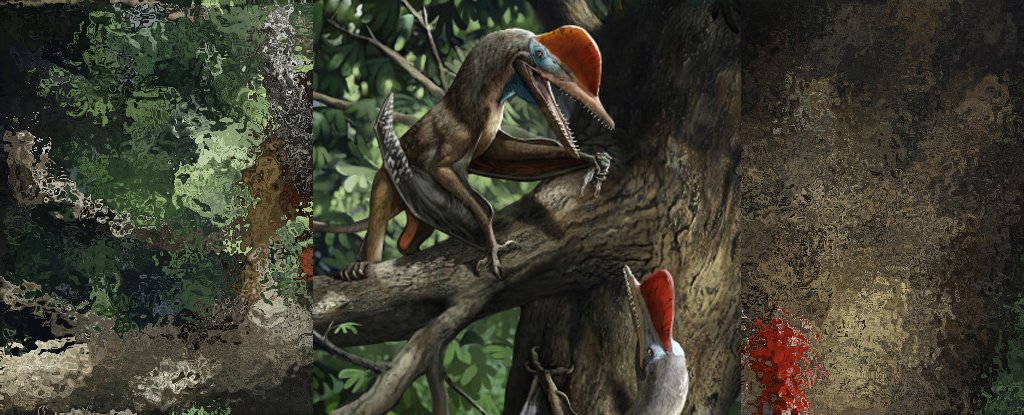
I'm a paleontologist, so I can't resist commenting on "Monkeydactyl." First, it's a pterosaur, not a dinosaur. Second, its real name is Kunpengopterus antipollicatus. Just the same, it's a really cool discovery.


Thumbs up!

Saturday, May 9, 2020

Seth Meyers tells 'murder hornets' 'not now' while LiveScience stresses the threat to bees

Seven years ago, I wrote "here is some scary biodiversity for you all, a potential invasive species I can frighten my students with: Giant hornets killing dozens in China." Asian Giant Hornets are no longer "a potential invasive species," they're an actual invasive species here in the U.S. That prompted a lot of sensational coverage as a change of pace during the COVID-19 pandemic. I engaged in a little of that on Twitter, tweeting "I wondered why there were giant wasps and hornets in the Final Fantasy games. Then I read about these things and understood." Now I will definitely scare my students with them this semester!

Seth Meyers was having none of it. Watch Not Now, Murder Hornets.

Seth takes a moment to ask Asian giant hornets, or "murder hornets," to give us all a break as we’re busy dealing with the coronavirus pandemic.
In his monologue, Seth does a good job of placing the threat in the context of the pandemic and official response in addition to the "now what" reaction to one more thing to worry about. Fortunately, as scary as Asian Giant Hornets are, they are mostly a threat to honeybees. LiveScience emphasizes that point in "Murder Hornets" Massacre Honey Bees, Not Humans FYI.

Sightings in Washington state of Asian giant hornets* raise concerns that the enormous insects may be settling in North America. Live Science Senior Writer Mindy Weisberger tells the tale of how "Murder Hornets" got their name and what's going on with our new visitors:
...
* not yellowjackets aka "American Hornets" which are only a 1/2-inch vs 2-inch length, and not European #hornets are also smaller than their giant Asian cousins, and do not attack bees as a group ~The more you know~ about #asiangianthornets
While they are less of a threat to humans than they seem — 50 dead per year out of the approximately three billion people in the countries where it is native does not seem impressive compared to the average of 62 Americans dying every year from bee, wasp, and hornet stings with a population one-tenth that size; Giant Asian Hornets might add an average of 5-10 each year to that total if fatalities are proportional to population — they are a real threat to bees. That makes them an indirect threat to humans because of the importance of honeybees to agriculture. Oh, boy, one more thing to include in this year's World Bee Day on May 20th.

Enough of the potential threat from murder hornets today. Stay tuned for a celebration of Mother's Day.

Saturday, September 26, 2015

Sunday's blood moon won't be the end of the world


There's a lunar eclipse tomorrow night, which has received a lot of press.  The sane perspective on the event comes from KPBS's Total Lunar Eclipse and Supermoon This Weekend.

Peggy Pico talks with Jerry Hilburn of the San Diego Astronomy Association to discuss the lunar event this weekend.
There, just a spectacular sky phenomenon.  However, some people are making it out be more than that.  Follow over the jump.

Saturday, November 22, 2014

Warmest October on record for planet, fourth warmest for U.S.


I put the U.S.-China climate deal in context in a parenthetical statement and footnote.
Given what the rest of the climate news I included in last week's Overnight News Digest: Science Saturday on Daily Kos was like, it comes not a moment too soon...Stay tuned for an entry about these stories.
It's time for that entry.

The top story comes from Brian Kahn of Climate Central via LiveScience: Earth Had Warmest October on Record.
For the third month in a row, global temperatures reached record territory according to newly available data from NASA. And if one global temperature record isn’t enough, the Japanese Meteorological Agency also provided new data on Friday that showed the warmest October on record.

Data from NASA Goddard Institute for Space Studies (GISS) show this October was 1.4°F above the 1951-1980 average they use as their baseline. That didn’t set a monthly mark, as did August and September, but rather tied 2005 as the warmest October since 1880. That keeps 2014 on track to be the hottest year on record.

While individual hot years or months don’t necessarily stand out, it’s notable that all 10 of the warmest years on record have all come since 1998, one of the clearest signs that the climate is warming due in large part to greenhouse gas emissions.
As if that wasn't enough, Kahn of Climate Central also told his readers in LiveScience to Feel the Heat: Fourth-Warmest October for U.S..
It might be chilly (OK, downright Arctic) in the middle third of the U.S. these days, but if you live there, you can warm yourself with memories of October. According to new data released Thursday, October wasn’t just a little warm, it was the fourth-warmest October for the lower 48 on record and not a single state recorded below normal temperatures.

In what’s been the year of the great weather schism, October showed reconciliation is possible. Warm weather that has been the hallmark of the West this year was also seen spreading across the South and Northeast. The only spot with near-normal temperatures was the Upper Midwest, though near normal probably sounds downright balmy to folks in Detroit who just weathered overnight lows of minus-14°F.

37 of the contiguous 48 states experiencing above-normal temperatures, that put the national average temperature 3°F above normal. That makes it the fourth warmest among the past 120 Octobers according to the new data from the National Climatic Data Center (NCDC). Not a single state saw below normal temperatures, the first time that’s happened since July 2013.
If it hadn't been for Philae landing on a comet, these would have been the top stories last Saturday.

Follow over the jump for more of last week's climate stories.

Tuesday, November 18, 2014

U.S.-China climate deal


I'm in the mood for some good news tonight, so here is something I mentioned at the end of U.S. home ownership rate and me, the U.S.-China climate deal.  Take it away, LiveScience!

US-China Climate Accord Gives Hope for Global Agreement
by Megan Gannon, News Editor
November 13, 2014 07:02am ET
The United States and China surprised climate-policy watchers this week by announcing a rare accord to cut carbon pollution. As details of the agreement are released, experts are hopeful that cooperation between the world's two biggest economies, and two biggest carbon emitters, bodes well for an as-yet elusive global climate pact.

"For many years, the reluctance of the U.S. and China to make strong commitments has been an oft-used excuse by other countries to not take action," said Anthony Leiserowitz, director of the Yale Project on Climate Change Communication.

"In fact, many in the U.S. Congress have resisted taking action because they argued that China wasn't acting," Leiserowitz told Live Science in an email. "And many Chinese leaders have long used the same argument about the United States to avoid making their own commitments. This very public and early agreement by the two largest national emitters in the world should help break the long-standing logjam in the international negotiations."
Not only is this good news, but it's exactly the kind of cooperation I was hoping for when I first called the Sino-American relationship The CoDominion in U.S.-China EcoPartnerships: The CoDominion plans for sustainability and repeated in An update on The CoDominion planning for sustainability.  Given what the rest of the climate news I included in last week's Overnight News Digest: Science Saturday on Daily Kos was like, it comes not a moment too soon.*  I should curb my enthusiasm, as the result is likely to be what Paul Krugman describes in China Deals.
[O]ne of the main arguments the usual suspects make against action — after arguing that it’s all a gigantic hoax, any limits on emissions will destroy the economy, and liberals are ugly — is that nothing the US does can matter, because China will just keep on emitting. Some of us have long argued that this is way too pessimistic — that the advanced countries, if they are willing to limit their own emissions, can have a lot of leverage via the threat of carbon tariffs. But now China is showing itself willing to deal even without that.

So you could say that a major prop of the anti-climate-action campaign has just been knocked away. But as I said, it probably won’t matter; they’ll just come up with another excuse.
I wish Krugman was wrong, but he probably isn't.  Sigh.

*Stay tuned for an entry about these stories.

Sunday, October 19, 2014

Siding Spring and other Mars news


Today, Comet Siding Spring flies by Mars.  Here are the stories about the event that I included in the past two Overnight News Digests on Daily Kos.

JPL/NASA: Comet Siding Spring: A Close Encounter with Mars

Comet C/2013 A1 Siding Spring will make a very close flyby of Mars on Oct. 19, 2014. Passing at a distance of only 87,000 miles (by comparison that's little more than 1/3 the distance between Earth and our moon), it’ll be a near miss of the Red Planet. Find out how NASA’s Mars orbiters will evade the onslaught of dust particles from the comet.
Space.com via LiveScience: Comet's Mars Flyby Sunday Has Scientists Abuzz
By Mike Wall, Senior Writer
October 17, 2014 11:06am ET
A comet's close shave with Mars this weekend could reveal some key insights about the Red Planet and the solar system's early days, researchers say.

Comet Siding Spring will zoom within 87,000 miles (139,500 kilometers) of Mars at 2:27 p.m. EDT (1827 GMT) on Sunday (Oct. 19). Scientists will observe the flyby using the fleet of spacecraft at Mars, studying the comet and any effects its particles have on the planet's thin atmosphere.

"On Oct. 19, we're going to observe an event that happens maybe once every million years," Jim Green, director of NASA's planetary science division, said in a news conference earlier this month. "This is an absolutely spectacular event."
Follow over the jump for the rest of the Mars news since MAVEN at Mars from the University of Colorado, including a video and story about MAVEN.

Sunday, August 24, 2014

Bardarbunga erupts, maybe


Tonight's top story in my Overnight News Digest: Science Saturday at Daily Kos is Bardarbunga eruption, or at least what most people think is one.  Take it away, LiveScience!

Subglacial Eruption Begins at Iceland's Bardarbunga Volcano (Updated)
By Becky Oskin, Senior Writer
August 23, 2014 01:25pm ET
One week after an earthquake swarm first warned of magma on the rise, a volcanic eruption has started near Iceland's Barðarbunga volcano, the Icelandic Met Office announced today (Aug. 23).

The small-scale eruption is taking place northeast of Barðarbunga, underneath the Dyngjujökull glacier. Scientists estimate 492 to 1,312 feet of ice (150 to 400 meters) covers the emerging lava, the Met Office said in a statement. Even though no one can see the eruption, seismic signals indicate that ice is flashing into steam. This suggests lava has broken through to the surface, beneath the glacier.

Update at 9:30 p.m. ET: Volcano experts in Iceland are not convinced that an eruption is underway. Earthquakes continue, including a magnitude-5.3 this evening, but the tremors that signaled steam blasts from lava have decreased, the Met Office said. Nor is meltwater draining from the glacier. "Presently there are no signs of ongoing volcanic activity," the Met Office said in an update. "The aviation color code for the Barðarbunga volcano remains red as an imminent eruption can not be excluded."
Several diaries on Daily Kos also covered the eruption, including This week in science: fire and ice-land by DarkSyde, Bárðarbunga: Eruption! by Rei, and Code Red: Bárðarbunga Volcano Erupts? Updated M5.3 Quake Confirmed, Largest Quake Yet by FishOutofWater.  In addition, Vox asks Is Iceland's volcano erupting? Scientists are still waiting to see.  The event has attracted a lot of attention, so stay tuned for further developments.

Saturday, August 23, 2014

Shark attacks for Shark Week 2014


Last week was Shark Week, even on Daily Kos.  Here are the two stories I received about the Discovery Channel promotional event that I used as the lead stories last week.

First, Mary Landers of Savannah Now reported Shark-bitten turtle rescued on Ossabaw.
This loggerhead's story is one of bad luck turned good.

First the bad: She was bitten by a shark. That's clear from the telltale semi-lunar chunk missing from her shell behind her right front leg, said naturalist John "Crawfish" Crawford.

A shark bite is a bit unusual for a big girl like Phoenix, an adult sea turtle who weighs in at 190 pounds. Sharks aren't known to be discriminating diners, but Georgia's adult loggerheads are too large and spend too much time feeding on the ocean floor to be much of a target for these predators, said Mark Dodd, a Department of Natural Resources wildlife biologist and the state's sea turtle coordinator.
Next, Tanya Lewis of LiveScience asked Shark Attack … In a Lake?!
The idea of a shark attacking someone in the ocean is scary enough, but this week, a 7-year-old boy was bitten by one of these fearsome fish in a lake.

The boy was swimming in Lake Pontchartrain in Louisiana, when something bumped into him in the water and chomped down on his foot, USA Today reported. The bite's appearance suggests it was probably a bull shark measuring about 5 feet (1.5 meters) long, experts say. The boy is expected to recover from the incident.
I figured it would be a bull shark. I mentioned it as one species of shark most likely to venture into freshwater to my biodiversity class this summer.  If I remember this story, I can give it as an example to my biodiversity students next summer.

That's it for this year's Shark Week.  It's less attention than I paid to it last year, when I posted A week of sharks, hurricanes, and geeks.  I'm OK with that.

Thursday, August 21, 2014

Music from space--gamma ray bursts and planetary magnetospheres


When I concluded Curiosity and other Mars news from the past two weeks by saying to stay tuned for more space news, I forgot that I wasn't done with space music when I posted 2001 music for the 2001st post.  I have some more from Overnight News Digest: Science Saturday to share.  Tanya Lewis of LiveScience brought Distant Galaxies' Explosions Become Psychedelic Songs via Yahoo! News two weeks ago.
An astronomer and a graphic artist have teamed up to turn powerful explosions in distant galaxies into spellbinding music and animations. The unique celestial compositions are psychedelic and strangely beautiful.

Known as gamma-ray bursts, these explosions of high-frequency electromagnetic radiation are the brightest events known to occur in the universe. Sylvia Zhu, a graduate student in physics at the University of Maryland, College Park, studies gamma-ray bursts at NASA's Goddard Spaceflight Center in Greenbelt, Maryland, using the Fermi Gamma-ray Space Telescope.
In addition to an embed of the video of the latest composition at the link, it's also available on Vimeo.  Here it is.

GRB suite from Turner Gillespie on Vimeo.

Follow over the jump for an older video converting gamma rays bursts into music and a bonus video of near-Earth space sounds that also sound musical.

Friday, July 18, 2014

Magnetic field reversal and 'Innovation the NASA Way'


Looking through my archives, I found that I didn't post all the space news from the past two weeks in Orbiting Carbon Observatory launches and space news video extravaganza and Supermoon and other space and astronomy news.  I missed one story each week that should have appeared in those two compendiums.  Without any further ado, here they are.

First, Kelly Dickerson of LiveScience reported Earth's Magnetic Field Is Weakening 10 Times Faster Now.
Earth's magnetic field, which protects the planet from huge blasts of deadly solar radiation, has been weakening over the past six months, according to data collected by a European Space Agency (ESA) satellite array called Swarm.

The biggest weak spots in the magnetic field — which extends 370,000 miles (600,000 kilometers) above the planet's surface — have sprung up over the Western Hemisphere, while the field has strengthened over areas like the southern Indian Ocean, according to the magnetometers onboard the Swarm satellites — three separate satellites floating in tandem.

The scientists who conducted the study are still unsure why the magnetic field is weakening, but one likely reason is that Earth's magnetic poles are getting ready to flip, said Rune Floberghagen, the ESA's Swarm mission manager. In fact, the data suggest magnetic north is moving toward Siberia.
This ties back into Discovery News on the sun flipping, in which I pointed out that "increased sunspot activity...would make for more solar storms.  That wouldn't be good for Earth, especially if they happen when the Earth's field is also reversing.  Such a combination might fry our electric grid."  This news indicates a reversal of Earth's magnetic field is becoming more likely.

Next, Space.com via LiveScience describes 'Innovation the NASA Way' (US 2014): Book Excerpt.
NASA's approach to leadership has inspired the public for decades, achieving results and overcoming obstacles that so often seemed impossible. Rod Pyle has provided leadership training to top executives at the agency and learned first-hand the situations that have guided the space agency at its most critical moments. With his latest book, he shares what he has learned and offers insight into both the inner workings of NASA and leadership lessons that span disciplines.

Below is an excerpt from his book, the first chapter of  "Innovation the NASA Way: Harnessing the Power of Your Organization for Breakthrough Success" — problem-solving anecdotes and lessons from the Mars Curiosity mission.
Read the excerpt; it's cool.

Sunday, June 22, 2014

Animals predict the World Cup in space


No, not really, but I couldn't resist the title based on combining the two World Cup related items from Overnight News Digest: Science Saturday (Summer Solstice 2014) I'm recycling tonight.

First, Discovery News asks and answers How Do Astronauts Watch The World Cup In Space?


Next, Tanya Lewis of LiveScience reports Animals 'Predict' 2014 World Cup Winning Teams.
They're baaack — in zoos around the world, animals are taking to the field — or at least, the tank or the food bin — to predict the results of the 2014 FIFA World Cup.
I'll plan on returning with another entertainment-themed entry later, as this weekend sees the return of two post-apocalyptic alien invasion shows, "Defiance" and "Falling Skies."  Stay tuned.

Saturday, June 21, 2014

Asteroid impact tied to Eocene extinction and other space and astronomy news


I've already shared today's top astronomical news in Happy Summer Solstice 2014!  It's time to pass along all the space and astronomy stories I collected for Overnight News Digest: Science Saturday (Fathers Day).  First, Becky Oskin of LiveScience reports on an ancient disaster in  Russia's Popigai Meteor Crash Linked to Mass Extinction.
SACRAMENTO, Calif. — New evidence implicates one of Earth's biggest impact craters in a mass extinction that occurred 33.7 million years ago, according to research presented here Wednesday (June 11) at the annual Goldschmidt geochemistry conference.

Researchers from the University of California, Los Angeles precisely dated rocks from beneath the Popigai impact crater in remote Siberia to the Eocene epoch mass extinction that occurred 33.7 million years ago. Popigai crater is one of the 10 biggest impact craters on Earth, and in 2012, Russian scientists claimed the crater harbors a gigantic industrial diamond deposit.

The new age, which is later than other estimates, means the Eocene extinction — long blamed on climate change — now has another prime suspect: an "impact winter." Meteorite blasts can trigger a deadly global chill by blanketing the Earth's atmosphere with tiny particles that reflect the sun's heat.
Apophis Day may be postponed until 2068, but it is coming.  We should be prepared.

Follow over the jump for the rest of the week's space and astronomy news.

Sunday, June 15, 2014

The science of fatherhood for Father's Day


To celebrate the holiday, here are the two lead stories from Overnight News Digest: Science Saturday (Fathers Day) on Daily Kos.  Under the "if it moves it leads" policy, the video from Discovery News goes first.

The Science Of Stay-At-Home Dads!


LiveScience explains 5 Ways Fatherhood Changes a Man's Brain By Bahar Gholipour, Staff Writer, on June 14, 2014 11:21am ET.
Fatherhood can change a man's life. It also changes his brain, in ways that it seems to equip dads with the very same "baby sense" that's often attributed to moms.

From an animal kingdom perspective, human dads are unusual. They belong to a group of less than 6 percent of mammal species in which fathers play a significant role in rearing offspring. In these species, paternal care often involves the same behaviors as maternal care, with the exception of nursing.

But how does fatherhood change a man's brain? Science has only recently delved into the neural and hormonal mechanisms of paternal care, but so far the evidence suggests that mothers' and fathers' brains use a similar neural circuitry when taking care of their children. Moms and dads also undergo similar hormonal changes that are linked to their brain and behavior changes.
Once again, Happy Fathers Day!

Thursday, May 22, 2014

The ancient Egyptians ate their vegetables


On LiveScience, Alexander Hellemans asks What Did Ancient Egyptians Really Eat?
(ISNS) -- Did the ancient Egyptians eat like us? If you're a vegetarian, tucking in along the Nile thousands of years ago would have felt just like home.

In fact, eating lots of meat is a recent phenomenon. In ancient cultures vegetarianism was much more common, except in nomadic populations. Most sedentary populations ate fruit and vegetables.
Be like the Egyptians--eat more fruit and vegetables!

Monday, May 5, 2014

Climate change reducing food supply


As if it weren't bad enough that we may be facing a food shortage by 2050 and natural disasters have alreacy caused food shortages, climate change may already be reducing our ability to produce food for the seven billion people already here.  In March, Denise Chow of LiveScience wrote Draft UN Report: Global Warming Could Cost $1.45 Trillion.
The effects of global warming could cost the world $1.45 trillion in economic damages, with the planet's crop production projected to decline up to two percent every decade, according to news coverage of a new UN report.
Last week, North Carolina State University contended that this may be happening this year in the U.S. as Increased Drought Portends Lower Future Midwest Crop Yields.
Increasingly harsh drought conditions in the U.S. Midwest’s Corn Belt may take a serious toll on corn and soybean yields over the next half-century, according to research published today in the journal Science.

Corn yields could drop by 15 to 30 percent, according to the paper’s estimates; soybean yield losses would be less severe.

North Carolina State University’s Roderick Rejesus, associate professor of agricultural and resource economics and a co-author of the Science paper, says that corn and soybean yields show increasing sensitivity to drought, with yields struggling in dry conditions in Iowa, Illinois and Indiana during the 1995 to 2012 study period.

“Yield increases are getting smaller in bad conditions,” Rejesus said. “Agronomic and genetic crop improvements over the years help a lot when growing conditions are good, but have little effect when growing conditions are poor, like during droughts.”
As 'Years of Living Dangerously' is pointing out, climate change is NOW.

Wednesday, March 26, 2014

Gravity waves from the Big Bang and other space and astronomy news


I concluded Floods in Colorado, the other top post for the third year of Crazy Eddie's Motie News, plus other climate news with a promise that I'm postponing keeping.
The next entry will document how another Peak Oil blogger, the Archdruid, has also been instrumental in improving my blogging.  Stay tuned.
That should have been the next entry in this series, as I'm not quite up to it tonight.  I'll probably post that one at 8 P.M. tomorrow night, just in time for Greer's next essay.  Tonight, I'm going to do something to honor Space News for the second and third year of Crazy Eddie's Motie News by posting this week's summary of space and astronomy news from Overnight News Digest: Science Saturday (Gravity Waves from the Big Bang) on Daily Kos.  Yes, I'm repeating the lead story.  What do you expect?  I'm an environmentalist, I recycle.

Under my "if it moves, it leads" policy, Discovery News goes first with How We Know The Big Bang Actually Happened?

Earlier this week, astronomers announced that they directly observed gravitational waves. These waves are evidence for quantum gravity. How does this prove the Big Bang actually happened? Trace is joined by Ian O'Neill to explain this new, groundbreaking finding.
For more, here's LiveScience with Scientists Report Evidence for Gravitational Waves in Early Universe by Ben P. Stein, ISNS Director on March 18, 2014 12:44am ET.
In what would represent the most direct evidence of Albert Einstein’s last major unconfirmed prediction, as well as a powerful confirmation of a violently fast expansion of the early cosmos, scientists using a cutting-edge South Pole telescope announced evidence for the first detection of gravitational waves in the initial moments of the universe.

Outside experts reacted enthusiastically to the results, but cautioned that the data has unusual characteristics that may ultimately conflict with earlier observations and could require more complicated models for the universe’s early expansion than previously expected.

The announcement was made by the brawny-sounding BICEP2 collaboration, which actually translates into the brainier name of "Background Imaging of Cosmic Extragalactic Polarization." The BICEP2 team announced their results today in series of scientific presentations and a news conference at the Harvard-Smithsonian Center for Astrophysics in Cambridge, Mass. The collaboration posted a preprint of their paper which has been submitted for publication and will undergo scientific peer review.
Follow over the jump for more space and astronomy news, including some energy and entertainment news that involves space.

Sunday, March 16, 2014

Update to Pi Day 2014


First, I posted A drum corps Pi Day.  Now it's time for science to take its turn with updates from Discovery News, LiveScience, and Texas Tech.

Is Tau Better Than Pi?

Pi Day is the annual celebration of the mathematical constant pi! It happens every year on March 14, since the numbers match the first three digits of pi. Is there anything better than pi? Tara joins Trace to discuss whether or not tau is better than pi.
Happy Pi Day! Fun Facts About Our Favorite Irrational Number
by Tanya Lewis, LiveScience Staff Writer
March 14, 2014 07:49am ET
Math lovers celebrate today (3/14) as Pi Day, in honor of the irrational number pi.

Pi, or ?, is defined as the ratio of the circumference of a circle to its diameter. Pi is an irrational number, meaning it cannot be written as a simple fraction. Instead, it can be expressed as an infinite, nonrepeating decimal (3.14159…) or approximated as the fraction 22/7.

Here are some nerdy facts about the irrational number, to impress your friends as you celebrate Pi Day (which is also Albert Einstein's birthday).
Easy as Pi: Alum Hopes Pie Pan Leads to Sweet Success
When Garrett Heath realized such a product didn't exist, he took matters into his own hands.
Written by Megan Ketterer
March 14, 2014
Pi or pie? With today (March 14) being celebrated around the nation as Pi Day, these homophones can be confusing, especially when baking pies is a popular way to celebrate the famous mathematical constant.

A Texas Tech University alumnus decided to combine these words and create something for everyone to enjoy on Pi Day: a Pi Pie Pan, a pan in the shape of the pi symbol designed for baking pies.

“It’s a fun way for people to show off being a little geeky while enjoying to cook,” said Garrett Heath, creator of the pan. “There’s no better way to make a pie on Pi Day than to have a pi-shaped pan.”
I can't have just one slice of pie--or Pi Day, for that matter.