Showing posts with label Jay Inslee. Show all posts

Thursday, August 22, 2019

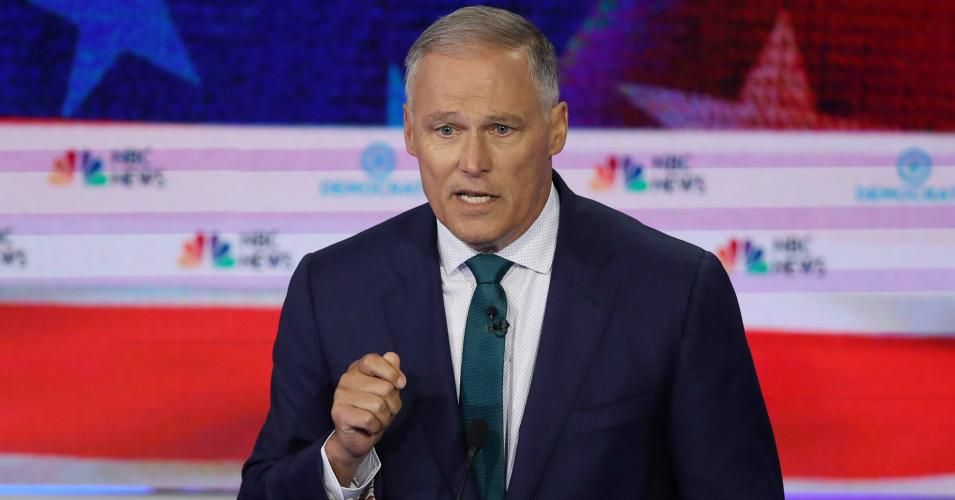
Washington Governor Jay Inslee drops out of presidential contest to run for re-election


I know that I promised three Vtimes to update On The Issues shows most of the Democratic candidates have moved left during the campaign, too, the last time writing "I've already collected the data.  I just need to sort it, write the post, and create the memes.  The entry should be ready tomorrow," meaning today.  While I've sorted the data, I'm not going to complete the rest today because of two breaking stories.  The first is Jay Inslee dropping out last night.  CBS News has a report in Governor Jay Inslee drops out of 2020 presidential race.

Washington Governor Jay Inslee, who made fighting climate change the central theme of his presidential campaign, announced Wednesday night that he is ending his bid for the 2020 Democratic nomination. Inslee announced his decision on MSNBC.
NBC News has the clip of Inslee on Maddow's show along with his plans for next year.
"It's become clear that I'm not going to be carrying the ball. I'm not going to be the president, so I'm withdrawing tonight from the race," he told Maddow, vowing he'd help keep the other 2020 candidates focused on issue of climate change, the centerpiece of his campaign. "I've been fighting climate change for 25 years, and I've never been so confident of the ability of America now to reach critical mass to move the ball."

Inslee sent an email to supporters on Thursday announcing that he will run for a third term as governor instead.

"I want to continue to stand with you in opposing Donald Trump and rejecting his hurtful and divisive agenda, while strengthening and enhancing Washington state's role as a progressive beacon for the nation," he wrote.
I wish I could say I was surprised.  When Inslee announced, I wrote that he had a "slim chance" and "I wish him good luck; he'll need it."  For what it's worth, the reporters and editors at FiveThirtyEight aren't either, as Inslee was the fifth candidate picked in their first 2020 drop out draft.  Two down, seven to go.

Speaking of which, the first candidate picked, John Hickenlooper, announced that he was running for U.S. Senate.  That's the other breaking story that I plan on writing about today.  Stay tuned, but follow over the jump first for the recipe and memes for Inslee I'm retiring now that he's out of the race.

Tuesday, July 16, 2019

On The Issues shows most of the Democratic candidates have moved left during the campaign, too


I concluded Senators and Representatives running for the Democratic nomination are drifting to the left as they campaign by observing that the phenomenon was more widespread than just current members of Congress.
By the way, the leftward movement of Democratic candidates isn't only shown by the Voteview scores of the current members of Congress; it's demonstrated by the Vote Match scores of all the candidates at On The Issues, which is something I found out after I wrote Wayne Messam at On The Issues, take one.  Nearly every candidate has become more liberal either economically or socially, and a few have moved left on both axes.
My findings are that, of the 25 candidates and one former candidate that I have examined, On The Issues rates eight as having become more liberal economically, six have become more liberal socially, and five have become more liberal along both scales, while four have remained the same and two actually become more moderate economically, so a total of nineteen have become more liberal on one or both dimensions.  Follow over the jump to see which candidates have new ideological scores and how those scores now arrange the candidates from left to center.

Wednesday, June 26, 2019

Drinks for the Democratic debates, Part 1


Four years ago, I wrote a five-part series about drinks for the Democratic debates.  Since the first Democratic debate for the 2020 nomination is tonight, it's time to revive the series.

The first item of business is the drinking game.  Unfortunately, Paul W. of You Might Notice A Trend is not creating drinking games this year; his experience with the 2016 election soured him on the idea.  That's the bad news.  The good news is that I've found three good ones at DebateDrinking.com, the site I used for the general election debates three years ago, Spectator USA, which is the funniest and most complex, and A.M. New York, which is the simplest.  I don't care which one my readers play, but please pick one.

Next, the drinks, one for each candidate in tonight's debate, which DebateDrinking.com lists as follows.
NIGHT 1
Wednesday, June 26
  • Cory Booker
  • Bill de Blasio
  • Julián Castro
  • John Delaney
  • Tulsi Gabbard
  • Jay Inslee
  • Amy Klobuchar
  • Beto O'Rourke
  • Tim Ryan
  • Elizabeth Warren
Follow over the jump for the drinks, one for each candidate.

Saturday, June 1, 2019

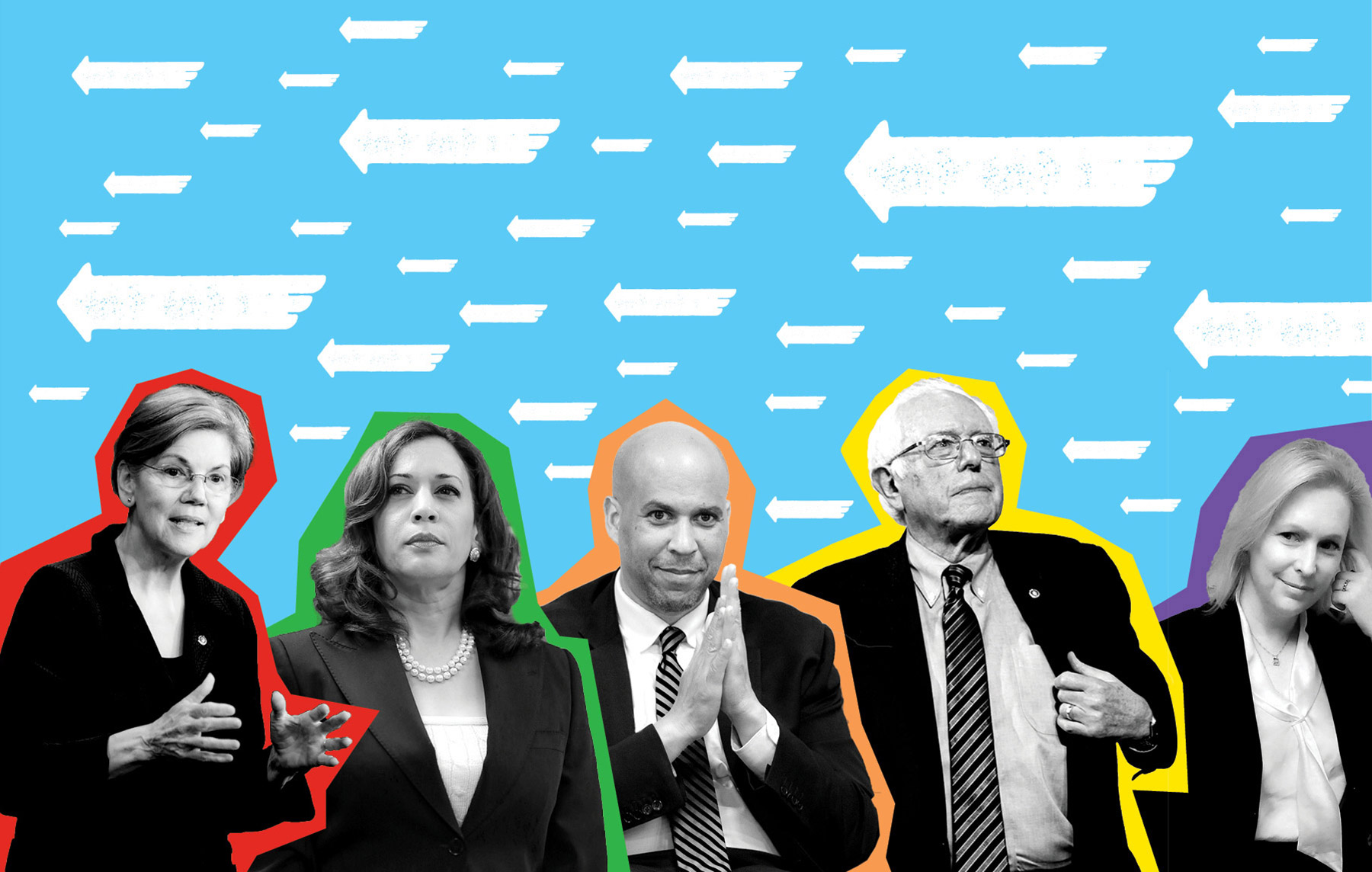
Democratic presidential candidates from left to center from Voteview


Full-sized original at In These Times.

This past April, I read a tweet describing Tulsi Gabbard and Bernie Sanders as "being objectively further left then the rest of the Dem primary field."  I thought "Really?  I don't think the data supports that claim" and decided to test it with the DW-NOMINATE scores and relative placements from Voteview.com of all the declared candidates for the Democratic nomination who had scores at the time.  Well, it's two months later, more candidates have declared, and the first two Democratic candidate debates are happening at the end of the month, so it's time to convert the scores into a post.

First, what's Voteview?
Voteview allows users to view every congressional roll call vote in American history on a map of the United States and on a liberal-conservative ideological map including information about the ideological positions of voting Senators and Representatives.
...
Ideological positions are calculated using the DW-NOMINATE (Dynamic Weighted NOMINAl Three-step Estimation). This procedure was developed by Poole and Rosenthal in the 1980s and is a "scaling procedure", representing legislators on a spatial map. In this sense, a spatial map is much like a road map--the closeness of two legislators on the map shows how similar their voting records are. Using this measure of distance, DW-NOMINATE is able to recover the "dimensions" that inform congressional voting behavior.

The primary dimension through most of American history has been "liberal" vs. "conservative" (also referred to as "left" vs. "right"). A second dimension picks up differences within the major political parties over slavery, currency, nativism, civil rights, and lifestyle issues during periods of American history.
In other words, liberal-conservative scores are calculated in two dimensions using DW-NOMINATE.  The votes are fed into the program and the program assigns scores and maps them out.  There is no human judgment involved so it's about as objective a measure of ideology as I can find.

The maps themselves have been animated to show changes in partisanship over time.  Watch This 60-second animation shows how divided Congress has become over the last 60 years, which is based on a study that used DW-NOMINATE data from Voteview.

It's news to no one that Congress has had a hard time passing legislation in recent years. Some have even asserted that partisanship in Washington has reached historic levels. But how do we put the current divide in perspective? A group of researchers recently tried to quantify and visualize House partisanship in a paper published in PLoS ONE.
That was fascinating, but enough about Voteview and its methods.  Follow over the jump for the ranking from liberal to moderate for the Democratic candidates running for President who are current or former members of Congress.