A blog about societal, cultural, and civilizational collapse, and how to stave it off or survive it. Named after the legendary character "Crazy Eddie" in Larry Niven and Jerry Pournelle's "The Mote in God's Eye." Expect news and views about culture, politics, economics, technology, and science fiction.
Congress has gotten steadily older over the past few decades, and that has major implications for the issues the legislature cares about.
The short answer to the question is demographics — America has growing older, despite fallinglifeexpectancy during the pandemic — and the power of incumbency. I'm sure my fellow fans of Strauss and Howe would not be surprised by this result; those authors saw something like this coming at about this time 30 years ago. I'm also sure that they would notice that FiveThirtyEight is using Strauss and Howe's names for the generations as well.
I agree with FiveThirtyEight's quick summary of what our gerontocracy means for policy. It's good for issues relevant to seniors, but maybe not so good for those important to younger Americans. That's good and bad for me personally. I'm 63, so the current Congress would be more likely to pay attention to health issues, like my diabetes, and retirement. On the other, they might not take climatechange and technology as seriously as I think they need to, while a younger group of legislators would. Sigh.
The end of the semester approaches and I need to spend more time on my work, so stay tuned for another short post tomorrow.
HappyInternationalWomen'sDay! For this year's celebration, I'm returning to the themes of 2018 and 2019, women running for high office. Unlike 2019, when a record six women were running for President, only two have announced their candidacies so far, Marianne Williamson challenging Joe Biden and Nikki Haley challenging Donald Trump (and probably Ron DeSantis, who is almost certainly running but hasn't announced his candidacy yet). Both face steep uphill battles in their quests to earn their parties' nominations. Follow over the jump as I cover both of them.
Despite the attempts by Nikki Haley (not "Hayley") and Rick Scott to make the party and convention seem normal and non-threatening, Kimberly Guilfoyle managed to set the tone that viewers on the other side of the aisle found believable. If the Republicans wanted to get the Fox News viewers fired up, she was the one to do it. If they wanted to convince persuadable voters to vote Republicans, she wasn't.
The flip side of this would be neither Haley nor Scott, both from South Carolina, would be the ones to fire up the Republican base. Steve M. of No More Mister Nice Blog disposed of the chances of both Scott and Haley this week, Scott in YOU MUST HAVE THESE PEOPLE CONFUSED WITH SOME OTHER REPUBLICAN PARTY and Haley in CALLING IT NOW: NIKKI HALEY WON'T EVEN BE A RUNNING MATE. I'm glad he wrote those posts so I didn't have to. Besides, Steve M. has this blog on his blogroll and I've been getting a lot of visitors from it. It's about time I thanked him and sent some of my readers his way.
Inspired by the delicious produce of South Carolina and Georgia, Charlotte created the South Carolina Swizzle Cocktail to celebrate one of her favorite regions of the United States. Served in a julep style, this refreshing libation is perfect as a summer sipper.
Remember, great cocktails start with measuring responsibly.
Recipe:
1 1/2 parts Hendrick's Gin - Watch The Unusual Times: http://bit.ly/hendricks_reservebar
1/2 part Bitter Truth Apricot Liqueur
3/4 part fresh lime juice
3/4 part simple syrup
1/4 part Yellow Chartreuse
Instructions:
Shake ingredients with ice.
Strain over crushed ice into hurricane or tall glass.
Garnish with a mint sprig.
Now I'm wondering if it's worth creating a label for her. Darling Nikki, anyone?
Seth takes a closer look at the GOP facing blowback for heckling President Biden during his State of the Union address after he accurately pointed out that several Republicans had proposed cutting Social Security and Medicare.
Biden is in no mood for a repeat of 2011, when the Tea Party in Congress served Satan Sandwich to the American people. He was also in no mood to suffer the opposition silently.
Tooning Out The News' all-star Special Coverage team tackles President Biden's State of the Union address including Biden's economic message and Freedom Caucus heckling with New York Times Columnist Charles Blow. Plus, Tyler Templeton chastises chickens for rising egg prices.
According to Charles Blow, the Republicans heckling Biden played right into his hands. I think Blow's right. Also, it reminds me that I should write something about inflation again.
President Biden delivered his second State of the Union address on Tuesday to a newly divided Congress. It was his first big national speech since the midterms and a preview of the arguments he could make in his likely 2024 reelection bid. In the installment of the FiveThirtyEight Politics podcast, the crew discusses the arguments Biden laid out and where he stands with American voters two years into his presidency.
While this episode of the podcast was supposed to be analysis, it still had its lighter moments. The panelists also worried that emphasizing the economy looks good now, but might not age well, as the economy might experience a recession later this year. I promise to keep an eye on that, so stay tuned.
On August 25, 2018, the Democratic National Committee (DNC) members passed reforms to the Democratic Party's primary process in order to increase participation[25] and ensure transparency.[26] State parties are encouraged to use a government-run primary whenever available and increase the accessibility of their primary through same-day or automatic registration and same-day party switching. Caucuses are required to have absentee voting, or to otherwise allow those who cannot participate in person to be included.[25]
Independent of the results of the primaries and caucuses, the Democratic Party, from its group of party leaders and elected officials, also appointed 771[a] unpledged delegates (superdelegates) to participate in its national convention.
In contrast to all previous election cycles since superdelegates were introduced in 1984, superdelegates will no longer have the right to cast decisive votes on the convention's first ballot for the presidential nomination. They will be allowed to cast non-decisive votes if a candidate has clinched the nomination before the first ballot, or decisive votes on subsequent ballots in a contested convention.[27][28] In that case, the number of votes required shall increase to a majority of pledged and superdelegates combined. Superdelegates are not precluded from publicly endorsing a candidate before the convention.
There were also a number of changes to the process of nomination at the state level. A decline in the number of caucuses occurred after 2016, with Democrats in Colorado, Hawaii, Idaho, Kansas, Maine, Minnesota, Nebraska, North Dakota, and Washington all switching from various forms of caucuses to primaries (with Hawaii, Kansas, and North Dakota switching to party-run "firehouse primaries"). This has resulted in the lowest number of caucuses in the Democratic Party's recent history, with only three states (Iowa, Nevada, and Wyoming) and four territories (American Samoa, Guam, Northern Marianas, and U.S. Virgin Islands) using them. In addition, six states were approved in 2019 by the DNC to use ranked-choice voting in the primaries: Alaska, Hawaii, Kansas, and Wyoming for all voters; Iowa and Nevada for absentee voters.[29] Rather than eliminating candidates until a single winner is chosen, voters' choices would be reallocated until all remaining candidates have at least 15%, the threshold to receive delegates to the convention.[30]
Several states which did not use paper ballots widely in 2016 and 2018, adopted them for the 2020 primary and general elections,[31] to minimize potential interference in vote tallies, a concern raised by intelligence officials,[32] election officials[33] and the public.[34] The move to paper ballots enabled audits to start where they had not been possible before, and in 2020 about half the states audit samples of primary ballots to measure accuracy of the reported results.[35] Audits of caucus results depend on party rules, and the Iowa Democratic party investigated inaccuracies in precinct reports, resolved enough to be sure the delegate allocations were correct, and decided it did not have authority or time to correct all errors.
Worse yet, neither of them earned the Democratic nomination for President, despite them essentially tying in the NewHampshirePrimary. That distinction went to Joe Biden.
Despite his un[der]performance, Biden would go on to win the nomination, becoming the first candidate to do so without winning Iowa since Bill Clinton in 1992. Additionally, with Biden defeating incumbent president Donald Trump in the general election, he became the first candidate to do so without finishing in the top 3 in Iowa since the conception of the caucuses in 1972.
On top of which, Biden showed that he didn't need New Hampshire, either.
Biden became the first Democratic candidate since Bill Clinton, and the third ever Democratic candidate,[c] to win the nomination without carrying either Iowa or New Hampshire, the first two states on the primary/caucus calendar.
On top of which, many in the Democratic Party have pointed out how unrepresentative both Iowa and New Hampshire are of the current Democratic electorate, so the party is trying to rearrange its primary calendar to reflect its voters. PBS NewsHour reported on that process in Democratic Party battles over rearranging its presidential primary calendar, uploaded, appropriately enough, on Groundhog Day.
Democrats will soon vote to rearrange their calendar for the presidential primaries in 2024 and beyond and it could have major ramifications for the party. The plan moves South Carolina to the top of the calendar and would be the first time in more than 50 years that Iowa and New Hampshire won’t be the first caucuses and primary. Lisa Desjardins reports.
Both guests agreed that the Democratic primary calendar should be rearranged to make it reflect the party's voters. They just disagree that the first state should be South Carolina, which has a history of voting more for moderates than progressives. FiveThirtyEight examined that possibility in What Would It Mean If SC Voted First In The Democratic Primary.
In Part 2 of this week’s FiveThirtyEight Politics Podcast, the crew looks at how the Democratic Party's effort to rearrange its presidential primary calendar is going and discusses the impact this reassortment could have on candidate selection.
I agree with the general sense of the panel; neither New Hampshire nor Georgia will comply with the proposed changes. New Hampshire has the first primary of the Presidential country by state law and I think the Granite State won't move it. Also, these are changes that benefit the Democratic Party but not the Republican Party. The calendar in place up to 2020 suits them just fine, especially since Iowa and New Hampshire do reflect their voters. They have no motivation to go along with this reform.
Michigan House Democrats voted Tuesday to move the state's presidential primary to the fourth week of February and become a part of a new group of states slated to lead off the Democratic party's presidential primary starting next year.
Governor Gretchen Whitmer signed a new law Wednesday that would bump Michigan up in the presidential primary process. Whitmer said the law would give the state’s voters a stronger voice in choosing the president, by counting their votes earlier.
But Republican leaders said their party’s rules mean that it could actually disenfranchise their primary voters. And, in either case, it’s still not clear if the law will take effect in time for the 2024 election.
...
The bill to move up the primary passed the state Legislature on a partisan vote, with Republicans objecting because they said it would hurt voters in their own primary. The Republican National Committee rules say most states cannot hold primary votes before March 1.
...
Under the state’s constitution, in order for a law to take immediate effect, it has to pass with a two-thirds majority in the Legislature. Because Republicans held out, SB 13 didn’t cross the threshold. That means it will now take effect 90 days after the end of this year’s legislative session.
To meet that deadline, Democratic leaders would have to adjourn the legislature no later than November 29. Currently, legislators are scheduled to be in session through the first few weeks of December.
Election Day is next Tuesday, so it's time for me to return my attention to the candidates and issues on Americans' ballots. One of those issues is abortion rights. FiveThirtyEight examined this issue in my adopted home state in Voters Will Decide The Future Of Abortion Rights In Michigan.
On Election Day, Michigan voters will vote on an amendment that could enshrine the right to abortion in the state’s constitution. This comes after an abortion law from 1931 was ruled enforceable following the overturning of Roe v. Wade in June. Abortion is currently legal in the state, because of the ruling against the 1931 law. However, without the amendment, that law could end up banning abortion in most cases.
That's a good summary of the issue and how it ties into the Governor's contest between Gretchen Whitmer and Tudor Dixon, as well as the state of the race right now. I'm confident Big Gretch will win, although the FiveThirtyEight forecast is no guarantee. That's why my wife and I voted for her and Proposal 3.
Just 11% of Americans who are voting this year say abortion is the number one issue deciding their vote, according to the latest PBS NewsHour/NPR/Marist poll. But abortion is on the ballot in some states after the Supreme Court overturned Roe v. Wade. Zoe Clark of Michigan Radio and Ryland Barton of Kentucky Public Radio joined Amna Nawaz to discuss the debates taking place at the state level.
I hadn't heard of the ballot measure in Kentucky, which really looks like a funhouse mirror version of Michigan's. The two made for an interesting contrast while still pointing out the valid comparisons between the two. Here's to hoping Kentucky's ballot measure fails like the one in Kansas.
“How sick does a patient have to get before we can provide her evidence-based, life-saving care without risking arrest?” That’s the kind of dystopian question that medical professionals have to ask themselves when treating pregnant people in post-Roe America, says Dr. Gregory Goyert, an OB-GYN based in Detroit. “We’re going backwards for our girls,” says Warren [sic — Wayne] County Prosecution [sic — Prosecuting] Attorney Kym Worthy. It’s why the passage of Proposal 3, a ballot measure that would enshrine abortion rights in Michigan’s constitution, is so important. Yet as Election Day nears, Worthy notes that disinformation about it has become rampant. “That’s what happens when people know on the opposing side that the majority of Michiganders want Prop 3 to pass.”
I enjoyed that segment, especially listening to Kym Worthy. She pointed out the real crimes she wants to focus on, not prosecuting doctors for actions that should not be illegal.
Trevor's point that politicians who complain about actions they claim to be morally questionable often turn out to be doing themselves reminds me of my favorite link to tweet, Projection is the Right's favorite defense mechanism. That has proven to be even more true during the past decade. Too bad their own hypocrisy doesn't seem to bother them or their voters. The flip side of that is that many times when they complain of liberal hypocrisy, they're not seeing an inconsistency between what liberals espouse and what they do, but what they think liberal ideals are. They expose that they don't really understand liberal principles at all. That deserves a good example, but that's a subject for another time.
In the Senate, tipping-point states are the states most likely to give the winning party control of the chamber. According to the Deluxe version of the FiveThirtyEight Senate forecast, the four likeliest tipping-point states in this year's midterms are Georgia, Nevada, Pennsylvania and Wisconsin. Galen Druke uses the interactive model to go through the possible scenarios in each state.
Wow! Winning Georgia certainly makes a difference in both parties' odds of controlling the Senate! Despite Walker's issues, this contest is no laughing matter.
"The MAGA Republicans represent an extremism that threatens the very foundations of our republic," President Joe Biden said during his prime-time speech in Philadelphia on Thursday.
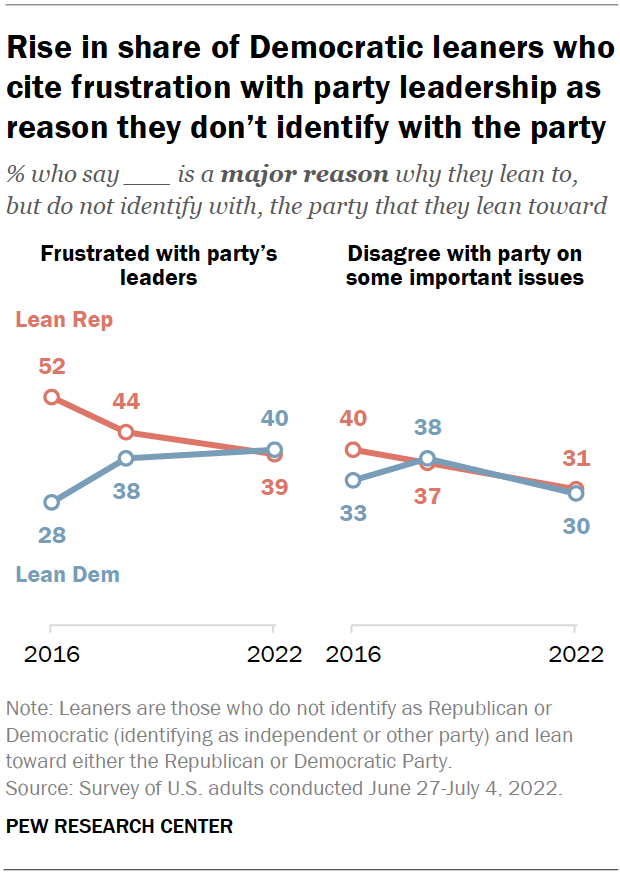
A lot of political commenters are having rhetorical fainting fits over the visual symbolism and aggressive tone of the speech, but I'm glad fighting Joe Biden is coming out finally. I suspect the relative lack of energy until very recently was one of the reasons for Democratic-leaning voters' frustration with the Democratic Party that Pew Research found.
Those who lean to the Democratic Party have become more critical of Democratic leaders. When asked why they lean toward a party – rather than identify with it – many leaners say they do not want to put a political label on their views, while nearly as many offer that they are frustrated with the leadership of the party they lean toward. The share of Democratic leaners who cite frustration with the party’s leaders as a major reason for why they do not more closely associate with the party has risen from 28% in 2016 to 40% currently. Over the same period, the share of Republican leaners who express frustration with GOP leadership has declined from 52% to 39%.
Here's the graphic that shows those results.
Notice, it's not policy, but leadership that is causing frustration. That probably plays into the other reasons for the disconnect, like inability to accomplish campaign promises and other Democratic agenda times. I think passing the InflationReductionAct and forgiving (some) student loan debt will take care of a lot of that. Biden's approval ratings are already improving, as FiveThirtyEight observed when the site examined What Biden's Rising Approval Could Mean For The Midterms.
In part three of this installment of the FiveThirtyEight Politics podcast, the crew analyzes why Biden’s approval rating has increased by nearly five points since late July. They also look to the future and discuss how this could possibly impact the midterm elections.
Democrats will vote for Biden and other Democrats. What's important is turnout among Democrats and persuading independents. Both of those look hopeful.
Stay tuned for the second installment of today's political news, which will focus on two initiatives that Republicans are keeping off the ballot in Michigan.
Vice President Kamala Harris cast the tie-breaking vote.
The Hill has more on Harris's tie-breaking vote and its significance.
Vice President Harris cast her 25th tiebreaking vote with the passage of the Inflation Reduction Act on Sunday, moving her within six votes of the almost two-century-old record held by former Vice President John Calhoun.
The Constitution stipulates the vice president also serves as president of the Senate and has the authority to break ties, which has occurred with some regularity over the past year and a half given the 50-50 makeup of the upper chamber.
Harris has already cast more tiebreakers than almost any other vice president, except for John Adams and Calhoun, who served from 1825 to 1832.
Calhoun has held the record of 31 tiebreaking votes since his tenure as vice president under John Quincy Adams and Andrew Jackson. John Adams, who served as vice president for nearly eight years under George Washington, cast 29 tiebreakers.
Harris, however, has cast more tiebreakers than Adams or Calhoun at the equivalent times in their vice presidencies.
Whether she will pass Adams or break Calhoun's record depends on how long the Senate remains tied at 50-50 between Republicans and Democrats, along with the independents who caucus with the latter. Right now, FiveThirtyEight forecasts that the Democrats have a 59% chance of retaining the chamber, which includes 8% probability that the chamber continues to have a 50-50 split with the Vice President breaking the tie. If that's the case, I expect Harris will set a new record for tie-breaking votes.
The U.S. Supreme Court has wrapped up a term that rewrote the law books on abortion, guns, climate change and asylum policy. That, in turn, set the stage for more history, when Justice Ketanji Brown Jackson became the first Black woman on the court. She was sworn in Thursday by Justice Stephen Breyer, who retired. The National Law Journal's Marcia Coyle joins John Yang to discuss.
This has certainly been an eventful term, thanks to the three justices that The Former Guy appointed, which moved the court even more to the right. The damage from his maladministration continues, a year and a half after he left office. At least the Biden Administration can claim victories over immigration and KetanjiBrownJackson.
Many environmental advocates acknowledged Thursday that the Supreme Court's decision in the Environmental Protection Agency’s case is a significant blow in the government's efforts to limit greenhouse gases in the short term. West Virginia won the case after a legal battle over the clean power plan. EPA Administrator Michael Regan joins Judy Woodruff to discuss.
This is indeed bad news for fighting climatechange and could be a precedent that constrains regulations by many branches of government. The good news is that hasn't happened yet and greenhouse gas emissions from power plants are decreasing because of market forces, which EPA Administrator Michael Regan mentioned in his interview. May we continue to be so lucky.
Follow over the jump for three of FiveThirtyEight's videos explaining the Supreme Court's decisions about abortion, the establishment clause, and guns.
Five states are holding primary elections today, the most populous of which is Pennsylvania. FiveThirtyEight's coverage of these primaries has focused on the Keystone State, most recently when it asked Who Will Win The GOP's Senate Primary In Pennsylvania?*
In this installment of the FiveThirtyEight Politics podcast, the crew discusses the races to watch in Tuesday's primaries in Idaho, Kentucky, North Carolina, Oregon and Pennsylvania. They also introduce a new FiveThirtyEight collaboration with Ipsos in which we ask Americans about the issues they care most about in the run-up to the midterm elections. The first poll, coming out this week, is all about inflation.
The supposed front runner for the GOP nomination is Mehmet Oz, but both Kathy Barnette and David McCormick (shown in the preview image) could beat him today. They're likely to face off against John Fetterman, who is leading Conor Lamb for the Democratic nomination for U.S. Senate. FiveThirtyEight has more on him in How John Fetterman Became A Democratic Favorite In Pennsylvania.
John Fetterman is the lieutenant governor of Pennsylvania. He's a Democrat, he's covered in tattoos, he's running for Senate and he's polling really well in his party's primary. But he's trending these days because of resurfaced reports that he chased an unarmed Black jogger with a shotgun in 2013.
Not a great look for a Democratic candidate, but it hasn't seemed to hurt him much, if at all.
Voters in Idaho, Kentucky, North Carolina, Oregon and Pennsylvania are heading to the polls this week to vote in their states’ primary elections. Here are the Republican candidates running for Congress, as well as state-level positions like secretary of state, who support former President Donald Trump’s “Big Lie.”
Of this week’s primaries, we’ve found Pennsylvania has the greatest share of Big Lie candidates running: We’ve identified 15 of 41 Republican candidates there who have backed Trump’s claims of a stolen election. In particular, the race to become the GOP nominee for governor has attracted multiple election deniers. One of the frontrunners in that race — Doug Mastriano — has repeatedly questioned the results of the 2020 election, including in Pennsylvania and he supported Trump’s efforts to try to overturn results there. He has said there was “cheating and fraud” in Pennsylvania and “rampant voting problems,” though his evidence relies on anecdotes and misinformation.
Personally, I'd rather call it Trump's dangerous delusion, his fixed belief that the election was stolen from him despite allevidence, which I see as related to his vulnerabilitytoconspiracy theories, but "the Big Lie" is the established phrase used by CNBC and others, so I'm calling it that instead. It's a lie, too.
Mayer's reporting shows that Trump's delusion is not just dangerous but contagious. It's bad enough that there is one pandemic running around; we don't need another.
The delusion has continued to spread, infecting a lot of candidates in today's elections. Ugh.
As Congress considers legislation that would decriminalize marijuana and end the sentencing disparity for crack and cocaine offenses, Galen Druke speaks with FiveThirtyEight contributor Lester Black on this episode of the FiveThirtyEight Politics podcast about what Americans think should be done about drugs and how politicians are responding.
So why exactly, then, aren’t more congressional Republicans representing their own voters’ views on this issue? One possibility is that many of these lawmakers simply don’t know how much Republicans’ opinions have changed. Political science research shows that politicians tend to overestimate their constituents’ support for conservative policies, with Republican lawmakers driving much of this phenomenon. Some congressional Republicans may therefore oppose federal legalization because they mistakenly believe they’re representing their own voters’ views.
Other members, however, are likely voting based on their own personal opposition to marijuana legalization. Compared with most Americans, congressional Republicans tend to be older and more religious, two demographic groups that are far more averse to legalization than younger and religiously unaffiliated Americans. Indeed, GOP politicians often oppose drug legalization on behalf of conservative principles like morality, order and family values.
This presents an opening for Democrats.
Regardless of the reasons, though, Democrats would be wise to make congressional Republicans’ opposition to marijuana legalization an issue in the upcoming midterm elections. As I noted two years ago, not only is legalization popular across the political spectrum, but political science research shows that it’s also one of the more important issues to Democrats, Republicans and independents. Every 4/20, in fact, it becomes more and more apparent that marijuana legalization is a winning political issue.
Here's to the Democrats taking advantage of this issue.
The Easter Bunny (Bowen Yang) invites Dr. Fauci (Kate McKinnon), Marjorie Taylor Greene (Cecily Strong), Mayor Eric Adams (Chris Redd), Elon Musk (Mikey Day), Britney Spears (Chloe Fineman), Jared Leto (Kyle Mooney), and Donald Trump (James Austin Johnson) to share their Easter wishes.
I'm glad to see Kate McKinnon return as Dr. Fauci for a holiday greeting. I'm not so glad to hear her say that she's not giving any advice because we wouldn't listen to it anyway. She's not wrong, but I wish it wasn't so. On the other hand, I am pleased that my snarky prediction "It will be a great four years — for Chris Redd and his fans" is so far coming true. I'm still not so sure if it will be a good four years for NYC Mayor Eric Adams.
Weekend Update anchors Colin Jost and Michael Che tackle the week’s biggest news, like JetBlue offering to buy Spirit Airlines.
Comparing Biden's approval rating to "Sonic the Hedgehog 2" is funny, but the approval rating itself is not. The good news is that particular poll is a negative outlier. The bad news is that FiveThirtyEight calculates Biden's approval rating at 41.6% approve and 52.2% disapprove. Yikes!
Since the second segment of last night's Weekend Update did not have an Easter theme, I'm embedding one of last year's segments, Weekend Update: Smokery Farm’s Easter Meats.
Wylene and Vaneta Starkie (Aidy Bryant, Kate McKinnon) of Smokery Farms meat gift delivery service stop by Weekend Update to show off their Easter meat selections.
I'm not sure the subject is all that funny, but Bryant and McKinnon sure are.
That's it for this year's Easter celebration on this blog. Enjoy your Easter, wherever you are!
*If I had followed my usual pattern, I'd have posted a drum corps video featuring Easter music, but I just wasn't feeling it today. Maybe next year or the year after, depending on whether my other usual source of Easter content, Tipsy Bartender, produces anything for the holiday. This year, they didn't.
Stephen Colbert delivers a live monologue following President Biden's first State of the Union address, where the POTUS touted his covid response, underlined America's steadfast support for the people of Ukraine, and unveiled his "Unity Agenda" of domestic policies.
I don't know if that was a fair summary of the speech, but it sure was a good highlight reel of the evening's funnier moments.* Still, it did capture that the Russian invasion of Ukraine, the pandemic, and inflation were major subjects of tonight's speech, just as Representative Debbie Dingell predicted yesterday, along with infrastructure. No surprises there.
Tonight President Biden delivered his First State of the Union speech, Marco Rubio decided to skip because of the COVID testing requirement, Biden did his best to come up with something to uplift all of us, Vladimir Putin has been suspended as the honorary President of the International Judo Federation and stripped of his honorary black belt in Taekwondo, Hollywood is fighting back by not showing the new Batman movie in Russia, a feisty fella from Texas went as far as to join the Russian army, OJ Simpson weighed in with his thoughts on Putin & Trump, Donald Trump Jr is busy complaining about FEMA guidance, 62% of Americans believe that Russia would not have invaded Ukraine if Trump was still in charge, a new edition of Cancel Nation, and clarinetist Doreen Ketchens sits in with the Cleto and the Cletones!
It was a night of firsts, with the first primaries of 2022 taking place in Texas and President Biden’s first “real” State of the Union speech. Galen asked the FiveThirtyEight crew what the key takeaways were in Biden’s optimistic State of the Union. They also analyzed the outcomes of the Texas primaries as the results came in in real time.
Senior elections analyst Nathaniel Rakich breaks down how New York state was able to pass its Democratically gerrymandered congressional map and what it could mean for the 2022 midterm race.
Democrats enacted an aggressive gerrymander of their own in New York, which we will analyze in some depth below.
...
Though New York had a newly-formed independent commission to oversee the line drawing this cycle, the legislature retained the power to draw the lines itself. As expected, Democratic legislators ended up doing just that, and Gov. Kathy Hochul (D-NY) made good on her earlier suggestion that she’d use the redistricting process to boost her party’s prospects.
Hochul’s approach is a departure from that of her predecessor, former Democratic Gov. Andrew Cuomo. A decade ago, he seemed intent on taking the high road, and publicly decried gerrymandering — Republicans also still controlled the state Senate back then, meaning that neither side could dominate the process. As a result, New York ended up going with a court-drawn map for the decade. But this round, New York supplanted Illinois as the largest state where Democrats had a free hand in drawing a map, although some Republicans may complain that California’s independent commission made consistently pro-Democratic choices.
While New York lost a district — had it counted just 89 more residents in the last census, it would have retained all its seats — Democrats seem likely to come out ahead. If the Democratic plan pans out as intended, the number of Republicans in the New York delegation will shrink from 8 of 27 to 4 of 26.
Hearing Andrew Rakich and reading Kondik and Coleman makes me glad that Michigan's independent redistricting commission was able to agree on its maps for the state's legislative and Congressional districts. At least that part of the reform has worked so far, but I'm not celebrating until the maps survive all the court challenges they face.
Also, it shows how important the U.S. Census is. Just 89 more New Yorkers to retain a Congressional seat? Yikes!
Follow over the jump for more from Sabato's Crystal Ball along with my commentary.
How many Americans believe in love at first sight? How many have been ghosted? In this Valentine’s Day episode of “The United Stats of America,” host Galen Druke quizzes people in New York City’s Washington Square Park on all things love, dating and relationships.
I didn't play, but if you did, how did you do on the quizzes? Were you surprised by either the answers or the questions?
I hadn't posted a Tipsy Bartender recipe for a holiday post here since Christmas, so it was about time I did. Happy Valentine's Day and drink responsibly!
*I decided to be a good environmentalist by conserving my resources. This applies to both the PBS Eons video I originally planned for today along with the other Tipsy Bartender recipes for Valentine's Day. Yes, there are more and I will eventually use them.
What was the purpose of America's longest war?
...
On August 15, 2021, the Taliban took over Afghanistan’s capital, Kabul. The Afghan president fled the country. Almost all of Afghanistan is now under Taliban control. It marks the end of an era: America’s longest war is now over, and it lost. And it happened fast, stunning the world and leaving many in the country racing to find an exit.
But even among those surprised by the way the end played out, many knew the war was destined to end badly. According to some experts, the seeds of disaster were planted back at the war’s very beginning.
Ever since the American war in Afghanistan began in the aftermath of the 9/11 attacks, the US government has struggled with answering exactly why the military was there. In the very beginning the goal was relatively clear: to capture the perpetrator of the attacks, Osama bin Laden. But almost immediately, the goals became murkier, and more complicated.
In this video, investigative reporter Azmat Khan and former US ambassador to Afghanistan Michael McKinley explain what the US military was actually doing in Afghanistan, what it got wrong, and why America’s long intervention there is considered a failure.
Welcome to mission creep. As I wrote ten years ago, we should have gone in, got the job done, then got out while declaring victory. It would probably have been better than what actually happened.
In this installment of the FiveThirtyEight Politics Podcast, Robert Crews, a professor of history at Stanford University, joins to reflect on the history of the Taliban and talk about the current political landscape in Afghanistan. The podcast crew also discusses how Americans are responding to the Biden administration’s handling of the end of the Afghanistan War.
Dr. Crews told a series of depressing truths about Afghanistan, including that the counter-terrorism mission ultimately failed with the situation made worse by the addition of ISIS, AKA the Sith Jihad, during the past decade and that oppression of women and ethnic minorities will return. Sigh. At least the American people generally support ending our military involvement and leaving the country, even if they're not pleased about the execution. Still, it's enough to make me return to comedy the next time I examine the subject. Stay tuned.
It’s another episode of Confidence Interval, where we make a persuasive case for a hot take we’ve been hearing … and then reveal how confident we really feel about the idea. This time, we talk about celebrity politicians. FiveThirtyEight politics reporter Alex Samuels explains the rise in the number of celebrities running for political office and argues whether or not they will be successful.
As one of the commenters snarked, I'd bet $20 on the confidence interval response being "I'd bet $20 on this," as it has probably been a more common response than "it makes sense" or "meh." More seriously, celebrities running for office happens often enough to be worth noting. As Alex Samuels mentioned, Caitlyn Jenner is running for Governor of California in the upcoming recall election and Andrew Yang, arguably a celebrity, is running for Mayor of New York City. On the other hand, some candidacies end up being mere publicity stunts, such as Kid Rockfor U.S. Senate. That's what I think Dwayne "The Rock" Johnson is doing. Matthew McConaughey seems to be more serious, but I don't think he'll get very far if Beto O'Rourke runs for Texas Governor.
The former Texas congressman says he hasn't ruled anything out.
I think Beto will push McConaughey out of the Democratic primary should he run, leaving McConaughey to try to win the Republican primary (good luck with that), mount an independent bid, or drop out and enjoy the free publicity. I'd bet $20 on the last option.
Georgia lawmakers pass sweeping voting restrictions, under threat of boycotts corporations are finally speaking out, and Trump trashes MLB, Coca-Cola, and more.
I can explain the reactions of Coca-Cola, Delta, and Major League Baseball in one sentence: Being inclusive, including supporting voting rights, has become good for business. In return, conservatives are finally realizing that corporations are no longer their allies on social issues after decades of tacit support for them after decades of open support and cooperation on economic issues, and conservatives, particularly those in the Republican Party, are freaking out. Jimmy Kimmel concentrated on that part of the reaction in Trump Complains About Cancel Culture, Wants EVERYONE Canceled.
LA was early to rise this morning after an earthquake hit, Jimmy breaks down his Easter, the White House made special eggs for Easter featuring President Joe Biden’s dogs, we got well wishes from President Obama and even the Easter Dummy himself Donald Trump, Donald Jr. shared a sweet anecdote from the Trump family memory book and a perfect metaphor for growing up Trump, “Gonzaga” is playing the #1 seed Baylor in the NCAA men’s basketball championship, the MLB has decided to not have the All-Star Game in Atlanta and Trump is trying to cancel them too, Florida Congressman Matt Gaetz is the talk of the town in Washington after the reported investigation by the Justice Department into sex trafficking, and since Godzilla vs Kong was tops at the box office this weekend Jimmy’s kids Jane & Billy watched the trailer and gave their commentary on it.
Yes, Trump and son are hypocrites, but laughing at that is like laughing at water being wet. What I'd rather point out is that my readers and I shouldn't be surprised at the split between the business community and the Republican Party; it's been building for a decade. Follow over the jump for my recycled observations from nine years ago when I began to notice.
How to eradicate a disease, in 4 steps.
...
As of March 2021, Covid-19 has killed more than 2.5 million people. It’s brought on a dramatic economic downfall, a mental health crisis, and has generally just put the world on pause. But we don’t have to look far back in history to see how much worse it could have been.
Smallpox was twice as contagious as Covid-19, and over 60 times as deadly. It plagued humanity for centuries, left many survivors blinded and covered in scars, and killed hundreds of millions of people in the 20th century alone. But today, smallpox has been eradicated. Through a massive global effort, we were able to wipe the disease completely out of existence.
So can we do the same thing with Covid-19? And if we can’t, what are our other options?
So Vox's answer is "probably not" for all the reasons it lists. However, it thinks the disease is likely to become endemic and turn into another childhood disease, a particularly nasty cold, while it can be contained in adults by vaccines.
On this week’s episode of PODCAST-19, we discussed what the endgame of the pandemic will be. It likely isn’t society reaching herd immunity. And if herd immunity isn’t the goal, how should people behave once they’re vaccinated? We have a science-backed guide for how to evaluate what’s risky and what’s safe. (Note: This episode was published on our website on 3/5/2021.)
That's not terribly optimistic — FiveThirtyEight doesn't think the U.S. will achieve herd immunity — but it is a tolerable one. The pandemic will end, although at a high cost. Speaking of which, Meet The Press on NBC worried that One Year Later, Possible Fourth Wave of Covid Looms on Sunday.
On January 1st, 2020 the WHO announced the discovery of a mysterious case of pneumonia in Wuhan, China. Since then, there have been over 29 million cases in the U.S. and more than 526,500 deaths.