
Happy National Food Day! New movie, new worksheet. Follow over the jump.
One of the world’s most beloved and influential primatologists and conservationists has died. Jane Goodall spent more than half a century studying chimpanzees and advocating for animal rights and environmental protection. As Jeffrey Brown reports, Goodall helped change the way we look at animals and their behavior.Watching Dame Jane on television growing up was one of the influences that made me an environmentalist. She continued to have that effect on young people right up to her death. ABC7 in Los Angeles showed that in Crowd waiting for Jane Goodall 'shocked' to learn of death.
"Shock" is the word that kept coming up after news broke of Jane Goodall's death. What was meant to be a celebration of new life planting trees for the future turned into a moment of gratitude and honor for the legacy Goodall left behind.Yes, her passing is sad and a loss to the world, but the best way to honor her is to plant those trees, both literally and metaphorically.
President Trump announced new tariffs which economists warn could plunge the world into a depression, Wisconsin voters overwhelmingly rejected Elon Musk's preferred candidate for the state's Supreme Court, and Senator Cory Booker spoke for a record-breaking 25 hours on the Senate floor in protest of Trump's actions.I call Trump Hoover Cleveland because he was the first president since Herbert Hoover to leave the Oval Office with fewer Americans employed than when he entered. His tariffs could repeat that. The only thing that could save him is that he's doing it so early in his second term. Still, it wasn't necessary for the good of the country. As I wrote in Forever 21 files for bankruptcy and will close all U.S. stores, a tale of the Retail Apocalypse and repeated in CNBC explains 'What’s Scaring Americans Into Shopping More':
If the U.S. does go into recession this year, it won't be because of internal economic forces, but because of government interference, which normally tries to cushion against economic downturns. Biden piloted the U.S. economy to a soft landing, then Hoover Cleveland tries to crash the plane anyway!I'm not even sure it's good for Hoover Cleveland, although he might think so. As I wrote in George Santos sues Jimmy Kimmel and Trump sells sneakers, "he has long had a very bad case of 'L'État, c'est moi.' As far as he's concerned, he is the country." Maybe it's good for his fellow billionaires, including Vladimir Putin, his partner in a bad bromance. I have long had my suspicions.
Michael Kosta recaps surprising wins for the Democrats, including a victory in the Wisconsin Supreme Court race despite Elon Musk's financial interference, and a record-breaking 25-hour speech by Cory Booker. Plus, Trump launches his "Liberation Day" tariffs, and Republicans scramble to supply cover.Since Kamala Harris lost, I've been wondering who would step up to be the next leading candidate for the 2028 Democratic Presidential nomination. Cory Booker might have just made his move.
Seth takes a closer look at the richest man in the world, Elon Musk, trying to buy a seat on the Wisconsin state Supreme Court.Can Elon Musk buy an election?
I'd like to think Democrats still have the turnout advantage in off-year elections they've had since the Supreme Court overturned Roe v. Wade. Hoover Cleveland won states like Wisconsin and Michigan through "bullet ballots" — people voting for him but no one else. They didn't vote for downballot contests and aren't likely to vote in an election where Trump is not on the ballot. That reminds me of an answer to the question I asked in I ask The Archdruid and his readers 'Can you show us on the doll exactly where the educated professionals hurt you?' The answer is turn against Republicans and deny them downballot victories. I hope that happens tomorrow in Wisconsin and other states where there are off-year and special elections.I got my wish. The answer to "can Elon Musk buy an election?" was "NO!"
It wouldn't be debate night without a LIVE episode of A Late Show! Watch as Stephen Colbert breaks down all the good, bad and ugly moments from the first of three contests between President Trump and Joe Biden.I have one thing to say about a debate when the monologue about it opens with "are you ready to watch democracy crumble?" and concludes with "this is not going to end well." Yikes!
Senator Cory Booker of New Jersey joins Stephen Colbert after the first Trump-Biden debate with his reaction to the President's dangerous courting of white supremacist groups from the debate stage.I agree with everything Senator Booker said, including Trump holding the virtues we need now in contempt. That remark reminds me of what I wrote last week.
Describing what Republican Senators are doing [as] hypocrisy actually gives them some moral credit, as "hypocrisy is the tribute vice gives to virtue." At least hypocrites know what virtue is. I don't think that applies to Trump. I suspect he thinks a lot of vices are virtues, so he's not even a hypocrite.Booker seems to think so, too.

When Julian Castro dropped out last week, I summarized the status of the remaining candidates picked in FiveThirtyEight's second drop out draft in November.Last week, it "ended up being neither my hope nor my fear" as Williamson suspended her campaign, but that was not the case yesterday. CBS News reported Cory Booker drops out of presidential race.Four down, five to go. In order of likelihood of suspending their campaigns, FiveThirtyEight listed the remaining five as Cory Booker, Marianne Williamson, Michael Bennet, Tom Steyer, and Amy Klobuchar. I'd prefer Bennet get out next, but I'm afraid it will be Booker.
Senator Cory Booker is the latest Democratic candidate to suspend his bid for the White House. He was one of only two African American candidates still in the race. CBSN political reporter Caitlin Huey-Burns and CBS News campaign reporter Jack Turman joined CBSN to discuss the breaking news.Booker's departure was noteworthy enough that Seth Meyers opened his monologue with the news: Senator Cory Booker Drops Out of 2020 Race.
This decathlon of democrats is feeling more like a bachelor-style reality TV show with each week that passes. "Cory, you're an attractive, charming bachelor. And I bet you're going to make a different caucus very happy one day. But America has no rose for you tonight..."LOL, cold, just like Seth's joke, but I think the punchline for Williamson was colder.
sarahf: Oof, I guess that means I’m up.Booker ended up being the sixth candidate dropping out after November behind Sestak, Bullock, Harris, Castro, and Williamson, so Nathaniel Rakich was more right than the rest of the panel.
I’m going with the other low hanging fruit out here … Sen. Cory Booker.
geoffrey.skelley: Oh! My pick. Dang.
nrakich: Whoa!
Interesting — I had him ranked seventh on my board.
This is a Gillibrand-esque pick, Sarah. Which probably means you’ll be right.So far, the panel's picks have done well by doing poorly, as the top five have dropped out along with the seventh pick, Sestak. All that remain are Bennet, who I hope drops out next, Tom Steyer, and Amy Klobuchar. Six down, three to go.
sarahf: Ha, I don’t know about that. But no matter how you slice it, this primary has not had a lot of breaks for Booker. Despite being a talented politician, he’s continually languished at what — 2 or 3 percent in the polls? Granted, he has made the November debate. But I do think making the December debate — while not impossible — will be a stretch for him with the higher thresholds (4 percent support in four national or early-state polls or 6 percent in two early-state polls). After all, he doesn’t have a single qualifying poll yet.
And similar to Kirsten Gillibrand, he still has a career in the Senate, so if it looks like he won’t make December (hitting that 4 percent threshold is going to be hard), I think he bows out. I mean, when was the last time Booker even hit 4 percent in a poll?
geoffrey.skelley: Booker last hit 4 percent in a debate-qualifying poll from Monmouth University in late August. He hasn’t managed to pull that off in a November or December debate poll yet.
sarahf: So tell us, Nathaniel, why did you have him so low on your draft list?
nrakich: I guess I didn’t realize how long Booker’s odds were to make the December debate.
I do think he’ll last another month, though, since as you said he’s qualified for November already.
And I think there are other candidates who will drop out first.
It’s worth noting, though, that Booker’s net approval rating (approval rating minus disapproval rating) among registered voters in his home state of New Jersey is down to +5, per Monmouth. That’s a decrease from +23 last year!
Mind you, I don’t think he’s in serious danger of losing reelection (he’s up in 2020), but he might not want to keep letting that discontent fester.

Trevor went LIVE after the Atlanta 2020 Democratic primary debate between Joe Biden, Elizabeth Warren, Cory Booker, Bernie Sanders, Kamala Harris, Pete Buttigieg, Amy Klobuchar, Andrew Yang, Tulsi Gabbard, and Tom Steyer.Noah wasn't alone in reacting live after the debate. Watch The Late Show's Stephen Colbert Breaks Down The 5th Democratic Presidential Debate.
Birthday boy Joe Biden provided the day's first gaffe, and the Democratic debate hadn't even started yet! Watch Stephen Colbert's LIVE post-debate analysis to find out who had the best night at Tyler Perry Studios in Atlanta.Stephen wasn't the only one on his show having a good time with the debate. Alex Wagner & John Heilemann: Cory Booker's "Weed" Comment Will Go Far.
The hosts of "The Circus" on Showtime, John Heilemann and Alex Wagner, join Stephen Colbert for LIVE analysis after the fifth Democratic debate.Not only were these segments funny, they were informative, too. I'm sure the other late night talk show hosts will have more to say about the debate tomorrow. In particular, I'm looking forward to what Seth Meyers and Jimmy Kimmel have to say, although they might do what both Noah and Colbert did — move on to impeachment.
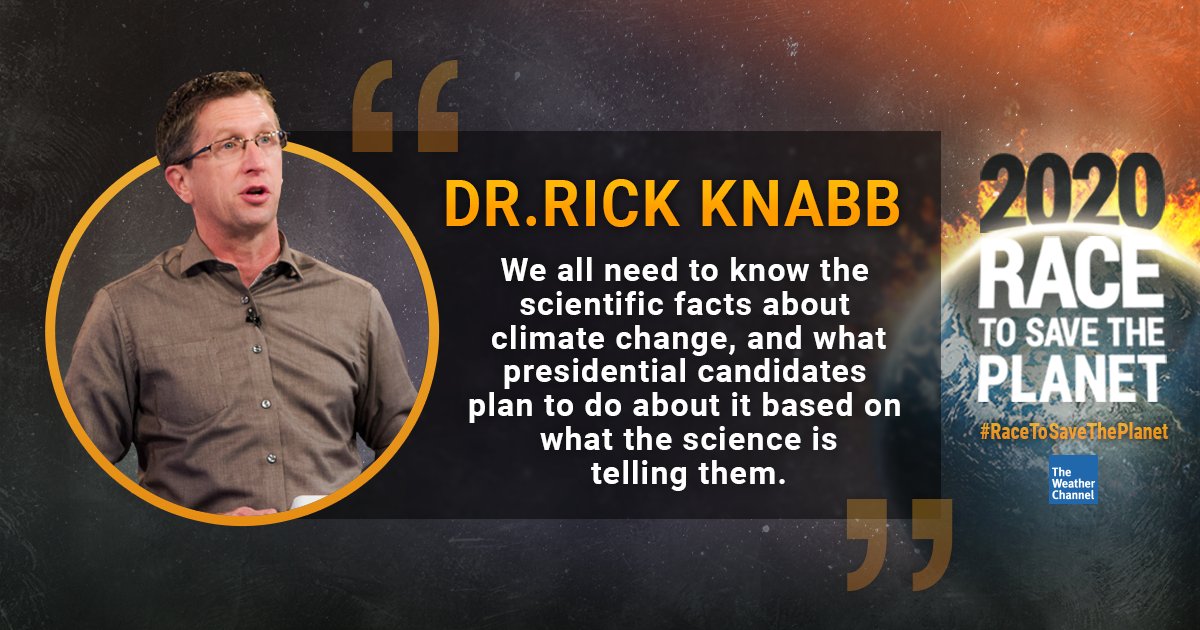
Viewers will hear from Senator Bernie Sanders, Senator Elizabeth Warren, Senator Kamala Harris, Mayor Pete Buttigieg, former Congressman Beto O’Rourke, Senator Cory Booker, former Congressman Joe Walsh, former Governor Bill Weld and former Governor Mark Sanford about how climate change is impacting jobs, the economy, national security, extreme weather, and more.Since that article was published on October 21, Beto O'Rourke dropped out, so it's no surprise that the 30 second promo spot, 2020: Race to Save the Planet, does not mention him.
Dr. Rick Knabb, former director of the National Hurricane Center and the network’s on-air hurricane expert, hosts the program and conducted the majority of the interviews. Meteorologist Stephanie Abrams, co-host of AMHQ, also conducted interviews.
On November 7th, The Weather Channel will air our new special, 2020: Race to Save the Planet.After the special aired, The Weather Channel posted four clips from the show to its YouTube channel. Follow over the jump to watch them.
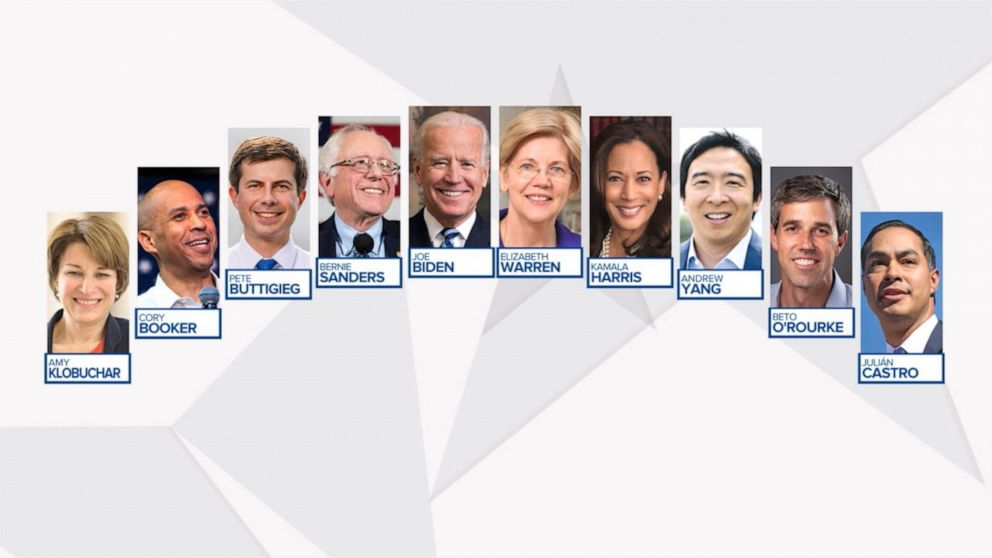


Before I start, I'm sharing a reminder of my methodology.Follow over the jump.[I] rank[ed] the candidates by economic score from low (left) to high (right, or in this case center) to make it comparable to the liberal-moderate (there are no true conservatives running for the Democratic nomination) ranking I used last [month and again earlier this month] which was based on the economic dimension [of Voteview's DW-Nominate scores]. I then used the social score to break ties in the economic score with high scores being considered more liberal and low scores being considered more conservative.With that out of the way, here are the Democratic candidates from left to center based on their Vote Match scores at On The Issues.

By the way, the leftward movement of Democratic candidates isn't only shown by the Voteview scores of the current members of Congress; it's demonstrated by the Vote Match scores of all the candidates at On The Issues, which is something I found out after I wrote Wayne Messam at On The Issues, take one. Nearly every candidate has become more liberal either economically or socially, and a few have moved left on both axes.My findings are that, of the 25 candidates and one former candidate that I have examined, On The Issues rates eight as having become more liberal economically, six have become more liberal socially, and five have become more liberal along both scales, while four have remained the same and two actually become more moderate economically, so a total of nineteen have become more liberal on one or both dimensions. Follow over the jump to see which candidates have new ideological scores and how those scores now arrange the candidates from left to center.


NIGHT 1Follow over the jump for the drinks, one for each candidate.
Wednesday, June 26
- Cory Booker
- Bill de Blasio
- Julián Castro
- John Delaney
- Tulsi Gabbard
- Jay Inslee
- Amy Klobuchar
- Beto O'Rourke
- Tim Ryan
- Elizabeth Warren

[T]his won't be the last time I plan on examining the ideology of the candidates. On The Issues has pages and ideological evaluations of just about all the candidates, including ones who never served in Congress. Compared to Voteview, it's more complete, but less objective and based on rhetoric, not action....Still, ranking the candidates by ideology, and comparing it to their DW-NOMINATE scores, if available, should be both entertaining and informative.Since the participants in the debates later this month have been selected, it's time to follow through.
Candidate's Political PhilosophyEnough of On The Issues' methodology. Mine was to rank the candidates by economic score from low (left) to high (right, or in this case center) to make it comparable to the liberal-moderate (there are no true conservatives running for the Democratic nomination) ranking I used two weeks ago which was based on the economic dimension. I then used the social score to break ties in the economic score with high scores being considered more liberal and low scores being considered more conservative.
The below is a way of thinking about the candidate's political philosophy by dividing the candidate's VoteMatch answers into "social" and "economic" questions. It is only a theory - please take it with a grain of salt!
Social Questions: Liberals and libertarians agree in choosing the less-government answers, while conservatives and populists agree in choosing the more-restrictive answers.
Economic Questions: Conservatives and libertarians agree in choosing the less-government answers, while liberals and populists agree in choosing the more-restrictive answers.
...
Social Score
This measures how much the candidate believes government should intervene in people's personal lives or on social issues. These issues include health, morality, love, recreation, prayer and other activities that are not measured in dollars.
- A high score (above 60%) means the candidate believes in tolerance for different people and lifestyles.
- A low score (below 40%) means the candidate believes that standards of morality & safety should be enforced by government.
Economic Score
This measures how much the candidate believes government should intervene in people's economic lives. Economic issues include retirement funding, budget allocations, and taxes.
- A high score (above 60%) means the candidate believes in personal responsibility for financial matters, and that free-market competition is better for people than central planning by the government.
- A low score (below 40%) means the candidate believes that a good society is best achieved by the government redistributing wealth. The candidate believes that government's purpose is to decide which programs are good for society, and how much should be spent on each program.
This measures how much the candidate believes government should intervene in people's economic lives. Economic issues include retirement funding, budget allocations, and taxes.
How We Score Candidates
How we determine a candidate's stance on each VoteMatch question:
- We collect up votes, excerpts from speeches, press releases, and so on, which are related to each question. Each of these are shown on the candidate's VoteMatch table.
- We assign an individual score for each item on the list. The scores can be: Strongly Favor, Favor, Neutral/Mixed, Oppose, Strongly Oppose. The scoring terms refer to the text of the question, not whether the candidate strongly opposed a bill, for example.
- We then average the individual scores, using the numeric scale: Strongly Favor = 2, Favor = 1, Neutral/Mixed = 0, Oppose = -1, Strongly Oppose = -2.
/OL>...
- If the average is above 1, the overall answer to the question is Strongly Favor.
- If the average is above 0, the overall answer to the question is Favor.
- If the average is exactly 0, the overall answer to the question is Neutral.
- If the average is below 0, the overall answer to the question is Oppose.
- If the average is below -1, the overall answer to the question is Strongly Oppose.
- To get the political philosophy of the candidate, we sum up the answers on two scales, the Personal/Social scale and the Economic Scale. Some questions aren't used in the political philosophy calculations.
- The VoteMatch table indicates the number of scale points from each answer (any one question can provide from 0 to 10 scale points on one scale or the other).
- The combination of social/moral scales and economic scales produces a political philosophy description.

