Showing posts with label Wisconsin. Show all posts

Monday, April 20, 2026

Hemp regulation and marijuana legalization updates for 420 Day

Happy 420 Day! I'm returning to the theme of marijuana legalization today with a reversal of the trend. PBS NewsHour explains How a small law change could have a huge impact on the U.S. hemp industry.

Tucked into the legislation that ended the longest government shutdown in U.S. history was a provision to change the definition of hemp. It was a small tweak involving minute measurements, but one that could have a huge impact on the booming market for hemp products. Jeffrey Brown reports from Kentucky.
That's a bummer, both for the users and the farmers. I'm going to offer some rare faint praise for Rand Paul, which is that I generally don't agree with his principles, but at least he has some, and this time I actually approve of how he's applying them. May he and others succeed in loosening the regulations on hemp.

Not all developments on legalization are bad. Two states are considering legalizing marijuana, Wisconsin and Pennsylvania. I begin with CBS 58 in Milwaukee reporting State Democrats announce new marijuana legalization proposal.

Supporters of legal marijuana in Wisconsin have announced a new effort at the state Capitol.
The racial disparity in enforcement is enough to make me support this bill, although I agree that making medical marijuana legal would be a good first step that might actually pass. Some of the commenters mentioned that the bar and tavern owners opposed legalization. Considering that Wisconsin is the drunkest state in the union and seems proud of it, I'm not surprised.

I close with WJACTV asking When will PA legalize recreational marijuana?

PENNSYLVANIA (WJAC) — Is this the year that Pennsylvania lawmakers legalize the recreational use of marijuana?

Governor Shapiro continues to push for it, but it is still not certain if the legislature will approve it.

State Representative Scott Conklin recently spoke about the fact that all but one of Pennsylvania’s neighboring states have already legalized marijuana. So, will it happen here?

Others in the legislature are not supportive of the idea, for various reasons, including one of the most heard about --- marijuana's possible link to harder drugs.

Raising revenue is one of the most cited reasons by Governor Shapiro and other backers to legalize.

Envisioned as a new cash crop in Pennsylvania, farmers paying a fee, growers’ licenses, tax on sales, all bringing in money, with the Department of Agriculture providing oversight.
I think Pennsylvania is a better bet than Wisconsin, but it's not a sure thing.

That's a wrap for today's sort-of holiday. Stay tuned for a Tuneful Tuesday post featuring the Marsh Family tomorrow, followed by the next episode of my series on the News & Doc Emmy Awards with the nominees for Outstanding Nature Documentary on Wayback Wednesday, which falls on Earth Day.

Thursday, April 3, 2025

Colbert, Kosta, and Meyers take closer looks at tariffs, Wisconsin, and Cory Booker

It's been a minute since I compiled the monologues of the late-night talk show hosts, so I'm returning with Stephen Colbert laughing at Trump Risks Historic Economic Damage | Musk Crushed In Wisconsin | Sen. Booker's Marathon Speech so he and his audience don't have to cry.

President Trump announced new tariffs which economists warn could plunge the world into a depression, Wisconsin voters overwhelmingly rejected Elon Musk's preferred candidate for the state's Supreme Court, and Senator Cory Booker spoke for a record-breaking 25 hours on the Senate floor in protest of Trump's actions.
I call Trump Hoover Cleveland because he was the first president since Herbert Hoover to leave the Oval Office with fewer Americans employed than when he entered. His tariffs could repeat that. The only thing that could save him is that he's doing it so early in his second term. Still, it wasn't necessary for the good of the country. As I wrote in Forever 21 files for bankruptcy and will close all U.S. stores, a tale of the Retail Apocalypse and repeated in CNBC explains 'What’s Scaring Americans Into Shopping More':
If the U.S. does go into recession this year, it won't be because of internal economic forces, but because of government interference, which normally tries to cushion against economic downturns. Biden piloted the U.S. economy to a soft landing, then Hoover Cleveland tries to crash the plane anyway!
I'm not even sure it's good for Hoover Cleveland, although he might think so. As I wrote in George Santos sues Jimmy Kimmel and Trump sells sneakers, "he has long had a very bad case of 'L'État, c'est moi.' As far as he's concerned, he is the country." Maybe it's good for his fellow billionaires, including Vladimir Putin, his partner in a bad bromance. I have long had my suspicions.

Michael Kosta at The Daily Show covered the same stories with the assistance of Desi Lydic, but scrambled their order, in Trump Launches "Liberation Day" Tariffs & Cory Booker's Speech Breaks Senate Record.

Michael Kosta recaps surprising wins for the Democrats, including a victory in the Wisconsin Supreme Court race despite Elon Musk's financial interference, and a record-breaking 25-hour speech by Cory Booker. Plus, Trump launches his "Liberation Day" tariffs, and Republicans scramble to supply cover.
Since Kamala Harris lost, I've been wondering who would step up to be the next leading candidate for the 2028 Democratic Presidential nomination. Cory Booker might have just made his move.

I conclude with Seth Meyers' Musk and Trump Lose Big in Wisconsin After Spending Millions to Buy Votes: A Closer Look.

Seth takes a closer look at the richest man in the world, Elon Musk, trying to buy a seat on the Wisconsin state Supreme Court.
Can Elon Musk buy an election?
I'd like to think Democrats still have the turnout advantage in off-year elections they've had since the Supreme Court overturned Roe v. Wade. Hoover Cleveland won states like Wisconsin and Michigan through "bullet ballots" — people voting for him but no one else. They didn't vote for downballot contests and aren't likely to vote in an election where Trump is not on the ballot. That reminds me of an answer to the question I asked in I ask The Archdruid and his readers 'Can you show us on the doll exactly where the educated professionals hurt you?' The answer is turn against Republicans and deny them downballot victories. I hope that happens tomorrow in Wisconsin and other states where there are off-year and special elections.
I got my wish. The answer to "can Elon Musk buy an election?" was "NO!"

I know I promised a retrospective for Throwback Thursday, but I decided I would catch up on my sleep, so I ran out of time. Definitely tomorrow for Flashback Friday, when I don't have to go to work. Stay tuned.

Monday, March 31, 2025

Can Elon Musk buy an election? Silly and serious takes on the Wisconsin Supreme Court contest

I'm closing out March's blogging by sharing silly and serious takes on tomorrow's election for Wisconsin Supreme Court Justice, beginning with The Daily Show's Elon Musk & Billionaires Flood the Zone in Wisconsin Supreme Court Race.

Ronny Chieng covers the upcoming Wisconsin Supreme Court election, including Elon Musk’s $20 million intervention in Republican Brad Schimel’s campaign, attack ads against the wrong Susan Crawford, and alternating pro-pedophilia smear campaigns. Plus, Grace Kuhlenschmidt sees how billionaires are turning elections into games.
The preview image asked "Can Elon buy a Wisconsin election?" That was the silly take. I begin the serious takes with Democracy Now! asking the nearly identical question, Can Elon Musk Buy Wisconsin? Ari Berman on Billionaire-Funded Attempt to Flip State Supreme Court.

After spending over a quarter of a billion dollars on Donald Trump's presidential election campaign, Elon Musk is pouring money into a Supreme Court election in Wisconsin. Musk has spent more than $18 million to support Trump-backed candidate Brad Schimel over liberal Susan Crawford and has been paying Wisconsin voters $100 to help flip the state's top court. This election could impact abortion rights, unions and Republicans' ability to keep gerrymandered districts in place to control Congress. "The level of corruption at play here, the level of money at play here, really is a warning sign for what's happening to our democracy," says Ari Berman, voting rights correspondent for Mother Jones magazine.
Amy Goodman and Ari Berman are right; this is part of a larger project that includes Hoover Cleveland's power grab in the form of an executive order regarding elections. The voters can stop it, but only if they demonstrate that the answer to The Daily Show's and Democracy Now's question is "no." To that end, I'm embedding NBC News's Steve Kornacki: Wisconsin Supreme Court race will test Democrat’s off-year turnout 'advantage'.

NBC News National Political Correspondent Steve Kornacki digs into battleground Wisconsin ahead of the state’s Supreme Court election.
I'd like to think Democrats still have the turnout advantage in off-year elections they've had since the Supreme Court overturned Roe v. Wade. Hoover Cleveland won states like Wisconsin and Michigan through "bullet ballots" — people voting for him but no one else. They didn't vote for downballot contests and aren't likely to vote in an election where Trump is not on the ballot. That reminds me of an answer to the question I asked in I ask The Archdruid and his readers 'Can you show us on the doll exactly where the educated professionals hurt you?' The answer is turn against Republicans and deny them downballot victories. I hope that happens tomorrow in Wisconsin and other states where there are off-year and special elections.

That concludes March's blogging. Stay tuned for a retrospective about holidays on April Fools Day.

Tuesday, April 2, 2024

Marching music for Connecticut, Delaware, New York, Rhode Island, and Wisconsin primaries

I'm resuming my series of marching music for primaries and caucuses with this year's edition of Marching music for the Wisconsin and New York primaries. I should go from east to west to follow poll closing times, but I'm going the other direction because Wisconsin has the better corps, followed by New York, then Connecticut. Hey, it's my blog; I can do that.

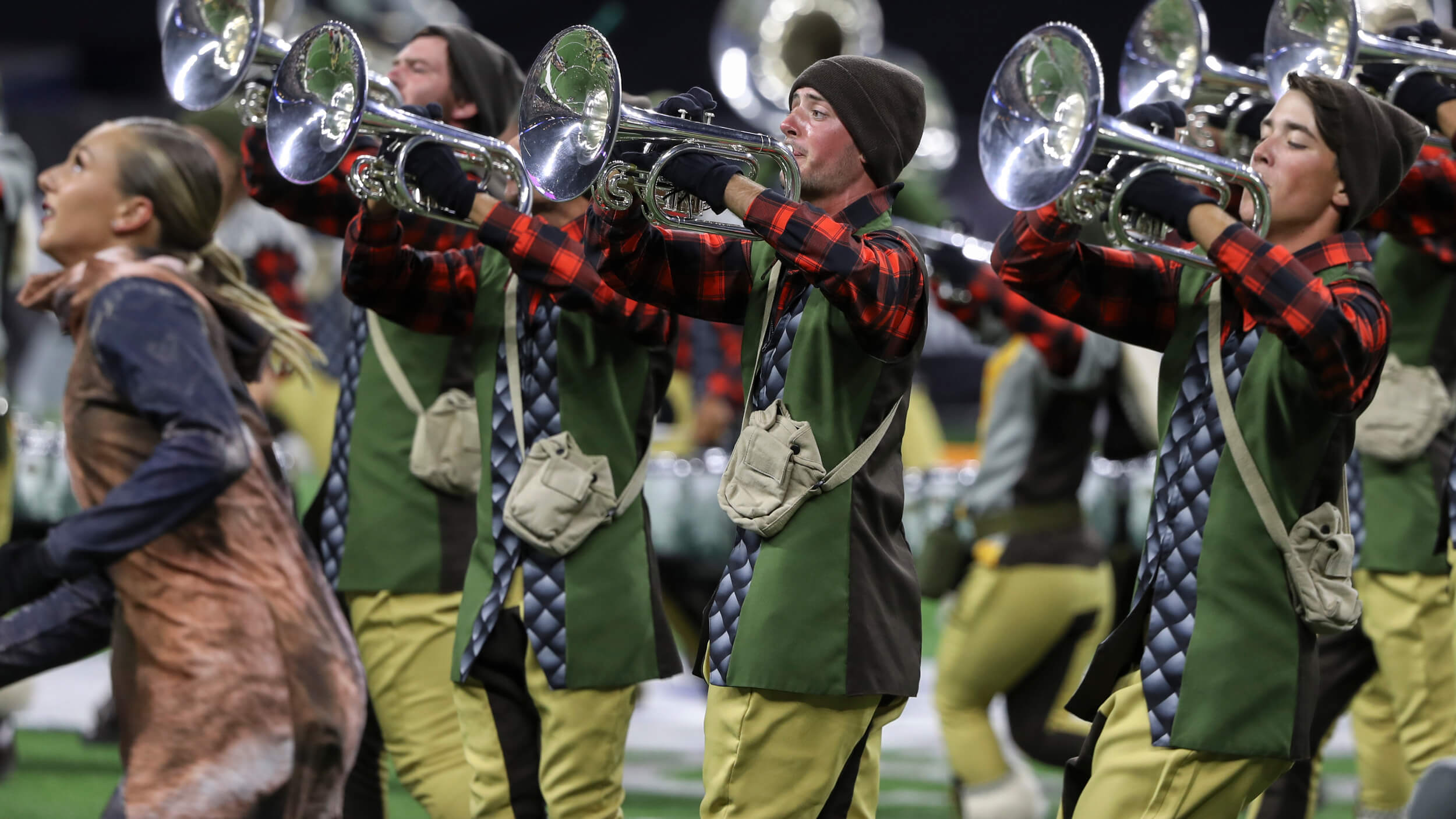
I kick off the music to watch and listen while waiting for results with Blue Stars | #dci2022 | Of War & Peace from Drum Corps International (DCI).

La Crosse, WI | 7th Place | 92.775

La Crosse, Wisconsin's Blue Stars perform a segment from the corps' #DCI2022 production, "Of War & Peace," during the 2022 DCI World Championships hosted August 12-14 at Lucas Oil Stadium in Indianapolis.
It didn't hit me at the time, but now I think a Russian show about war and peace has become a little on the nose given what's happening in Ukraine. Otherwise, this is a great show, and oddly daring in other ways while simulutaneously being old-fashioned. All-girls corps put their musicians in skirts, but I don't recall seeing women in a co-ed corps doing that before. It worked.

FloMarching has the 2021 Blue Stars Full Show [with audio], an official upload DCI doesn't have.

The 2021 Blue Stars performing at Music on the March on August 1, 2021!
The 2021 shows didn't have to be competitive; they just had to be entertaining and fun to perform and this show succeeded at that.

Moving on to the other Wisconsin corps, Madison Scouts | #dci2022 | Installation 85.

Madison, WI | 15th Place | 83.725

Madison Wisconsin's Madison Scouts perform a segment from the corps' #DCI2022 production, "Installation 85," during the 2022 DCI World Championships hosted August 12-14 at Lucas Oil Stadium in Indianapolis.
I'm still not completely sold on electric guitars in a drum corps pit, but in this case, it works. Also, the Scouts are just as jazzy as ever, but they're not as powerful as they were in the 20th Century. I miss that.

The marching band representative from the Badger State is Wisconsin Northwoods Marching Band - 2023 Pasadena Rose Parade, courtesy of Luis at Music213.

From Minocqua, Wisconsin
The Wisconsin Northwoods Marching Band performing their musical selections at the 134th Pasadena Tournament of Roses Parade on Monday, January 2, 2023. This is a composite group of 8 high schools: Lakeland, Northland Pines, Three Lakes, Merrill, Antigo, Wausau East, DC Everest, and Mosinee high schools and is making their first appearance at this event.
On, Wisconsin!

Follow over the jump for units from the rest of today's primary states.

Friday, February 16, 2024

CityNerd describes how to 'Live Your Best Life In These 18 Swing-State Cities'

How dedicated are my readers to maximizing the power of their votes? Are they (you) dedicated enough to move? If my readers are, and care about urbanism, then CityNerd has a list of places to move to as he describes how to Live Your Best Life In These 18 Swing-State Cities.

It's 2024. Ever think about moving to a state where your vote might actually make a difference? It's what I did in 2022 and I highly recommend it -- if you can "swing" it. Today we're looking at this year's likely swing states and affordable neighborhoods in each with great urban qualities.
I'm pleasantly surprised Ray Delahanty, CityNerd's real name, listed two neighborhoods in Detroit as destinations, praising the Motor City's potential and predicting, like I have for the past dozen plus years, the city's comeback. I would choose Midtown over Downtown, because of the Whole Foods store, where my wife and I have shopped, but both are good choices.

I also appreciate Grand Rapids earning an honorable mention as well as Ypsilanti being mentioned in passing. I'd also recommend Royal Oak, where I used to live, and Ferndale. Any one of those are good places to live, although my wife and I got priced out of Royal Oak and moved to a municipality with a more prestigious name yet better housing at a lower price. I wouldn't recommend my current neighborhood for urbanism. My miles driven increased enough that I made good on my promise to buy a hybrid by trading in my mini-SUV for a Prius to compensate.

I close by noting that I don't have to do anything to live where my vote matters. I have lived in Michigan for 35 years already. To see why my adopted home state is important, read 'How Michigan explains American politics' by Vox. Now I'm wondering what my readers who live in Arizona, Georgia, Nevada, New Hampshire, North Carolina, Pennsylvania, and Wisconsin think of CityNerd's recommendations. Comments?

Wednesday, January 12, 2022

Rachel Maddow reports on suspicious similarities among fake elector letters in five states

While I've focused on the after-effects of the violent part of last year's attempted self-coup, there was also a non-violent, if possibly also illegal, effort to retain The Former Guy as President. MSNBC uploaded an edited-for-time version of Rachel Maddow reporting and commenting on Similarities Suggest Coordination In Fake Elector Letters From Republicans In Five States.

Rachel Maddow updates reporting on Republicans submitting forged elector letters as if Donald Trump had won their states instead of Joe Biden, with the number of states involved up to at least five, and a pattern of coordination becoming more evident.
I agree with Rachel; it sure looks coordinated. American Oversight thinks so, too.
The fake electoral certificates were assembled by groups of Trump supporters in Arizona, Georgia, Michigan, New Mexico, Nevada, Pennsylvania, and Wisconsin who sought to replace the valid presidential electors from their state — who had been chosen by voters in free and fair elections — with bogus slates of pro-Trump electors.

None of the certificates contains any indication that they list illegitimate slates of electors not chosen by those states’ voters.

The coordinated, multi-state effort to cast doubt on the 2020 election and undermine the electoral vote process tragically led to the violent Jan. 6 attack on the U.S. Capitol in which a pro-Trump mob stormed the building and sought to physically block the congressional certification of each state’s real Electoral College votes.
Both the Rachel Maddow Show and American Oversight are continuing to investigate this multi-state effort to overturn the election. I plan on relaying their findings when they come out. Stay tuned.

Friday, May 1, 2020

Vox and FiveThirtyEight explain voting by mail during a pandemic

Just yesterday, I observed that "It's hard to vote by mail without the USPS."  Voting by mail continues to be a major topic as two videos I watched explored the topic this week.  One that popped up on my YouTube feed today was Vox's How to vote during a pandemic.

Coronavirus threatens the US election. Voting by mail could save it.
...
On April 7, 2020, as the coronavirus held much of the US under lockdown, the state of Wisconsin held an election. Many other states had already decided to delay their spring elections to protect voters. But in Wisconsin, voters were forced to choose between participating in the election, and their own safety. Wisconsin's decision sparked outrage, but it also highlighted a question that the US really needs to figure out soon: How do you hold an election during a pandemic?

Fortunately, there's actually a simple solution to this one: voting by mail. Tens of millions of Americans already vote this way, and if the rest of the US can prepare their election systems in time for the November election, they could avoid Wisconsin's fate. But time's running out.
Vox presents a very optimistic case, which I'd like to agree with.  However, I also watched FiveThirtyEight's Why Switching To A Vote-By-Mail System Is Tougher Than It Seems, which takes a contrary view.

Elections analyst Nathaniel Rakich looks into the difficulties we face if states want to switch to a vote-by-mail system in time for the general elections in November.
While FiveThirtyEight is more skeptical, it agrees with Vox that the switch needs to start now for widespread voting by mail to work by November.  I concur with both news sources on that.

That's the pandemic post for today.  Stay tuned for a drum corps May Day.

Tuesday, April 7, 2020

Marching music for the Wisconsin Primary, which is still being held today


Despite the coronavirus pandemic, the Wisconsin Primary is being held today, even though the results won't be announced until Monday, April 13, 2020.  I'll let FiveThirtyEight tell the story.
On Monday, Gov. Tony Evers issued an executive order attempting to postpone in-person voting for Wisconsin’s April 7 election to June 9; however, Republican legislators successfully challenged the order in the Wisconsin Supreme Court. So as of Monday evening, Wisconsin will be going to the polls on Tuesday.

However, in a separate court case, the U.S. Supreme Court ruled late on Monday that all absentee ballots must be postmarked by April 7, overturning an earlier ruling by a federal judge that said ballots would count as long as they were received by April 13.
What drama!  I didn't know if I was going to post this entry today, Next Monday, or in June until I read the news this morning.  Now that I have, enjoy one of my marching music for a primary election entries as the in-person vote takes place, an update of 2016's Drum corps for the Wisconsin Primary.

I begin with the 2019 Blue Stars | Call of the Wild.


La Crosse, WI | 8th Place | 91.225

I have no idea if the Blue Stars were aware that a movie by the same name would come out this year, but it's a fun coincidence.

Next, the stars of the 2016 edition of this post, the 2019 Madison Scouts | Majestic.


Madison, WI | 17th Place | 82.137

I think that show was a noble effort to get back to the corps' roots.  I know it pleased a lot of fans, even if it didn't impress the judges.

Finally, the final performance of 2018 Pioneer - "Celtic Dragons", who are no longer with us.


Milwaukee, WI | 36th Place | 64.300

R.I.P., Pioneer.

Follow over the jump for two marching bands from the Badger State that participated in this year's Rose Parade.

Saturday, May 25, 2019

Shopko liquidating, a tale of the Retail Apocalypse


I made a conditional promise to close out Retail Archeology looks at Family Dollar, a tale of the Retail Apocalypse.
Not good news is what International Business Times reported about Shopko.
After filing for Chapter 11 bankruptcy, Shopko said it will close all of its store locations by June 16. The closures affect 360 stores in 26 states.
Unless something more dramatic intervenes, I know which tale of the Retail Apocalypse I'm telling next.
Something more dramatic did intervene, which is why I wrote Dressbarn closing all 650 stores, a tale of the Retail Apocalypse.  I also promised that "Pinterest and comments on the blog [are] coming up next."  As it turns out, the most commented posts are about the Retail Apocalypse, so I can fulfill both promises by writing about Shopko's demise followed by a retrospective over the jump.

I begin the story of Shopko's demise with Shopko closing all of its stores from NBC 26 in Green Bay, Wisconsin, where Shopko began.

Liquidation of all of Shopko's stores is expected to finish by June.
That was in March, when Shopko's bankruptcy, which I first mentioned in February's Sears and KMart avoid liquidation, a tale of the Retail Apocalypse, turned into a liquidation.

NBC 26 followed up by asking What comes next for Shopko workers?.

More than 2,000 people across Wisconsin will lose their jobs later this year when Shopko stores and a distribution center close their doors.
NBC 26 continued its coverage by reporting on the closure of the store in DePere, which was the site of the previous segment.


At least Kim Flom, who is in charge of economic development for the city of DePere, displays some optimism about redeveloping the property, which includes a Payless ShoeSource.  One the one hand, that makes her another Crazy Eddie, which she should take as a compliment from me.  On the other, she'll need it.

All of the above is about what's happening this year.  For the history of the chain, including how it ended up liquidating, I'm turning to Brick Immortar's Shopko - Another Major Retailer... Bankrupt: Lifeless Retail Ep. 04 in which does a poor man's job of being Retail Archaeology, who he follows on Twitter, in the video.

Shopko recently announced the closure of all remaining stores across all "brands" and plans to have this completed by June, 2019. Shopko failed to find a buyer during the lead up to filing chapter 11 bankruptcy so, here we are.

From the late 90's onward, the chain slowly began struggling to find their footing against "the big 3". Updating their identity with ever changing slogans, branding, store closures/remodels/acquistitions and also leadership. This trend continued until their ultimate decline in the present day.
Oh, man, did the changing retail environment clobber Shopko!

Follow over the jump for the two most commented on posts of the eighth year of Crazy Eddie's Motie News, both of which are about the Retail Apocalypse.

Friday, May 17, 2019

Watch reports on the 2019 March for Science from Green Bay and Sacramento, an update to the March for Science for the eighth year of Crazy Eddie's Motie News


In yesterday's retrospective, I promised that "the next installment in this series...will be about the March for Science and other Resistance events [today] for Flashback Friday."  Before I tell the story of how Watch reports on March for Science 2018 from four U.S. cities earned its page views, I am sharing reports from this year's events.

I begin with the Sacramento Bee, which invited its viewers and readers to Watch the Sacramento March for Science

The Sacramento March for Science on May 4, 2019 brought out a presidential candidate, a state senator and an anti-vaccination activist in Star Wars attire.
That anti-vaccine activist may not realize it, but he's actually advocating an anti-science position to a bunch of scientifically literate people.  He picked the wrong crowd.  At least he was properly dressed for Star Wars Day.

The person who picked the right crowd was Jay Inslee.  He knew they would agree with his message about science and climate change  He also knew it would be big enough to be worth talking to.


Green Bay had a smaller event, but WFRV promoted it heavily.  The station's first segment on the March for Science featured the Green Bay March for Science's organizer, Gary Lefko.


Lefko did a good job of explaining the event and demonstrating some cool science.  He will show up again in another video.

WFRV promoted the event again in its second March for Science the day before the event.


That looked like it was fun.

WFRV covered the actual event in March for Science in Green Bay for residents.  Lefko played a prominent part in the video, where he not only speaks, but implodes the 55-gallon drum he brought to the studio in the first video.


SCIENCE!

That's all for news videos about this year's March for Science on YouTube.  Follow over the jump for how the one entry about the Resistance to enter the top 40 earned its page views.

Friday, April 5, 2019

The 2018-2019 flu season is experiencing a second wave, an update to 'Flu killed 80,000 Americans last year, including 183 children, the CDC reported, so get a a flu shot'


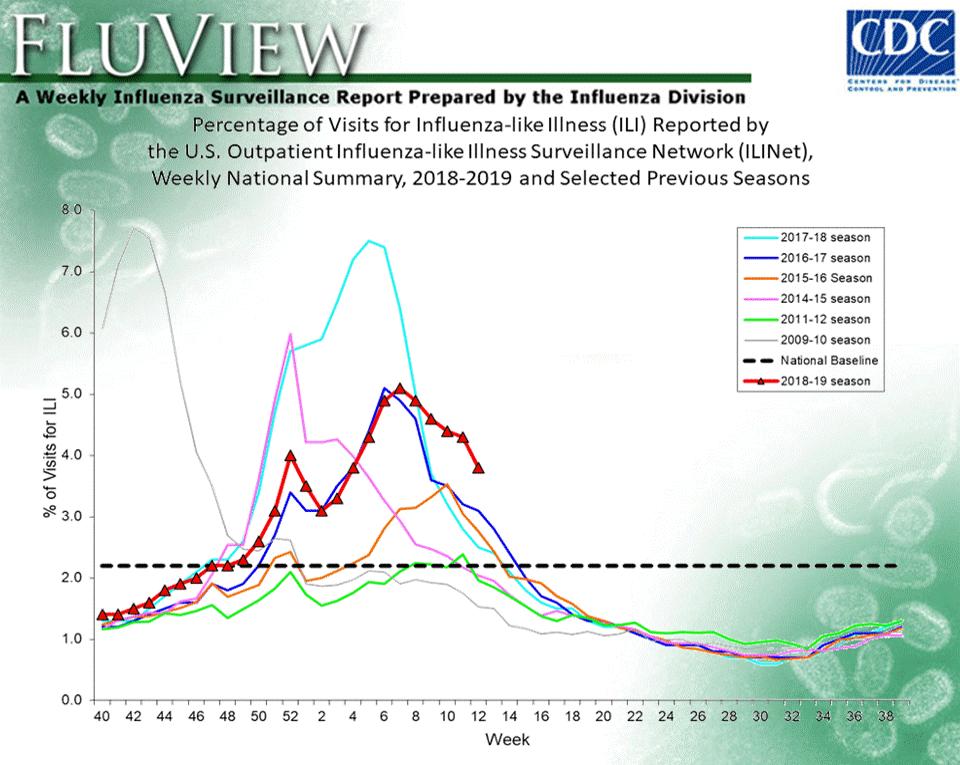
I told my readers at the end of Wonkette reacts to its Media Bias Chart placement, an update to 'A comparison of two measures of media bias shows readers and viewers respond to both ideology and quality' to "stay tuned" as "I plan on continuing this retrospective series tomorrow with an installment on last year's flu epidemic."  That's because Flu killed 80,000 Americans last year, including 183 children, the CDC reported, so get a a flu shot posted October 19, 2018 was the fifth most read entry of the eighth year of the blog, earning 7176 raw page views by March 20, 2019.  It was also the most read entry during October 2018 with 7061 default page views.  That deserves an update about the current flu season, which, while less severe than last year, is hanging on longer.

At first, it looked like flu season was winding down in February, as WXYZ reported in 28 children have died so far in 2018-2019 flu season, CDC reports.

The CDC has released a new estimate concerning flu-related deaths. The numbers range between 9,600 to almost 16,000 deaths for the 2018-2019 flu season. And so far, 28 children have died.
Despite the dire numbers of deaths, I found the statistics for effectiveness of the vaccine to be reassuring.  That written, the indications that the current flu season would be relatively mild turned out to be premature, as the Mayo Clinic reported a month later in Infectious Diseases A-Z: Flu season part two.


The replacement of H1N1 with H3N2, producing more severe symptoms, started showing up in news reports almost immediately.  For example, CBS Los Angeles uploaded Hard Hitting Flu Season Is Peaking the very next day.

If you thought flu season was winding down you better think again. A lot of people are coming down with the bug. A new strain of the flu is hitting people hard. As CBSLA's Jasmine Veil explains, it's peaking now.
At the end of the week, WISN in Wisconsin reported Flu season far from over.

With the flu season far from over, state health officials warn of a spring flu spike. There have been 36 influenza-related deaths in Wisconsin this season.
The wave continued this week with WCVB in Boston reporting Massachusetts health officials report 4th child flu death of season.

Last year, the state saw just one flu-related pediatric death.
The Delaware News Journal updated the flu statistics for Delaware and the country just yesterday in State: Influenza A still raging; 2018-2019 flu season now has 2nd highest number of cases.
The 2018-2019 flu season has tallied the second-highest number of influenza cases in state-recorded history — and likely isn't going to go away for weeks, state officials said Thursday.
...
As of March 23, the state has confirmed 5,854 confirmed cases of influenza, 943 hospitalizations and 20 deaths this season. The actual number of confirmed flu cases is much higher because only a small fraction of cases are officially tested in a lab.

Nationally, there have been about 508,000 flu hospitalizations and 46,800 deaths, CDC officials said.
Am I ever glad I got my vaccination this year.  As for the rest of you, stay healthy.  I need you to stick around to the next post in the series, which would most likely be about the intersection between foreign policy and the economy.  Trade policy, anyone?

Previous posts in this series
Previous retrospectives about risk and doom.

Monday, July 31, 2017

Vox explains the gerrymandering cases before the Supreme Court


While I last mentioned gerrymandering and redistricting in John Oliver and Vox examine gerrymandering, the issue has continued to make news.  The top story on the issue is that the U.S. Supreme Court has agreed to hear arguments on two lawsuits contesting the gerrymandered districts in North Carolina and Wisconsin.  These cases have different bases, as Vox explains in The difference between racial and partisan gerrymandering.

The Court won't use the same criteria for either case. Here's why.
...
In America, voting districts are redrawn every ten years to account for shifts in demographics. Someone has to be in charge of drawing the new lines. And because voting is left to the states, in many jurisidictions this responsibility is left to partisan politicians. This creates an opening for politicians who might want to alter the outcome of an election through a process called gerrymandering.

But not all gerrymandering is the same. There are, in fact, two types: racial, and partisan. It is much more difficult to prove harm as a plaintiff in a partisan gerrymandering case than a racial one. And that distinction has to do with provisions of the Voting Rights Act of 1965.
The North Carolina example was egregious enough that Vox used it as an example in one of its earlier videos on the subject, Gerrymandering: How politicians rig elections.

Most Americans think elections are rigged, and they're right. Vox editor-in-chief Ezra Klein explains how gerrymandering works, and how to fix it.
As I've written before, I support the idea of nonpartisan, independent redistricting commissions to reduce gerrymandering.  As for the Supreme Court cases, I'm much more optimistic about North Carolina's districts being remedied than Wisconsin's, although I'm hoping that the Supreme Court does find that partisan gerrymandering has gone too far.

That's it for this month.  Stay tuned for more about the Emmy nominees. I'm planning several posts on nominated political shows next month, which begins in a few hours.

Tuesday, April 5, 2016

Drum corps for the Wisconsin Primary


Today is the Wisconsin Presidential Primary, in which Cruz is favored over Trump on the Republican side and Sanders is leading Clinton on the Democratic side. Neither are absolute locks, so it will be worth seeing if Wisconsin is the speed bump that keeps Trump from getting to 1,237 delegates and a first ballot nomination and keeps Bernie's victory streak alive.  While my readers are waiting for the results, I'm going to do the same thing I did for Iowa Caucuses, Super Tuesday, The Ides of March, and Arizona, Utah, and Idaho--share music from marching units from the state having an election.  Drum corps fans already know that Wisconsin has some outstanding drum and bugle corps that I'm pleased to feature, beginning with 2015 Madison Scouts - 78th and Madison.

Madison, WI - 8TH PLACE 88.750

Classic MGM movies staring Gene Kelly influenced "78th & Madison," the title referencing Manhattan and the corps' 78th anniversary year. Listen for the roar of the MGM lion and look for the travel stickers on the prop suitcases that featured cities along the DCI Tour. Be on the lookout for the aspiring Broadway performer who made a performing troupe on his third audition and became smitten with a starlet he saw on a billboard, fantasizing about her while dancing with her silhouette.
The presidential campaigns are often called "The Circus," which happens to be the name of Showtime's series on the election.  I've even called the 2012 campaign that  Another Wisconsin corps has the perfect show for this trope: 2015 Blue Stars - Sideshow.

La Crosse, WI – 11TH PLACE 85.150

In "Sideshow," the color guard section gradually transitioned from being rural members of a circus audience to become circus performers on various sideshow stages. Among those under the big top seen rising in the opener were clowns, a contortionist, a juggler, a unicyclist, a sword-swallower, conjoined twins, a tightrope walker walking over members of the horn line, and a fortuneteller reading the palm of a flugelhorn soloist.
Follow over the jump for more corps.

Friday, September 5, 2014

Another victory for marriage equality


Last week offered an opportunity to revising a topic I hadn't written about since A song for marriage equality in Michigan.  Last Tuesday, I included the following story from Reuters in a comment to another diarist's Overnight News Digest, along with the rest of the day's top U.S. news, including the story that formed the core of Update on Detroit water shut-offs and bankruptcy.

U.S. appeals court challenges states on gay marriage bans
By Fiona Ortiz
CHICAGO Tue Aug 26, 2014 3:38pm EDT
(Reuters) - A U.S. appeals court in Chicago appeared ready to strike down gay marriage bans in Indiana and Wisconsin after vigorously challenging the two states' attorneys at a hearing on Tuesday.

The oral arguments before a three-judge panel of the 7th U.S. Circuit Court of Appeals come at a crucial stage in the legal fight over same-sex marriage as the U.S. Supreme Court is expected to take up the issue in its next term.

At the U.S. appeals court level, judges have struck down similar bans on gay marriage in Utah, Oklahoma and Virginia.
Ortiz got it right, as Vox reported Thursday in An appeals court struck down same-sex marriage bans in Wisconsin and Indiana.
The Seventh Circuit Court of Appeals on Thursday struck down same-sex marriage bans in Wisconsin and Indiana, upholding previous rulings from lower courts.

The unanimous decision, written by US Circuit Judge Richard Posner, cited the Constitution's Equal Protection and Due Process Clauses. It continues a number of legal victories for same-sex couples following the US Supreme Court ruling that ended the federal ban on same-sex marriage.
That's the good news.  The bad news is that it won't take effect immediately.  Just like the ruling legalizing same-sex marriage in Michigan, it's going to have to go through the appeals process and will likely end up in front of the Supreme Court.  In the meantime, Professor Farnsworth and I approve of this step toward healing.

Thursday, June 26, 2014

Great Lakes cities and their roles in the regional economy


I left a variation of a story I tell my students as a comment at Kunsler's blog two weeks ago, a shortened version of how and why Detroit became the Motor City in the context of its place in the Great Lakes regional economy and what might be in store for it in response to a remark by Kunstler.
“I’m convinced that the Great Lakes region will be at the center of an internally-focused North American economy when the hallucination of oil-powered globalism dissolves. Places like Buffalo, Cleveland, and Detroit will have a new life, but not at the scale of the twentieth century”

In my classes, I spend a good chunk of a lecture on the roles of Great Lakes cities. It was pretty natural that North America’s manufacturing would be centered on the Great Lakes, as all of the natural resources required for making things out of steel were there–iron ore, coal, and lime–and the entire region was connected by a vast natural waterway, making shipping cheap. All that was needed to make cars was imported rubber. Detroit ended up with the distinction because of its central location, skilled manufacturing work force, and money looking for something to invest in once the timber boom ended. Now that cars are winding down, the city is looking for something else to make. Urban farming and trade with Canada aren’t enough to support a metropolitan population of four million.

It also helped that all the rest of the Great Lakes cities had something else to do already. Buffalo is a trade center between New York and the Great Lakes to the west. I suppose the Erie Canal might get revived as a functioning trade route in the post-petroleum future. Cleveland was the original oil capital and secondary manufacturing center. Now, it’s trying to become a tourist attraction. I’m not sure what it will do in a future without mass tourism. Toledo is the Glass City, which means its a subsidiary of Detroit. It’s still a trade center where the Maumee enters Lake Erie, but the rest of its future depends on what Detroit does.

As for the cities to the west, Chicago is the ultimate trade center, where the raw materials of the west get sent to the manufacturing centers of the east and the manufactured goods get sent to the west with Chicago profiting as the middleman (think Chicago Board of Trade). There will still be room for such a role in the future, even if it’s smaller. Milwaukee is the place where milk and grain become beer and cheese. Again, that’s useful, but how much of a mass market will there be for it?

All of the above is a story I tell my students that helps them understand their place in the world. Now they have to help create their own story so that they can keep a place in the world.
I transitioned out of that passage by promising to repost it to here in a more refined form.  Honestly, I think it's good enough.  Now follow over the jump for responses to it and to another comment about Detroit I posted this week at Kunstler's blog.