Showing posts with label Wall Street Journal. Show all posts

Monday, August 4, 2025

'Bankrupt - TGI Fridays' by Bright Sun Films, a tale of the Retail Apocalypse

I made a promise in the conclusion to Company Man asks 'The Decline of TGI Fridays...What Happened?' A tale of the Retail Apocalypse: "I stand by my opinion that 'I feel like no bankrupt company's story is fully told until both Company Man Mike and Jake Williams of Bright Sun Films have weighed in.' Should Jake follow through with a video of his own, I'll post it here." Jake did. Watch Bankrupt - TGI Fridays.

From its inception as a bar in New York, TGI Fridays great to become a massive restaurant brand across America and even the world. With well over 600 locations domestically and 70,000 employees company wide, it was truly an enormous chain. However despite it's meteoric growth, it would all come crashing down in just a few short years. Join me as I find out what happened to this iconic chain restaurant and how it ultimately declared bankruptcy.
Jake's take on why TGI Fridays ended up declaring bankruptcy was different from Company Man Mike's. Jake paid much less attention to competitors except at the end and much more on external factors, like the Great Recession, which initiated TGI Fridays' decline, and pandemic, which finally did the chain in. Company Man Mike also ignored private equity, which CNBC thought was behind TGI Fridays' and Red Lobster's bankruptcies. Jake made that a central part of the second half of the story, although he generally seemed to think that the private equity firms were at least trying.

That written, I think it's time to repeat my standard rant about private equity."I listed a who's who of retail chains gutted by private equity in CNN Business explains retail bankruptcies and how private equity is gutting retail, tales of the Retail Apocalypse and again in Business Insider and CNBC explain the rise and fall of Chuck E. Cheese, a tale of the Retail Apocalypse and pandemic." Add Party City, Red Lobster, TGI Fridays, Joann, Weight Watchers, and At Home to that list.

I missed Why So Many TGI Friday Restaurants Are Closing | WSJ What Went Wrong last November, which told a similar and more compressed version of the chain's story.

TGI Fridays, widely considered the first singles bar in the U.S., filed for Chapter 11 bankruptcy in November, citing a problematic capital structure and fallout from the pandemic. The fast-casual restaurant chain has closed over 200 locations across the U.S. since 2019 and have even been kicked out of its headquarters in Dallas.

WSJ breaks down how the once happy hour hot spot lost its flair.
The Wall Street Journal added two factors that both Company Man Mike and Jake missed, whole business securitization and frequent leadership changes. The first is the kind of arcane financial arrangement that I'm not surprised WSJ caught but Mike and Jake ignored or glossed over, while the second is exactly the kind of thing Mike would normally catch. Now I'm wondering if Mike did his best work last November.

That's a wrap for today's installment of the slow-motion disaster that is the Retail Apocalypse. Stay tuned as I resume my coverage of the Creative Arts Emmy Awards.

Friday, April 18, 2025

Trump implementing Project 2025 for a Flashback Good Friday

Happy Flashback Good Friday! I'm looking back at last year's second most popular series after Randy Rainbow, Project 2025. I begin with The Wall Street Journal describing How Trump’s Policies Align With Project 2025: A Comparison.

President Trump distanced himself from Project 2025’s radical conservative vision on the campaign trail. Now, more than half of his executive orders including some on immigration and DEI policies align with recommendations made in the Heritage Foundation’s blueprint. Trump has even hired multiple key architects and contributors of Project 2025 to be in his administration.

WSJ explores some of the notable ways Trump’s first few months are aligning with Project 2025 – and what that can tell us about his second term.
I begin my reaction by recycling what I first wrote in MSNBC examines Project 2025, part 5.
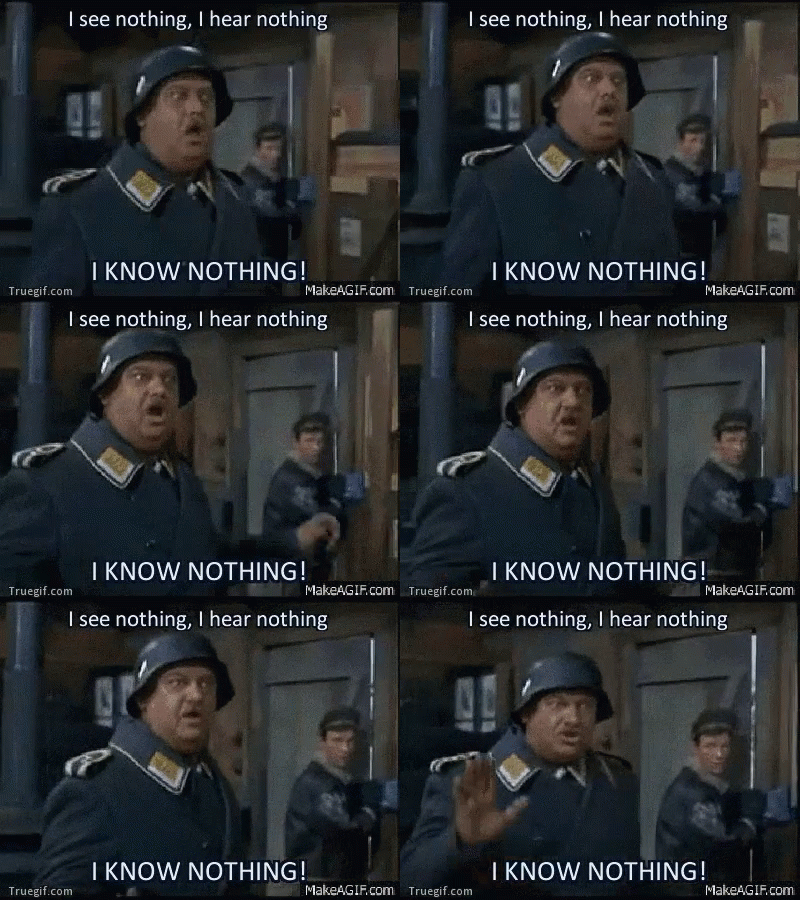
"I know nothing about Project 2025" — Convicted criminal Hoover Cleveland is doing his best Sergeant Schultz impression about Project 2025.
As for Hoover Cleveland (un)truthing "I have no idea who is behind [Project 2025]," check out MSNBC's list of chapter authors.
All of them have worked for him, so of course he's lying. He's not fooling anyone but himself and his most devoted followers.
...
I leave my readers with the following list Digby embedded in Incomplete Cheat Sheet.
As I've written before, yikes! No wonder it's unpopular!
I last included this list in Vox explains 'Why the US has birthright citizenship' and commented, "Look at the list and notice how many of these Hoover Cleveland is already trying to enact. It's not as if people like Digby and me didn't do our best to warn Americans!"

Shortly after WSJ uploaded the above, MSNBC reported Tracker says Trump has already implemented nearly half of Project 2025 policies.

On the campaign trail, President Trump distanced himself from the writers and content of Project 2025, but just two months into his presidency, much of what was laid out in the sprawling document has been enacted. Atlantic staff writer David Graham, who has written on Project 2025, joins Katy Tur to discuss how far along the Trump administration is in the conservative playbook.
In addition to mentioning unitary executive "theory" (I'm a scientist, so I won't let that usage go uncontested, even if it's proper in constitutional law) and possible use of the zombie Comstock Act, Katy Tur and David Graham shared this graphic.


That's after only two months! Angelo Carusone on tracking Project 2025 and right-wing media remarked on both the unitary executive and the speed of implementation as a guest on PBS NewsHour.

Project 2025, the conservative policy project, became a flashpoint during the presidential campaign. Angelo Carusone of Media Matters studied the 900-page document and spoke with Geoff Bennett for our series, On Democracy, where we hear a range of perspectives on how government should function, what led to this moment in American history and where the country goes next.
I attribute the rapidity of its implementation to Trump's "shock and awful" and especially "Elon Musk's...Chainsaw Massacre of our federal workforce." Russell Vought wouldn't have moved this fast.

Carusone and PBS News host Geoff Bennett also shared this graphic.


That illustrates the problem for Democrats and other resisters; a lot of people get their news and views from podcasts and videos and the overwhelming majority learn right. The stat that 32% of Americans get their news from YouTube now compared to 23% in 2020 shows the effect of the pandemic on Americans' media diet. I resemble that remark, as I'm using YouTube uploads of mainstream media here on my blog instead of watching the newscasts directly. I hope my curation helps direct my readers to good sources of news!

Follow over the jump for a retrospective of the top posts examining Project 2025.

Wednesday, March 19, 2025

Forever 21 files for bankruptcy and will close all U.S. stores, a tale of the Retail Apocalypse

Today's tale of the Retail Apocalypse comes from The Wall Street Journal, which uploaded How Forever 21 Plummeted From $4B in Sales to Twice Bankrupt two days ago as part of its "What Went Wrong" series.

Forever 21 was once the premier shopping destination for teens who wanted cheap and fashionable clothing. But now, the fast fashion pioneer is filing for its second Chapter 11 bankruptcy. After being bought out by licensing firm Authentic Brands Group and real-estate companies Simon Property Group and Brookfield Property Partners, Forever 21 struggled against Asian e-commerce powerhouses like Shein and Temu.

WSJ breaks down how its own market toppled the fast fashion giant.
I haven't mentioned Forever 21 since Vox explains 'The lies that sell fast fashion' nearly a year ago and blogged specifically about Forever 21 since Company Man asks 'The Decline of Forever 21...What Happened?' — a tale of the Retail Apocalypse three years ago. Company Man Mike composed a list of the chain's liabilities then, which I'm reproducing here.


The Wall Street Journal covered all of these, then added competition with Shein and Temu. As I wrote just before Forever 21 filed for bankruptcy the first time, "until Americans, especially young women, change their fashion tastes, they will just buy fast fashion online..." That happened. The best I can say is that Amazon isn't to blame this time.

The Wall Street Journal did not emphasize that Forever 21 would close all U.S. stores, but NBC News made that its headline in Forever no more. Iconic American retailer to close its doors.

Forever 21, known for trendy fast fashion pieces, has filed for bankruptcy. The final sales in its stores are offering steep discounts as the company liquidates its assets. As NBC News’ Brian Cheung reports, in part the company cites pressure from online Chinese retailers for its demise.
The consumer sales figures remind me that I should go on recession watch again. If the U.S. does go into recession this year, it won't be because of internal economic forces, but because of government interference, which normally tries to cushion against economic downturns. Biden piloted the U.S. economy to a soft landing, then Hoover Cleveland tries to crash the plane anyway!

I close with A look at fast fashion and consumer behavior as Forever 21 closes all U.S. stores from KCAL News.

Asit Sharma, The Motley Fool senior analyst, discusses the downfall of Forever 21.
Neither Company Man Mike nor The Wall Street Journal mentioned the effects of the pandemic on consumer behavior as a cause of Forever 21's travails, so Asit Sharma added another factor to its failure.

That concludes today's tale of the Retail Apocalypse. Stay tuned for the Vernal Equinox on the last day of the blogging year.

Saturday, February 15, 2025

Wall Street Journal and CBC examine ending penny production

I'm returning to timely topics by re-examining one Jimmy Kimmel mentioned in Stewart, Oliver, Meyers, and Kimmel take closer looks at 'Gulf of America Day' and Musk on the cover of Time, "Trump was at the Super Bowl and...decided to declare a war on pennies during the game..." The Wall Street Journal examines the proposal in Trump Wants to End Penny Production. Here Are the Pros and Cons.

President Trump wants to ditch the penny, a move that some experts say is long overdue. Advocates of the least-valuable coin say it should stick around. WSJ examines the question of whether or not it makes sense to get rid of the penny.
The cost of minting pennies and the possibility of no longer doing so is a story I tell my students, usually in the context of using pennies as references for hardness of minerals. What makes this problematic is that the penny has changed in composition over time.
The penny has always been assigned a hardness of around 3. But we have conducted tests and found this is not true.

The penny has changed in composition over the years since 1909 when the first Lincoln cent was issued. Its composition was specified as 95 percent copper and 5 percent tin plus zinc, an alloy classified as bronze. Except for the wartime year of 1943, pennies were bronze from 1909 until 1962. Pennies for the following 20 years were copper and zinc, technically brass rather than bronze. And in 1982 the proportions were reversed so that pennies today are 97.5 percent zinc surrounded by a thin, thin copper shell.
...
The Indian head penny had the same nominal composition as the Lincoln penny, with zinc and tin combined making up 5 percent, but we suspect that the older penny had a little more tin. Maybe one penny isn't a fair test.
Each of these changes made pennies cheaper to produce. To make them even cheaper, the U.S. would have to make them out of steel, like we did in 1943. Those became collectors items, but I don't know if most Americans would accept such a different looking coin when we're not in a world war. It might be easier to stop minting them.

The Wall Street Journal mentioned that Canada had abandoned pennies in 2012, so I'm turning to CBC News asking Is Trump right about eliminating the penny? | About That.

President Donald Trump wants the U.S. Mint to stop making new pennies, but is the one-cent coin really more trouble than it's worth? Andrew Chang explains.
Based on the Canadian experience, ceasing to mint pennies might actually be a good idea. Chalk that up to a stuck clock being right twice a day, and Hoover Cleveland is definitely a stuck clock. The other issue he might be right on? Ending Daylight Saving Time, which will be a subject for next month. In the meantime, stay tuned for the Sunday entertainment feature. Awards season, anyone?

Wednesday, January 15, 2025

The Wall Street Journal explains 'Why America’s Groundwater Is Disappearing'

I left a note to myself at the end of 'Weathered' on PBS Terra asks 'Has Earth Already Crossed MAJOR Tipping Points?' that I repeated in 'Weathered: Earth's Extremes' asks 'What Happens When the Land Runs Out?'
The description mentioned groundwater, but the video itself didn't include anything about the subject. Just the same, reading it reminded me that I show a Wall Street Journal video about groundwater depletion to my students and I should embed it here.
Without any further ado, I'm sharing Why America’s Groundwater Is Disappearing.

Unchecked groundwater use is draining aquifers across the U.S., threatening drinking water supplies and the nation’s status as a food superpower. For example, the Ogallala Aquifer beneath the Great Plains supports about 30% of all U.S. crop and animal production, but in 2022, parts of the water table reached their lowest levels since NASA started measuring two decades ago.

WSJ explains why this crisis is posing an “existential threat” to many communities and looks at how the critical natural resources could be saved.
That gets the point across about groundwater depletion, especially in the Ogallala Aquifer, and sets the stage for the next slide, which is about subsidence and sinkholes. I've been showing those videos to my students for a decade already. Welcome to blogging as professional development.

I don't show the next video, PBS NewsHour's Depletion of major groundwater source threatens Great Plains farming, but if anything happens to The Wall Street Journal's video or I decide not to support the paper (it is a NewsCorp property, after all), it's available as a backup.

In the heart of the country, Great Plains farmers and ranchers produce a quarter of all U.S. crops and 40 percent of its beef. But they rely on a resource that has been slowly drying up, water. Stephanie Sy reports from Kansas for our series on the impact of climate change, Tipping Point.
It's the same basic story with all new characters except for Brownie Wilson, who appears in both videos. PBS also emphasizes the effects of climate change more and makes even clearer two of Commoner's Laws: "Everything Is Connected to Everything Else" — the economy and society of western Kansas is connected to agriculture, and local agriculture is dependent on groundwater — and "There Is No Free Lunch — over-reliance and overuse of groundwater is already incurring costs. Brant Peterson switching from corn to sorghum could also serve as an example of a third law, "Nature Knows Best," although corn, originally from Mexico and cultivated by Native Americans, comes closer to a native plant than sorghum, which is originally from Africa.

The Wall Street Journal video also mentioned cracks forming in Arizona because of groundwater depletion. PBS Terra's Maiya May addresses this phenomenon in Why Are These Huge Cracks Appearing in the Desert?

In Arizona, fissures are becoming an increasingly common phenomenon due to lack of rain and groundwater depletion. Weathered's Maiya May explains.
Yikes! That might scare my students should I care to replace one of my subsidence videos with it.

Stay tuned as I track down more of my promises for future posts and share them as evergreen entries through the end of the month.

Friday, June 7, 2024

Starliner, Starship, and Chang'e, a week of good space news

This has been a good week in space for the U.S. and China, which makes it a welcome change of pace from the news here on Earth. After all, I can't be all DOOM all the time! I begin the stories of success with CNN reporting Boeing spacecraft carrying two NASA astronauts lifts off in historic launch.

A Boeing spacecraft carrying two NASA astronauts is on its historic maiden voyage. The landmark launch kicked off the first crewed test flight of the capsule and marked the culmination of a long and trying development process.
It's been six years since I posted Commercial spaceflight crews announced and testing for return to Moon as NASA celebrates its 60th anniversary, so it's been quite a wait to get both vehicles off the ground. Yes, SpaceX launched the first crewed mission from U.S. soil since 2011 almost exactly four years ago, but Dragon wasn't supposed to be the only American crewed capsule operating. It's good to have an alternative.

Starliner also passed another important milestone, as CNN showed in Boeing Starliner docks with space station after encountering new issues.

Boeing’s Starliner mission has safely docked with the International Space Station after navigating new issues that cropped up overnight en route to the orbiting laboratory. CNN's Kristin Fisher reports.
Not only am I happy that Starliner successfully docked with the ISS, I'm glad for the astronauts and cosmonauts on the station that they'll be able to recycle their water. I often jokingly gross out my environmental science students by calling water recycling "toilet-to-tap," but in this case it's not only justified, but necessary.

Speaking of SpaceX, Kristin Fisher mentioned the Starship test flight in the first video. WSJ News covered that event as it told its viewers : SpaceX’s Starship Successfully Completes Re-entry and Splashdown.

SpaceX achieved a new milestone with its mega Starship rocket, after both the booster and the spacecraft made controlled returns to Earth.
I watched the re-entry live and was amazed that Starship successfully splashed down after one of its flight control surfaces burned through but remained attached. Like the proverbial honey badger, the spaceship didn't seem to care!

China also reported a success, which DW News shared in China's Chang'e 6 mission travels back to earth from the dark side of the moon.

China’s Chang’e lunar probe has taken off from the far side of the moon to return back to earth, according to China’s national space agency. If China successfully makes it back to earth, it will be the first country to have gathered samples from the far side of the moon. China’s previous lunar mission, Chang’e 5, gathered samples from the near side of the moon, but collecting samples from the far side has required additional technical know-how as well as operating on more challenging terrain. According to the China National Space Administration (CNSA), Chang’e 6 “withstood the test of high temperature on the far side of the moon."
We have a space race!

I expect to report more on the return to the Moon on Moon Day and recap these missions in this year's edition of 2023 in space. In the meantime, stay tuned for World Oceans Day.

Wednesday, April 24, 2024

'Inside the Messy Battle for the Biggest Swing State of 2024' by The Wall Steet Journal for Wayback Wednesday

Happy Wayback Wednesday! I'm continuing with the Keystone State theme from yesterday's Marching music for the Pennsylvania Primary, The Cadets, Buccaneers, and West Chester University with The Wall Street Journal reporting Inside the Messy Battle for the Biggest Swing State of 2024.

Both President Biden and former President Trump see Pennsylvania as a must-win state in the 2024 presidential election, but both are grappling with party divisions and sagging voter enthusiasm surrounding their rematch.

WSJ's Shelby Holliday traveled across PA to talk to voters, officials and campaign managers to learn how each candidate could win—or lose—the biggest swing state of the 2024 election.
Pennsylvania is important to President Biden because he was born there and it was the state that made him President-elect in 2020. Biden continued to recognize its significance when he made three visits to Pennsylvania in 2022 including one in Philadelphia where he warned about threats to American democracy. The video shows that his campaign is still focused on Pennsylvania.

I didn't write about Donald Trump winning the state in 2016 — I reacted to his win more generally in Kunstler said Americans would elect maniacs — but I did blog about how important the state was for Republicans in FiveThirtyEight on today's primary elections in Pennsylvania and four other states. As The Wall Street Journal's video shows, the Big Lie hasn't lost any of its power with GOP voters.

I plan on writing more about the election in Pennsylvania and the rest of the swing states, especially Michigan. On that note, follow over the jump for a retrospective of the top post about my adopted state during the 13th year of Crazy Eddie's Motie News.

Sunday, May 28, 2023

Examinations of Disney v. DeSantis from CNBC, Wall Street Journal, and Yahoo! Finance

I told my readers to "stay tuned" yesterday, "as I plan on updating the Disney-DeSantis feud as tomorrow's Sunday entertainment feature." It's tomorrow, so I'm following through on my program note with the financial channels' examination of the conflict, beginning with CNBC's Disney V. DeSantis: Why Florida’s Governor Took On America’s Media Giant.

The political feud between Florida Gov. Ron DeSantis and Disney has been heating up for the last few months. In April 2023, Disney filed a First Amendment lawsuit against DeSantis, accusing the governor of waging a ‘targeted campaign of government retaliation.” DeSantis, who’s preparing for a 2024 presidential campaign on the GOP ticket, says he isn’t backing down. So how did this all begin? And who will come out on top, once it’s all done?
I'm being a good environmentalist by recycling my reaction from last week.
[DeSantis is] "making himself look even worse while getting liberals to side with a big corporation. Nice trick, but not the one he's trying to pull."

Another trick he's pulling is continuing the trend that I saw developing more than a decade ago and summarized in DeSantis to sign replacement for Reedy Creek Improvement District, Disney World's own government.
Aren't Republicans supposed to be the business-friendly party? Well, they were, but this split has been building for a decade since I wrote about how Newt Gingrich threw big business under the bus while campaigning against Mitt Romney. Ten years later, the rift between Republicans and big business has opened up wide enough for everyone to see. Who knows? Maybe the Republican Party or at least DeSantis will fall into it. Break out the popcorn.
At the time, I thought DeSantis and the Florida Republican Party hadn't fallen into the rift between them and big business. Now, I think they haven't just fallen, but jumped into the widening and deepening chasm. That calls for more popcorn.
...
[The] observation that Republican primary voters are more interested in cultural issues than economic issues fits the shift in “the Republican Party’s base moving from country club to country” as CNN quoted Tom Davis, a former Republican representative from northern Virginia, in 2017. That's what I've been seeing since 2012.
[M]ajor U.S. political parties don't have consistent ideologies. They do, however, have consistent core interest groups and Gingrich is throwing one of them, the northeastern business interests, which have been with the GOP since it formed out of the remains of the Whigs in the 1850s, under the bus. That ended up being smart in the short run, given that he was angling for the votes of Southern populists, who don't care much for the northeastern business interests and haven't since before the founding of the republic.
DeSantis is hoping that will work in his favor.
Based on the polling data CNBC showed and the interviews with DeSantis supporters in Florida, it has so far. It remains to be seen how well it will continue to work now that Ron DeSantis is officially running for President against Donald Trump for the Republican nomination, and, should he actually get the nomination, in the general election.

Follow over the jump for videos by The Wall Street Journal and Yahoo! Finance on the subject.

Saturday, March 18, 2023

Wall Street Journal and CNBC explain the collapse of Silicon Valley Bank

I've already shared a comedic closer look at the reactions to the failure of Silicon Valley Bank, so it's time for a serious examination of the bank collapse, beginning with The Wall Street Journal explaining How Silicon Valley Bank Collapsed in 36 Hours | What Went Wrong.

Silicon Valley Bank collapsed in less than two days when FDIC regulators seized control. In that time, the bank’s stock price fell over 60%, a $42 billion bank run was sparked and a liquidity crisis ensued.

Here’s how SVB’s collapse became the second largest U.S. bank failure ever, and what it means for customers in the future.
I mentioned that increasing interest rates, which is inverting the yield curve, work by reducing demand in Vox asks 'Why is everything getting so expensive?' They also disrupt investment strategies, like SVB's, when they change rapidly. That led to a chain reaction ending in SVB's collapse, a demonstration of "everything is connected to everything else and there is no free lunch." However, it might not end there, as CNBC asked Did Silicon Valley Bank Start a Banking Crisis?

Silicon Valley Bank is no more. The question now, though, is whether the collapse of this tech-friendly regional bank is the start of something more serious — or just what happens when higher interest rates give companies less room for error.
So will we be partying like 1929? Or will the FDIC, Federal Reserve, Treasury Department, and "too big to fail" banks contain the damage? I hope for and expect the latter, but stay tuned to find out. At its core, this blog is still about collapse and this is exactly the kind of story I created this blog for.

Speaking of staying tuned, come back tomorrow for the Sunday entertainment feature, which will not be about "Saturday Night Live" — no new show until April First, no fooling!

Saturday, February 11, 2023

Company Man asks 'The Decline of Bed Bath & Beyond...What Happened?' — a tale of the Retail Apocalypse

I posted Bed Bath & Beyond facing bankruptcy, a tale of the Retail Apocalypse for Friday the 13th last month. Since then, the chain's situation has continued to worsen, prompting Company Man Mike to ask The Decline of Bed Bath & Beyond...What Happened?

Bed Bath & Beyond has been going through some tough times lately. This video tries to identify the causes of those problems.
Company Man Mike compiled this list to explain what happened.


When I told my wife that I was writing a blog post about Bed Bath & Beyond, she immediately brought up how their weak online presence hurt them in competition with Amazon based on her personal shopping experience. The pandemic just exacerbated that problem. We haven't been in one of their stores since COVID-19 hit, but we've bought plenty through Amazon. On the other hand, I've gone into the nearest Target if only to pick up online orders, which I did when I had an eventful three days and two nights because of a severe storm knocking out my power, and my wife and I have had a lot of Target orders delivered to our house. Target is beating Bed Bath & Beyond both online and in the store, which Erik of Retail Archaeology showed that he did when he declared Bed Bath & Beyond: Headed For Bankruptcy!

Bed Bath & Beyond is a failure: In this episode we take an updated look at Bed Bath & Beyond.
Disappointed with Bed Bath & Beyond's selection, prices, and quality, Erik went to Target. He could also see the handwriting on the wall this past summer. The company hasn't filed for bankruptcy yet, but it's very close, as The Wall Street Journal reported Bed Bath & Beyond Misses Interest Payments as It Weighs Chapter 11 resulting in its lenders sending it a notice of default and CNN reported Bed Bath & Beyond is closing 149 more stores. See the list.
Bed Bath & Beyond has revealed the locations of the 149 stores it’s closing.

The new list of closures comes just a week after it announced it was shuttering 87 other stores. Over the past several months, it has closed or in the process of closing about 400 locations, which includes the closure of 5 buybuy Baby locations and all 49 remaining Harmon Face Value stores.

In total, the company is reducing the number of Bed Bath & Beyond stores from 760 to about 360, with the company keeping its most profitable stores open in key markets. At its peak in 2017, the storied brand had 1,552 stores open.
Wow! I was pretty sanguine in 2019 when I wrote "the chain is facing a crisis, but it's not in imminent danger of going out of business," but things have become much worse since then. For example, I wrote then that "I'm not terribly worried that the nearest location, just a little more than two miles west of me, is going to close any time soon." It closed last fall, so I guess three years was just longer than "any time soon" in August 2019.

Returning to Company Man Mike's list, he noted that the problem with the turnaround plan wasn't the plan itself, but management's rushing it in its impatience to get it to work. I think that's a common problem with American businesses, particularly publicly traded ones that are driven by quarterly bottom lines. Speaking of public trading, this is the second time I've seen stock buybacks being a driver of debt since GNC's bankruptcy. I wrote then "I might see stock buybacks as a cause of cash flow problems more often as the pandemic-caused recession continues." That recession ended almost as soon as it began and we may be closer to another recession later this year, but that prediction still came true.

That's it for the latest on the Retail 'Apocalypse. Stay tuned for Darwin Day and the Sunday entertainment feature.

Friday, January 13, 2023

Bed Bath & Beyond facing bankruptcy, a tale of the Retail Apocalypse for Friday the 13th

It's Friday the 13th! This year, instead of exploring the psychology and history of the day or spooky theme park attractions, I'm examining a real-life tale of woe, Bed Bath & Beyond’s Potential Bankruptcy, Explained, uploaded by the Wall Street Journal today.

Bed Bath & Beyond recently warned it may be filing for bankruptcy in just a few weeks. WSJ’s Suzanne Kapner explains the roller coaster of events over the past six months that led to this low point for the company.
The Wall Street Journal examined the longer-term history of the chain in July, when it asked Bed Bath & Beyond Is in Crisis Mode. What Went Wrong?

After years of declining sales, Bed Bath & Beyond is facing an existential crisis. WSJ’s Suzanne Kapner explains why the company has fallen on hard times and looks forward to what’s next for the veteran retailer.
None of this comes as a surprise to me, as I posted CNBC warns that Bed Bath & Beyond is 'facing extinction,' a tale of the Retail Apocalypse nearly four years ago. I was fairly sanguine then, writing "the chain is facing a crisis, but it's not in imminent danger of going out of business," but became more concerned in 2020, when I wrote "I'm not as calm about the fate of the chain now, if only because 100,000 dead and 40 million unemployed in the U.S. has made the economic environment much more precarious for retailers other than daily essentials such as food and medicine, which I shopped for yesterday and picked up without ever entering the store." I'm only surprised it took me this long to return to the topic.

Follow over the jump for more on Bed Bath & Beyond from CNBC and Yahoo Finance.

Saturday, October 22, 2022

Wall Street Journal on 'Las Vegas: A Water Conservation Trailblazer Amid the Worst Drought in 1,200 Years'

I promised "a more positive story about dealing with the drought to share with my readers" in PBS NewsHour on Great Salt Lake shrinking during the current drought. It's the Wall Street Journal's Las Vegas: A Water Conservation Trailblazer Amid the Worst Drought in 1,200 Years, which YouTube also recommended to me. Behold the power of the YouTube algorithm!

As severe drought in the West forces states to make drastic water cuts, Las Vegas offers a road map to making the most out of every drop of water. Since 2002, Southern Nevada has cut its Colorado River water use by 26% while its population has grown by 750,000.
The video I embedded in PBS Terra asks 'What Will Life Look Like as MAJOR Rivers Run Dry?' mentioned the water conservation measures Las Vegas was taking before it moved on to more efficient irrigation practices for agriculture, itself an expansion of the policies in Vox asks and answers 'Who's really using up the water in the American West?' I'm glad Las Vegas can serve as good example to Salt Lake City, Phoenix, where my stepdaughter lives, and other cities in the arid and semiarid west and southwest. We could use more good examples. Speaking of which, I might show this to my students as an example of household water conservation. If so, welcome to blogging as professional development.

Since there is no new episode of "Saturday Night Live" tonight, stay tuned for a real Sunday entertainment update.

Saturday, August 6, 2022

Biden Administration declares monkeypox a public health emergency

I began the month by lamenting that I didn't take monkeypox seriously enough.
As I wrote in June, "it looks like I may have been too sanguine about monkeypox." I didn't think it would get this bad. Now I expect it will get worse.
It has. ABC News reported US declares monkeypox outbreak a public health emergency Thursday night.

Amid growing calls from health officials, the Biden administration declared that the U.S. Department of Health and Human Services will take a series of actions to combat the monkeypox outbreak.
The number of cases has continued to increase over the past two days, as the CDC website shows 7,510 reported cases in the U.S. as I type this. As the CDC Director said, cases will continue to go up before they start going down.

CNBC Television uploaded two videos that I'm sharing, beginning with Monkeypox is now a national public health emergency.

CNBC's Shomari Stone joins Shep Smith to report on the spread of monkeypox and government efforts to administer the vaccine.
CNBC concentrated on the short supply of the vaccine in this segment. At least there were already vaccines to administer, as monkeypox has been known for decades, unlike COVID-19, which was completely novel and much more deadly.

The Shepard Smith segment mentioned Scott Gottlieb, who called the potential establishment of monkeypox in the U.S. a major public health failure. CNBC interviewed him earlier in Monkeypox will become a low-level infection but can be dangerous, says Dr. Scott Gottlieb.

Dr. Scott Gottlieb, former FDA commissioner and CNBC contributor, joins CNBC's 'Squawk Box' to discuss the outbreak in monkeypox cases after the U.S. declared the virus a public health emergency.
Monkeypox is nowhere near as deadly as COVID-19, but it deserves to be taken seriously as a health threat.

All the above videos point out that the current outbreak acts like a sexually transmitted disease, but it's not really one, and it can affect anyone. Another point that Gottlieb made in passing was that monkeypox is a relative of smallpox, which I think is perversely good news. The CDC page on vaccinations states "Because Monkeypox virus is closely related to the virus that causes smallpox, the smallpox vaccine can protect people from getting monkeypox. Past data from Africa suggests that the smallpox vaccine is at least 85% effective in preventing monkeypox." Older Americans like me who have been vaccinated against smallpox are actually in better shape than younger people to avoid becoming ill from monkeypox. I'll take that, as it's the reverse of the usual relationship between age and morbidity and mortality from infectious diseases.

One aspect of monkeypox that the first three videos generally ignored is that monkeypox is a zoonotic disease, one that originally passed from non-human animals to people. The Wall Street Journal tackled that head on in Why Monkeypox Is a Global Health Threat, which the paper uploaded to its YouTube account the day before the Biden Administration declared the disease a health emergency. Perfect timing!

What smallpox is to humans — monkeypox is to animals. So what happens when a human is infected with an animal disease? WSJ explains the symptoms, reactions and treatment of a monkeypox infection.
Despite the name, monkeypox mostly infects rodents, which I find concerning because it can get into native rodent populations that could become reservoirs for the virus. The SciShow video I embedded in May mentioned that the previous outbreak in the U.S. resulted from contact with infected prairie dogs. It could have been worse; I know of cases of bubonic plague transmitted from prairie dogs to humans. Yikes!

That was the post about monkeypox I planned to write until I watched Colbert's monologue yesterday. Stay tuned for this year's post about Saturday Night Live's Emmy nominations for the Sunday entertainment feature.

Tuesday, July 26, 2022

Wall Street Journal and CNBC explain 'Why a 2022 Recession Would Be Unlike Any Other'

With the likelihood of a second quarter of declining GDP being announced on Thursday, it's time to update CNBC explains 'Why Recessions May Be Inevitable' with the Wall Street Journal explaining Why a 2022 Recession Would Be Unlike Any Other.

Is the U.S. in a recession? Many economists think that’s a possibility and by some measurements, it may have already started. But why aren’t people losing their jobs?
The GDP numbers may signal a recession, but consumers and possibly even businesses aren't showing signs of it. We may end up having a "Wile E. Coyote moment" where both look down and realize they are over an abyss and then start falling, but that hasn't happened yet. If it does, then I expect it would be like the recession I predicted at the end of 2017 to happen by the end of the last decade, not the one we actually got in 2020 because of the pandemic.

That was the serious examination. As a contrast, I'm sharing CNBC Television's Jim Cramer breaks down 3 possible recession scenarios to show how to make lemonade out of lemons for fun and profit.

CNBC's Jim Cramer broke down three possible scenarios that could happen if the economy enters a recession on Thursday's episode of "Mad Money."
While this video reminds me of my complaints about CNBC viewing the economy through the lens of investing, I couldn't resist Cramer's comedy and sense of humor making investment advice and education about the economy entertaining.

I may have more about the economy, guns, or the Emmy Awards tomorrow. I may even combine two of them. To find out, stay tuned.

Sunday, April 24, 2022

Governor DeSantis and Florida Republicans repeal the Reedy Creek Improvement District, Disney World's own government

For this week's Sunday entertainment feature, I'm following up on an aside in 'SNL' satirizes 'Fox & Friends' in its Supreme Court cold open: "I'm going to have to examine the right wing's attack on Disney; it's surreal." This took several forms, but the most serious was the repeal of the legislation authorizing Disney's own government, the Reedy Creek Improvement District. I begin today's examination with the Wall Street Journal's Disney's Special Tax District in Florida, Explained.

Since 1967, the Florida land housing Disney’s theme parks has been governed by the company, allowing it to manage Walt Disney World with little red tape. WSJ’s Robbie Whelan explains the special tax district that a Florida bill would eliminate.
That's a good description of how this particular part of the political battle played out. Reuters presented a broader if briefer description in Florida governor signs bill stripping Disney of special status.

Florida Governor Ron DeSantis signed a bill that strips Disney of self-governing authority at its Orlando-area parks in retaliation for its opposition to a new law that limits the teaching of LGBTQ issues in schools.
Not only did Reuters explain what led up to the revocation of the Reedy Creek Improvement District, but it also showed the spectacle of the right-wing protests of Disney at one of the entrances to the complex. That was one of the things I found surreal.

I could share many more videos, but I'm going to embed just one more, CNN's Tax collector says DeSantis' move could end up hurting his own voters.

Orange County, Florida, tax collector Scott Randolph goes through the fallout of Gov. Ron DeSantis' move to dissolve Disney's special self-governing status.
What a mess! Not only did CNN report on the effects of the repeal on services and taxes, it also mentioned the other actions DeSantis wanted passed during the special session, a congressional district map that disenfranchised African-American voters and a repeal of a provision of an anti-censorship bill that exempted Disney — two legislative acts of revenge on the Mouse, not just one! In the bigger picture, the apparent violations of state and federal law in passing the maps that DeSantis wanted over those passed by the Florida Legislature, which he vetoed, are the most important of all of them, but I'm not surprised that attacking Disney got more attention. As I first wrote in 2011, "America is quite clear about its screwed up priorities­. My experience has convinced me that the surest way to get Americans to act is to mess with their entertainm­ent." Retaliating against Disney in ways that might affect its ability to provide services for its guests has at least the appearance and maybe even the reality of messing with Americans' entertainment. This might not end well for DeSantis.

Another reason for the attention this story has attracted is its "man bites dog" aspect. Aren't Republicans supposed to be the business-friendly party? Well, they were, but this split has been building for a decade since I wrote about how Newt Gingrich threw big business under the bus while campaigning against Mitt Romney. Ten years later, the rift between Republicans and big business has opened up wide enough for everyone to see. Who knows? Maybe the Republican Party or at least DeSantis will fall into it. Break out the popcorn.

Saturday, July 24, 2021

California's drought causing a crisis in agriculture and rural communities

So far, Western drought likely worst in a millennium and may be the beginning of 'aridification' is the most read entry of the current blogging year with ~1,660 default and 2,192 raw page views. I updated the story in Drought, fire, and mudslides in California, a story I tell my students earlier this month, but CNBC uploaded How The West Coast Drought Could Cause More ‘Water Wars’ yesterday. It adds an economic and government perspective to the scientific one in the two earlier posts, so I'm sharing it.


How The West Coast Drought Could Cause More ‘Water Wars’

While the previous two posts looked at climate change and its effect on water supply, I haven't focused on that pathway's effect on agriculture and food production for seven years, with Climate change reducing food supply examining the subject in general and CNN on the San Joaquin, America's most endangered river looking at California in particular. It's about time I returned to the subject.

I have my reservations about the solutions proposed, particularly water indexes, a financial instrument that may be better for investors than for consumers, and desalination. As I tell my students, that's a technology that works only where there is a lot of demand, money and available energy, but few alternatives for increasing water supply. All those perfectly describe Israel but hasn't described California until very recently. As I wrote in Drought and polar vortex from KPBS seven years ago: "In Tunnel in the Sky, published early 60 years ago, Robert Heinlein expected that southern California would become dependent on desalination plants to supply freshwater. I thought that future was a long way off, but it may happen sooner than I expected.

PBS NewsHour uploaded their own report on the effects of the drought four days ago, Californians scramble for fresh water as taps, wells run dry.

The severe drought across the Western U.S. is already causing long term problems, exacerbated by the warming atmosphere driven by climate change. As William Brangham reports from California’s San Joaquin Valley, the demand for water has threatened the drinking supply for hundreds of thousands of rural residents — including the farmers who grow a significant part of the country’s food supply.
While PBS also reported on the impacts on and of agriculture, it focused more on the individual farmer and consumer. It certainly doesn't have the question "how can I make money off of this" lurking in the background like CNBC. The Wall Street Journal could have done that in Why the Western Drought Will Have Major Ripple Effects, but it focused more on the science and effects on individuals.

Watering the Country's Food Basket Is Becoming a Challenge

Droughts are part of a natural cycle of water. But the drought currently gripping the Western U.S. has climate scientists concerned that the cycle may be shifting. This has major implications for those who rely on the water the most: farmers and the communities they surround.
The "ripple effects" the Wall Street Journal describes are examples of two of Commoner's Laws, "everything is connected to every thing else" and "there is no free lunch," both of which make this a story I can tell my students. Welcome to blogging as professional development.

I'm sure I'll return to the drought and its effects later. Right now, stay tuned for the Sunday entertainment feature, which I'm planning on being part two of Coffee Party USA announces the 2020 Golden Coffee Cups movie shortlists, part 1: films.

Friday, March 5, 2021

CNBC explains why U.S. malls are disappearing, plus Forever 21 and Brooks Brothers saved for now, tales of the Retail Apocalypse and pandemic

Last Black Friday/Buy Nothing Day, I shared a CNBC Television video reporting that one-third of malls present in 2012 were already gone in 2020 with 25% more to close in the next 3-5 years. Yesterday, CNBC's main channel expanded on that statistic in a video explaining Why U.S. Malls Are Disappearing.

Shopping malls in the U.S. were already in decline before the Covid-19 pandemic as consumers shifted away from traditional brick-and-mortar stores to e-commerce. The outbreak has only exacerbated the challenges at malls as social distancing has placed restrictions on stores, movie theaters and restaurants. So what will become of malls in America after the pandemic ends?

Shopping malls across the U.S. have been reeling as restaurant and retail tenants struggle to keep their doors open.

Data compiled by Coresight Research shows about a quarter of U.S. malls could close over the next three to five years, accelerating a trend that began before the pandemic.
...
Malls are a big tax driver for the communities they serve and employ lots of people locally. Watch the video above to find out more about the struggles U.S. malls face and what could become of them after the pandemic ends.
Before examining the decline of malls more closely, CNBC reviewed the history of malls, including the role of architect Victor Gruen in designing the long-closed Northland Mall in Southfield, Michigan, and the Southdale Shopping Center in Edina, Minnesota, and how they fit in the history of suburbia, a topic I covered in Wired on dead malls, a tale of the Retail Apocalypse two years ago. It then followed up on two stories I left hanging, the bankruptcies of Forever 21 and Brooks Brothers. Mall owners like Simon Properties and Brookfield Properties bought parts of both of them, rescuing both chains from bankruptcy, just as they did for JCPenney. Korea Now has the first story in Korean fast-fashion brand Forever 21 finds new owner in 4 months after filing for bankruptcy.

Korea’s fast-fashion emporium, Forever 21 has found a new owner in just four months after it filed for bankruptcy. The retail brand is to sell most of its business for $81 million to a consortium made up of mall operators Simon Property Group, Brookfield Property Partners and brand management firm Authentic Brands Group. Watch this video, for more information.
That's good news for Forever 21 and its new owners, the mall operators, even as it's bad news for the environment and factory workers.

The Wall Street Journal, whose The Rise and Fall of Brooks Brothers concluded with Simon Properties and Authentic Brands buying Brooks Brothers, has the second story.

Brooks Brothers -- the self-proclaimed oldest clothier in the U.S. -- filed for bankruptcy in July. Analysts say the suit dealer wasn’t able to keep up with modern men who often wanted styles that were cheaper and more functional.
That was fast. However, I shouldn't be surprised. As I first observed about Twinkies, some products and brands are too valuable to let go extinct and someone will save them. Looks like JCPenney, Forever 21, and Brooks Brothers are among them.

Returning to the CNBC video, it will be worth watching which solutions mall owners and the communities around the mall pursue once the pandemic ends. Stay tuned.

Friday, November 29, 2019

The death and rebirth of Toys R Us, a tale of the Retail Apocalypse for Black Friday/Buy Nothing Day


Happy Black Friday/Buy Nothing Day!  Last year, I covered the Retail Apocalypse by focusing on Macy's and Bon-Ton.  This year, I continue with the tradition by re-examining the death and rebirth of Toys R Us, one of the first two chains I followed in covering the decline of brick-and-mortar retailers.  I begin with Wall Street Journal's How Toys 'R' Us Went Bankrupt, which concludes with the chains rebirth under new ownership.

For decades, Toys "R" Us was not only one of the top toy retailers in the United States, it was one of the top retailers period. Until it suddenly wasn’t. Toys “R” filed for bankruptcy in 2017 and liquidated six months later. This is the story of how Toys "R" Us went bankrupt.
The part about the private equity firm that secured their loans to Toys R Us's intellectual property, including Geoffrey the Giraffe, was a new facet of the story to me.  It ties into what I wrote in June about the revival of the name.
Toys R Us is like TwinkiesThe products are too valuable and someone will make them.
Companies will do so even if it involves killing off the original company and stripping the carcass.  To paraphrase Steve Martin, capitalism is not pretty.

Follow over the jump for two videos about the opening of the first Toys R Us store under Tru Kids, the new ownership.

Friday, September 21, 2018

Vox explains how social media contributes to polarization and promotes trolls, conspiracy theorists, and fake news


In June, Vox explained how Russian trolls weaponized social media.  In July, Vox explained how not to get phished (like the DNC).  Today, Vox followed up on both by explaining Why every social media site is a dumpster fire.

Social media sites like Facebook, Twitter, and YouTube exploit our tribalism to keep us watching ads. That makes them a perfect target for trolls, conspiracy theorists, and con artists.
...
Social media sites like Facebook, Twitter, YouTube, and Instagram are built to cater to the base preferences and desires of their users -- figuring out what information people enjoy with and then showing them more of it. That’s a great way to keep people online, but it also makes these platforms prime target for con artists. People are naturally drawn to inflammatory and sensational news stories, regardless of whether or not they're true. So bad actors -- conspiracy theorists, trolls, and fake news writers -- have been tremendously successful in using these platforms to spread false and divisive content that exploit people’s tribal instincts.

In 2016, it was Macedonian teens making thousands of dollars publishing inflammatory fake stories about Hillary Clinton. After the Parkland shooting, it was random YouTubers going viral by accusing students of being crisis actors. Even the Russian trolls who meddled in the presidential election did so by posting low-quality, highly emotional content to social media -- content they knew would go viral.

The problem with these social media sites isn’t that a few bad apples are ruining the fun. It’s that they’re designed to reward bad apples. And as long as con artists can use these platforms to prey on people’s most base desires, social media sites will continue reflecting the worst of human nature back at us.
Promoting engagement is a feature.  So are the partisan media bubbles.  The trolls, conspiracy theorists, and scam artists, along with the fake news they spread, are bugs — I hope.  Seeker explains how television entertainment can shape our political opinions mentioned one of the best ways to fight them — consume a variety of news media in order to get a diversity of viewpoints instead of staying inside a partisan media bubble.  Time for me to follow my own advice and read The Wall Street Journal, the only news source both liberals and conservatives think is unbiased.

Monday, February 19, 2018

Movie and TV Presidents from the Wall Street Journal for (Not My) Presidents Day


Happy (Not My) Presidents Day!  I'm still in a mood to deal with fantasy instead of reality, so I'm posting the Wall Street Journal's Election 2016: Fake Presidents Edition to mark today's holiday.

The 2016 U.S. presidential campaign season may seem stranger than fiction, but is it really that bad? It could be worse, compared to other American presidents who exist in the reality of our smartphones and televisions.
I don't know if the fictional presidents would be worse.  Selina Meyer is not any worse than Trump in competence and character and she has better staff.  Plus, she's a Democrat.  Fitzgerald Grant also has better staff and really does try to make things better for Americans.  Frank Underwood is a very evil man, but he's also very competent and knows he has to at least been seen trying to make things better for the mass of people, even as he's killing off rival politicians.  None of them are my favorite TV President.  That honor goes to Tom Kirkman of "Designated Survivor."  He is the most decent character of the bunch and he's been learning fast on the job.  Watching him is the next best thing to watching Josiah Bartlett from "The West Wing."*

In the comments, I ask my readers to name their favorite fictional U.S. President.  If I get enough nominations, I'll post my readers' favorites.

*Many of the actors from "The West Wing" made a cameo at my blog in a video I posted first in Examiner.com article on Free Press endorsements and again in Second Year of Crazy Eddie's Motie News: Examiner.com.  The video is still up; I suppose that's because Bridget Mary McCormack will likely be running again this year.