A blog about societal, cultural, and civilizational collapse, and how to stave it off or survive it. Named after the legendary character "Crazy Eddie" in Larry Niven and Jerry Pournelle's "The Mote in God's Eye." Expect news and views about culture, politics, economics, technology, and science fiction.
Happy Throwback Thursday! I'm pulling a video out of the archives for today, Last Week Tonight with John Oliver asking Ayn Rand - How Is This Still A Thing?
Ayn Rand, author of "Atlas Shrugged" and "The Fountainhead," is still kind of a thing. How?
While Trump, who I've been calling Hoover Harding Cleveland and will now start calling Pervert Hoover, may be a good (bad) example of selfishness, he does not aspire to be a philosopher. On the other hand, Curtis Yarvin does. As I wrote in Leeja Miller examines 'The Ideology Behind The End Of Democracy', "I've decided to focus on Yarvin/Moldbug as a source of the terrible ideas being implemented by this administration. He seems to be replacing Ayn Rand and Objectivism as the person and philosophy animat[ing] the Right." I'm not sure that's an improvement.
Rand and Objectivism were the topics of two of last year's top posts. Follow over the jump for their stories.
The earliest and most viewed comparison video I'm sharing today is Everything Contagion got right on the Coronavirus outbreak. Its creator Caya examines the subject from an intelligent layman's perspective early on in the pandemic. He also chose the best preview image. I'm not above arranging my videos using that shallow criterion.
I’ve been stuck at home for a week after the coronavirus outbreak has halted the world… so I decided to watch Contagion.
...
The 2011 film, written by Scott Z. Burns and directed by Steven Soderbergh, depicts a worldwide outbreak of a deadly virus… sound familiar?
Roy Wood, Jr., is right about "Contagion." It hits way too close to home, as it accurately predicted what has happened so far. That's a point Grace Randolph made in Beyond The Trailer's Apple to Buy Disney? What to Watch on Netflix, Disney Plus, calling it "scarily accurate."
That extends to the penultimate sentence of Caya's video description, which was a transcript of his narration.
As for what comes next, the film predicts a suspension in basic services, food shortages, and mass graves. Let’s hope we don’t see any of that.
The specialist I see for my diabetes and I talked about how accurate "Contagion" was during my last appointment, down to the civil disturbances and looting, although those were not directly connected to the pandemic. I told him "we are living in a horror movie." He replied "that's right!"
Dr. Seema Yasmin, pandemic expert and former epidemic intelligence service officer, examines the 2011 film "Contagion" and compares the Hollywood feature to the current Covid-19 pandemic. The prescient film got a lot of things right, but plenty of the movie's main points were pure fiction. Dr. Yasmin combs through the picture, offering her professional insights.
Dr. Yasmin concentrated on the science in the film as well as the interactions between scientists and the government, not the average citizen's perspective, but she provided a valuable science lesson for her viewers.
Contagion (2011) was a chilling medical thriller upon release — now that COVID-19 has changed our lives forever, Steven Soderbergh’s film now functions more like a documentary. Contagion used to be a “what if…” kind of movie, leaving us to speculate whether it portrayed what life would be like in such a scenario. In hindsight, we can see that Contagion accurately predicted much of our current coronavirus circumstances.
Beyond comparisons to Contagion and our current lives in quarantine, there is something really fascinating about how Steven Soderbergh used the camera to capture a pandemic. Even before COVID-19, watching Contagion had a unique ability to get under our skin, so to speak — but how? In this video essay, we’ll explore the cinematography in Contagion and how Soderbergh used very simple yet effective techniques to make the fictional pandemic feel grounded, and much more terrifying.
Contagion stars Matt Damon, Gwyneth Paltrow, Marion Cotillard, Kate Winslet, Jude Law, and Laurence Fishburne in a deadly global pandemic. Soderbergh’s filmmaking prioritizes these characters above the macro chaos swirling around them. Most films in this genre focus on an ensemble of survivors but few pay so much attention to the characters in the cinematography. Soderbergh uses three key elements to lock us into these characters: voyeuristic framing, shallow focus, and follow shots that never lose sight of the subject.
By prioritizing the characters and leaving the chaos more to the imagination, Steven Soderbergh keeps this outbreak grounded and real. Now that COVID-19 has shown us what life in quarantine is really like, we can see just how much truth there is in Contagion. Soderbergh’s cinematography and filmmaking skills were never more focused or prescient.
This was much more about the art of directing than about the science, but I found it interesting and useful just the same.
By the way, the movie ended with people receiving the vaccine. That's a good sign, as my wife and I got our first shots today. The horror movie is almost over for us.
I hope that's really true, not just for my wife and me, but also for my readers.
Follow over the jump for the most commented on entries during the tenth year of this blog.
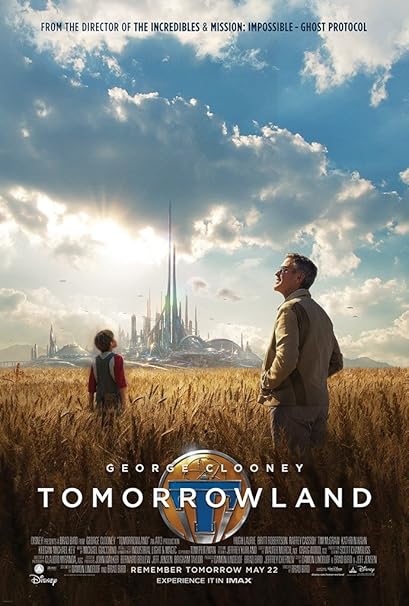
It emerges that Bird, in Tomorrowland, is mounting nothing less than a full-throated assault on the nihilism, dystopianism, and what might be called the fetishization of apocalypse in today’s movies, TV shows, and books — especially YA books that worm their way into the fantasies of impressionable kids. This is not, you understand, the movie’s subtext. It’s the Über-Über-text. It’s the message that’s articulated in multiple ways, as boldly as that Einstein sign, by characters bad and good, and it’s implicit in the riddle posed by Casey’s NASA dad that becomes the cornerstone of his daughter’s worldview: You have two wolves, one representing darkness and despair, the other light and hope. Which one lives? Says Casey: “The one you feed.”
My response to Bird’s anti-dystopianism is “Cool.” Because, really, how many more plague–flood–road warrior–kids-killing-kids movies do we need? It is time to feed that other wolf, if only for the sake of variety. And maybe we’ve learned too well since the days of Dr. Strangelove — which came out the same year as the New York World’s Fair — to “stop worrying and love the bomb.”
The trouble comes when Bird gets carried away with his critique of all things critical. In Tomorrowland, he suggests that it’s the people sounding the alarm — the ones constantly reminding us about climate change or the dangers of nuclear power — who are accelerating our demise, their pessimism wreaking havoc on imaginations that would otherwise be busy inventing solutions. I suspect that’s Bird’s Ayn Rand side showing its warty head, spinning another tale of extraordinary individuals kept from manifesting their creativity by repressive liberal groupthink. If Bird really believes we should shift the blame from a fossil-fuel industry bankrolling anti-science propaganda embraced by greedheads and fundamentalist wackjobs to the 98 percent of the world’s scientists saying, “If we don’t act now, and we mean now, we’re royally screwed,” he’s living in his own private Disneyland.
I hadn't known that Bird was an Objectivist. Too bad, it makes me think less of him. [ETA: Bird denies this, as The Dissolve points out. Still, there is definitely a Randian flavor to his films' themes, one that the critics pick up.] As for his film, follow over the jump for how it fared at the box office, especially compared to the films that it's critricizing.
I concluded 'Snowpiercer', by quoting the following transition and commenting on it.
There is one thing that's puzzled me, though. Some reviews, including several raves, have claimed to see the influence of a writer who is about as far from Occupy Wall Street as it's possible to get. Despite the political allegory, the very clear parallels to modern life, and the criticism of elitist greed that permeates the entire film, a handful of people are convinced that Snowpiercer was at least partially inspired by the least liberal, least likely of writers: Ayn Rand.
Yes. Really.
That sets up part two, in which Ellid descended from the sublime to the ridiculous. Stay tuned.
Follow over the jump for Ellid's take on Ayn Rand and "Atlas Shrugged."
I posted a link to the most recent entry about the Archdruid to Kunstler's blog this morning. So far, I've pulled in 400+ page views to that post, moving it up to the third most read entry this calendar year and the ninth most read in the history of the Crazy Eddie's Motie News. That only took 12 hours.
Kunstler himself responded to me, writing "Greer’s essay last week was really outstanding." Obviously, that entry continued to gain readers and page views throughout the week.
As for what the entry was about, and what led up to my writing it, those same Dreamwidth and LiveJournal entries told the tale.
My success with those entries prompted me to write "I think I'll keep reading and responding to The Archdruid after all." Follow over the jump for how that has panned out for me.
I had such a good time putting together A conversation with The Archdruid for the Solstice that I decided to do it again on Christmas while I was in Chicago. It helped that John Michael Greer revisted the points in The Fate of Civil Religion that I excerpted in The Archdruid on Objectivism as civil antireligion, a comparison of Objectivism and Satanism.* This time, he made an explicit comparison between Objectivism and Satanism and pointed out the implications for the Republican Party. I couldn't resist, even on vacation.
Follow over the jump for the relevant passages from A Christmas Speculation, my response with side commentary, and Greer's reply to me.
I'll get around to the acceptance speech I promised in Let's celebrate with Grumpy Cat presently. Right now, I'm a little too tired from putting together my wife's bike to compose one.
Instead, I'm posting the material about "After Earth" that I included in Overnight News Digest: Science Saturday (Asteroid Fly-by) on Daily Kos last night. It turns out that the movie isn't just an adventure flick. It has a serious environmental message and fits right in with my theme on this blog of examining sustainability issues through science fiction.*
After Earth's lead actor/producer and his co-star son Jaden share their view of an Earth that has 'kicked out" its human inhabitants as punishment for their mistreatment. Also, fmr. NASA astronaut Garrett Reisman opines on the movie's spaceship.
Will Smith produced this movie, so it looks like he's more of an environmentalist that I thought.**
It's a sci-fi film, but could our future resemble Will and Jaden Smith's in 'After Earth'? Trace interviews biologist and author, Dr. Joe Levine, about what made life uninhabitable for humans in the new movie, and how we can prevent a similar fate.
Levine points out what is fantastic about this movie when he acknowledges that large animals don't evolve as fast as they'd have to in the film. Still, he does a good job of explaining the scientific background for the future Earth.
Jaden Smith, star of Columbia Pictures' movie "After Earth," is featured in a new NASA public service announcement that describes the contributions of the agency's Earth science program to environmental awareness and exploration of our home planet.
Yet another reason to support NASA. It has a mission here on Earth, not just in space.
*Yes, that's the "Roots" thought for the day, if I don't get around to composing an acceptance speech.
Third, civil religions share with theist religions a curious and insufficiently studied phenomenon that may as well be called the antireligion. An antireligion is a movement within a religious community that claims to oppose that community’s faith, in a distinctive way: it embraces essentially all of its parent religion’s beliefs, but inverts the values, embracing as good what the parent religion defines as evil, and rejecting as evil what the parent religion defines as good.
The classic example of the type is Satanism, the antireligion of Christianity. In its traditional forms—the conservative Christians among my readers may be interested to know that Satanism also suffers from modernist heresies—Satanism accepts essentially all of the presuppositions of Christianity, but says with Milton’s Satan, “Evil, be thou my good.” Thus you’ll have to look long and hard among even the most devout Catholics to find anyone more convinced of the spiritual power of the Catholic Mass than an old-fashioned Satanist; it’s from that conviction that the Black Mass, the parody of the Catholic rite that provides traditional Satanism with its central ceremony, gains whatever power it has.
Antireligions are at least as common among civil religions as they are among theist faiths... Communism has its antireligion, which was founded by the Russian expatriate Ayn Rand and has become the central faith of much of America’s current pseudoconservative movement. There is of course nothing actually conservative about Rand’s Objectivism; it’s simply what you get when you accept the presuppositions of Marxism—atheism, materialism, class warfare, and the rest of it—but say “Evil, be thou my good” to all its value judgments. If you’ve ever wondered why so many American pseudoconservatives sound as though they’re trying to imitate the cackling capitalist villains of traditional Communist demonology, now you know.
I couldn't resist the juxtaposition of Satanism with Objectivism. I'm not the first to make that connection, which goes all the way back to Anton LaVey himself, as noted by Joe Carter at First Things.
Perhaps most are unaware of the connection, though LaVey wasn’t shy about admitting his debt to his inspiration. “I give people Ayn Rand with trappings,” he once told the Washington Post. On another occasion he acknowledged that his brand of Satanism was “just Ayn Rand’s philosophy with ceremony and ritual added.” Indeed, the influence is so apparent that LaVey has been accused of plagiarizing part of his “Nine Satanic Statements” from the John Galt speech in Rand’s Atlas Shrugged.
Devotees of Rand may object to my outlining the association between the two. They will say I am proposing “guilt by association,” a form of the ad hominem fallacy. But I am not attacking Rand for the overlap of her views with LaVey’s; I am saying that, at their core, they are the same philosophy. LaVey was able to recognize what many conservatives fail to see: Rand’s doctrines are satanic.
I also can't resist pointing out that the Pournelle Chart shows both Communism and Objectivism enthrone Reason, which makes both anti-conservative according to Pournelle's definition. Where they differ is their attitude to the State. Communism worships it, at least as the personification of the will of the collective, while Objectivism thinks of it as the ultimate necessary evil, allowing only the military, police, and courts as its legitimate functions. That makes Objectivism the funhouse mirror reflection of Communism, exactly the point Greer is making.
Finally, there are posts that were in the top ten between January 1st and March 21st, but which fell out by the time I compiled the list. That should take care of the series.
I suspect the largest political unit that is aware that it is managing contraction is the City of Detroit, where they can't avoid the realization. I blogged about it in THE LATEST INSTALLMENT OF CRAZY EDDIE'S MOTIE NEWS. Of course, Detroit and its collapse and renewal are the subject of more than half the posts on my blog. The topic is, as Spock would say, "fascinating."
That's not very informative. I like my justification for using it better.
[I]t's not every day that the New York Times covers exactly those aspects of Detroit that I cover in this blog. Better yet, it was picked up by the Columbus Dispatch, which doesn't have the 20 article limit before hitting a paywall that the New York Times has. Also, a friend of mine in Columbus posted the link on my Facebook wall. Who am I to refuse a good story when it's dumped in my lap?
Who am I to refuse, indeed? It had plenty of readers. I can't say how many it had when it dropped out of the top ten, but it currently has 580 page views according to the alternative counter on my site, which overcounts the number of readers relative to the one I use for my official top ten. That's 234 more than Detroit as a travel destination? The New York Times, BBC, and Financial Times think so, which has 346 page views using the alternative method and which made the end of year top ten.
One of the many entries I posted about the GOP debatehere in Michigan also cracked the top ten, although briefly, during the primary season, as people Googled it after every debate: Video clips from last night's Republican debate. Unfortunately, the clip of Perry being unable to name a third federal department to eliminate got pulled down, but there is a funnier version still up in Rick Perry blowing his answer to the Jeopardy theme.
As I wrote back then, "Sorry, Governor, the correct answer was 'What is the Department of Energy?'"
The listing of the dozen most viewed entries at the end of the first year is now complete, but I'm not done yet. Follow over the jump for the ten most viewed posts from the first year that didn't make the official top ten after January 1, 2012, along with their dates of posting, current page views according to the alternative counter, and the image or video I think best represents each one.
7.Every time someone mentions the Pirate, drink. Seriously, there's a pirate. His name is Ragnar and he’s a Viking god with golden hair and a face so handsome it can never be scared. Is he a hero or villain? You get one guess.
Yes, there is an Objectivist pirate who is a hero to Rand, but read the following passage about his motivation and see if it fits that of a conventional hero.
Ragnar Danneskjold: "But I’ve chosen a special mission of my own. I’m after a man whom I want to destroy. He died many centuries ago, but until the last trace of him is wiped out of men’s minds, we will not have a decent world to live in."
Hank Rearden: "What man?"
Ragnar: "Robin Hood. ...He was the man who robbed the rich and gave to the poor. Well, I'm the man who robs the poor and gives to the rich – or, to be exact, the man who robs the thieving poor and gives back to the productive rich."
...
"What I actually am, Mr. Rearden, is a policeman. It is a policeman's duty to protect men from criminals – criminals being those who seize wealth by force. ... But when robbery becomes the purpose of the law...then it is an outlaw who has to become a policeman."
Another source supplies more of Ragnar's animosity to Robin of Locksley.
[Robin Hood] is not remembered as a champion of property, but as a champion of need, not as a defender of the robbed, but as a provider of the poor. He is held to be the first man who assumed a halo of virtue by practicing charity with wealth which he did not own, by giving away goods which he had not produced, by making others pay for the luxury of his pity. He is the man who became a symbol of the idea that need, not achievement, is the source of rights, that we don’t have to produce, only to want, that the earned does not belong to us, but the unearned does. He became a justification for every mediocrity who, unable to make his own living, had demanded the power to dispose of the property of his betters, by proclaiming his willingness to devote his life to his inferiors at the price of robbing his superiors. It is this foulest of creatures – the double-parasite who lives on the sores of the poor and the blood of the rich – whom men have come to regard as the moral idea." ". . . Do you wonder why the world is collapsing around us? That is what I am fighting, Mr. Rearden. Until men learn that of all human symbols, Robin Hood is the most immoral and the most contemptible, there will be no justice on earth and no way for mankind to survive."
As Smoop's page on him concludes, the other strike leaders don't completely approve of Ragnar's methods. As for me, I don't approve of Ragnar at all. That's one pirate I'd rather not hear people speaking like, even if he has an argh sound in his name.
I know I promised "a post reviewing WXYZ's reporting about how the Dream Cruise fuels tourism," but I that will take some time to watch video I don't have right now. Instead, I have some more about Paul Ryan and his relationship to AynRand.
First, Tom Tomorrow at Daily Kos posted this last night.
That prompted a couple of commenters to post some macros to point out how the members of the ticket accidentally highlight the relationship between Ryan and Rand.
That's a much more impressive version than the one I first saw on Facebook courtesty of Nebris, who got it from Failbook.
In case you doubt the veracity of this anagram, another commenter from Daily Kos prepared this demonstration.
Sweet.
Finally, a diary at Daily Kos describes how Ryan has had to run away from Rand.
Paul Ryan came to town yesterday to be the main attraction for a fundraiser for Pete Hoekstra, who is running for Senate. Since I've had my share of thingsto say about Paul Ryan, it was an easy sell to get me to be one of the people demonstrating his visit. A bunch of us carried signs about protecting Social Security and Medicare. The protest even made the Detroit Free Press.
About a dozen protesters, including some senior citizens, picketed the event at the Westin Hotel in Southfield and were more than happy to talk about their fear of spiraling health care costs.
“All I have is Social Security and my husband’s pension and now I feel like I’m being squeezed out,” said Deanna Tachna, 73, of Birmingham. “I always thought that I was part of the middle class, but with this, there’s not going to be a middle class anymore.”
The reporter came at the end of the demonstration as people were starting to leave. If she had counted five minutes earlier and included the people demonstrating by the entrance to the parking garage less than 100 feet away, she would have recorded twice as many. That's not the only error in the report. She identified Paul Ryan as an "Illinois Republican." He's not. Paul Ryan is a representative from Wisconsin, not Illinois. He represented my wife when she lived in Kenosha County, not when she lived in the Chicago suburbs.
On the subject of followers of Ayn Rand, there is a diary about their ill effects on U.S. politics and society over at Daily Kos: Book Review: Ayn Rand Nation, by Gary Weiss. I recommend you read it.
And now, the macro I keep on hand just for mentions of Ayn Rand.
Ryan clearly has a passion for ideas and isn’t just interested in short-term positioning. It would be nice if the party had people like that who didn’t also happen to be loons.
...
Last week, I called Republican budget sorta-kinda point man Paul Ryan "crazy but honest."
It turns out that Krugman has since figured out that Ryan isn't honest, either.
One crucial thing you need to understand about political journalists is that with some honorable exceptions, they don’t know or care about actual policy. In a way, that makes sense — the skills needed to cultivate contacts, to get the inside scoop on what’s going on in Congressional scheming or campaign war rooms, are very different from the skills needed to interpret CBO spreadsheets. The problem, however, is that all too often political journalists mistake the theater of policy for reality (or don’t care about the difference).
Hence, the awful decision of Politico to give Paul Ryan an award as healthcare policymaker of the year.
Even if you like the thrust of Ryan’s ideas, even if you think privatizing Medicare and turning it into a voucher scheme is fine, what became painfully, embarrassingly clear during the debate over the Ryan plan was that Ryan is, well, incompetent; the plan was a mess, from its invocation of ludicrous Heritage Foundation projections to its crazy assertions about what would happen to discretionary spending. It’s true that the plan “got everyone talking”, as Politico says — but mostly it got people talking about what a mess Ryan’s effort was.
Oh, and it was pretty clear that Ryan wasn’t being honest about his own numbers.
What’s going on here, I suppose, is that Politico is mistaking theater for policy. Ryan isn’t an important health care reformer, or even minimally competent in his attempted wonkery, but he plays a deep thinker on TV. And the people at Politico either don’t understand the difference, or they don’t care.
Here's what I had to say in response.
As you've figured out, Paul Ryan isn't an intellectual, although he plays one in Congress; he's a salesman who uses the pretence of being an intellectual to sell himself and what passes for his ideas. As Gaius Publius on AmericaBlog wrote in response to your comment last January that Ryan was being "intellectually lazy" in not knowing the truth about the pre-crisis debt status of European countries:
Unfortunately, you can't be intellectually lazy if you're not an intellectual. Ryan's a Movement Conservative operative, one with good enough hair to get him into Congress.
Intellect is not his playing field, it's his "act", as Krugman correctly points out (or his "USP" in sales parlance, unique selling point, like "squeezably soft" or "doesn't leave a ring"). Ryan's playing field isn't intellect, it's power, and his tool is "Say anything to win". It was Rove's tool, Bush's tool, Rumsfeld's tool; it's Newt's tool, McCain's tool, Boehner's tool; and it's Ryan's tool.
You can't be an intellectual if the mind doesn't matter.
So Ryan isn't "crazy but honest," he's just another politician who will lie in the service of his "higher ideal" Based on what I've posted about Ayn Rand and Objectivism, you can tell what I think of his "higher ideal"--not much!
Time to pull out a blast from the past, in this case an essay I posted to Daily Kos back in January of this year, two months before I created this blog. It looks like a good day to re-post it.
In Two Speeches and an Editorial, Paul Krugman juxtaposed two quotations from President Obama about the importance he placed on empathy with the following sentence from the National Review Online on the same subject.
Empathy is simply a codeword for an inclination toward liberal activism.
Follow me over the fold for the observations of the commenters on one particular implication of Paul Krugman's point, including my own comment.
On February 11th of last year, Paul Krugman quoted Jonathon Chait, on the revelation that Paul Ryan is an Ayn Randite:
Ryan clearly has a passion for ideas and isn’t just interested in short-term positioning. It would be nice if the party had people like that who didn’t also happen to be loons.
The rest of Chait's post read as follows:
Last week, I called Republican budget sorta-kinda point man Paul Ryan "crazy but honest." Today, some of the intellectual influences behind the first half of that description are coming out. TPM reports that Ryan is a big fan of Ayn Rand and "Atlas Shrugged." The Daily Beast, interviewing Ryan, reports that he was influenced by Jonah Goldberg's "Liberal Fascism."
What do those works have in common? They're written by people who don't understand liberalism and the left at all, and are thus unable to present liberal ideas in terms remotely recognizable to liberals themselves. The specific lack of understanding lies in an inability to grasp the enormous differences between American liberalism and socialism or communism, seeing them as variants on the same basic theme. The historical reality is that the architects of American liberalism saw it as a bulwark against communism, and communists and socialists in turn viewed the liberals as in implacable enemy. (Yes, you can cherry pick a few data points of commonality, but these are the exceptions rather than the rule.) The result is a tendency to see even modest efforts to sand off the roughest edges of capitalism in order to make free markets work for all Americans as the opening salvo of a vast and endless assault upon the market system.
One of the commenters on Chait's piece posted the following about the comparison between Rand and Goldberg:
Jonah Goldberg is no Ayn Rand. Indeed, they are opposites. Ayn Rand's books are appealing (forget the politics), but her personality was nothing less than looney. Jonah Goldberg's personality is appealing (forget the politics), but his books are nothing less than looney.
And this brings us to Alan Greenspan, whom I've known for over 50 years and who I regarded as one of the best young business economists. Townsend-Greenspan was his company. But the trouble is that he had been an Ayn Rander. You can take the boy out of the cult but you can't take the cult out of the boy. He actually had instruction, probably pinned on the wall: 'Nothing from this office should go forth which discredits the capitalist system. Greed is good.'
There is one part of Atlas Chugged I find worth revisiting.
15.Rand's descriptions of love making are truly screwed up; vicious acts of near-sadism. Reardon essentially masturbates using Dagny's body as a tissue and she likes it. Even when Dagny experiences the perfect physical bliss of sex with John Galt (and yes, that's in there too), it's pretty creepy.
Every time you throw up a little during a sex scene, drink. Or at least rinse your mouth out.
TV Tropes has noticed this. Under Author Appeal, there is this little gem.
Ayn Rand had a thing for The Red Sonja and "bodice-ripper" style ravishment sex, which her sex scenes usually involved. The rather violent sex scenes she wrote (especially the rather infamous Howard Roark/Dominique Francon sex scene in The Fountainhead) can plausibly be read as Rape Is Love, although this is debated by many (including anarchist-feminist Wendy McElroy).
Additionally, Rand practiced consensual polyamory during the time she was writing Atlas Shrugged. The heroine of Atlas, Dagny Taggart, has multiple relationships over the course of the novel's plot.
Rand's belief in Brains and Bondage female sexual submission shows in a passage of Atlas Shrugged that describes the diamond bracelet worn by Dagny as giving her "the most feminine of all aspects: the look of being chained." This belief was also expressed in an infamous essay condemning the idea that a woman might want to be President, on the grounds that life without a man to look up to would make a woman "unfeminine, sexless, metaphysically inappropriate, and rationally revolting."
Ayn Rand is well known for this trope, as it falls in line with her personal fetishes. Rand liked strong, take-charge men and bodice-ripping, ravishment-type sex. Her works are sometimes accused of containing Rape Is Love, though it is a debatable matter.
Dagny Taggart from Atlas Shrugged is a modernized version of this.
Dominique from The Fountainhead.
Parodied in The Illuminatus! Trilogy's Rand parody Telemachus Sneezed.
Rand also wrote an essay arguing that no rational woman would ever want to be president because "the essence of femininity is hero worship — the desire to look up to man." A woman president, being the supreme authority of the land, would have no superior man to admire.
There's more under Rape Is Love, but in the spirit of a picture being worth 1000 words, I'll post the following instead.
There are certain habits in Rand’s writing; repeated phrases, archetypical characters and recurring situations. Habits which beg to be immortalized in their very own drinking game.
Atlas Shrugged, for those of you who never read it, can be summarized entirely fairly as follows. Unknown to our viewpoint characters at first, an inventor named John Galt has invented a "free energy" machine, a motor that runs on ambient static electricity and the Earth's own inertia and puts out enough electricity in a fairly small unit to power almost anything, including vehicles, force field generators, energy weapons, even an invisibility cloak if you use a big enough unit. He invented this while working at a company where his contract gave them rights to stuff he invented on the clock, like most professional engineers and inventors, but he assumed that as the inventor, he was entitled to all of the profits from this fabulous new invention. The company's management and other employees, though, saw just how much resentment would happen if one company owned the monopoly on an invention this valuable, and started making plans for how to invest some of the profits into charitable ventures, so they wouldn't get the whole thing taken away from them via eminent domain. John Galt, outraged that anybody would even suggest that he or the company he worked for owed anything to the nation that provided his education, protected him from infectious disease outbreaks, protected him from Communist invasion, built the roads that got him to work each day, provided the police that kept him safe, and provided the court system that protected his property rights at all, sabotaged the Galt Engine, so nobody could have it.
Then he went further and, in a fit of offended pique, promised to "stop the motor of the world," to kill 90% or so of Earth's population by intentionally wrecking the economy. Which he then did. How? By finding every other competent engineer or manager in the US and persuading them to be just as selfish as him, just as unwilling to pay back or protect their country; he declared a covert "strike of the mind," as he called it. He hid them all in a secretive compound in the Rocky Mountains, protected by force field and invisibility cloak, and waited for the US economy to collapse, which, obligingly, it did -- because John Galt had carefully sabotaged the bridges and railroads that made it possible for fuel and seeds to make it from the coastal cities to inland farms, and make it possible for food grown on inland farms to make it to the coastal cities. And as chaos was breaking out, he and his fellow inventors hijacked every radio transmitter in the US to broadcast his manifesto: You all deserve to die, for asking us to pay you back even one nickel, because we are all so selfish we don't consider any of the things you all paid for out of your taxes and that you did with your labor to have been at all helpful to us as entirely self-sufficient brilliant inventors and managers. So die.
I told you. Deliberately engineered collapse in the service of Objectivist goals is all there in the manual. Furthermore, John Galt, the mastermind behind this plan, is someone that Objectivists think is a hero. Lovely.
Furthermore, George Monbiot noted that efforts to prevent collapse, especially environmental collapse, absolutely enrage Objectivists.
A new movement, most visible in North America and Australia, but now apparent everywhere, demands to trample on the lives of others as if this were a human right. It will not be constrained by taxes, gun laws, regulations, health and safety, especially environmental restraints. It knows that fossil fuels have granted the universal ape amplification beyond its Palaeolithic dreams. For a moment, a marvellous, frontier moment, they allowed us to live in blissful mindlessness.
The angry men know that this golden age has gone; but they cannot find the words for the constraints they hate. Clutching their copies of Atlas Shrugged, they flail around, accusing those who would impede them of communism, fascism, religiosity, misanthropy, but knowing at heart that these restrictions are driven by something far more repulsive to the unrestrained man: the decencies we owe to other human beings.
Furthermore, they have elite help as Stranded Wind stated on Daily Kos.
How did we get here? You’ll find the Friedmanite free market ideology, lacking in merit for many of the situations to which it has been applied, yet its followers continuing howling that we ought to let the market decide, marketwide credit constipation be damned. The handmaiden of this foolishness, Rand’s objectivism, provides the ideological zombie virus that created many of the Freidmanite ideology’s true believers.
I'm in the middle of reading Naomi Klein's "Shock Doctrine," in which Milton Friedman's free market ideology plays a starring, albeit villainous, role, so I found the juxtaposition of Friedman and Rand particularly striking. When I finish the book, I promise to blog about it. I just hope it doesn't take seven months.
Of course, what comes around goes around. One of the quotes collected on Mike Huben's site comes from Bob Black, "Smokestack Lightning" and is most apt.
As it happens there is light to be shed on the libertarian position on breathing. Ayn Rand is always inspirational and often oracular for libertarians. A strident atheist and vehement rationalist -- she felt in fact that she and three or four of her disciples were the only really rational people there were -- Rand remarked that she worshipped smokestacks. For her, as for Lyndon LaRouche, they not only stood for, they were the epitome of human accomplishment. She must have meant it since she was something of a human smokestack herself; she was a chain smoker, as were the other rationals in her entourage. In the end she abolished her own breathing: she died of lung cancer.
Yesterday, I remarked about my tardiness in following up.
Back in April, I started a series about Atlas Shrugged and how Objectivism is contributing to collapse. It's been seven months, so I'm way behind. In fact, I'm so behind and so many new people have started reading this blog that I'm going to review what I rewrote back then. That it helps explain the nature of the hornet I'm swatting is a bonus.
Time for the next section of relevant quotes from that entry.