Showing posts with label fiction. Show all posts

Wednesday, October 29, 2025

'Catacombs' and other spooky songs by the Harp Twins for Halloween

I'm continuing my celebration of spooky season with music from Camille and Kennerly, the Harp Twins. I begin with CATACOMBS (Gothic Celtic) - Harp Twins original.

CATACOMBS is from our new dark fantasy ORIGINAL album, Twin Destinies! The companion dark fantasy novel was written by New York Times Bestselling author, Debbie Viguié!
...
Book & album teaser:
When their great-grandmother Kaia, a world-famous harpist, dies, two sisters find themselves the heirs to twin harps, an ancient book of music, and a legacy that stretches back centuries.
The Harp Twins have still more songs from Twin Destinies I haven't shared yet, but I'm moving on to music from their latest collaboration with Debbie Viguié, Changeling - spooky Celtic - Harp Twins original.

CHANGELING is part of our new original epic dark fantasy album and novel collaboration with New York Times Bestselling Author, Debbie Viguié!
...
Celtic Charms book & album teaser
After arriving in Ireland to play their harps for a wedding at a mystical castle, twin Seers find themselves caught in a web of ancient feuds, family secrets, creatures of myth, and a seemingly doomed romance that only they can save.
A harpist played at my middle sister's first wedding reception. That was a story in and of itself, but not one I'll tell today. It took place on Valentines Day and I should save it for then.

I close with the Harp Twins' latest, Welcome to Your Wake - Harp Twins (Official Music Video).

"Welcome to Your Wake" is part of our new original epic Celtic fantasy album and novel collaboration with New York Times Bestselling Author, Debbie Viguié!
A wedding and a wake? How Irish! Speaking of Irish, the rest of the songs seem like they would fit better with St. Patrick's Day, so I'll be a good environmentalist and save them for then.

Since crypts share a connection to catacombs, I'm closing with The Crypt Keeper: A "Tales From The Crypt" Inspired Cocktail | 31 DAYS OF HALLOWEEN by Secret of the Booze.

Even though Tales from the Crypt got held up by HBO from releasing a rebooted series by M. Night we thought with the Halloween season we give you a drink from one of our favorite story tellers. Each day we are creating a new drink for 31 days of Halloween inspired by iconic characters that go bump in the night.

RECIPE

INGREDIENTS
3 oz. Brandy
1 oz. fresh lime juice
1 oz. fresh lemon juice
½ oz. honey whiskey
Dash of Angostoria bitters

INSTRUCTIONS
Set a piece of paper on fire and place the glass over it so that it fills with smoke.
Add brandy, juices, and whisksy to a cocktail shaker with ice. Shake vigorously.
Strain into smoke filled glass.
Top with a few drops of bitters.
Drink responsibly and stay tuned for more Halloween posts through the end of the month plus a bonus Day of the Dead entry. Trick or treat!

Monday, September 22, 2025

'When Tolkien changed The Hobbit' for Hobbit Day on the Autumnal Equinox

Happy Hobbit Day on the Autumnal Equinox!* I'm featuring Robert of In Deep Geek again with his tale of When Tolkien changed The Hobbit.


Robert is right; the original version of the riddle game in The Hobbit makes no sense given the powers and history of The One Ring and Gollum's relationship with it in The Lord of the Rings. The new version sets up the sequels. More interestingly, the original tale remains in The Fellowship of the Ring as a cover story, even after it has been replaced in the new editions of The Hobbit. I respect that clever use of the retcon. I also didn't know any of this before I watched Robert's video, so I learned something new. It's always a good day when I learn something new.

Enough fantasy. Time for reality with The National Weather Desk asking and answering What Actually Causes the Seasons? Meteorologist Breaks Down Fall Equinox.

Ever wonder why fall feels so different from spring even though they're both equinoxes? Meteorologist Evan Chickvara reveals the science behind why identical daylight hours create completely different weather patterns.
Evan Chickvara does a good job of explaining why temperature lags behind hours of daylight. It takes even longer for water to warm up and cool down than ground, so seasons are even more delayed in Michigan and other parts of the Great Lakes states.

Speaking of the Great Lakes, I'd heard of Manhattanhenge, but not Chicagohenge. Watch The Weather Channel's Fall Equinox Episode Of 'Chicagohenge'.

Two times a year, the sunrise and sunset perfectly align with some streets in the heart of Chicago, putting on a show between the skyscrapers. The fall equinox episode of “Chicagohenge” is about to happen, but will the weather mess up the view?
Detroit also has a lot of east-west streets, so we would see the Sun rise and set down our major streets as well, but it's raining here now, so not today. Darn.

*It's also World Rhino Day, National Elephant Appreciation Day, and Car Free Day today. I'll save those for when I have more time and energy.

Thursday, May 9, 2024

Meyers, Colbert, Kimmel, and 'The Daily Show' take closer looks at Stormy Daniels testimony and Kristi Noem's book appearances

Happy Throwback Thursday! I know I suggested "a serious look back at Trump's hush money trial so far" yesterday, but I couldn't resist examining the proceedings through comedy, just like last week. Laughter helps me digest the news better.

Without any further ado, I begin with Seth Meyers examining Trump Humiliated in Court by Stormy Testimony; Kristi Noem’s Disastrous Book Tour: A Closer Look.

Seth takes a closer look at Donald Trump coming face to face with Stormy Daniels in his criminal trial while his top VP contender Kristi Noem is grilled about lying in her book.
Seth is right; how will we teach today's events to tomorrow's children as history? Seth isn't the only comedian wondering about that. Stephen Colbert did as well in Trump To Stormy: You Remind Me Of My Daughter | Met Gala Looks | Dogs Dyed To Look Like Pandas.

Stormy Daniels testified about her one-night stand with Donald Trump, Stephen broke down his favorite looks from the Met Gala, and a Chinese zoo got caught trying to pass off dogs as pandas.
Unlike SNL, which made Kristi Noem a running joke in 'SNL' covers protests, Kristi Noem, and hush money trial with Dua Lipa doing double duty, Stephen couldn't bring himself to mention her in the video description, even though he included her media appearances in his monologue. Instead, he closed with two light topics, the Met Gala and the dogs as fake pandas. At least those dogs were cute and made even cuter by dying them like giant pandas.

Jimmy Kimmel remarked that his show was entered as an exhibit for the trial in Stormy Daniels Details Sex with Trump, Jimmy Mentioned AGAIN & Puppy Killer Noem's Disastrous Book.

Today the prosecution called Stormy Daniels to the stand in Trump’s hush money case, Jimmy was mentioned AGAIN in reference to an interview she did on our show, she revealed some details about her sexual encounter with Trump, after hearing the first half of her testimony he took to Truth social begging for a mistrial, after making a huge deal about missing his son Barron’s graduation - Donny is set to headline an event in Minnesota, Governor Kristi Noem is now distancing herself from her own autobiography after admitting to shooting her puppy and lying about meeting Kim Jong Un, the Met Gala took place in New York last night, and the monologue gets interrupted by a man named Von Schitzenpantz, who bares the same name that Trump’s former lawyer Michael Cohen came up with for him.
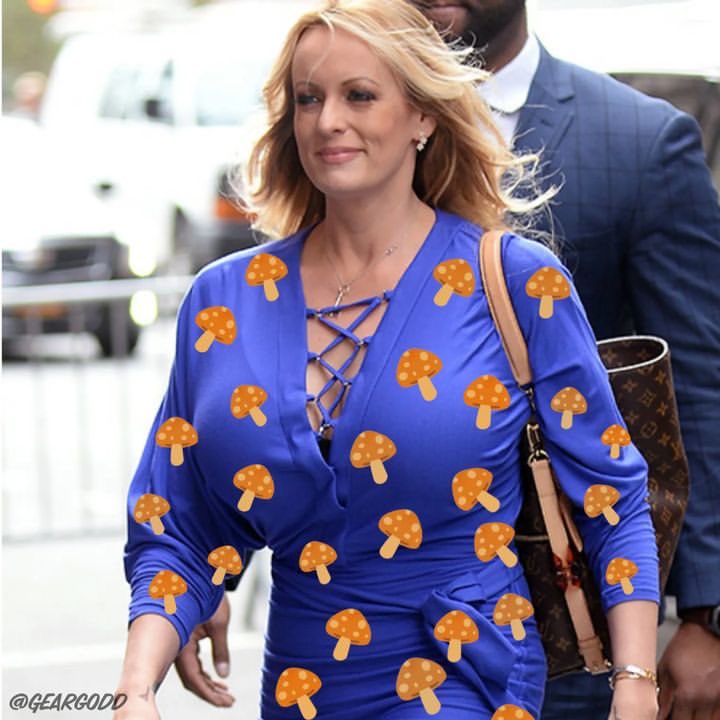
All of these clips have mentioned that there would be no description of genitalia, but Kimmel told his viewers where to look for one. This manipulated photo gives a hint.


Too bad it's fake. The real dress was plain royal blue without any orange mushrooms. Darn.

The Daily Show had its own take on Stormy's testimony in Stormy Daniels's NSFW Testimony & Vladimir Putin Wins “Democratic” Election.

Jordan Klepper recaps his favorite Met Gala looks, Putin puts on his own night of dictator opulence at his inauguration, and Troy Iwata weighs in on the disturbingly dirty details of Stormy Daniels's testimony during Trump's criminal hush money trial.
At least The Daily Show didn't talk about Noem, her dog, and Kim Jong Un. That was getting painful.

I close by returning to The Late Show with the relevant cold open, Porn Hub’s New Legal Series.

"Court Hub" is a new series of adult legal films released to celebrate Stormy Daniels testifying in the Trump hush money trial.
*Snork!*

Stay tuned for more coverage tomorrow.

Friday, January 5, 2024

Golden Globes, Critics Choice, and Emmy screenplay and writing nominees for National Screenwriters Day

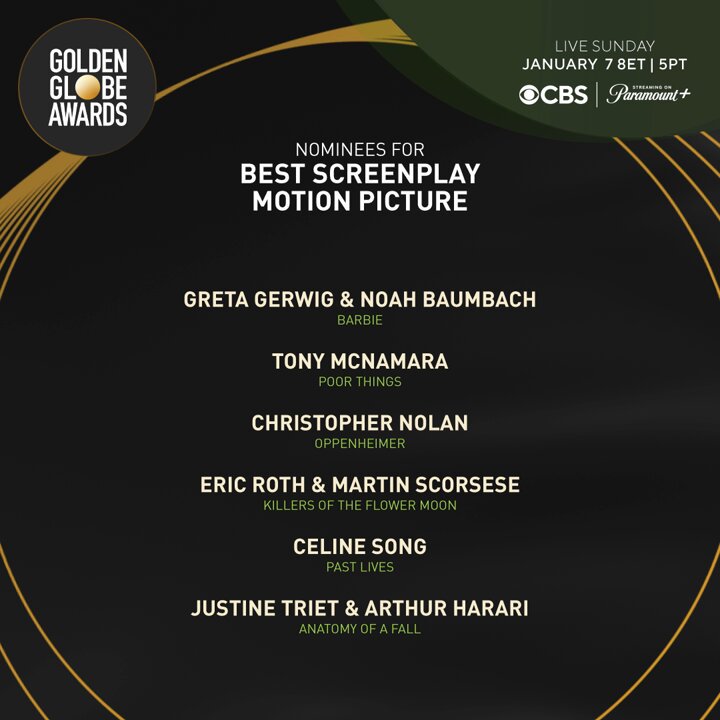
Happy National Screenwriters Day! As I promised yesterday, I'm celebrating by blogging about the screenplay and writing nominees at the Golden Globes, Critics Choice, and Emmy Awards in that order. Without any further ado, here are the screenwriting nominees.

Best Screenplay
Greta Gerwig and Noah Baumbach – Barbie
Tony McNamara – Poor Things
Christopher Nolan – Oppenheimer
Eric Roth and Martin Scorsese – Killers of the Flower Moon
Celine Song – Past Lives
Justine Triet and Arthur Harari – Anatomy of a Fall
I already made my personal preference known by voting for Barbie for Best Film Screenwriting at the Saturn Awards. I also described the odds of the scripts winning this Golden Globe in 'Avatar: The Way of Water' leads Saturn Awards with 12 nominations: "The Gold Derby editors are tied, with five each picking Barbie and Poor Things with Oppenheimer placing no higher than second and most editors thinking it's in third." That's still the case with the eleventh editor choosing Celine Song for Past Lives. The Gold Derby experts manage to be more decisive while paradoxically being more dispersed in their choices with eight picking Barbie, three choosing Oppenheimer, two each selecting Poor Things and Past Lives, and one ranking Killers of the Flower Moon first. I'll stand by my choice of Barbie.

Gold Derby interviewed Celine Song ('Past Lives' writer-director) reveals ‘intense emotional work', one of the nominees.

Celine Song (‘Past Lives’ writer-director) reveals ‘intense emotional work,’ ‘extraordinary’ shots in Seoul and New York City. The first-time filmmaker shot the emotional movie about a reunion of childhood friends (Greta Lee, Teo Yoo) after two decades apart in both New York City and Seoul. Gold Derby's David Buchanan hosts this webchat.
Song has a nomination in the next category at the Critics Choice Awards as well.

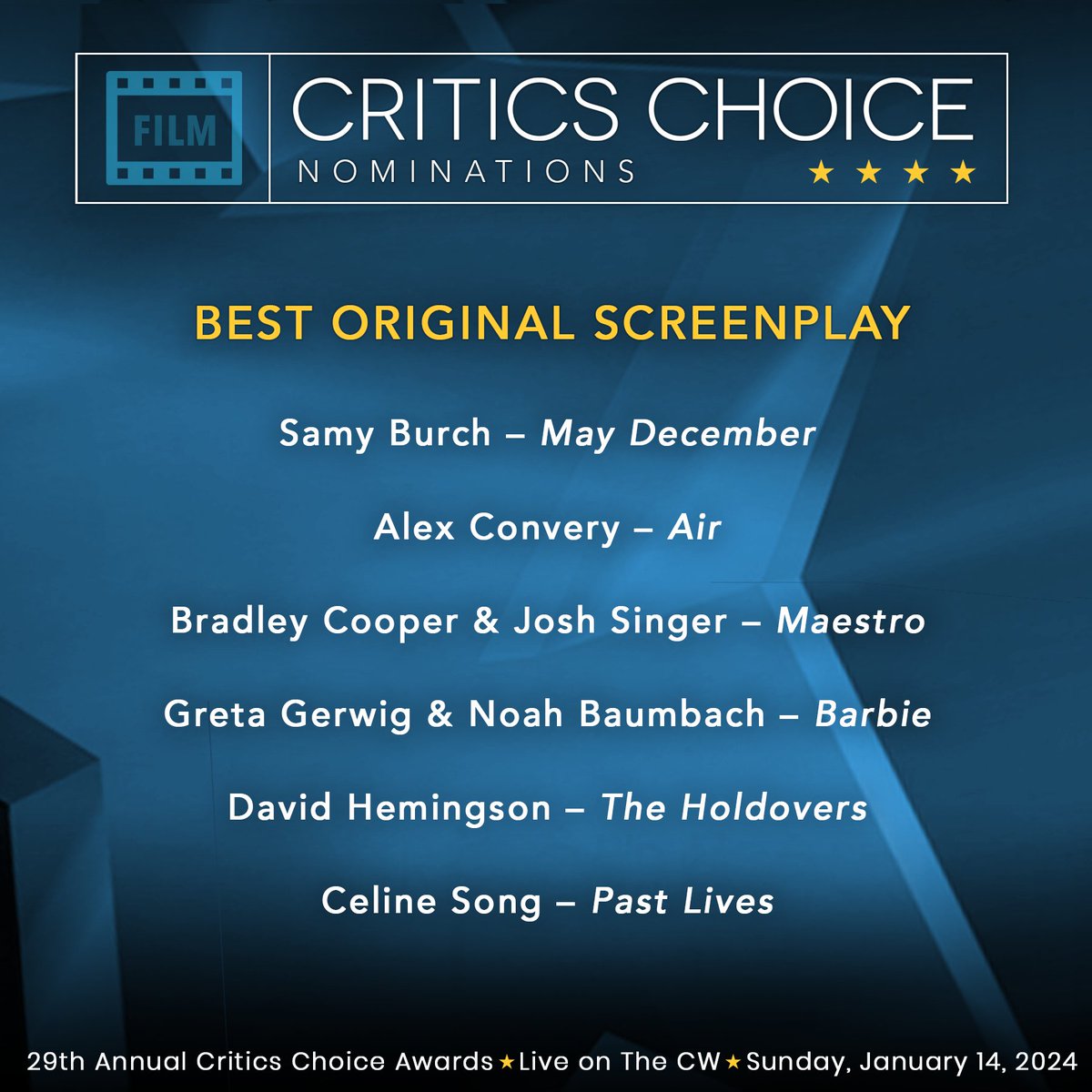
Best Original Screenplay
Samy Burch – May December
Alex Convery – Air
Bradley Cooper and Josh Singer – Maestro
Greta Gerwig and Noah Baumbach – Barbie
David Hemingson – The Holdovers
Celine Song – Past Lives
I wrote last month that "Gold Derby's editors think Baumbach and Gerwig have the inside track to win Original Screenplay with six picking them to ascend the stage..." Since then, one more editor switched their vote to Barbie while two each ranked Past Lives and The Holdovers first. The experts are even more in favor of Barbie with nine of ten experts picking it to win while one chose The Holdovers, so I'm expecting Barbie to win.

Now that the Writers Branch of the Motion Picture Academy has ruled that Barbie is an adapted story, not an original one, I'm penciling in the latter two as the co-favorites to win the Original Screenplay Oscar. I've already embedded Celine Song, so it's time for Gold Derby's 'The Holdovers' writer David Hemingson thought friend pranked him, but it really was Alexander Payne.

'The Holdovers' writer David Hemingson on assuming it wasn't really Alexander Payne on the phone but his friend pranking him. He compares his hiring by the acclaimed director to Charlie finding the Golden Ticket in 'Charlie and the Chocolate Factory.' Gold Derby editor Ray Richmond hosts this webchat.
Like Past Lives, The Holdovers contains autobiographical elements. Unlike Past Lives, it's a comedy. So are the two other nominees for this award Gold Derby interviewed. The first alphabetically was 'Air' writer Alex Convery thought that 'no one would be crazy enough to make this movie'.

'Air' writer Alex Convery thought that 'no one would be crazy enough to make this movie.' For the Ben Affleck film, ultimately, 'one of the great joys of this was the joy of creation and the work itself.' Gold Derby editor Daniel Montgomery hosts this special 'Meet the Experts' panel with film writers.
Watching The Last Dance during the pandemic inspired this script. I didn't know that, but I shouldn't be surprised. Add this to My Garden of a Thousand Bees and Summer of Soul as projects conceived while staying safe at home.

The other nominee for Best Original Screenplay at the Critics Choice Awards that is also nominated for Best Motion Picture, Musical or Comedy, at the Golden Globes Gold Derby interviewed was 'May December' writer Samy Burch on using humor to break the tension of 'dark' story.

'May December' writer Samy Burch on using humor to break the tension of 'dark' story. About the Todd Haynes film starring Natalie Portman: 'Character is sort of the anchor for me when I'm telling a story,' she says. Gold Derby editor Daniel Montgomery hosts this special 'Meet the Experts' panel with film writers.
I grew up in Los Angeles, so I'm familiar with the Mary Kay Letourneau story that inspired this screenplay. It's definitely dark and has a tragic end, regardless of the comedic potential.

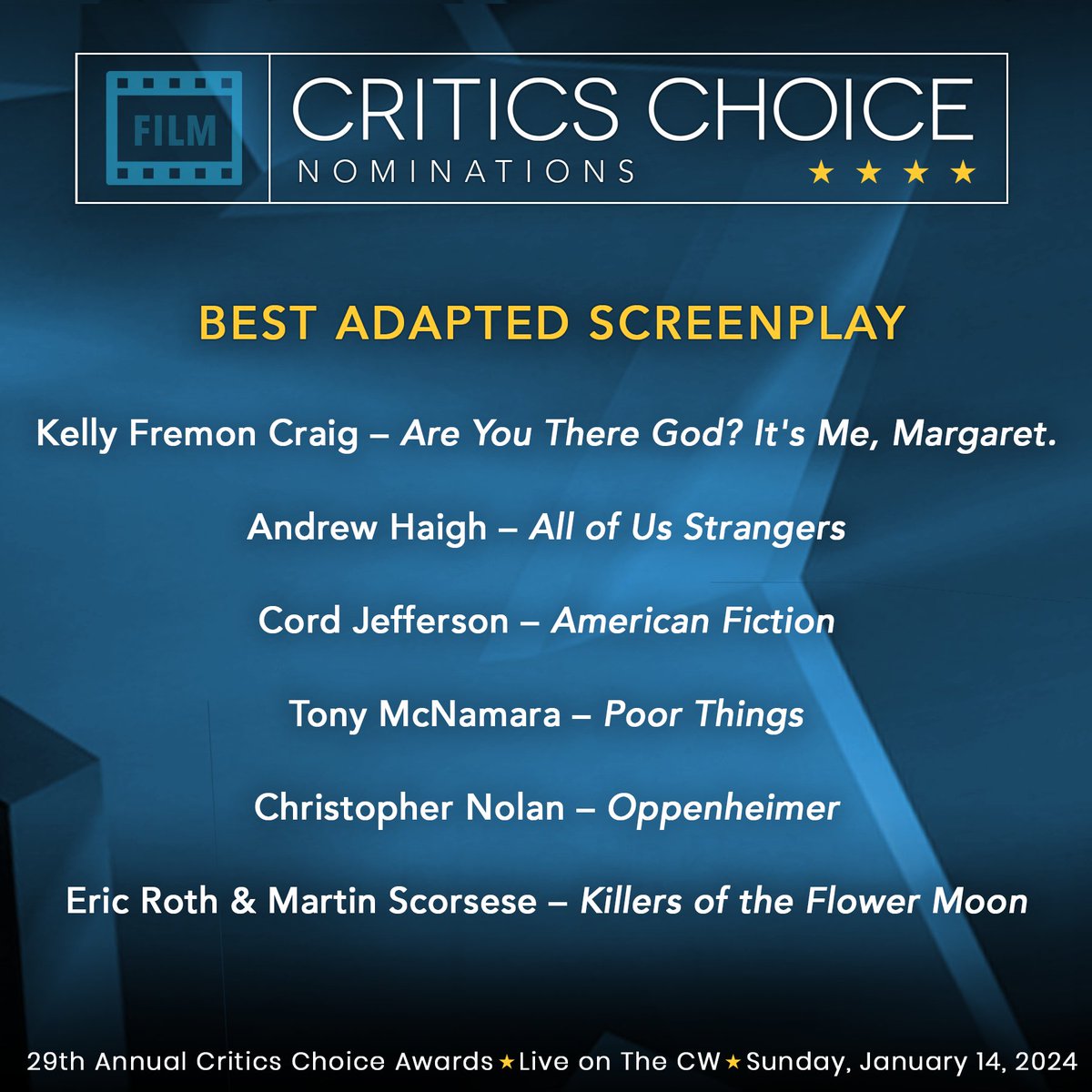
Best Adapted Screenplay
Kelly Fremon Craig – Are You There God? It's Me, Margaret.
Andrew Haigh – All of Us Strangers
Cord Jefferson – American Fiction
Tony McNamara – Poor Things
Christopher Nolan – Oppenheimer
Eric Roth and Martin Scorsese – Killers of the Flower Moon
Last month, I wrote that the Gold Derby editors "think Poor Things, which I expect will be nominated for Best Fantasy Film at next year's Saturn Awards, will beat Oppenheimer for Adapted Screenplay with six of eight editors also picking it." More editors have made their picks since, with a total of seven now choosing Poor Things, two ranking American Fiction first, and one each thinking Killers of the Flower Moon and Oppenheimer will win. I'm penciling in Poor Things as the winner.

The one nominee for this award Gold Derby interviewed was 'Are You There God? It's Me, Margaret' writer-director Kelly Fremon Craig: 'Adapting a sacred text'.

'Are You There God? It's Me, Margaret' screenwriter-director Kelly Fremon Craig: 'It feels like adapting a sacred text.' 'There were so many things that struck me when I read it as a kid. It just felt like, oh my gosh, somebody gets me,' she says. Gold Derby editor Daniel Montgomery hosts this special 'Meet the Experts' panel with film writers.
Like Air, Are You There God? It's Me, Margaret. is connected to a documentary, Judy Blume Forever, which I examined in 'Still: A Michael J. Fox Movie' leads nominees for Outstanding Documentary or Nonfiction Special at the Emmy Awards. Between the documentary and this movie, Judy Blume is having quite the moment!

I'll return to the Golden Globe and Critics Choice Award nominees later. Right now, follow over the jump for the Primetime Emmy Awards nominees for comedy and drama.

Saturday, December 9, 2023

Creators of COVID-19 mRNA vaccine and other Nobel Prize winners for an early Nobel Prize Day

A happy early celebration of Nobel Prize Day! I begin the observance with NBC News reporting Two scientists receive Nobel Prize in medicine for work on Covid-19 mRNA vaccine this past October.

Katalin Karikó and Drew Weissman received the Nobel Prize in medicine for their work on the Covid-19 mRNA vaccine. The two found a way to create a vaccine that would get past the body’s defenses but still prompt the immune system to make antibodies to fight the disease. NBC News’ Andrea Mitchell shares more.
Katalin Karikó and Drew Weissman won the Nobel Prize just days after How to Survive a Pandemic about the development of the COVID-19 vaccine won Outstanding Science and Technology Documentary. That's two expert recognitions of COVID-19 vaccines, which came from HIV research and can still result in an HIV vaccine — a technology going full-circle! It's also an early fulfillment of a prediction I made three years ago — "work on coronavirus is likely to win Nobel Prizes, whether in Chemistry or Medicine, about a decade from now. May we all live long enough to see it." It only took three years!

Follow over the jump for the rest of this year's Nobel Prize winners.

Saturday, October 29, 2022

PBS Digital's Storied examines the legacies of Lovecraft and Poe for Halloween

PBS Digital's Storied uploaded two videos about seminal horror authors this year, H.P. Lovecraft and Edgar Allan Poe. I think they would be excellent subjects for spooky season, so I'm sharing them, beginning with How Cthulhu Transcended its Creator, H.P. Lovecraft | Monstrum.

The tentacle-faced creature Cthulhu is H.P. Lovecraft’s most enduring eldritch creation. But while Lovecraft may be Cthulhu’s inventor, this monster has outgrown its creator, impacting both horror fiction and the real world in significant and unexpected ways.
The Chaosium game Call of Cthulhu introduced me to the Cthulhu Mythos. I never played it, as I preferred role-playing characters who became more skilled and powerful instead of progressively more insane because of their knowledge, but it did induce me to read "The Color Out of Space," a scary science fiction story. It also influenced my view of the Ghostbusters role playing game, which I called "Call of Cthulhu for laughs" and a gaming acquaintance called "Scooby-Do except the monsters are real but don't matter." I actually played Ghostbusters with my kids, who thought it was a hoot.

By the way, while I've mentioned "Lovecraft Country" many times, a cursory search of my blog indicates I've never mentioned H.P. Lovecraft himself before today. Considering his retrograde views on race, I think that's appropriate.

Next, Why Edgar Allan Poe Isn't Just a Sad Boy | It's Lit.

We remember Edgar Allan Poe for his tales of horror and the macabre as well as inventing the entire Detective Fiction Genre. But unlike many of the great authors of Western classic literature, he has become an icon unto himself, recognized to this day by name and face almost more than the titles of his stories and poems. But his legacy is more complicated than school books may have lead us to believe.
On the other hand, I've mentioned Poe three times on this blog, mostly in reference to the Opera Ghost dressing up as The Red Death in "The Phantom of the Opera." Welcome to the intersection of drum corps, horror, and pandemics.

As I have for the rest of this year's (and last year's) Halloween entries, I'm closing with a drink recipe video. Today, it's Cocktails With Cthulhu! Velveteen Lounge Kitsch-en.

Ponder Cthulhu's return and the attendant appalling destruction of humanity with our delicious cocktail and snack!
Drink responsibly and stay tuned for more Halloween posts through the end of the month. Trick or treat!

Thursday, September 22, 2022

Hobbit Day and Rhino Day on the Autumnal Equinox

Happy Hobbit Day on the Autumnal Equinox! As I did last year, I open with National Day Calendar's Hobbit Day | September 22.

The novels The Hobbit and the trilogy The Lord of the Rings trilogy written by J.R.R. Tolkien, bring to life the world of Middle-Earth. According to the stories, Bilbo and Frodo were born during the Third Age in the years 2890 and 2968 respectively. Translated to Shire-reckoning, Bilbo was born in 1290 and Frodo in 1368.

Reading the book or watching movies are other ways to enjoy the day. Create a celebration worthy of a Hobbit.
A bunch of Tolkien YouTubers have put together a Hobbit Day 2022 Tolkien YouTubers Collaboration Playlist to create "a celebration worthy of a Hobbit." I particularly recommend Clans of the Hobbits | Hobbit Day 2022, which ties into "Rings of Power" on Amazon Prime.

On a more serious note, today is also World Rhino Day. Watch the Cheyenne Mountain Zoo video explaining its significance.

Today is #WorldRhinoDay! We're in Encounter Africa with #CMZoo senior lead keeper, Annie, to raise awareness for the five remaining rhino species left in the wild. Black rhinos, like our 17-year-old Jumbe, are critically endangered, along with Javan and Sumatran rhinos. White rhinos are considered near threatened and greater one-horned rhinos are vulnerable to extinction. Annie tells us how coming to Cheyenne Mountain Zoo can help wild rhinos, and what you can do to support Jumbe's wild relatives.
I'm continuing the conservation theme in The First Day Of Fall | September 22, 2022 from CNN 10.

It's officially fall and today we're explaining the science behind the autumnal equinox. We're also traveling to Australia to learn about a scientist using a network of sound recording devices to track an endangered species of bird. And finally, our own Coy Wire chats with two sports icons about their secrets to success.
Science and technology in the service of studying and helping preserve biodiversity!

As I promised yesterday, I plan on returning with more television tomorrow. Stay tuned!

Friday, December 10, 2021

Journalists, climate modelers, and others recognized for Nobel Prize Day 2021

Happy Nobel Prize Day! As I have the past three years, I begin by recognizing the recipients of the Peace Prize. Watch Why the Nobel Peace Prize was won by 2 journalists, and what that means for press freedom from PBS NewsHour.

The Nobel Committee often likes to make a statement when it awards the Nobel Peace Prize every year, and 2021 is no different. Two journalists, one from the Philippines, the other from Russia, were recipients — at a time when the free press is under global attack, and the truth is hard to find. Nick Schifrin reports.
The Peace Prize recipients generally piss people off and I'm O.K. with that as long they piss off the right people. I think this year's prize qualifies.

Moving on to the sciences, two researchers who work on climate change were among those honored today. Watch DW News report Climate modelers awarded with the 2021 Nobel Prize in Physics.

The 2021 Nobel Prize in Physics has been awarded jointly to Syukuro Manabe, Klaus Hasselmann and Giorgio Parisi for "groundbreaking contributions to our understanding of complex physical systems."

The 2021 Nobel Prize in Physics was awarded to three scientists whose cumulative work can be summed up in two words: Climate change. Half of the prize went to Syukuro Manabe and Klaus Hasselmann "for the physical modeling of Earth’s climate, quantifying variability and reliably predicting global warming." And the other half went to Giorgio Parisi "for the discovery of the interplay of disorder and fluctuations in physical systems from atomic to planetary scales." The Nobel Committee got Parisi on the line from his home in Rome to Stockholm, and when asked whether he had a message for politicians meeting at the COP26 United Nations Climate Change Conference, he said simply: "We have to act now."
I tell my students that modeling was the original scientific method, at least for the oldest science, astronomy, but that it generally doesn't get the respect that controlled experiments do. Now I can tell them that modeling has earned two of its practitioners a Nobel Prize.

Follow over the jump for the rest of this year's Nobel Prize recipients.

Saturday, October 30, 2021

PBS Storied's Monstrum on werewolves through the centuries for Halloween

For today's treat, I'm continuing my tradition for the past two years of blogging about monsters on Candy Corn Day. This year, Dr. Emily Zarka of PBS Digital's Storied explored the history of werewolves for Halloween, just as she exhumed the history of zombies last year. At least her werewolf history spanned only two episodes in contrast to three for zombies. Watch The Killer Origins of the Werewolf to see the first part.

Long before a full moon could transform a human into a beast, the werewolf was present across the literature, lore, and mythologies of ancient Europe. Whether a punishment for the wicked, a cure for the unlucky, or a blessing for the strong, the human to wolf shapeshifter is almost always violent. Real wolves posed a real threat to humans and their livestock, but how did these predators come to be associated with cannibalism, sorcery, and mental illness? The first in a two-part series, featuring werewolf expert and Gothic scholar Dr. Kaja Franck, this episode tackles the rise of the werewolf in its myriad of forms, looking at what happened when Christianity interceded and turned the werewolf into the embodiment of evil—a change that reached its devastating climax with the persecution and execution of accused werewolves.
While I appreciated both the history and the science used to explain it, I agree with Dr. Zarka's final question, "but why?" For the answer, watch part two, The Werewolf’s Modern Metamorphosis.

Modern interpretations of werewolves include grotesque transformations, bloodied muzzles, and loyal packs. Many of these tropes first appeared on film but how did the modern world integrate older fears of lupine shapeshifters into haunting depictions of modern anxieties? The second installment in Monstrum’s werewolf series looks at the evolution of the werewolf through Gothic fantasy, horror films, literature, and video games, exploring the monster’s evolution into one of popular culture’s most malleable metaphors. With insights from werewolf expert Dr. Kaja Franck, horror critic Meagan Navarro, and werewolf graphic novelist Olivia Stephens, this episode will help you understand why the popularity of the werewolf only continues to grow.
If Dr. Z and her guests are right, then werewolves could be the answer to after zombies and vampires, what's next? Time will tell.

Since Dr. Z and her guests mentioned "Werewolf of London," I'm sharing A Werewolf of London cocktail that has nothing to do with the film | Warren Zevon Piña Colada as today's drink.

Werewolf of London is a classic horror film. This cocktail has nothing to do with that film, and draws flimsy inspiration from Warren Zevon's 1977 novelty song. This episode, we're bringing you a Piña Colada twist on the Trader Vic's classic that'll have you howling for another round!

THE RECIPE:
1 oz Pusser's British Navy Rum
1 oz J. Wray Overproof Rum
3 oz Pineapple Juice
1/2 oz Lime Juice
1/2 oz Cream of Coconut
2 dashes Angostura Bitters
Haha! I enjoyed this video enough that I left the following comment: "Your channel needs more subscribers, so I subscribed, and this video needs more viewers, so I'm embedding it on my blog for an entry about werewolves. Happy Halloween!" I hope my actions encourage the creators to make more videos. Since Spirits of Horror is a Canadian channel, it also has a recipe for "Ginger Snaps." I'll save that for a future post about lycanthropes, just in case Dr. Zarka and her guests are right about the rising popularity of werewolves in literature and media. After all, I'm an environmentalist; I conserve my resources in addition to recycling my comments.

Stay tuned for one final Halloween post for this year. Trick or treat!

Wednesday, September 22, 2021

Happy Hobbit Day on the Autumnal Equinox!


Happy Hobbit Day on the Autumnal Equinox! Since I became aware of the day through National Day Calendar, it's only appropriate that the first video I share is today's NATIONAL DAY CALENDAR: National Hobbit Day from KX News in North Dakota.


As the National Day Calendar entry states, "Explore the Shire on September 22nd during Hobbit Day. While there, celebrate the birthdays of Bilbo and Frodo Baggins."

CBS Miami celebrated the day two years ago in It's National Hobbit Day.

Hobbits Bilbo and Frodo Baggins were both born on September 22nd.
That's the fantasy. Here's some reality from WHAS11 asking What is the autumnal equinox?

This year's autumnal equinox takes place on Sept. 22, but what does that mean? Here's what you need to know.
Remember, axial tilt is the reason for the season!

Sunday, May 3, 2020

PBS Digital's Storied examines pandemics in literature and entertainment

When I told my readers to "stay tuned for the Sunday entertainment feature" at the end of Marching music for the Kansas Primary, I had only the vaguest idea of what I would write about other than it would have some relationship to the pandemic.  Then I saw YouTube recommend How Fictional Pandemics Reflect the Real Thing (Feat. Lindsay Ellis and Dr. Z) on PBS Digital's Storied, the channel shared by Monstrum and It's Lit!*  I watched it and decided it would be the subject of today's entry.  As I remarked in the footnote to Pandemic effects from and on space, an April asteroid flyby, and NASA at Home for Apophis Day on Monday the 13th, "Behold the power of the YouTube algorithm!"

Although we are currently living through a pandemic that has disrupted our lives and will shape the course of humanity, pandemics have been around since the dawn of civilization, as have stories about fictional pandemics. So now seems like as good a time as any to explore how fictional pandemics have evolved over time, and what they say about their own time.
Long-time readers of my blog will recognize some of the more recent works, as I have written about them.  While I've mentioned Edgar Allan Poe only once here, I've referenced his creation, The Red Death, several times, usually in conjuction with Ebola.  That's because the Opera Ghost appears in costume as The Red Death in "Phantom of the Opera" and I thought it made for a good personification of the disease.


No Ebola-chan on this blog!

In addition, there are all the references to zombies as pandemic metaphors, something I mentioned first in Discovery News on World War Z: "Who needs a imaginary zombie plague when a very real flu pandemic combined with mass riots against a background of crumbling infrastructure could produce the same response, if not much the same result?"  As for other zombie works mentioned, I have an entire entry dedicated to Warm Bodies and a series of posts about "The Walking Dead.  As for "I Am Legend," I've mentioned it several times in passing, but only did the book justice in a response to a comment by Infidel753 on Entertainment for the sixth year of Crazy Eddie's Motie News.
"It's rare that movies do justice to really good science fiction or fantasy books. There have been three movie adaptations of I Am Legend (that I know of) and they made a mess of it each time."
...
As for your gripe about Hollywood screwing up film adaptations of science fiction, I blame that on star power and the executives idea of the kinds of endings that movies need to get box office. The original ending of "I Am Legend" is not one that is a happy one for the original form of humanity, so more palatable ones had to be devised. Also, the past two leads have both been action heroes, Charlton Heston and Will Smith, which may bring in viewers for box office but leads to emphasizing action over thought. In addition, the movie adaptations have made things progressively worse for themselves, as the original work was intended as a scientific explanation for vampires, but ended up becoming the basis for the modern science fiction zombie. Therefore, all the zombie apocalypse tropes became incorporated in the most recent movie version. I suspect that a more faithful adaptation would have to be on television, where the economic and artistic pressures are different. See the SyFy Channel version of "Dune" and Fox's "Wayward Pines" for examples of how that might turn out.
It was about time I recycled those comments into a post.

Finally, while I've mentioned Stephen King on this blog before, usually in the context of either ebola or the Saturn Awards, I don't think I've ever mentioned his pandemic novel "The Stand" here.  Other than quipping that if the biological weapon in that book is Captain Trips, then the novel coronavirus is Private Trips, I won't write more about it.  Instead, I'm going to conclude my commentary on the above video by sharing the following musical moment that I've had open in a tab for several weeks, just waiting for an opportunity to embed it.  Now is that opportunity.


The opening to the mini series The Stand

"I've got a fever, and the only cure is — more cowbell!"  Looks like the cowbell got there too late.

Enough horror.  Tomorrow is a science fiction holiday, Star Wars DayMay the Fourth be with you!

*Both presenters first appeared on my blog last year, Ellis in PBS Digital's Hot Mess asks if climate fiction can save the planet and Dr. Zarka in Halloween science: Cyclops and other monsters inspired by fossils.  I'm glad to have had another opportunity to use one of their videos.

Sunday, December 1, 2019

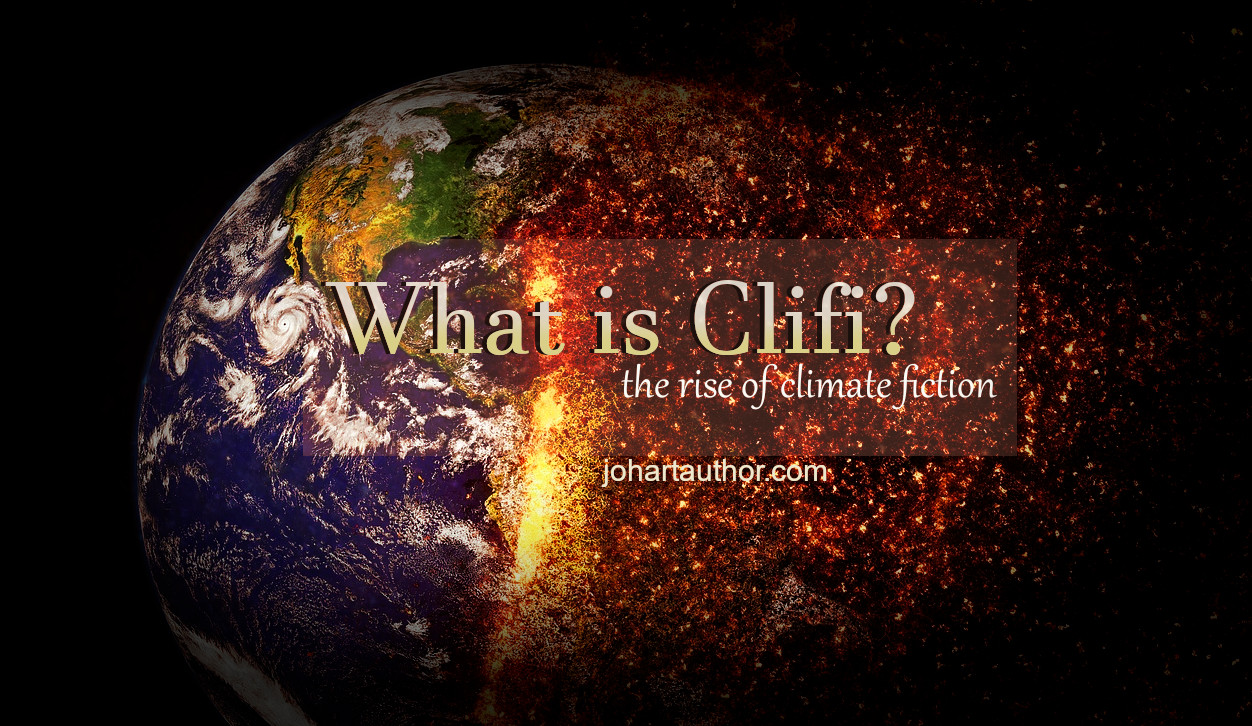
PBS Digital's Hot Mess asks if climate fiction can save the planet


While I was writing Vox explains how thawing permafrost is already releasing dangerous diseases and looking at all the examples of science fiction media in which a disease is released from climate change ("Interstellar," "The Last Ship," "Fortitude," "A Plague Tale : Innocence," and "Resident Evil."), I was thinking about a video from Hot Mess that came out at beginning of October, Can These Books Save The Planet? The Rise of Climate Fiction feat. Lindsay Ellis & Amy Brady.

Climate Fiction comes in all sorts of forms, there’s your Mad Maxes, your Games of Thrones, your Parables of the Sowers, and your WALL-Es. But are all these Cli-Fi books, movies, and TV shows just capitalizing on a hot topic, or do they actually change people’s perceptions of climate change? Lindsay Ellis, of It’s Lit, and Amy Brady, the editor-in-chief of The Chicago Review of Books, help us find out.
On the one hand, I'm glad science fiction writers are examining the topic of climate in books and other media.  I'm one of them, albeit in non-fiction reviews of climate fiction and other "eco-horror, such as the worst eco-horror films early in the decade about to end and more recently in Polygon explains how climate change is changing horror.  On the other hand, science fiction addressing current anxieties may make people more aware, but it may not actually make them do anything about it.

That's not all bad, as awareness is still the first step in environmental literacy.  Action is the last one.  The intermediate steps are knowledge, attitudes, and skills.  For the past eight-and-one-half years, I've been working on the first three steps with myself and my readers, something I alluded to last year in A reminder of why I write this blog.
"I have been advocating for all aspects of sustainability, viable natural environments, nurturing communities, and sufficient economies, on my blog Crazy Eddie's Motie News since 2011.  There, I educate my readers on these topics and hope to inspire them to work for an equitable social environment, sustainable economic development, and a sustainable natural and built environment."  I also "discuss politics, science, technology, the environment, education, and entertainment."
Here's to my continuing to increase my readers' awareness, knowledge, and attitude about the environment, whether through fact or fiction.

That's it for the Sunday entertainment feature.  Stay tuned for Cyber Monday.

Tuesday, August 29, 2017

Part II of When did speculative fiction go 'mainstream'? When SF novels became best-sellers


I left off Part I of When did speculative fiction go 'mainstream'? What the critics think with a hypothesis and my plans to test it.
Having looked at some of the previous studies of when science fiction and other speculative fiction genres becoming mainstream, I now have an alternative claim from Greer's that the mainstreaming of speculative fiction genres started happening by the early 1970s if not by 1960.  Stay tuned for my testing that hypothesis by using another data series and a slighly different criterion.  On Tuesday, I plan to use the Publishers Weekly lists of bestselling novels in the United States and Lists of The New York Times Fiction Best Sellers to determine when science fiction and other speculative fiction genres became mainstream from the perspective of the book-buying public instead of the critics.
Before 1942, the New York Times Fiction Best Sellers list did not cover book sales outside of the New York City area.  On the other hand, the Publishers Weekly list of best sellers goes back to the 1890s.  Since it does not cover all of the last decade of the Nineteenth Century, I will examine it from 1900 to the present before also examining the New York Times list.

There are some false positives between 1900 and 1942, the first of which is "Mr. Britling Sees It Through" by H. G. Wells from 1917. Despite the author, this is not a science fiction novel.  It's a mainstream story about England during the early years of World War I.  Therefore, the author broke through, but not the genre he helped to create.  Another is "Seven Gothic Tales" by Henrik Ibsen from 1934 and "It Can't Happen Here" by Sinclair Lewis from 1936.  Even though the first doesn't claim to be science fiction at all, I mention this collection of spooky but not especially supernatural short stories because it because it foreshadows the taste for horror fiction that will become important at the same time science fiction breaks through to the mainstream.  The anti-fascist work of Sinclair Lewis is closer to the mark, as it is definitely speculative fiction, but not science fiction.  Even so, it has lessons that apply to the present day.  As Charlottesville's violence points out, it can happen here.

Actual science fiction first appears on the Publishers Weekly list in 1957  when two novels make the annual top ten, "Atlas Shrugged" by Ayn Rand and "On the Beach" by Nevil Shute.  The first is explicitly a work of science fiction as it uses the effects of not yet invented materials and technologies to help move the plot and poses the science fiction plot premises of "what if," "if only," and "if this goes on."  The second examines the effects of an already existing technology, the atomic bomb, and asks "what if?"  It also examines a post-apocalyptic world, a science fiction staple.  That written, it was not the science fiction elements that made either of them popular.  "Atlas Shrugged" is about Ayn Rand's political philosophy, not Reardon metal, while it was the examination of how the characters reacted to their situation that made "On the Beach" gripping, not the science of nuclear war.  In addition, both authors were established in mainstream literature, Rand for "The Fountainhead" and Shute for a myriad of works including "A Town Like Alice."  So, like Anthony Burgess writing "A Clockwork Orange," Rand and Shute found science fiction a reputable enough genre to write in and readers found the genre respectable and interesting enough to buy, so long as established mainstream writers were producing it.  As a breakthrough of genre authors writing genre fiction finding mainstream acceptance that both Greer and I are talking about, the success of "Atlas Shrugged" and "On the Beach" comes as a false dawn.

The Cold War formed the environment in which both "On the Beach" and "Atlas Shrugged" were written and received, the former explicitly and the latter implicitly, and the contest between the superpowers continued to inspire speculative works that reached the best seller lists during the next decade.  1962 saw both "Seven Days in May" by Fletcher Knebel and Charles W. Bailey II and "Fail Safe" by Eugene Burdick and Harvey Wheeler.  The former harkened back to "It Can't Happen Here" as a political cautionary tale while the latter echoed the nuclear war fears of "On the Beach."  Both ask "what if" and wonder what happens "if this goes on," so they are based on science fiction plot ideas.  However, neither is really science fiction, even though the first takes place a decade after it was written and the second settled a lawsuit by the author of "Red Alert," which became the basis for "Dr. Stranglove," which is definitely science fiction; the movie won the Hugo Award for Best Dramatic Presentation in 1965.  On top of which, both were written by mainstream authors like Burdick, who also wrote "The Ugly American."  The same is true of "The Shoes of the Fisherman" by Morris West from 1963. Again, a false positive.

The same can be said about 1964's "You Only Live Twice" and 1965's "The Man with the Golden Gun," both James Bond novels by Ian Fleming.  While I have said that the Bond movies are science fiction, the Bond novels, at least these two, are not.  Close, but no cigar.  However, that these particular Bond Novels show up on the bestsellers list shows another trend, that of movies prompting book sales.  I might have more to say about that later.

The real breakthrough for speculative fiction happened in 1967, but not for science fiction.  Instead, "Rosemary's Baby" by Ira Levin made horror part of the mainstream, at least as far as the book-buying public was concerned.  Horror, not science fiction or fantasy, eventually becomes the dominant speculative fiction genre on the bestsellers lists in the U.S.

As for science fiction by genre authors, 1969 saw a breakthrough with "The Andromeda Strain" by Michael Crichton.  He may have been a bit too mainstream for the science fiction fans and writers, as they never nominated him for his novels.  However, that didn't stop them from nominating the films and screenplays he co-wrote, as "The Andromeda Strain" was nominated for Best Dramatic Presentation at the 1972 Hugo Awards.  The original "Westworld" movie was nominated for both the Hugo and the Nebula Award for Best Script in 1974, and "Jurassic Park" won the Hugo in 1994.  That makes him genre enough for me.

Speculative fiction skipped 1970, but shows up on both the Publishers Weekly annual list and the New York Times Best Sellers list in 1971 with "The Exorcist" by William Peter Blatty, the first speculative fiction novel to appear at number one on the latter list.*  Remember, horror is the dominant speculative fiction genre on the U.S. bestseller lists.  If I count "Jonathan Livingston Seagull" by Richard Bach as a fantasy, every year from 1971 on has at least bestselling speculative fiction novel on one or both of the bestsellers lists.  Even if I don't, it becomes every year since 1973 with Kurt Vonnegut's "Breakfast of Champions," at least nominally a science fiction book.  At least according to the book-buying public, science fiction went mainstream between 1969 with "The Andromeda Strain" and 1973 with "Breakfast of Champions."  That's definitely earlier than Greer's "late 1970s" although he could argue he's using a different criterion than I am.

I'll get around to a part III next month, after the Emmy Awards.  Stay tuned for more posts of mine on the best in political television throughout the week.

*I've referenced "The Exorcist" once before in May Pazuzu curse the Sith Jihad.

Sunday, August 20, 2017

Part I of When did speculative fiction go 'mainstream'? What the critics think


At his new blog Ecosophia, John Michael Greer made several claims about science fiction that I feel inspired to test.  Today, I'm examining the easiest one to verify or falsify, Greer's claim that "science fiction went mainstream in the late 1970s."  He's basing it on the criterion that "tenured academics stopped turning up their noses at 'all that Buck Rogers stuff,' as a handful of the more literary SF authors found their work being reviewed in highbrow periodicals and the genre as a whole found itself afflicted with creeping respectability."  That's a difficult criterion for me to evaluate.  As much as I am becoming an expert on current science fiction in film and television and am starting my project of blogging the Saturn Awards to become better versed in the history of speculative fiction on the large and small screens, I am not yet ready to do this for literary science fiction in the way I think this claim deserves.  To begin with, I do not have the access to an academic library full of literary reviews to examine to see if that indeed began happening then based on identifying the subjects of reviews and counting the relevant ones by year to detect a trend or inflection point.  So, I'll have to do it some other way.  After all, this is a blog entry, not a formal academic paper.

For plan B, I'm citing two articles on the subject, When sci-fi went mainstream from the Los Angeles Review of Books republished in Salon and a review of "The Secret History of Science Fiction" at Tor.com to see if there is an alternative hypothesis about when science fiction "went mainstream" (I'm not disputing that it has; my writing about science fiction and other speculative fiction genres being successful at awards shows demonstrates that has happened).  The first, published in 2012, refers to science fiction's "meteoric rise over the last thirty years from lowbrow genre to literary respectability," placing the beginning of science fiction becoming mainstream about 1972.  The author Lee Konstantinou then writes about how the process really began in 1960 with the publication of "New Maps of Hell" by Kingsley Amis, a series of literary essays about science fiction.  One of Amis's predictions, that "this genre will never make it in film or television," amuses me, as it quite evidently has.  In fact, it already had made it on television with "The Twilight Zone" debuting in 1959.  I won't let that bad prognostication stand in the way of using Amis's book as evidence for an eariler date for the beginning of science fiction's mainstream acceptance.  Konstantinou also cites the early science fiction works of Anthony Burgess, particularly "A Clockwork Orange," published in 1962, as an example of a mainstream novelist finding science fiction a respectable enough genre to write in.  Both examples point to science fiction becoming mainstream before the late 1970s.

"Genre in the mainstream: The Secret History of Science Fiction" also argues that mainstream writers have been writing science fiction since the 1970s and points to an incident in the early 1970s that supports the mainstreaming of the genre then.  The nominees for the 1974 Nebula Award for Best Novel included "Gravity's Rainbow" by Thomas Pynchon, a mainstream writer.  It lost, but its mere nomination shows that, not only were mainstream novelists accepting science fiction by writing in the genre, but science fiction writers were beginning to accept them as well.  Again, this is evidence that science fiction was becoming mainstream by the early 1970s, if not earlier.

Having looked at some of the previous studies of when science fiction and other speculative fiction genres becoming mainstream, I now have an alternative claim from Greer's that the mainstreaming of speculative fiction genres started happening by the early 1970s, if not by 1960.  Stay tuned for my testing that hypothesis by using another data series and a slighly different criterion.  On Tuesday, I plan to use the Publishers Weekly lists of bestselling novels in the United States and Lists of The New York Times Fiction Best Sellers to determine when science fiction and other speculative fiction genres became mainstream from the perspective of the book-buying public instead of the critics.  Why Tuesday?  Tomorrow is the Great American Eclipse.  I can't miss that!

Sunday, August 13, 2017

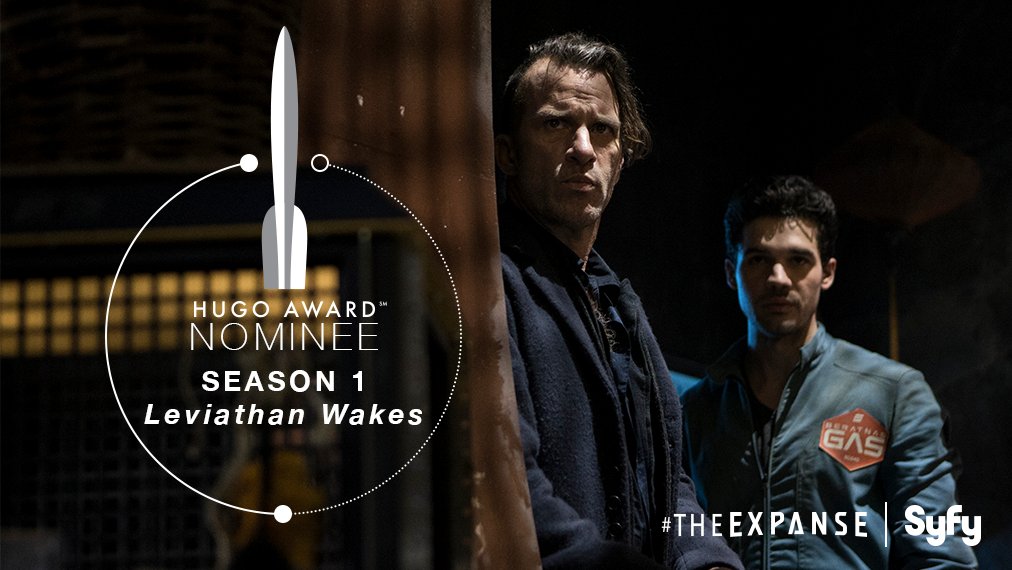
'Arrival' and 'The Expanse' win Best Dramatic Presentation at the Hugo Awards


Today, I'm fulfilling the second promise I made at the end of SNL mocks Trump for Presidential Joke Day, "stay tuned for...the winners for Dramatic Presentation at the Hugo Awards."*  Tor.com has announced the winners of all the Hugo Awards, so it's time to check my prediction that "I think "Arrival" will win this category in a walk."  It did.  Eric Heisserer can put the rocket for Best Dramatic Presentation (Long Form) next to his Saturn Award for Best Film Screenplay and the Ray Bradbury Award for Outstanding Dramatic Presentation.  Congratulations!  The best science fiction film of last year really did win, the Saturn Award for "Rogue One: A Star Wars Story" notwithstanding.


It turns out that I didn't make a prediction for Best Dramatic Presentation (Short Form); I was too busy whining that "Westworld" wasn't nominated.  It turned out that the episode I proposed, "The Bicameral Mind," didn't qualify.  It has a running time of 90 minutes, which meant it qualified for the long form category, not the short form.  "The Original" would have qualified at 68 minutes, but it wasn't nominated.  Darn.  I reacted by deciding to promoting "Westworld" at the 2017 Saturn Awards.  It worked, as it won the Saturn Award for Best Science Fiction Television Series.

As for what I would have predicted in April, it would have been “Black Mirror: 'San Junipero'” or “Doctor Who: 'The Return of Doctor Mysterio.'”  However, if I were voting, it would have been for "The Expanse: 'Leviathan Wakes.'"  Much to my pleasant surprise, it won.  Congratulations!  My favorite of all the nominees won!

It turns out that it was the second time for this story at the Hugo Awards.  The book "Leviathan Wakes" was nominated for Best Novel in 2012 but didn't win.  Looks like being turned into a television show helped it the second time around.

As for the rest of the nominees, it looks like the insurgency posed by the Sad Puppies and Rabid Puppies is over, as none of their nominees won (again) and most of the slate didn't even get nominated.  That's the good news.  The bad news is that these people, like the Gamergators, have become more active outside of fandom.  Ugh.

*The first I satisfied by posting Worksheet for 'Treasures of the Earth: Power'.  The third will be about the winners of the Teen Choice Awards.  Stay tuned.

Sunday, April 3, 2016

2016 Saturn Awards for Television


At the conclusion of Paul Wartenberg, Infidel753, and The Archdruid comment on me, I told my readers to "stay tuned for Entertainment Sunday. I have more awards shows to write about!"  Today's subject will be a show I first mentioned in 'The Walking Dead' at Comic-Con, the Emmys, and the Saturn Awards.  Since today is the season finale for "The Walking Dead," the most nominated series this year, I begin with the 42nd Annual Saturn Awards - Television Nominations.

Greetings fellow Genre Entertainment Enthusiast,

As fans and devotees of the genre, we invite you to go to our website: www.SaturnAwards.org where we are offering a special membership for the next few months which will allow you to VOTE for your favorite actors, actresses, movies and TV shows, so please join, tell your friends & fans and spread the word -- !!!

The Saturn Awards (and Academy of Science Fiction, Fantasy & Horror) was founded in 1972 by noted film historian Dr. Donald A. Reed to honor and recognize films often overlooked by mainstream awards. These are the Films and TV shows that we all know and love -- and its our mission to honor and acknowledge the many talents that entertain and enlighten us!
Yes, I will be paying the $40 so that I can vote for my favorite among all nominees.  After all, that was one of my New Year's resolutions.

Follow over the jump for my opinions of the nominees and which ones I currently intend to vote for.

Sunday, November 29, 2015

J.J. Abrams and his mystery box


For Entertainment Sunday, I'm sharing a TED talk by J.J. Abrams,* one of my favorite directors, about the object that represents his philosophy of story telling: The Mystery Box.

J.J. Abrams traces his love for the unseen mystery - a passion thats evident in his films and TV shows, including Cloverfield, Lost and Alias -- back to its magical beginnings.
From his TED page:
Why you should listen

As the Emmy-winning creator of the smart, addictive TV dramas Lost, Alias and Felicity, J.J. Abrams' name looms large on the small screen. As the writer/director behind the blockbuster explode-a-thon Mission: Impossible III, Cloverfield and the new Star Trek movie, these days Abrams also rules the big screen -- bringing his eye for telling detail and emotional connection to larger-than-life stories.

Abrams' enthusiasm -- for the construction of Kleenex boxes, for the quiet moments between shark attacks in Jaws, for today's filmmaking technologies, and above all for the potent mystery of an unopened package -- is incredibly infectious.

What others say

“As a boy, JJ Abrams was fascinated with magic. As a television writer, director, and producer, he has beguiled audiences with a masterful use of suspense, plot reversals, and special effects.” — Wired
Abrams' interest in character explains what I observed in his "Star Trek" movie.
While J.J. Abrams went to great lengths to free his movies from the strictures of Star Trek canon by creating a new timeline that diverged just before Kirk's birth, he also went to great lengths to ensure that the characters would stay as intact as possible.
The characters were important to him, not the events, although the next movie had echoes of what occurred in the TV show and second movie.

So much for J.J. Abrams and Star Trek.  As for how he treats Star Wars, there is already an answer to the question "Will the lens flares on Tatooine be doubled?"  It's no.  Thank goodness!

*I've decided to use a J.J. Abrams label.  Took me long enough.

Thursday, March 26, 2015

'Insurgent' tops box office in opening weekend


I teased my readers three times then offered a rain check.
I told my readers to "stay tuned for a delayed entertainment entry about "Insurgent," the sequel to Divergent as well as more retrospectives" at the end of Top post for the fourth year of Crazy Eddie's Motie News: James Robertson.  My readers will have to wait, as breaking news is shouldering that planned post aside.
It's time to redeem that rain check.  Follow over the jump for news about the movie from Daily Variety by way of Reuters and Vox plus my comments about the first movie.

Sunday, March 8, 2015

EsoterX on 21st Century monsters


For this week's Sunday entertainment entry, I present an excerpt from Consciousness Insecurity: Modern Monsters Want You for Your Mind, Not Your Body.  It explains that the monsters that haunt modern imaginations aren't the ones that kill people and eat them, or even steal their souls, as modern industrial civilization has made people safer from harm and made people doubt the existance of souls, but ones that deprive people of their autonomy.
Consider the big themes that populate modern horror and science fiction.  The mass of humanity gets turned to mindless zombies slumping about the countryside looking for brains to consume.  Humans are turned into living batteries.  Virtual realities warp our perceptions so that we don’t understand what is real and what is not.  Aliens abduct us and perform decidedly invasive and uncomfortable experiments, and we are powerless to do anything about it.  Time travelers hop in and out, manipulating the course of history, unbeknownst to most, by tweaking essential elements here or there.  Even those classic bloodsucking vampires have morphed into irresistibly charming, ravishingly sexy aristocrats that can compel you to bend to their will with a twinkle in their eye.  Increasingly, our monsters are monsters of consciousness, that is, a control of human consciousness.  Where once the fearsome beasts of our imaginations were a threat to life and limb, now they represent a grave danger to human autonomy.  As technology continues to pervade our lives, human consciousness has expanded to encompass an interconnected world, where thought contagion spreads with a virulence that most microbes could only dream of.  Consequently, our monsters have evolved.  We may no longer have to worry about sharp teeth and claws, but we face the far more terrifying prospect of no longer being afforded a choice. In a world where we are able to reconstruct our identities at will (just change the “About” section on your webpage), the dreadest demon is the one that exerts control over who we imagine ourselves to be.  We may as well be the walking dead, for as psychologist Erik Erikson said, “In the social jungle of human existence, there is no feeling of being alive without a sense of identity”.
At first, this was a surprising take on zombies, but it shouldn't have been.  It's appeared in at least two entries on the undead.  The entire idea of zombies as a metaphor for a thought virus taking over our consciousness and depriving us of our autonomy is the entire thesis of Reblog of Mike Norman Economics: The triumph of Neo-liberalism and why we love "The Walking Dead".  It's also the punchline of the Cracked article I featured in Zombies, gangsters, and sideshows--we are the zombies.

Rick's "We Are The Walking Dead" Speech Episode 5x10 (Them)

Rick Grimes' We are The Walking Dead speech from Season 5 Episode 10 "Them." One of the most famous lines from the comics adapted to television.
As for the other personifications of our fears of losing our autonomy, EsoterX has more on modern monsters.  Stay tuned.

Sunday, February 22, 2015

ABC and CNN on Oscar predictions and controversies


As I promised last week and yesterday, I'm covering the Oscars for today's entertainment entry.  I begin by getting the predictions and controversies about the major awards out of the way first, starting with ABC News answering its own question, Who Will Win On Oscar Sunday?

Hollywood expert Grae Drake has her picks for Sunday’s Academy Awards.
Of all the films mentioned, only "Birdman," a work of magical realism, qualifies as science fiction or fantasy.  Two others, "The Imitation Game" and "The Theory of Everything," are historical films about scientists.  Both of them figure in CNN's Oscar nominees blur the line between fact and fiction.

As Stephanie Elam reports, some Oscar-nominated films based on true stories have strayed from the facts.
If a viewer wants historical accuracy more than artistic truth, watch documentaries instead of historical dramas.  That's what they're for.

Stay tuned for how the documentaries and other movies for nerds and geeks along with movie music fared in tonight's awards in a follow-up, much like I did last year.